controlling the heart and breathing rates
 Call Kai
 Learn
Learn Practice Test
 Spaced Repetition
 Match
Match Flashcards
 Knowt Play
1/19

There's no tags or description
Looks like no tags are added yet.
Name | Mastery | Learn | Test | Matching | Spaced | Call with Kai |
|---|
No analytics yet
Send a link to your students to track their progress
20 Terms
what is cardiac volume
The volume of blood pumped at each heartbeat
what is cardiac output
Cardiac output (CO) is the term used to describe the volume of blood that is pumped by the heart (the left and right ventricle) per unit of time
An average adult has a cardiac output of roughly 4.7 litres of blood per minute when at rest
Individuals who are fitter often have higher cardiac outputs due to having thicker and stronger ventricular muscles in their hearts
Cardiac output increases when an individual is exercising
This is so that the blood supply can match the increased metabolic demands of the cells
In trained atheltes heart rate begins to increase before the exercise begins
what is heart rate
Heart rate is the number of times a heart beats per minute
This can also be described as the number of cardiac cycles per minute
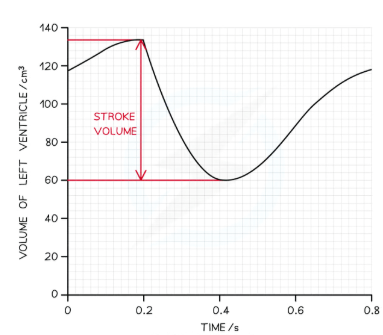
What is stroke volume
Stroke volume is the volume of blood pumped out of the left ventricle during one cardiac cycle
how to calculate cardiac output
Cardiac output = heart rate x stroke volume
The equation can be rearranged to find the heart rate and stroke volume if required:
Heart rate = cardiac output ÷ stroke volume
Stroke volume = cardiac output ÷ heart rate
Cardiac output is measured in cm3 min-1
Heart rate is measured in beats per min (bpm)
Stroke volume is measured in cm3
what changes does body do to accommodate cells requiring more oxygen and producing mroe CO2 during exercise?
Increase the rate and depth of breathing which will increase the amount of oxygen entering the lungs and bloodstream, while getting rid of more carbon dioxide
Increase the heart rate which will transport the oxygen (and glucose) to the muscles much faster, while removing the additional carbon dioxide produced due to the increased rate of respiration
what is cardiovascular control centre
Situated in the medulla oblongata of the brain
It unconsciously controls the heart rate by controlling the rate at which the sinoatrial node (SAN) generates electrical impulses
how are changes in internal environment of the body detected
Chemical, stretch and pressure receptors called baroreceptors and cehmoreceptors in the lining of the blood vessels and the chambers of the heart send nerve impulses to the cardiovascular cotnrol centre
The cardiovascular control centre in the medulla oblongata will respond by sending impulses to the SAN along sympathetic or parasympathetic neurones
effect of sympathetic nervous system via autonomic nervous system
Sympathetic neurones is excitatory so will increase the rate at which the SAN generates electrical impulses, thus speeding up the heart rate
These neurones form part of the sympathetic nervous system which prepares the body for action ('fight or flight' response) and increases the heart rate during exercise
what do impulses that travel down sympathetic nerve do? Effect?
Nerve impulses that travel down the sympathetic nerve from the cardiovascular control centre to heart release noradrenaline to stimulate the SAN
This increases the frequency of the signals from the pacemaker region, so heart beats more quickly
Branches of this sympathetic nerve also pass into the ventricles, so they also increase the force of contraction
effect of parasympathetic nervous system via autonomic nervous system
Parasympathetic neurones are inhibitory and will decrease the rate at which the SAN fires, thus slowing down the heart rate
These neurones form part of the parasympathetic nervous system which calms the body down after action ('rest and digest' response) and decreases the heart rate after exercise
what do impulses that travel down parasympathetic neurones do?
Nerve impulses in parasympathetic nerve release acetylcholine, inhibiting SAN and slowing heart down
what are baroreceptors
Baroreceptors are found in the aortic and carotid bodies and they are stimulated by high and low blood pressure
Important in the feedback control of the heart rate during exercise
At rest, they send a steady stream of signals back through sensory neurons to the cardiovascular control centre in the brain
what do baroreceptors do during exercise?
At beginning of exercise, the blood vessels dilate in response to hormone adrenaline which is reelased in anticipation of exercise
Due to vasodialtion, blood pressure falls a little
This reduces stretch on baroreceptios
Due to this reduced stimulation the cardiovascular control centre immediately sends signals along sympathetic nerve which screte neurotransmitter noradrenalin
Noradrenalin binds to receptors on SAN to fire more frequently
The heart rate speeds up and increase the blood pressure again by constricting blood vessels
What do baroreceptiors do when exercise stops?- low blood pressure
When exercise stops, blood pressure in the arteries increases as the heart continues to pump harder and faster than it needs to, and so the baroreceptors are stretched
They respond by sending more sensory nerve impulses to the cardiovascular control centre which sends impulses through parasympathetic system which secrete acetylcholone.
Acetylcholien binds to receptors on SAN causing it to fire less frequently
Sow down heart rate and cause blood vessels to become wider and so blood pressure reduces
what are chemoreceptors
Chemoreceptors are found in the medulla oblongata, as well as in the aortic and carotid bodies
They are stimulated by changes in the levels of carbon dioxide and oxygen in the blood, as well as blood pH
what do chemoreceptors do when CO2 levels go up and so pH of blood goes down?
Detected by chemoreceptors which send impulses to cardiovascular control centre
It sends impulses along sympathetic neurones which secrete the neurotransmitter noradrenaline
Noradrenaline binds to receptors on SAN causing it to fire more frequently
Heart rate speeds up so more blood flow to lungs so more CO2 removed from blood and O2 / CO2 and pH levels return to normal
what do chemoreceptors do when low CO2
Detected by chemoreceptors which send impulses to cardiovascular control centre
It sends impulses along parasympathetic neurones which secrete the neurotransmitter acetylcholine
Acetylcholine binds to receptors on SAN causing it to fire less frequently
Heart rate slows down and O2 / CO2 and pH levels return to normal
what happens to heart rate hwen you are stressed?
Sympathetic nerve stimulates the adrenal medulla to release hormone adrenaline
It is carried around body in blood and binds to receptors in target organs eg SAN
Adrenaline stimulates the cardiovascular contorl centre in the brain, increasing the impulses in the sympathetic neurones which supply heart
Also causes SAN to increase freq of excitation and so heart rate increases
Suppleis oyu wiht extra oxygen and glucose for msucles and brian in case you need to run or fight
effect on other blood vessels when you exercise?
Sympahtetic system sends fewer impulses to many blood vessels causing contraction of smooth muscles lining vessels, thus narrowing or closing vessels
This diverts blood flow from less important areas to provide mroe blood to heart and muscles

