Week 6 -- Structures and function of the ear
 Call Kai
 Learn
Learn Practice Test
 Spaced Repetition
 Match
Match Flashcards
 Knowt Play
1/8

There's no tags or description
Looks like no tags are added yet.
Name | Mastery | Learn | Test | Matching | Spaced | Call with Kai |
|---|
No analytics yet
Send a link to your students to track their progress
9 Terms
What are the three regions of the ear?
External ear (Collects soundwaves and channels them inward), Middle ear, Internal ear (Houses receptors for hearing and equillibrum)
Parts of the external ear
Auricle = flap of elastic cartilage shaped like the end of a trumpet (covered in skin)
External Auditory Canal = curved tube 2.5cm long that leads to the tympanic membrane (Contains a few hair cells & ear wax)
Tympanic membrane (ear drum) = boundary between inner and outer ear
Parts of the middle ear
When ear drum is vibrating, the auditory ossicles vibrate and then passes that to the inner ear. (Moves the fluid in the inner ear/cochlea)
The round window is there so that cochlea fluid has space to move around
Auditory canal (a tube made of bone & elastic cartilage), connects middle ear with nasal tharynx (top part of throat). Allows air to enter/leave the middle ear to equalise the pressure.
Internal Ear
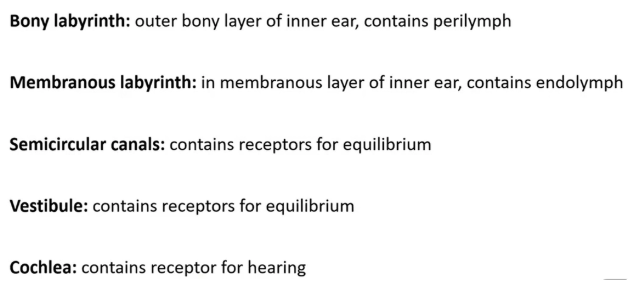
What is Equillibrium? (Balance)
A state of balance and stability maintained by vestibular system (vestibule & semicircular canals)
Inner ear parts that contribute to equilibrium detection
Vestibule and semicircular canals house receptors for equilibrium
Vestibule (utricle and saccule) monitor static equilibrium (body movement, head position)
Semicircular canals monitor dynamic equilibrium (shaking head, spinning)
What causes receptor potentials for static equilibrium
Sitting on top of hair cells is the otolithic membrane and otoliths
Tilting head/linear movement = otoliths move
This movement drags the membrane, bends hair cells and causes a receptor potential
What causes receptor potentials for dynamic equilibrium
Within each semicircular ducts ampulla is a small elevation called the crista
Hair cells cover crista, and are surrounded by gelatinous cupula
As the head moves, so do the hairs and cupula, but endolymph in semicircular ducts lags
This causes bending of hair cells and generation of receptor potential
How do hearing receptors work
Sound waves enter outer ear
Travel thru external auditory canal
Strikes the tympanic membrane, causing it to vibrate
Middle ear ossicles vibrate at oval window, moving inner ear fluid
Inner ear fluid movement causes vibration of vestibular membrane which causes vibration of cochlear fluid
Fluid movement stimulates hair cells on the cochlea membrane
The bending stimulation generates a receptor potential and is sent to brain stem via auditory nerve.
Explore top notes

Explore top flashcards
