anth2020 notes
 Call Kai
 Learn
Learn Practice Test
 Spaced Repetition
 Match
Match Flashcards
 Knowt Play
1/73

There's no tags or description
Looks like no tags are added yet.
Name | Mastery | Learn | Test | Matching | Spaced | Call with Kai |
|---|
No analytics yet
Send a link to your students to track their progress
74 Terms
Intro
Problems with the way the Pacific Islands were understood and represented
Who defines success? (ontologies) What worldview dominates and is excluded?
The need for Indigenous anthropologists (theory and methodology are entangled)
The responsibilities of anthropologists to the communities they work with
Anthropology is not just about advancing theory
Theory: an idea or set of ideas that tries to explain social phenomenon, conditions or practices, was typically masculine associated
Manlinowski Kula exchange
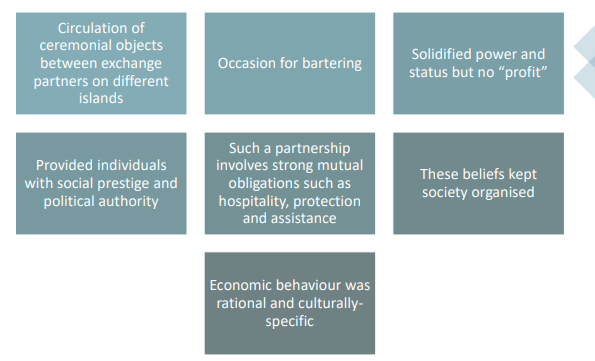
Mauss Kula exchange
criticised malinowski, Gifting involves reciprocal obligations that maintain social bonds • These obligations are an inherent mental structure, a logic shared by everyone • A universal principal of exchange that governed economy, social organisation, and kinship. Malinowksi is about individuality and return, while mauss was about relationships and mental structures
Weiner Kula exchange
also did work that found that women created the wealth which maintained matrilineal relationships
19th Century Anthropology
arose in 1850’w, eurocentric idea of discovery
Anthropologists in 19th century
• an effort to understand the character of humanity in all its diversity and
complexity
• what was universally human?
• to explain the social and political life of people in their ‘natural’ state
• search for the origins of humanity
• Eg Victorian era ‘noble savage’ concept
• Haddon/Cambridge expedition to Torres Strait Islands
Engendering Colonialism
• Pacific masculinities have been shaped in relation to and in contestation with colonial racial hierarchies (Jolly 2016; Tengan 2008) • What are some of the binaries/categories he identifies? • Key concepts – hegemony, structure and agency • Patriarchy and ‘the white family structure’ p. 242 • Modern masculinities in sport and the military (complexities and contradictions)
unilinear evolution
All societies pass through the same stages; things occur
and change everywhere in the world in the same way
capitalism introduced
became intertwined, could be used to help the indigenous community, money made exchange more fluid but it also disrupted cultural practices. For example, the women who looked after pigs could be bypassed, mining ruined many environments by introducing violence and increasing health risks
margret mead
•What were some of the things she was trying to achieve with her work?
If children in all cultures experienced turmoil
If the stresses of everyday life was common everywhere
To study primitive societies before they became westernised
Stages human pass through, nature vs nurture in adolescence
How do children learn about their own culture, what did they know? What could they know?
Moved later on to how men and women think and learn differently
The behaviour of mothers and children
British and american troops, and then this effect on the cultures like Peri she previously studied
•What was her understanding of 'culture'? Where did she look for 'culture'?
The way people do things, what they wear, what they celebrate, what is important
She not only looked for it in the pacific, but analysed what made her own culture in america through studying her family
•Do you think she was more concerned about people in the New Guinea societies where she worked or about American society?
I think she cared about the children, but also keeping in mind that all of her findings were being reported back to americans and being compared to american and western cultures
She learned to care about the villages' people, a consequence of studying the culture, a lot of people in these cultures feel she is a part of them and can get quite defensive, but also a lot of people are quite critical, asking why they didn't receive any benefit from studying their culture
•What do you think are some pros and cons of popularising anthropology?
Brought more attention to cultures disimilar to our own, allows us to understand and connect more with people
Has created more stigma and stereotypes
Can create a need for people to want to change a culture e.g. westernisation
gender in relation to culture
Women typically seen as related to nature (devalued) while men are seen as related to culture (ortner). However there is an argument that there is no universal understanding of culture because nature is not universal
Gender is central to cultural identity, the proper way of being a woman for example
Colonialism strucutred the patriarchy and presented men as macho, agents of violence
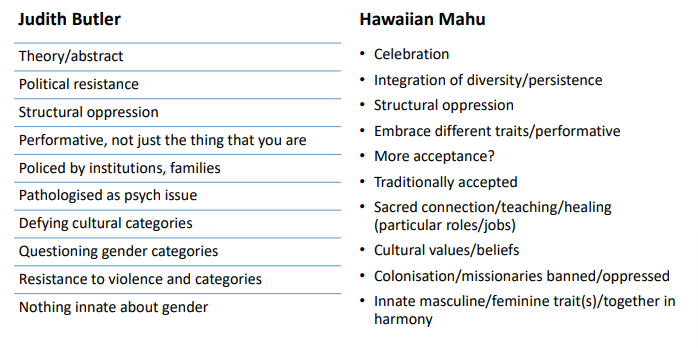
Judith Butler vs Hawaiian Mahu genders
• ‘your behaviour creates your gender’ (Butler) • Very focused on the individual and a western personhood, an autonomous self? • Some anthropologists argue that queerness is too often defined in terms of “visible, intentional, and effective subversions of mainstream cultural norms” (Lewin 2016)
fa’afafine and fa’afatama (somoan gender diversity)
Literally means ‘in the manner of a woman.’ • A fa’afafine does not have to identify as a man or a woman but may be ‘fluid’ (Feu’u 2013, p. iii cited in Lim-Bunnin p 82) • fa'a fatama, in the manner of a man • The Māori equivalent is whakawāhine. • Counterparts around the Pacific are the ‘akava’ine of the Cook Islands, the mahu of Hawai’i, vaka sa lewa lewa of Fiji, rae rae of Tahiti, fakafifine of Niue, and fakafāfine or fakaleitī of Tonga. LIM BUNNIN: Decolonial perspective critiques the power, precedence, and prevalence of Western epistemology • Lim-Bunning uses the term ‘gender-divergent’ p 77 • Epistemic violence directed at Samoan gender-divergent people through knowledge systems and language (p 77) – what term/concept are they particularly concerned with and why? • How do they define epistemic violence? P 77 • ‘white anthropological ‘third gender’-focused scholarship’ (p 86), wrong to use transgender or transliminal terms
functionalism
british reaction to evolutionary models
Structural functionalism (radcliffe brown): how cultural institutions maintained the equilibrium and cohesion of society; studying the underlying structure of societies and the social laws that governed them
Psychological functionalism (malinowski): cultural institutions function to meet the basic physical and psychological needs of people in a society
structuralism
It focuses on uncovering the underlying structures, such as kinship systems and myths, that shape human thought and social practices across different cultures.
Boas’ holistic, historical, cultural approach
meant for culture to be understood as contextual and dynamic yet the way he and his students tended to study it produced lots of accounts of traits from the past, which were compared to other groups’ traits
• promoted the idea that only anthropologists, through being empiricist, could analyse and see cultures, and that people on the inside were unaware of their culture
• The rise of culture as an explanation for difference
• Direct observation meant different things but was increasingly important and made the author powerful
• The anthropologist was meant to provide omniscient scientific description
• Lasting relations, hierarchies, categories, names, practices were set up/valorised and entrenched
interpretive approach
Interpretive anthropology is an approach that focuses on understanding cultures by interpreting the meanings and symbols as perceived within a society. It emphasizes the subjective experiences of individuals and aims to understand social phenomena from the participants' perspectives rather than imposing external frameworks.
Decolonialism
ongoing undoing of colonialism, relates to research, knowledge and social criticism, critiques the perceived universality and superiority of Western culture, epistemology, and knowledge, seeks to dismantle colonial structures of power, knowledge, not a metaphor, also includes repatriation of land, museums, offices, unis, researchers etc.
post modern
challenges modernist views and practices, objective neutral knowledge of another culture is impossible, moderninity is the global construction of patriarchy
post colonial
examines the impacts of colonialism on cultures and societies, focusing on the power dynamics between colonizers and the colonized. It seeks to challenge dominant narratives and highlight the voices and experiences of marginalized groups affected by colonial rule.
feminist theory
• First wave, from 1850 to 1920, in western countries, focused on legal issues, primarily on securing women's right to vote.
• Second wave, ‘liberal’, particularly 1960s-1980, focused on issues of equality and discrimination, public and private injustices, such as reproductive rights, domestic violence, racism, and workplace harassment.
• criticised for centring the experiences of white, middle-class, heterosexual women
Third wave:
• Focus on patriarchy, diversity in gender and sexualities • Focus on deconstructing terms and ideas, and on ‘representations’
• interrogated ideas like reason, progress and emancipation.
• Notion of intersectionality to reckon with diverse experiences, multiple forms of discrimination, too much work of third world women was centered around privilige and assumptions, differences should not be defined by the majority, also there is discrimination against men for the assumption that they are violent and masculine
indigenous feminisms
• Writers and activists of the 1980s and 1990s articulated the inadequacy of Western feminist theory and practice for Indigenous women
• Indigenous feminist theory and activism are often applied now to examine how heteropatriarchy has been used as a tool for colonisation, creating distinct forms of gendered inequity and oppression that must be addressed in order to decolonise (Arvin, Tuck, and Morrill 2013)
Colonial/developmental focus is often on ‘saving’ women; discourses of free,
passive women vs violent and ‘primitive’ men. People are also subject to erasure
(Teaiwa, Bikinis), but histories of ‘Indigenous globalisation’ (Banivanua Mar)
provide evidence of agency, creativity, persistence
cultural determinism
idea that beliefs, habits, preferences and values are ingrained or programmed, the culture in which we are raised determines behaviour and emotions for example that australians are laid back
materialists vs idealists
Materialist: arisen from ecological, economic, technological conditions
Idealists: shared beliefs, symbols and myths
anthropological writing
“modernist” – detachment, scientific neutrality, objective • Claim to represent the native perspective
• Claim to completely describe a culture
• Realistic – a sense of being there (Malinowski) • Contained little information on the actual research process
• Invest the scholar with interpretive agency • Obscure dependence on quality of relationships with interlocutors
Racialisation:
new notions of culture are a marker of difference. Most pacific islanders are construction and healthcare or lower skilled jobs
whiteness
• A system of privilege maintained through institutions, policies, and cultural norms, often in ways that aren't immediately visible
advantages can include:
• Greater access to educational and economic opportunities
• Less scrutiny from law enforcement
• Representation as the "default" or "normal" in media and institutions
• Ability to move through spaces without racial identity being questioned
• Calls for making visible the ways racial privilege operates, encouraging white people to examine their own racial identity
colonialism
• One country wants to take something from another country – spices, goods, resources that could be rare/unique • A country might want more land • Might want to move people to another place (eg convicts/prisoners) • Various forms of oppression – military force, policies/rules/regulations, eg segregation based on perceived racial categories • Assimilation agendas, displacing indigenous languages for colonial languages • Removing/displacing Indigenous peoples • Creating forms of reliance or dependence on colonial (metropole), administration etc • Introduction of addictive substances as part of labour trade/ ‘paying’ labourers • Creating identity categories that can the basis for colonial policies • Violence, overt • Creating social categories, strata, different classes or groups of people
resistance
make and transform the world they live in, human agency and social structure intertwined, collaboration like with west papua feminist forum, space to reflect and explore
refusal
challenging state recognition and citizenship, assert preexisting sovereignty
resurgence
‘rebuilding Indigenous nations according to our own political, intellectual and cultural traditions', clinics set up in a specific way
decolonizing methodologies
examines the historical and philosophical bases of Western research
• including conceptions of the individual and society, space, and time, colonial schooling and other ways that Western knowledge became seen as superior
• Provides a framework for an Indigenous research agenda that encompasses the processes of decolonisation, healing, mobilization, and transformation
Identity
(McGavin; Teaiwa, Trask; Iamo), ideas around sovereignty,
Sovreignity (Trask)
What makes someone indigenous or authentic (kabu)
Fonofale model
Roles of feminine and masculine roles
Nuclear testing
(Teaiwa; Jetnil-Kijiner)
• The bomb and the bikini symbols of destruction, phallic element, destroying Bikini Atoll, erasure of the Bikinian people contrasting the visibility of bikini clothing/female body • Not well known that bikini was named after Bikini bombing; obfuscation • Bikini means ‘beach’ in Marshallese language, symbolising surrendering the beach for test • Christian goodwill, to help the international community • Justified by US/others in terms of small population being affected, promised they could return after a short time • Does tourism continue some of these dynamic, different kinds of tourism? • bikinis were named after the Bikini atoll nuclear testing, representing entwined acts of colonialism, sexism, patriarchy. • Exposure of women’s bodies to male gaze • exposure of Bikinians to bodily suffering and harm. • Bikini Islanders were erased yet tourists walk around the islands in bikinis, enjoying tropical paradise • Bikini is the local language term for ‘beach’
Militarisation legacies
delisles of the navy infaltrating the hospital, missions and navy bases taking away homelands, military takeover of hawaii
imperialism and colonisation
Black birding: Part of a wider context of colonisation, where different external agencies struggled for the control of the islands • Recruitment created a scenario of structural violence that was echoed in interethnic relations beyond the explicit violent moments • Blackbirders promoted violence between islanders, taking advantage of it • Recruitments were the ground for racial stereotypes and hierarchies which passed to Australia and were the ground for divisions inside the plantations
• “preparing” Indigenous peoples for governance, leadership • Appointing successors • Maintaining economic dominance or at least benefits • Maintaining political influence • Belief in superiority of Christian civilisation • ‘dressing up’ in the language of decolonization (Tuck and Yang) • the language of decolonization has been superficially adopted into education and other social sciences
Questioning dominant narratives about pacific peoples and places
(Hau’ofa; Kabutaulaka; Banivanua Mar)
Criticism of applied anthropology was that it always destroyed the culture, growing need for criticism
Banivanua Mar: • Sees decolonisation in the Oceanic world as an indigenous and an international phenomenon • Indigenous peoples responded to these limits by developing rich intellectual, political and cultural networks transcending colonial and national borders • not as an historic event, but as a fragile, contingent and ongoing process continuing well into the postcolonial era • “while traces of Indigenous peoples’ presence and movements are often detectable in the archive, it is often our informed imagination that must picture their thoughts, emotions, desires, anger and intentions”
Hau'ofa: • Epeli argued for Indigenous Pacific islanders to produce narratives that are “our own distinctive creations” (Hau‘ofa 2000) • keeping cultural depth and reach, roots and routes, always articulated together • How to make broad connections and new relationships without losing cultural specificity • “Culture and identity can, and must, be viewed in more expansive and fluidic terms than are typically afforded “native” traditions by modern discourse, but this expansive and fluidic reach must also not come at the expense of the more familiar depth and specificity” Diaz 29
gender inequality and diversity
masculinity vs femininity, three genders, gender roles before vs after colonisation,
decolonisation and resistance
(Banivanua Mar, Marsh, DeLisle, Diaz)
Grew out of a need for nuclear free and independent pacific in 1975,
Diaz: "Milanesians" in minesota, • a Chuukese community of almost 700 people has sprung up in rural, southwest Minnesota plains; Chuukese now comprise three-quarters of the town’s population • “They want to continue to be Micronesian in what they think is modern America by revitalizing outrigger canoe building and sailing using traditional knowledge from their kinship relations in the Central Carolines.” • Developing a partnership to practice indigenous Micronesian cultural traditions in Dakota homelands, waters, and skyways without replicating the sins of settler colonial dispossession and disenfranchisement, canoe revitalisation practices, community resilience and decolonisation through revitalisation
DeLisle: Nurse midwives in guam: • Eradicating traditional practices • Because they didn’t align with the US beliefs (medical, hygiene) – ‘modernity’ • Had already experienced Spanish colonialism including disease and violence, erasure and co-optation of local beliefs to add to their control • They thought of themselves as liberators, ‘rehabilitation’, development, public health, education, assimilation • Wanted American settlers, farmers to move there and work on the land, including a wage economy • Midwives, involved healing more broadly, godmothers • Their practices seemed unsafe, unhygienic, not modern to the colonial authorities • Pregnancy, reproduction, the next generation • Older generation and seen as threat to authority • Government wanted to train the younger generation in this vein of assimilation • Blending traditional and western cultural systems • Continuing traditional practices • Adopting some medical aspects to help ensure continuity in other ways PLACENTAL POLITICS: • Using old practices as forms of resistance; insistence on the old while practicing the new and vice versa (para 3) • Persistence, with links to the concept of Resurgence • Relations with the land and other elements (spiritual) • Important for mental and physical wellbeing for women giving birth and for the community in general • Pattera leadership • Burying placenta form of protection for baby, health for mother • Asserting some autonomy in shaping who the baby becomes and in doing so, the future • colonizers sought to maintain their own health and stamina in a foreign environment while exerting control over and “civilizing” the local population • medical treatment to sustain a labour force • Maternity care to increase the birth rate • Biomedical knowledge is one way populations are disciplined and controlled • Surveillance, Record-keeping, Medicalisation • In the name of producing the right population • In the name of health and vitality – but to benefit who/what?
Marsh: • many women have always engaged with “feminism,” even if the label had been rejected • there is a need for feminism in the Pacific • developing relevant definitions and agendas for such feminisms such as Mana Wahine and Mana Tama’ita’i • Pacific feminism ‘can navigate different oceans of thought, charting its way between interconnected islands of culture, class, religion, and other ideological institutions and frameworks, mapping solutions embedded in specific, contextualized understandings’
epistemic violence
• introduced by Gayatri Chakravorty Spivak in her 1988 essay “Can the subaltern speak?” • to actively obstruct and undermine non-Western methods or approaches to knowledge • the overwriting of existing knowledge and ways of thinking by colonial powers through education, language, etc • the “subaltern” - a person of marginalized status • silencing by removing their ability to speak for themselves—including by destroying their systems of knowledge, beliefs, traditions, and language under colonialist rule • Influenced by Michel Foucault and his thoughts on the relationships between knowledge, power, and social control • “Intentional use of knowledge and knowledge networks by human beings to harm other human beings” (Lim-Bunnin 2020, 77). Forms: • Concerns about authoritative knowledge produced by those without lived experience • Knowledge is also experiential and intensely personal • How pathologisation, exoticisation and hypersexualisation might relate to gender-divergent people • How Polynesia, Melanesia, Micronesia distinctions, notions of attractiveness and anti-black racism might shape dominant knowledge • External fascination vs direct benefit or advancing wellbeing and rights
seasonal workers
tonga and vanuatu supply 80%, government scheme, low skilled work for low money, can be exploited on lack of accomodation
feminism development
• 1960s critical of the disregard for women’s work, experiences, conditions • Argued that global capitalism caused women’s marginalization and oppression but critics said that this neglected social relations of gender within classes and ignored local conditions • Argued that colonialism and ‘modernization’ often placed men in positions of greater control, but this view led to agendas of ‘saving’ women who were seen as passive, homogeneous • 1980s, 1990s contributed to a broader concept of development that included placing gender relations at the centre (GAD) • Critics continue questioning Eurocentric development studies and the development ‘expert’, and inequalities in the ‘international development’ industry CRITIQUE: • Development feminism simplifies gendered oppression and women’s struggles, perpetuates victim-subjectivities and erasures, and defines freedom as economic participation. • “although development feminism emanates principally from centers of power and moves along hegemonic channels, it nevertheless contains models and practices that are harnessed by a range of actors with diverging agendas who incorporate and articulate their lives and identities in relation to global feminist practices.”
kulena
hawaiian, responsibility, ethics in practice and respect of homeland, tengan
tahui va
nurture the space, pillar of tongan culture (fonofale pillars)
fonofale
The Fonofale model is a Pasifika framework for health and wellbeing that emphasizes the importance of family, culture, and various dimensions of health, including physical, mental, and spiritual wellbeing. It represents a house structure, where the foundation is family, the posts symbolize different aspects of health, and the roof signifies cultural identity.
SUNA
A place of community and togetherness
Objects and tools have different meanings
Songs are very important, straw mats made by community
Inez Fainga’a-Manu Sione
Ta and Va and connecting at the same level in conversations
Family and faith first, the pillars of pacific culutre
Family structure and order of generations
Learning people and names first before learning content
Mistrust in a lot of western medicine and scientific thinking
Kastom: traditional culture
Importance of food and giving
Reading:
1. What are the differences between the Pasifika ways of being, knowing, and doing in contrast to western ways of being, knowing, and doing as expressed in the Collective or Individual, why not both? article.
Information is shared and discussed in the pacific community while the western academic community is typically more analytical in approach
'being skinny is sick' different body standards and body images
Language like edge walkers that implies that people who are outside are excluded
The collective motivates the individual, not the other way around, very isolating western academia like having to sit exams alone
Lack of spiritual focus in western academia, health includes spirituality
Barriers around paperwork and communication, 'people help people like themselves', the definition of researcher vs participant
A difference in opinion on how research should be used, helping people vs gaining for own education like phd, different ideas of service
Academic and personal worlds colliding, having to pick between going to a family event or doing research, not a good world where they coexist
2. Why is it important to use Indigenous methodologies when conducting service delivery or research with Pasifika communities?
Standing in solidarity, similar struggles for example in healthcare, having to go against the grain
More connection and understanding within communities
Also makes researchers feel more connected and in line with their ethics and spirit
3. What does equity, diversity, and inclusion look like for Pasifika communities based on these two articles?
Lack of support and communication between western and pacific worlds
Having more understanding of their family comittments and faith etc
Having a more family and ethics basis
More support and encouragement for pacific islanders
Changing language so they are included and not just diversity tokens or people who are 'in both worlds'
More programs and education for both parties
theory and society in the pacific
An appreciation of Pacific anthropology – its past and present • An appreciation of Indigenous anthropology
Seeing present day issues through an understanding of past relationships, structures, interactions
Considering different perspectives simultaneously
Being aware of different ontologies (or at least worldviews) and epistemologies (ways of knowing about/researching the world)
anthropology 60/70/80’s
feminism and queer anthropology gains attention
1700's western european thinking shift
moved from thinking that all humans are essentially similar, variation is externally induced, distaste for non-christians, to science of race, human difference as permanent, hereditary and biological (anth) due to colonialism and settlements
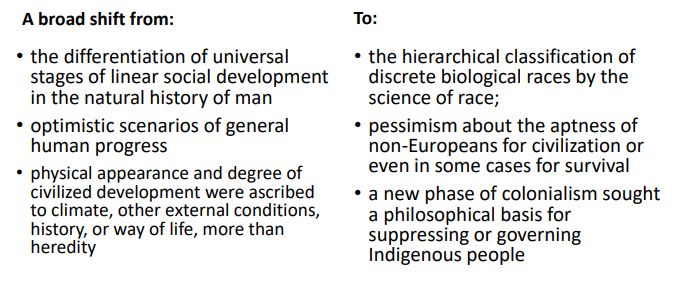
the science of race
• classifying animals influenced the practice of classifying humans (racial taxonomy) • Notions of inheritance and hereditary features gained prominence • German-trained French comparative anatomist Georges Cuvier (1769-1832) • “espoused the fixity of species, the inheritance of racial characteristics, the primacy of physical organization, and the diagnostic interconnectedness of cranial structure and intelligence as a key racial differentia” (Douglas 2008, 53), nation of heirarchies and non-western countries were ignored, many were unstudied as they were perceived to be stuck in a primitive state and unable to change
Crawfurd: • Doctor/administrator in SE Asia; Wrote histories • Ideas: No unity to mankind; Hierarchical view of different races;Distinct species; Pure racial types • Comparison of east vs west parts of present day Indonesia • Based on inspection of Papuan slaves in Java, e.g., illustration of 10 year old boy to support theory of Papuans as a ‘puny’ race • attempts to theorise the whole region
Windsor Earl: • The main reference point on Papua for a long time • Writing after Crawfurd he argued there were 2 different types of Papuans, but one ‘race’ • Like others, did not spend much time there • Short observation lends itself to not seeing complex societies but rather simple societies • His view was that Papuans were physically superior to ‘Malays’ but intellectually inferior • Connecting character to appearance • Notions of purity connected to ‘healthy’ culture and other characteristics vs ‘mixed’ as ‘sick’ cultures • Which ‘races’ are more peaceful, less stratified; connecting to colonial violence, where is policing ‘needed
british anthropology in png
the increasing priority accorded to observation or presence in the field; • the fundamental role of cardinality or orientation in the regional comparison of human populations; • the importance of notions of purity and boundedness in racial types • The observers had different opinions but Ballard argues these became unified/fused in subsequent years, visualism
queer theory
• A field of critical theory emerging in the 1980s out of women’s studies and queer studies, feminism, poststructuralism • Rejects biological explanations for sexuality • Seeks to destabilize gender categories and to break free of the oppressive hetero- normativity that pervades discussion of sexual and reproductive behavior • Key figures Michel Foucault, Gayle Rubin, Judith Butler
Heteronormativity: Critiques the idea that heterosexual attraction and relationships are the normal form of sexuality • Critiques a simple, dichotomous understanding of sexuality (a person is either heterosexual or homosexual) and gender (a person is either a man or a woman)
Non-heteronormativity: • “Heteronormative” has gained currency to refer to structures, relationships, and identities that conform to and affirm hegemonic gendering and sexuality • Non-heteronormative Pacific Islanders are at once part and parcel of their societies and subversive of the social order. • They are deeply enmeshed with what many think of as “tradition,” but they are also the heralds of the new, the experimental, and the exogenous
medicalisation
“the process by which human problems come under control of medical authority and become classified as something to be diagnosed, treated and potentially cured” Johnson p. 518 • what Foucault called 'the medical gaze' • Arguably pathologisation is done more by medicine than by anthropology
colonial anthropology
• Why did anthropologists spend so much time on ‘the colonised’ and so little on ‘colonisers’? • Were there not competing colonial agendas? Different class and gender interests? • Colonial communities actively created and maintained the racial divide (Ann Stoler’s work) • Different formations and nuances of colonialism eg West Papua ‘love letter to a soldier’ vs Prof Haunani-Kay Trask on Hawaiian history • Colonial violence was physical, discursive and economic, and bound up in racialised stereotypes that legitimated gross inequalities and mistreatment
colonialism in the pacific
• “Formal imperialism” rising in late 1800s • Putting in place borders, regulations, restrictions = confinement of mobile worlds • Move towards taking land and labour (people), not just ‘raiding’ for specific items • Imposed notions of race and culture were essential to rule
colonial encounters idea
• Was it always straightforward domination? • Colonial “Encounters”, mutuality • preconceptions from both sides were brought into confrontation, dialogue, mutual influence and ultimately mutual transformation • tumultuous misunderstandings, political contests and extreme violence also characterised Indigenous-European interactions
gender in western anthropology
• A male-dominated discipline • women anthropologists were often treated as ‘wives’ or ‘field assistants’ of male anthropologists • Women were directed towards particular topics (eg Ruth Benedict, Margaret Mead) on children, emotions, gender • The contributions of women of colour were not recognised in the discipline for some time • Contributions that did not fit the dominant way of writing anthropology were also criticised. Early gender anthropologists: • Their own assumptions and binary Western notions • Men’s work and experiences. Women were in chapters or notes on family and kinship only, not politics, economics, spirituality • Cultural diversity in gender arrangements • Debates over women’s status, power, authority and the definition of these things (eg gendered division of labour, spiritual power, everyday influence) • A sisterhood (esp. 1960s)/universal oppression of women
The contingency of anthropological ‘truths’ about gender and sexuality – from no
sexuality (Malinowski) to sexually ‘free’ (Mead), to warring without love and care
in the post-colonial era (as Hau’ofa criticised)
early sexuality anthropology in pacific
• anthropologists wrote psychosocial analyses of sexuality in Pacific Island societies that grappled with the theoretical debates of their times • Margaret Mead (1928), Bronislaw Malinowski (1929), and Ralph Linton (1939), with Mead’s famous depiction of “sexual freedom” among Samoan adolescents • Malinowksi wrote about reproduction and marriage, but called it ‘sexual life’ • Early works make either only passing, derogatory mention or no mention of non-heteronormative persons and practices, there are also other practices such as following local concepts and also avoiding western classifications such as gay or lesbian
gender concepts today
• the social/cultural meanings attributed to sex characteristics • ‘The cultural construction of beliefs and behaviours considered appropriate’ p 11 • cultural categories of feminine and masculine, what it means to be a woman/man/non-binary/trans • ‘who is permitted to engage in which kinds of work, performance, and expression’ (Lim-Bunnin 2020, 80) • Some cultures are more likely than others to assume gender based on presentation - name, clothing, secondary sex characteristics,etc.
gender norms
• define what it is permissible and not permissible •Are embedded in social life and institutions • vary with historical and other circumstances. • can have negative outcomes for all genders, since they influence behaviour, define values and shape choice
social embodiment
• The Body is not just a biological entity but is a sociocultural construct • Bodily sensations are mediated by culture • What is ‘normal’ is socially constructed • ‘embodiment’ draws attention to how the body internalizes cultural meanings, how does culture make its mark on the body?
diverse genders
locally specific categories, such as South Asian hijra and koti, Thai kathoey, Indonesian waria or banci, or what is commonly referred to as “two spirit people” in Native North America. In the Pacific Islands, a variety of terms are used to refer to individuals who embody nonheteronormative identities, such as leitī in Tonga, fa‘afafine in Samoa (plural form, fa‘afāfine), ‘akava‘ine or laelae in the Cook Islands, māhū and raerae in Tahiti.
racism
informs norms and assumptions about sexuality and gender
insider ethnography
Anthropology and data from native stories, Trask, Han'ofa or McGavin
sovereignty
Trask, conflict around who colonised islands feel 'loyal' to
intersectionality
Differing experiences of being a gender in culture, ideas around privilege informing third class experiences
functionalism and structural functionalism
Functionalism
Needing eachother: structural is that cultural institutions create societal cohesion, while psychological is that society dictates the cultural institution
Structural-functionalism
Complex system of parts that have a specifc place to function, kula ring example
interpretivism
Understanding culture by understanding their symbols, emphasies subjective experiences
essentialism and cultural essentialism
Cultures have a set of characteristics that make them what they are. Kab… has discussed that there are charcateristics to make one authentic, Sione has also discussed the fonofale methodology and tauhi va that is shared in tongan culture
biological vs cultural determinism
Biological determinism
Genetics defines who we are
Cultural determinism
Culture defines who we are
reflexivity
researchers critically examine their own influence on the research they conduct, including how their identity, biases, and cultural background shape their observations and interpretations. Trask criticises, kabutaulaka acknowledges
hegemony
dominance and control one group holds over others, often through cultural, political, and economic means, shaping societal norms and values.
transindigeneity
Fa'fafaine in somoan, third gender, male with femininity etc.
power
Banivanua Mar: kings discussing their issues with the 'larger' colonising countries, also traders and the colonised learning from eachother and learning to live in their confines
but also traditional ideas around family order in fonofale model

