Topic 6 - Groups in the Perodic Table
 Call Kai
 Learn
Learn Practice Test
 Spaced Repetition
 Match
Match Flashcards
 Knowt Play
1/71

There's no tags or description
Looks like no tags are added yet.
Name | Mastery | Learn | Test | Matching | Spaced | Call with Kai |
|---|
No analytics yet
Send a link to your students to track their progress
72 Terms
List properties of alkali metals.
Soft.
Relatively low melting and boiling points.
Low density.
Very reactive.
Why should alkali metals be stored in oil?
To prevent them reacting with water vapour and oxygen in the air.
What are the products of the reaction between lithium and water?
Lithium hydroxide and hydrogen.
Why does reactivity increase down group 1?
The number of electron shells increases down the group.
As a result, there is weaker attraction between the positive nucleus and outer shell electrons.
Makes it easier to lose an outer shell electron to form a positive metal ion as less energy is needed to overcome forces of attraction.
Why are noble gases inert?
They have a full outer shell, meaning they have a very stable electronic configuration so don’t lose or gain electrons.
What properties of helium make it suitable for use in balloons?
Less dense than air and doesn’t burn.
Why is argon used to fill electric light bulbs?
It’s chemically inert and non flammable so will not react when the light bulb gets hot.
Why is argon used for welding?
Provides an inert welding atmosphere. Argon is more dense than air so keeps air away from the metal.
Which noble gases are used in advertising signs?
Neon, argon and xenon.
What is the trend in boiling points down group 0? Why?
Boiling point increases.
The relative atomic mass increases so there are more intermolecular forces between atoms.
What is the trend in density down group 0?
Increases.
Which state are noble gases at room temeprature?
Colourless gases.
List the noble gases form least to most density.
Helium, Neon, Argon, Krypton, Xenon, Radon.
Which group of elements has full outer shells?
Noble gases.
What group are the halogens in?
Group 7.
What are group 7 elements also known as?
Halogens.
What is the colour and state of fluorine at room temperature?
Yellow gas.
What is the colour and state of chlorine at room temperature?
Pale green gas.
What is the colour and state of bromine at room temperature?
Red brown liquid.
What is the colour and state of iodine at room temperature?
Black/Dark grey solid.
Why are halogens at different states at room temperature?
Melting and boiling points increases as you move down the group.
Which state would you expect flourine to be at room temperature?
Gas.
Which state would you expect astatine to be at room temperature?
Solid.
Do M.P. and B.P. increase or decrease down group 7?
Increase.
Why does melting and boiling points increases down group 7?
The molecules get bigger down the group so there are more intermolecular forces to overcome during melting and boiling so more energy is required.
What is the chemical test for chlorine?
Damp litmus paper placed in gas.
If chlorine is present, the litmus paper will turn red then white due to bleaching effect of chlorine.
Why does damp litmus paper turn white during the test for chlorine?
Chlorine bleaches it.
Why does damp litmus paper turn red briefly during the test for chlorine?
Acids are produced when chlorine comes into contact with water.
How many outer shell electrons are found on halogens?
7 electrons.
Halogens are diatomic. What does this mean?
They form molecules consisting of 2 atoms.
What type of molecule are halogens?
Diatomic.
Do group 7 elements lose or gain electrons?
Gain electrons.
Do group 7 elements form positive or negative ions?
Negative.
What charge does a halide ion carry?
-1.
Describe the trend in reactivity of the halogens.
Reactivity decreases down the group.
Describe the trend in rate of reaction down group 7.
Rate of reaction decreases down the group.
Does reactivity decrease or increase down group 7?
Decrease.
Does rate of reaction decrease or increase down group 7?
Rate of reaction.
List the halogens from most to least reactive.
Flouring, chlorine, bromine, iodine, astatine.
Which halogen is more reactive: Fluorine or chlorine?
Flourine.
Which halogen is more reactive: Bromine or chlorine?
Chlorine.
Which halogen is more reactive: Iodine or chlorine?
Chlorine.
Which halogen is more reactive: Fluorine or bromine?
Flourine.
Which halogen is more reactive: Iodine or bromine?
Bromine.
Why does reactivity decrease down the group?
Atomic mass of halogen increases as well as electron shells, so atoms get larger as you go down the group.
Therefore the outer shell is further from the nucleus so the attraction of outer electrons to the nucleus decreases.
This means its harder for the atom gain electrons, decreasing reactivity.
Explain why chlorine is more reactive than iodine.
Outer shell of electrons is further from the nucleus so force of attraction between nucleus and electrons decreases,
Iodine does not gain electrons as readily.
What is formed when a halogen reacts with a metal?
Metal halide salt.
Write the word equation for a reaction between iodine and potassium.
Iodine + Potassium → Potassium iodine.
What is formed when hydrogen reacts with halogen?
Hydrogen halides.
What is formed when hydrogen halides dissolve water?
An acidic solution as hydrogen ions dissociate, making the solution acidic.
Chlorine reacts with hydrogen in the presence of sunlight but bromine requires a flame. Why?
Reactivity decreases down the group so bromine requires more energy for the reaction to occur.
When does a halogen displacement reaction occur?
When a more reactive halogen displaces a less reactive halogen from an aqueous solution of its halide.
Why can’t iodine displace chlorine or bromine from an aqueous ionic solution?
Reactivity decreases down the group and iodine is below chlorine/bromine so is less reactive. Displacement will only occur if iodine is more reactive than the halogen in the ionic compound.
Write the word equation for the reaction between chlorine and potassium bromide.
Chlorine + Potassium bromide → Potassium chloride + Bromine.
Write the word equation for the reaction between chlorine and potassium iodide.
Chlorine + Potassium Iodide → Potassium Chloride + Iodine.
Write the word equation for the reaction between bromine and potassium iodide.
Bromine + Potassium Iodide → Potassium Bromide + Iodine.
Write the word equation for the reaction between bromine and potassium chloride.
No reaction because bromine is less reactive than chlorine so chlorine won’t be displaced.
Write the word equation for the reaction between iodine and potassium chloride.
No reaction because iodine is less reactive than chlorine so chlorine won’t be displaced.
Write the word equation for the reaction between iodine and potassium bromide.
No reaction because iodine is less reactive than bromine so chlorine won’t be displaced.
Which halogen would you expect astatine to displace?
None as it is the least reactive halogen.
Which halogen would you expect Flourine to displace?
All halogens because it is the most reactive halogen.
What colour is chlorine water?
Colourless.
What colour is bromine water?
Orange.
What colour is iodine solution?
Brown.
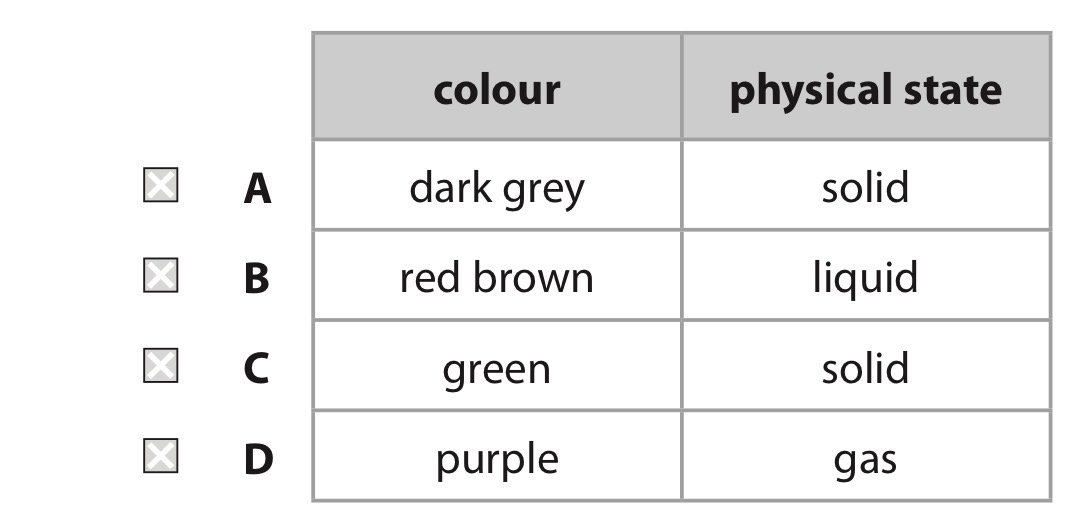
Which row shows the colour and physical state of iodine at room temperati
A.
What would be observed when chlorine is added to potassium bromide?
Colour change from colourless to orange.
What would be observed when colourless sodium bromide solution is added to chlorine water?
Turns yellow/orange.
What is a redox reaction?
A reaction where oxidation and reduction take place at the same time.
In a displacement reaction, is the halide ion oxidised or reduced to form a halogen atom?
Oxidised.
In a displacement reaction, is the halogen atom oxidised or reduced to form a halide ion?
Reduced.
Bromine reacts with potassium iodide. What is reduced and what is oxidised?
Bromine is reduced to bromide ions. Iodine ions are oxidised to iodine.
Chlorine gas can be prepared by reacting concentrated hydrochloric acid with solid potassium manganate (VII).
Use a fume cupboard because chlorine is a toxic gas.
Wear gloves/goggles because hydrochloride acid is corrosive.