3.1.6.1 - The demand for labour, marginal productivity theory
 Call Kai
 Learn
Learn Practice Test
 Spaced Repetition
 Match
Match Flashcards
 Knowt Play
1/13

There's no tags or description
Looks like no tags are added yet.
Name | Mastery | Learn | Test | Matching | Spaced | Call with Kai |
|---|
No analytics yet
Send a link to your students to track their progress
14 Terms
Labour Market =
Consists of the demand for labour coming from employers (firms) combined with the supply of labour coming from individuals seeking work.
How does demand for product determine the demand for labour?
The demand for labour is derived from the demand for the product/service they are used to produce. (Derived demand for labour)
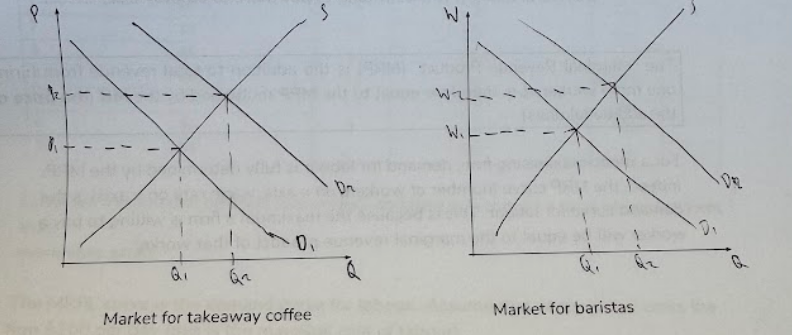
Therefore, increase in demand for takeway coffees → increase demand for baristas
Show on Diagrams the result of an increase in demand for takeway coffees on baristas
Marginal Revenue Product (MRP) =
The addition to total revenue generated by the firm by employing one extra worker
= MPP x MR
Marginal Physical Product (MPP)
The additional output that an extra worker produces
Demand for Labour =
The quantity of workers an employer is willing and able to hire at a given wage rate in a given time period.
What does the MRP curve represent?
MRP = D.
MRP is the demand curve for labour for an individual firm.
MRP used for diagram for firm, not for industry diagram (which uses D)
Why is the Demand curve for Labour Downwards Sloping?
Law of diminishing marginal productivity - As more workers are hired, the additional output produced by each new worker decreases → MRP decreases → firms willing to hire more only at lower wages
Where is the Profit-Maximising point for a firm on labour market
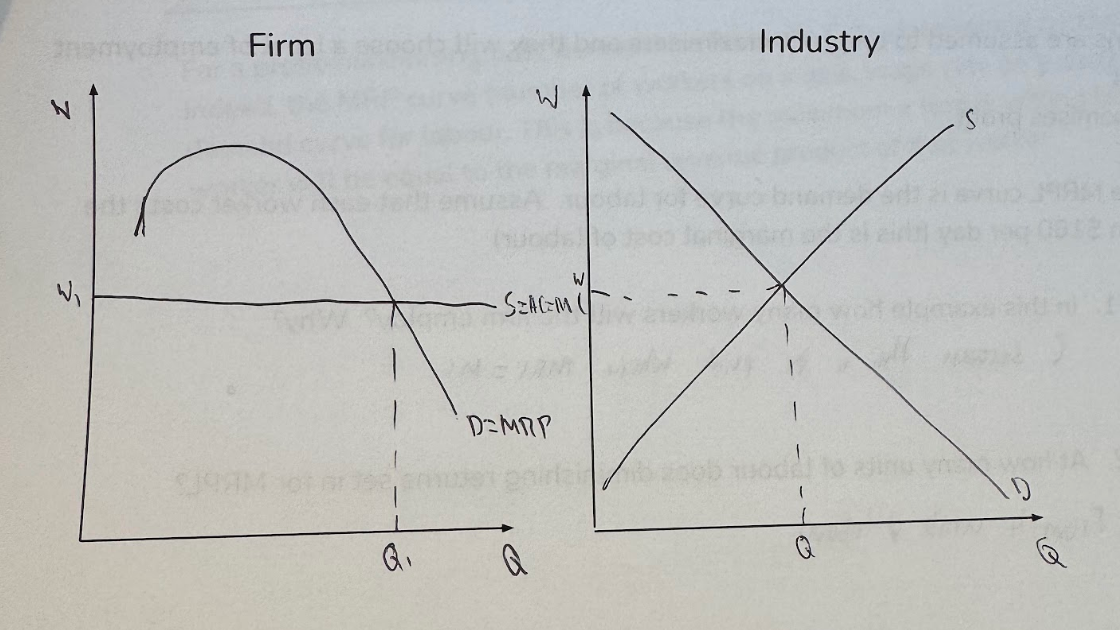
MRP = MC
Diagram for Competitive Labour Market (Firm & Industry)
In competitive labour market, each firm can only hire workers if they offer the market-clearing wage rate, because if they offered less, they would work at other rival firms instead. → Supply curve is horizontal
Factors causing a MOVEMENT along a firm’s Demand for Labour
Price of Labour (wage rate)
e.g. change in min wage
Causes MRP to extend/contract
Factors causing a SHIFT in a firm’s Demand for Labour
Consumer demand for product - DD4L
Productivity of labour (e.g. from training/education) → ↑MPP → ↑MRP
Price/productivity of other FoP - e.g. capital more expensive → swap labour in
Market price of final product → change in MR → change in MRP
Government employment subsidy → allows firm to employ more workers
Elasticity of Demand for Labour (definition + formula)
= Responsiveness of quantity demanded for labour to a change in the wage rate
= % Change in Quantity Demanded of Labour / % Change in Wage Rate
Determinants of Elasticity of Demand for Labour
Time period - In LR, easier to substitute in capital so more elastic
Ease of capital subtitutiton - More elastic if labour can easily be substituted by capital
Elasticity of Demand for Product - If product is elastic, firm cannot pass on higher wage costs to consumers without losing sales, so labour is elastic.
Proportion of Total Costs - If labour is a large % of total costs, rise in wages have a larger impact on costs → more elastic

