Cellular Neurophysiology - Lecture 1
 Studied by 0 people
 Call with Kai
 Learn
Learn Practice Test
 Spaced Repetition
 Match
Match Flashcards
 Knowt Play
1/26

There's no tags or description
Looks like no tags are added yet.
Name | Mastery | Learn | Test | Matching | Spaced | Call with Kai |
|---|
No study sessions yet.
27 Terms
Battery
Something that stores electrical energy through the separation of charge (Q)
RMP: concentration gradient of ions across the membrane
Q (charge)
Can be electrons in a wire or ions in solution
Charge (Q) separation creates a potential difference or voltage (V) across the charges
Voltage (V)
makes a separated charge (Q) want to flow (it’s the electrical energy)
increasing the separation distance of Q increases V (increases the electrical energy)
increasing the density of Q increases V (increases the electrical energy)
what makes the charge flow
Conductor (g)
Separated charge flows through g, creating a current (I)
I = Q/t
RMP: Selectively permeable ion channels
Ohm’s law
The amount of current (I) that flows through a conductor (g) is proportional to the voltage (V)
V = l/g
V = IR
I = V/R
Current (I)
Flow of charge over time
Current can flow onto conducting plates, but across a dielectric
Capacitors
Separate charges of opposite signs
Store charge (similar to battery)
Made up of 2 conducting plates separated by an insulating layer called a dielectric
RMP: Membrane that can separate ions
Capacitance
Ability of a capacitor to store Q (measured in farads, F = 1 coulomb of charge per volt)
Increasing capacitance means
more Q stored on the plates to maintain the same voltage (Q density or electric field) across the plates
Increasing the capacitor’s area (A) increases
capacitance (C) —> more charge required to maintain the same charge density/electric field & therefore voltage
Increasing distance (D) between plates decreases
capacitance (charge density needed to maintain the same voltage is less)
Greater density of Q on plates
greater voltage across it
Neuronal membranes are capacitors because
They separate charge much like an electronic capacitor —> create a voltage across the membrane
Only right along the membrane is charge unequal —> creates a voltage
Charge further from membrane is in equilibrium
Phospholipids
Self-assemble into a bilayer in water due to the hydrophilic (water-loving) phosphate heads and hydrophobic (water-hating) lipid tails
Specific capacitance
The specific properties of phospholipid bilayer give it a _____ of ~1 µF/cm²
Neurons membrane capacitance
cm is a lot smaller than 1 µF
cm = specific capacitance x Area
1 pC
charge needed to create a voltage of -100 mV across this cell’s membrane
Eion
Point where chemical driving force is in equilibrium w/electrical driving force
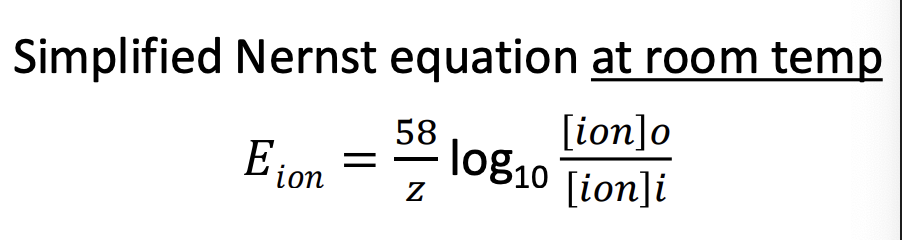
Each ion species contributes to resting membrane voltage based on
The equilibrium ptl for that ion & relative permeability of the membrane to that ion
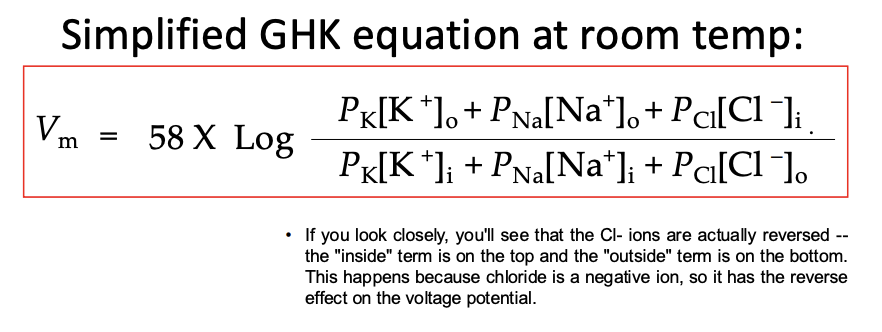
Goldman-Hodgkin-Katz (GHK) equation
RMP formula (form of Nernst equation)
P is relative permeability of the membrane to a specific ion species
Typical permeability ratios at rest might be PK : PNa : PCl = 1.0 : 0.03 : 0.1
How do neuronal membranes behave like electronic circuits?
Equilibrium potential for each ionic species acts like a battery
Conductance (or permeability) of the membrane to specific ionic species acts like resistors in parallel
The membrane acts like a capacitor in parallel with resistors.
Together, these properties determine the voltage across the membrane
Primary active transport
Uses energy from ATP hydrolysis —> ADP
Transports ions against their concentration gradients
3 bound Na+ ions move up their concentration gradient from inside —> outside cell at cost of ATP energy
2 bound K+ ions are also pumped against their concentration gradient to cell
Secondary active transport
Takes advantage of ptl energy of ionic concentration gradients
3 Na+ ions move down their concentration gradient from outside to inside cell at no energy cost, taking 1 bound Ca2+ up it’s concentration gradient to outside the cell
What determines membrane ptl
The concentration gradient that these pumps set up and the selectively permeable ion channels
Active transport
Creates concentration gradients and selectively permeable ion channels set up RMP according to GHK equation
Ion pumps set up
Ionic concentration gradients across membrane
Selectively permeable ion channels set up
Ptl difference across the membrane
 Note
Note  Flashcards (68)