Fundamentals of Nutrition
 Studied by 0 people
 Call Kai
 Learn
Learn Practice Test
 Spaced Repetition
 Match
Match Flashcards
 Knowt Play
1/70

Earn XP
Description and Tags
These flashcards cover key terms and concepts from the Fundamentals of Nutrition lecture series, designed to help reinforce understanding and retention for the exam.
Name | Mastery | Learn | Test | Matching | Spaced | Call with Kai |
|---|
No analytics yet
Send a link to your students to track their progress
71 Terms
Nutrition
The scientific study of nutrients and how the body uses them.
Nutrients
Essential substances in food that are needed for growth, maintenance, and repair of the body.
Food Choices
Influenced by availability, culture, social acceptability, psychological factors, personal preferences, health concerns, price, and media.
Availability
The accessibility of food types based on environmental factors like grocery stores and restaurants.
Culture
Food preferences and eating habits learned from family, cultural, national, and social backgrounds.
Social Acceptability
Food choices influenced by social interactions and cultural norms.
Psychological Factors
Emotional influences on food choices, such as comfort foods and emotional eating behaviors.
Personal Preferences
Individual likes and dislikes affecting food consumption based on taste and texture.
Health Concerns
Limitations on food choices due to allergies, dietary restrictions, and medical conditions.
Price
Cost of foods, which can limit choices for individuals with lower incomes.
Media Influence
Impact of advertisements on food choices and consumption patterns.
American Diet
Characterized by high consumption of added sugars, fats, and proteins, but low in fruits and vegetables.
Malnutrition
Condition arising from an unbalanced diet that can either be undernutrition or overnutrition.
Undernutrition
A form of malnutrition resulting from insufficient intake of energy or nutrients.
Overnutrition
Type of malnutrition resulting from excessive intake of nutrients or calories.
Essential Nutrients
Nutrients that must be obtained from food because the body cannot produce them.
Macronutrients
Nutrients required in large amounts: carbohydrates, proteins, and fats.
Micronutrients
Nutrients needed in smaller amounts, such as vitamins and minerals.
Nutrient Density
A measure of nutrients a food provides compared to its calorie content.
Dietary Reference Intakes (DRIs)
Recommendations for nutrient intake designed to promote health and reduce disease risk.
Estimated Average Requirements (EARs)
Nutrient intake levels estimated to meet the needs of 50% of the population.
Recommended Dietary Allowances (RDAs)
Nutrient intake levels sufficient to meet the needs of 97-98% of the population.
Tolerable Upper Intake Levels (ULs)
Maximum daily intake unlikely to cause adverse health effects.
Adequate Intakes (AIs)
Nutrient intake levels estimated when there is not enough evidence to establish an EAR.
Estimated Energy Requirements (EERs)
Average energy intakes predicted to maintain body weight based on various factors.
Acceptable Macronutrient Distribution Ranges (AMDRs)
Ranges for intake of macronutrients expressed as a percentage of total calories.
Dietary Guidelines for Americans
Federal nutrition recommendations revised every five years for the general population.
MyPlate
A visual representation of dietary guidelines emphasizing proportionate food groups.
Nutrition Facts Label
Required label providing nutritional information on packaged foods.
Fortified Foods
Foods enhanced with additional nutrients not originally present.
Dietary Supplements
Products containing vitamins, minerals, herbs, and other substances that supplement the diet.
Nutritional Genomics
Study of the relationship between human genetics and nutrition.
Observational Studies
Studies that observe and analyze diet, health, and disease patterns in populations.
Case-Control Studies
Comparative studies that look retrospectively at individuals with and without a condition.
Clinical Trials
Experimental studies manipulating dietary variables to observe effects on health outcomes.
Laboratory Studies
Experiments conducted under controlled conditions to understand nutrient functions.
Nutritional Assessment
Evaluation of an individual's dietary intake and nutritional status.
Anthropometric Measurements
Measurements of body dimensions used to assess nutritional health.
Food Frequency Questionnaire
Survey method that assesses how often specific food items are consumed.
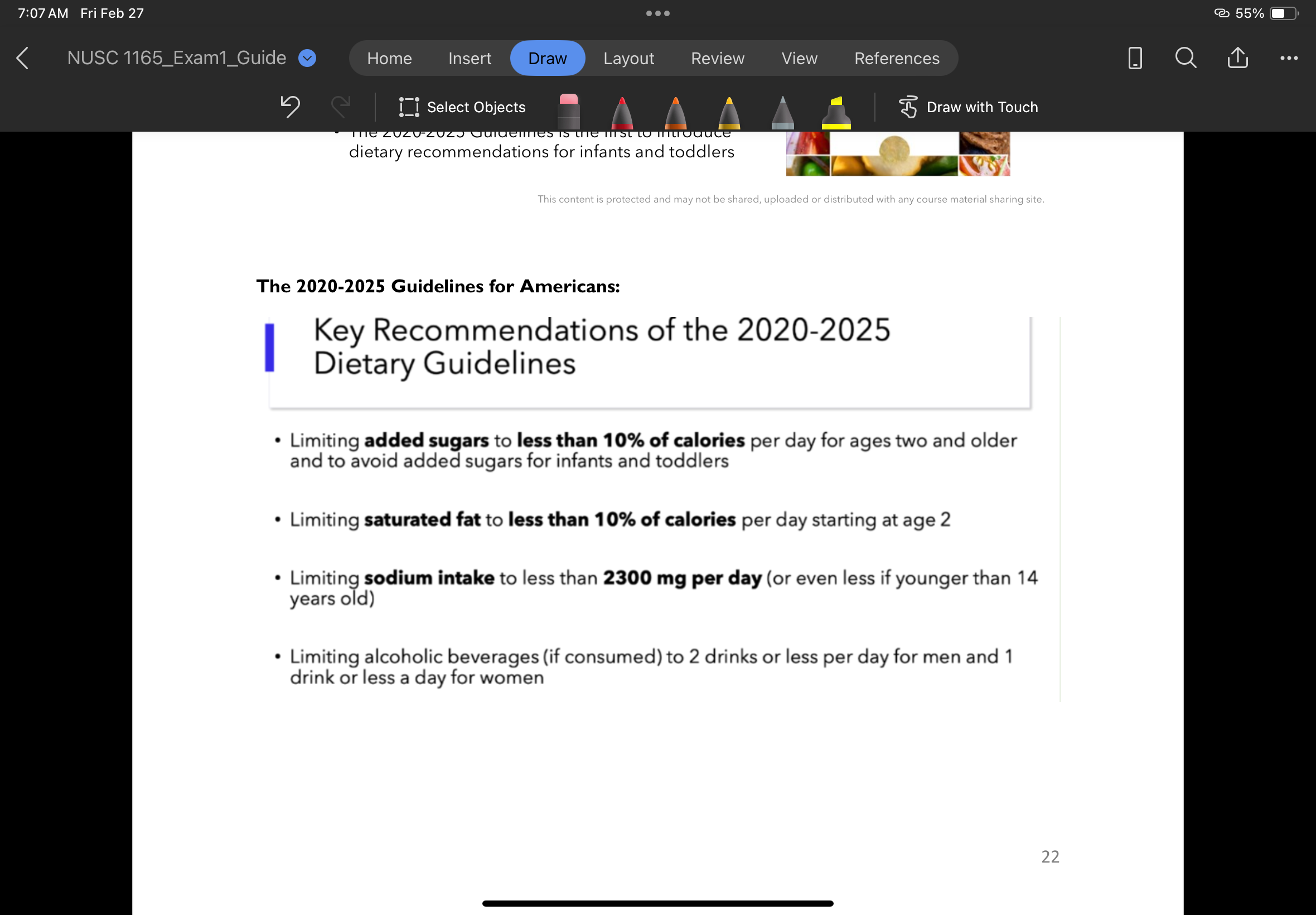
Key Recommendations of the 2020-2025 Dietary Guidelines
Recommendations of physical activity a week
The Dietary Guidelines suggest that most Americans increase their aerobic physical activity gradually over time to a minimum of 150 min/week.
Health Promotion
Strategies aimed at improving health through diet and lifestyle choices.
Do Americans eat a good amount of veggies?
Americans eat much lower than recommended amounts of vegetables
Acceptable Macronutrient Distribution Ranges (AMDRs)
According to the AMDRs, a healthy diet for an adult can contain from 45 to 65% of calories from carbohydrate, 20 to 35% from fat, and 10 to 35% from protein.
How much sugar does the average American consume?
Americans consume more than double the recommended maximum
amount of sugar.
National Health and Nutrition Examination Survey (NHANES)
Survey collecting data on health and nutrition status of Americans.
Healthy Eating Index (HEI)
Assessment tool to evaluate diet quality based on adherence to dietary guidelines.
Digestive System
The organ system responsible for the breakdown and absorption of nutrients.
Transit Time
Time taken for food to move through the GI tract.
Digestion
The process of breaking down food into smaller components for absorption.
Absorption
The process by which nutrients pass through the intestinal wall into the bloodstream.
Digestive Secretions
Substances like mucus and enzymes that aid the digestive process.
Peristalsis
Wave-like muscle contractions that move food through the GI tract.
Villi
Small, finger-like projections in the intestine that increase surface area for absorption.
Microvilli
Tiny projections on the surface of villi that further enhance absorption area.
Bicarbonate
Substance secreted by the pancreas to neutralize stomach acid in the small intestine.
Three types of Nutrition Studies
Observational, Human Intervention, and Laboratory
Case Control Studies
Case-Control study is a type of observational study that compares two groups of people: those with a specific disease or condition (cases) and a similar group without the disease (controls).
Key features of a Case-Control study:
o Starts with the outcome: Case-control studies start by identifying individuals with and
without the outcome of interest (e.g., a disease).
o Retrospective: Data about past exposures or risk factors is collected retrospectively,
meaning after the outcome has already occurred.
o Compares exposure: The main goal is to compare the case and control groups to
identify potential risk factors that may have caused the disease.
Human Intervention Studies (Clinical Trials)
o Involves experimental manipulation of some members of the population
o Observations and measurements are made to determine the effects of the manipulation.
o Example: Study to determine if a high fiber diet reduces risk of colon cancer
o Experimental group participants receive the treatment.
▪ High Fiber diet
o Control group participants do not receive the treatment for comparison purposes.
▪ Low Fiber diet
Laboratory Studies
Settings are usually at hospitals and universities
o Used to learn more about how nutrients function and to evaluate the relationships among
nutrient intake, levels of nutrients in the body, and health.
o Involves studying whole organisms (humans or animals) or cells.
o Example of the Use of Whole Organisms in Laboratory Studies:
o Depletion Repletion Study
• The nutrient is eliminated in the diet until deficiency symptoms appear.
• Then, the nutrient is added back to the diet to a level which may eliminate the symptoms. (eg Vit C and Scurvy).
DIETARY REFERENCE INTAKE
The Dietary Reference Intakes (DRIs) are recommendations for the amounts of energy, nutrients, and other food components that healthy people should consume in order to stay healthy, reduce the risk of chronic disease, and prevent deficiencies
Four Important Nutrients on every label
Vitamin D, Calcium, Iron, Potassium
Ingredients List
Lists ingredients in order from highest to lowest weight
Safety with Supplements
According to the Dietary Supplement Health and Education Act, the manufacturer is responsible for ensuring that a supplement is safe before it is sold. The USP symbol indicates that the supplement has been verified as manufactured according to the quality, purity, and potency standards set by the USP Convention
Current Good Manufacturing Practice
regulations are established by the FDA to ensure that products contain_right ingredients and the right dose. It requires manufacturers to test their products to ensure___identity_________, ___purity__________, ___strength_________, and ___composition__________
Nutritional Status
Is a state of health influenced by dietary intake and nutrient utilization.
Organ systems that help with nutrient transport
• Digestive system
• Endocrine System
• Cardiovascular System
• Endocrine System
How long is food in the GI tract?
In a healthy adult, transit time is about 24 to 72 hours
How Carbs, protein, and lipids are digested
Starch→Amylase(enzyme)→Individual Glucose Molecules
Protein→Pepsin(enzyme)→Amino Acids Lipids→Lipases(enzyme)→Fatty Acids and Glycerol
Important Hormones with digestion
Gastrin comes from stomach mucosa and it stimulates secretion of hydrochloric acid and pepsinogen by gastric glands in the stomach and increases gastric mobility and emptying
CCK(Cholecystokinin) comes from the Duodenal mucosa and it stimulates contraction of the gallbladder to expel bile: increases output of enzyme rich pancreatic juice: slows stomach emptying and contributes to satiety
Where Certain Nutrients are absorbed
➢ Water soluble nutrients like sugar, amino acids, Vit C and B vitamins are absorbed through the blood.
➢ Fatty acids and fat soluble nutrients like Vit A,D , E and K are absorbed through the lymph
vessels

