ANP1115 Midterm 2 Flashcards

0.0(0)
Studied by 0 people
call kaiCall Kai
learnLearn
examPractice Test
spaced repetitionSpaced Repetition
heart puzzleMatch
flashcardsFlashcards
GameKnowt Play
Card Sorting

1/338

encourage image

There's no tags or description

Looks like no tags are added yet.

Last updated 6:50 PM on 3/17/26
Name
Mastery
Learn
Test
Matching
Spaced
Call with Kai

No analytics yet

Send a link to your students to track their progress

339 Terms

1
New cards

Two main immune defenses

Innate immunity (non-specific), and adaptive immunity (specific/acquired)
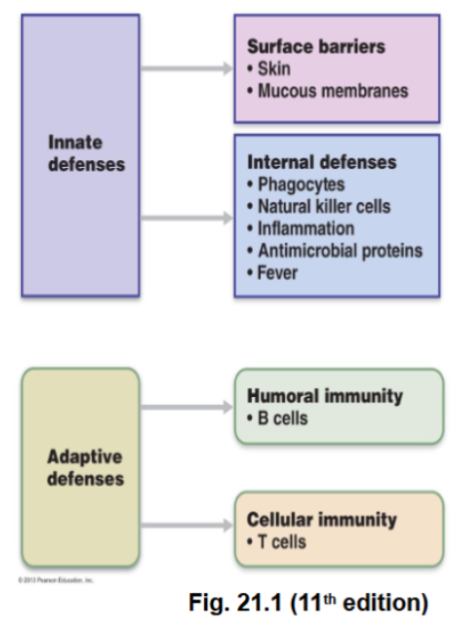
<p>Innate immunity (non-specific), and adaptive immunity (specific/acquired)</p>
2
New cards

Innate immunity

The non-specific immune defence.

Protects without recognizing a specific pathogen. Instead, it recognizes general molecular patterns on microbes (carbohydrates/lipids on cell surfaces).

It’s present at birth, is a rapid response, has no immunological memory, main response every time.

The main components are surface barriers (think skin, mucus membranes), and internal defences. (Think phagocytes, natural killer cells, inflammation, antimicrobial proteins and fever.)

Activated by PAMPs (Pathogen-associated molecular patterns), and DAMPs (damage-associated molecular patterns)

PAMPs and DAMPs alert the innate immune system that something is wrong, and don’t require identification of a specific microorganism.

3
New cards

Adaptive immunity:

The specific/acquired immunity.

Defined as an immune response carried out by lymphocytes that recognize specific antigens.

The key features of this type of immunity are that it’s highly specific, has memory, and develops after exposure to antigens.

There are 2 major types:

  • Humoral immunity: Mediated by B cells and produces antibodies.

  • Cell-Mediated Immunity: Mediated by T cells, destroys infected or abnormal cells.

Macrophages are a key player in this too. They attack antigen-presentin cells.

4
New cards

PAMPs (Pathogen-Associated Molecular Patterns)

Molecules found on microorganisms but not normally in the body

Eg: Bacterial cell wall molecules

Recognized by Toll-like receptors (TLRs) on phagocytes

Effects

  • Trigger phagocytosis

  • Trigger inflammatory response

  • Notify adaptive immune system

5
New cards

DAMPs (Damage-Associated Molecular Patterns)

Defined as molecules located in the wrong place in the body

Example: DNA outside the nucleus or cell

They signal tissue damage even if no infection is present

6
New cards

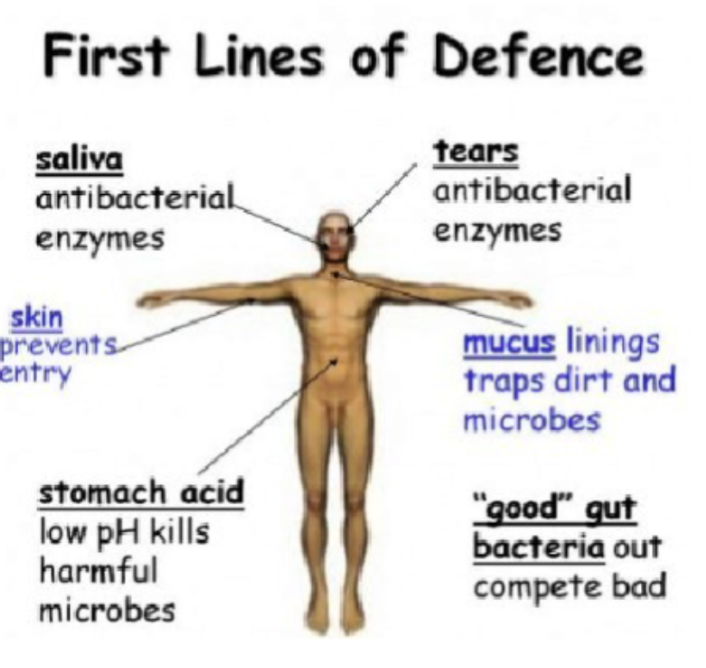
Innate Defenses

These are the “surface barriers”. They are effective, but can be breached.

Acid

  • Skin acidity

  • Vaginal secretions

  • Stomach acid

Enzymes

Lysozyme (an antimicrobial enzyme) in:

  • Saliva

  • Respiratory mucus

  • Tears

Protein-digesting enzymes in stomach

Mucus

  • Traps microorganisms in respiratory and digestive tracts

Defensins

  • Antimicrobial peptides secreted by skin and mucous membranes

Other Chemicals

  • Lipids in sebum

  • Dermicidin in sweat

  • Toxic to bacteria

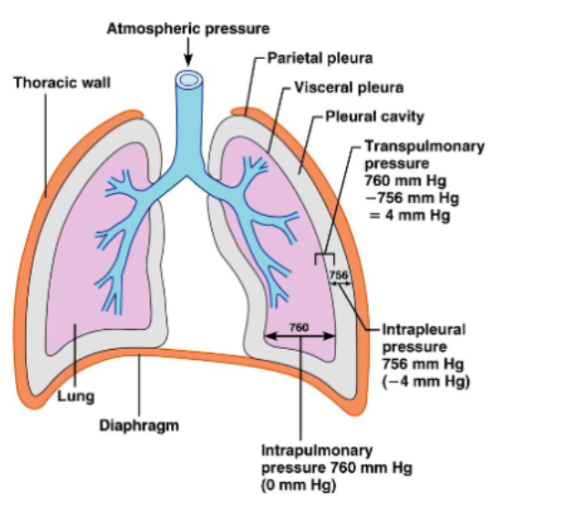
<p><span style="background-color: transparent;">These are the “surface barriers”. They are effective, but can be breached.</span></p><p><span style="background-color: transparent;"><u>Acid</u></span></p><ul><li><p><span style="background-color: transparent;">Skin acidity</span></p></li><li><p><span style="background-color: transparent;">Vaginal secretions</span></p></li><li><p><span style="background-color: transparent;">Stomach acid</span></p></li></ul><p><span style="background-color: transparent;"><u>Enzymes</u></span></p><p><span style="background-color: transparent;">Lysozyme (an antimicrobial enzyme) in:</span></p><ul><li><p><span style="background-color: transparent;">Saliva</span></p></li><li><p><span style="background-color: transparent;">Respiratory mucus</span></p></li><li><p><span style="background-color: transparent;">Tears</span></p></li></ul><p><span style="background-color: transparent;">Protein-digesting enzymes in stomach</span></p><p><span style="background-color: transparent;"><u>Mucus</u></span></p><ul><li><p><span style="background-color: transparent;">Traps microorganisms in respiratory and digestive tracts</span></p></li></ul><p><span style="background-color: transparent;"><u>Defensins</u></span></p><ul><li><p><span style="background-color: transparent;">Antimicrobial peptides secreted by skin and mucous membranes</span></p></li></ul><p><span style="background-color: transparent;"><u>Other Chemicals</u></span></p><ul><li><p><span style="background-color: transparent;">Lipids in sebum</span></p></li><li><p><span style="background-color: transparent;">Dermicidin in sweat</span></p></li><li><p><span style="background-color: transparent;">Toxic to bacteria</span></p></li></ul><p></p>
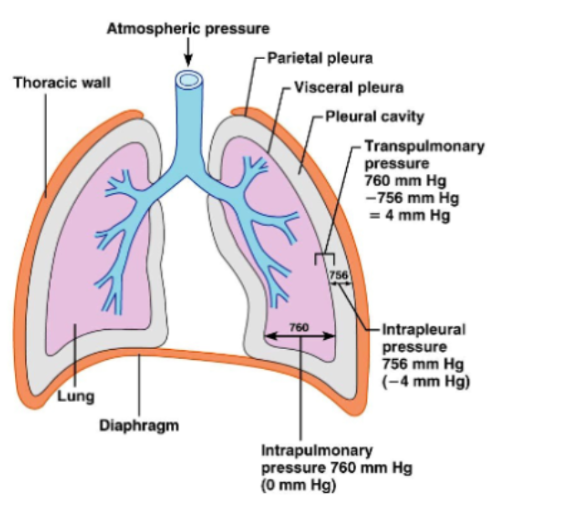
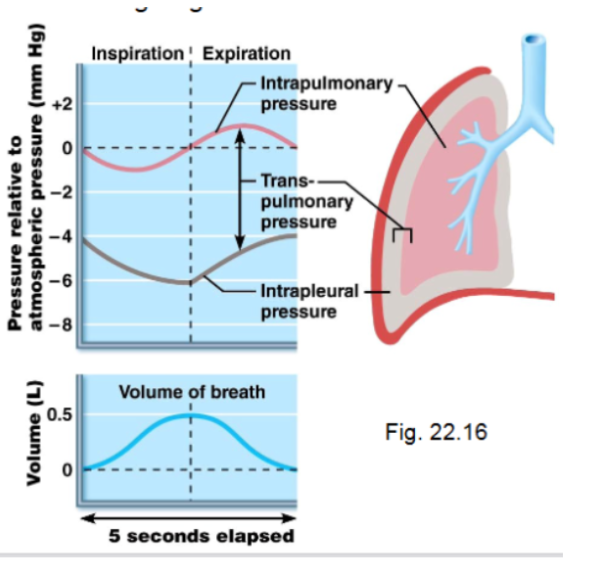
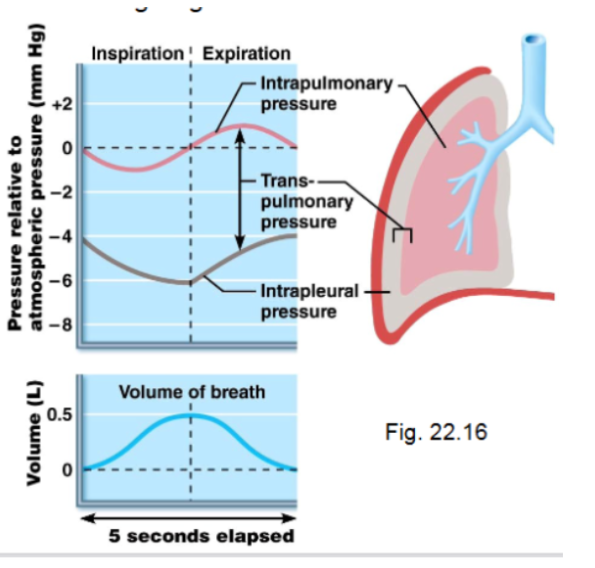
7
New cards

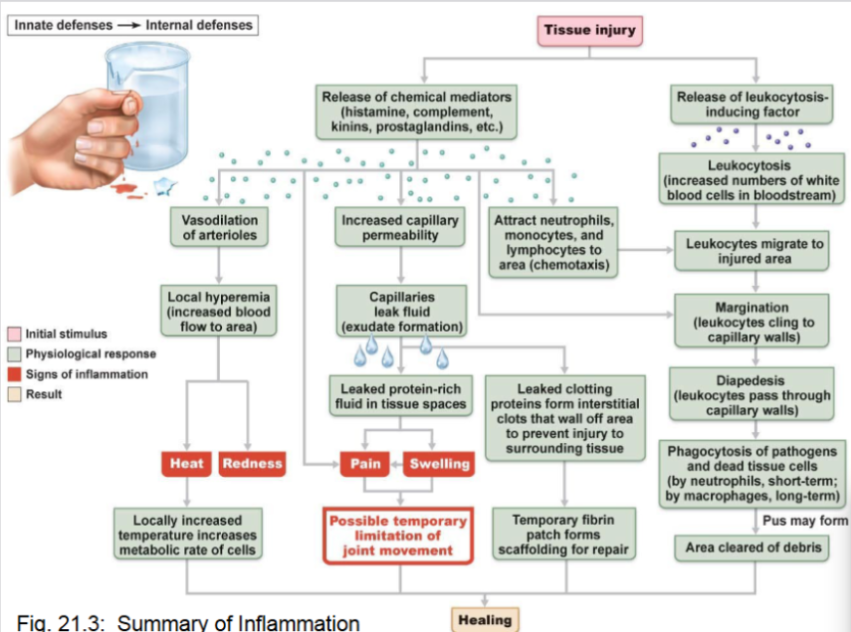
Inflammation

A response to tissue injury or infection.

The four key signs of inflammation are redness, heat, swelling & pain.

Functions:

  • Preventing spread of microorganisms

  • Removing pathogens and cell debris

  • Initiating tissue repair

  • Alerting the adaptive immune system

Inflammatory chemicals (eg: histamine, kinins, prostaglandins, and complement proteins) are released by injured cells and immune cells and cause vasodilation, increased capillary permeability, and attraction of immune cells.

8
New cards

Leukocyte Response During Inflammation

Leukocytosis

  • Increase in circulating white blood cells

Margination

  • Leukocytes adhere to capillary walls

Diapedesis

  • Leukocytes squeeze through capillary walls

Chemotaxis

  • Leukocytes follow chemical signals to the injury site
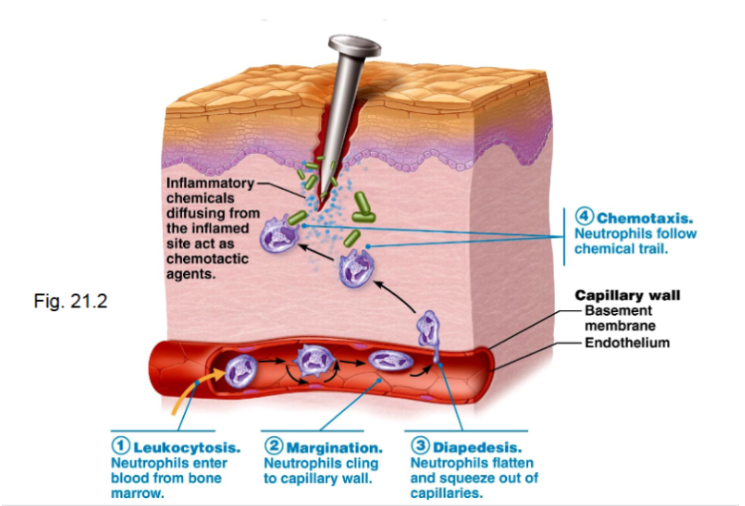
<p><span style="background-color: transparent;">Leukocytosis</span></p><ul><li><p><span style="background-color: transparent;">Increase in circulating white blood cells</span></p></li></ul><p><span style="background-color: transparent;">Margination</span></p><ul><li><p><span style="background-color: transparent;">Leukocytes adhere to capillary walls</span></p></li></ul><p><span style="background-color: transparent;">Diapedesis</span></p><ul><li><p><span style="background-color: transparent;">Leukocytes squeeze through capillary walls</span></p></li></ul><p><span style="background-color: transparent;">Chemotaxis</span></p><ul><li><p><span style="background-color: transparent;">Leukocytes follow chemical signals to the injury site</span></p></li></ul><p></p>
9
New cards

Inflammatory Process Summary

  1. Tissue injury occurs

  2. Chemical mediators released

  3. Vasodilation increases blood flow

  4. Capillary permeability increases

  5. Protein-rich fluid leaks into tissues

  6. Immune cells migrate to site

  7. Phagocytosis of pathogens

  8. Debris cleared

  9. Healing begins

<ol><li><p><span style="background-color: transparent;">Tissue injury occurs</span></p></li><li><p><span style="background-color: transparent;">Chemical mediators released</span></p></li><li><p><span style="background-color: transparent;">Vasodilation increases blood flow</span></p></li><li><p><span style="background-color: transparent;">Capillary permeability increases</span></p></li><li><p><span style="background-color: transparent;">Protein-rich fluid leaks into tissues</span></p></li><li><p><span style="background-color: transparent;">Immune cells migrate to site</span></p></li><li><p><span style="background-color: transparent;">Phagocytosis of pathogens</span></p></li><li><p><span style="background-color: transparent;">Debris cleared</span></p></li><li><p><span style="background-color: transparent;">Healing begins</span></p></li></ol><p></p>
10
New cards

Interferons

An antimicrobial protein released by virus-infected cells.

Effects:

  • Diffuses to nearby cells

  • Blocks viral protein synthesis

  • Degrades viral RNA

It also activates macrophages, mobilizes natural killer cells and may have anti-cancer effects.

11
New cards

Complement system

A group of approx 20 plasma proteins circulating in inactive form

When activated, they enhance inflammation and pathogen destruction

The major effects of this system are:

  • Direct destruction of microbes via membrane attack complex (MAC)

  • Basodilation & increased permeability

  • Chemotaxis which attracts immune cells 

  • Oopsonization (coating pathogens to enhance phagocytosis)
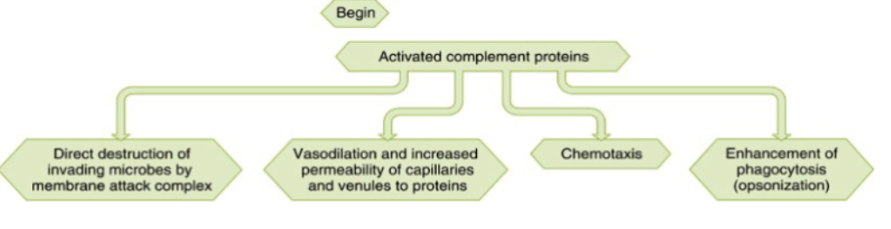
<p><span style="background-color: transparent;">A group of approx 20 plasma proteins circulating in inactive form</span></p><p><span style="background-color: transparent;">When activated, they enhance inflammation and pathogen destruction</span></p><p><span style="background-color: transparent;"><u>The major effects of this system are:</u></span></p><ul><li><p><span style="background-color: transparent;">Direct destruction of microbes via membrane attack complex (MAC)</span></p></li><li><p><span style="background-color: transparent;">Basodilation &amp; increased permeability</span></p></li><li><p><span style="background-color: transparent;">Chemotaxis which attracts immune cells&nbsp;</span></p></li><li><p><span style="background-color: transparent;">Oopsonization (coating pathogens to enhance phagocytosis)</span></p></li></ul><p></p>
12
New cards

Complement Pathways

Classical pathway

  • Triggered by antibodies

Lectin pathway

  • Activated by lectins binding sugars on microbes

Alternative pathway

  • Activated spontaneously on microbial surfaces

13
New cards

Membrane Attack Complex (MAC)

Formed by complement proteins C5b–C9

It inserts into the pathogen membrane, then creates pores which causes cell lysis
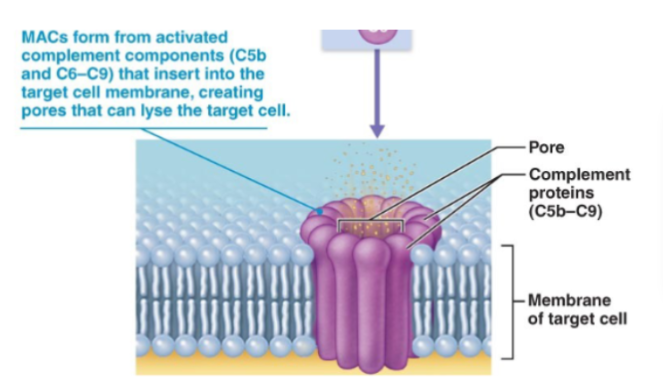
<p><span style="background-color: transparent;">Formed by complement proteins C5b–C9</span></p><p><span style="background-color: transparent;">It inserts into the pathogen membrane, then creates pores which causes cell lysis</span></p>
14
New cards

Fever

  • Defined as an elevated body temperature caused by resetting of the hypothalamic thermostat

  • It’s caused by pyrogens released by leukocytes and macrophages exposed to pathogens

  • The benefits are that it increases metabolic rate and causes the liver and spleen to sequester (isolate) iron and zinc, which limits microbial growth.

15
New cards

Natural Killer (NK) Cells

A type of lymphocyte in the innate immune system. It’s not antigen-specific

It targets virus-infected and cancer cells.

The mechanism of detection:

  • Note that all normal cells express MHC I proteins.

  • NK cells attack when MHC I is missing or reduced, or if stress markers are present.

  • Many infected or cancer cells reduce MHC I expression, triggering NK.

NK cells can express toll-like receptors and respond to PAMPs or DAMPs

16
New cards

Lymphocytes

Derived from hemocytoblasts in red bone marrow

All of them start identical, then become B cells (mature in bone marrow) or T cells (mature in thymus).

During maturation, they develop immunocompetence and self-tolerance.

17
New cards

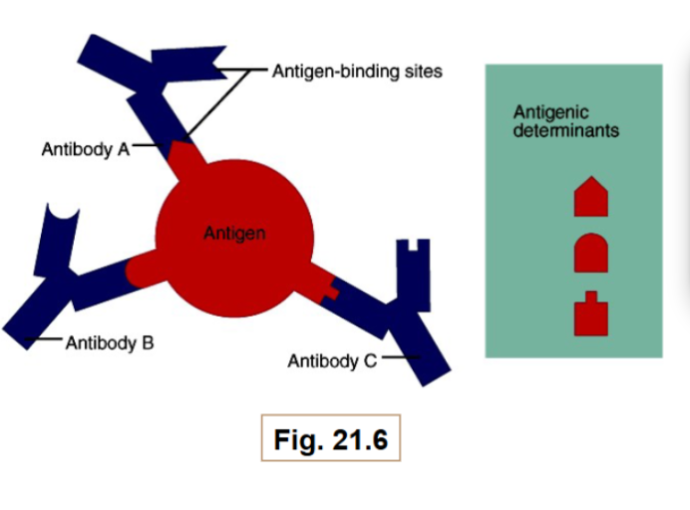
Antigen

A substance capable of mobilizing adaptive immune responses

They may have multiple antigenic determinants (epitopes)

18
New cards

Major histocompatibility complex (MHC)

Refers to cell surface glycoproteins which mark cells as “self”, and present antigens to T cells.

Each MHC molecule contains a groove where a self-antigen or foreign antigen can bind
<p><span style="background-color: transparent;">Refers to cell surface glycoproteins which mark cells as “self”, and present antigens to T cells.</span></p><p><span style="background-color: transparent;">Each MHC molecule contains a groove where a self-antigen or foreign antigen can bind</span></p><p></p>
19
New cards

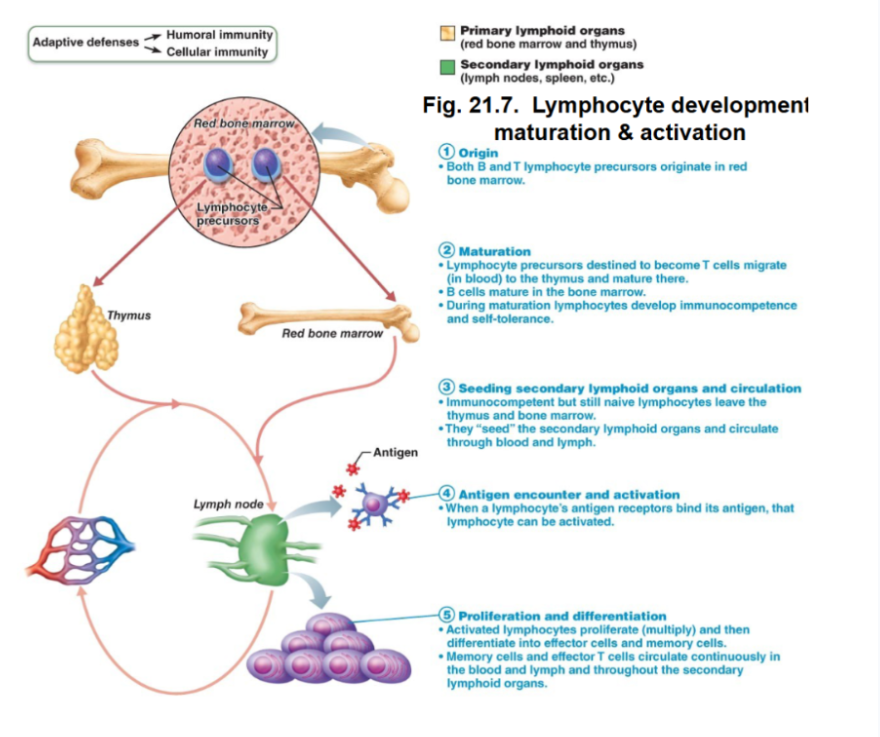
Lymphocyte development

1. Origin

  • Both B and T lymphocyte precursors originate in bone marrow

2. Maturation

  • T cells migrate to the thymus to mature, and B cells mature in bone marrow

  • During maturation, they acquire immunocompetence (recognizing and defending) and self-tolerance.

3. Seeding secondary lymphoid organs

  • Naive lymphocytes migrate to lymph nodes, spleen and other lymphoid tissues

4. Antigen encounter

  • When lymphocyte receptors bind their specific antigen, they become activated

5. Proliferation and differentiation

  • Activated lymphocytes proliferate (clonal expansion), then differentiate into effector cells or memory cells.

  • Memory cells provide long-term immunity.
<p><span style="background-color: transparent;"><u>1. Origin</u></span></p><ul><li><p><span style="background-color: transparent;">Both B and T lymphocyte precursors originate in bone marrow</span></p></li></ul><p><span style="background-color: transparent;"><u>2. Maturation</u></span></p><ul><li><p><span style="background-color: transparent;">T cells migrate to the thymus to mature, and B cells mature in bone marrow</span></p></li><li><p><span style="background-color: transparent;">During maturation, they acquire immunocompetence (recognizing and defending) and self-tolerance.</span></p></li></ul><p><span style="background-color: transparent;"><u>3. Seeding secondary lymphoid organs</u></span></p><ul><li><p><span style="background-color: transparent;">Naive lymphocytes migrate to lymph nodes, spleen and other lymphoid tissues</span></p></li></ul><p><span style="background-color: transparent;"><u>4. Antigen encounter</u></span></p><ul><li><p><span style="background-color: transparent;">When lymphocyte receptors bind their specific antigen, they become activated</span></p></li></ul><p><span style="background-color: transparent;"><u>5. Proliferation and differentiation</u></span></p><ul><li><p><span style="background-color: transparent;">Activated lymphocytes proliferate (clonal expansion), then differentiate into effector cells or memory cells.</span></p></li><li><p><span style="background-color: transparent;">Memory cells provide long-term immunity.</span></p></li></ul><p></p>
20
New cards

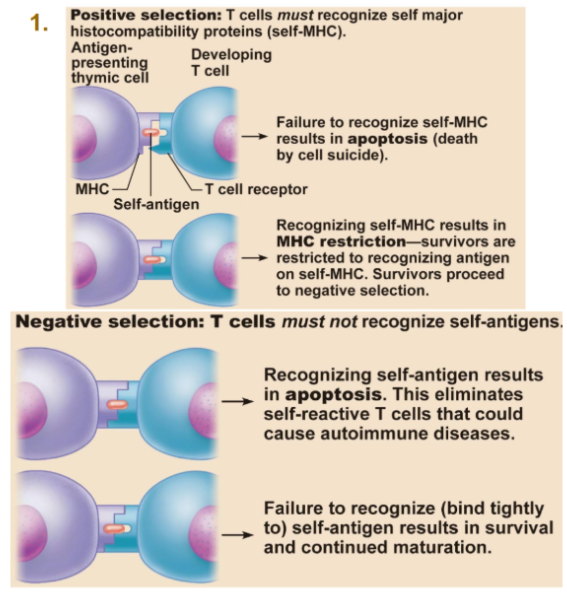
T cell education in the thymus

As we know, T-cells imgrate tot he thymus where they undergo maturation.

Positive selection:

  • T cells must recognize self-MHC; if it doesn’t, apoptosis occurs.

  • Successful cells survive but are restricted to recognizing antigen on self-MHC.

Negative selection:

  • T cells must not recognize self-antigens strongly. If they do, they undergo apoptosis to prevent autoimmune diseases.
<p><span style="background-color: transparent;">As we know, T-cells imgrate tot he thymus where they undergo maturation.</span></p><p><span style="background-color: transparent;"><u>Positive selection:</u></span></p><ul><li><p><span style="background-color: transparent;">T cells must recognize self-MHC; if it doesn’t, apoptosis occurs.</span></p></li><li><p><span style="background-color: transparent;">Successful cells survive but are restricted to recognizing antigen on self-MHC.</span></p></li></ul><p><span style="background-color: transparent;"><u>Negative selection:</u></span></p><ul><li><p><span style="background-color: transparent;">T cells must not recognize self-antigens strongly. If they do, they undergo apoptosis to prevent autoimmune diseases.</span></p></li></ul><p></p>
21
New cards

B Cell Maturation

  • The immature B cells mature in bone marrow. The self-reactive ones are eliminated.

  • After maturation, B cells express unique antigen receptors, and each B cell responds only to one antigen.

  • Lymphocytes become immunocompetent before encountering antigens.

22
New cards

Humoral immune response

Occurs when B lymphocytes respond to an antigen.

Antigen challenge usually occurs in lymph nodes or the spleen

23
New cards

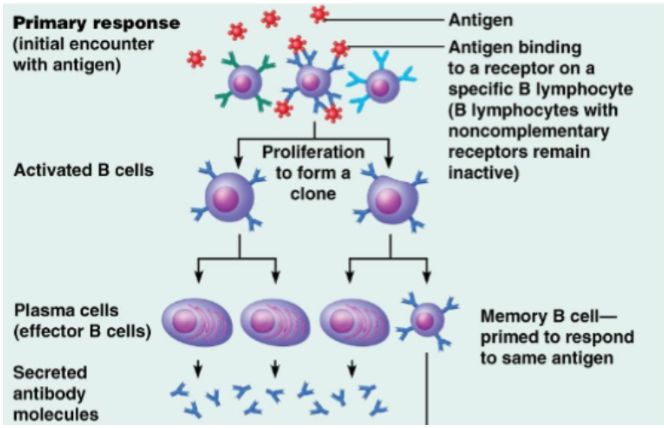
Activation of B cells

Antigen binds to the receptor on a specific B lymphocyte

Only the B cell with the complementary receptor becomes activated

The activated B cell proliferates (clonal expansion) which produces a clone of identical cells.

After proliferation, B cells differentiate into two main types of cells. Plasma cells (effector B cells) and memory B cells.

24
New cards

Plasma cells

  • Also known as effector B cells

  • A type of B cell

  • Their function is to procude large amount of antibodies

  • They typically survive 4-5 days

  • The antibodies circulate in body fluids, they bind antigens and mark pathogens for destruction.

25
New cards

Memory B cells

  • A type of B cell

  • Their function is to provide long-term immunity.

  • They don’t immediately produce antibodies

  • Remain in the body for years

  • Can respond rapidly upon future exposure to the same antigen

26
New cards

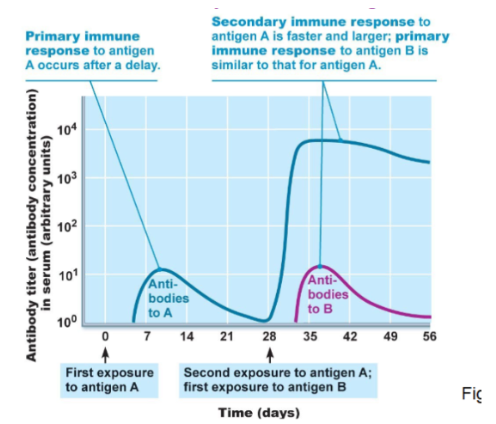
Primary immune response

Occurs during the first encounter with an antigen

A slower response

Produces less antibodies

  1. Antigen binds to B-cell receptor

  2. B cells proliferate

  3. Plasma cells produce antibodies

  4. Memory B cells are formed

<p><span style="background-color: transparent;">Occurs during the first encounter with an antigen</span></p><p><span style="background-color: transparent;">A slower response</span></p><p><span style="background-color: transparent;">Produces less antibodies</span></p><ol><li><p><span style="background-color: transparent;">Antigen binds to B-cell receptor</span></p></li><li><p><span style="background-color: transparent;">B cells proliferate</span></p></li><li><p><span style="background-color: transparent;">Plasma cells produce antibodies</span></p></li><li><p><span style="background-color: transparent;">Memory B cells are formed</span></p></li></ol><p></p>
27
New cards

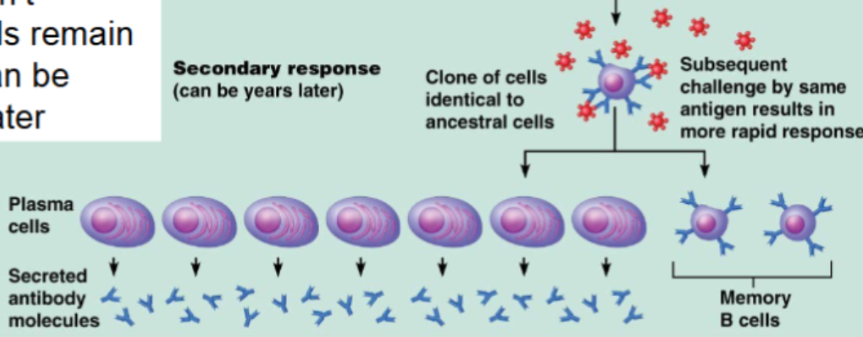
Secondary immune response

Occurs during later exposure to the same antigen

  • It’s much faster

  • Produces more antibodies

  • Memory B cells rapidly become plasma cells
<p><span style="background-color: transparent;">Occurs during later exposure to the same antigen</span></p><ul><li><p><span style="background-color: transparent;">It’s much faster</span></p></li><li><p><span style="background-color: transparent;">Produces more antibodies</span></p></li><li><p><span style="background-color: transparent;">Memory B cells rapidly become plasma cells</span></p></li></ul><p></p>
28
New cards

Macrophages

A type of white blood cell

They engulf athogens

Present antigen fragments to T cells

Help activate adaptive immune responses

29
New cards

Humoral Immunity

The immunity that has to do with B cells

  • The antigen binds to B-cell receptor
    Helper T cell sends chemical signals

  • B cell diffrenaites into lpasma cells

  • Plasma cells release antibodies

30
New cards

Mechanisms of Antibody Action

Note: Antibodies don’t directly kill pathogens, rather they tag them so other immune mechanisms can destroy them.

1. Neutrization

  • Antiboides bind dangerous parts of pathogens, which prevents viruses or toxins from entering cells

2. Agglutination

  • Antibodeis bind multiple pathogens, causing them to clum together.

  • This is easier for phagocytes to remove

3. Precipitation

  • Antibodies bind double antigens, which forms complexes that settle out of solution.

4. Complement activation

  • Antibodies activate compliment proteins which cause inflammation, phagocytosis and cell lysis.

31
New cards

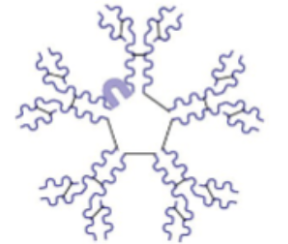
Immunoglobulin classes (antibodies)

knowt flashcard image
32
New cards

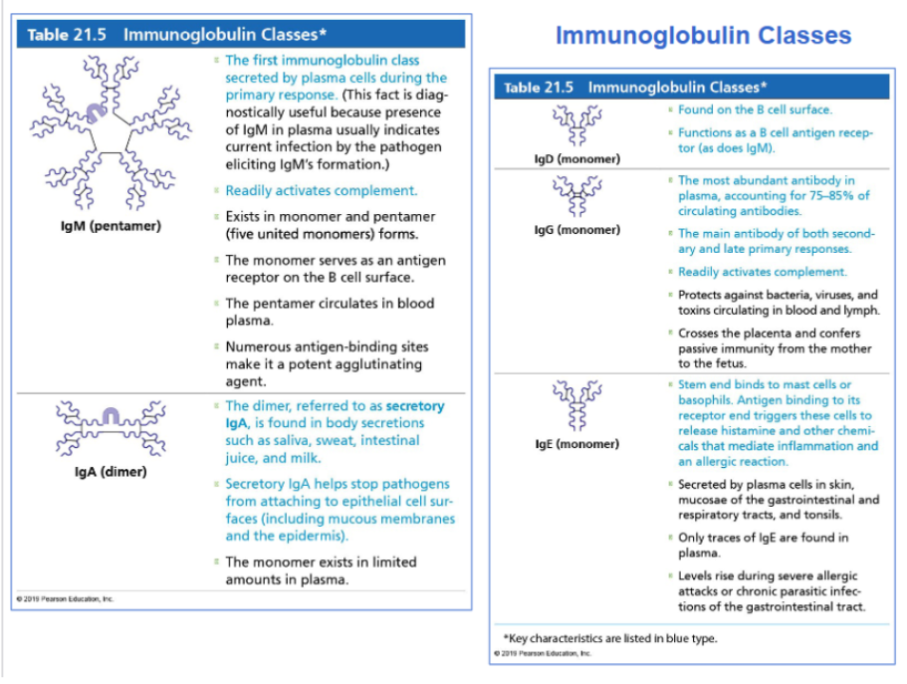
IgM

  • The first antibody produced during primary response

  • Indicates current infection

  • Strong activator of complement

  • Exists as pentamer in plasma

<ul><li><p><span style="background-color: transparent;">The first antibody produced during primary response</span></p></li><li><p><span style="background-color: transparent;">Indicates current infection</span></p></li><li><p><span style="background-color: transparent;">Strong activator of complement</span></p></li><li><p><span style="background-color: transparent;">Exists as pentamer in plasma</span></p></li></ul><p></p>
33
New cards

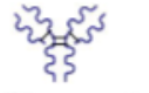
IgG

  • Most abundant antibody in blood (75–85%)

  • Major antibody in secondary immune response

  • Activates complement

  • Crosses placenta which provides fetal immunity
<ul><li><p><span style="background-color: transparent;">Most abundant antibody in blood (75–85%)</span></p></li><li><p><span style="background-color: transparent;">Major antibody in secondary immune response</span></p></li><li><p><span style="background-color: transparent;">Activates complement</span></p></li><li><p><span style="background-color: transparent;">Crosses placenta which provides fetal immunity</span></p></li></ul><p></p>
34
New cards

IgA

Found in body secretions:

  • Saliva

  • Sweat

  • Intestinal fluid

  • Milk

Protects mucosal surfaces

<p><span style="background-color: transparent;">Found in body secretions:</span></p><ul><li><p><span style="background-color: transparent;">Saliva</span></p></li><li><p><span style="background-color: transparent;">Sweat</span></p></li><li><p><span style="background-color: transparent;">Intestinal fluid</span></p></li><li><p><span style="background-color: transparent;">Milk</span></p></li></ul><p><span style="background-color: transparent;">Protects mucosal surfaces</span></p>
35
New cards

IgE

Binds to mast cells and basophils

Triggers histamine release

Important in:

  • Allergic reactions

  • Parasitic infections

<p><span style="background-color: transparent;">Binds to mast cells and basophils</span></p><p><span style="background-color: transparent;">Triggers histamine release</span></p><p><span style="background-color: transparent;">Important in:</span></p><ul><li><p><span style="background-color: transparent;">Allergic reactions</span></p></li><li><p><span style="background-color: transparent;">Parasitic infections</span></p></li></ul><p></p>
36
New cards

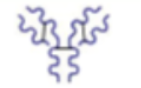
IgD

  • Found on B-cell surfaces

  • They function as B-cell antigen receptors
<ul><li><p><span style="background-color: transparent;">Found on B-cell surfaces</span></p></li><li><p><span style="background-color: transparent;">They function as B-cell antigen receptors</span></p></li></ul><p></p>
37
New cards

Vaccine mechanisms

  • They work by triggering a primary immune response without causing disease

  • This creates memory B and T cells

  • Upon a later exposure to the pathogen, it causes a rapid secondary immune response
<ul><li><p><span style="background-color: transparent;">They work by triggering a primary immune response without causing disease</span></p></li><li><p><span style="background-color: transparent;">This creates memory B and T cells</span></p></li><li><p><span style="background-color: transparent;">Upon a later exposure to the pathogen, it causes a rapid secondary immune response</span></p></li></ul><p></p>
38
New cards

Active immunity

  • A type of immunity where the body produces it’s own antibodies

  • It can either be naturally acquired (via infection with pathogen), or artificially acquired (via vaccination)

  • Only active immunity produces immunological memory.

39
New cards

Passive immunity

  • A type of immunity where antibodies come from another source

  • They can be naturally acquired from the mother (fetus gets antibodies through the placenta, or infant through milk) or artifically acquired via injection of antibodies (gamma globulin)

  • It provides immediate protection, but holds no memory.

40
New cards

T cells

  • A type of cell that destroys infected or abnormal body cells

  • Targeted cells include virus-infected cells, cancer cells, transplanted tissues, and cells with intracellular bacteria.

  • These cells recognize antigen fragments presented on MHC molecules

Types are:

  • Cytotoxic T Cells (CD8) (the killers)

  • Helper T cells (CD4) (coordinate adaptive immune response)

  • Regulatory T Cells (suppress or stop immune responses)

41
New cards

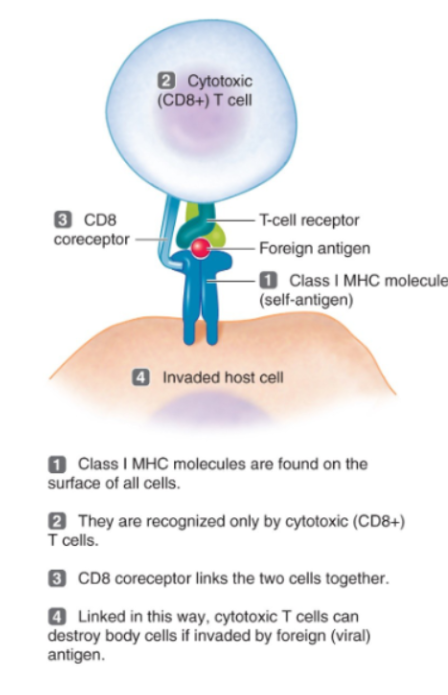
Cytotoxic T Cells (CD8)

  • The killer T cells.

  • They destroy infected or abnormal cells

Mechanism of killing:

  • Release perforin

  • Release granzymes

  • Cause apoptosis (cell death)

<ul><li><p><span style="background-color: transparent;">The killer T cells.</span></p></li><li><p><span style="background-color: transparent;">They destroy infected or abnormal cells</span></p></li></ul><p><span style="background-color: transparent;"><u>Mechanism of killing:</u></span></p><ul><li><p><span style="background-color: transparent;">Release perforin</span></p></li><li><p><span style="background-color: transparent;">Release granzymes</span></p></li><li><p><span style="background-color: transparent;">Cause apoptosis (cell death)</span></p></li></ul><p></p>
42
New cards

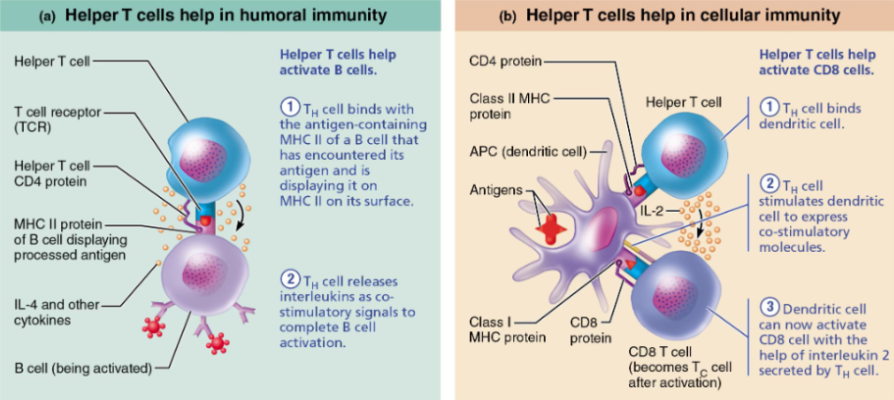
Helper T Cells (CD4)

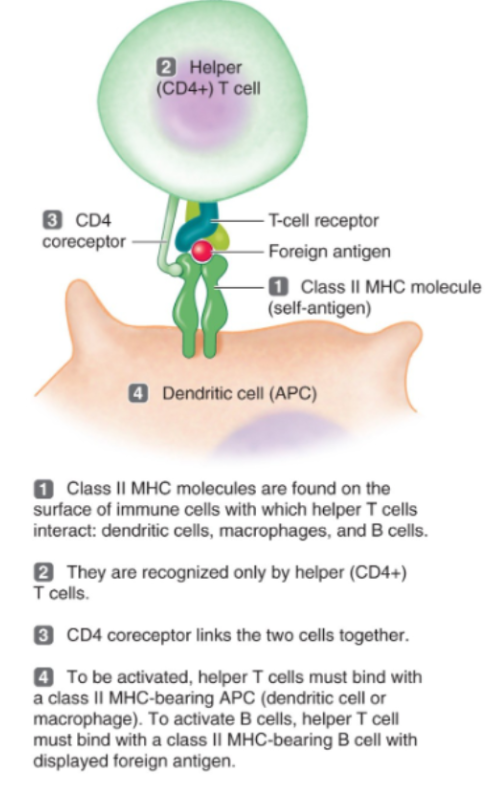
Most common T cells.

  • They activate B cells

  • Activate cytotoxic T cells

  • Activate macrophages

  • Release cytokines (ex: IL-2)

They basically coordinate the entire adaptive immune response./
<p><span style="background-color: transparent;">Most common T cells.</span></p><ul><li><p><span style="background-color: transparent;">They activate B cells</span></p></li><li><p><span style="background-color: transparent;">Activate cytotoxic T cells</span></p></li><li><p><span style="background-color: transparent;">Activate macrophages</span></p></li><li><p><span style="background-color: transparent;">Release cytokines (ex: IL-2)</span></p></li></ul><p><span style="background-color: transparent;">They basically coordinate the entire adaptive immune response./</span></p>
43
New cards

Regulatory T Cells

They suppress or stop immune responses

They do this to prevent excessive immune activity

44
New cards

MHC Class I proteins

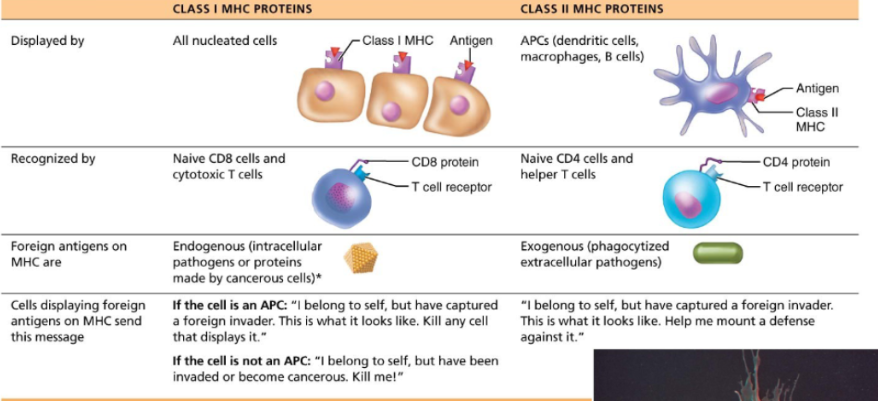
  • These proteins are found on all nucleated cells.

  • They are recognized by CD8 cytotoxic T cells

  • These proteins display internal (endogenous) antigens… So viral and cancer proteins.

  • The signal sent is basically “I belong to self, have been infected. Destroy me.”
<ul><li><p><span style="background-color: transparent;">These proteins are found on all nucleated cells.</span></p></li><li><p><span style="background-color: transparent;">They are recognized by CD8 cytotoxic T cells</span></p></li><li><p><span style="background-color: transparent;">These proteins display internal (endogenous) antigens… So viral and cancer proteins.</span></p></li><li><p><span style="background-color: transparent;">The signal sent is basically “I belong to self, have been infected. Destroy me.”</span></p></li></ul><p></p>
45
New cards

MHC Class II proteins

  • These proteins are found on antigen-presenting cells. Think macrophages, dendritic cells and B cells.

  • They are recognized by CD4 helper T cells.

  • They display external (exogenous) antigens.

  • The signal sent is basically “I captured a pathogen. Activate immune response”
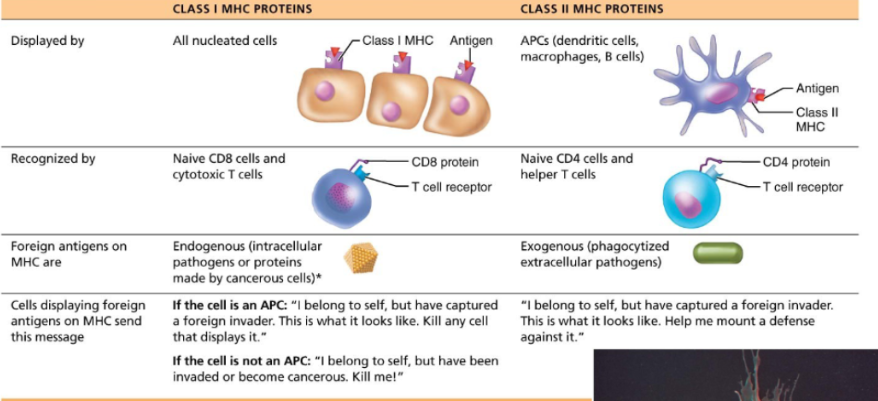
<ul><li><p><span style="background-color: transparent;">These proteins are found on antigen-presenting cells. Think macrophages, dendritic cells and B cells.</span></p></li><li><p><span style="background-color: transparent;">They are recognized by CD4 helper T cells.</span></p></li><li><p><span style="background-color: transparent;">They display external (exogenous) antigens.</span></p></li><li><p><span style="background-color: transparent;">The signal sent is basically “I captured a pathogen. Activate immune response”</span></p></li></ul><p></p>
46
New cards

Macrophages (antigen-presenting cells)

They are derived from monocytes from bone marrow

Functions are:

  • Phagocytosis (engulfing pathogens)

  • Antigen presentation (displaying antigen fragments to T-cells)

  • Immune activation (releasing signalling proteins, activating T cells)

Note: Activated T cells then stimulate macrophages, which creates a feedback loop.

47
New cards

Mechanism of Helper T Cell Mechanism

Antigen presentation

  • Dendritic cell presents antigen on MHC II

Double recognition

  • T-cell receptor binds antigen

  • CD4 binds MHC

Costimulation

  • Additional receptor interactions occur

Clonal expansion

  • Helper T cells proliferate

Formation of:

  • Effector T cells

  • Memory T cells

<p><span style="background-color: transparent;">Antigen presentation</span></p><ul><li><p><span style="background-color: transparent;">Dendritic cell presents antigen on MHC II</span></p></li></ul><p><span style="background-color: transparent;">Double recognition</span></p><ul><li><p><span style="background-color: transparent;">T-cell receptor binds antigen</span></p></li><li><p><span style="background-color: transparent;">CD4 binds MHC</span></p></li></ul><p><span style="background-color: transparent;">Costimulation</span></p><ul><li><p><span style="background-color: transparent;">Additional receptor interactions occur</span></p></li></ul><p><span style="background-color: transparent;">Clonal expansion</span></p><ul><li><p><span style="background-color: transparent;">Helper T cells proliferate</span></p></li></ul><p><span style="background-color: transparent;">Formation of:</span></p><ul><li><p><span style="background-color: transparent;">Effector T cells</span></p></li><li><p><span style="background-color: transparent;">Memory T cells</span></p></li></ul><p></p>
48
New cards

Cytotoxic T Cell Killing Mechanism

  1. Cytotoxic T cell recognizes antigen on MHC I

  2. Releases perforin

  3. Perforin creates pores in target cell membrane

  4. Granzymes enter the cell

  5. Trigger apoptosis

  6. T cell detaches and attacks another cell/
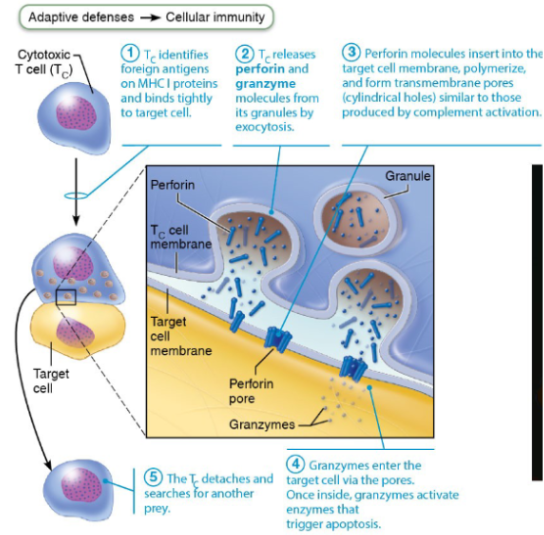
<ol><li><p><span style="background-color: transparent;">Cytotoxic T cell recognizes antigen on MHC I</span></p></li><li><p><span style="background-color: transparent;">Releases perforin</span></p></li><li><p><span style="background-color: transparent;">Perforin creates pores in target cell membrane</span></p></li><li><p><span style="background-color: transparent;">Granzymes enter the cell</span></p></li><li><p><span style="background-color: transparent;">Trigger apoptosis</span></p></li><li><p><span style="background-color: transparent;">T cell detaches and attacks another cell/</span></p></li></ol><p></p>
49
New cards

Lines of immune defence

First line of defence: (Surface barriers):

  • Skin

  • Mucous membranes

  • Enzymes in saliva and tears

  • Stomach acid

  • Mucus

Second line of defence (Innate internal defences):

  • Phagocytes

  • Natural killer cells

  • Inflammation

  • Complement

  • Interferons

  • Fever

Third Line of Defence (adaptive immunity)

  • This line of defence provides specific, long-term protection

  • Components are B cells (antibodies), T cells and memory cells

50
New cards

Four processes of respiration

Pulmonary ventilation

  • Movement of air into and out of lungs

External respiration

  • Exchange of gases between air in alveoli and blood

Transport of respiratory gases

  • Blood transports O₂ and CO₂ between lungs and tissues

Internal respiration

  • Exchange of gases between blood and tissue cells

Note that the respiratory system performs ventilation and external respiration, while the cardiovascular system handles transport and internal respiration
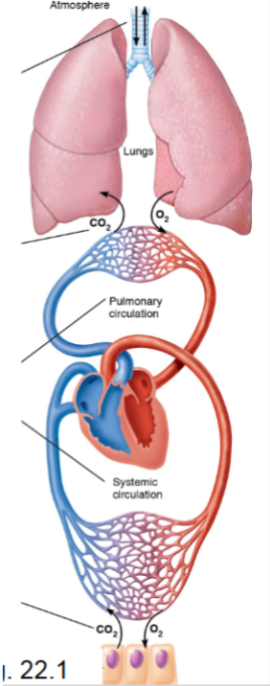
<p><span style="background-color: transparent;">Pulmonary ventilation</span></p><ul><li><p><span style="background-color: transparent;">Movement of air into and out of lungs</span></p></li></ul><p><span style="background-color: transparent;">External respiration</span></p><ul><li><p><span style="background-color: transparent;">Exchange of gases between air in alveoli and blood</span></p></li></ul><p><span style="background-color: transparent;">Transport of respiratory gases</span></p><ul><li><p><span style="background-color: transparent;">Blood transports O₂ and CO₂ between lungs and tissues</span></p></li></ul><p><span style="background-color: transparent;">Internal respiration</span></p><ul><li><p><span style="background-color: transparent;">Exchange of gases between blood and tissue cells</span></p></li></ul><p><span style="background-color: transparent;">Note that the respiratory system performs ventilation and external respiration, while the cardiovascular system handles transport and internal respiration</span></p>
51
New cards

Conducting Zone

Provides a passageway for air

Filters, warms and humidifies incoming air

No gas exchange occurs here

Structures include:

  • Nose

  • Nasal cavity

  • Pharynx

  • Larynx

  • Trachea

  • Bronchi

  • Bronchioles

  • Terminal bronchioles

52
New cards

Respiratory Zone

The sites of gas exchange in the body

Structures include:

  • Respiratory bronchioles

  • Alveolar ducts

  • Alveoli

Gas exchange occurs via diffusion across the respiratory membrane.
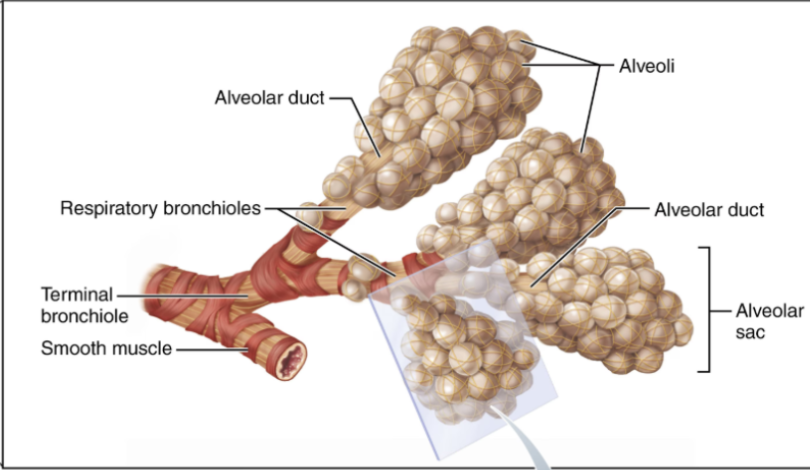
<p><span style="background-color: transparent;">The sites of gas exchange in the body</span></p><p><span style="background-color: transparent;"><u>Structures include:</u></span></p><ul><li><p><span style="background-color: transparent;">Respiratory bronchioles</span></p></li><li><p><span style="background-color: transparent;">Alveolar ducts</span></p></li><li><p><span style="background-color: transparent;">Alveoli</span></p></li></ul><p><span style="background-color: transparent;">Gas exchange occurs via diffusion across the respiratory membrane.</span></p>
53
New cards

The nose

  • A facial organ

  • Provides an airway for respiration

  • Warms and moistens the air

  • Filters air

  • Is a resonating chamber for speech

  • Contains olfactory receptors for smell

  • It has a rich blood supply (thin veins beneath epithelium), which makes nosebleeds common

  • Has sensory nerves, hence why infants have a sneeze reflex

  • Cold air slows cilia movement, leading to runny nose

54
New cards

External nose structure

  • The shape of the nose is determined by nasal cartilages

  • The skin covering the nose contains many sebaceous glands

  • Important structures include the nasal bone, septal cartilage, major and minor alar cartilages
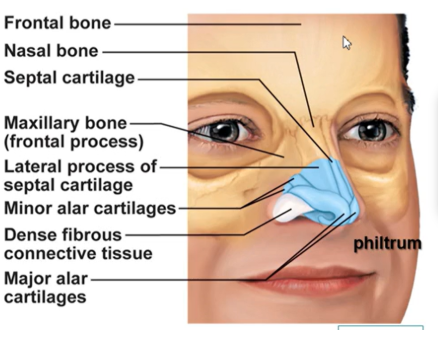
<ul><li><p><span style="background-color: transparent;">The shape of the nose is determined by nasal cartilages</span></p></li><li><p><span style="background-color: transparent;">The skin covering the nose contains many sebaceous glands</span></p></li><li><p><span style="background-color: transparent;">Important structures include the nasal bone, septal cartilage, major and minor alar cartilages</span></p></li></ul><p></p>
55
New cards

Air entering the nasal cavity

Air enters from the external nares (nostrils) to the nasal cavity, internal nares, and then nasopharynx. It’s divided by the nasal septum, which is made up of cartilage and bone.
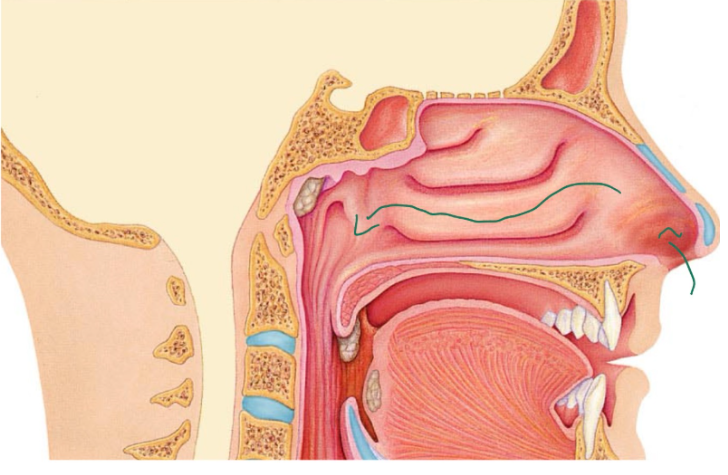
<p><span style="background-color: transparent;">Air enters from the external nares (nostrils) to the nasal cavity, internal nares, and then nasopharynx. It’s divided by the nasal septum, which is made up of cartilage and bone.</span></p>
56
New cards

Olfactory mucosa

A type of nasal mucosa

It contains receptors for smell

57
New cards

Respiratory Mucosa

A type of nasal mucosa

Structure is pseudostratified ciliated columnar epithelium and goblet cells, which produce mucus.

Function is trapping dust and microbes via the mucus, and cilia moves mucus towards the pharynx.

Mucus contains lysozyme, which is an antibacterial enzyme

58
New cards

Vibrissae

  • Refers to the coarse hairs inside the nostrils

  • They trap large particles

59
New cards

Nasal Conchae

  • There are 3 pairs. Superior, middle and inferior.

  • They increase surface area, create air turbulence and improve warming, humidifying, and filtering of air.

60
New cards

Paranasal sinuses

They are located in the bones surrounding the nasal cavity

  • Frontal

  • Sphenoid

  • Ethmoid

  • Maxillary

Their function is to lighten the skull, produce mucus and help warm and moisten air

Sinus headache occurs from sinus drainage pathways being blocked, which causes air in the sinuses to be absorbed and create a partial vacuum, causing pressure & pain.
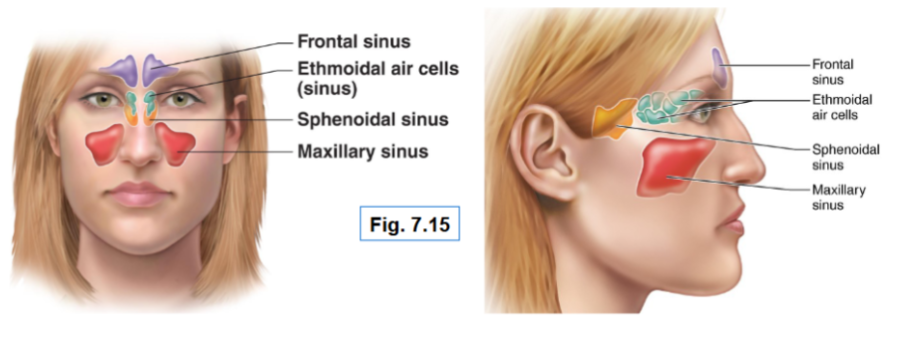

<p><span style="background-color: transparent;">They are located in the bones surrounding the nasal cavity</span></p><ul><li><p><span style="background-color: transparent;">Frontal</span></p></li><li><p><span style="background-color: transparent;">Sphenoid</span></p></li><li><p><span style="background-color: transparent;">Ethmoid</span></p></li><li><p><span style="background-color: transparent;">Maxillary</span></p></li></ul><p><span style="background-color: transparent;">Their function is to lighten the skull, produce mucus and help warm and moisten air</span></p><p><span style="background-color: transparent;"><u>Sinus headache </u>occurs from sinus drainage pathways being blocked, which causes air in the sinuses to be absorbed and create a partial vacuum, causing pressure &amp; pain.</span></p><p><br></p>
61
New cards

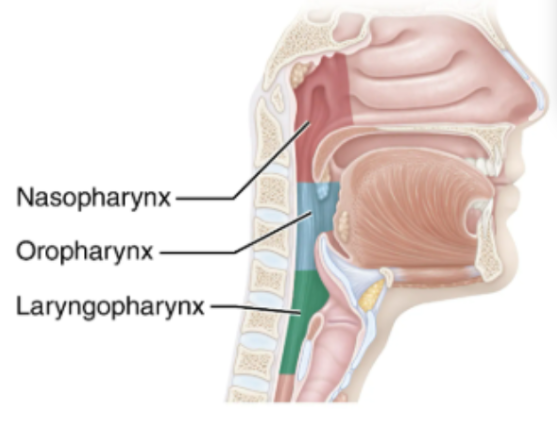
Pharynx

A common pathway for air and food

Its walls are composed of skeletal muscle, it’s approx 13 cm long.

There are 3 regions to this:

  • Nasopharynx

  • Oropharynx

    • Laryngopharynx

<p><span style="background-color: transparent;">A common pathway for air and food</span></p><p><span style="background-color: transparent;">Its walls are composed of skeletal muscle, it’s approx 13 cm long.</span></p><p><span style="background-color: transparent;">There are 3 regions to this:</span></p><ul><li><p><span style="background-color: transparent;">Nasopharynx</span></p></li><li><p><span style="background-color: transparent;">Oropharynx</span></p><ul><li><p><span style="background-color: transparent;">Laryngopharynx</span></p></li></ul></li></ul><p></p>
62
New cards

Nasopharynx

  • Located below the sphenoid bone and above the soft palate

  • Allows for air passage only

  • It’s structure is pseudostratified ciliated columnar epithelium

  • Contains pharyngleal tonsil and pharyngotympanic (auditory) tubes, which drain into the middle ear.
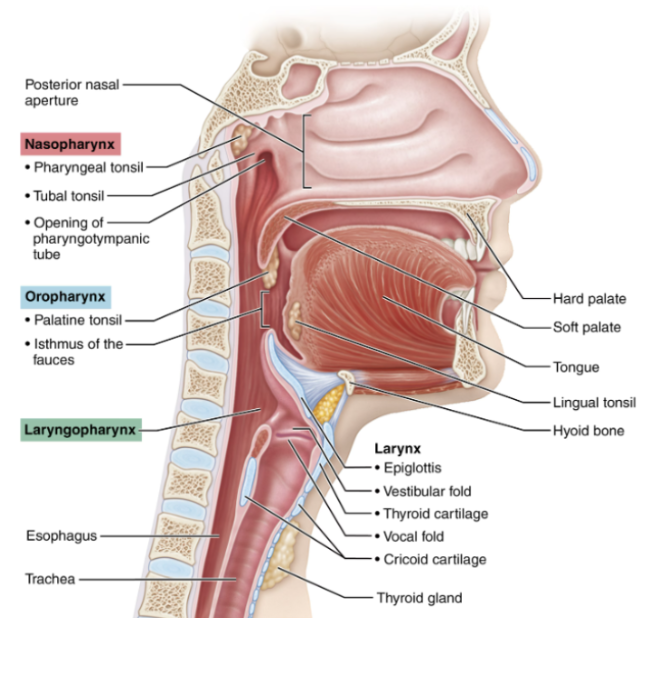
<ul><li><p><span style="background-color: transparent;">Located below the sphenoid bone and above the soft palate</span></p></li><li><p><span style="background-color: transparent;">Allows for air passage only</span></p></li><li><p><span style="background-color: transparent;">It’s structure is pseudostratified ciliated columnar epithelium</span></p></li><li><p><span style="background-color: transparent;">Contains pharyngleal tonsil and pharyngotympanic (auditory) tubes, which drain into the middle ear.</span></p></li></ul><p></p>
63
New cards

Oropharynx

Extends from the soft palate to epiglottis

Connected to the mouth via the isthmus of the fauces

Provides a passageway for air and food

Has stratified squamous epithelium, which protects against abrasion

Structures include the palatine tonsils and lingual tonsils.
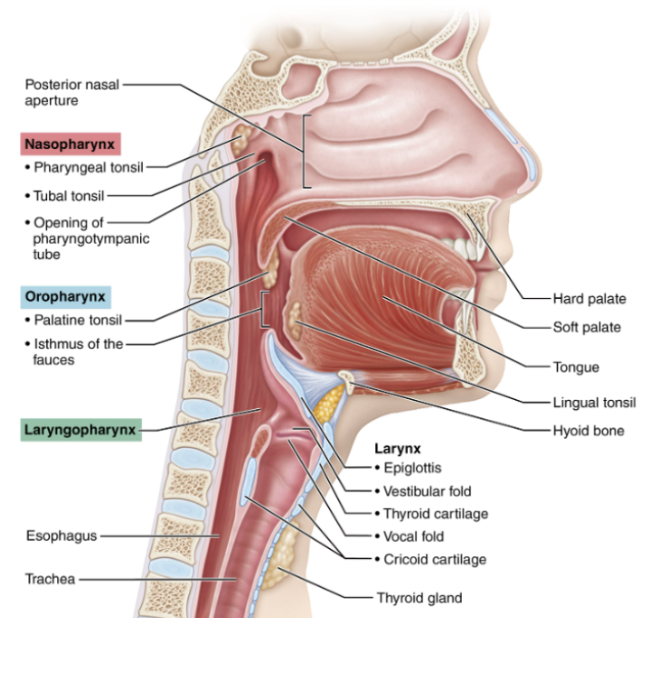
<p>Extends from the soft palate to epiglottis</p><p>Connected to the mouth via the isthmus of the fauces</p><p>Provides a passageway for air and food</p><p>Has stratified squamous epithelium, which protects against abrasion</p><p>Structures include the palatine tonsils and lingual tonsils.</p><p></p>
64
New cards

Laryngopharynx

  • Extends from the epiglottis to the larynx

  • Provides a passageway for air and food

  • Has stratified squamous epithelium

  • During swallowing, it directs food into the esophagus
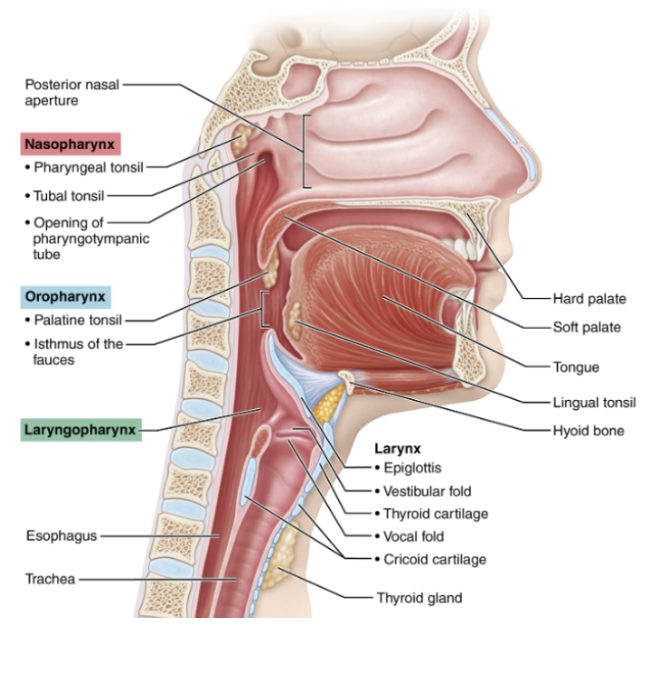
<ul><li><p><span style="background-color: transparent;">Extends from the epiglottis to the larynx</span></p></li><li><p><span style="background-color: transparent;">Provides a passageway for air and food</span></p></li><li><p><span style="background-color: transparent;">Has stratified squamous epithelium</span></p></li><li><p><span style="background-color: transparent;">During swallowing, it directs food into the esophagus</span></p></li></ul><p></p>
65
New cards

Larynx

  • The voice box

  • Located between the pharynx and trachea. It’s roughly 5cm long

  • It’s attached to the hyoid bone

  • Functions are to maintain an open airway, switching pathway between air and food, and producing voice

  • In laryngitis, the vocal cords are inflamed, which prevents normal vibration causing hoarseness
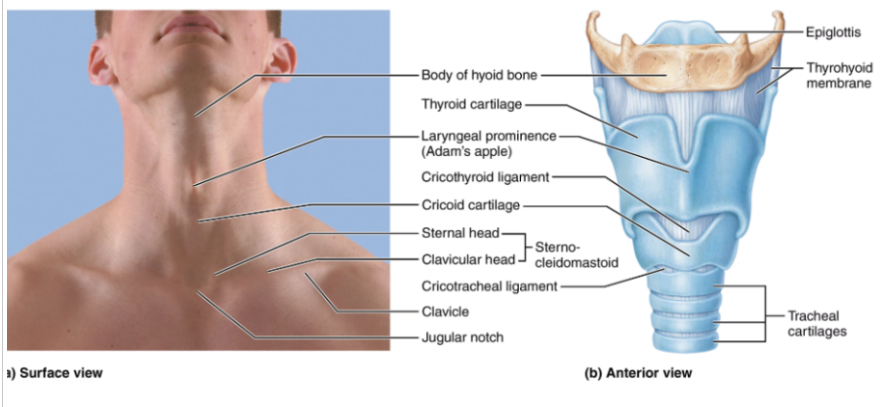
<ul><li><p><span style="background-color: transparent;">The voice box</span></p></li><li><p><span style="background-color: transparent;">Located between the pharynx and trachea. It’s roughly 5cm long</span></p></li><li><p><span style="background-color: transparent;">It’s attached to the hyoid bone</span></p></li><li><p><span style="background-color: transparent;">Functions are to maintain an open airway, switching pathway between air and food, and producing voice</span></p></li><li><p><span style="background-color: transparent;">In laryngitis, the vocal cords are inflamed, which prevents normal vibration causing hoarseness</span></p></li></ul><p></p>
66
New cards

Laryngeal cartilages

There are a total of 9

Thyroid cartilage: 

  • A large shield-shaped cartilage. It forms the Adam’s apple

Cricoid cartilage: 

  • Located below the thyroid cartilage

Arytenoid cartilages:

  • Anchor vocal cords

Epiglottis: 

  • An elastic cartilage that covers the airway during swallowing.
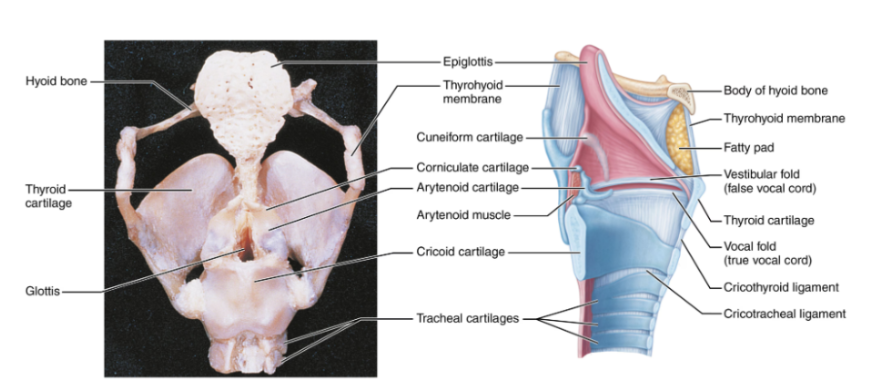
<p><span style="background-color: transparent;">There are a total of 9</span></p><p><span style="background-color: transparent;"><u>Thyroid cartilage:&nbsp;</u></span></p><ul><li><p><span style="background-color: transparent;">A large shield-shaped cartilage. It forms the Adam’s apple</span></p></li></ul><p><span style="background-color: transparent;"><u>Cricoid cartilage:&nbsp;</u></span></p><ul><li><p><span style="background-color: transparent;">Located below the thyroid cartilage</span></p></li></ul><p><span style="background-color: transparent;"><u>Arytenoid cartilages:</u></span></p><ul><li><p><span style="background-color: transparent;">Anchor vocal cords</span></p></li></ul><p><span style="background-color: transparent;"><u>Epiglottis:</u>&nbsp;</span></p><ul><li><p><span style="background-color: transparent;">An elastic cartilage that covers the airway during swallowing.</span></p></li></ul><p></p>
67
New cards

Vocal cords

True vocal cords:

  • White bands of elastic tissue, which vibrate to produce sound

False vocal cords:

  • Are located above true cords and have no role in sound production

The glottis is an opening between the true vocal cords
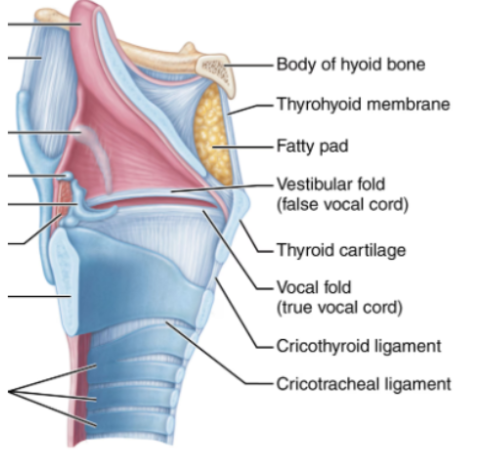

<p><span style="background-color: transparent;"><u>True vocal cords:</u></span></p><ul><li><p><span style="background-color: transparent;">White bands of elastic tissue, which vibrate to produce sound</span></p></li></ul><p><span style="background-color: transparent;"><u>False vocal cords:</u></span></p><ul><li><p><span style="background-color: transparent;">Are located above true cords and have no role in sound production</span></p></li></ul><p><span style="background-color: transparent;">The glottis is an opening between the true vocal cords</span></p><p><br></p>
68
New cards

Voice Production

  • Speech occurs when expirated air passes through the vocal cords. The vocal cords open and close rapidly.

  • Pitch is influenced by the length and tension of the vocal cords.

  • During puberty in males, the vocal cords lengthen, hence the lower voice.

69
New cards

Trachea

  • A flexible and mobile airway

  • 10-12 cm in length, has a diameter of approx 2.5cm

  • It has pseudostratified ciliated columnar epithelium

  • The cilia move mucus towards the pharynx. Smoking is bad because it destroys cilia, resulting in only coughing being able to clear mucus.
<ul><li><p><span style="background-color: transparent;">A flexible and mobile airway</span></p></li><li><p><span style="background-color: transparent;">10-12 cm in length, has a diameter of approx 2.5cm</span></p></li><li><p><span style="background-color: transparent;">It has pseudostratified ciliated columnar epithelium</span></p></li><li><p><span style="background-color: transparent;">The cilia move mucus towards the pharynx. Smoking is bad because it destroys cilia, resulting in only coughing being able to clear mucus.</span></p></li></ul><p></p>
70
New cards

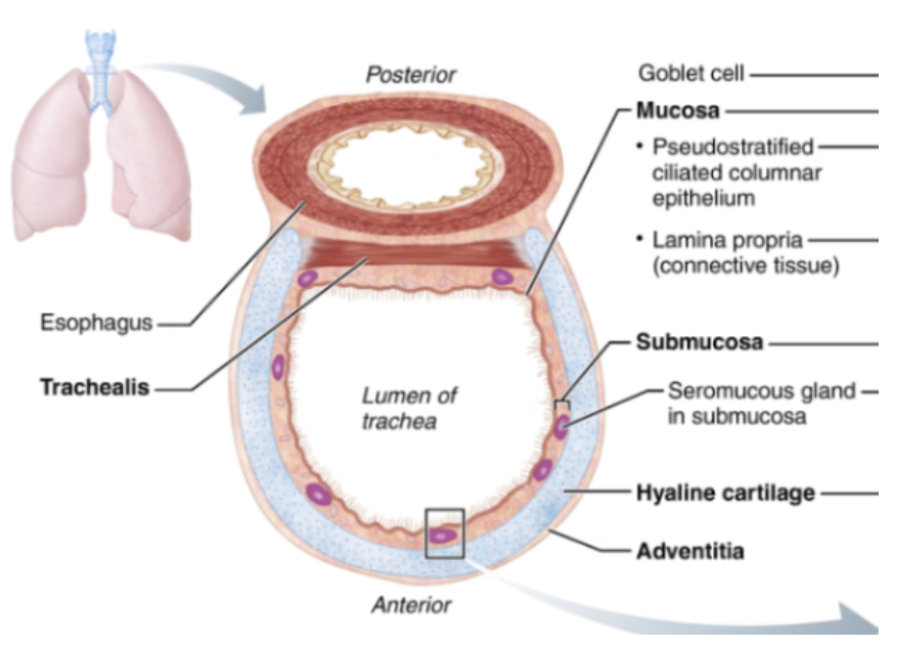
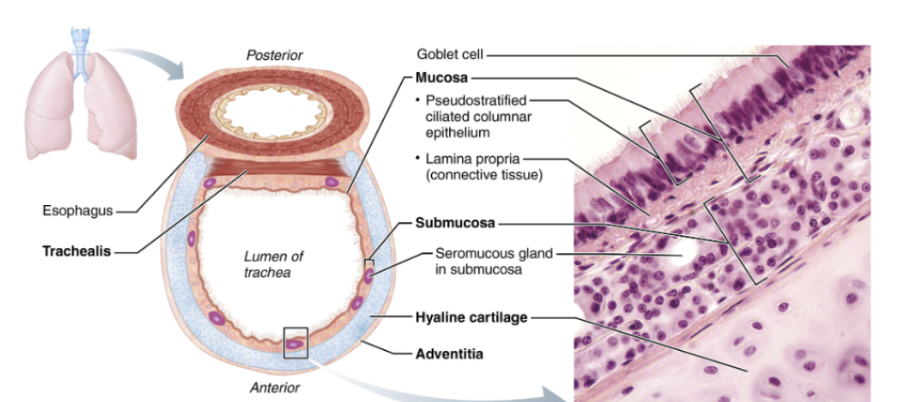
Tracheal Wall Layers

Mucosa

Submucosa

  • Contains seromucous glands

Hyaline cartilage rings

  • 16–20 C-shaped rings

  • Prevent airway collapse

Adventitia

<p><span style="background-color: transparent;"><u>Mucosa</u></span></p><p><span style="background-color: transparent;"><u>Submucosa</u></span></p><ul><li><p><span style="background-color: transparent;">Contains seromucous glands</span></p></li></ul><p><span style="background-color: transparent;"><u>Hyaline cartilage rings</u></span></p><ul><li><p><span style="background-color: transparent;">16–20 C-shaped rings</span></p></li><li><p><span style="background-color: transparent;">Prevent airway collapse</span></p></li></ul><p><span style="background-color: transparent;"><u>Adventitia</u></span></p>
71
New cards

Respiratory membrane

  • Made up of alveolar wall, capillary wall and basal lamina

  • It forms an air-blood barrier. Gas exchange occurs by diffusion

72
New cards

Type I Alveolar Cells

  • Made up of simple squamous epithelial cells

  • Form a thin gas-exchange surface

73
New cards

Type II Alveolar Cells

  • Create a surfactant which reduces surface tension and prevents alveolar collapse.

74
New cards

Notable features of Alveolis

Elastic fibres

  • These allow lungs to expand and recoil

Alveoloar pores

  • These equalize air pressure between alveoli

  • Provide alternate pathways if the bronchi are blocked

Alveolar macrophages

  • Remove dust and pathogens

  • Over 2 million macrophages are cleared per hour
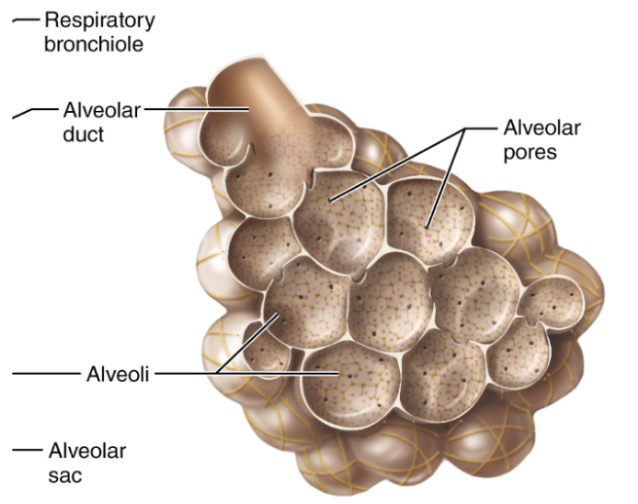
<p><span style="background-color: transparent;"><u>Elastic fibres</u></span></p><ul><li><p><span style="background-color: transparent;">These allow lungs to expand and recoil</span></p></li></ul><p><span style="background-color: transparent;"><u>Alveoloar pores</u></span></p><ul><li><p><span style="background-color: transparent;">These equalize air pressure between alveoli</span></p></li><li><p><span style="background-color: transparent;">Provide alternate pathways if the bronchi are blocked</span></p></li></ul><p><span style="background-color: transparent;"><u>Alveolar macrophages</u></span></p><ul><li><p><span style="background-color: transparent;">Remove dust and pathogens</span></p></li><li><p><span style="background-color: transparent;">Over 2 million macrophages are cleared per hour</span></p></li></ul><p></p>
75
New cards

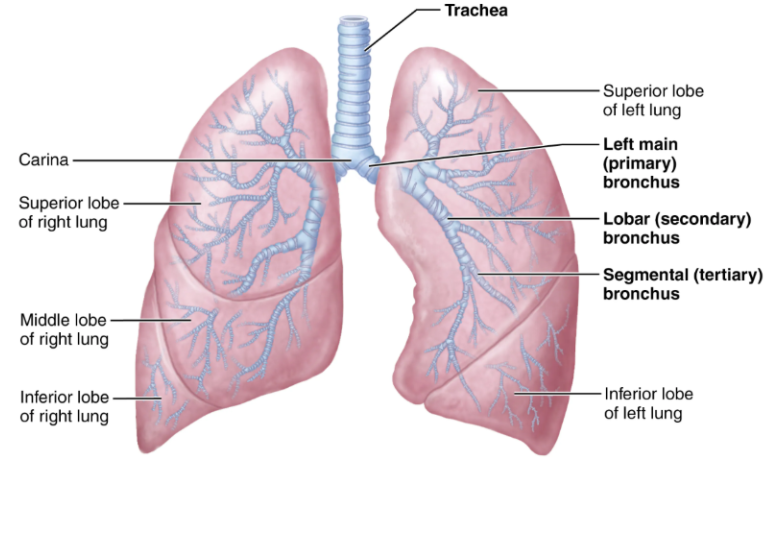
The Bronchial Tree

  • Refers to the branching system of airways inside the lungs. Air travelling through will become warmed, humidified, and cleansed of impurities.

  • There are approximately 23 orders of branching air passages.

There are two primary bronchi, with the rIght primary bronchus being wider, shorter and more vertical. As a result, foreign objects are more likely to enter it

The bronchial tree progressively branches into smaller airways. It goes like this

  1. Primary bronchi

  2. Secondary bronchi

  3. Tertiary bronchi

  4. Bronchioles

  5. Terminal bronchioles

<ul><li><p><span style="background-color: transparent;">Refers to the branching system of airways inside the lungs. Air travelling through will become warmed, humidified, and cleansed of impurities.</span></p></li><li><p><span style="background-color: transparent;">There are approximately 23 orders of branching air passages.</span></p></li></ul><p><span style="background-color: transparent;">There are two primary bronchi, with the rIght primary bronchus being wider, shorter and more vertical. As a result, foreign objects are more likely to enter it</span></p><p><span style="background-color: transparent;">The bronchial tree progressively branches into smaller airways. It goes like this</span></p><ol><li><p><span style="background-color: transparent;">Primary bronchi</span></p></li><li><p><span style="background-color: transparent;">Secondary bronchi</span></p></li><li><p><span style="background-color: transparent;">Tertiary bronchi</span></p></li><li><p><span style="background-color: transparent;">Bronchioles</span></p></li><li><p><span style="background-color: transparent;">Terminal bronchioles</span></p></li></ol><p></p>
76
New cards

Bronchioles and terminal bronchioles

  • Bronchioles have a diameter less than 1mm, while terminal ones have a diameter less than 0.5mm (they’re the smallest structures of the conducting zone)

  • After the terminal bronchioles, the respiratory zone begins

77
New cards

Structural changes along the bronchiole tree

Cartilage (function is keeping larger airways open):

  • The trachea has C-shaped rings

  • Bronchi have cartilage plates
    Bronchioles have no cartilage

Epithelium:

  • Changes from Pseudostratified ciliated columnar epithelium (larger airways) to columnar and cuboidal epithelium (smaller bronchioles)

Bronchioles have no cilia or mucus-secreting cells

Smooth muscle (function is to allow bronchoconstriction and bronchodilation, which regulates airflow):

  • Relative amount present increases as airway diameter decreases. 

78
New cards

Lung structure

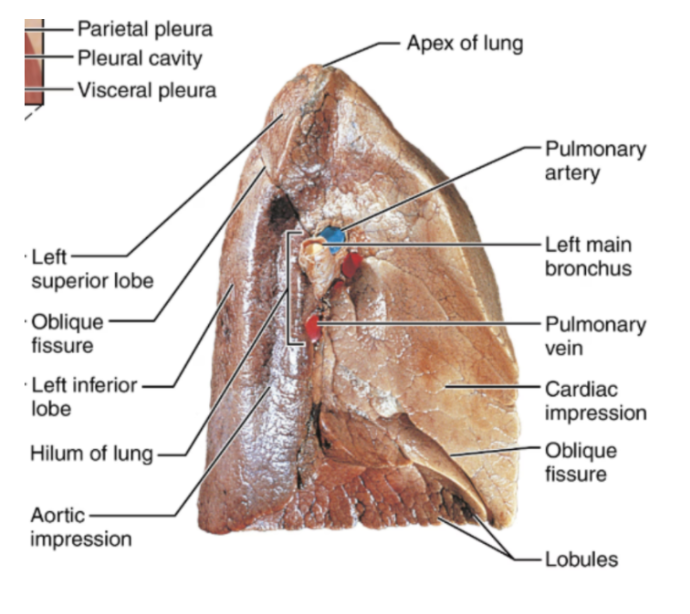
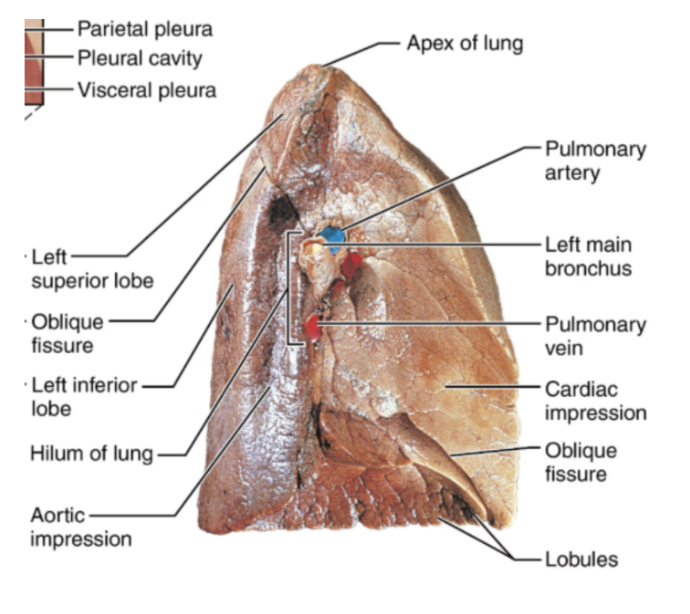
  • Lungs are paired organs, occupying most of the thoracic cavity

  • The mediastinum lies between the lungs

  • Each lung sits in its own pleural cavity

  • Lungs are connected to the mediastinum through vascular and bronchial attachments

79
New cards

External Lung Features

Apex

  • The superior tip of the lung

Base

  • The inferior surface rests on the diaphragm

Hilium

  • A region where structures enter and leave the lungs.

  • Structures include bronchi, blood & lymphatic vessels, and nerves.

Costal surface

  • Lung surface that contacts the ribs

Cardiac Notch

  • An indentation in the left lung that accommodates the heart
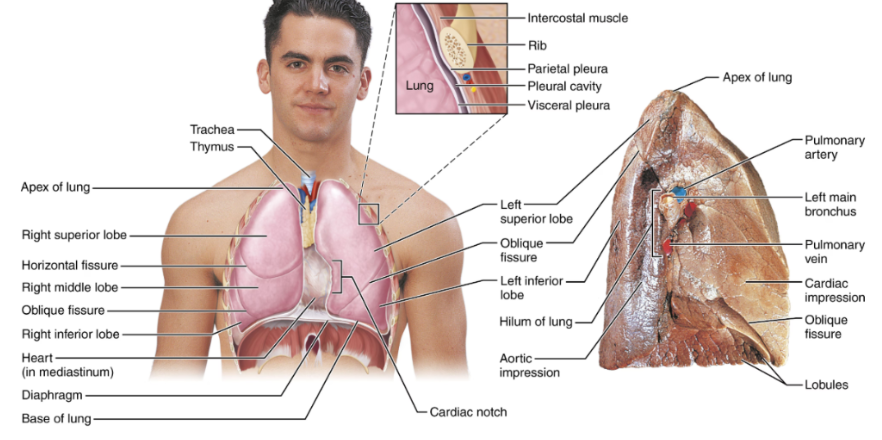
<p><span style="background-color: transparent;">Apex</span></p><ul><li><p><span style="background-color: transparent;">The superior tip of the lung</span></p></li></ul><p><span style="background-color: transparent;">Base</span></p><ul><li><p><span style="background-color: transparent;">The inferior surface rests on the diaphragm</span></p></li></ul><p><span style="background-color: transparent;">Hilium</span></p><ul><li><p><span style="background-color: transparent;">A region where structures enter and leave the lungs.</span></p></li><li><p><span style="background-color: transparent;">Structures include bronchi, blood &amp; lymphatic vessels, and nerves.</span></p></li></ul><p><span style="background-color: transparent;">Costal surface</span></p><ul><li><p><span style="background-color: transparent;">Lung surface that contacts the ribs</span></p></li></ul><p><span style="background-color: transparent;">Cardiac Notch</span></p><ul><li><p><span style="background-color: transparent;">An indentation in the left lung that accommodates the heart</span></p></li></ul><p></p>
80
New cards

Lung fissures

Oblique fissure

  • Present in both lungs

Horizontal fissure

  • Present only in the right lung

  • The fissures divide lungs into lobes

<p><span style="background-color: transparent;"><u>Oblique fissure</u></span></p><ul><li><p><span style="background-color: transparent;">Present in both lungs</span></p></li></ul><p><span style="background-color: transparent;"><u>Horizontal fissure</u></span></p><ul><li><p><span style="background-color: transparent;">Present only in the right lung</span></p></li><li><p><span style="background-color: transparent;">The fissures divide lungs into lobes</span></p></li></ul><p></p>
81
New cards

Bronchoulmonary segments

Subdivided by the septum, approx 10 segments.

Each segment has its own tertiary bronchus, pulmonary artery and pulmonary vein

82
New cards

Lobules

  • The smallest visible subdivisions of the lung

  • They are hexagon-shaped

  • Approx the size of a pencil eraser

  • Supplied by a large bronchiole

<ul><li><p><span style="background-color: transparent;">The smallest visible subdivisions of the lung</span></p></li><li><p><span style="background-color: transparent;">They are hexagon-shaped</span></p></li><li><p><span style="background-color: transparent;">Approx the size of a pencil eraser</span></p></li><li><p><span style="background-color: transparent;">Supplied by a large bronchiole</span></p></li></ul><p></p>
83
New cards

Pulmonary circulation

  • Pulmonary arteries carry deoxygenated blood to the lungs

  • Pulmonary veins return oxygenated blood to the heart

  • Both the parasympathetic and sympathetic nervous systems control airway diameter and other lung functions

84
New cards

Bronchial circulation

  • Bronchial arteries deliver oxygenated systemic blood to lung tissues

Bronchial veins return blood to the right side of the heart

85
New cards

Pleurae

Thin, double-layered serous membranes

Parietal pleura: 

  • Lines the thoracic cavity wall

Visceral pleura: 

  • Covers the lung surface

They have 3 chambers, the central mediastinum and 2 lateral pleural compartments

  • Pleurisy refers to inflammation of the pleural membranes, causing painful breathing.
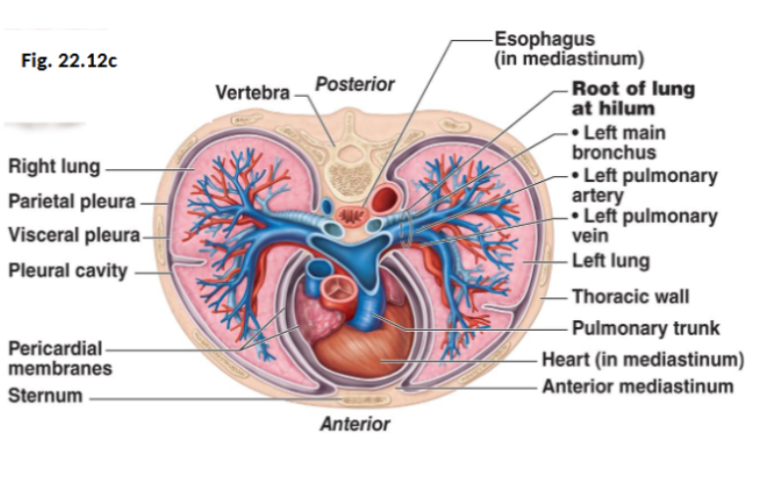
<p><span style="background-color: transparent;">Thin, double-layered serous membranes</span></p><p><span style="background-color: transparent;"><u>Parietal pleura:&nbsp;</u></span></p><ul><li><p><span style="background-color: transparent;">Lines the thoracic cavity wall</span></p></li></ul><p><span style="background-color: transparent;"><u>Visceral pleura:&nbsp;</u></span></p><ul><li><p><span style="background-color: transparent;">Covers the lung surface</span></p></li></ul><p><span style="background-color: transparent;">They have 3 chambers, the central mediastinum and 2 lateral pleural compartments</span></p><ul><li><p><span style="background-color: transparent;">Pleurisy refers to inflammation of the pleural membranes, causing painful breathing.</span></p></li></ul><p></p>
86
New cards

Pleural cavity

  • The space between the pleural layers

  • It’s filled with pleural fluid

Functions of pleural fluid include:

  • Lubricating lung movement during breathing

  • Keeping lungs attached to the thoracic wall via surface tension
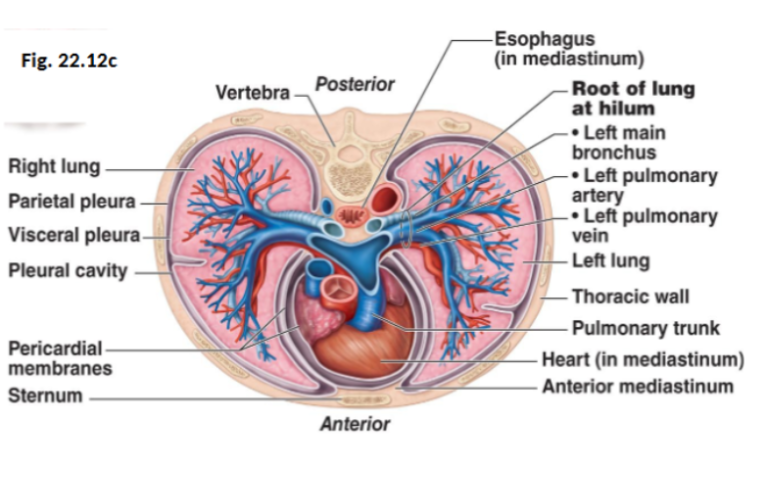
<ul><li><p><span style="background-color: transparent;">The space between the pleural layers</span></p></li><li><p><span style="background-color: transparent;">It’s filled with pleural fluid</span></p></li></ul><p><span style="background-color: transparent;"><u>Functions of pleural fluid include:</u></span></p><ul><li><p><span style="background-color: transparent;">Lubricating lung movement during breathing</span></p></li><li><p><span style="background-color: transparent;">Keeping lungs attached to the thoracic wall via surface tension</span></p></li></ul><p></p>
87
New cards

Physiologic Dead Space

Refers to the air that does not participate in gas exchange

Typical dead space is 150mL.

Eg: If tidal volume is 500mL, 150mL is dead sace, and 350mL is alvelolar ventilation

Anatomical dead space: Refers to air in conducting airways

Functional Dead Space: Refers to air reaching non-erfused alveoli

Pulmonary ventilation is made up of inspiration + expiration

If some alveoli are no longer functional, total dead space = 150mL + alveolar dead spaces

88
New cards

Atmospheric pressure

  • Refers to the pressure exerted by the air around the body

  • At sea level, it’s 760mmHg

  • Respiratory pressures are measured relative to atmospheric pressure

  • Eg: 04mmHg relative pressure = 756 mmHg absolute pressure
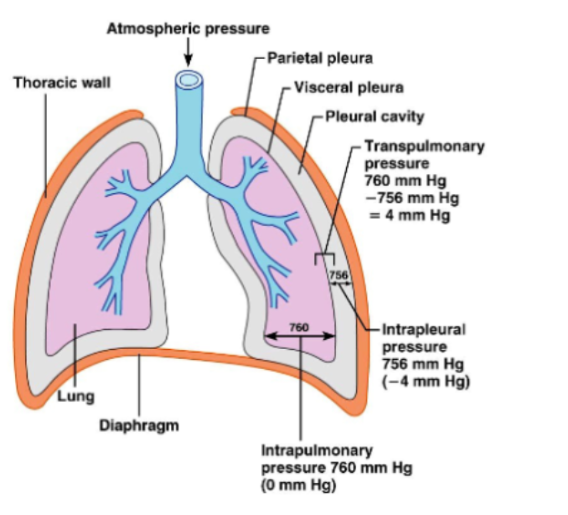
<ul><li><p><span style="background-color: transparent;">Refers to the pressure exerted by the air around the body</span></p></li><li><p><span style="background-color: transparent;">At sea level, it’s 760mmHg</span></p></li><li><p><span style="background-color: transparent;">Respiratory pressures are measured relative to atmospheric pressure</span></p></li><li><p><span style="background-color: transparent;">Eg: 04mmHg relative pressure = 756 mmHg absolute pressure</span></p></li></ul><p></p>
89
New cards

Intrapulmonary Pressure

  • Refers to pressure inside alveoli.

  • Changes during breathing.

  • Eventually equalizes with atmospheric pressure.
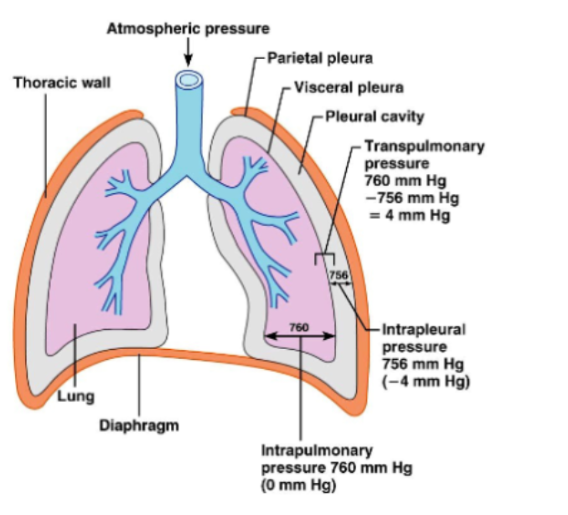
<ul><li><p><span style="background-color: transparent;">Refers to pressure inside alveoli.</span></p></li><li><p><span style="background-color: transparent;">Changes during breathing.</span></p></li><li><p><span style="background-color: transparent;">Eventually equalizes with atmospheric pressure.</span></p></li></ul><p></p>
90
New cards

Intrapleural Pressure

Pressure inside the pleural cavity.

Normally, about 4 mmHg lower than alveolar pressure.

This negative pressure is due to:

  • Elastic recoil of lungs

  • Surface tension of alveolar fluid

  • Elasticity of chest wall

If intrapleural pressure becomes equal to atmospheric pressure, the lung collapses. It’s possible for only one lung to collapse because they are in separate pleural cavities.

<p><span style="background-color: transparent;">Pressure inside the pleural cavity.</span></p><p><span style="background-color: transparent;">Normally, about 4 mmHg lower than alveolar pressure.</span></p><p><span style="background-color: transparent;"><u>This negative pressure is due to:</u></span></p><ul><li><p><span style="background-color: transparent;">Elastic recoil of lungs</span></p></li><li><p><span style="background-color: transparent;">Surface tension of alveolar fluid</span></p></li><li><p><span style="background-color: transparent;">Elasticity of chest wall</span></p></li></ul><p><span style="background-color: transparent;">If intrapleural pressure becomes equal to atmospheric pressure, the lung collapses. It’s possible for only one lung to collapse because they are in separate pleural cavities.</span></p><p><br></p>
91
New cards

Transpulmonary pressure

The pressure that keeps the lungs expanded

TP = Intrapulmonary pressure - Intrapleural Pressure
<p><span style="background-color: transparent;">The pressure that keeps the lungs expanded</span></p><p><span style="background-color: transparent;">TP = Intrapulmonary pressure - Intrapleural Pressure</span></p>
92
New cards

Quiet Inspiration

A mechanic of breathing

Muscles involved are the diaphragm and the external intercostals

Basically

  • Thoracic cavity volume increases

  • Intrapulmonary pressure decreases

  • As a result, air flows into the lungs

The lung volume increases by about 0.5L, and intrapleural pressure drops ot about -6mmHg
<p><span style="background-color: transparent;">A mechanic of breathing</span></p><p><span style="background-color: transparent;">Muscles involved are the diaphragm and the external intercostals</span></p><p><span style="background-color: transparent;">Basically</span></p><ul><li><p><span style="background-color: transparent;">Thoracic cavity volume increases</span></p></li><li><p><span style="background-color: transparent;">Intrapulmonary pressure decreases</span></p></li><li><p><span style="background-color: transparent;">As a result, air flows into the lungs</span></p></li></ul><p><span style="background-color: transparent;">The lung volume increases by about 0.5L, and intrapleural pressure drops ot about -6mmHg</span></p>
93
New cards

Quiet Expiration

A mechanism of breathing. It’s a passive process. Depends more on the elastic recoil of the lungs

  1. Inspiratory muscles relax

  2. The rib cage descends

  3. Lungs recoil

  4. Thoracic volume decreases

As a result, intrapulmonary pressure rises to +1mmHg, and air flows out of the lungs
<p><span style="background-color: transparent;">A mechanism of breathing. It’s a passive process. Depends more on the elastic recoil of the lungs</span></p><ol><li><p><span style="background-color: transparent;">Inspiratory muscles relax</span></p></li><li><p><span style="background-color: transparent;">The rib cage descends</span></p></li><li><p><span style="background-color: transparent;">Lungs recoil</span></p></li><li><p><span style="background-color: transparent;">Thoracic volume decreases</span></p></li></ol><p><span style="background-color: transparent;">As a result, intrapulmonary pressure rises to +1mmHg, and air flows out of the lungs</span></p>
94
New cards

Deep/Forced Inspiration

  • This process is assisted by accessory muscles (neck and chest)

  • These muscles raise the ribs further and expand the thoracic cavity more.

95
New cards

Forced Expiration

  • An active process

  • The muscles involved are the abdominal muscles and the internal intercostals

  • This process increases abdominal pressure and depresses the rib cage.

  • As a result, air is forced out of the lungs.

96
New cards

3 major factors influencing pulmonary ventilation

  1. Airway resistance

  2. Alveolar Surface Tension

  3. Lung compliance

<ol><li><p><span style="background-color: transparent;">Airway resistance</span></p></li><li><p><span style="background-color: transparent;">Alveolar Surface Tension</span></p></li><li><p><span style="background-color: transparent;">Lung compliance</span></p></li></ol><p></p>
97
New cards

Airway Resistance

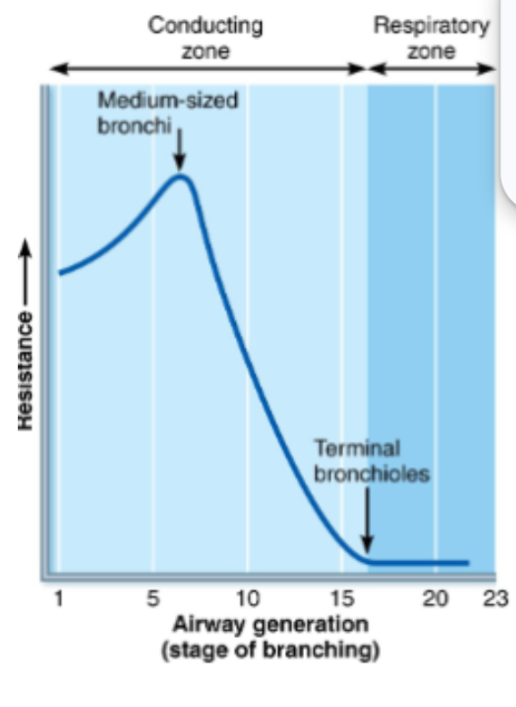
A major factor influencing pulmonary ventilation

Note: Gas Flow = Pressure Gradient/Resistance

  • As a result, resistance depends mainly on airway diameter.

  • Resistance is greatest in medium-sized bronchi

The parasympathetic nervous system causes bronchoconstriction. This can occur during asthma attacks

The sympathetic nervous system causes bronchidilation

Airway resistance also increases with mucus, infection or tumours

98
New cards

Alveolar Surface Tension

  • A major factor influencing pulmonary ventilation

  • Surface tension occurs at the air-liquid interface in alveoli

  • Water molecules are more attracted to each other than to the gas, and as a result, tend to collapse alveoli.

  • They resist any force to increase surface area.

  • I guess they take up space that should be occupied by air?

99
New cards

Surfactant

  • Produced by type II alveolar cells

  • A detergent-like lipoprotein

  • It reduces surface tension and prevents alveolar collapse by interfering with the cohesiveness of water molecules

100
New cards

Infant Respiratory Distress Syndrome (IRDS)

  • Occurs in premature infants

  • Caused by insufficient surfactant production

  • The result is alveoli collapsing, and as a result, the infants need assisted ventilation

Explore top notes

note
Bio Lectures Jan 23/25/29
Updated 664d ago
0.0(0)
note
WORLD HISTORY
Updated 1391d ago
0.0(0)
note
Literary Device Glossary
Updated 1282d ago
0.0(0)
note
science grade 9
Updated 418d ago
0.0(0)
note
AP Psychology Unit 4
Updated 1218d ago
0.0(0)
note
3.3: Criminal behaviours
Updated 256d ago
0.0(0)
note
Bio Lectures Jan 23/25/29
Updated 664d ago
0.0(0)
note
WORLD HISTORY
Updated 1391d ago
0.0(0)
note
Literary Device Glossary
Updated 1282d ago
0.0(0)
note
science grade 9
Updated 418d ago
0.0(0)
note
AP Psychology Unit 4
Updated 1218d ago
0.0(0)
note
3.3: Criminal behaviours
Updated 256d ago
0.0(0)

Explore top flashcards

flashcards
Harrison History Chapter 3
58
Updated 540d ago
0.0(0)
flashcards
L8: Protein Structure
42
Updated 752d ago
0.0(0)
flashcards
Religion
89
Updated 308d ago
0.0(0)
flashcards
IB World Religions Islam Vocab
58
Updated 307d ago
0.0(0)
flashcards
Intro to Healthcare quiz 1
22
Updated 936d ago
0.0(0)
flashcards
Harrison History Chapter 3
58
Updated 540d ago
0.0(0)
flashcards
L8: Protein Structure
42
Updated 752d ago
0.0(0)
flashcards
Religion
89
Updated 308d ago
0.0(0)
flashcards
IB World Religions Islam Vocab
58
Updated 307d ago
0.0(0)
flashcards
Intro to Healthcare quiz 1
22
Updated 936d ago
0.0(0)