Chemistry Final Exam: Titration, Gas Laws, Calorimetry, and Periodic Table
 Studied by 0 people
 Call with Kai
 Learn
Learn Practice Test
 Spaced Repetition
 Match
Match Flashcards
 Knowt Play
1/25

There's no tags or description
Looks like no tags are added yet.
Name | Mastery | Learn | Test | Matching | Spaced | Call with Kai |
|---|
No study sessions yet.
26 Terms
What is the titrant in this experiment?
The titrant is NaOH.
Is the indicator generally added in titrant or analyte in a titration?
The indicator is generally added to the analyte.
What color should the solution be at the endpoint of a titration?
The solution should be pink.
What is the volume of HA acid used in the titration?
The volume of HA acid is 25.00 mL.
What is the volume of NaOH used in the titration?
The volume of NaOH is 14.53 mL.
What is the molar concentration of NaOH?
The molar concentration of NaOH is 0.1320 mol/L.
What are the moles of NaOH dispensed?
The moles of NaOH dispensed is 0.0019 mol.
What is the molar concentration of HA acid?
The molar concentration of HA acid is 0.07 mol/L.
What volume does one mole of an ideal gas occupy at STP?
One mole of an ideal gas occupies 22.4 L at STP.
What are the units for the molar volume of a gas?
The units for the molar volume of a gas are liters per mole (L/mol).
What gas is produced in the reaction of CaCO3 and HCl?
The gas produced is CO2.
How much mass of CaCO3 produces 50 mL of CO2 at STP?
The mass of CaCO3 that produces 50 mL of CO2 is 0.22 g.
How many moles of O2 are collected from the decomposition of KClO3?
The moles of O2 collected are 9.15 x 10^-4 mol.
What type of process is the dissolving process for most salts?
The dissolving process for most salts is an endothermic process.
How does the solubility of most salts change with temperature increase?
The solubility of most salts increases with temperature increase.
Is the molar ΔHn of a strong acid and a strong base constant within experimental error?
True, the molar ΔHn is constant within experimental error.
How much heat is lost to the calorimeter when mixing water at different temperatures?
The heat lost to the calorimeter is 439 J.
What is the specific heat of the unknown metal in the calorimetry experiment?
The specific heat of the metal is 0.527 J/g·°C.
What is the balanced neutralization reaction of NaOH with HCl?
The balanced reaction is NaOH (aq) + HCl (aq) → NaCl (aq) + H2O (l).
What is Dalton's Law of Partial Pressure?
Dalton's Law states that the total pressure of a gas mixture is equal to the sum of the partial pressures of each individual gas.
What is the specific heat of water?
The specific heat of water is 4.18 J/g·°C.
What is the concept of molar volume?
Molar volume is the volume occupied by one mole of a substance at a given temperature and pressure.
What is the principle behind calorimetry?
Calorimetry measures the heat transfer during physical or chemical processes.
What is the octet rule?
The octet rule states that atoms tend to gain, lose, or share electrons to achieve a full outer shell of eight electrons.
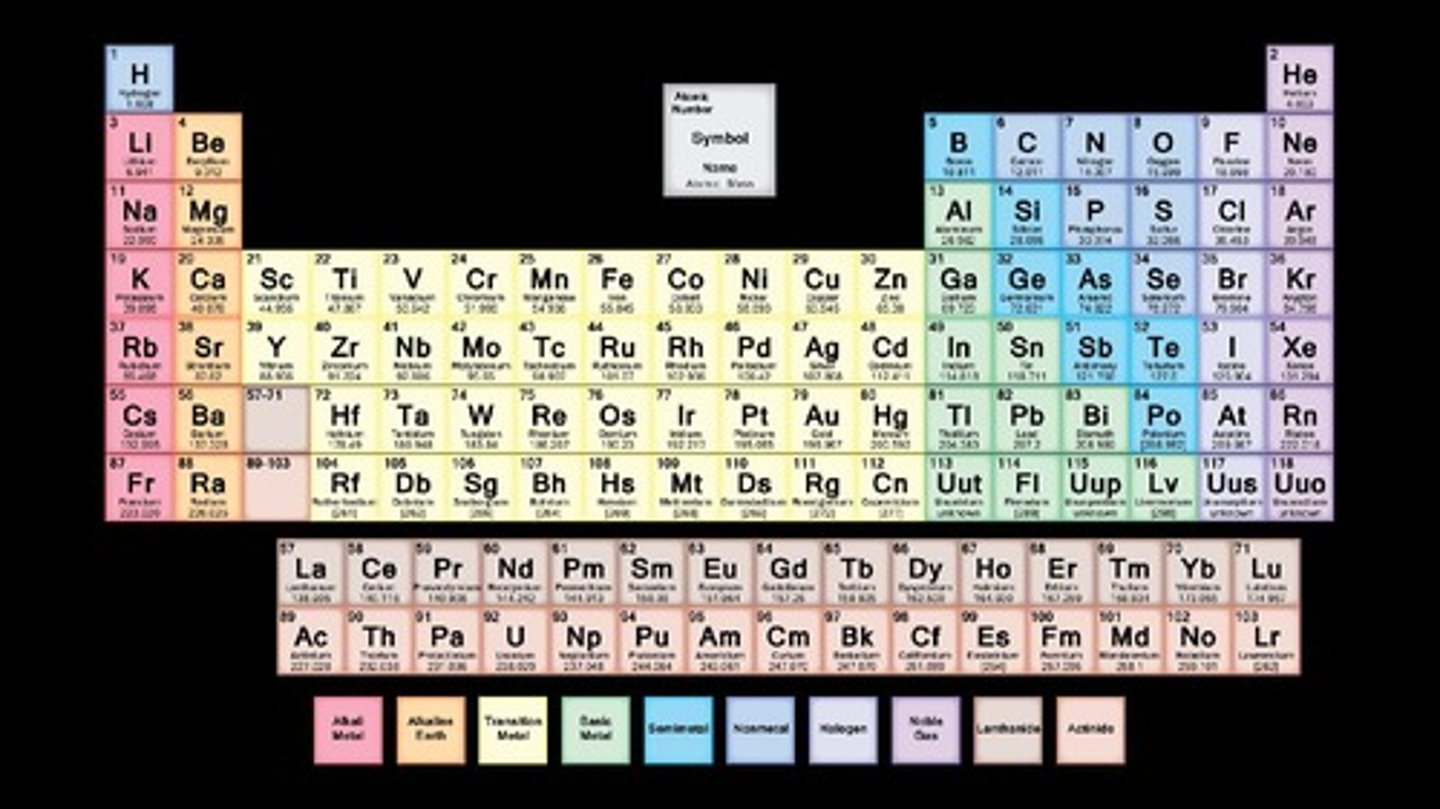
What are valence electrons?
Valence electrons are the electrons in the outermost shell of an atom that are involved in chemical bonding.
What is the visible region of the electromagnetic spectrum?
The visible region of the electromagnetic spectrum ranges from 400 to 700 nm.
 Note
Note  Flashcards (45)