Earth Science Unit 3 Exam - Huff
 Call Kai
 Learn
Learn Practice Test
 Spaced Repetition
 Match
Match Flashcards
 Knowt Play
1/106

There's no tags or description
Looks like no tags are added yet.
Name | Mastery | Learn | Test | Matching | Spaced | Call with Kai |
|---|
No analytics yet
Send a link to your students to track their progress
107 Terms
Compositional layers
Crust (continental and oceanic) mantle, core (inner and outer core)
Functional layers
Lithosphere (crust and upper mantle) and asthenosphere (lower mantle/rest of the mantle)
Lithosphere
Crust and upper mantle
Asthenosphere
Lower mantle/rest of the mantle
Plate tectonics
States that the earth is divided into several geologic plates (pieces of lithosphere) that are moving relative to each other
Geologic plates
Pieces of lithosphere
Active margin
Where plates are actively moving
Passive margin
The areas where no movement or tectonic activity is occurring
Divergent boundary
Plates move away from each other; 1 plate slits apart into 2 plates; new lithosphere is created; can be oceanic or continental
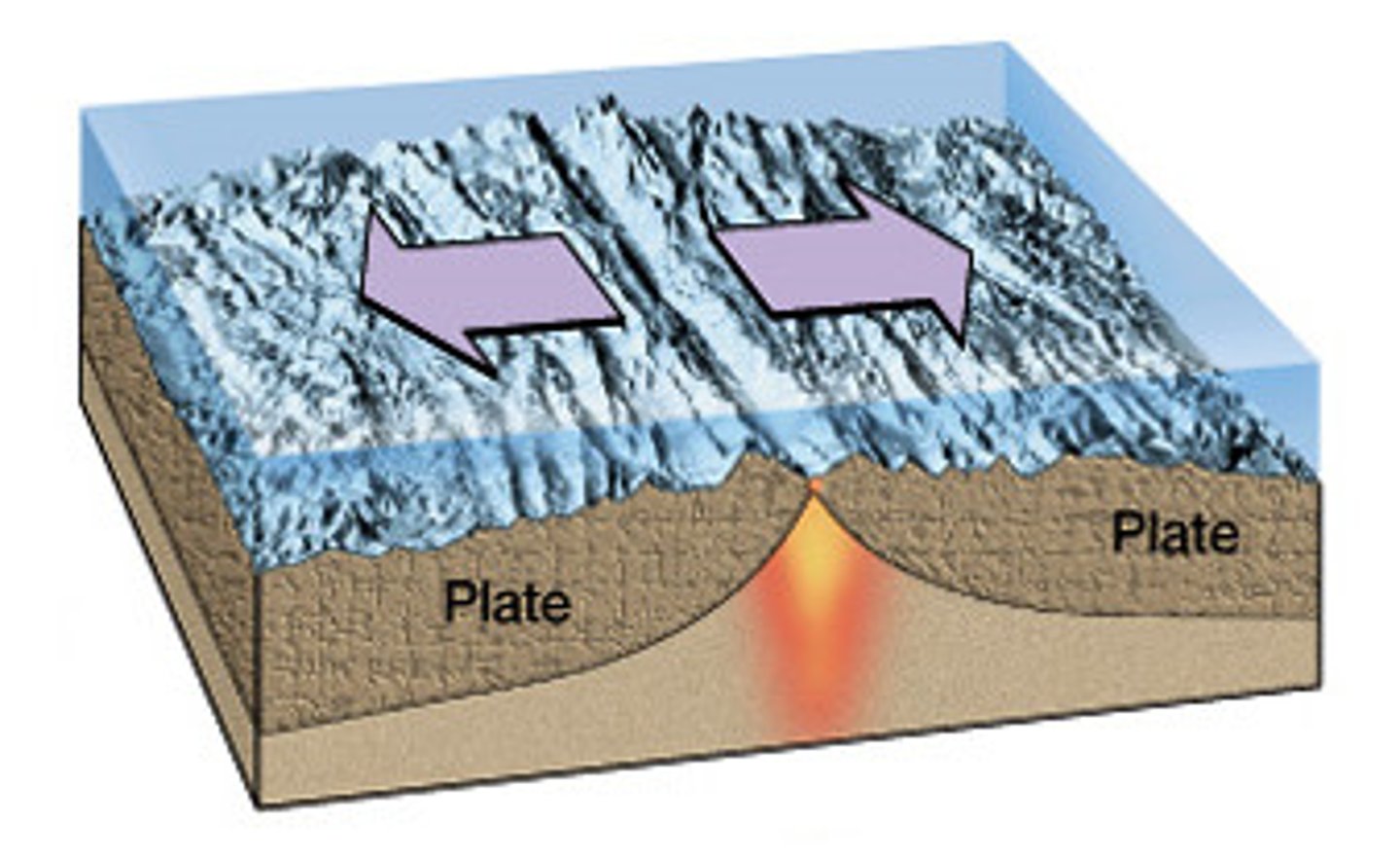
Seafloor spreading
Oceanic divergent boundaries
Continental rift
Continental divergent boundaries
Convergent boundary
2 plates come together and collide with each other
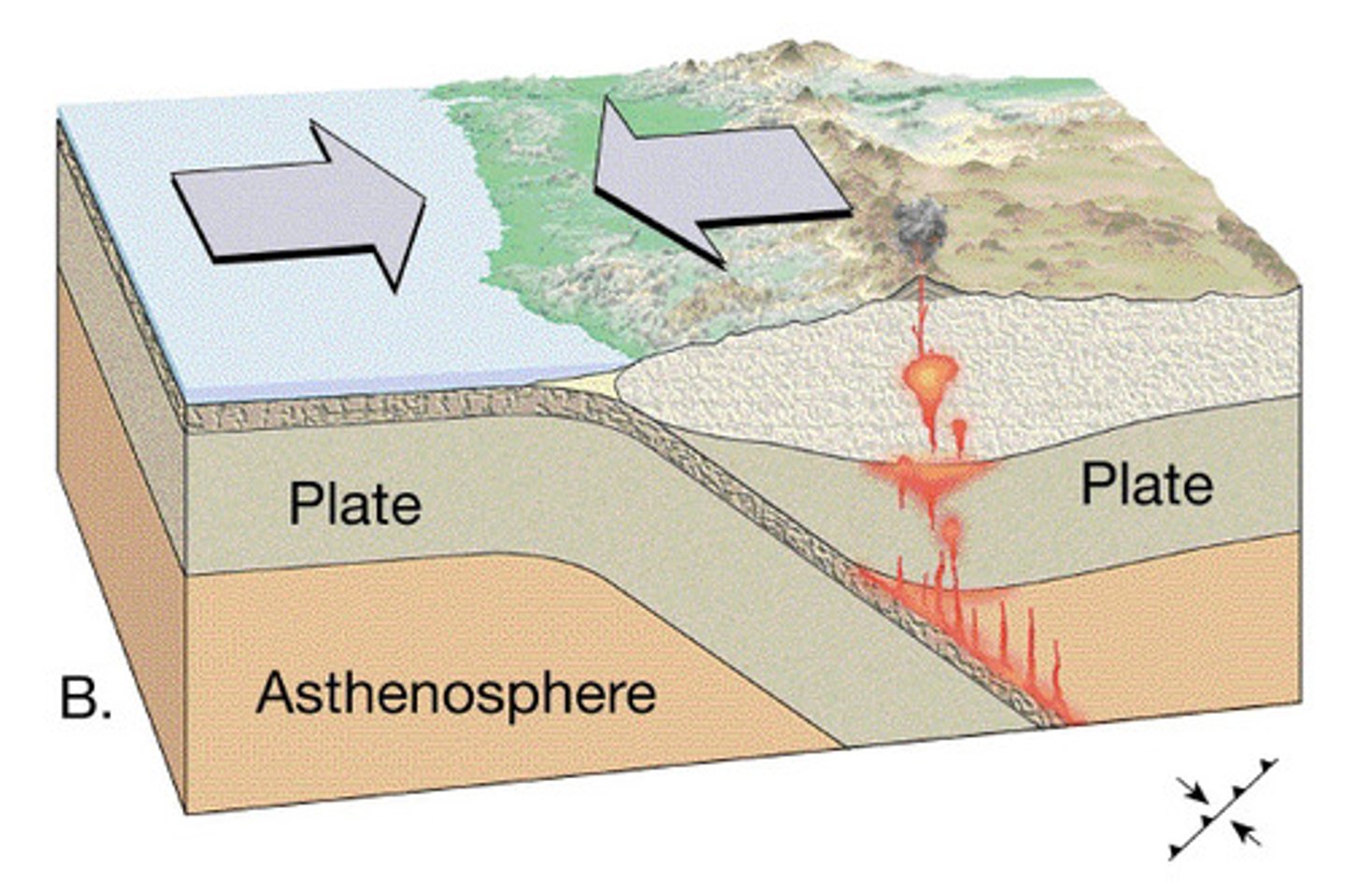
Subduction
Oceanic lithosphere sinks into the asthenosphere (mechanism/cause of oceanic-continent and ocean-ocean plate boundaries
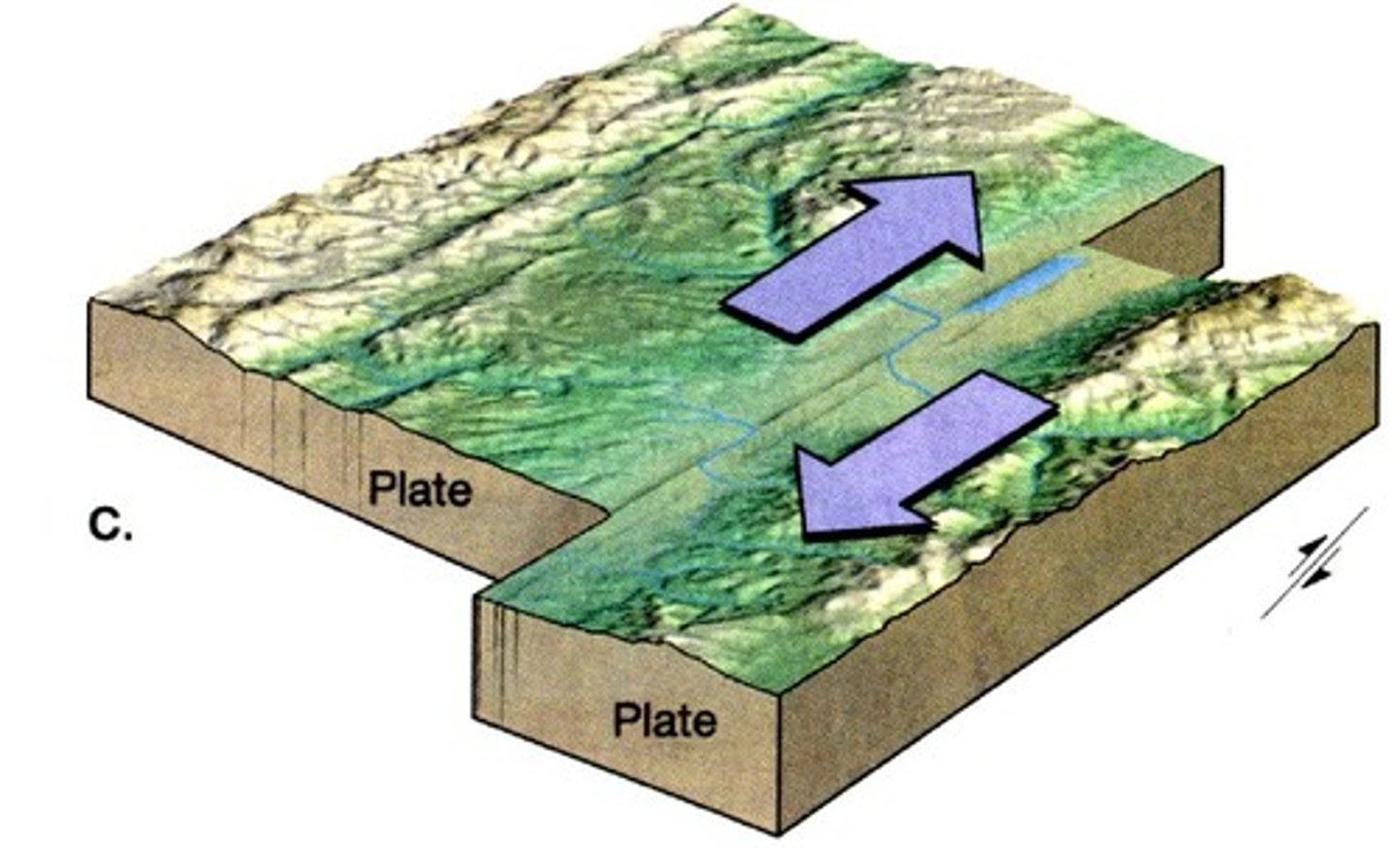
Transform boundary
2 plates slide horizontally passed each other
Hot spot
Oceanic or continental; an area of volcanism created by a mantle plume in the middle of a plate; example: Hawaiian Islands (oceanic) and Yellowstone (continental)
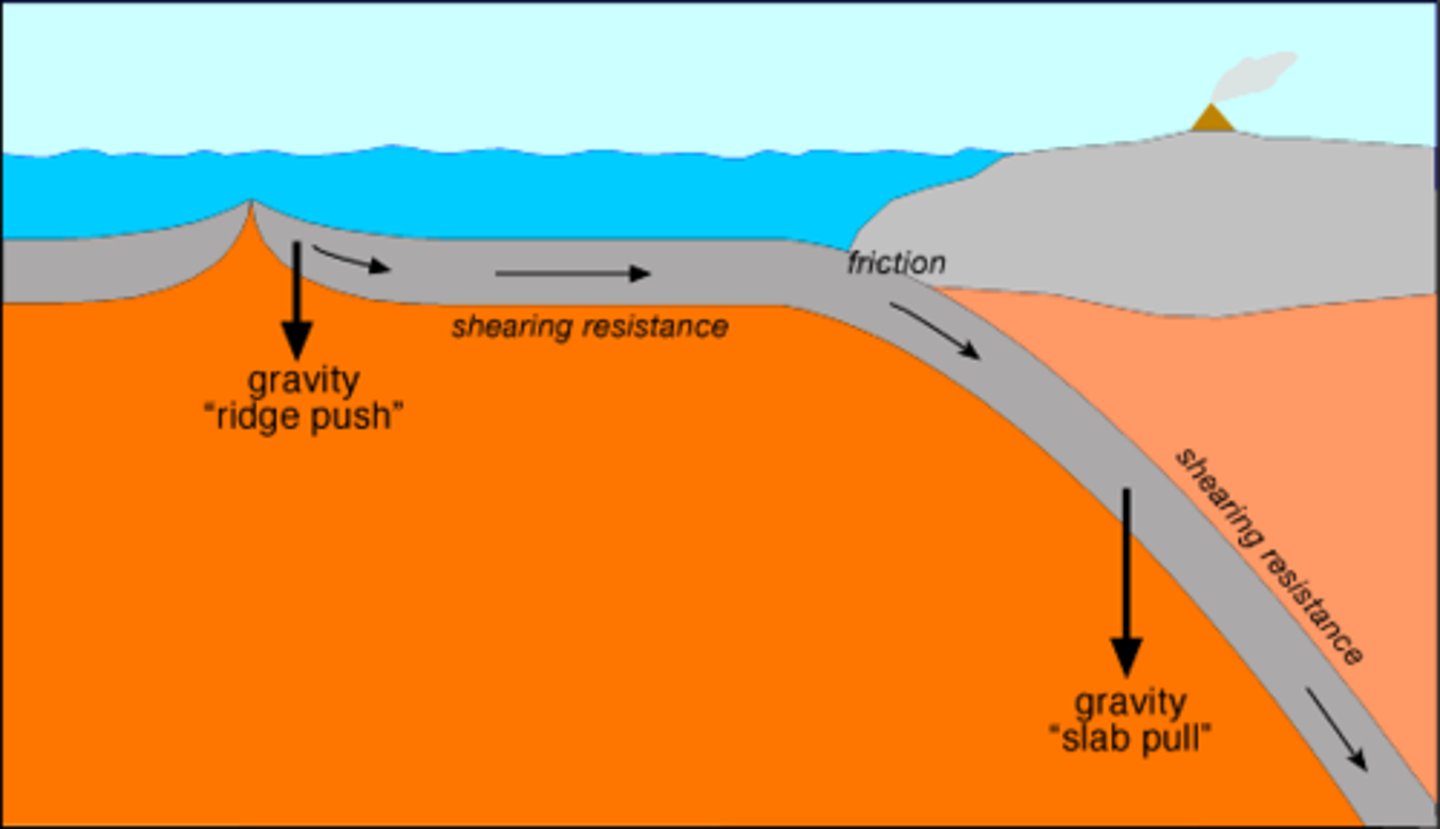
Slab-pull and slab-push model
Descending oceanic crust pulls the plate, elevated ridge system pushes the plate
Plate-mantle convection
Convection is currents generated by density differences, lithosphere moving at the surface is a result of the convection
Explain the continental drift hypothesis. What evidence was there? Why was it abandoned?
Supercontinent called Pangea began breaking apart about 200 mil years ago. Continents "drifted" to present positions. Continents "broke" through the oceanic crust
What are the compositional layers of the earth?
Crust, mantle, core
3 multiple choice options
What are the functional (mechanical) layers of the earth? How are they different from the compositional layers?
Lithosphere, Asthenosphere
2 multiple choice options
What is the difference between active and passive margins? What are some examples of each?
Active-where plates are actively moving
Passive-the areas where no movement or tectonic activity is occurring
2 multiple choice options
Describe the characteristics of Divergent Plate Boundary-Oceanic Divergent
2 plates move apart; seafloor spreading;
3 multiple choice options
Describes the characteristics of Divergent Plate Boundary-Continental Divergent
2 plates move apart; continental rifts
3 multiple choice options
Describes the characteristics of Convergent Plate Boundary-Ocean-Continent Plate
oceanic and continental lithosphere collide
3 multiple choice options
Describe the characteristics of Convergent Plate Boundary-Ocean-Ocean Convergent
oceanic and oceanic lithosphere collide
3 multiple choice options
Describe the characteristics of convergent plate boundary-continent-continent convergent
continental and continental lithosphere collide; no subduction because both components are continental (nothing sinks)
3 multiple choice options
Describe the characteristics of Transform Plate Boundary
2 plates slide horizontally passed each other; no new crust is created or destroyed
3 multiple choice options
Why do mid-ocean ridges form?
Through oceanic divergent boundaries (seafloor spreading)
Why does subduction occur?
Oceanic lithosphere sinks into the asthenosphere
What are the two types of hot spots?
Oceanic or continental
What is the mechanism that causes hot spots? Features and examples?
Magma pushes up through a plate while the plate moves (rising plumes of mantle material in the middle of a plate)
2 multiple choice options
What are the two major features that occur with oceanic hot spots? Example?
Volcanoes and linear island chain; ex. Hawaiian Islands (oceanic) and yellowstone (continental)
What is the major feature that occurs with continental hot spots?
Volcanoes. Yellowstone
What are the two major models for the mechanism of plate tectonics?
Slab-pull and slab-push model, Plate-mantle convection
Slab-pull and slab-push model
descending oceanic crust pulls the plate; elevated ridge system pushes the plate
"The mountains rose; the valleys sank. The water went to the places you made for it."
Chapter 4 Scripture (Psalm 104:8)
Earthquakes
Vibrations of Earth produced by the rapid release of energy
Seismology
Study of earthquakes
Seismograph/seismometer
Earthquake recording instrument
Seismogram
Record by seismograph
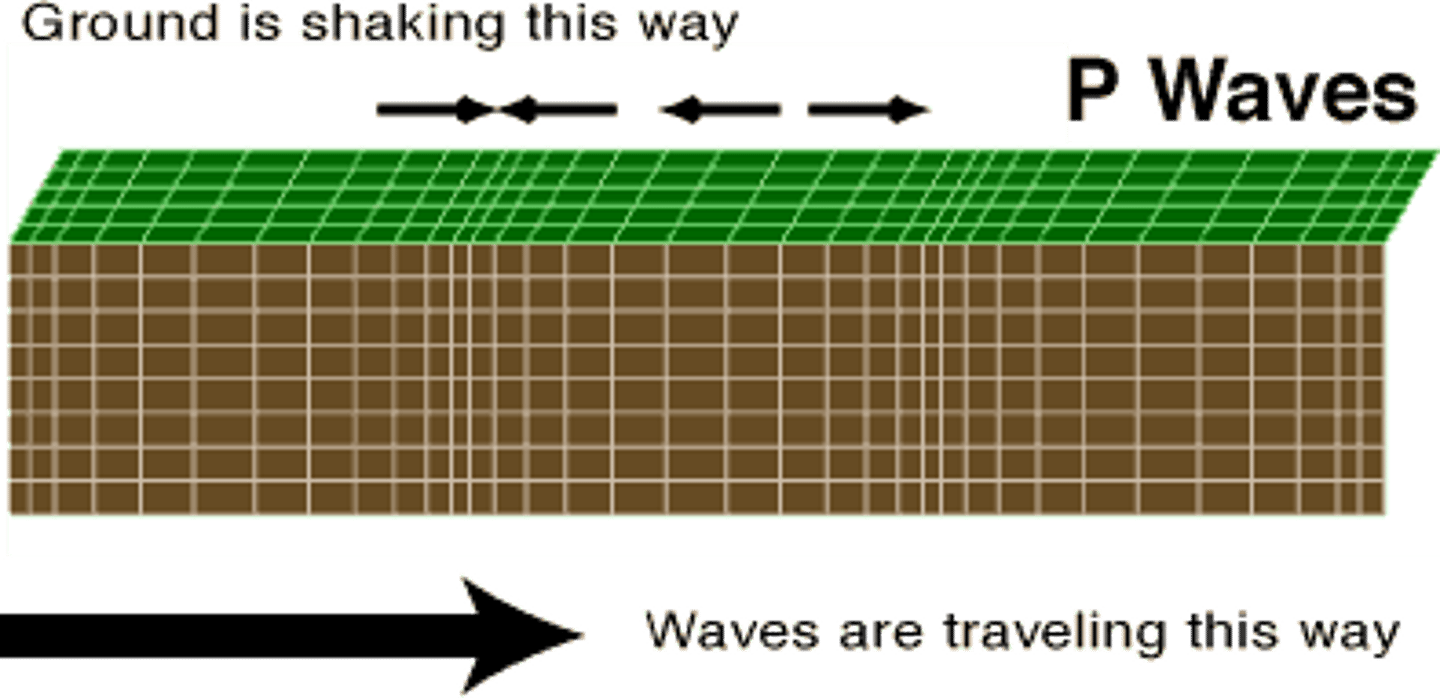
Primary wave
Push-pull waves; (P) waves
2 multiple choice options
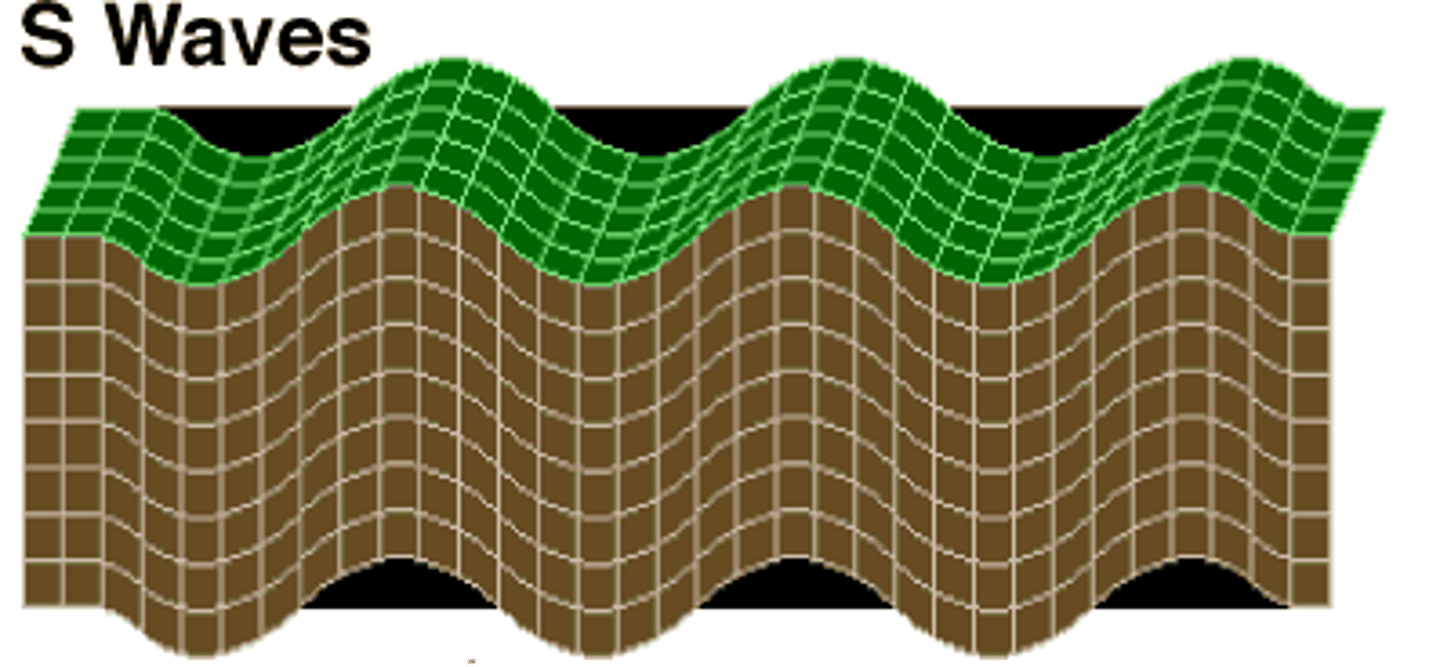
Secondary wave
up and down shaking motion; (S) waves
3 multiple choice options
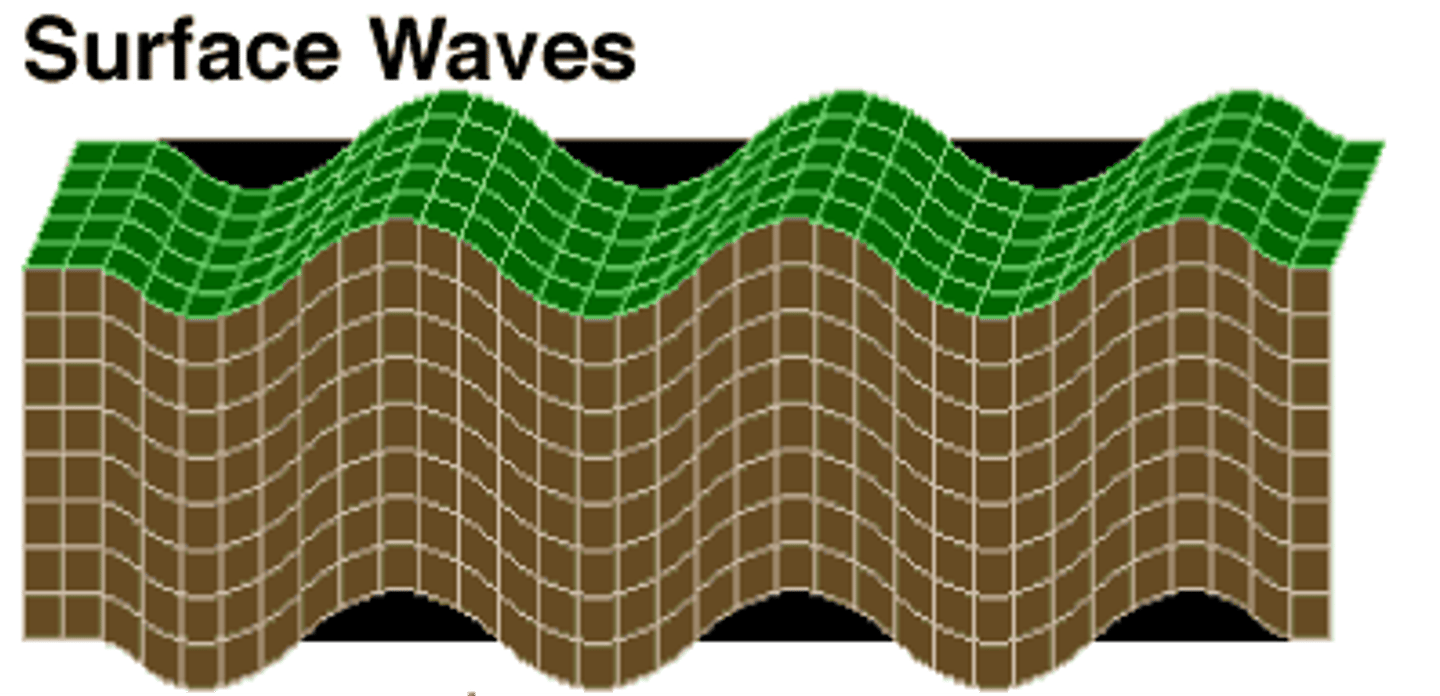
Surface wave
complex motion: side ot side (like a snake) and up and down (like a water wave) simultaneously
3 multiple choice options
Focus
The place within Earth where earthquake waves originate
Epicenter
Point on the surface, directly above the focus
1 multiple choice option
Triangulation
Three station recordings are needed to locate an epicenter
Intensity
A measure to the degree of earthquake shaking at a given locale based on the amount of damage
Modified Mercalli intensity scale
Measures intensity
Magnitude
Often measured using the Richter scale
1 multiple choice option
Richter scale
Measurement of magnitude
Moment magnitude scale
Measures very large earthquakes
1 multiple choice option
Liquefaction
Sediment (like sand) acts as a liquid during the shaking
Tsunami
Seismic sea wave
“He just looks at the earth, and it shakes. He touches the mountains, and they smoke.”
Chapter 6 Scripture (Psalm 104:32)
How are seismic waves measured?
Seismograph/seismometer
What are the different types of waves?
Surface waves, Primary (P) waves, Secondary (S) waves
Primary (P) waves
Push-pull (compressional) motion, travel through, travels through solid, liquids, and gases, but refract (bend) when changing between them, greatest velocity of all earthquake waves, show up first on seismograph
Secondary (S) waves
Up and down shaking motion, travel only through solids, slower velocity than P waves, arrives second on a seismograph
Surface waves
Complex motion: side to side and up and down simultaneously, slowest velocity of all waves, occurs across the surface of the earth, responsible for the majority of the damage to structures
How are earthquakes measured What is the name of the scale used for each?
Intensity and magnitude. Measured by Modified Mercalli Intensity Scale and moment magnitude scale
What are the factors that determine structural damage?
Intensity of the earthquake, duration of the vibrations, nature of the material upon which the structure rests, the design of the structure
What earthquake evidence exists indicating what the center of the earth is like?
From the study of P and S waves
"I looked at the mountains, and they were shaking. All the hills were trembling."
Chapter 5 Scripture (Jeremiah 4:24)
Viscosity
(of magma) Measure of a material's resistance to flow
2 multiple choice options
Magma
Molten rock below the surface
Lava
Molten rock at the surface
Silica
Composition of magma
Pahoehoe lava
Resembles braids in ropes' smooth ropey lava
aa lava
Rough, jagged lava
Pyroclastic materials
"Fire fragments" (associated with volcanic eruptions)
Volcano
Cone-shaped mountain through which an eruption occurs
Volcanic neck
A conduit, or pipe, that carries gas-rich magma to the surface
Vent
The surface opening (connected to the magma chamber via a pipe)
Crater
Steep-walled depression at the summit left behind after the volcano erupts
Caldera
A summit depression greater than 1 km diameter
Shield volcano
broad base, gently sloping and made of layers of lava flows
3 multiple choice options
Cinder cone/scoria cone
Built from ejected lava fragments (recall cinder is a type of pyroclastic material) steep slopes, smaller in size, made of loose material, rather small size making them least dangerous, frequently occur in groups, commonly basaltic lava, ex. sunset crater
3 multiple choice options
Composite volcano/stratovolcano
composed of alternating layers of lava flows and pyroclastic material; steeper slopes and tall
3 multiple choice options
Pyroclastic flow
Hot, fiery, turbulent avalanche moving hundreds of miles per hour
Eruption column
Column of ash and pyroclastic material that travels thousands of feet into the atmosphere
Lahar
Volcanic mudflow produced as heat melts snow cap on mountain
Calderas
Yellowstone, Crate Lake, Mona Kea in Hawaii
1 multiple choice option
Fissure eruptions
Fluid basaltic lava extruded from crustal fractures called fissures
Fissures
Crustral fractures
Flood basalt
Large volume of lava extruded at one time ex. Columbia River Plateau
Geyser
Water heated under pressure with volcanic gases
Hot spring
Heated groundwater rises to surface
Mud volcano
Chemical reactions convert rock to clay
Fumerole
Volcanic gases escape in absence of water
How is viscosity determined? (what are the controls)
Higher-less fluid-more sticky; lower-more fluid-water
How do the composition and silica content effect viscosity?
Composition=silica content is #1 controlHigh silica-high viscosity; low silica-more fluid
How does temperature effect viscosity?
Temperature=hotter magmas are less viscous; colder magmas are more viscous
How does viscosity relate to eruptions?
Escaping volcanic gases drive eruptions, gases are dissolved in magma, pressure on magma decreases as magma rises toward surface, gases are released as pressure decreases
What are pyroclastic materials?
Ash and dust, pumice, lapilli, cinders, blocks, bombs
What impact do dissolved gases have on eruptions?
Provide the force to extrude lava, violence of an eruption is related to how easily gases escape from magma
Describe the characteristics of shield volcanoes
Broad base, gently sloping and made of layers of lava flows; largest of all volcanoes, primarily basaltic compositions, rarely explosive; aa and pahoehoe lava types; typical of oceanic hot spots; ex. Hawaii
Describe the characteristics of Cinder Cones/Scoria Cone volcanoes
Built from ejected lava fragments; steep slopes, smaller in size, made of loose material; rather small size making them least dangerous; commonly basaltic lava; ex. Sunset Crater
Describe the characteristics of Composite/Stratovolcano Volcanoes
Composed of alternating layers of lava flows and pyroclastic material, steeper slopes and tall; most are adjacent to the Pacific Ocean along the Pacific Ring of Fire-occurs with subduction zones); higher viscosity (non-basaltic magma), most violent type of activity; unpredictable
What plate boundary or hot spot is each type of volcano associated with?
Shield volcano=oceanic hot spots
Cinder cone=basaltic lava??
Composite=pyroclastic??
What is significant about the Pacific Ring of Fire?
Occurs with subduction zones

