L.17 –– L.23 Grammar Structures: WITH EXAMPLES
 Studied by 0 people
 Call Kai
 Learn
Learn Practice Test
 Spaced Repetition
 Match
Match Flashcards
 Knowt Play
1/251

There's no tags or description
Looks like no tags are added yet.
Name | Mastery | Learn | Test | Matching | Spaced | Call with Kai |
|---|
No analytics yet
Send a link to your students to track their progress
252 Terms
I was forced to carry a bag by my boss.
私わ部長にかばんをはこばされました。
I was forced to sing a song.
歌を歌わされました。
I am always forced to eat my vegetables.
いつもやさいを食べさせられました。
causative-passive conjugation rules
ru-verbs: drop -ru and add -sase-rare-ru
u-verbs that end w/ す: drop -u and add -ase-rare-ru
all the other u-verbs: drop -u and add -asare-ru
する —> させられる
来る —> 来させられる
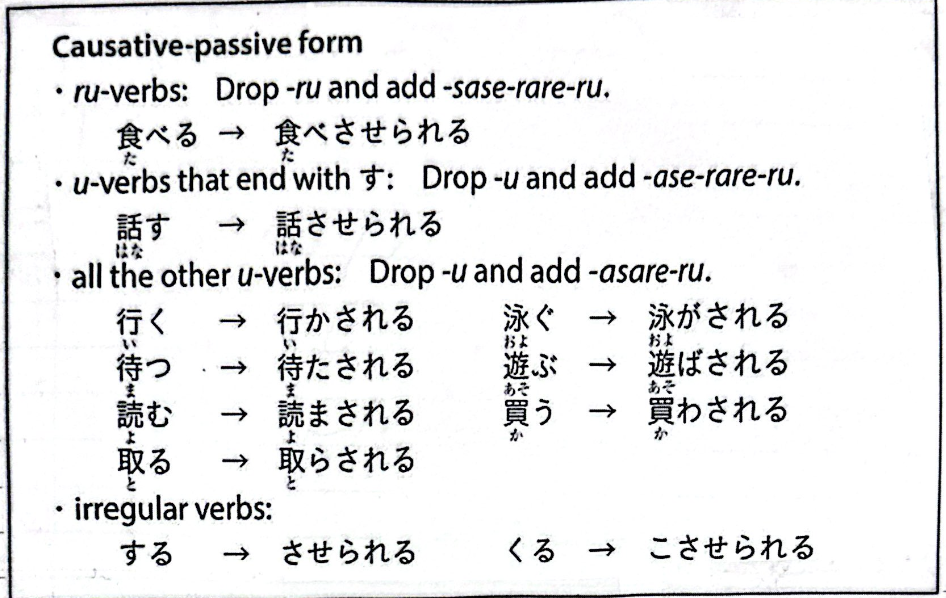
causative-passive form sentence structure
[puppet] は [puppet master] に [action]
(the subject before は here is the same as a regular, noncausative, nonpassive sentence; aka the opposite of a passative or causative sentence).
〜ても sentence structure
[A (te-form)] + も + [B]
We will have a BBQ, even if it rains.
雨がふっても、バーベキューをします。
I will not turn on the A/C, even if it’s hot.
あつくても、アイコンをつけません。
〜ても conjugation structure
verbs: te-form (negative: なくても usually)
な-adj. and nouns: use でも instead of ても (UNLESS negative: じゃなくても usually works… ish)
い-adj.: く trick (adverb form… ex: さむくても) (negative: くなくても usually)
I have decided to buy a new house.
新しい家を買うことにしました。
I won’t complain from now on.
これからもんくを言わないことにします。
I have decided to continue my study of Japanese/Japanese studies.
日本お勉強を続けることにしました。
I have decided to get up early and go jogging.
早く起きして、ジョッギングすることにしました。
I have made it a rule/habit to get up early and go jogging.
早く起きして、ジョッギングすることにしています。
“have decided to do” structure
[V(short form)] + ことにする
〜ことにしました —> “I have decided to do [thing]”
〜ことにしています —> “I make it a habit/rule to do [thing]”
〜ことにします —> “I have just now decided to do [thing]”
〜ことにしよう —> “I have decided to do [thing] [after much discussion]”
[After discussion], we have decided to take a trip abroad this summer.
今年の夏は海外旅行に行くことにしよう。
I have made it a rule/habit not to talk behind someone’s back.
私は悪口を言わないことにしています。
“until X” sentence structure
[V(short form)] + まで
Note: the verb here must always be in positive short form, never negative.
Until it clears up [outside], I will wait in the café.
はれるまで、カフェで待ちます。
I won’t quit baseball until [my team] wins a championship.
ゆうしょうするまで、やきゅうをやめません。
“how to do X” sentence structure
[V(masu stem)] + 方
“how to do X” conjugation rules
if the verb is a する verb、then the を before the verb becomes a の. Additionally, add a の before the する. Then, the します changes to し方. Regular verbs that involve を simply have the one を turned into の.
(ex.: 日本語の勉強のし方 —> how to study Japanese).
how to swim
およぎ方
how to use chopsticks
はしの使い方
“the way people think” or “how to think [about something]”
考え方
how to read kanji
漢字の読み方
how to book a hotel room
ホテルのよやくするのし方。
how to study Japanese
日本語の勉強のし方
There are many ways to eat this vegetable.
このやさいの食べ方はいろいろあります。
Could you please teach me how to write this kanji? [formal]
この漢字の書き方を教えていただきませんか。
How to go to the airport
空港の行き方
The way Tanaka eats ramen is interesting.
田中さんおらめんお食べ方はおもしろいです。
I don’t know how to use this app.
このアプリの使い方がわかりません。
Please explain how to order.
ちゅうもんのし方をせつめしてください。
〜ために sentence structure
[noun] + の + ために + [rest of sentence]
What do you do for your health?
けんこうのために、何をしていますか。
[victim]は[villain]に[evil act]
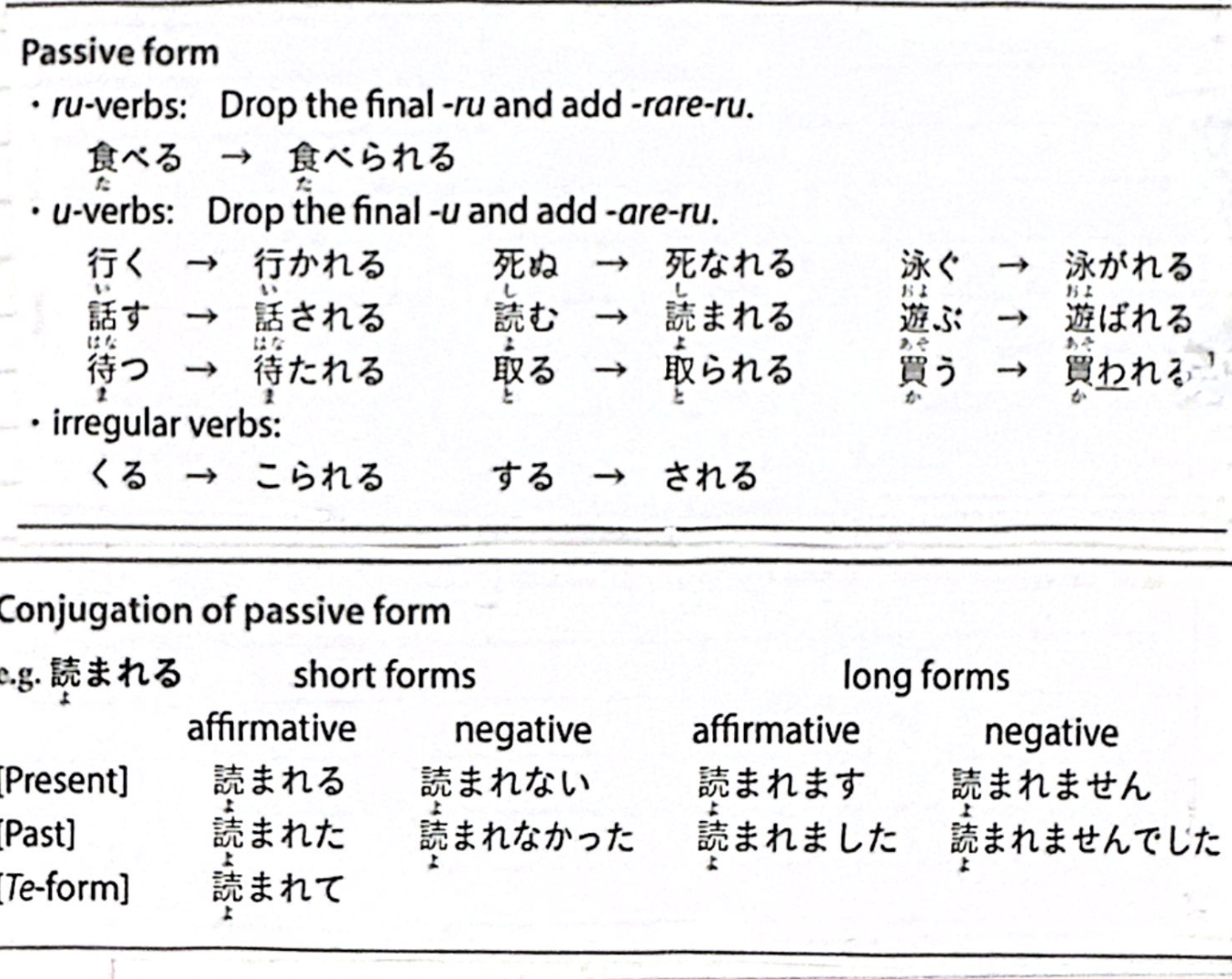
passive sentence structure
passive form conjugation
ru: drop final ru and add rare-ru
u: drop final u and aded are-ru
irregular: 来る—> 来られる and する—>される
I had my wallet stolen.
さいふをぬすまれました。
I had my car used by my friend (and I’m upset about it).
私は友だちに車をつくわれました。
I heard that Professor Yamashita had his password stolen by someone.
山下先生はだれかにパソワードをねすまれたそうです。
something has been done (and kept that way).
〜が + verb + てある
because it is cold, the heater is on [and has been kept that way]
さむいので、ヒーターがつけてあります。
flowers are on the table [and have been kept there]
テーブルの上に花がおいてあります。
bread has been bought [and is still there]
パンが買ってあります。
something happens during another longer event.
[event A] + [ている] + 間に + [event B]
there was a phone call while i was in the bath.
おふろに入っている間に電話がありました。
there was an earthquake while i was asleep last night.
昨日の夜、ねっている間にじしんがありました。
to make something colder
つめたいする
make something better
よくする
make something easier / simpler
かんたんにする
please make the next exam easier.
すぎの試験はやさしくしてください。
let’s all make the world a better place.
みんなで世界をよくしましょう
I want [person] to do….
[私は] [person に ] [V(te-form)] ほしい
I want my sick friend to get well.
私は病気の友だちに元気になってほしいです。
I wanted my roommate to help me w/ my homework.
私はルームメイトに宿題を手伝ってほしかったです。
NEGATIVE form of “i want someone to do something”
〜ほしくないです OR [verb negative]ほしいです。
I don’t want my dad to tell stories about the old days.
私はお父さんに昔の話をして欲しくないです。
I dont want my japanese friend to speak in english.
私は日本人の友だちに英語で話せないでほしいです。
how many times? / many times doing a thing
なんども(何度も)
not even once / i havent done it even once
一も+ negative verb (一度もありません)
“I made someone do something”
[director] は [cast] に [thing]
I made my little brother carry my luggage
私は弟ににもつをはこばせました。
I made my child meet his teacher. (hint: multiple にs rule)
子供を先生に合わせました。
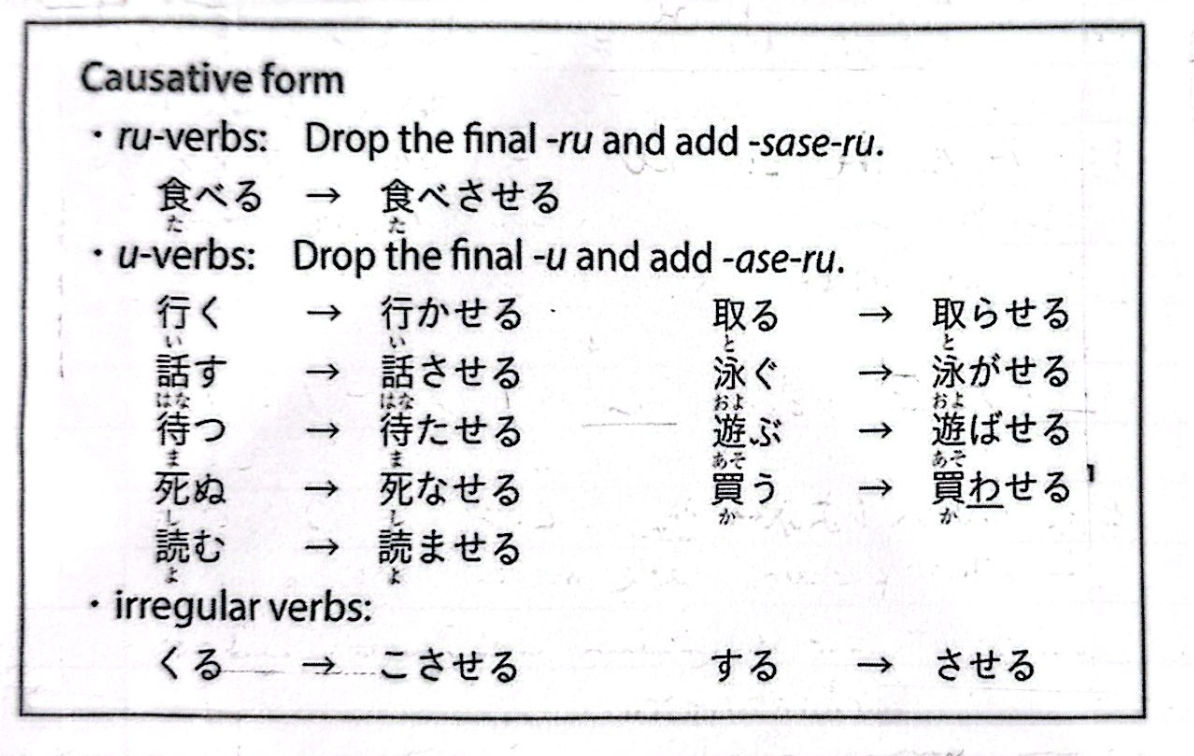
causative form conjugation
ru: drop ru, add sase-ru
u: drop u, add ase-ru
irregular: 来る—>来させる and する—>させる
The professor made me go to the bathroom (hint: multiple にs rule)
先生は私をトイレに行かせました。
“let someone” structure
causative + てあげる / てくれる / てもらう
“please let me do something”
causative + てください
the prof didn’t allow me to speak in english.
先生は私に英語を話させてくれませんでした。
please let me do this job. (hint: やる = “to do / perform” )
私にこの仕事をやらせてください。
firm command form
V(masu stem) + なさい。
The father let his children live alone.
お父さんは子供に一人ぐらしをさせてあげました。
please let me live alone.
一人ぐらしをさせてください。
if i study a lot, I can get a good grade.
たくさん勉強すれば、いいせいせきがとれます。
if ___, then (good result)
[clause A] 〜ば [clause B]
If you memorize the vocab, youll be fine.
たんごを覚えれば、大じょうぶでしょう。
despite A, B is true”
Thing A[short form]* + のに + thing B
*if a noun or na-adj, this means ending in な.
I studied for 8 hours, but i still couldn’t do well on the exam.
八時間も勉強したのに、試験ができなかった。
Even though tanaka is nice, yamada dislikes her.
田中さんはしんせつなのに、山田さんは田中さんがきらいです。
X is like Y (comparison statement)
[thing A] のように [thing B]
X is like Y (example statement)
[thing A] のような [thing B]
Mary is very skilled at swimming, like a fish.
メアリーさんは魚のように上手におよげです。
Antonio is strong like Son Goku.
アントニオさんはそんごくのようにうよいです。
I like towns like Kamakura.
私はかまくらのような町が好きです。
If i run, i will catch the train. (lit. make it in time)
走れば、電車にまにあいます。
where should i go? (lit. where would it be good for me to go?)
どこにいけばいいですか。
despite it being 10:00, i can’t go home.
もう十時なのに、帰れません。
honorific verb for いる
いらっしゃる(いらっしゃいます)
honorific verb for 行く
いらっしゃる(いらっしゃいます)
honorific verb for 来る
いらっしゃる(いらっしゃいます)
honorific verb for 食べる
めしあがる(めしあがります)
honorific verb for 飲む
めしあがる(めしあがります)
honorific verb for くれる
くださる(くださいます)
honorific verb for する
なさる(なさいます)
honorific verb for ねる
お休みになる(お休みになります)
honorific verb for 見る
ごらんになる(ごらんになります)
honorific verb for 言う
おっしゃる(おっしゃいます)
honorific verb for 〜ている
〜ていらっしゃる(〜ていらっしゃいます)
what characters go before honorific forms of する?
ご or お. ご is used w/ most kanji compounds, while お is used w/ japanese origin words and a few common kanji compounds.
Around what time will you be coming to work tomorrow? [literal:
coming to the company”]. [honorific]
明日何時ごろ会社にいらっしゃいますか。
 Note
Note  Flashcards (87)