Industrial Wastewater Management
 Call Kai
 Learn
Learn Practice Test
 Spaced Repetition
 Match
Match Flashcards
 Knowt Play
1/79

There's no tags or description
Looks like no tags are added yet.
Name | Mastery | Learn | Test | Matching | Spaced | Call with Kai |
|---|
No analytics yet
Send a link to your students to track their progress
80 Terms
Domestic wastewater
Process wastewater
Cooling wastewater
Enumerate the three (3) classifications of industrial wastewater.
Cooling wastewater
INDUSTRIAL WASTEWATER CLASSIFICATIONS. Determine what is being asked below.
It is from various cooling processes.
Process wastewater
INDUSTRIAL WASTEWATER CLASSIFICATIONS. Determine what is being asked below.
It is from spills, leaks, product washing, and non-cooling processes.
Domestic wastewater
INDUSTRIAL WASTEWATER CLASSIFICATIONS. Determine what is being asked below.
It is produced by plant workers, shower facilities, and cafeterias.
Once-pass systems
Multiple-recycle cooling systems
INDUSTRIAL WASTEWATER CLASSIFICATIONS. Determine what is being asked below.
Cooling wastewater can be (2):
Once-pass systems
INDUSTRIAL WASTEWATER CLASSIFICATIONS. Determine what is being asked below.
These systems employ large volumes of cooling waters that are used once, then returned to the environment.
Multiple-recycle cooling systems
INDUSTRIAL WASTEWATER CLASSIFICATIONS. Determine what is being asked below.
These systems have various types of cooling towers to return excess heat to the environment.
Multiple-recycle cooling systems
INDUSTRIAL WASTEWATER CLASSIFICATIONS. Determine what is being asked below.
These systems require periodic blowdown to prevent salt build-up.
Process wastewater
INDUSTRIAL WASTEWATER CLASSIFICATIONS. Determine what is being asked below.
It does not normally pose the potential for pathogenic microorganisms but pose potential damage to the environment through either direct or indirect chemical reactions.
Cooling wastewater
INDUSTRIAL WASTEWATER CLASSIFICATIONS. Determine what is being asked below.
It is the least dangerous, but can contain process wastewater as a result of leaks in the cooling systems.
Domestic wastewater
INDUSTRIAL WASTEWATER CLASSIFICATIONS. Determine what is being asked below.
It is generally handled by the normal sanitary-sewerage system to prevent the spread of pathogenic microorganisms.
Recycling cooling systems
INDUSTRIAL WASTEWATER CLASSIFICATIONS. Determine what is being asked below.
These systems tend to concentrate inorganic and organic contaminants to a point at which damage can be created.
READ.
Under harmful effects of process wastewater,
Some process wastes are readily biodegraded and create an immediate oxygen demand.
Other process wastes are toxic and represent a direct health hazard to biological life and the environment.
READ.
Under harmful effects of process wastewater,
Some process wastes are readily biodegraded and create an immediate oxygen demand.
Other process wastes are toxic and represent a direct health hazard to biological life and the environment.
READ.
Under subtle aspects of environmental damage,
Presence of substances in water at concentrations far below those that will produce overt toxicity or excessive reduction of DO levels can have a major impact by altering the predomination of organisms in the aquatic ecosystem
This is beginning to have an effect on water quality standards and, consequently, allowable discharges
Extent of knowledge is not yet sufficient.
READ.
Under subtle aspects of environmental damage,
Presence of substances in water at concentrations far below those that will produce overt toxicity or excessive reduction of DO levels can have a major impact by altering the predomination of organisms in the aquatic ecosystem
This is beginning to have an effect on water quality standards and, consequently, allowable discharges
Extent of knowledge is not yet sufficient.
Priority pollutants
Organics
Dissolved organics (DO)
Inorganics
pH and alkalinity
Temperature
Solids
Nutrients and Eutrophication
Whole effluent toxicity (WET)
Oil and grease
Enumerate the 10 characteristics of industrial wastewater.
Priority pollutant
INDUSTRIAL WASTEWATER CHARACTERISTICS. Determine what is being asked below.
It is treated on an individual-substance basis for regulatory control.
Organics
INDUSTRIAL WASTEWATER CHARACTERISTICS. Determine what is being asked below.
It includes proteins, carbohydrates, fats and oils, petrochemicals, solvents, pharmaceutical, small and large molecules, solids and liquids.
True
INDUSTRIAL WASTEWATER CHARACTERISTICS. Determine what is being asked below.
TRUE OR FALSE. Organic composition of industrial wastes varies widely due to different raw materials used by each specific industry.
True
(ADDITIONAL: It is important to conduct a material balance throughout an entire production facility and analysis of each stream.)
INDUSTRIAL WASTEWATER CHARACTERISTICS. Determine what is being asked below.
TRUE OR FALSE. A typical industry produces many diverse waste streams.
READ.
READ.
READ.
READ.
Biochemical oxygen demand
INDUSTRIAL WASTEWATER CHARACTERISTICS. Determine what is being asked below.
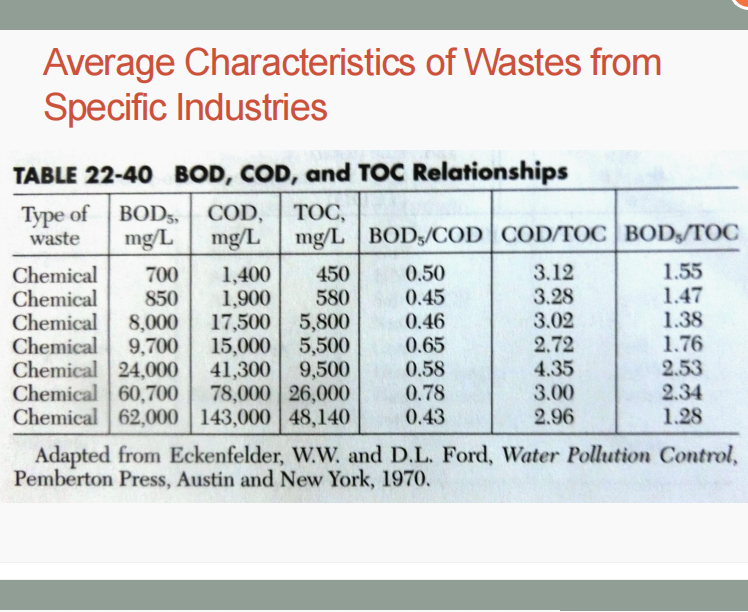
It is a primary parameter in determining the strength and effects of a pollutant.
Biochemical oxygen demand
INDUSTRIAL WASTEWATER CHARACTERISTICS. Determine what is being asked below.
It is an important measure of the waste organic strength.
Biochemical oxygen demand
INDUSTRIAL WASTEWATER CHARACTERISTICS. Determine what is being asked below.
It measures the demand for oxygen in the water environment caused by organics released by industries and municipalities.
BOD5 test
INDUSTRIAL WASTEWATER CHARACTERISTICS. Determine what is being asked below.
It determines the oxygen demand of a waste exposed to biological organisms (controlled seed) for an incubation period of 5 days.
BOD5 test
INDUSTRIAL WASTEWATER CHARACTERISTICS. Determine what is being asked below.
It measures the decrease in DO concentrations in 5 days, which is then related to the sample strength.
Organic waste + O2 (D.O) —→ CO2 + H2O
INDUSTRIAL WASTEWATER CHARACTERISTICS. Determine what is being asked below.
The oxygen demand is caused by degradation of organics according to the equation:
BOD20
INDUSTRIAL WASTEWATER CHARACTERISTICS. Determine what is being asked below.
This is obtained if the test is extended over 20 days.
Ultimate BOD
INDUSTRIAL WASTEWATER CHARACTERISTICS. Determine what is being asked below.
The BOD20 test is also called as ___.
BOD20
INDUSTRIAL WASTEWATER CHARACTERISTICS. Determine what is being asked below.
This test corresponds more closely to the COD test.
Chemical oxygen demand (COD) test
INDUSTRIAL WASTEWATER CHARACTERISTICS. Determine what is being asked below.
It uses strong chemical oxidizing agents with catalysts and heat to oxidize the wastewater and obtain a value that is almost always larger than the 5- and 20-day BOD values.
Pyridene
(ADDITIONAL: Pyridene is a nitrogen-containing ring structure.)
INDUSTRIAL WASTEWATER CHARACTERISTICS. Determine what is being asked below.
It is an example of a chemical compound that resists chemical oxidation, giving a low COD.
Less than 3 hours
INDUSTRIAL WASTEWATER CHARACTERISTICS. Determine what is being asked below.
The completion time of the COD test is ___.
Total organic carbon (TOC)
INDUSTRIAL WASTEWATER CHARACTERISTICS. Determine what is being asked below.
It is a more rapid measure of the organic content of wastes.
Total organic carbon (TOC)
INDUSTRIAL WASTEWATER CHARACTERISTICS. Determine what is being asked below.
Its test takes only a few and may be correlated with BOD and COD for specific wastes.
Continuous respirometry
INDUSTRIAL WASTEWATER CHARACTERISTICS. Determine what is being asked below.
It is another technique for organics measurement, which can also yield information on toxicity, the need to develop an acclimated biomass, and required rates of oxygen supply.
Continuous respirometry
INDUSTRIAL WASTEWATER CHARACTERISTICS. Determine what is being asked below.
In this technique for organics measurement, waste (full-strength rather than diluted) is contacted with biomass in an apparatus that continuously measures the DO consumption.
True
INDUSTRIAL WASTEWATER CHARACTERISTICS. Determine what is being asked below.
TRUE OR FALSE. Low-molecular-weight water-soluble organics are readily biodegraded.
False
(ADDITIONAL: As organic complexity increases, solubility and biodegradability decrease.)
INDUSTRIAL WASTEWATER CHARACTERISTICS. Determine what is being asked below.
TRUE OR FALSE. As organic complexity increases, solubility and biodegradability increase.
True
INDUSTRIAL WASTEWATER CHARACTERISTICS. Determine what is being asked below.
TRUE OR FALSE. Soluble organics are metabolized more easily than insoluble organics.
READ.
Under general information on organics,
Complex carbohydrates, proteins, and fats and oils must be hydrolyzed to simple sugars, aminos, and other organic acids prior to metabolism.
Petrochemicals, pulp and paper, slaughterhouse, brewery, and numerous other industrial wastes containing complex organics have been satisfactorily treated biologically, but proper testing and evaluation is necessary.
READ.
Under general information on organics,
Complex carbohydrates, proteins, and fats and oils must be hydrolyzed to simple sugars, aminos, and other organic acids prior to metabolism.
Petrochemicals, pulp and paper, slaughterhouse, brewery, and numerous other industrial wastes containing complex organics have been satisfactorily treated biologically, but proper testing and evaluation is necessary.
Inorganics
INDUSTRIAL WASTEWATER CHARACTERISTICS. Determine what is being asked below.
It is the direct result of inorganic compounds in the carriage water in industrial wastes.
Soft water sources
INDUSTRIAL WASTEWATER CHARACTERISTICS. Determine what is being asked below.
Which of the following have lower inorganics: soft water sources or hard-water or saltwater?
Sodium
INDUSTRIAL WASTEWATER CHARACTERISTICS. Determine what is being asked below.
Many food processing wastewaters are high in what element?
Domestic wastewaters
INDUSTRIAL WASTEWATER CHARACTERISTICS. Determine what is being asked below.
These wastewaters have a balance in organics and inorganics.
Process wastewaters
INDUSTRIAL WASTEWATER CHARACTERISTICS. Determine what is being asked below.
These wastewaters are deficient in specific inorganic compounds.
Biodegradation of organic compounds
INDUSTRIAL WASTEWATER CHARACTERISTICS. Determine what is being asked below.
It requires adequate N, P, Fe, and trace salts (K, Ca, Mg, Co, Mo, Cl, S).
Ammonium or nitrate salts
INDUSTRIAL WASTEWATER CHARACTERISTICS. Determine what is being asked below.
These provide the N.
Phosphates
INDUSTRIAL WASTEWATER CHARACTERISTICS. Determine what is being asked below.
These supply the P.
Ferrous/ferric salts or normal steel corrosion
INDUSTRIAL WASTEWATER CHARACTERISTICS. Determine what is being asked below.
These supply the Fe.
Carriage water or demineralizer wastewaters or corrosion products
INDUSTRIAL WASTEWATER CHARACTERISTICS. Determine what is being asked below.
These supply the needed trace elements for good metabolism.
6 and 9
INDUSTRIAL WASTEWATER CHARACTERISTICS. Determine what is being asked below.
Wastewaters should have pH values between ___ and ___ for minimum impact on the environment.
pH < 6
INDUSTRIAL WASTEWATER CHARACTERISTICS. Determine what is being asked below.
If pH is ___, WW tend to be corrosive (result of excess H ions).
pH > 9
INDUSTRIAL WASTEWATER CHARACTERISTICS. Determine what is being asked below.
If pH is ___, precipitation of metal ions as carbonates or hydroxides.
Alkalinity
INDUSTRIAL WASTEWATER CHARACTERISTICS. Determine what is being asked below.
It keeps pH values at the right level.
Adequate alkalinity
INDUSTRIAL WASTEWATER CHARACTERISTICS. Determine what is being asked below.
It neutralizes the acid waste components and those formed by partial metabolism of organics.
Neutral organics
INDUSTRIAL WASTEWATER CHARACTERISTICS. Determine what is being asked below.
These are biodegraded through organic acids, which must be neutralized by the available alkalinity.
Bicarbonate alkalinity
INDUSTRIAL WASTEWATER CHARACTERISTICS. Determine what is being asked below.
It is the primary buffer in wastewater.
Sodium carbonate
INDUSTRIAL WASTEWATER CHARACTERISTICS. Determine what is being asked below.
If alkalinity is inadequate, this is better to be added than lime.
Lime
INDUSTRIAL WASTEWATER CHARACTERISTICS. Determine what is being asked below.
It tends to be hard to control accurately, resulting in high pH levels and precipitation of Ca that forms part of the alkalinity.
True
INDUSTRIAL WASTEWATER CHARACTERISTICS. Determine what is being asked below.
TRUE OR FALSE. Most industrial wastes tend to be on the warm side.
False
(EXPLANATION: Temperature is not a critical issue below 37°C.)
INDUSTRIAL WASTEWATER CHARACTERISTICS. Determine what is being asked below.
TRUE OR FALSE. Temperature is a critical issue below 37°C if the wastewater is to receive biological treatment.
65°C
INDUSTRIAL WASTEWATER CHARACTERISTICS. Determine what is being asked below.
Thermophilic biological wastewater treatment systems can be operated up to ___ with acclimated microbes.
Low-temperature operations
INDUSTRIAL WASTEWATER CHARACTERISTICS. Determine what is being asked below.
These result in slow reaction rates for both biological and chemical wastewater treatment systems.
Increased viscosity
INDUSTRIAL WASTEWATER CHARACTERISTICS. Determine what is being asked below.
What makes solid separation more difficult at low temperatures?
10°C and 30°C
INDUSTRIAL WASTEWATER CHARACTERISTICS. Determine what is being asked below.
Operating temperatures are generally kept between ___ and ___.
Oxygen
INDUSTRIAL WASTEWATER CHARACTERISTICS. Determine what is being asked below.
It is considered a critical environmental resource in receiving water streams and lakes.
True
INDUSTRIAL WASTEWATER CHARACTERISTICS. Determine what is being asked below.
TRUE OR FALSE. Aquatic life requires reasonable dissolved oxygen (DO) levels.
Dissolved oxygen (DO)
INDUSTRIAL WASTEWATER CHARACTERISTICS. Determine what is being asked below.
It is a poorly soluble gas in water.
True
INDUSTRIAL WASTEWATER CHARACTERISTICS. Determine what is being asked below.
TRUE OR FALSE. As temperature increases and pressure decreases, solubility of oxygen decreases.
~9.1 mg/L
INDUSTRIAL WASTEWATER CHARACTERISTICS. Determine what is being asked below.
What is the solubility of oxygen at 20°C and 1 atm?

