Factors affecting the accuracy of eyewitness testimony: Anxiety
 Call Kai
 Learn
Learn Practice Test
 Spaced Repetition
 Match
Match Flashcards
 Knowt Play
1/17

There's no tags or description
Looks like no tags are added yet.
Name | Mastery | Learn | Test | Matching | Spaced | Call with Kai |
|---|
No analytics yet
Send a link to your students to track their progress
18 Terms
What is anxiety?
A state of emotional and physical arousal.
The emotions include having worried thoughts or tension.
Physical changes include increased heart rate or sweating.
It can affect EWT in positive and negative ways!
How can anxiety have a negative effect on recall?
Weapon focus
What is weapon focus?
The presence of a weapon leads to anxiety and we focus our attention on the weapon, reducing the witness’s recall for other details of the event
Who studied weapon focus?
Johnson and Scott
What was the procedure of Johnson and Scott’s experiment?
Their participants believed they were taking part in a lab study
They were seated in a waiting room
The experiment used an independent groups design as they took part in 2 conditions:
In the low anxiety ‘no-weapon’ condition - they overheard a casual conversation from the next room and a man left the lab walking past holding a pen, with this hands covered in grease
In the high anxiety ‘weapon’ condition - they overheard a heated exchange and the sound of breaking glass. This was followed by the man running into the reception area, holding a bloodied knife
Both groups were shown 50 photographs and asked to identify the person who left the lab
What were the findings of Johnson and Scott’s experiment?
Those in the no weapon condition, correctly identified the man 49% of the time
Those in the weapon condition, correctly identified the man 33% of the time
What were the conclusions of Johnson and Scott’s experiment?
The tunnel theory argues that people have enhanced memory for central events.
Loftus claimed that those exposed to the knife had higher anxiety are were more likely to focus their attention on the weapon rather than the man’s face (weapon-focus effect)
How can anxiety have a positive effect on recall?
Witnessing a stressful event creates anxiety
This triggers the fight or flight response, increasing alertness
This may improve memory for the event as we become more aware of cues in the situation.
Who studied anxiety’s positive effect on recall?
Yuille and Cutshall
What was the procedure of Yuille and Cutshall’s study?
Investigated the effect of anxiety in a real life shooting in a gun shop in Vancouver, Canada
The shop owner shot a thief dead
There were 21 witnesses, 13 took part in the study (aged 15-32)
They were interviewed 4-5 months after the incident and these interviews were compared with the original police interviews at the time of the shooting
Accuracy was determined by the number of details reported in each account
Witnesses were also asked to rate how stressed they felt at the time of incident (on a 7-point scale) and whether they had any emotional problems since the event
What were the findings of Yuille and Cutshall’s study?
Witnesses were accurate in their EW accounts 5 months later
The PPs who reported the highest level of stress were most accurate (88% compared to 75% in the low stress group)
What were the conclusions of Yuille and Cutshall’s study?
Anxiety does not have a detrimental effect on the accuracy of EW memory in a real-world context and may enhance it!
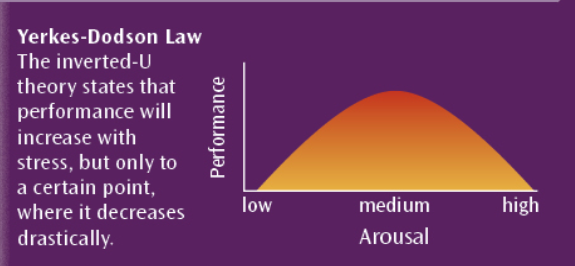
What is Yerkes-Dodson Law?
When we witness a crime, we become emotionally and physiologically aroused
This means we experience anxiety (emotional) and physiological changes in our body (fight or flight response)
Low levels of anxiety produce low recall accuracy, and then memory becomes more accurate as the anxiety increases
However, there is an optimal level of anxiety.
If a person experiences any more anxiety, their recall will drastically decline
What is an image of Yerkes-Dodson Law?
What is a limitation of Johnson and Scott’s study?
It may not have tested anxiety
The reason participant’s focused on the weapon is because they were surprised at what they saw rather than scared.
Pickel conducted an experiment using scissors, a handgun, a wallet or a raw chicken as the hand-held items in a hairdressing salon video (where scissors are high anxiety, low unusualness)
EW accuracy was poorer in the high unusualness conditions (chicken + handgun)
This suggests that weapon focus effect is due to unusualness rather than anxiety
What is a strength of research into anxiety’s effect on EWT?
Evidence supporting anxiety having a negative effect on recall
Valentine and Mesout’s study supports weapon focus effect. The researcher’s used an objective measure (heart rate) to divide participants into high and low anxiety groups.
Anxiety clearly disrupted the PPs ability to recall details about an actor in the London Dungeon’s Labyrinth.
This suggests that high anxiety does have a negative effect on the EW recall of a stressful event
What is another strength of research into anxiety’s effect on EWT?
Evidence supporting anxiety having a positive effect on recall
Christianson and Hubinette interviewed 58 witnesses to actual bank robberies in Sweden.
Some witnesses were directly involved (e.g. bank workers) and some indirectly involved (e.g. bystanders)
The researchers assumed that those directly involved would experience the most anxiety.
They found that recall was 75% accurate across all witnesses.
Direct victims (most anxious) were more accurate.
This suggests that anxiety does not reduce recall accuracy and may even enhance it
COUNTERPOINT
Christianson and Hubinette interviewed their witnesses 7 months after the event!
Thus, they had no control over what happened to their PPs in the intervening time (e.g. post event discussions)
Therefore, a lack of control over confounding variables may be responsible for these findings, invalidating their support
What is a limitation of research into anxiety’s effect on EWT?
It ignores the fact that anxiety has many elements (cognitive, behavioural, emotional and physical)
It only focuses on physical and assumes that this is the only aspect linked to EWT!

