Evolution Exam 3
 Call Kai
 Learn
Learn Practice Test
 Spaced Repetition
 Match
Match Flashcards
 Knowt Play
1/59

There's no tags or description
Looks like no tags are added yet.
Name | Mastery | Learn | Test | Matching | Spaced | Call with Kai |
|---|
No analytics yet
Send a link to your students to track their progress
60 Terms
Analysis of the 1918 and 2009 flu epidemics reveals that the most likely scenario was that ________.
the virus ultimately arose in birds, jumped to pigs, and then was able to switch to humans
Heritability measures ________.
the portion of the total variation in a trait that is due to variation in genes
Evidence for the evolution of antibiotic resistance in bacteria has been evaluated ________.
in studies comparing the fraction of patients with resistant bacteria and society-wide use of antibiotics
in studies comparing newly diagnosed patients v. patients who have relapsed after antibiotic treatment
in populations of bacteria within individual patients
Two evolutionary hypotheses on the function of fever have been suggested: A fever may reflect manipulation of the host by the pathogen, to the pathogen's benefit, or a fever may be an adaptive response by the host to help to control the pathogen itself. Studies on whether the use of fever-reducing drugs were helpful or interfered with the body's ability to fight the pathogen ________.
In experiments by Greene and colleagues (1987) with the tephritid fly Zonosemata vittigera and the jumping spider Phidippus apacheanus, the purpose for gluing housefly wings onto the bodies of the tephritid fly was to ________.
test for the effect of wing surgery in preventing predation
In experiments with Caenorhabditis elegans by Anderson and colleagues (2011), the relationship between physiological performance and temperature was measured. This type of measurement is termed a ________.
thermal performance curve
The total variation in a trait is known as the ________.
phenotypic variation
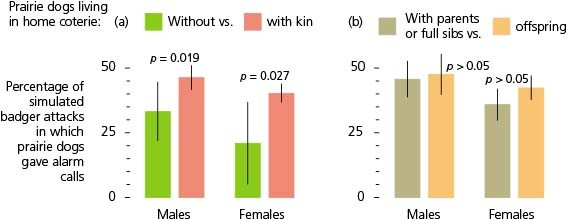
The accompanying figure shows that the rate of alarm calls made by black-tailed prairie dogs is dependent on a perceived threat by a predator. This behavior most closely approximates that predicted by ________.
altruism
The differences between males and females of a species are called ________.
sexual dimorphism
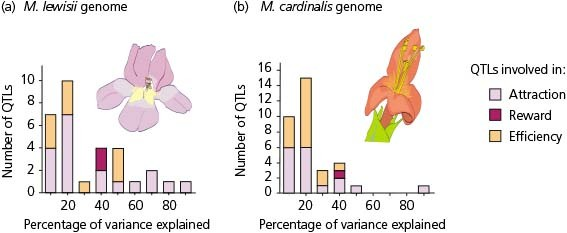
When Bradshaw and colleagues investigated the quantitative trait loci (QTL) of two species of Mimulus (Mimulus cardinalis and Mimulus lewisii), they used marker loci as a way to map the QTLs. Their results are shown in the accompanying figure. According to these results, ________.
some of the QTLs did have pronounced effects on the flowers' phenotypes
at least one QTL explained 90% of the phenotypic variance for each species
the differences in genotype for the majority of these QTLs explained small amounts of the variations in flower phenotypes for both species
Variation among individuals that is due to factors other than genetic factors is called ________.
environmental variation
Selection for the ability to successfully compete with members of their own sex to mate with opposite sex is termed ________.
intrasexual selection
In his study of the Mediterranean fruit flies (Ceratitis capitata), Matthew Gage (1991) found that ________.
males allowed to mate alone produced 2 1/2 times less sperm than those mating in the presence of other males
Adam Jones and colleagues (2000) studied the mating behaviors of broad-nosed pipefish (Syngnathus typhle) in a laboratory situation. For which sex is sexual selection a more potent evolutionary force?
females
As demonstrated by the experiments of Huey and colleagues (1989) on thermoregulation in garter snakes, snakes have a wide range of options for behavioral thermoregulation during the day―so long as they avoid thin rocks or direct sunlight at noon―but during the evening they are most often observed ________.
on or under rocks that are of medium (20-40 cm) or thick (>40 cm) thickness
Traits that are conditioned by one locus are most appropriately termed ________.
qualitative traits
Which of the following are NOT one of Stuart Levy's guidelines for limiting the development of antibiotic resistance?
Consumers should always use antibacterial soaps and cleaners, even when no perceived bacterial threat is present.
John Hoogland (1998) studied Gunnison's prairie dogs (Cynomys gunnisoni) and observed that an increase in litter size was observed when females ________.
mated with more than one male
Experiments by Steve Tanner and colleagues (2000) with gray tree frogs demonstrated that female frogs preferentially mated with male frogs exhibiting ________.
longer calls rather than shorter calls
Darwin called differential reproductive success due to variation among individuals in success at getting mates ________.
sexual selection
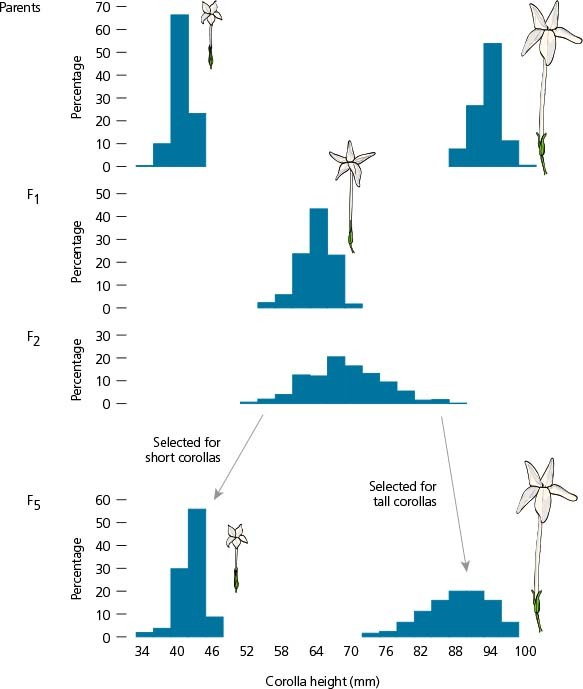
The experimental work of Edward East in 1916, shown in the accompanying figure, confirmed that ________.
quantitative traits are established by the combined influence of Mendelian alleles at multiple loci
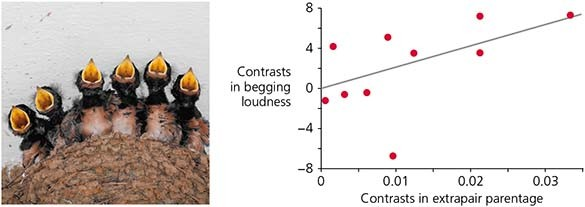
The analysis of parent—offspring conflict in birds has generated some interesting observations. For example, researchers hypothesized that chicks should beg to be fed by their parents more loudly when their nestmates are less closely related. (See Figure A, where Of = optimal parental investment where the lost siblings are full sibs, and Oh for an offspring whose lost siblings are half sibs.) Do the data collected bear this out (Figure B)?
Yes, species that evolve extra-pair parentage also tend to evolve louder begging chicks.
A measure of the reproductive fitness of genetic relatives resulting from the actions of an individual is called ________.
indirect fitness
Pawlowski and colleagues (2000) gathered data from over 3,000 Polish men, and investigated the hypothesis that sexual dimorphism in humans is the result of female choice. They found that there was a slight but significant level of sexual selection on ________.
the height of men in their twenties, thirties, and forties for both marriage and producing offspring
The fraction known as the broad-sense heritability (where VG = genetic variation, VP = phenotypic variation, and VE = environmental variation) is expressed by ________.
Multicellular organisms such as humans could be thought of as populations of cells, where each member of the population is derived from a single ancestor: the zygote. In such populations, we would expect to see that ________.
mutations could occur in any cell, and if so, they may be still be capable of division, leading to cells with heritable genetic variation
mutation events that lead to increased cell survival or more rapid reproduction could, in effect, develop into tissues which evolve by natural selection within the organism
When one animal makes a sacrifice to support or benefit another, we call this ________.
altruism
The statement "Natural selection should favor pathogens that strike an optimal balance between the costs and benefits of harming their hosts" describes ________.
the trade-off hypothesis
Clayton and colleagues (2003) examined the frequency of host shifts observed among both wing feather and body lice that infect doves. They observed that body lice rarely shift host species, whereas wing feather lice often shift from one species to another. The higher frequency of host shifts observed in wing feather lice is due to the observation that ________.
the lice that infect wing feathers often move from host to host on a parasitic fly
In general, when sexual selection is strong for one sex and weak for the other, we can predict that members of the sex subject to strong sexual selection will be ________, and members of the sex subject to weak sexual selection will be ________.
competitive; choosy
Traits that are conditioned by multiple loci and form continuously variable phenotypes that are conditioned by both the genotypes and environmental influences are most appropriately termed ________.
quantitative traits
The form of natural selection that leads to an increase in the frequency of alleles which promote the fitness of genetic relatives is called ________.
kin selection
Maureen Stanton and colleagues (1986), experimenting with wild radishes (Raphanus raphanistrum), demonstrated that sexual selection on male flowers has led to ________.
showy flowers that attract male pollinators
Determining the effects of natural selection on human behavior is much more robust if ________.
data is collected cross-culturally to eliminate the effects of culture on behavior
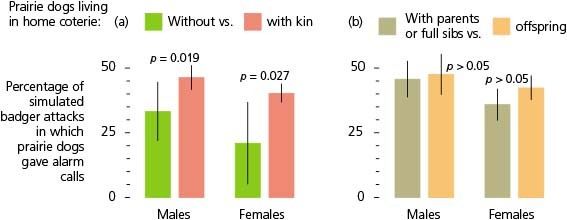
The accompanying figure shows that the rate of alarm calls made by black-tailed prairie dogs is dependent on a perceived threat by a predator. This behavior affects ________.
both the direct and indirect fitness of the caller
Initial studies of the influenza A virus by Walter Fitch and colleagues showed that ________.
selection by the immune system drives change in hemagglutinin's antigenic sites
Social interaction between animals where one individual imposes a penalty on another, and in so doing suffers a loss, is termed ________.
spite
The data of Huey and colleagues (1989) on thermoregulation in garter snakes is an example of the ________ method evolutionary biologists use to test hypotheses about adaptations.
observational
One of the keys to understanding altruistic behavior is that ________.
other members of the population will share alleles with the "actor"
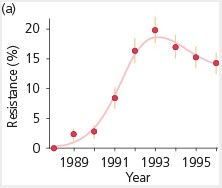
In the late 1980s and early 1990s, the percentage of Icelandic children whose bacterial infections were caused by bacteria resistant to penicillin rose at an alarming rate. After public health officials initiated a campaign to reduce the use of penicillin, resistance dropped off. (See the accompanying figure.)
This observation is consistent with the hypothesis that ________.
bacterial populations evolve in response to the selection pressure imposed by antibiotics
The statement "The virulence of many pathogens in humans may not be a target of selection itself, but rather an accidental by-product of selection on other traits" describes ________.
the coincidental evolution hypothesis
Social interaction between animals that benefits both the actor and the recipient is known as ________.
mutual benefit
Which hypothesis has been proposed to explain the evolution of eusociality?
the ecology/life history hypothesis
the Monogamy hypothesis
the haplodiploidy hypothesis
Given that humans shifted from hunter-gathers to an agriculturally based society within the last 10,000 years does NOT mean that ________.
humans are unique in that we have the capacity evolve by natural selection much more rapidly in response to changes in our environment than other organisms do
Goriely and colleagues (2003) studied a genetic disease caused by a mutation in the gene coding for fibroblast growth factor receptor 2 (FGFR2). This disease, known as ________ syndrome, is a dominant mutation that causes premature fission of the joints in the skull, facial malformations, and fusion of the fingers and toes.
Apert
One would expect that conflicts between parents and offspring over parental investment would be the most pronounced in ________.
birds
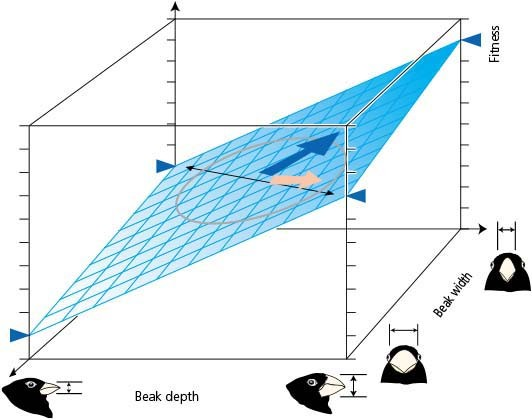
Multiple trait analysis (beak width and beak depth) on the medium ground finch, in response to the drought of 1976-77, has generated the three-dimensional graph, shown in the accompanying figure. If the blue triangles represent fitness levels for the quantified parameters, then the birds showing the greatest fitness should have ________.
A measure of the reproductive fitness of an individual without the help of others is known as ________.
direct fitness
Which of the following has NOT been observed as a trait of sperm competition?
the production of large ejaculates containing many sperm
applying pheromones that reduce the female's attractiveness
depositing a copulatory plug
prolonged copulation during mating
To demonstrate the response of several Daphnia genotypes across a wide range of environments, Luc De Meester (1996) measured the change in phototactic behavior of Daphnia sampled from lakes that contained different numbers of predatory fish. Some genotypes altered their behavior in the presence versus absence of fish. The variation in response is termed ________.
genotype-by-environment interaction
Futuyma and colleagues (1995) used the herbivorous leaf beetles of the genus Ophraella to study constraints in genetic diversity. Ophraella beetles feed and lay eggs on only certain members of the sunflower family because the beetles are unable to ________.
detect and detoxify chemical defenses produced by nonhost plants
In cases where selection consistently favors a higher (or lower) value of a trait or phenotype, the result over time is a change in the average value of a trait in the population. This mode of selection is known as ________.
directional selection
A mating system in which at least some females mate with more than one male is termed ________.
polyandry
Conventional wisdom holds that oxpeckers remove ticks from the backs of cattle on which they feed in a mutualistic relationship, and the cattle tolerate the oxpecker's presence because the birds help remove parasites. Weeks (2000) performed observational experiments in Zimbabwe and demonstrated that the relationship between oxpeckers and cattle was not the removal of parasites but that the oxpeckers are ________.
in fact parasitic, and create and feed on wounds they make, and also feed on earwax in the cattle
Social behavior between animals where the actor benefits at the expense of the recipient is called ________.
selfishness
Variation among individuals that is due to variation in factors other than environmental influences is called ________.
genetic variation
In the Kotukutuku plant, fuchsia excortiata, pollinated flowers turn colors from ________ to ________ in order to signal pollinators that nectar is no longer being produced.
green; red
Small, nonterritorial male marine iguanas typically have their mating interrupted by larger males prior to ejaculation. What alternative mating strategy have these small males developed to compensate for this?
Small males induce ejaculation prior to copulation, and store the ejaculate in their cloacal pouches.
Determining the slope of the best-fit line for a data set of midparent versus midoffspring values by utilizing least-squares linear regression generates an estimate of heritability known as the ________.
narrow-sense heritability
To learn the location of and determine the role that QTLs have on phenotypes, researchers look for associations between a marker locus genotype and phenotype. Examples of research focusing on such methods have been conducted on ________.
human diseases such as Crohn's disease
the speed of thoroughbred race horses
human personality traits

