Linear Algebra - Chapter 6
 Studied by 0 people
 Call Kai
 Learn
Learn Practice Test
 Spaced Repetition
 Match
Match Flashcards
 Knowt Play
1/32

There's no tags or description
Looks like no tags are added yet.
Name | Mastery | Learn | Test | Matching | Spaced |
|---|
No study sessions yet.
33 Terms
What is an inner product in ℝⁿ?
The inner product of vectors u and v is u·v = u₁v₁ + u₂v₂ + … + uₙvₙ.
What does it mean for two vectors to be orthogonal?
They are orthogonal if their dot product is zero: u·v = 0.
What is the norm / length of a vector v?
‖v‖ = sqrt(v·v) = sqrt(v₁² + v₂² + … + vₙ²).
What is the distance between vectors u and v?
distance(u, v) = ‖u − v‖ = sqrt((u₁ − v₁)² + (u₂ − v₂)² + … + (uₙ − vₙ)²).
What is an orthogonal set?
A set {v₁, …, vₖ} where vᵢ·vⱼ = 0 for all i ≠ j.
What is an orthonormal set?
A set of vectors that are orthogonal and each has norm 1.
What is an orthonormal basis?
A basis whose vectors are orthonormal.
What is the projection of v onto a non-unit vector u?
projᵤ(v) = [(v·u) / (u·u)]u.
How do you compute proj_W(v) when W has an orthonormal basis {u₁, …, uₖ}?
Sum the projections of V onto each basis vector.
What is the orthogonal decomposition theorem?
A vector y can be written in the form y = y-hat + (y - y-hat), where y-hat is the projection into a subspace.
What is the best approximation of the vector y?
y-hat
W^{COMPLIMENT}
All vectors orthogonal to every vector in W.
What is a least-squares solution to Ax = b?
A vector x̂ that minimizes ‖Ax − b‖.
What is the geometric meaning of Ax̂ in least squares?
Ax̂ is the projection of b onto Col(A).
What is an orthogonal matrix?
A matrix whose columns form an orthonormal set: QᵀQ = I.
What property do orthogonal matrices preserve?
Lengths and angles: ‖Qv‖ = ‖v‖.
What is the error vector in least squares?
e = b − Ax̂, and e is orthogonal to Col(A).
What are the normal equations?
AᵀA x = Aᵀb.
What are the steps for solving using normal equation?
Calculate A^{Transpose}A and a^{Transpose}b seperately
Plug answers in and solve for x-hat
Solve for b-hat with the equation b-hat = A dot x-hat
Calculate the error: b-b^{hat}
What is a unit vector?
A unit vector is a vector whose length is 1.
What is an orthogonal compliment?
The orthogonal complement of a subspace W (within a larger subspace V) is the set of all vectors in V that is orthogonal to every vector in W.
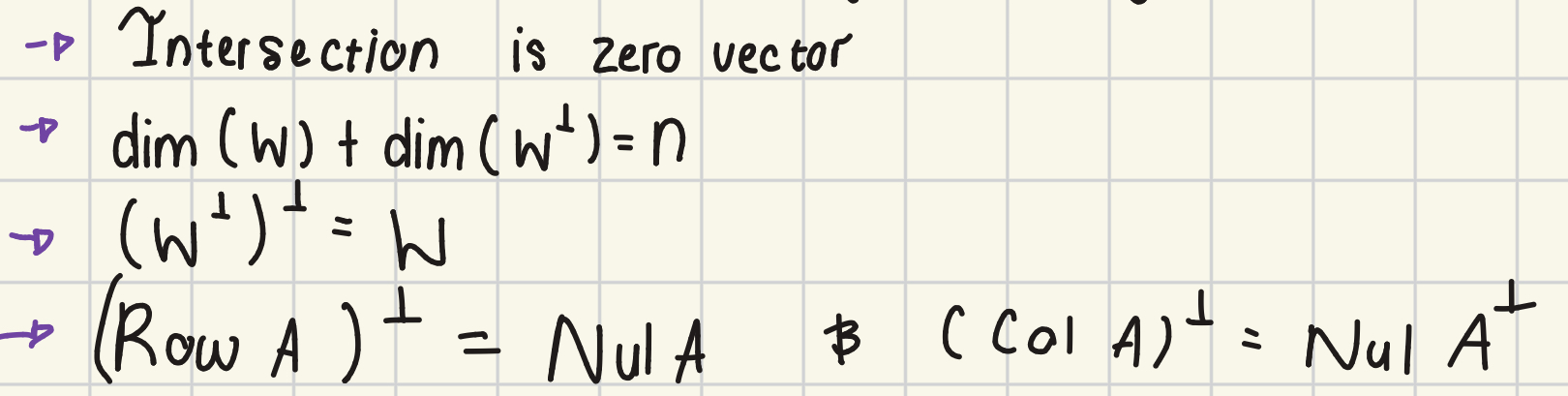
What are the properties of an orthogonal complement?
What is the formula needed to normalise a vector?
\frac{1}{\left\Vert u\right\Vert}u
Provide the pythagorean theorem for orthogonal vectors?
Two vectors u and v are orthogonal if and only if \left\Vert u+v\right\Vert^2=\left\Vert u\right\Vert^2+\left\Vert v\right\Vert^2
Provide the orthogonal complement properties?
(Row A)orthogonal complement = Nul A and (Col A) orthogonal complement = Nul A orthogonal complement
Why is the application of the Gram-schmidt process?
To take a set of linearly independent vectors and transform it into an orthogonal set that spans the same space
What are the steps of the Gram-schmidt process?
Set a vector equal to the first basis vector; Calculate preceding vectors by subtracting the vector you’re projecting from the projection of that vector onto each of the basis vectors. Finally normalise the vector
What does X, Beta and y represent in the equation X Beta = y?
X is the design matrix, Beta is the vector contiang Beta-nought and Beta-one (in least square line) and y is the observed vector.
How do you construct the design matrix X?
Set the first column to 1’s, set the following columns to the x-cordinates of a given data set.
Provide the equation for the residual vector e?
e = y - Xbeta
What does the residual vector represent?
The residual vector is the distance between y (original vector) and the projection of y into the design matrix
What is the linear model equation?
y = X Beta + e
What is the linear model normal equation?
XTranposeX Beta = X transpose y
 Note
Note  Flashcards (46)