ECON 333 Exam 2
 Call Kai
 Learn
Learn Practice Test
 Spaced Repetition
 Match
Match Flashcards
 Knowt Play
1/83

There's no tags or description
Looks like no tags are added yet.
Name | Mastery | Learn | Test | Matching | Spaced | Call with Kai |
|---|
No analytics yet
Send a link to your students to track their progress
84 Terms
_________ savings refer to savings that are hoarded. The money you stow under your mattress or in your piggy bank rather than deposit in your bank where it can be (hopefully productively) lent out would be an example of this.
Idle savings
_________ savings refer to savings that are invested. The money you deposit at the bank that is then lent out into (hopefully productive) investment projects would be an example of this.
Genuine savings
Which three major factors determine the supply of savings? Check all three that apply
Time preference (patience and impatience)
Consumption smoothing
Interest rates
Which three major factors determine the demand to borrow and invest? Check all three that apply.
Consumption smoothing
Interest rates
The need to finance large-scale investment projects
Economists use the word "investment" a bit different than people in other disciplines. By "investment," economists are specifically referring to:
The purchase of new physical capital (most often done by businesses)
Definition of consumption smoothing.
borrowing in periods of low income and savings in periods of high income to make consumption less variable than income
Identify three examples of consumption smoothing.
taking student loans
depositing a portion of one's salary into a retirement account
acquiring a mortgage to purchase a house
Time preference is:
the desire to have goods and services sooner rather than later (all other things being equal).
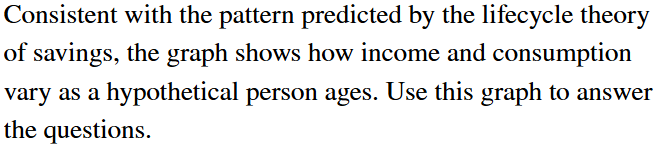
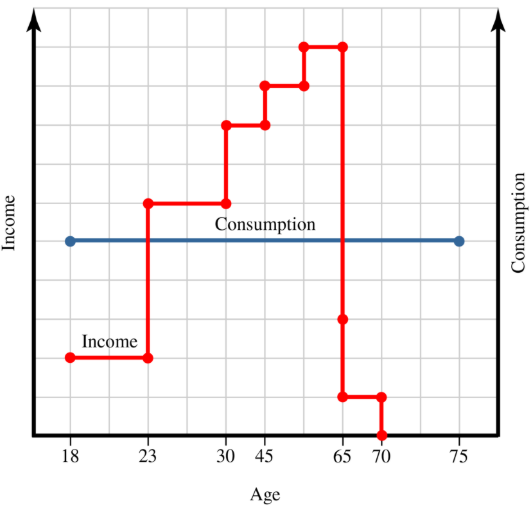
At which age listed on the graph does this person begin saving?
Age 23
At which age listed on the graph does this person retire completely?
Age 70
At age 70, this person is:
dissaving
According to the graph, which is most likely to have occurred at age 45?
A pay raise
The source of the ______ for loanable funds is saving.
supply
The source of the ________ for loanable funds is investment.
demand
The ___________ represents the price of a loan.
interest rate
What effect will an increase in interest rates have on the quantity of loanable funds supplied?
Quantity supplied will increase
As interest rate decreases, what happens to the quantity of loanable funds demanded?
Quantity demanded will increase
Which of the following terms denotes the "price" in the middle for loanable funds?
interest rate
If the projected rate of return for a project is less than the interest rate required to obtain a loan for a project, how will the business proceed in considering the project?
The business will not take out the loan
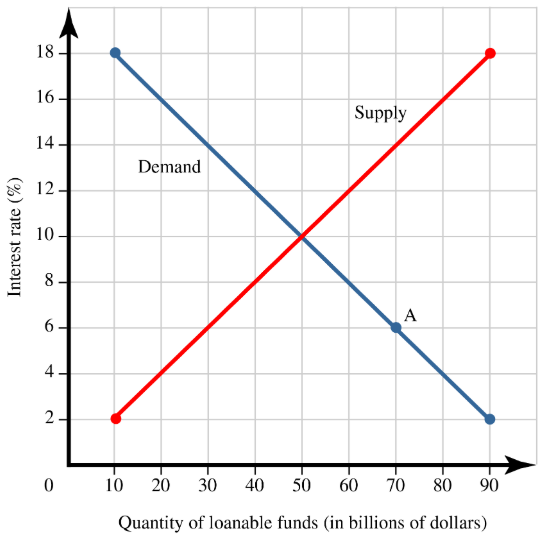
Given the market conditions, what will be the prevailing equilibrium interest rate?
10%
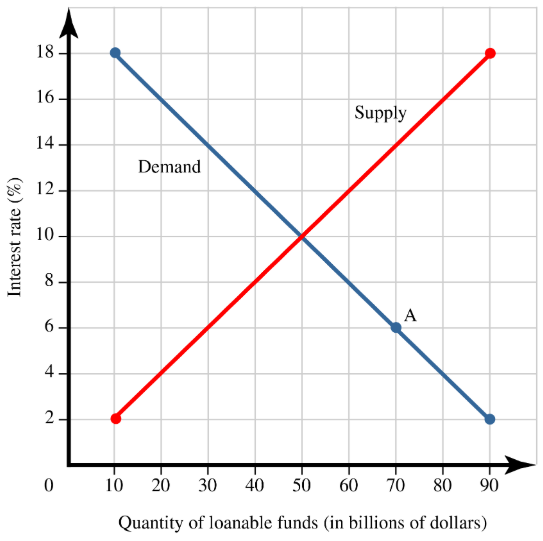
Given the market conditions, how much will be available in loanable funds in equilibrium?
$50 billion
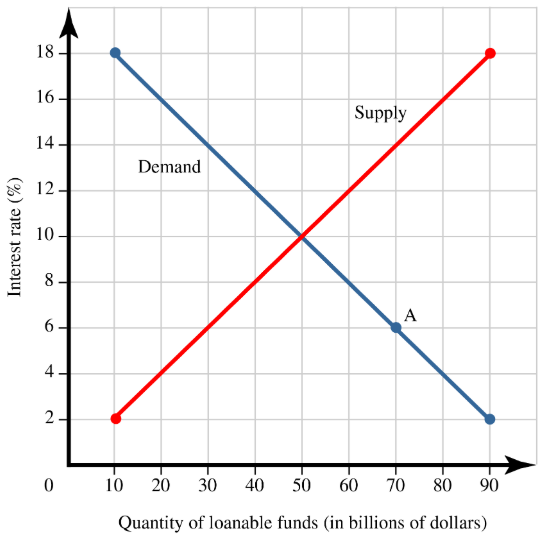
Which statement best describes a situation in effect at point A?
Wayne projects that if takes out a loan to open another gym franchise, he will earn a lower return than the interest rate he would have to pay, so he decides against it.
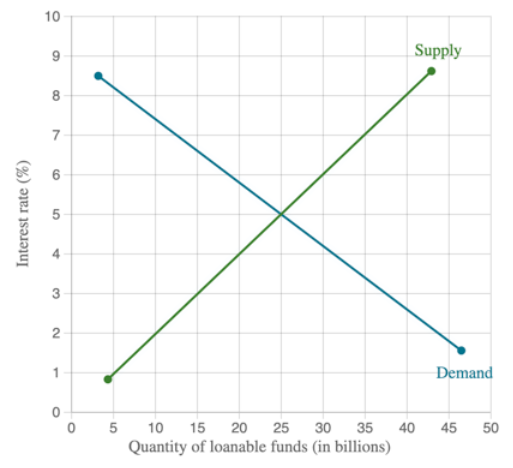
In the market for loanable funds (LF), the supply for loanable funds curve represents the supply of __________ and the demand for loanable funds curve represents the ___________ at various interest rates.
savings; investment and borrowing
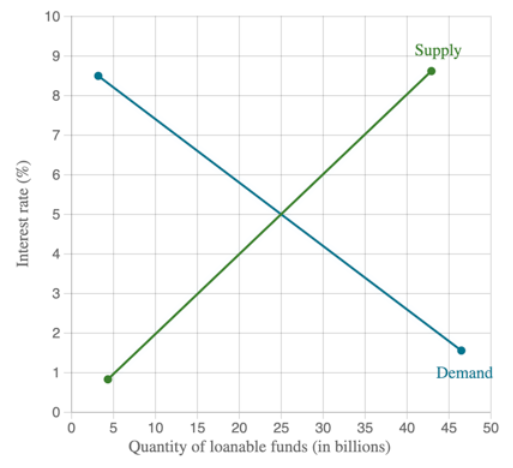
The equilibrium interest rate in this market is __________ ; the equilibrium quantity of LFs is __________ billion
5% ; $25 billion
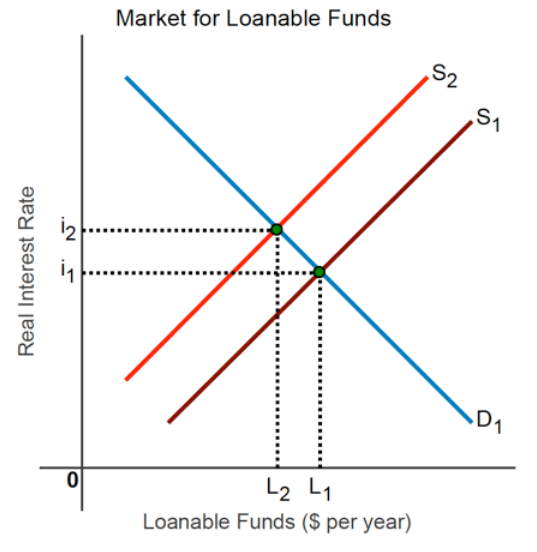
The shift from S1 to S2 represents a(n) _________ in the supply of loanable funds. With this shift in supply, the equilibrium interest rate in the market for loanable funds _________. With this shift in supply, the equilibrium quantity of loanable funds _________.
decrease ; increase ; decreases.
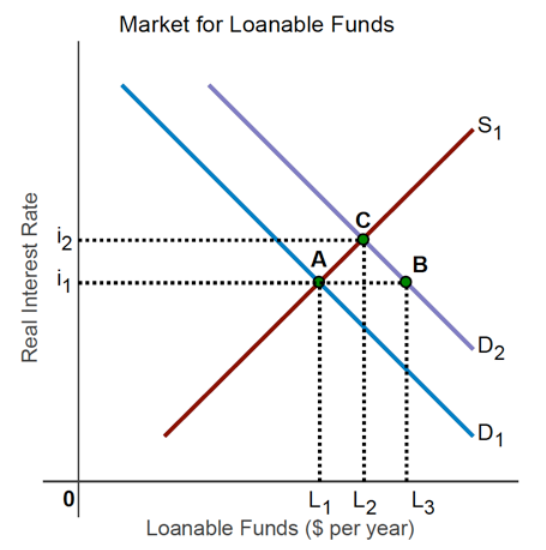
With the shift in the demand for loanable funds, the equilibrium interest rate __________ and the equilibrium quantity of loanable funds __________.
increases; increases.
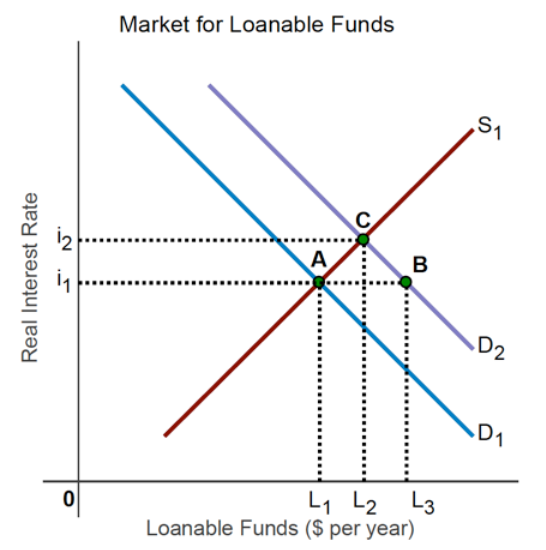
What might explain this shift in the demand for loanable funds?
An increase in business optimism and the demand among businesses to invest in large-scale projects

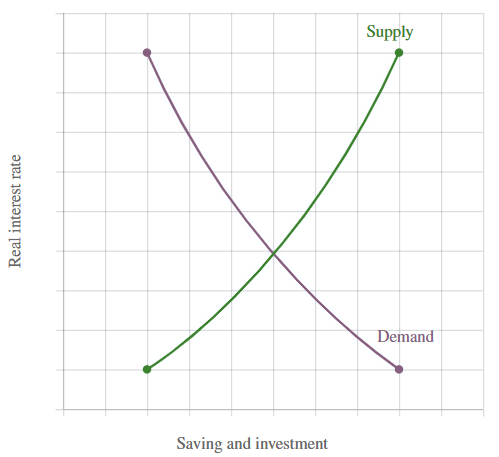
According to this model, what is the result?
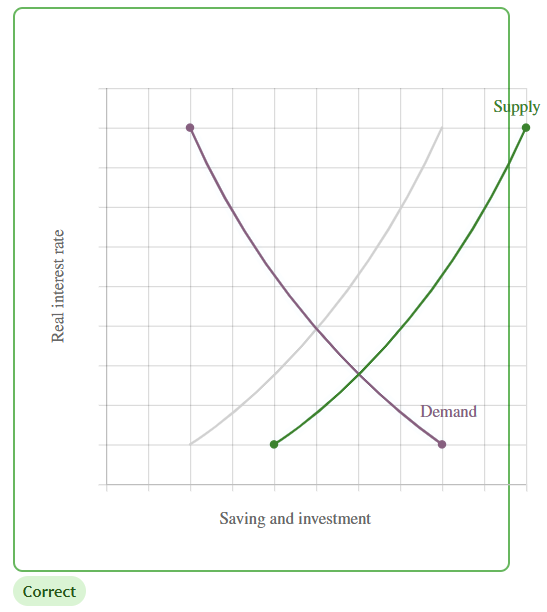
Private investment would increase as the cost of borrowing decreased.

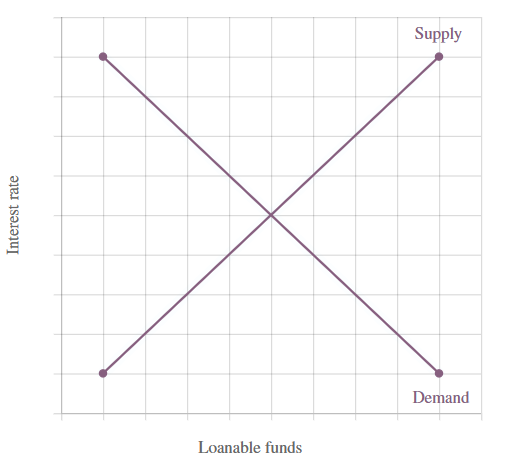
No ‘question’ only graph
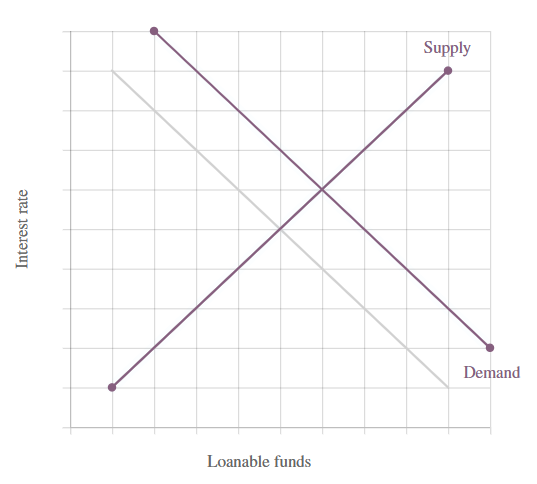
No ‘answer’ only graph
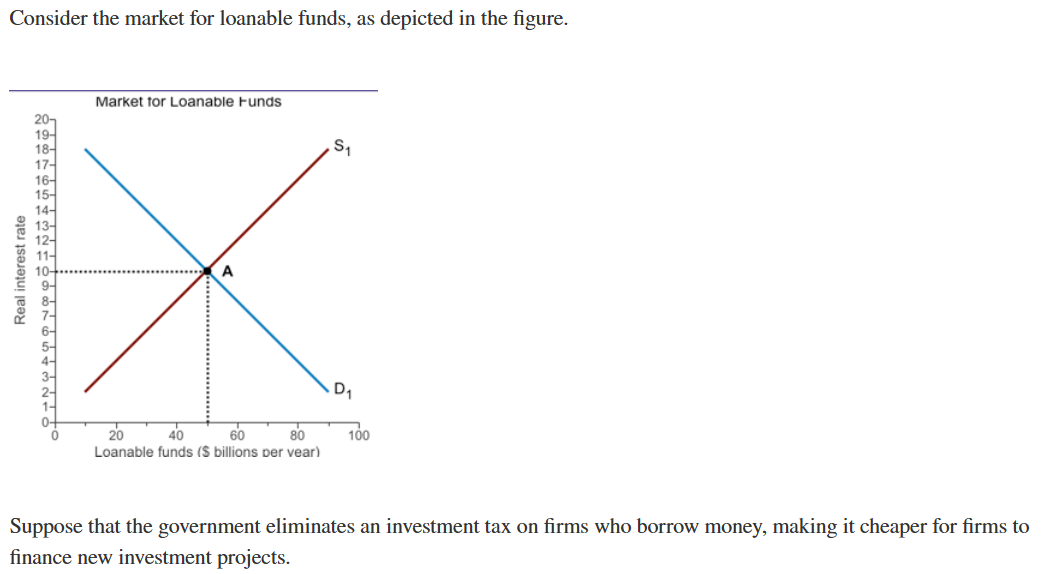
What would be the effect of this decrease in taxes on borrowing and investment spending by firms on the market for loanable funds (i.e. which curve will shift, and in which direction)? Will savings and investment increase or decrease as a result?
The demand for loanable funds will increase (i.e. shift outward to the right). Savings and investment will both increase.
An investment tax credit increases the interest rate. True or False?
True
An increase in large investments increases the interest rate. True of False?
True
An increase in savings, decreases the interest rate. True of False?
True
A decrease in investor optimism, decreases the interest rate. True of False?
True
If economic conditions deteriorate, prompting households to save a larger portion of their income, then __________ loanable funds will __________.
supply of ; increase.
In an effort to balance the budget, the governemt increases taxes paid by busineses. As a result, the _________ loanable funds will __________.
demand for ; decrease.
If economic conditions improve, increasing the demand for goods and services, then the _________ loanable funds will _________.
demand for ; increase.
Innovations in robotics technology vastly improves productivity within manufacturing firms. As a result, the ____________ loanable funds will ___________.
demand for ; increase.
Banks are known to act as financial intermediaries.
between savers and borrowers
The crowding-out effect describes a senario in which federal deficit spending causes:
increased interest rates, which reduces private spending.
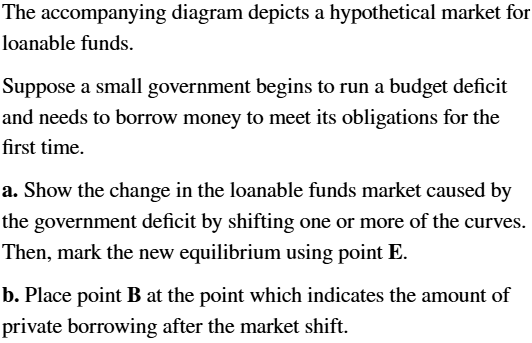
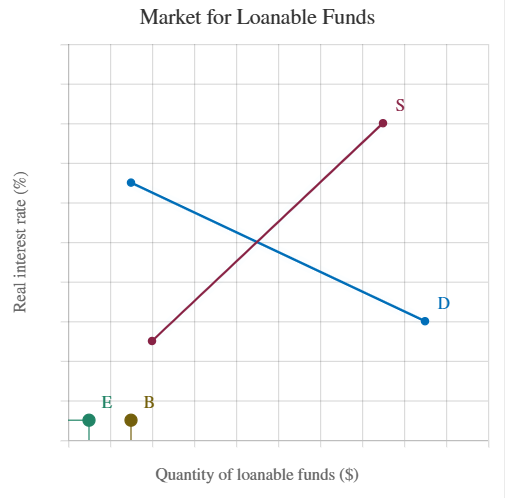
How does this level compare to pre-deficit levels?
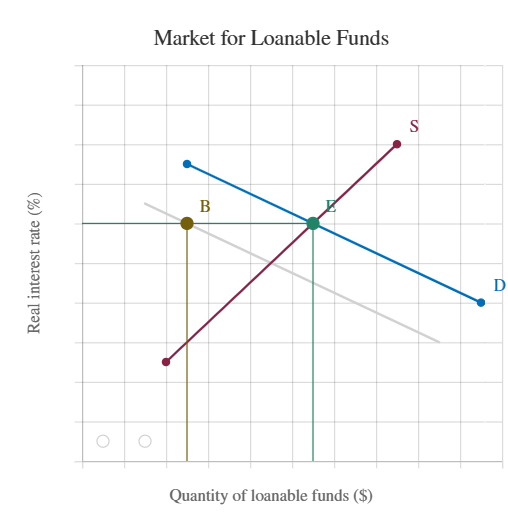
Private borrowing decreased
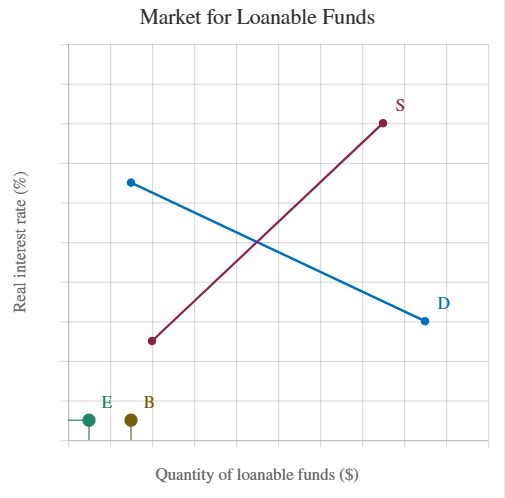
The effect of additional government borrowing on private borrowing is an example of what concept?
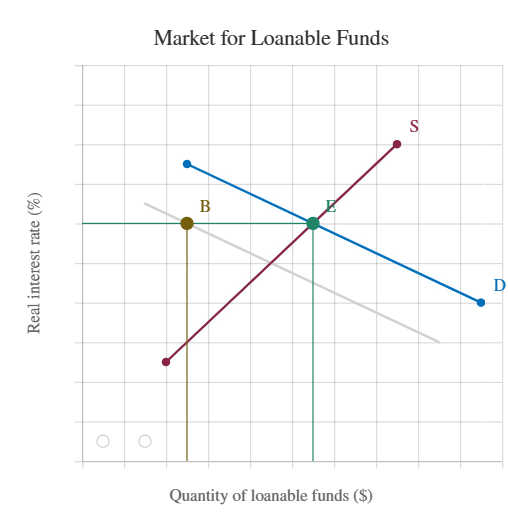
Crowding out
What are the four factors that inhibits financial intermediation that we discussed?
Bank failures and panics
Insecure property rights
Politicized lending and government control
Interest rate controls
Stock market indices:
are average stock prices for a group of companies meant to measure a section of the stock market.
Includes the stock prices of five hundred U.S. firms.
S&P 500
Index of the stock prices of thirty large firms.
DJIA
Includes the stock prices of firms whose shares are traded "over-the-counter."
NASDAQ Composite
Stock markets are a way of:
raising capital for new investments.
How do mutual funds reduce risk for average individual investor?
Mutual funds reduce risk through portfolio diversification.
The major difference between active and passive funds is that active funds:
involve stock picks by managers, while passive funds match the movement of a broad market index.
The efficient markets hypothesis is the idea that:
asset prices represent all publicly available information.

Given this information, what would the efficient markets hypothesis suggest was occurring?
Investors in orange juice futures were using publicly available information that scientists at the National Weather. Service were not using.
Investors face various choices regarding what they can invest in, and the choices carry varying amount of risk.
For example, stock prices are much more volatile than bond prices.
Riskier investments typically have higher returns.
Suppose you are looking at two investment portfolios. Portfolio A has an expected annual return of 10%, and Portfolio B has an expected annual return of 5%.
Which portfolio is likely to be riskier?
Portfolio A
Choose the series that places these financial instruments in order of increasing average return.
U.S. T-Bills, corporate bonds, S&P 500 Index fund, small stocks
A risky portfolio is one that:
I. is poorly diversified.
II. has a volatile stock in a basket of 200 stocks.
III. has a positive correlation between most of its stock prices.
I and III only
Caro has $10,000 to invest. Her best friend, Imelda, happens to be a stockbroker. Imelda tells Caro that her investments should be diversified. To make sure that Caro understand what diversification really means, Imelda asks her to rank a set of investment opportunities from most to least diversified. How will Caro's ranking look?
I. $3,400 in a mutual fund, $3,300 in bonds, and $3,300 in real estate
II. $10,000 in a mutual fund
III. $5,000 in one stock and $5,000 in another stock
IV. $10,000 in one stock
I, II, III, IV
People who might need to retrieve part or all of their investment relatively soon, such as the elderly, are often advised to invest a higher percentage of their money in bonds, and thus a lower percentage in stocks, than people who can leave the investment untouched for decades. We know, however, that bonds typically have a lower rate of return than stocks Why would people be advised to invest in assets that yield lower average returns?
Although stocks have a higher rate of return in the long run, they are much more volatile, or riskier, in the short run. Therefore, there is a higher probability that the value of the stocks will be less than the original value of the investment for people who might need to withdraw the investment in the short run.
Ford Motor Company announces that it will have to decrease profit expectations for the current year, as an increase in gas prices has led many people to hold off on buying a new car. Demand for Ford stock will _________ and the price of Ford stock will _________.
decrease ; decrease
Due to a successful advertising campaign using the "Pepsi Challenge," PepsiCo announces that sales of its signature soft drink are higher than expected. Demand for Pepsi stock will __________, and the price of Pepsi stock will ___________.
increase ; increase.
On the same day that you buy a share of Google Inc. stock, the U.S. government announces an increase in interest rates, making bonds a more attractive option for investors. Demand for Google stock will _________, and the price of Google stock will _________.
decrease; decrease
Starbucks Coffee Company informs the public that profits this year are greater than previously predicted, due to its expansion into the retail ice cream and chocolate businesses Demand for Starbucks stock will ___________, and the price of Starbucks stock will ____________.
increase ; increase
Stock market bubbles have real effects in the economy because:
overvalued stocks divert capital to less-productive uses.
Assume that the money in your investment account grew from $30,000 to $60,000 in nine years. What was your approximate annual rate of return?
7.8%
Using the rule of 70, how many years willit take an investment to double if the return is 8%? Round your answer to two decimal places.
About 8.75 years
Bond prices and bond interest rates move:
in opposite directions.
John has to decide whether to buy a zero-coupon bond with very little risk that costs $950 and will pay $1085 in one year or put his money in a savings account with an annual interest rate of 12%.
Compute the difference in the rate of return of the two investments. Round your answer to one decimal place.
Difference in the rates of return:
Difference in the rates of return: 2.2%
John has to decide whether to buy a zero-coupon bond with very little risk that costs $950 and will pay $1085 in one year or put his money in a savings account with an annual interest rate of 12%.
Compute the difference in the rate of return of the two investments. Round your answer to one decimal place.
Which of the two investments will John prefer?
the zero-coupon bond
What is inflation?
an increase in the overall price level
What scenario provides the best evidence that inflation has occurred?
A person whose salary has increased can purchase fewer goods and services.
The corresponding graph shows the GDP (gross domestic product) deflator) for a hypothetical economy at several points in time. Use this graph to answer the questions.
Inflation occurred in what time period or periods?
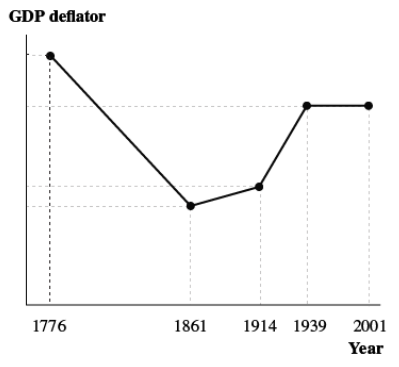
1861 - 1914
1914 - 1939
The corresponding graph shows the GDP (gross domestic product) deflator) for a hypothetical economy at several points in time. Use this graph to answer the questions.
Deflation occurred in what time periods or periods?
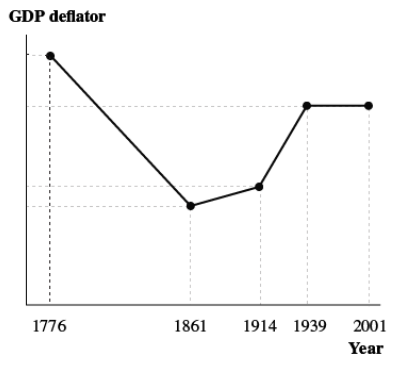
1776 - 1861
Which of the following is a challenge that the Bureau of Labor Statistics (BLS) faces when calculating the CPI?
The basket of goods & services the typical consumer buys is constantly changing to the new and better quality products
As a result of these problems in calculating the CPI, many economists argue that the CPI actually ___________ inflation by a little each year.
overstates
Which of the following statements highlights the difference between the CPI (consumer price index) and the GPD deflator?
The CPI measures the average prices of goods and services consumed by typical consumers, whereas the GDP deflator measures the average prices of a broader basket (all finished goods & services produced in an economy)
If the CPI was 100 in 2000 and 120 in 2010 and the price of a gallon of milk was $4.00 in 2000 and $4.80 in 2010, then in relative terms the real price of milk between 2000 and 2010:
remained the same.
If you earned $10 an hour ib 2005 when the CPI was 100, and you earn $11 an hour today when the CPI is 120, then your real wage rate has ________ since 2005.
decreased
Which answer best explains why prices of some popular goods have fallen over time?
Technological advances have reduced production costs.
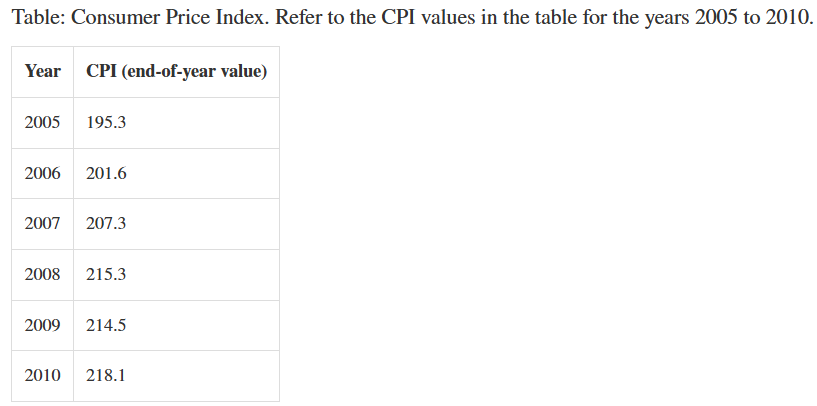
What was the inflation rate in 2008?
3.86% inflation
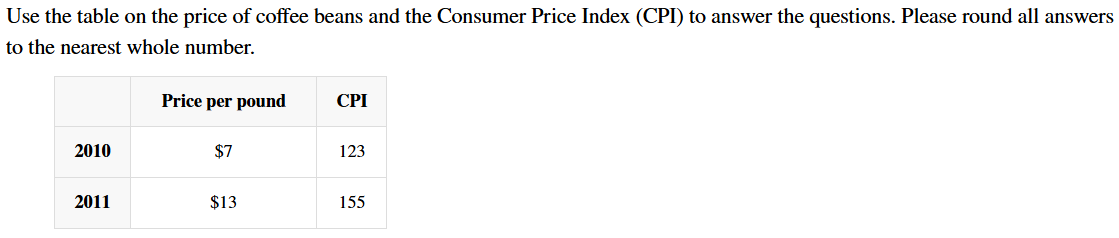
What is the inflation rate between 2010 and 2011?
26%
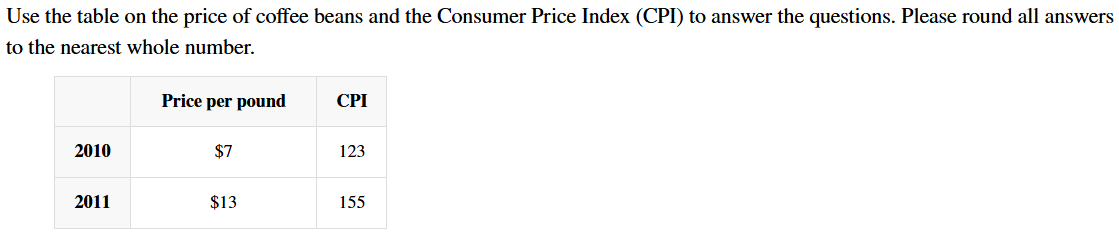
What is the percentage change in the price per pound of coffee between 2010 and 2011?
86%

By what percentage did the CPI price level change between 1982 and 2019?
150%

What was the inflation rate between 2018 and 2019 using the CPI?
2%

