AP Biology - CELL STRUCTURE & FUNCTION ASSESSMENT
 Studied by 0 people
 Call Kai
 Learn
Learn Practice Test
 Spaced Repetition
 Match
Match Flashcards
 Knowt Play
1/107

There's no tags or description
Looks like no tags are added yet.
Name | Mastery | Learn | Test | Matching | Spaced | Call with Kai |
|---|
No analytics yet
Send a link to your students to track their progress
108 Terms
(Intro to UNIT 2: CELL STRUCTURE & FUNCTION (NOTES)) Let’s hear it for Cells! (A review of their form and function… another example of evolutionary design at its best!)
What is a “cell”?
Smallest unit of structure AND function in all living things (each cell performs all the life processes (metabolism) to maintain homeostasis)
Enclosed by membranes that maintains an internal environment separate from external environment
All membranes are made of phospholipids
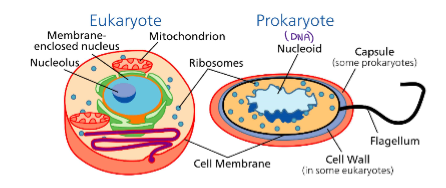
(Intro to UNIT 2: CELL STRUCTURE & FUNCTION (NOTES)) Let’s hear it for Cells! (A review of their form and function… another example of evolutionary design at its best!)
Prokaryotic cells and Eukaryotic cells are the two major cell types: What do they have in common?
Ribosomes (protein synthesis) → Archaea/Eukarya have larger ribosomes; Bacteria have smaller ribosomes
Cytoplasm (most metabolism occurs here)
(aka cytosol)
DNA (the genetic code; hereditary material) → Archaea/Bacteria have a single, circular piece of DNA; Eukarya have linear chromosomes
Cell membrane (phospholipid bilayer barrier)
(plasma membrane)
ALL CELLS have the same basic building blocks/macromolecules (carbs, lipids, amino acids, nucleic acids)
Energy Molecule for all cells --> ATP
All cells require & transform energy
(Intro to UNIT 2: CELL STRUCTURE & FUNCTION (NOTES)) Let’s hear it for Cells! (A review of their form and function… another example of evolutionary design at its best!)
Prokaryotic cells and Eukaryotic cells are the two major cell types: How are they different?
Prokaryotes → 0.1-10 μm (very small), some have flagella (bacterial), *NO NUCLEUS or MEMBRANE BOUND ORGANELLES
Eukaryotes → 10-100 μm (larger, *HAVE NUCLEUS & MANY MBO [compartmentalization, mbos allowed eukaryotes to become larger ]
(Intro to UNIT 2: CELL STRUCTURE & FUNCTION (NOTES)) Let’s hear it for Cells! (A review of their form and function… another example of evolutionary design at its best!)
Explain how each are able to maintain high levels of energy efficiency.
Both prokaryotes and eukaryotes are highly efficient:
Prokaryotes:
Due to size:
VERY HIGH Surface Area to Volume Ratio! (very fast metabolism/reproduction)
(They are 10-100 times smaller than eukaryotes!)
Eukaryotes:
Maintains efficiency by the use of membrane bound organelles (compartmentalization → mbos separated parts and said all the enzymes for cellular respiration are going to be here, and all the enzymes for digestion in lysosomes are going to be here, etc. )
*Ability to divide into 2 cells when it gets too large
(Intro to UNIT 2: CELL STRUCTURE & FUNCTION (NOTES)) Let’s hear it for Cells! (A review of their form and function… another example of evolutionary design at its best!)
Explain how each are able to maintain high levels of energy efficiency.
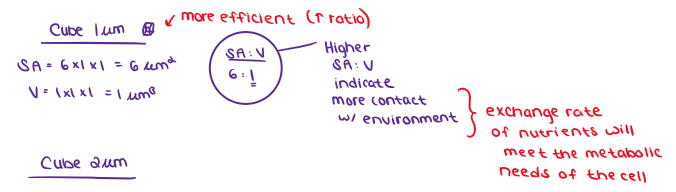
More contact w/ the environment…
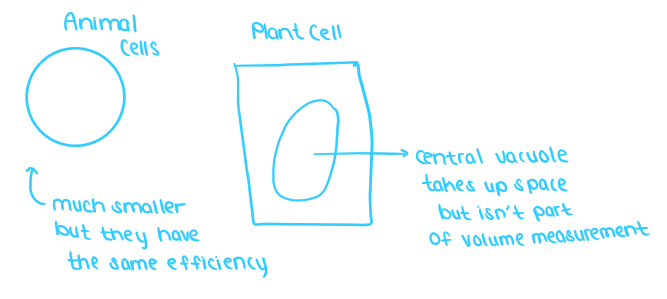
higher SA : lower volume
(Intro to UNIT 2: CELL STRUCTURE & FUNCTION (NOTES)) Let’s hear it for Cells! (A review of their form and function… another example of evolutionary design at its best!)
Advantages to compartmentalization (membrane bound organelles)
All materials/enzymes are together and "ready to use"; specialization and efficiency of each organelle!
Allows for specialization of cells and more complex organisms without sacrificing efficiency
(Lots Mitochondria → muscle cells)
(Lots Golgi Bodies → endocrine cells, cells that secrete)
Different reactions can occur simultaneously without disruption from other reactions
Protects the cytoplasmic proteins and (DNA in the nucleus) to be protected and not degraded by enzymes (from peroxisomes and lysosomes)
(Intro to UNIT 2: CELL STRUCTURE & FUNCTION (NOTES)) Let’s hear it for Cells! (A review of their form and function… another example of evolutionary design at its best!)
Advantages to compartmentalization (membrane bound organelles)
What are PEROXISOMES?
in ALL EUKARYOTES
breaks down fats
breaks down toxic H2O2 (hydrogen peroxide)
contains an enzyme called catalase
also helps in detoxification of drugs/alcohol (liver has a ton of peroxisomes)
(Intro to UNIT 2: CELL STRUCTURE & FUNCTION (NOTES)) Let’s hear it for Cells! (A review of their form and function… another example of evolutionary design at its best!)
Advantages to compartmentalization (membrane bound organelles)
What are PEROXISOMES?
What is HYDROGEN PEROXIDE?
a natural metabolite/waste product that accumulates in all cells
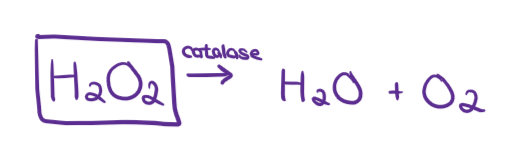
(Intro to UNIT 2: CELL STRUCTURE & FUNCTION (NOTES)) Let’s hear it for Cells! (A review of their form and function… another example of evolutionary design at its best!)
Advantages to compartmentalization (membrane bound organelles)
What are LYSOSOMES?
found mainly in animal cells
contain enzymes that hydrolyze carbs, lipids, proteins, nucleic acids
Hydrolytic Enzymes → Lysosome
(Organelle Worksheet) The Parts of a Cell: DEFINE “ORGANELLE.”
small, specialized structures in cells that carry out specific tasks
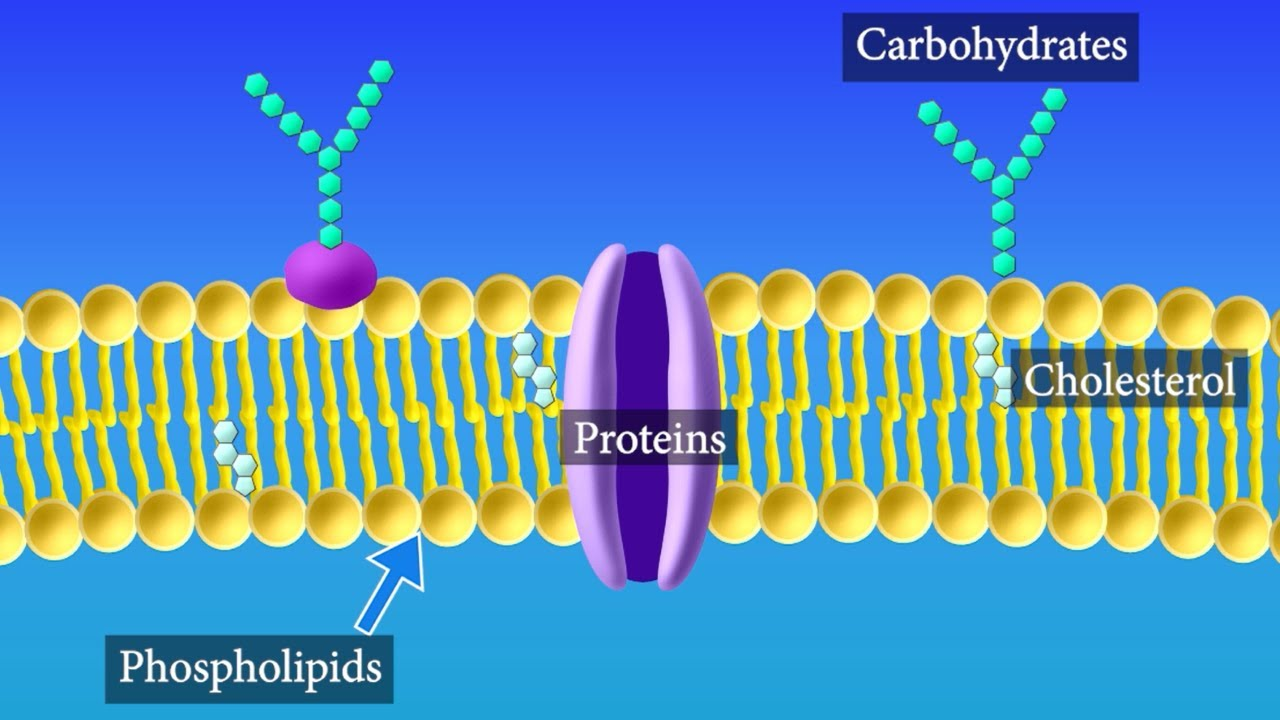
(Organelle Worksheet) The Parts of a Cell: CELL MEMBRANE
Found in prokaryotes and eukaryotes
Found in animal and plant cells
FUNCTION: controls the movement into and out of the cell; made of phospholipid
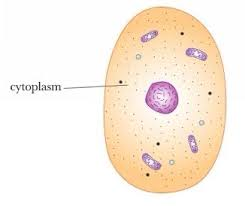
(Organelle Worksheet) The Parts of a Cell: CYTOPLASM
Found in prokaryotes and eukaryotes
Found in animal and plant cells
FUNCTION: watery material/gel which contains many of the materials (nutrients & ions) involved in cell metabolism (AKA cytosol)
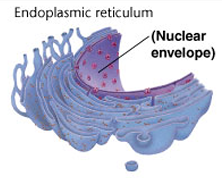
(Organelle Worksheet) The Parts of a Cell: ENDOPLASMIC RETICULUM
Found in eukaryotes
Found in animal and plant cells
FUNCTION: a series of membrane “tubes” that allows materials to travel
One type with ribosomes (synthesizes proteins to be shipped out of the cell)
One type without ribosomes (synthesizes lipids)

(Organelle Worksheet) The Parts of a Cell: RIBOSOMES
Found in prokaryotes and eukaryotes
Found in animal and plant cells
FUNCTION: smallest organelles (no membranes) which are the site of protein synthesis
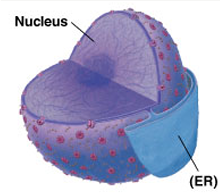
(Organelle Worksheet) The Parts of a Cell: NUCLEUS
Found in eukaryotes
Found in animal and plant cells
FUNCTION: serves as the “control center” for cell metabolism and reproduction; contains the genetic material (DNA)

(Organelle Worksheet) The Parts of a Cell: LYSOSOME
Found in eukaryotes
Found in animal cells
FUNCTION: a membrane enclosed organelle that contains hydrolytic enzymes (digestive enzymes) that break down food, waste, and old cell parts that can be recycled to build new cell parts
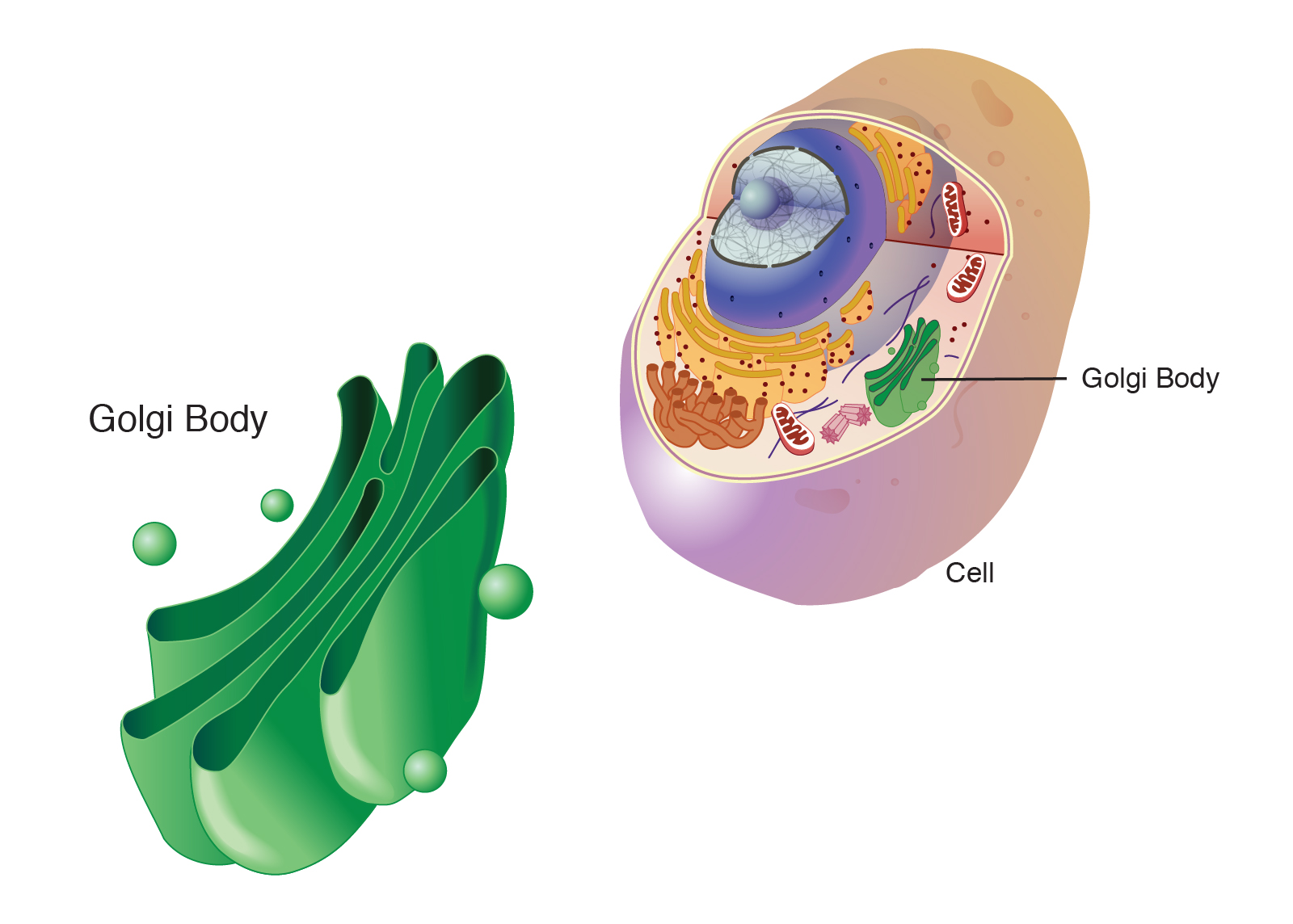
(Organelle Worksheet) The Parts of a Cell: GOLGI BODIES
Found in eukaryotes
Found in animal and plant cells
FUNCTION: packages, sorts, and secretes (“ships out”) the products of the cells

(Organelle Worksheet) The Parts of a Cell: MITOCHONDRIA
Found in eukaryotes
Found in animal and plant cells
FUNCTION: performs respiration, releasing the energy (ATP) from food molecules
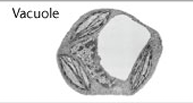
(Organelle Worksheet) The Parts of a Cell: VACUOLE
Found in prokaryotes and eukaryotes
Found in animal and plant cells
FUNCTION: membrane enclosed organelle containing stored food, water, wastes; animals have many, small one, plants have one or two large, central ones
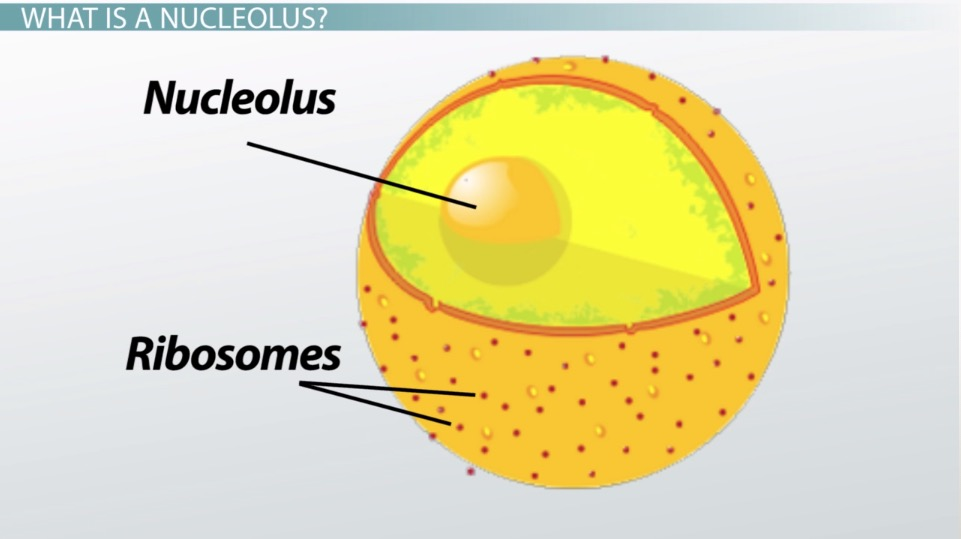
(Organelle Worksheet) The Parts of a Cell: NUCLEOLUS
Found in eukaryotes
Found in animal and plant cells
FUNCTION: site of the production of ribosomes; found inside the nucleus

(Organelle Worksheet) The Parts of a Cell: CELL WALL
Found in prokaryotes and eukaryotes
Found in plant cells
FUNCTION: gives cells its shape/structure and provides protection (outside the cell membrane); in plants it contains is made of cellulose
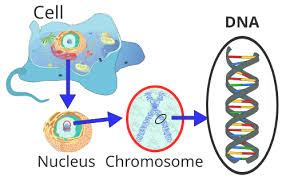
(Organelle Worksheet) The Parts of a Cell: DNA
Found in prokaryotes and eukaryotes
Found in animal and plant cells
FUNCTION: the genetic material; in eukaryotes it’s linear, in prokaryotes it’s circular
(Organelle Worksheet) The Parts of a Cell: CHLOROPLAST
Found in eukaryotes
Found in plant cells
FUNCTION: site of photosynthesis, produces sugars for plant cells
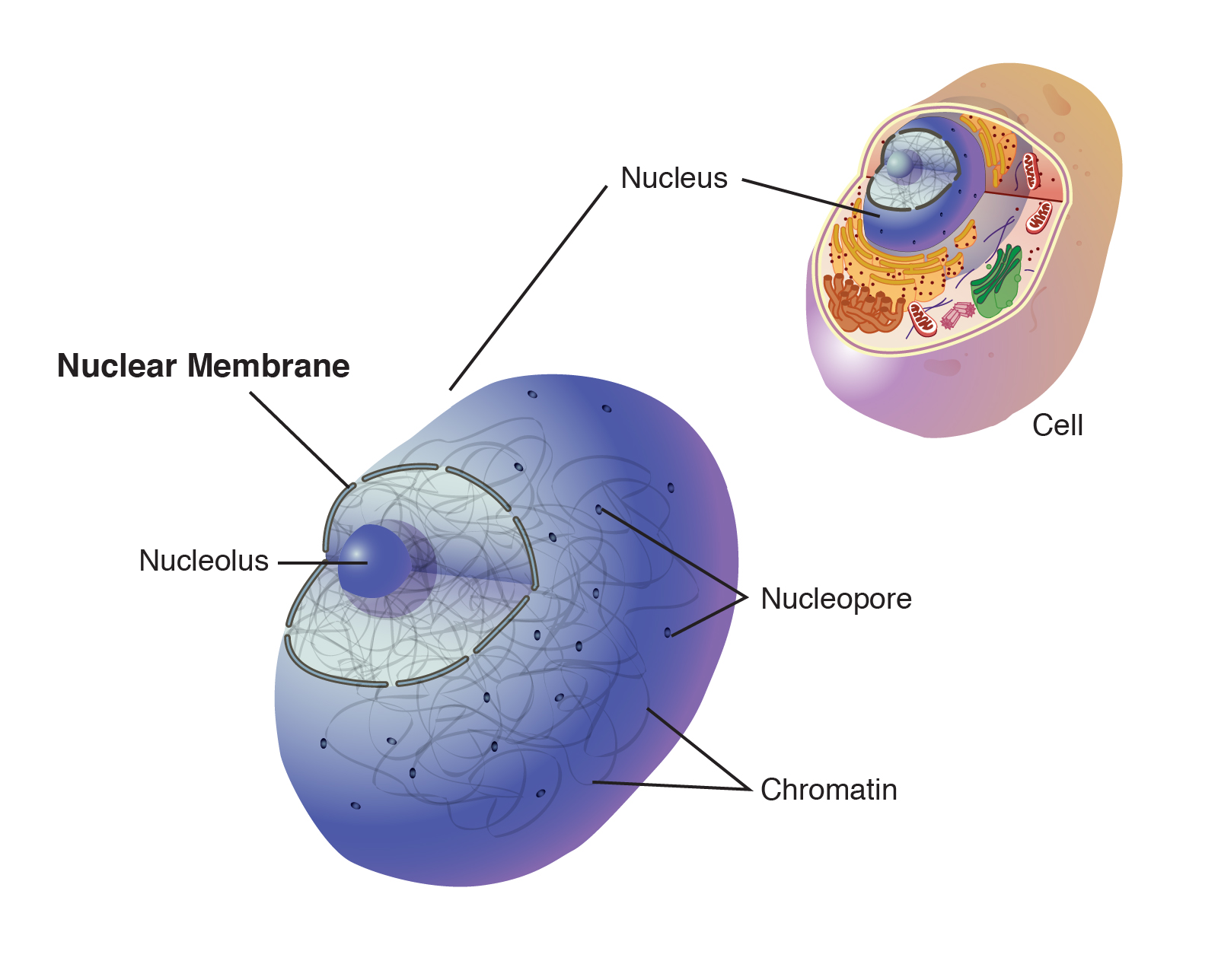
(Organelle Worksheet) The Parts of a Cell: NUCLEAR MEMBRANE
Found in eukaryotes
Found in animal and plant cells
FUNCTION: controls movement into and out of the nucleus; contains “pores”
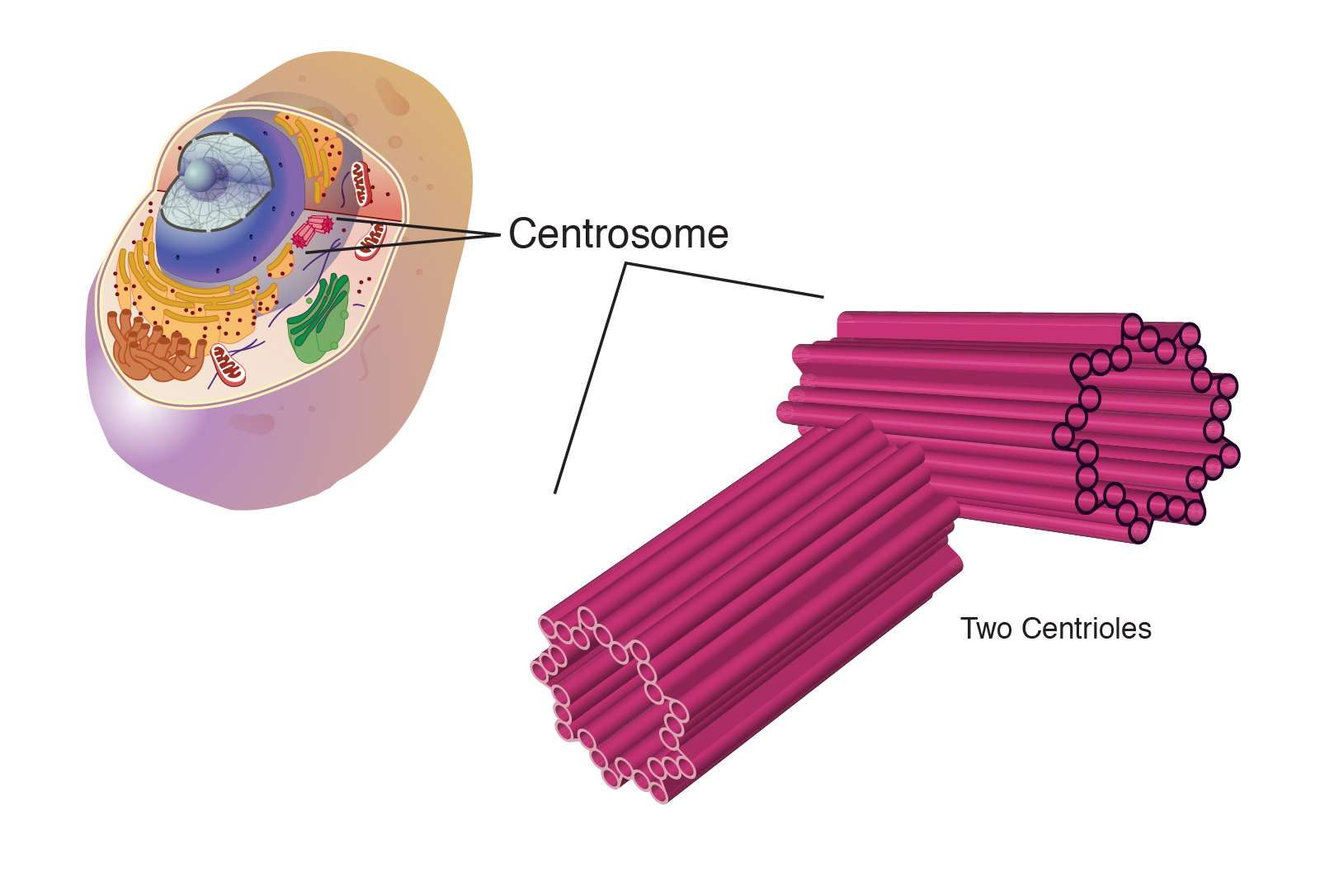
(Organelle Worksheet) The Parts of a Cell: CENTROSOME
Found in eukaryotes
Found in animal cells
FUNCTION: small structures that aid in cell division by making microtubules (spindle fibers) that attach to chromosomes
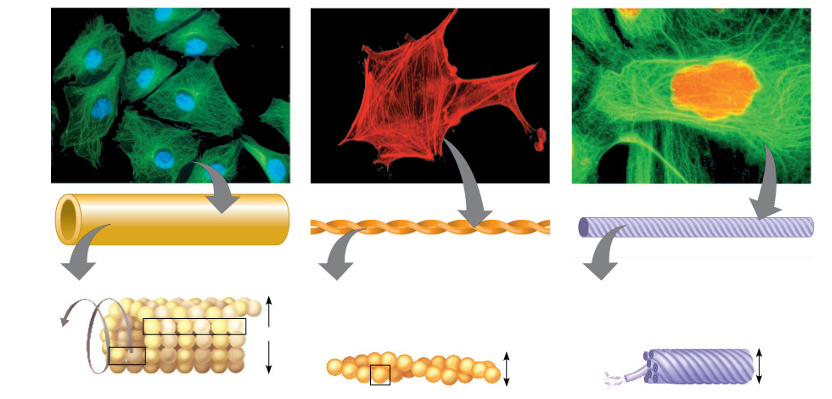
(Organelle Worksheet) The Parts of a Cell: CYTOSKELETON
Found in prokaryotes and eukaryotes
Found in animal and plant cells
FUNCTION: three proteins (microtubules, microfilaments, and intermediate fibers) that are found in the cytoplasm that help give structure to the cell and aid in cell movement
(Modern Cell Theory & Endosymbiotic Theory) Whether an organism is unicellular, or multicellular, every individual cell must be able to carry out all the life processes. Need a refresher? List the LIFE PROCESSES in this box.
Growth
Excretion
Nutrition
Transport
Synthesis
Regulation
Reproduction
Respiration
(Modern Cell Theory & Endosymbiotic Theory) To do this, each cell has ORGANELLES, which are…
structures within cells that have specialized functions
(Modern Cell Theory & Endosymbiotic Theory) Recall the levels of organization in living things.
organelles → cells → tissue → organs → organ system → complex organism
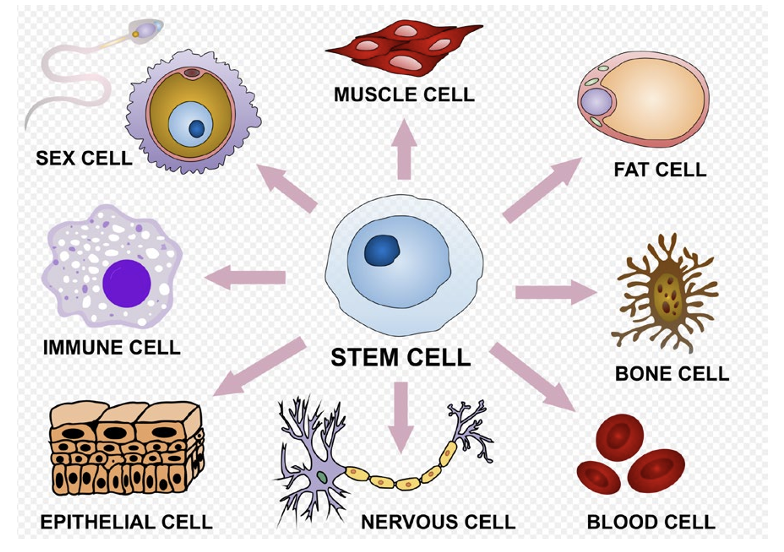
(Modern Cell Theory & Endosymbiotic Theory) As cells become tissues, they become…
specialized/differentiated = STEM CELLS
TOTIPOTENT → full potential to become any cell type
(Modern Cell Theory & Endosymbiotic Theory) What is SPONTANEOUS GENERATION?
“Spontaneous generation” is the outdated theory that life can arise from non-living matter, which has been disproven by many scientific experiments.
Believes living organisms can develop from non-living things like decaying matter.
Examples:
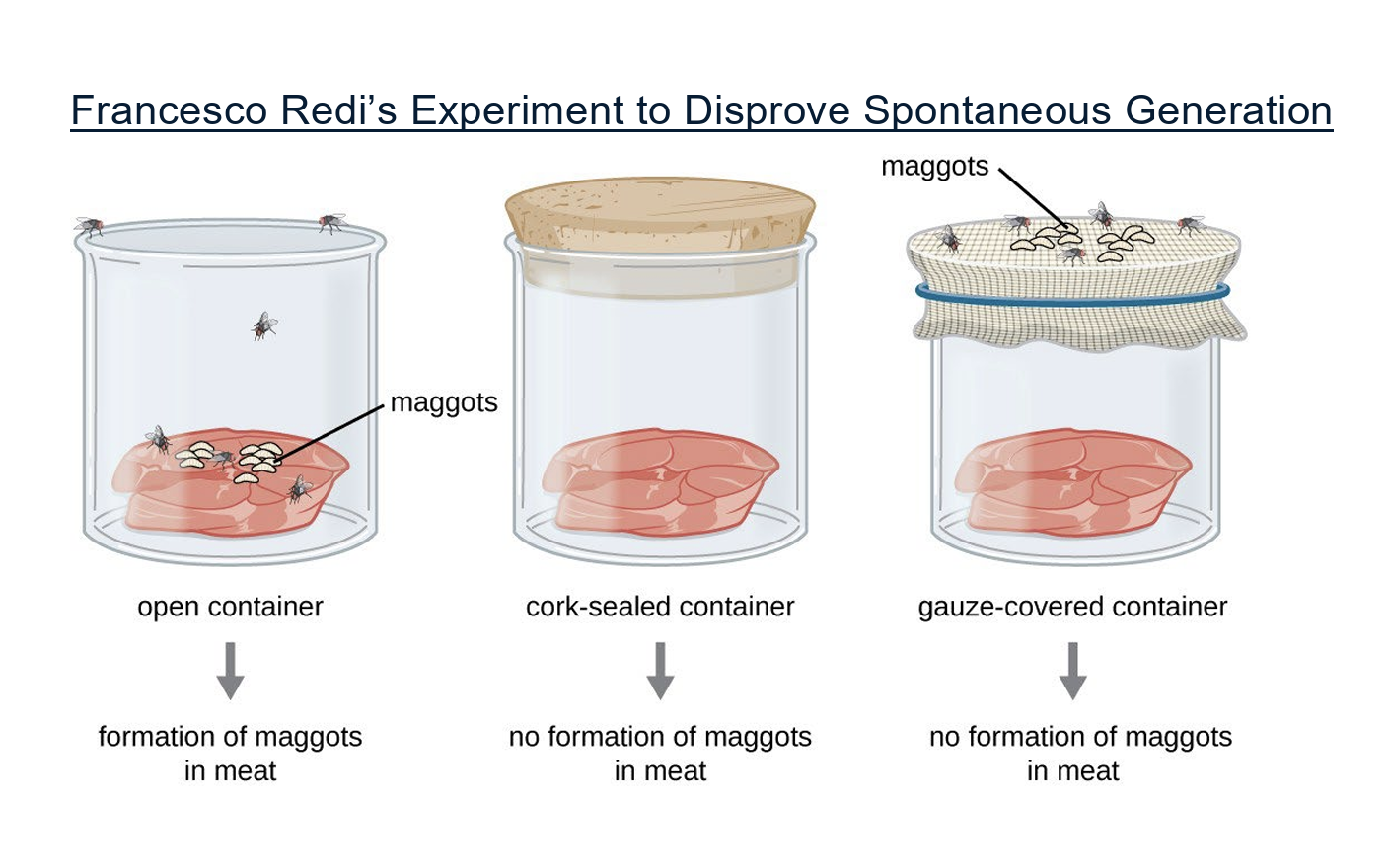
Maggots appearing on rotting meat were once thought to arise spontaneously.
The “Van Helmont Experiment” (17th century) involved placing a dirty shirt in a container with wheat grains, believing that after a period of time (around 21 days), the combination of sweat from the shirt and the wheat would spontaneously generate mice.
(Modern Cell Theory & Endosymbiotic Theory) Francesco Redi’s Experiment to Disprove Spontaneous Generation (1668)
(Modern Cell Theory & Endosymbiotic Theory) Louis Pasteur’s Experiment to Disprove Spontaneous Generation
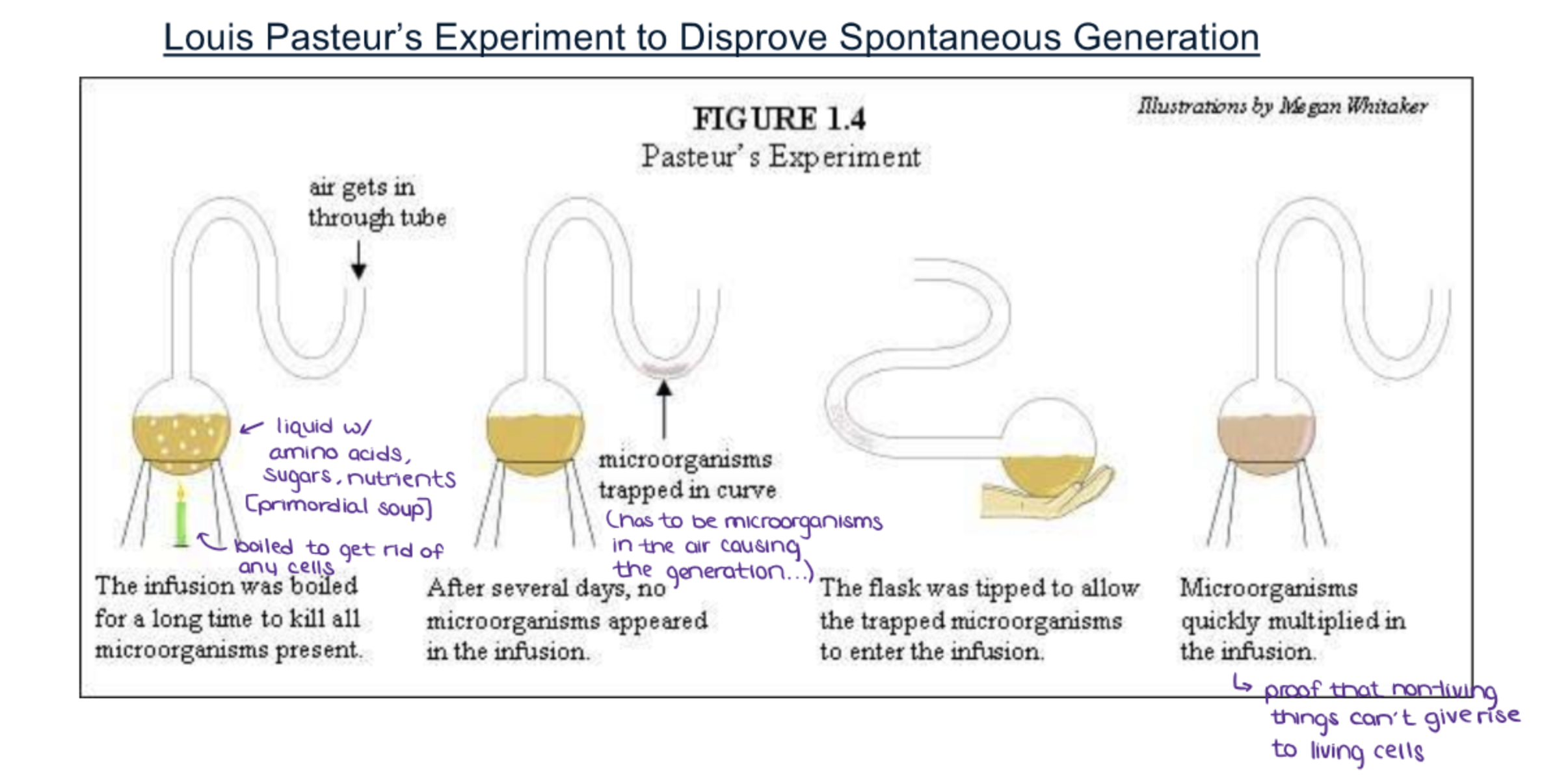
(Modern Cell Theory & Endosymbiotic Theory) What is BIOGENESIS?
Biogenesis is the accepted scientific theory that all life comes from pre-existing life.
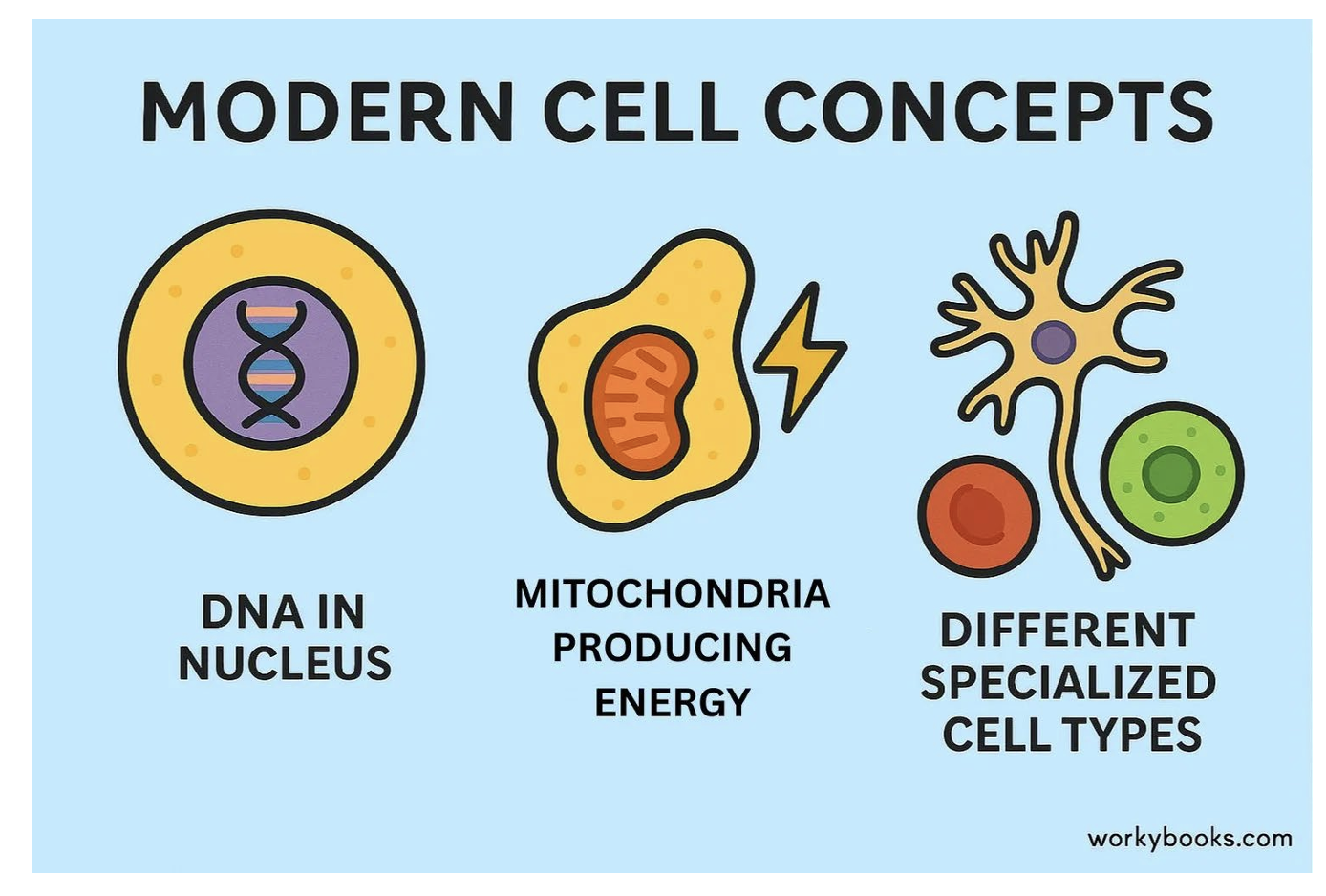
(Modern Cell Theory & Endosymbiotic Theory) The Modern Concept of Cell Theory (The original Cell Theory included the 3 highlighted in yellow.)
Cellular basis of life: All living things are made up of one or more cells.
Cell as the basic unit: The cell is the fundamental unit of structure and function in all living organisms.
Cell division: New cells arise only from pre-existing cells through division.
Genetic material: Cells contain DNA, which carries the genetic information passed on to new cells during division.
Energy flow within cells: All metabolic activity and energy flow occurs within cells.
Chemical similarity: Cells from similar organisms have a similar chemical composition (Carbs, Lipids, Proteins, Nucleic Acids!)
(Modern Cell Theory & Endosymbiotic Theory) What is the ENDOSYMBIOTIC THEORY?
The Endosymbiotic Theory explains how eukaryotic cells evolved from prokaryotic cells through a symbiotic relationship.
(Modern Cell Theory & Endosymbiotic Theory) Here’s a step-by-step summary of the ENDOSYMBIOTIC THEORY.
Starting with a Prokaryotic Cell - A primitive ancestral prokaryotic cell existed, likely resembling a modern archaea or bacteria.
Infolding of Membranes - The cell’s plasma membrane folded inward over time, forming internal compartments like the nuclear envelope and endoplasmic reticulum, which led to early eukaryotic features.
Engulfing of Aerobic Bacteria - The early eukaryote engulfed an aerobic (oxygen-using) prokaryotic bacterium. Instead of digesting it, the bacterium survived inside the host cell and provided energy. This led to the formation of mitochondria, making the host cell more efficient at energy production.
(larger cell recognized smaller cell provided energy while big cell protects small cell → mitochondria (engulfed 1st because not all eukaryotes have chloroplast but all have mitochondria)
Engulfing of Photosynthetic Bacteria (in Plants & Algae) - Some of these early eukaryotic cells also engulfed photosynthetic cyanobacteria, which eventually became chloroplasts. This allowed cells to harness sunlight for energy, giving rise to plant and algal cells.
(big cell engulfs small cell that makes food for it → chloroplast)
Symbiotic Relationship Forms - Over time, these engulfed bacteria became permanent organelles, no longer able to survive independently. They transferred some of their DNA to the host nucleus and became dependent on the host cell for survival.
Evolution into Complex Eukaryotes - With mitochondria (in all eukaryotes) and chloroplasts (in photosynthetic eukaryotes), cells became more complex, leading to the diversity of eukaryotic life seen today.
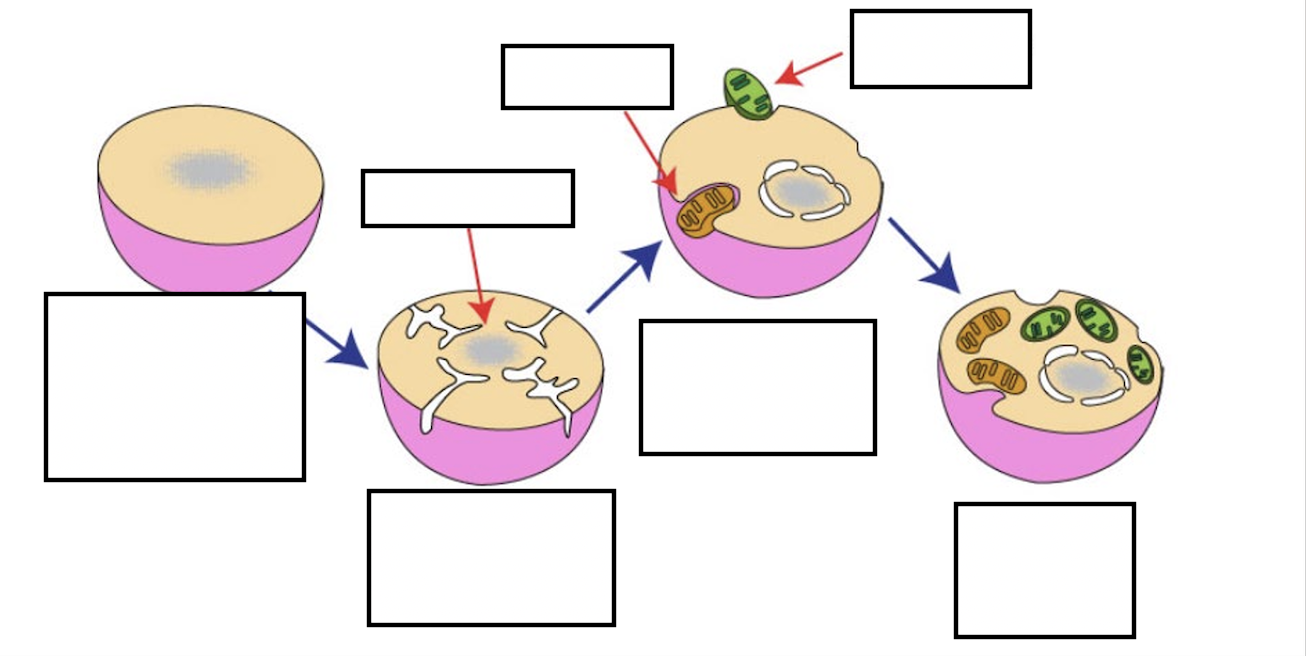
(Modern Cell Theory & Endosymbiotic Theory) Label the steps of the ENDOSYMBIOTIC THEORY.
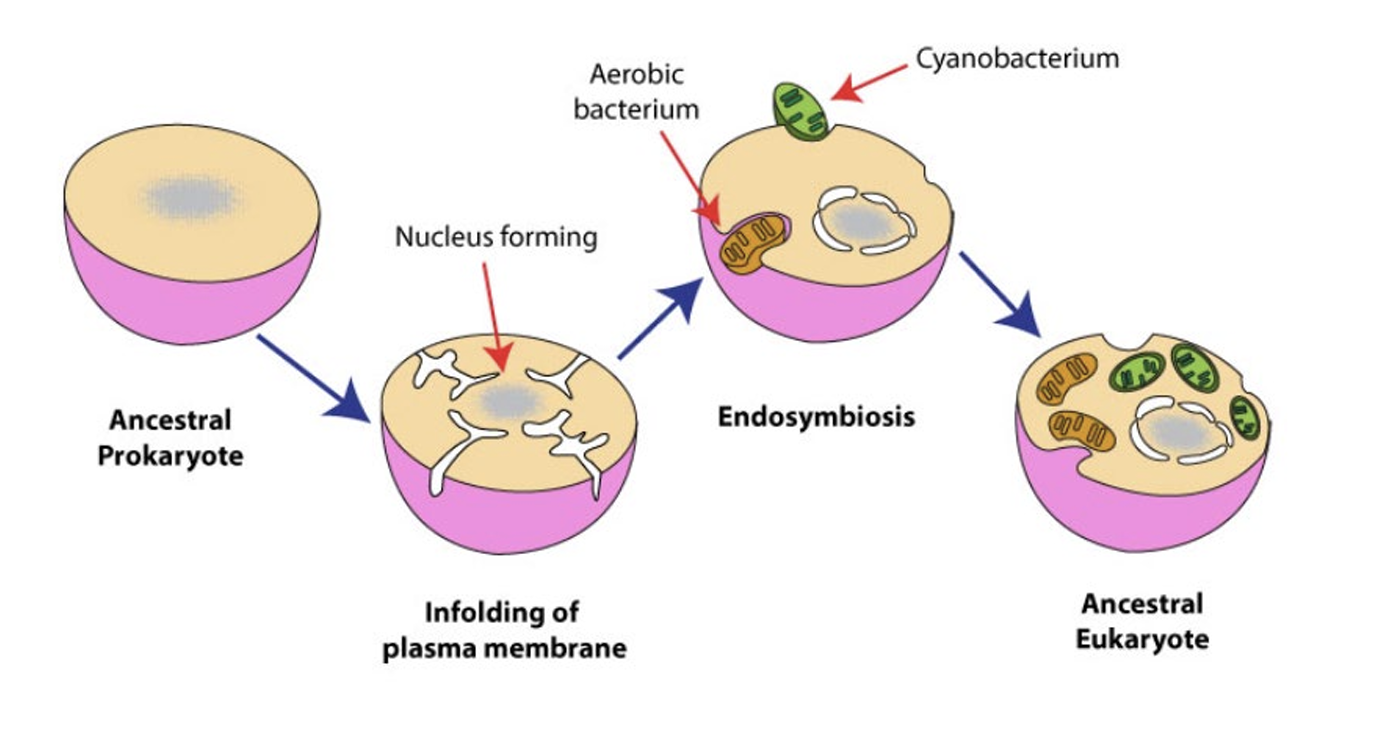
(Modern Cell Theory & Endosymbiotic Theory) Did MITOCHONDRIA or CHLOROPLASTS engulf first?
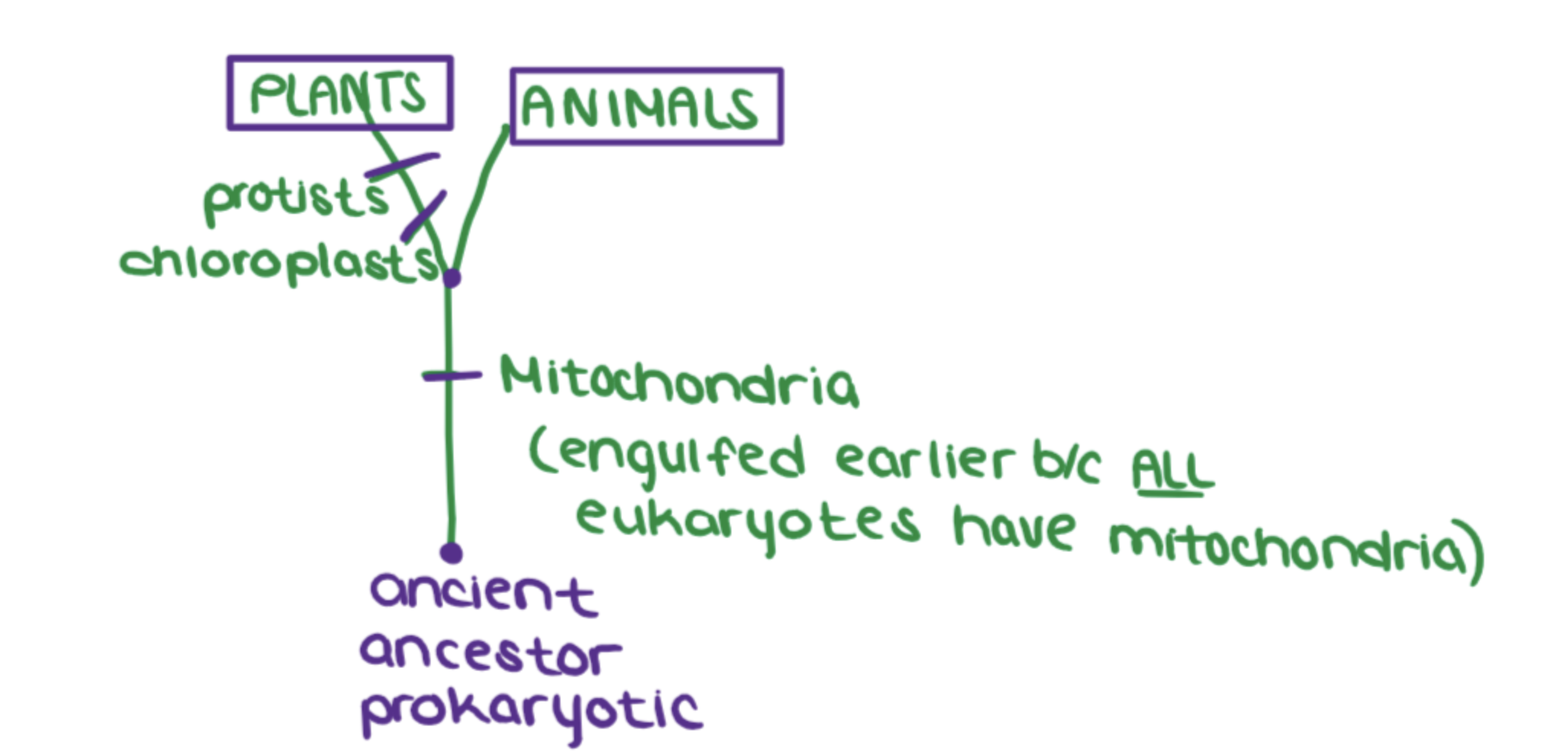
(Modern Cell Theory & Endosymbiotic Theory) EVIDENCE OF ENDOSYMBIOTIC THEORY?
Mitochondria and chloroplasts are membrane-bound organelles that show strong evidence of prokaryotic origins.
They:
are similar in size and shape to prokaryotic cells,
contain their own circular DNA and ribosomes (just like prokaryotes),
have a double membrane, suggesting they were once engulfed by another cell, and
divide independently of the rest of the cell.
(Modern Cell Theory & Endosymbiotic Theory) ENERGY TRANSFORMING ORGANELLES: The oxygen utilizing “bacteria” became…
MITOCHONDRIA
performs CELLULAR RESPIRATION (releases energy from food)
All Eukaryotic cells have mitochondria: chemical energy → ATP (chemical energy)
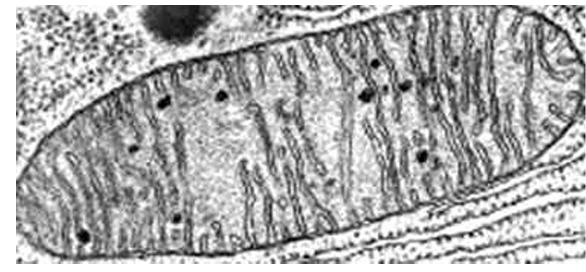
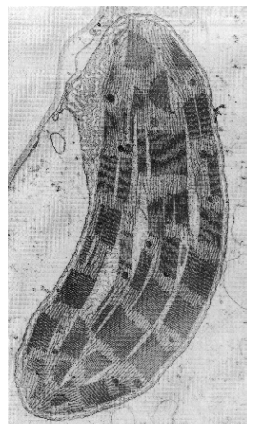
(Modern Cell Theory & Endosymbiotic Theory) ENERGY TRANSFORMING ORGANELLES: Some of the prokaryotic cells engulfed were blue-green algal cells - which became…
CHLOROPLASTS
performs PHOTOSYNTHESIS
All Eukaryotic PHOTOAUTOTROPHS (protists, plants) have CHLOROPLASTS
SUNLIGHT ENERGY → GLUCOSE (chemical energy)
*inoragnic carbon → organic forms
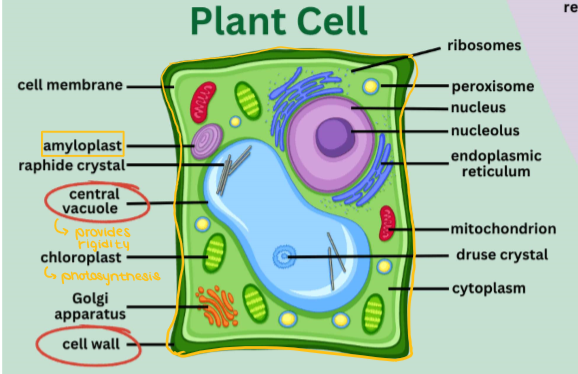
(Types of Cells) PLANT CELL VS ANIMAL CELL
Explain the properties of PLANT CELLS.
Cell wall (rigid shape)
Large central vacuole
Chloroplasts (autotroph)
Lack centrosomes
Some lysosomes
(Types of Cells) PLANT CELL VS ANIMAL CELL
Explain the properties of ANIMAL CELLS.
No cell wall (irregular shape)
Numerous small vacuoles
No chloroplasts (heterotroph)
Centrioles / centrosomes
Lysosomes → contain hydrolytic enzymes that break down stuff [heterotrophic]
![<ul><li><p>No cell wall (irregular shape)</p></li><li><p>Numerous small vacuoles</p></li><li><p>No chloroplasts (heterotroph)</p></li><li><p>Centrioles / centrosomes</p></li><li><p>Lysosomes → contain hydrolytic enzymes that break down stuff [heterotrophic]</p></li></ul><p></p>](https://knowt-user-attachments.s3.amazonaws.com/05c93ba3-727e-43e1-b6ae-16bc12cc4aab.png)
(Types of Cells) Plant Structures & Organelles
Cell Wall (Cellulose)
PLASTIDS
chloroplast --> photosynthetic (makes glucose) pigments (chlorophyll)
leucoplast (amyloplast) - stores starch (amylose)
chromoplast ("chromo" --> color) - stores pigments for fruits and flowers (not photosynthetic)
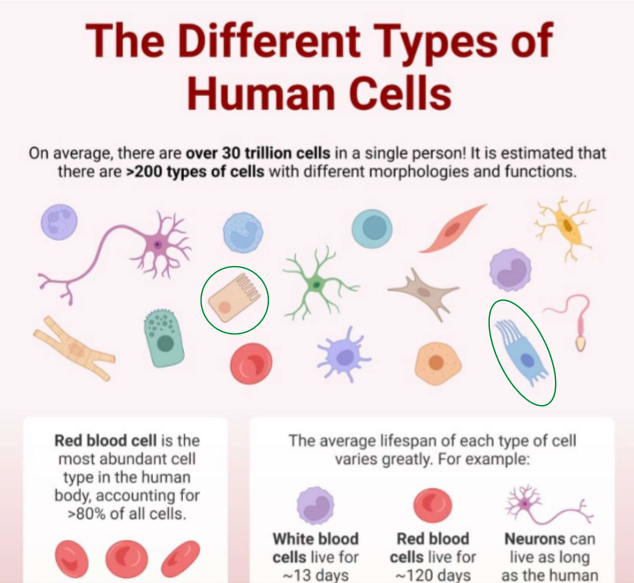
(Types of Cells) The Different Types of Human Cells
On average, there are over 30 trillion cells in a single person! It is estimated that there are >200 types of cells with different morphologies and functions.
___ _____ ____ is the most abundant cell type in the human body, accounting for >80% of all cells.
The average lifespan of each type of cell varies greatly. For example:
White blood cells live for ~13 days
Red blood cells live for ~120 days
Neurons can live as long as the human
Red blood cell
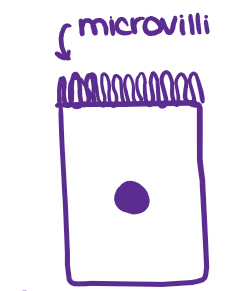
(Types of Cells) Some types of cells, including some epithelial cells, have characteristics on the surface of the cell that help them perform certain functions, including:
Microvilli
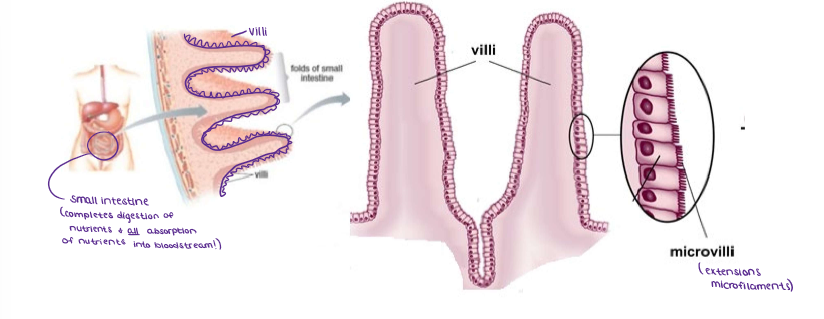
Microvilli are non-motile (they don’t move) finger-like structures on the surface of epithelial cells that function to increase the cell’s surface area so that it can better absorb substances and have more contact w/ the environment. The epithelial cells that line your small intestine have thousands of microvilli that absorb nutrients from the food you eat and protect your body from intestinal bacteria.
Microfilaments are proteins that don’t move but push the microvilli up.
Ex> small intestinal cells, reproductive tract
(Types of Cells) Some types of cells, including some epithelial cells, have characteristics on the surface of the cell that help them perform certain functions, including:
Cilia
Cilia are tiny, hair-like, motile (they can move) structures on the surface of the cell that help move entire cells or can move substances along the outer surface of the cell. Ciliated cells usually have hundreds of cilia on their surfaces. Epithelial cells lining your respiratory tract have cilia that trap dust and other substances you breathe in and move them toward your nostrils so that they don’t go into your lungs. Another example of cells with cilia are the epithelial cells that line the fallopian tubes that help move an egg from an ovary to the uterus.
wave around (“sweeping motion”), use a lot of energy (require a lot of ATP → lot of mitochondria present)
contain microtubules
(Types of Cells) Some types of cells, including some epithelial cells, have characteristics on the surface of the cell that help them perform certain functions, including:
Stereocilia
Stereocilia are specialized microvilli that resemble cilia and project from the surface of certain epithelial cells. Stereocilia are needed on the epithelial tissue in your inner ear for hearing and balance.
(Types of Cells) Explain the DIFFERENTIATION PROCESS.
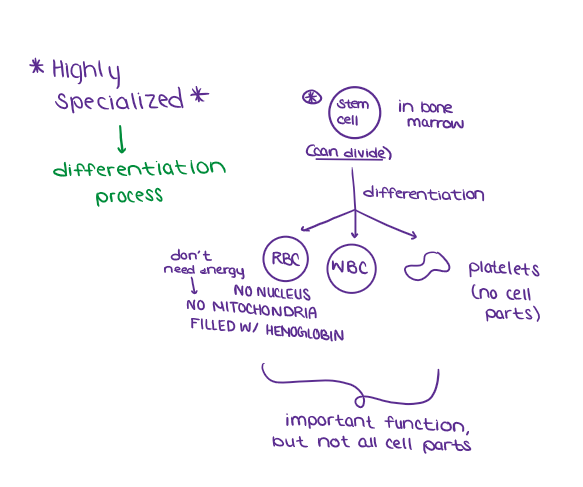
(Types of Cells) NOT ALL CELLS WILL HAVE ALL CELL PARTS!
Because certain cells are highly specialized, they lose the ability to perform certain functions
(Types of Cells) NOT ALL CELLS WILL HAVE ALL CELL PARTS!
Red Blood Cells
For example, red blood cells lose their nuclei and other cell parts during the specialization process to accommodate more hemoglobin to carry more oxygen!
(NO DNA)
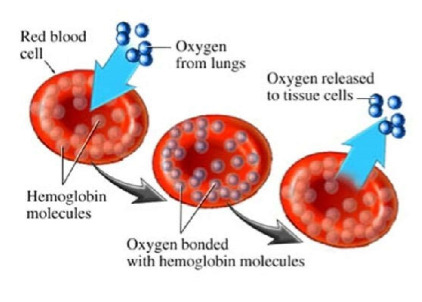
(Types of Cells) NOT ALL CELLS WILL HAVE ALL CELL PARTS!
Epidermal
Other supportive cells, like epidermal, both in plants are not alive a serve a protective role.
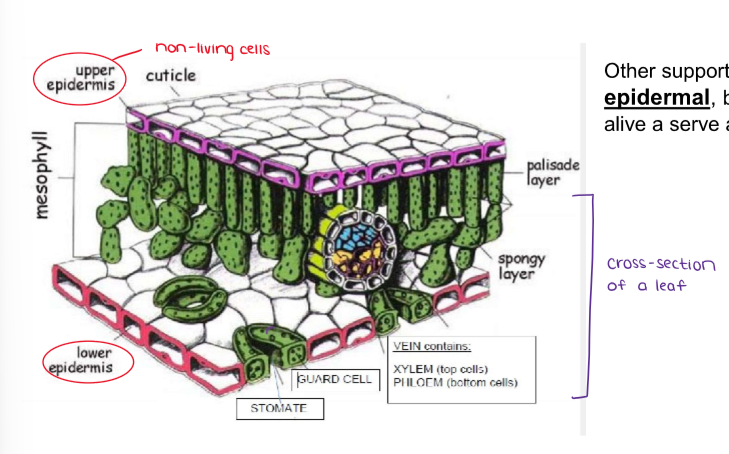
(Types of Cells) NOT ALL CELLS WILL HAVE ALL CELL PARTS!
Xylem and Phloem Cells
In plants, xylem and phloem cells are support cells that allow materials to pass through them (capillary action for H2O delivery)!
Xylem is composed primarily of dead cells, but phloem cells are alive and transport sap.

(Types of Cells) Non-living cells can still have functions…
last unused parts during specialization
support!
protection!
transport!
(Cell Size (Maintaining Cellular Efficiency)) WHY CELLS ARE SMALL
We use a _______ ____ (plasma membrane (contact w/ environment)) to ______ (cytoplasm) ratio as a measure of ______ _________ and ____ _________.
SURFACE AREA
VOLUME
ENERGY EFFICIENCY
CELL EFFICIENCY
(Cell Size (Maintaining Cellular Efficiency)) WHY CELLS ARE SMALL
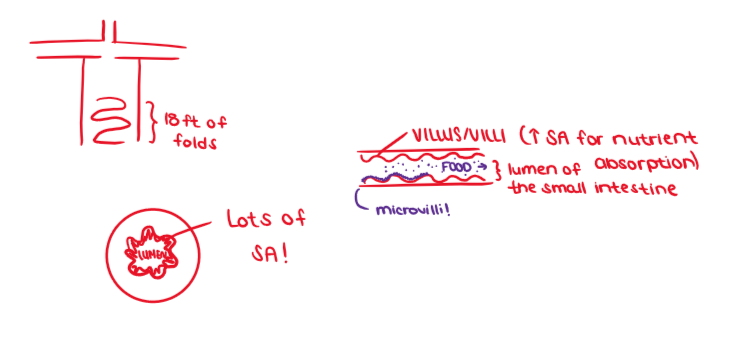
Specific cellular structures are used to maximize the exchange of materials with the environment. → these structures ________ _______ ____ _______ __________ ______!
INCREASE SURFACE AREA WITHOUT INCREASING VOLUME
High SA : V = more efficient cells
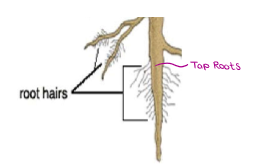
(Cell Size (Maintaining Cellular Efficiency)) Some examples of these structures are: Root Hairs
Root hairs are thin extensions of the root that increase the surface area for water/mineral absorption.
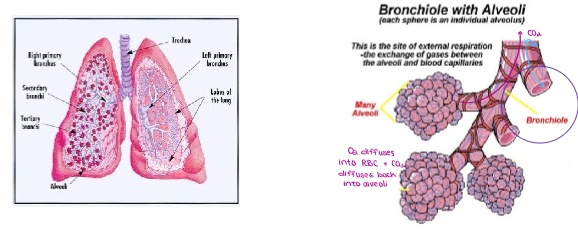
(Cell Size (Maintaining Cellular Efficiency)) Some examples of these structures are: Alveoli
Alveoli are thin, small sacs in the lungs to increase surface area to maximize gas exchange.
O2 into blood cells + O2 out
(Cell Size (Maintaining Cellular Efficiency)) Some examples of these structures are: Villi and Microvilli
Villi and microvilli (these are filled with microfilaments) are finger like projections of the small intestine to increase surface area to increase absorption of nutrients into the bloodstream.
(Cell Size (Maintaining Cellular Efficiency)) Are CENTRAL VACUOLES a part of the VOLUME MEASUREMENT?
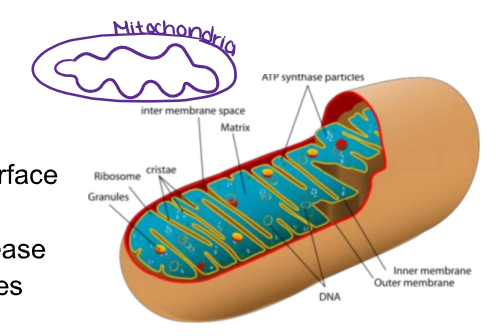
(Cell Size (Maintaining Cellular Efficiency)) Surface area can even be increased inside organelles to increase organelle function efficiently!
Cristae
Cristae is the folded inner membrane of the mitochondria to increase surface area for maximum reactions to generate ATP through respiration.
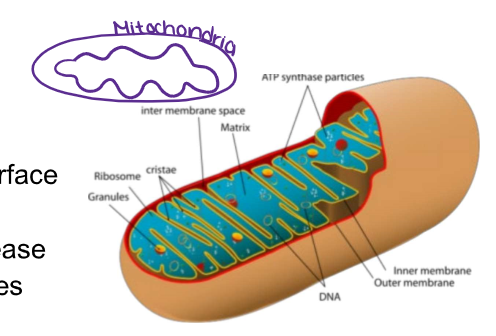
(Cell Size (Maintaining Cellular Efficiency)) Surface area can even be increased inside organelles to increase organelle function efficiently!
Thylakoids
Thylakoids are the folded inner membranes of the chloroplast that increase surface area for maximum reactions to capture sunlight and create energy molecules for photosynthesis.
(Cell Size (Maintaining Cellular Efficiency)) Which increases faster as cells grow: Surface area or volume?
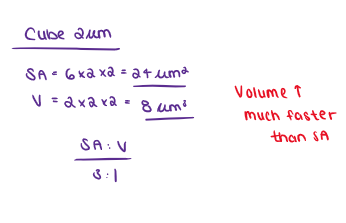
Volume → it’s cubed!
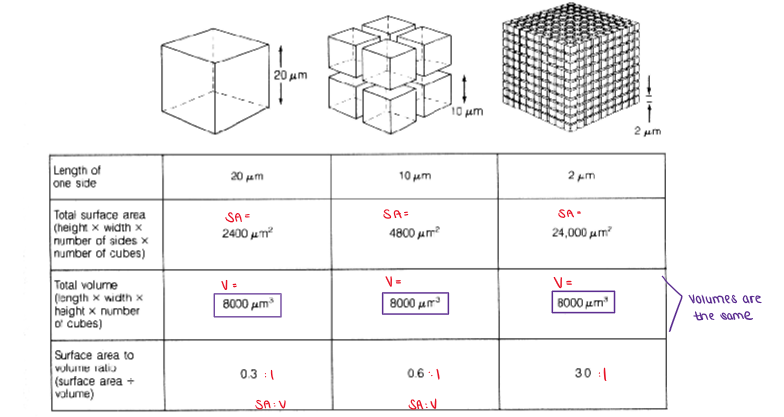
(Cell Size (Maintaining Cellular Efficiency)) Which increases faster as cells grow: Surface area or volume?
SA and Volume Formulas

(Cell Size (Maintaining Cellular Efficiency)) Determine the SA:V RATIO for a 1 μm cube.
(Cell Size (Maintaining Cellular Efficiency)) Determine the SA:V RATIO for a 2 μm cube.
(Cell Size (Maintaining Cellular Efficiency)) HOW SURFACE AREA TO VOLUME RATIO LIMITS CELL SIZE
(AKA WHO DO CELLS HAVE TO STAY SMALL?)
All raw materials necessary for metabolism can enter the cell only through the membrane.
The number of reactions required to maintain cell efficiency increases as the volume within a cell increases.
As a cell grows, the SA:V ratio decreases (because volume (cubed) increases faster than surface area (squared))
At some point, the SA:V ratio becomes so small that the SA is too small (not enough contact with the environment) to supply the raw materials required to maintain the cell's metabolic needs.
(Cell Size (Maintaining Cellular Efficiency)) HOW SURFACE AREA TO VOLUME RATIO LIMITS CELL SIZE
Cells at this point can…
(1) Undergo APOPTOSIS (cell death)
(2) Make more organelles
(3) Divide into 2 smaller cells
(Cell Size Practice) What is DIFFUSION RATE?
Diffusion Rate = movement into cell (distance) / time
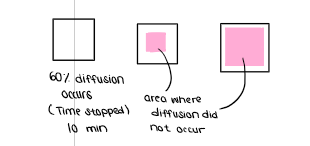
(Cell Size Practice) Does DIFFUSION RATE change with CELL SIZE?
rate won’t change! the time it takes changes…
Diffusion rate will be the same in all the cells, but the smallest cube will take the least amount of TOTAL TIME.
(CYTOSKELETON & CELL JUNCTIONS) What is THE CYTOSKELETON?
A cellular “scaffolding” or “skeleton” contained within the cytoplasm to help keep cell shape/structure.
(CYTOSKELETON & CELL JUNCTIONS) All eukaryotic cells have cytoskeletal fibers indicating…
…they are in our common ancestry + necessary to pass on to all organisms
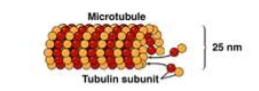
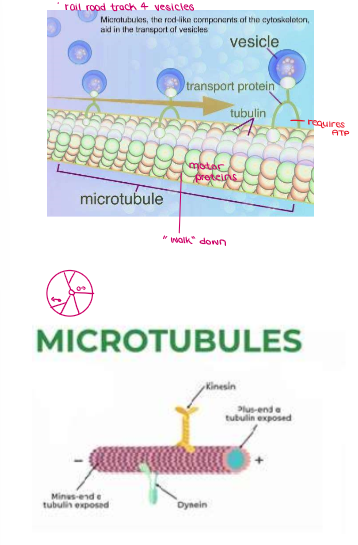
(CYTOSKELETON & CELL JUNCTIONS) 3 proteins make up the cytoskeleton: MICROTUBULES
Long, HOLLOW tubes made of the protein, Tubulin
form a mostly rigid skeleton
Provide a framework for organelles/vesicles to move within cell (uses motor proteins)
rail road track four vesicles
![<p>(CYTOSKELETON & CELL JUNCTIONS) <u>3 proteins make up the cytoskeleton:</u> [structural] <strong>INTERMEDIATE FIBERS</strong></p>](https://knowt-user-attachments.s3.amazonaws.com/5c7385c8-eac4-46f0-8504-502014b38e04.png)
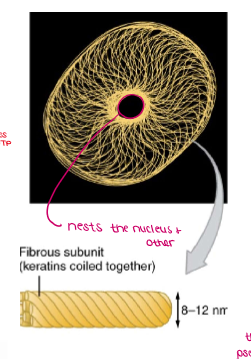
(CYTOSKELETON & CELL JUNCTIONS) 3 proteins make up the cytoskeleton: [structural] INTERMEDIATE FIBERS
Fibrous, Rope-like protein, KERATIN (there are many)
Stabilizes a cell’s structure by resisting tension (prevents tearing of tissues)
Helps anchor nucleus and other organelles
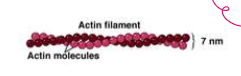
(CYTOSKELETON & CELL JUNCTIONS) 3 proteins make up the cytoskeleton: MICROFILAMENTS
Thin, threadlike strands of contractile protein, ACTIN
found in microvilli extension, microfits are for structures purpose to keep extension of membrane → increase SA for increased environment contact (ex> intestinal cell)
sometimes found in our muscle cells, allows cytoplasm to move about (“treadmilling”
Allows for the cell to change shape
Microfilaments aid in moving the cytoplasm around the cell: CYCLOSIS or CYTOPLASMIC STREAMING (allows for transport simply)
(CYTOSKELETON & CELL JUNCTIONS) 3 proteins make up the cytoskeleton: MICROFILAMENTS
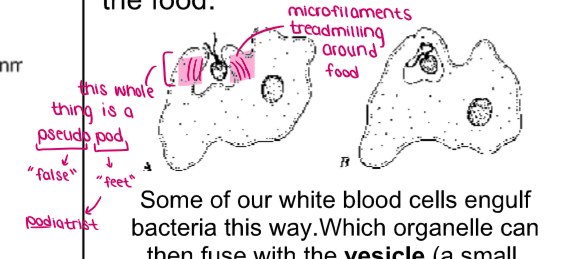
What is ENDOCYTOSIS?
Amoebas use ENDOCYTOSIS to engulf its food. The microfilaments push the cytoplasm out against the cell membrane, allowing “pseudopods” to form aorund the food.
(CYTOSKELETON & CELL JUNCTIONS) 3 proteins make up the cytoskeleton: MICROFILAMENTS
Some of our white blood cells engulf bacteria this way. Which organelle can then fuse with the vesicle (a small, membrane-enclosed sac) & kill the bacteria inside?
lysosomes fuse w/ vacuole to hydrolyze the bacteria
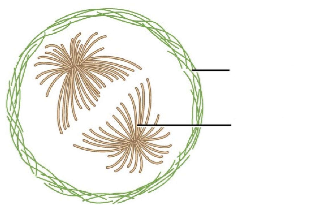
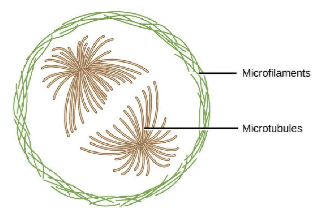
(CYTOSKELETON & CELL JUNCTIONS) Label the MICROFILAMENTS and MICROTUBULES.
(CYTOSKELETON & CELL JUNCTIONS) In addition to being part of the cytoskeleton, MICROTUBULES are found in:
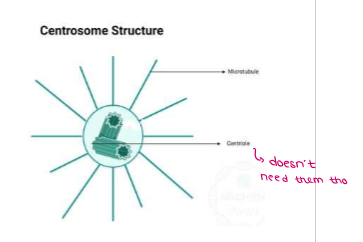
CENTRIOLES/CENTROSOME
(found in animal cells only)
These structures are used to help make spindle fibers (made of microtubules) which are involved in chromosome movement during cell division
“microtubule organizing center”
have 1 pair when not dividing, protective
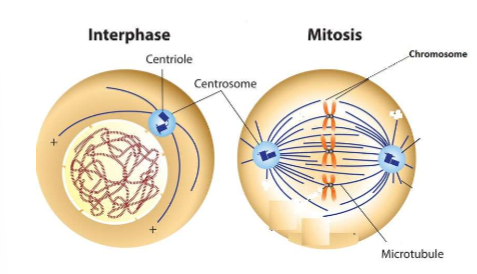
(CYTOSKELETON & CELL JUNCTIONS) In addition to being part of the cytoskeleton, MICROTUBULES are found in:
FLAGELLUM
longer, whip-like structure involved in movement
REQURIE ENERGY (ATP) FOR MOTION TO OCCUR.
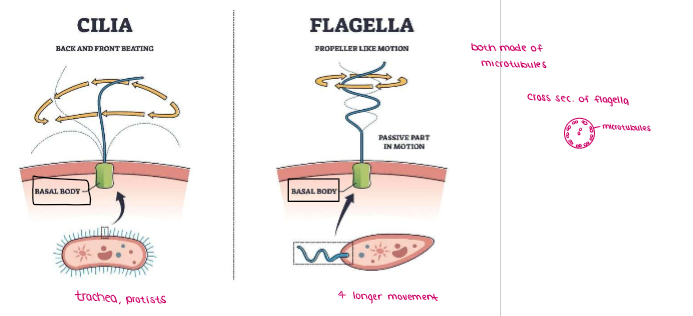
(CYTOSKELETON & CELL JUNCTIONS) In addition to being part of the cytoskeleton, MICROTUBULES are found in:
CILIA
short, hair-like projections that are involved in sweeping motions; sometimes used for movement in protists
REQURIE ENERGY (ATP) FOR MOTION TO OCCUR.
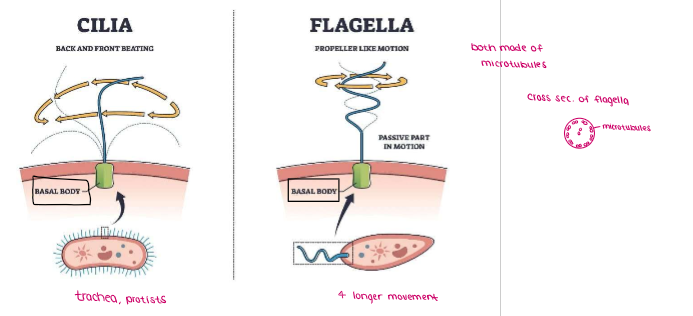
(CYTOSKELETON & CELL JUNCTIONS) In addition to being part of the cytoskeleton, MICROTUBULES are found in:
CILIA/FLAGELLA: What is the BASAL BODY?
the microtubule “base” where the cilia/flagella originate from
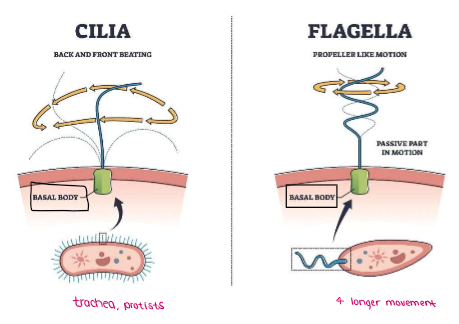
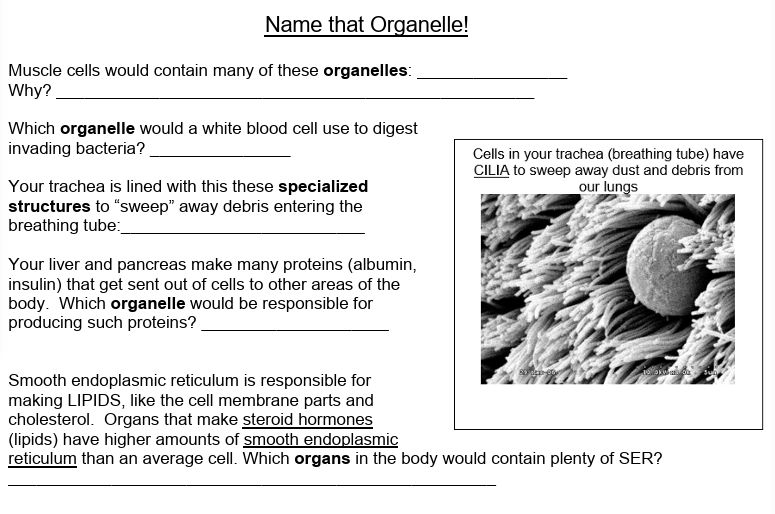
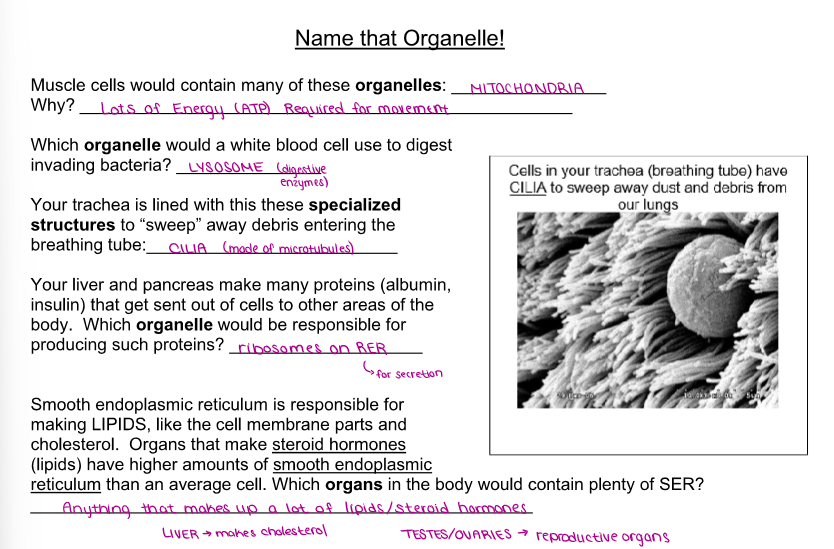
(CYTOSKELETON & CELL JUNCTIONS) Name that Organelle!
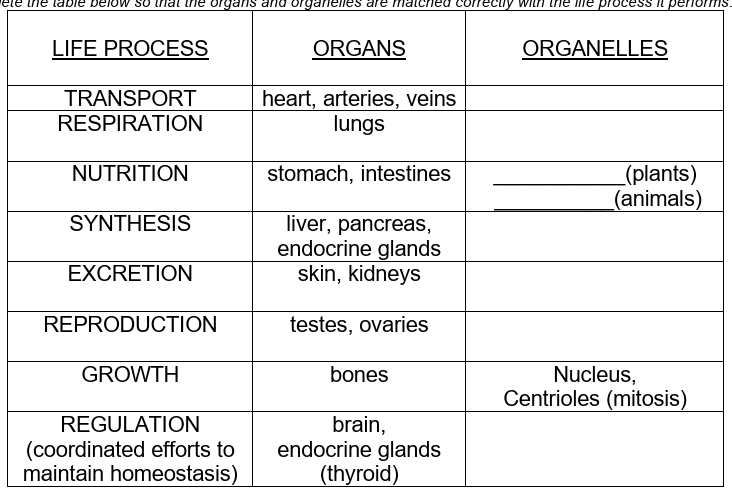
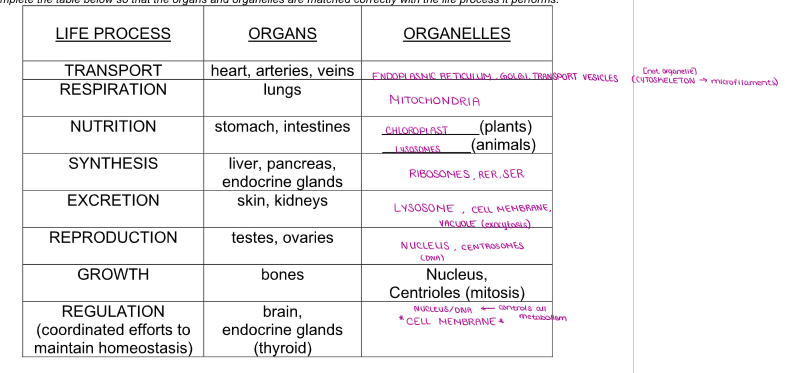
(CYTOSKELETON & CELL JUNCTIONS) Organs are responsible for performing specific tasks in our body. Likewise, individual cells have organelles that are responsible for carrying out each life function. Complete the table below so that the organs and organelles are matched correctly with the life process it performs.
(CYTOSKELETON & CELL JUNCTIONS) What are CELL JUNCTIONS?
how cells stick together (and sometimes communicate)
(CYTOSKELETON & CELL JUNCTIONS) CELL JUNCTIONS: Plants have cell walls composed of _________ (10 - 100 times thicker than the plasma membrane). ______ ______________ help hold the cells together. To function as coordination tissues’ however, cells must connect & communicate.
cellulose
“Sticky” polysaccharides
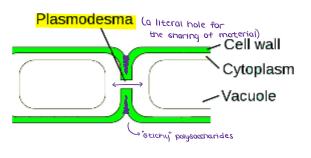
(CYTOSKELETON & CELL JUNCTIONS) CELL JUNCTIONS: What are PLASMODESMATA?
channels between adjacent plant cells that allow chemical messages and nourishment to be shared
**THIS IS AN IMPORTANT FORM OF COMMUNICATION FOR PLANTS**
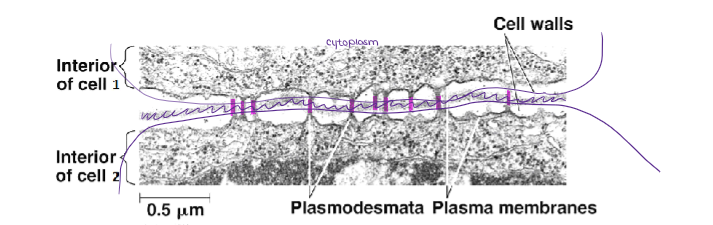
(CYTOSKELETON & CELL JUNCTIONS) CELL JUNCTIONS: Animal cells lack cell walls, but most secrete a sticky layer called the…
…extracellular matric (ECM). This layer helps hold cells together.
lots of proteins in b/w cells that help them connect (ex> collagen)
(CYTOSKELETON & CELL JUNCTIONS) CELL JUNCTIONS: Animal cells can connect by 3 types of junctions…
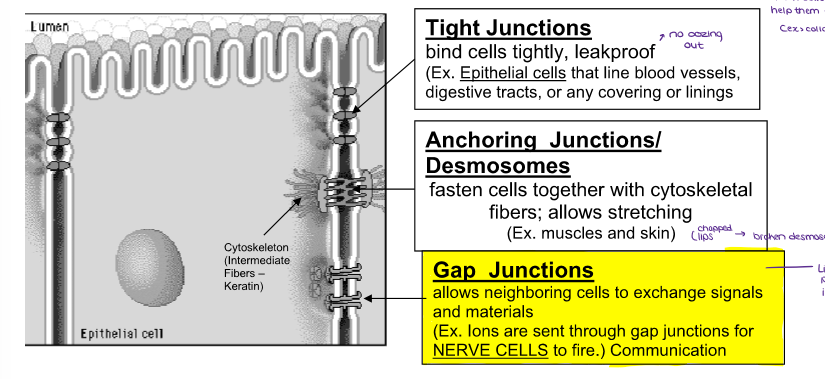
What are TIGHT JUNCTIONS?
bind cells tightly, leakproof (no oozing out)
(Ex. Epithelial cells that line blood vessels, digestive tracts, or any covering or linings
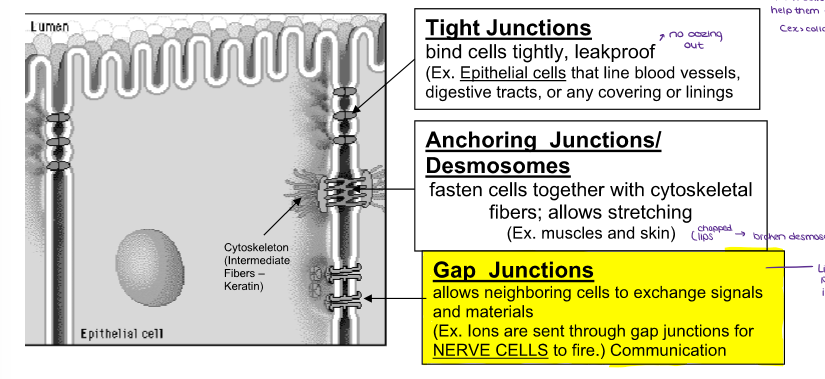
(CYTOSKELETON & CELL JUNCTIONS) CELL JUNCTIONS: Animal cells can connect by 3 types of junctions…
What are ANCHORING JUNCTIONS/DESMOSOMES?
fasten cells together with cytoskeletal fibers; allows stretching
(Ex. muscles and skin; chapped lips means broken desmosomes)
(CYTOSKELETON & CELL JUNCTIONS) CELL JUNCTIONS: Animal cells can connect by 3 types of junctions…
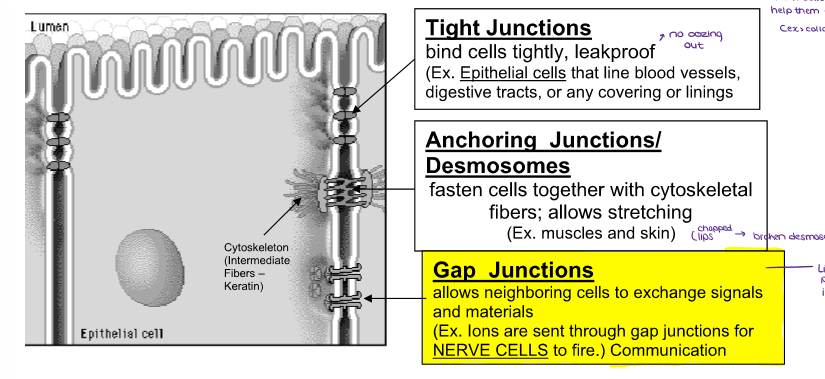
What are GAP JUNCTIONS?
allows neighboring cells to exchange signals and materials
(Ex. Ions are sent though gap junctions for NERVE CELLS to fire.) Communication
like plasmodesmata in plants
(Protein Processing & Secretion) A brief review/reminder: What is GENE EXPRESSION?
Gene expression is the process by which the instructions in a gene are used to make a function product, like a protein.
This process determines how cells use genetic information to perform specific tasks and create the traits we see (phenotypes).
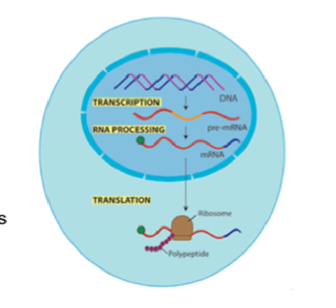
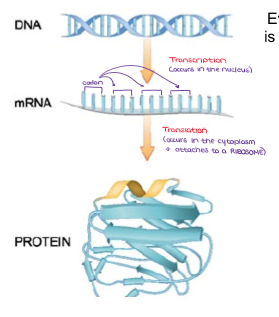
(Protein Processing & Secretion) A brief review/reminder: What are the two main steps involved in GENE EXPRESSION?
Transcription - The DNA is copied into messenger RNA (mRNA).
occurs in the nucleus
Translation - The mRNA codons are read and the correct sequence of amino acids is put together to make a polypeptide.
occurs in the cytoplasm and attaches to a RIBOSOME
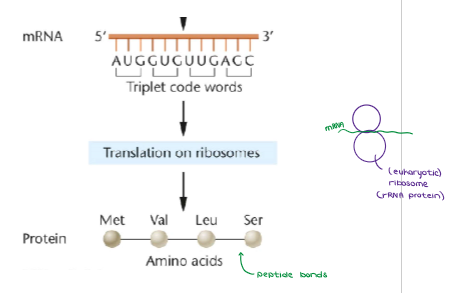
(Protein Processing & Secretion) A brief review/reminder: What are CODONS?
Every three consecutive bases on mRNA is called a CODON; each codon codes for a specific amino acid
(Protein Processing & Secretion) A brief review/reminder: What are FREE FLOATING RIBOSOMES?
AKA cytoplasmic ribosomes
synthesize proteins that will be utilized in the cell
(Protein Processing & Secretion) PROTEIN SYNTHESIS, PROCESSING, and SECRETION: What is SECRETION?
Secretion (Exocytosis) is the process by which cells release substances, like hormones, enzymes, neurotransmitters, or waste, to the outside of the cell or into the body for a specific purpose.
(Protein Processing & Secretion) PROTEIN SYNTHESIS, PROCESSING, and SECRETION: What is the ENDOMEMBRANE SYSTEM?
The endomembrane system is a network of interconnected membrane-bound organelles within a eukaryotic cell that work together to synthesize, modify, package, and transport proteins (in the rough ER) and lipids (in the smooth ER). It includes the nuclear envelope, endoplasmic reticulum, Golgi apparatus (lysosomes), and vesicles; essentially, it’s a system of membranes that compartmentalize cellular functions within the cytoplasm.
(Protein Processing & Secretion) PROTEIN SYNTHESIS, PROCESSING, and SECRETION: Explain the process.
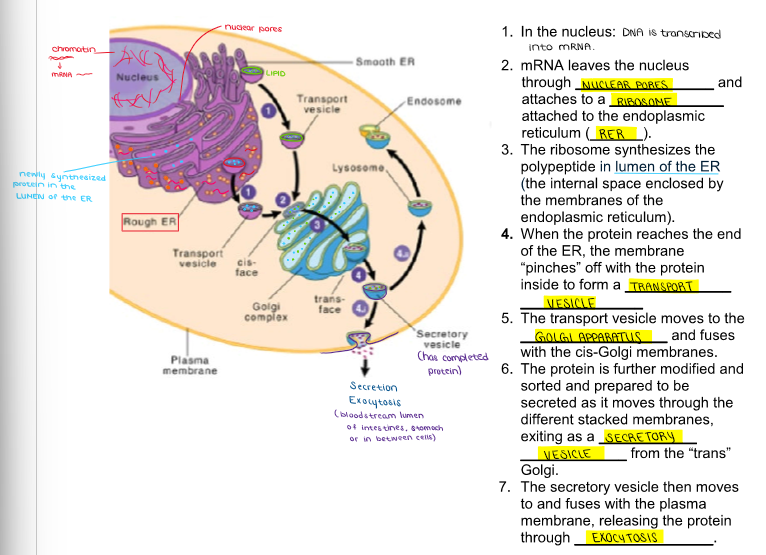
(Protein Processing & Secretion) PROTEIN SYNTHESIS, PROCESSING, and SECRETION: Can mRNA be used many times or just once?
mRNA is SYNTHESIZED IN THE NUCLEUS….and then LEAVES THE NUCLEUS TO ATTACH TO RIBOSOMES ON THE RER. THE mRNA CAN BE USED MANY TIMES TO MAKE MANY COPIES OF THE POLYPEPTIDE IT CODES FOR, BUT WHEN IT IS DONE, THE mRNA IS DEGRADED.
 Note
Note  Flashcards (56)