Biol 214 - Genes, Chromosomes and Human Genetics
 Studied by 0 people
 Call Kai
 Learn
Learn Practice Test
 Spaced Repetition
 Match
Match Flashcards
 Knowt Play
1/33

Earn XP
Description and Tags
For Exam 3. Describes the fundamental unit of heredity (genes), the structures that organize this information (chromosomes), and the study of how they determine traits and health (human genetics).
Name | Mastery | Learn | Test | Matching | Spaced | Call with Kai |
|---|
No analytics yet
Send a link to your students to track their progress
34 Terms
Linked Genes
Genes near each other on the same chromosome.
Linkage
The tendency for genes located close together on the same chromosome to be inherited together. Means that linked genes do not undergo independent assortment.
Parental Phenotypes
The physical or observable characteristics of the original parents in an individual after a genetic cross.
Recombinant Phenotypes
Observable traits that are a result of new combinations of alleles in an individual after a genetic cross.
Genetic Recombination
A process in which two homologous chromosomes exchange segments with each other by crossing-over during meiosis.
The frequency of this recombination is a function of the distance between linked genes – the nearer two genes are, the greater chance they will be inherited together but the rates of recombination will be lesser.
Progeny
Offspring
Recombination Frequency
Used to determine the distance between two genes on the chromosome and the percentage of testcross progeny that are recombinants.
number of recombinants/total progeny
Linkage Map
Made from recombination frequencies, showing relative locations of genes on a chromosome.
Genes that are widely separated on a chromosome are so likely to undergo recombination that no linkage is detected between them due to the fact that they could be crossed over – the genes assort independently.
Linkage between such widely separated genes can still be detected, however, by testing their linkage to one or more genes that lie between them.
Some of the genes Mendel studied assort independently, even though they are on the same chromosome.
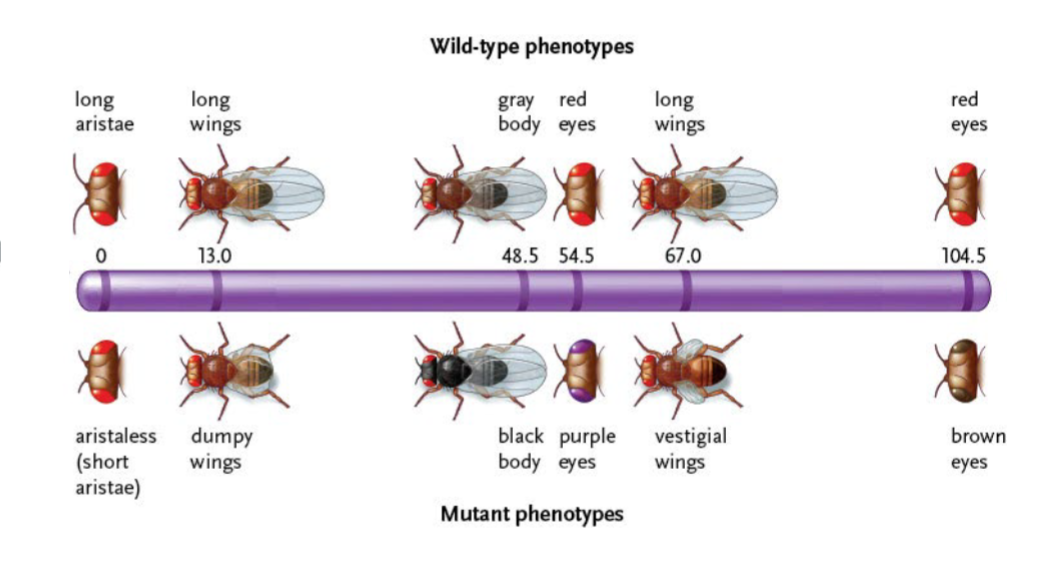
Centimorgan (cM)
A linkage map unit (mu) that’s equivalent to a recombination frequency of 1%.
Autosomal Genes
Genes located on chromosomes other than the sex chromosomes. In humans, chromosomes 1 to 22 are the autosomes.
Sex-Linked Genes
Genes located on the sex chromosomes that are inherited differently in males and females. In humans, chromosome 23 is the sex chromosome.
Homogametic Sex
XX females that produce only one type of gamete (X) with respect to the sex chromosomes. However, some animals might not share the same sex chromosome arrangements.
Heterogametic Sex
XY males produce two types of gametes (X and Y) with respect to the sex chromosomes. However, some animals might not share the same sex chromosome arrangements.
SRY Gene
A gene on the Y chromosome. Structures that give rise to reproductive organs are the same in XX and XY embryos early in embryonic development.
When the SRY gene becomes active, parts of these structures develop as testes. Hormones from testes cause tissues for female structures to degenerate and tissues for male structures to develop.
X-Linkage
Alleles carried on the X chromosome occur in two copies in females, but in only one copy in males.
Alleles carried on the Y chromosome are present in males, but not in females. X-linked genes are not passed down in the Y chromosome.
X-linked recessive traits appear more frequently among males because males need to receive only one copy of the allele on the X chromosome to exhibit the trait. Females must receive two copies of the recessive allele, one from each parent, to exhibit the trait.
Crisscross Inheritance
The pattern of inheritance for sex-linked genes, where a trait is "crosses over" (passed) from the male parent to a female carrier, who then passes it to the next male generation.
Reciprocal Cross
A pair of breeding experiments where the sexes of the parents are reversed in the second cross to see if the results differ.
Pedigree
Diagrams that show the occurrence of a genetic trait through multiple generations of a family.
Dosage Compensation Mechanism
X chromosome inactivation in one of the two X chromosomes in most body cells of females using the Barr body process.
Barr Body
A condensation process that folds and packs the chromatin of one X chromosome into a tightly coiled state during early embryonic development.
If the two X chromosomes carry different alleles of a gene, one allele will be active in some cell lines, and the other allele will be active in others.
Autosomal Recessive Inheritance
Individuals who are homozygous for the dominant allele are free of symptoms and are not carriers.
Heterozygotes are usually symptom-free, but are carriers.
Homozygotes for the recessive allele show the trait.
Autosomal Dominant Inheritance
People who are either homozygous or heterozygous for the dominant allele are affected.
Individuals homozygous for the recessive normal allele are unaffected.
A sign that the trait is dominant (but not necessarily autosomal) is when each affected individual has an affected parent.
Male to male transmission is a sign that the inheritance pattern is autosomal, not x-linked.
X-Linked Recessive Inheritance
X-linked recessive traits appear more frequently
among males because males need to receive only one
copy of the allele on the X chromosome to develop
the trait.
Females must receive two copies of the recessive
allele, one from each parent, to develop the trait.
X-Linked Dominant Inheritance
A pattern of genetic inheritance where a mutation in a gene on a single X chromosome can cause a disorder.
Males are fully affected, while females usually present with mosaicism: not all of their cells express that chromosome.
A sign that the trait is dominant (but not necessarily X-linked) is when each affected individual has an affected parent.
No male to male transmission is a sign that the inheritance pattern is X-linked, not autosomal.
Cytoplasmic Inheritance
Inheritance patterns of DNA found in chloroplasts and mitochondria that are different from those of genes in the nucleus.
These genes do not segregate by meiosis, so gene ratios typical of Mendelian segregation are absent.
These genes usually show uniparental inheritance – mitochondria chloroplasts in particular are passed down maternally since cytoplasmic structures are inherited from the mother.
Uniparental Inheritance
All progeny (male and female) have the phenotype of only one of the parents. Either maternal inheritance, or paternal inheritance.
Deletion
When a segment is broken and lost from a chromosome, leading to genetic loss.
Duplication
When a segment is transferred from one chromosome and inserted into its homolog. In the receiving homolog, the alleles in the inserted fragment are added to the ones already there.
Translocation
When a broken segment is transferred from one chromosome and inserted into a different, nonhomologous chromosome. In the receiving homolog, the alleles in the inserted fragment are added to the ones already there.
Inversion
When a broken segment reattaches to the same chromosome from which it was lost, but in reversed orientation, so that the order of genes is reversed.
Euploid
An individual with a normal set of chromosomes.
Aneuploid
An individual with extra or missing chromosomes.
Monoploid
An aneuploid; specifically, an individual with missing chromosomes.
Polyploid
An aneuploid; specifically, an individual with extra chromosomes. (Triploids = 3 chromosomes, tetraploids = 4 chromosomes, etc.)
 Note
Note  Flashcards (44)