PSYCH 230 Exam 3
 Call Kai
 Learn
Learn Practice Test
 Spaced Repetition
 Match
Match Flashcards
 Knowt Play
1/151

There's no tags or description
Looks like no tags are added yet.
Name | Mastery | Learn | Test | Matching | Spaced | Call with Kai |
|---|
No analytics yet
Send a link to your students to track their progress
152 Terms
Hormones
chemicals, secreted by a group of cells (i.e., gland), that travel through the bloodstream to act on targets
endocrine glands
release hormones within the body
exocrine glands
use ducts to secrete fluids such as tears and sweat outside the body
Endocrinology
the study of endocrine glands and their associated hormones
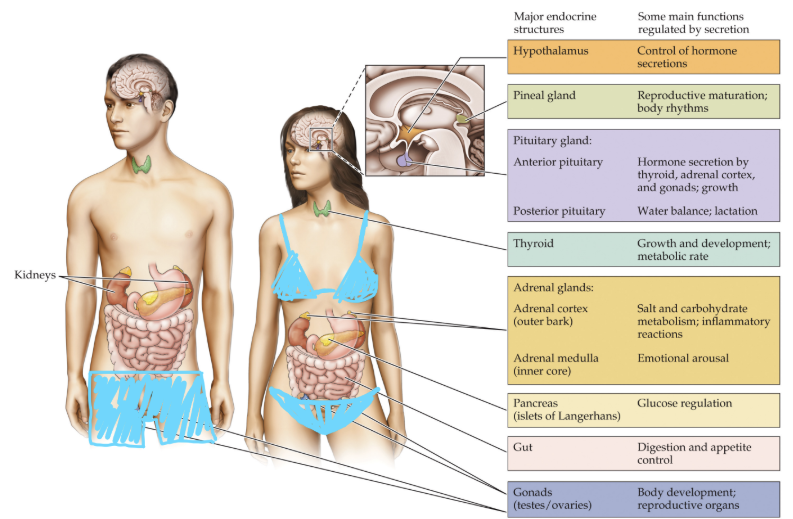
The first formal study of endocrinology
Conducted by Arnold Berthold in 1849
Castration
removal of the gonads (testes) → results in behavioral and physiological changes
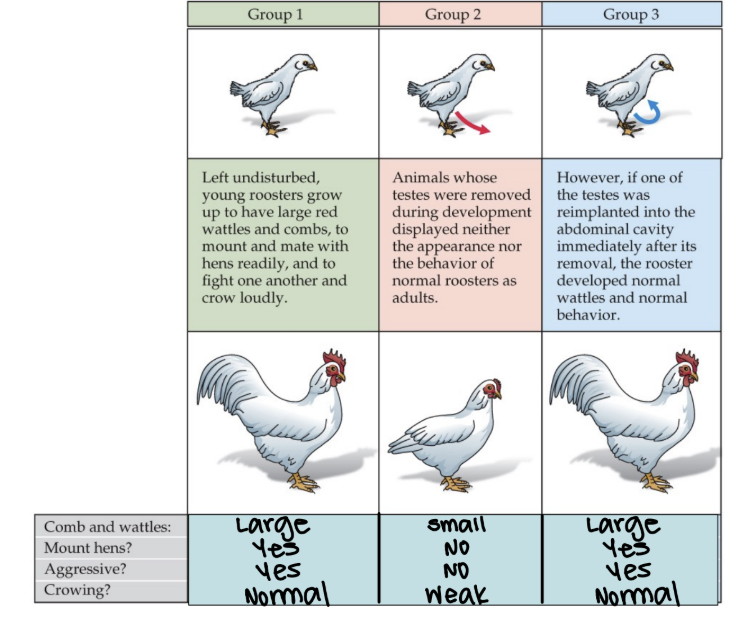
Berthold demonstrated experimentally that…
a product released from testes into the blood is necessary for an immature chicken to develop into a normal male rooster, both behaviorally and physically
exposure to hormones early in life
The brain and body are “organized” by ____________, and these changes can be dramatic and long-lasting
hormones “activate” behaviors
Later in life, ____________, but their effects tend to be less dramatic and short-lived
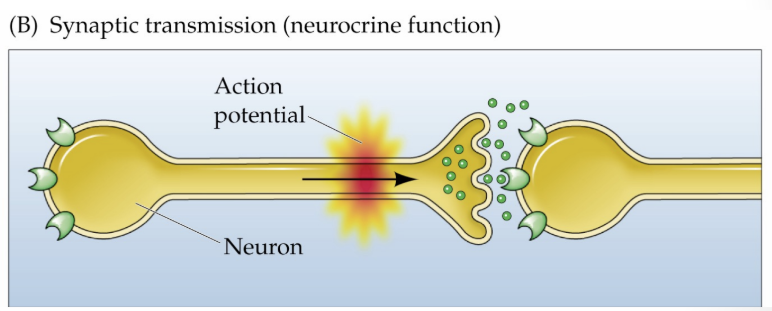
Synaptic communication
involves chemical release into the synaptic cleft for action on the postsynaptic membrane
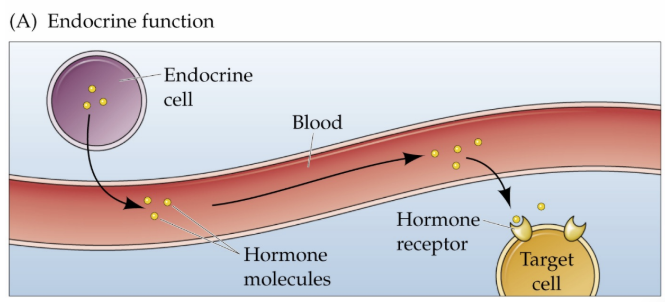
Endocrine communication
a hormone released into the bloodstream to act on target issues
Neuroendocrine (or neurosecretory) cells
neurons that release hormones into the blood
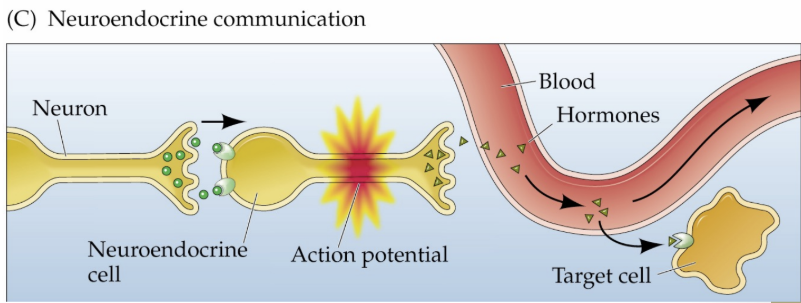
Synaptic communication:
travels only across a synaptic cleft to act on receptor
signal travels along a laid path (circuit)
very fast
Endocrine communication:
Spreads anywhere throughout the body if there is a blood supply; can act on cells with the appropriate receptor
Relatively slower

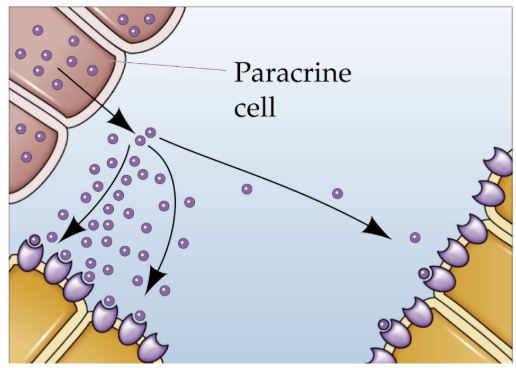
Paracrine function
the released chemical diffuses to nearby target cells (e.g., synaptic transmission)
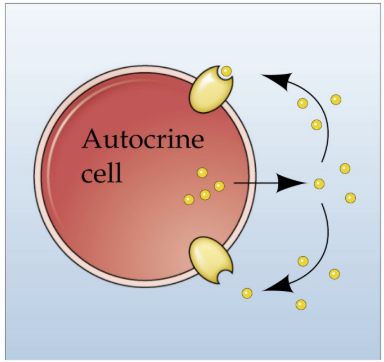
Autocrine function
a released chemical acts on the releasing cell
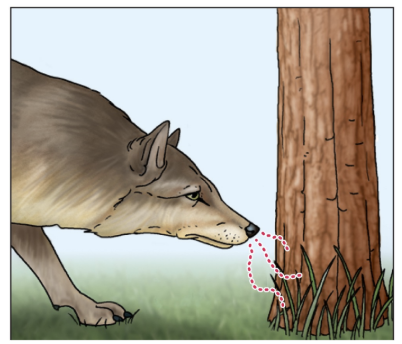
Pheromone function
hormones can be used to communicate between individuals of the SAME species; pheromones are released into the environment
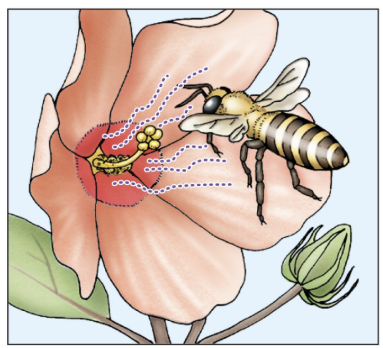
Allomone function
Allomones are chemicals released by one species to affect the behavior of ANOTHER species
gradual
Hormones act in a _________ fashion
probability or intesity
Hormones act by changing the ____________________________ of a behavior
DO NOT
Hormones _______ make you do anything
reciprocal, or bidirectional relationship
Hormones can affect behavior, and behavior can affect hormones
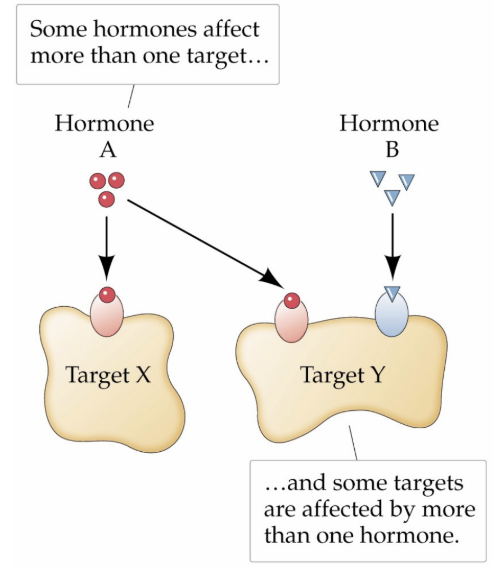
multiple; several
A hormone may have ____ effects, and one behavior can be affected by ______ hormones
pulsatile
Hormones often act in a _______ secretion pattern (i.e., bursts)
change their affects
Hormones can interact with other hormones and…
with a receptor for that hormone
Hormones can only affect cells…
Peptide hormone, Amine hormones, Steroid hormones
Chemical structure of hormones:
Peptide hormone
a string of amino acids
Amine hormones
modified amino acids, called monoamine hormones
Steroid hormones
four rings of carbon atoms (derivatives of cholesterol)
neurotransmitters AND hormones
Some chemicals can act as both…
→ It depends on the cells that release them, and where they are released
peptide hormones
most common type of hormone found in animals
peptides hormones
Only a few amino acids in length
protein hormones
larger ones (>50 amino acids)
peptide hormones
Can be stored within the cell (in vesicles)
peptide hormones
LARGE (can’t pass through cell membranes)
oxytocin, insulin, leptin
examples of peptide/protein hormones
Indoleamines (e.g., serotonin) and catecholamines (e.g., epinephrine, dopamine)
two classes of amine hormones affect behavior
they don’t affect behavior
Thyroid hormones are also monoamines, but…
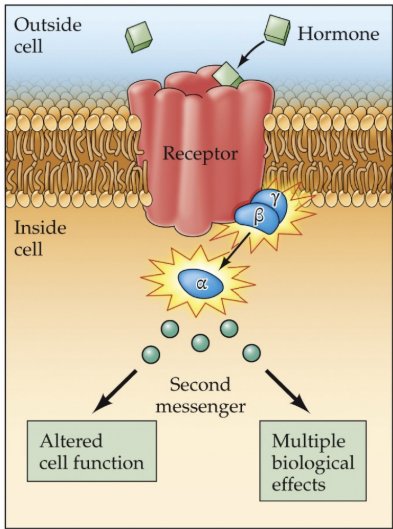
within the cell membrane; which brings about changes in cellular function
Protein and amine hormones bind to specific receptors embedded _______________and cause the release of a second messenger…
FAST
peptide hormone action is relatively _______(effects on order of ms to min)
Steroid hormones
Most come from the adrenal glands and gonads
Steroid hormones
Small and lipophilic (passes through cell membrane)
Steroid hormones
Never stored and some require carrier proteins, or cofactors
estrogens, androgens
examples of steroid hormones
bind to receptors inside the cell
Steroid hormones pass through the cell membrane and…
transcription factor
The steroid-receptor complex binds to DNA in the nucleus and acts as a…
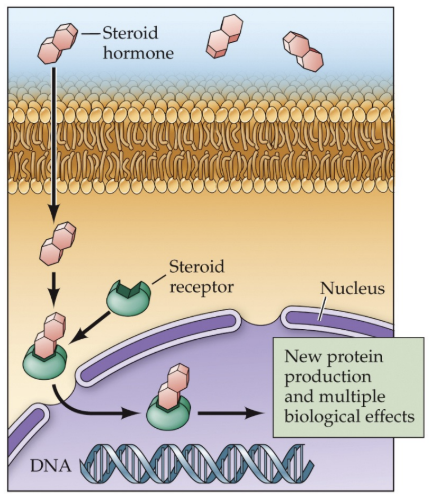
steroid hormone action → transcription factor
controlling gene expression and protein production—hence, effects are longer-lasting
SLOW
steroid hormone action relatively ______ (effects usually on order of hours to days)
Genomic action
steroid hormone action is called…
nongenomic action
Estradiol (steroid hormone) can have a rapid, brief effect involving neuronal membrane receptors
Neurosteroids
steroids made in the brain, including testosterone and estrogens
combining an enzyme with a different hormone
Many steroid hormones are made by…
aromatase
an enzyme that can convert testosterone into estrogens inside a cell
positive feedback and negative feedback
Hormones are regulated by feedback systems:
negative feedback
output feeds back and inhibits further secretion
positive feedback
output feeds back and increases further secretion
negative feedback
more common feedback in terms of hormone regulation
autocrine negative feedback loop
involves endocrine cells releasing a hormone whose presence feeds back on the endocrine cells
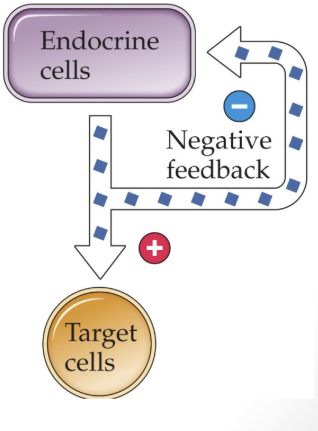
target cell feedback
the hormone acts on its target cells and has a biological effect
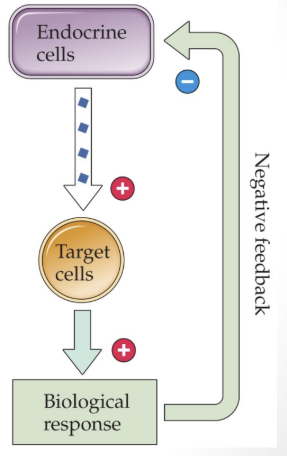
further release is inhibited
The biological effect is detected by the endocrine gland and…
example of target cell feedback
insulin release in response to glucose after eating
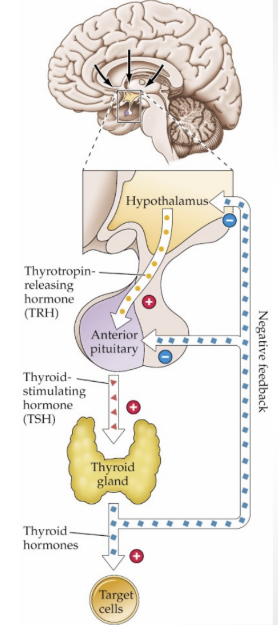
hypothalamus
A more complex endocrine system involves the brain, usually the _________
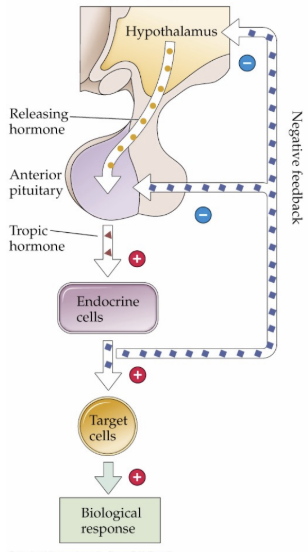
releasing hormones; tropic hormones; the pituitary and the hypothalamus
First the hypothalamus uses _________ to act on the anterior pituitary
Then the pituitary releases _________ that affect other endocrine cells
Negative feedback from the endocrine cells goes to both _____________
direct hormone release from endocrine glands (one of which is the pituitary gland)
Brain regulation involves the hypothalamus which can…
negative feedback on the hypothalamus
The brain detects the hormone’s effects and exerts…
Posterior pituitary, Anterior pituitary
The pituitary gland releases hormones, and has two main but separate parts:
oxytocin and vasopressin
The posterior pituitary secretes two principal hormones:
supraoptic nuclei and paraventricular nuclei
Neurons in the _________ and ___________ of the hypothalamus synthesize oxytocin and vasopressin
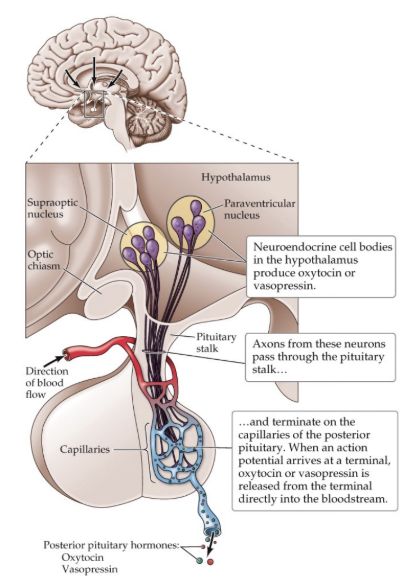
pituitary stalk
oxytocin and vasopressin travel along the ________ and into the blood supply in the posterior pituitary
posterior pituitary hormones
Because oxytocin and vasopressin are released into the blood supply of the posterior pituitary, they are called…
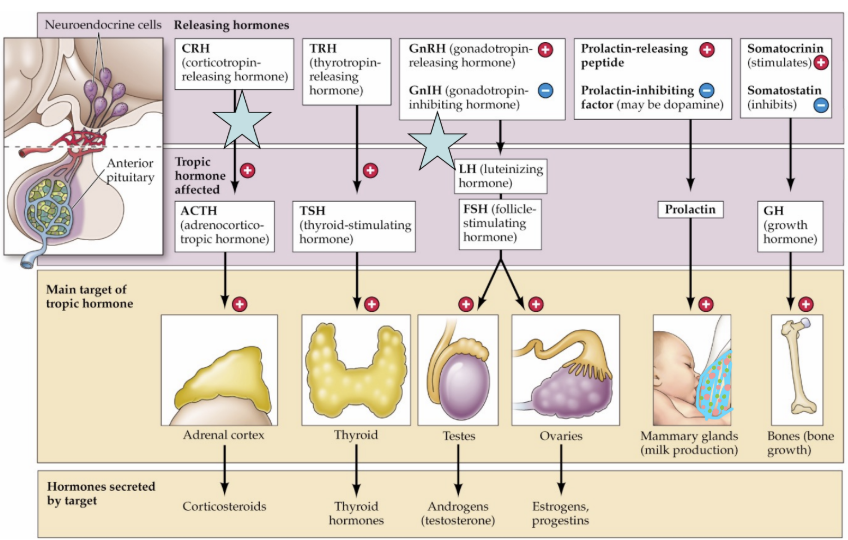
releasing hormones
Some hypothalamic neuroendocrine cells synthesize _____________
anterior pituitary
The hypothalamus communicates with the ________ differently, requiring additional steps
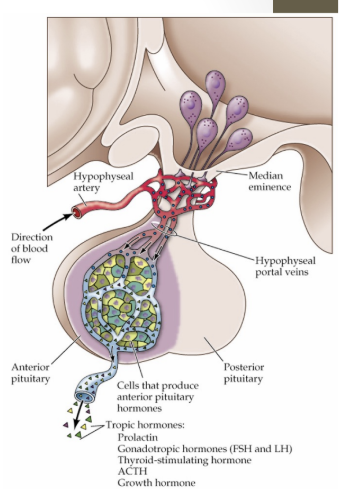
median eminence
Axons from hypothalamic neuroendocrine cells converge on the __________, above the pituitary stalk
hypophyseal portal system
Releasing hormones are secreted into blood vessels called the ____________, and are carried to the anterior pituitary
tropic hormones
The releasing hormones stimulate specific cells in anterior pituitary to release _________ into general circulation, where they’ll travel through the body to their targets
Circulating messages, such as other hormones, blood sugar, immune system products, and synaptic inputs from other brain areas
The hypothalamic neuroendocrine cells that synthesize releasing hormones are influenced by:
Hypothalamic-pituitary-thyroid axis
Example of Complex Endocrine Regulation
Secretions of the Anterior Pituitary
physiology; behavior
Hormones can affect both _______ as well as ________
hormones affecting physiology
Oxytocin stimulates uterine contractions and is involved in milk letdown (nursing)
hormones affecting behavior
Oxytocin is released during nursing interactions and during O to facilitate bonding; in female prairie voles, it promotes pair-bonds; Vasopressin facilitates the formation of pair-bonds in male prairie voles
Sex
biological sex, the physical body
Essentially the “biological and physiological characteristics that distinguish females from males”
Gender
social concept, self-identification
This includes “socially constructed roles, relationships, behaviors, relative power, and other traits societies ascribe to women and men”
Sex determination
the process by which the decision is made for a fetus to develop as a male or a female
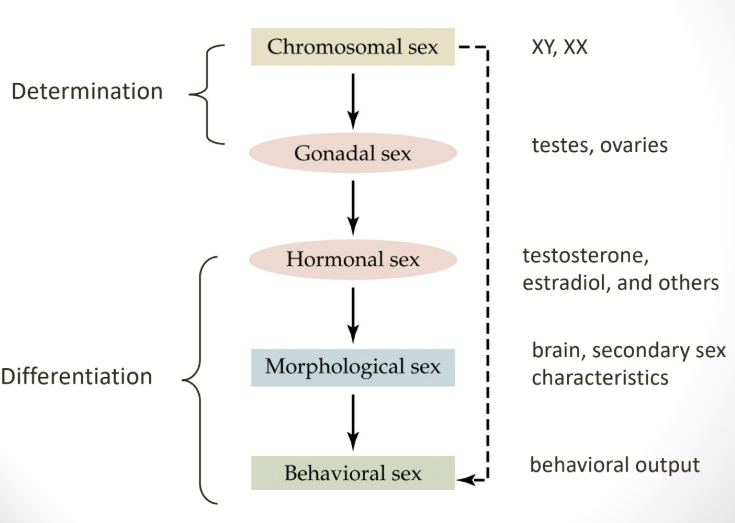
chromosome driven
Sex determination is…
Sexual differentiation
the process by which individuals develop either male or female bodies and behaviors
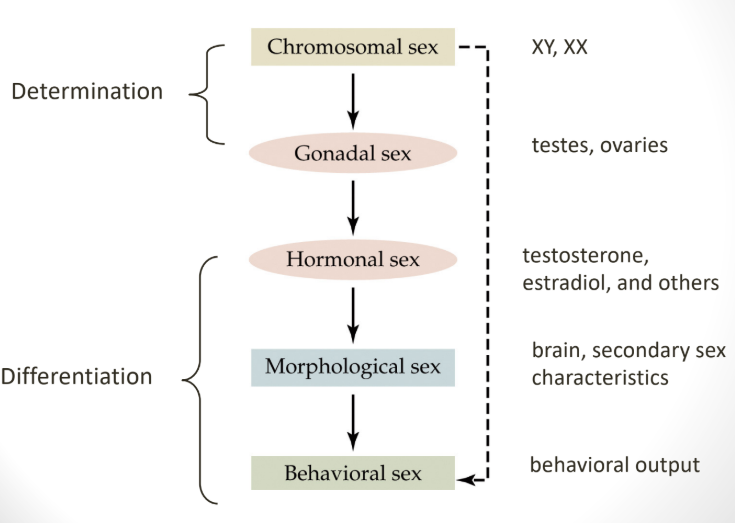
hormone driven
Sexual differentiation is…
the offspring will become male
If the sperm that enters the egg has an Y chromosome…
the offspring will become female
If the sperm that enters the egg has an X chromosome…
bipotential
When the gonads are first made, they are _________
the SRY gene, or sex-determining region of the Y chromosome
The Y chromosome has a gene (_____________) that codes for the development of testes from the bipotential gonad
an ovary forms
Without an SRY gene…
product of gametes and production of steroid hormones
The gonads serve two purposes:
steroid hormones are required for…
gamete production, development of secondary sex characteristics, behaviors that bring gametes together
testes
Male gonads =
androgen
primary steroid produced is testosterone, which is an __________
in utero
Testosterone production begins as soon as the testes are formed ________
masculine development
testosterone production helps guide…
ovaries
Female gonads =

