BIO 300 Lecture2.Cells
 Studied by 0 people
 Call Kai
 Learn
Learn Practice Test
 Spaced Repetition
 Match
Match Flashcards
 Knowt Play
1/110

Earn XP
Description and Tags
BIO 300 Pathophysiology
Name | Mastery | Learn | Test | Matching | Spaced | Call with Kai |
|---|
No analytics yet
Send a link to your students to track their progress
111 Terms
Eukaryotic Cell General areas
• Protoplasm = internal matrix of cell.
• Cell/Plasma membrane.
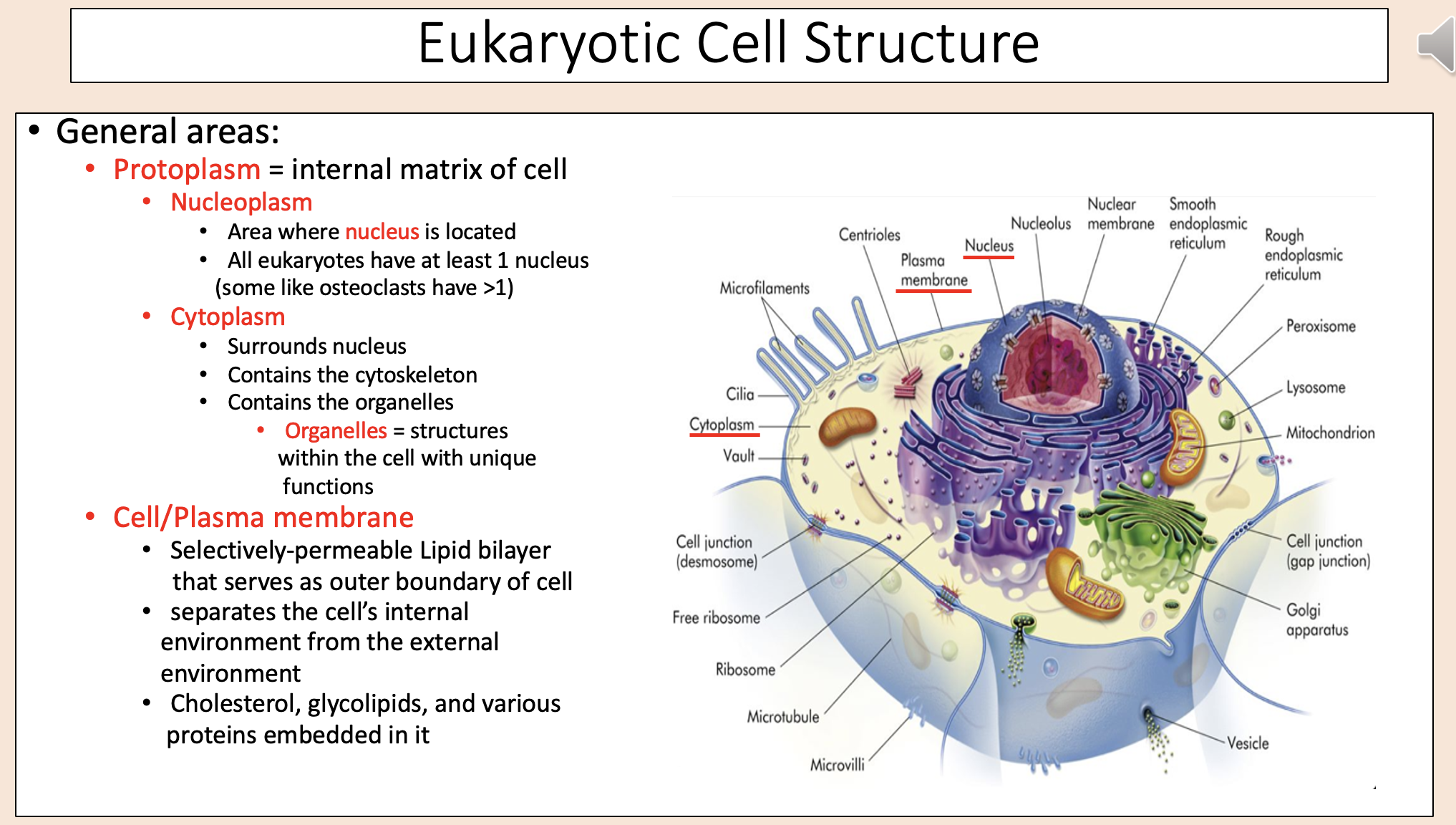
Protoplasm
Internal matrix of cell.
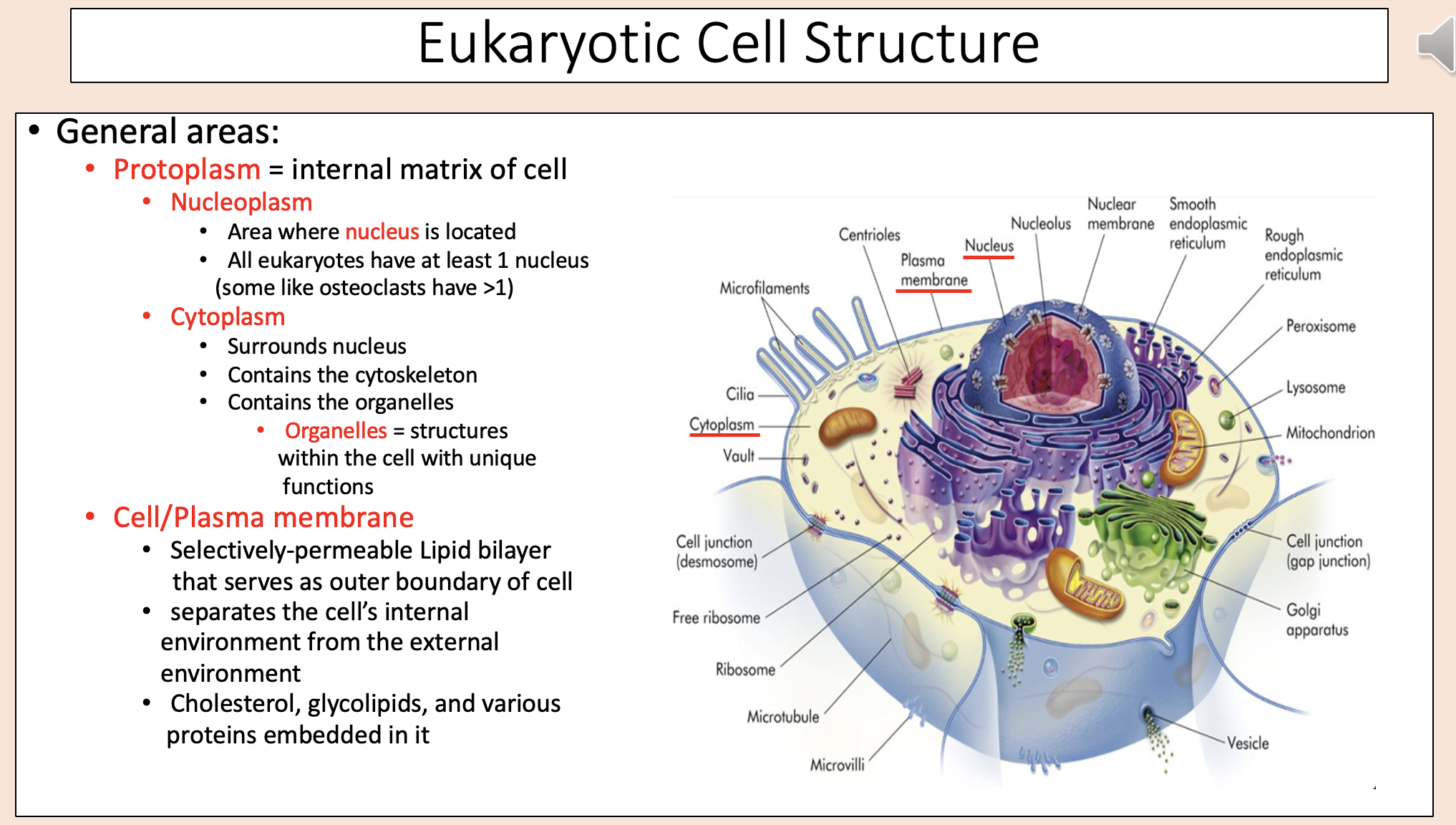
Protoplasm = internal matrix of cell
• Nucleoplasm.
• Cytoplasm.
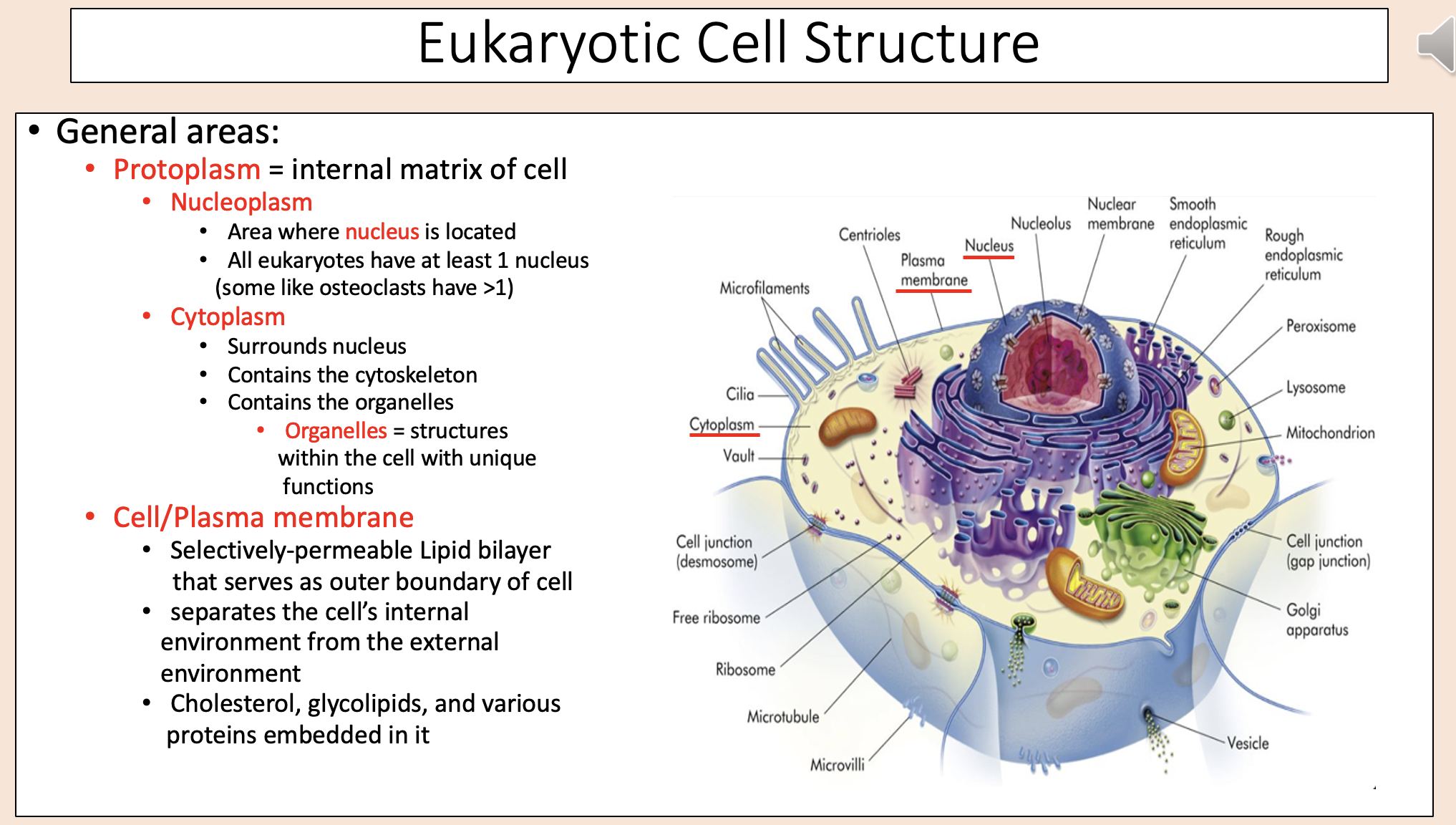
Nucleoplasm
• Area where nucleus is located.
• All eukaryotes have at least 1 nucleus (some like osteoclasts have >1.
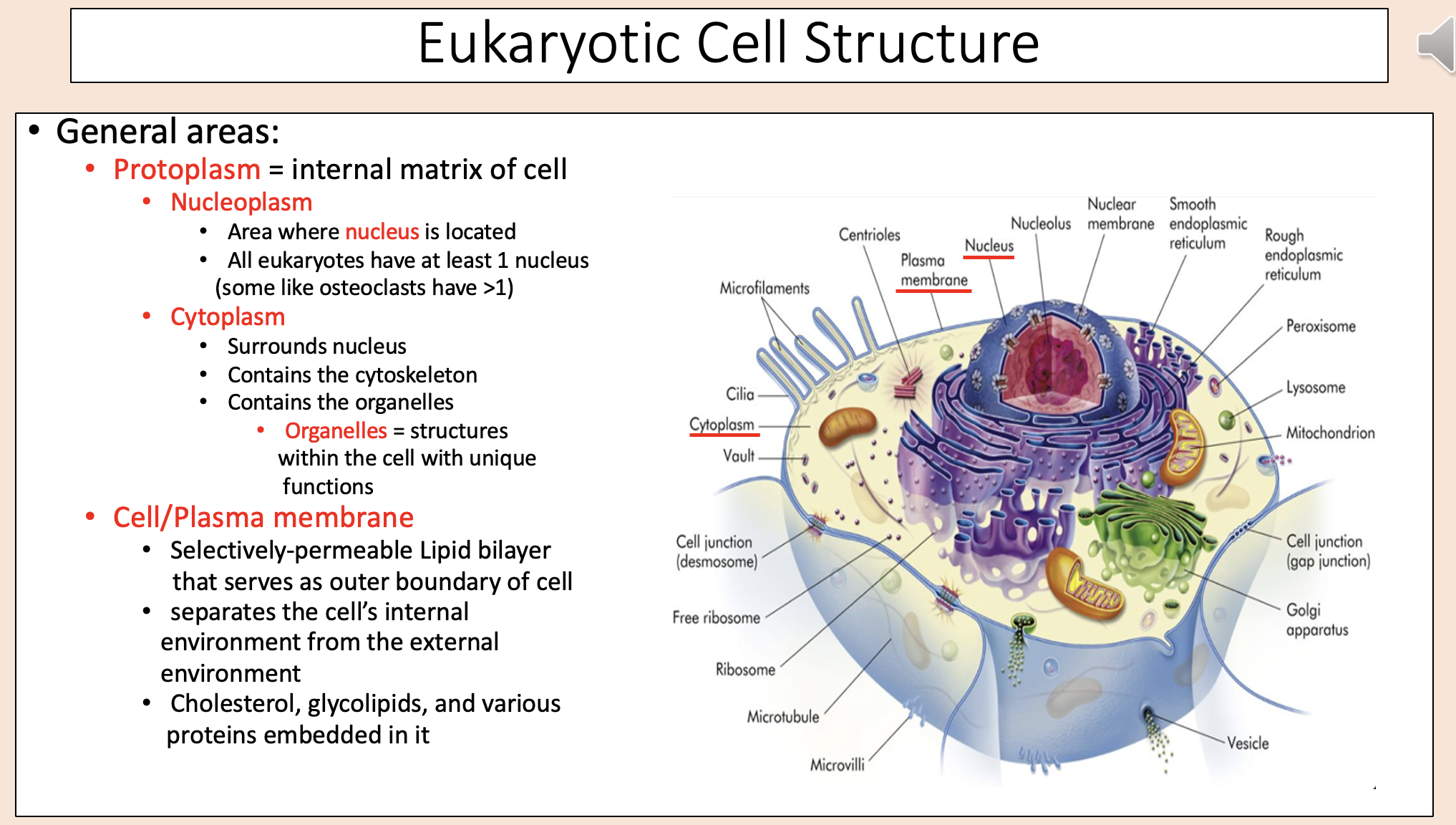
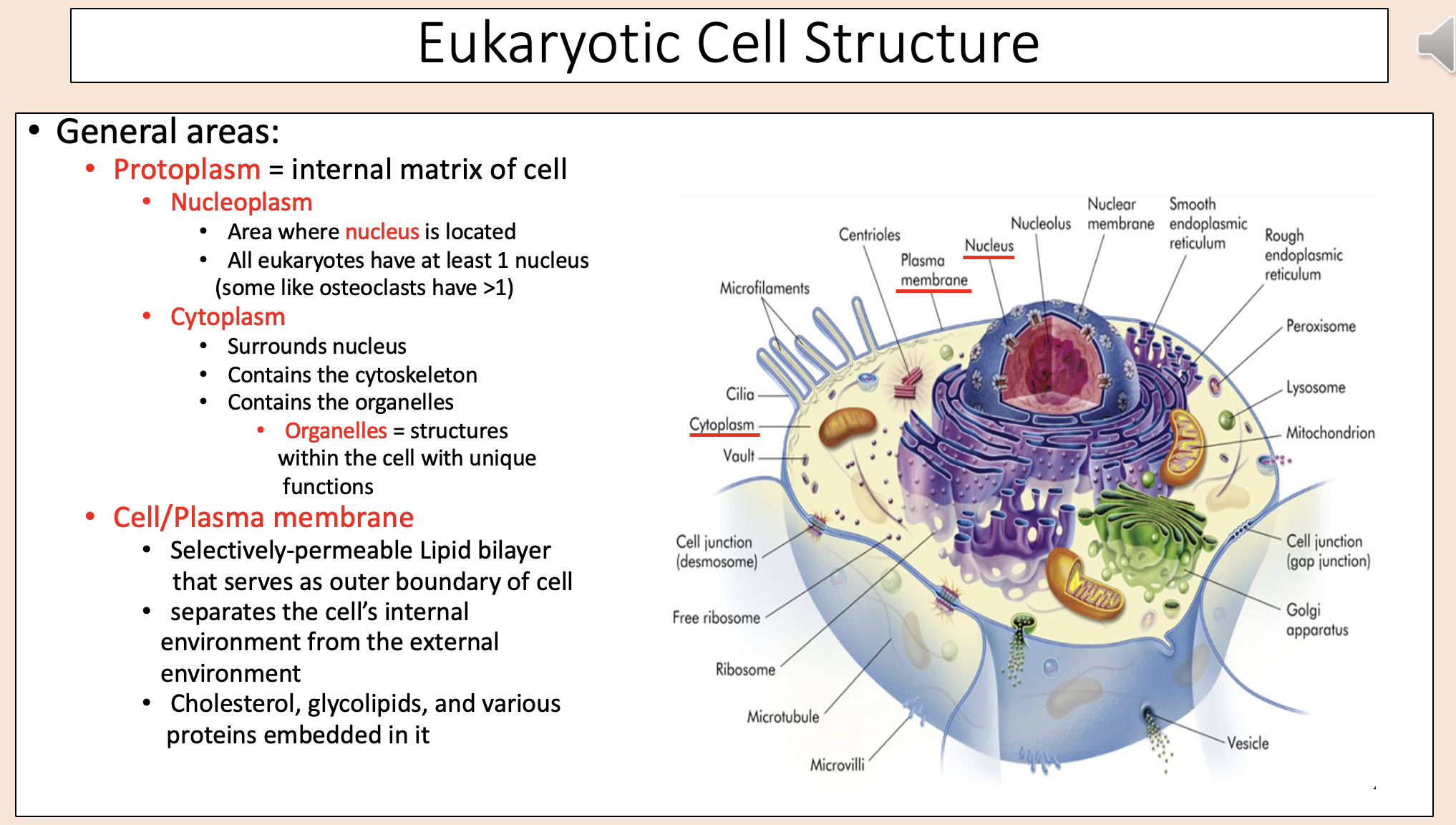
Cytoplasm
• Surrounds nucleus.
• Contains the cytoskeleton.
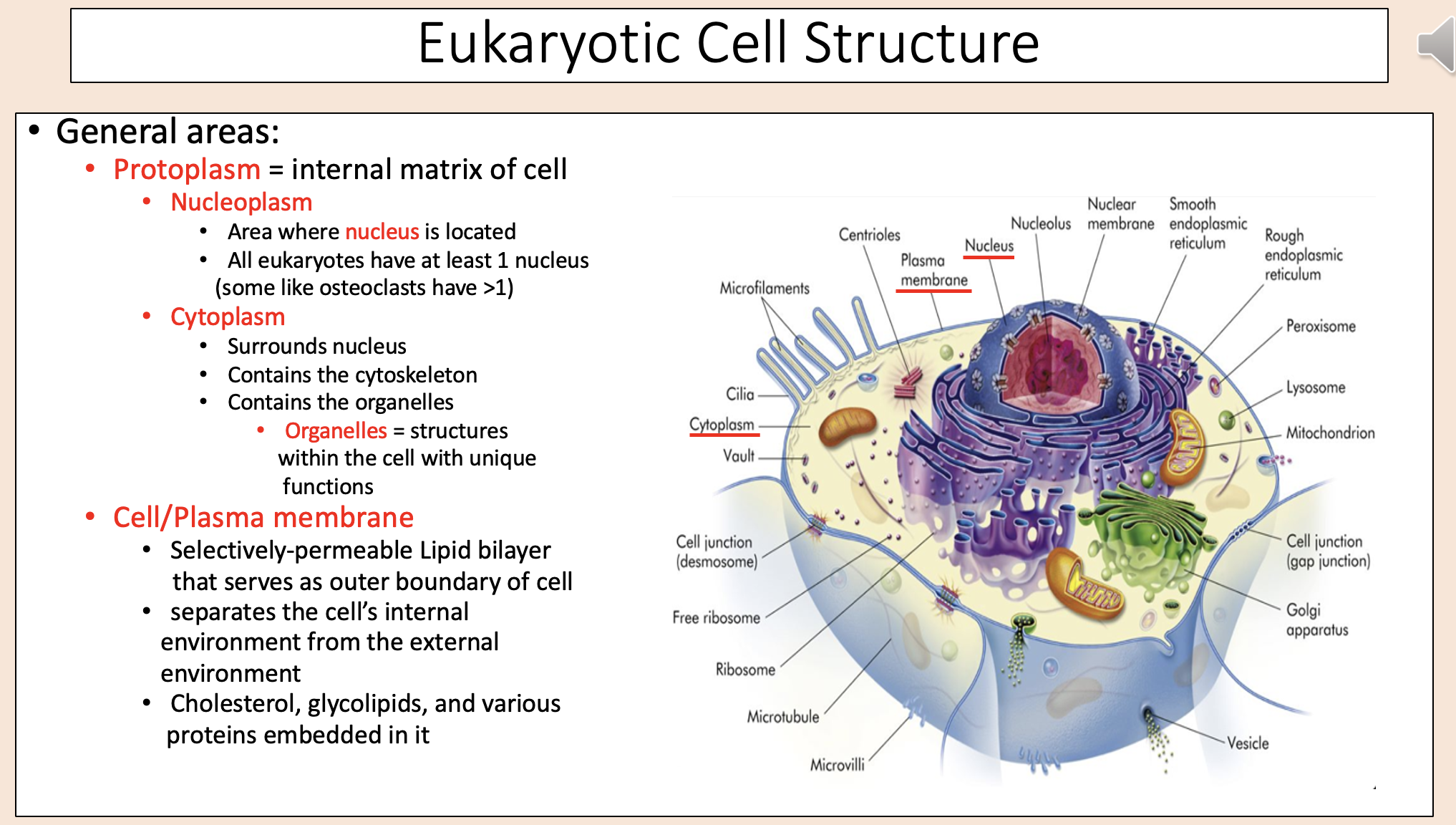
• Contains the organelles.
Cytoplasm
Organelles = structures within the cell with unique functions.
Organelles
Structures within the cell with unique functions.
Cell/Plasma membrane
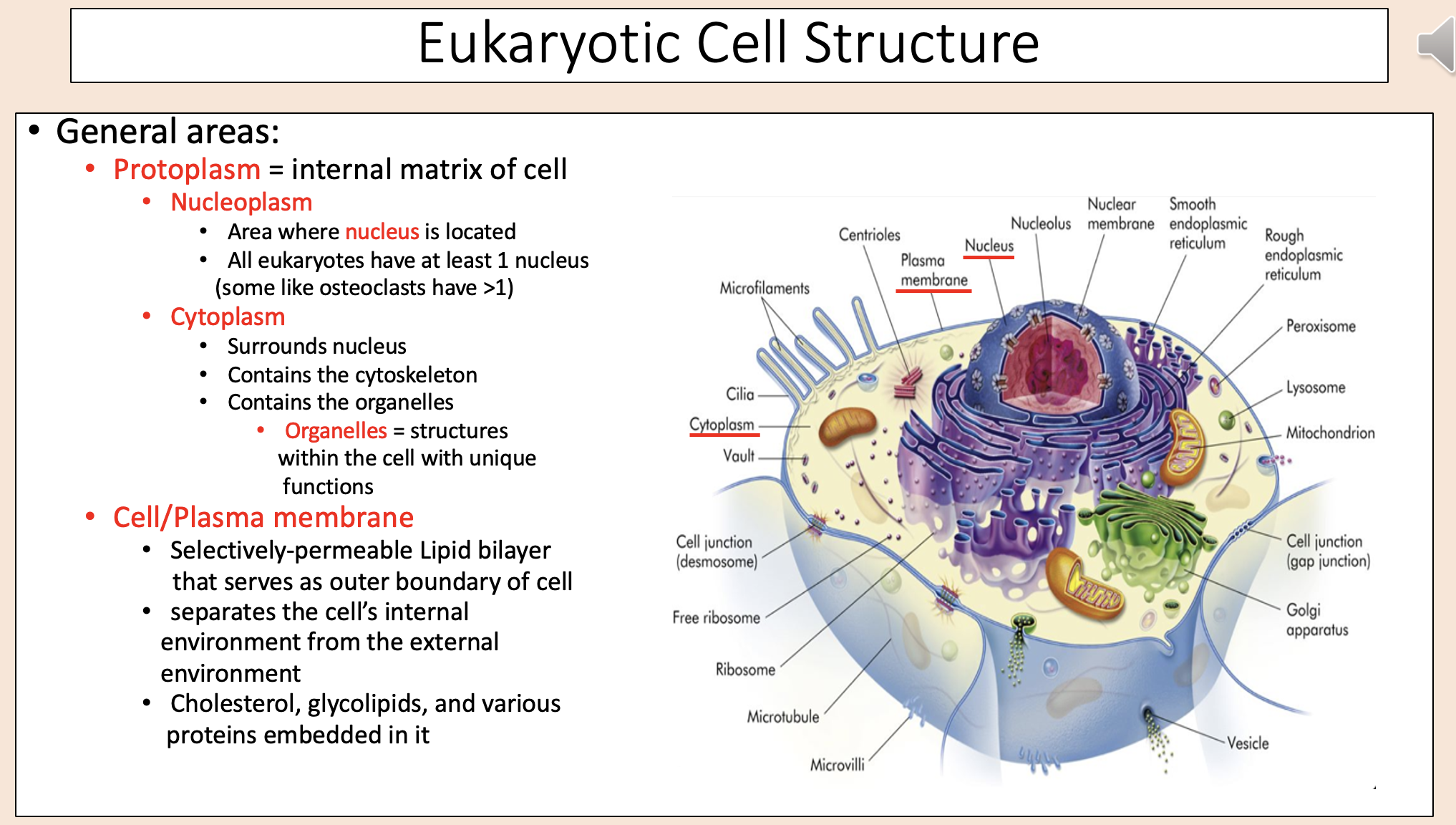
• Selectively-permeable Lipid bilayer that serves as outer boundary of cell.
• Separates the cell’s internal environment from the external environment.
• Cholesterol, glycolipids, and various proteins embedded in it.
Nucleus
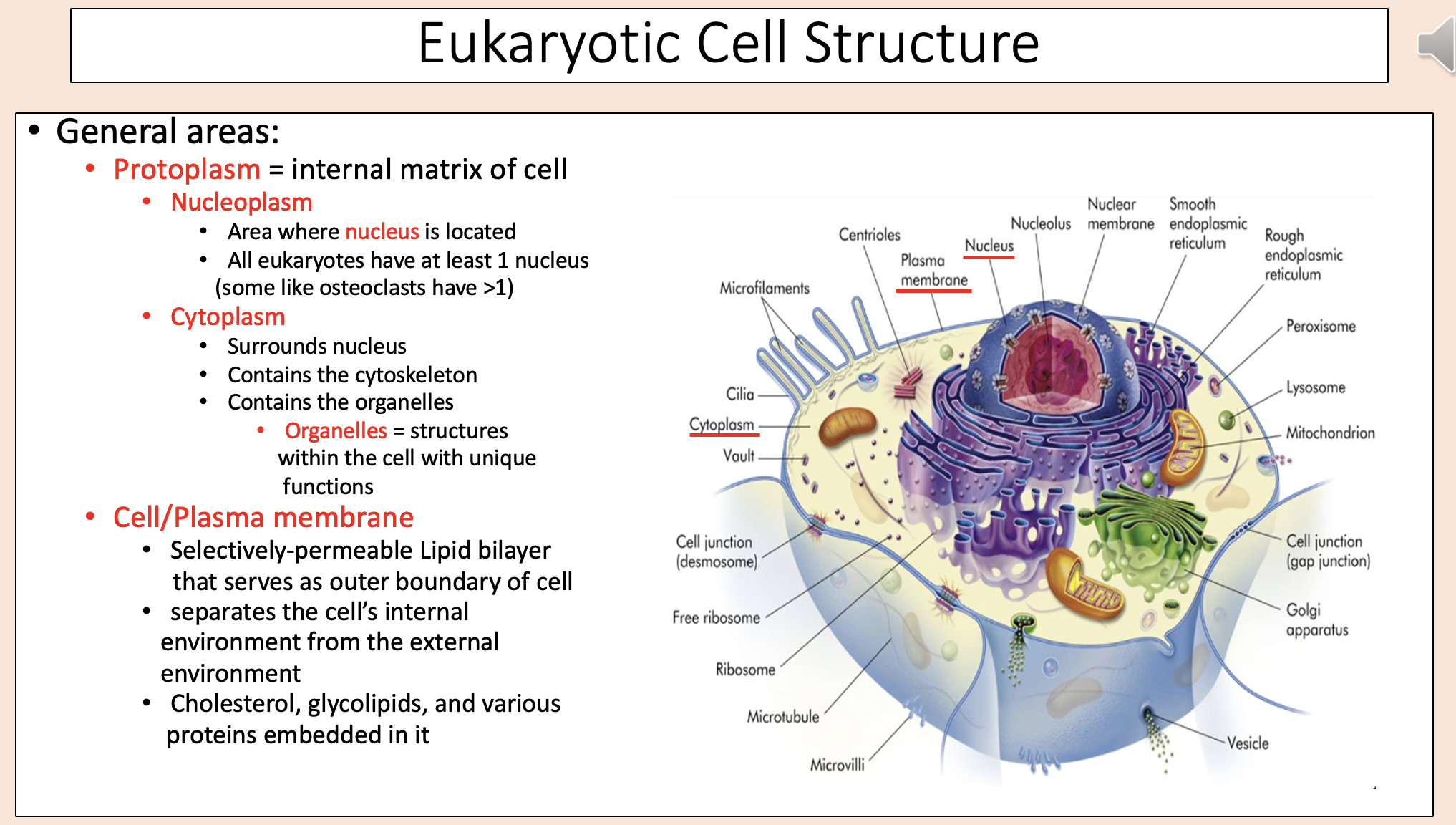
• “Control Center” of cell.
• Site for RNA production (m, t, & rRNA).
• Contains the nucleolus.
• Surrounded by a nuclear envelope.
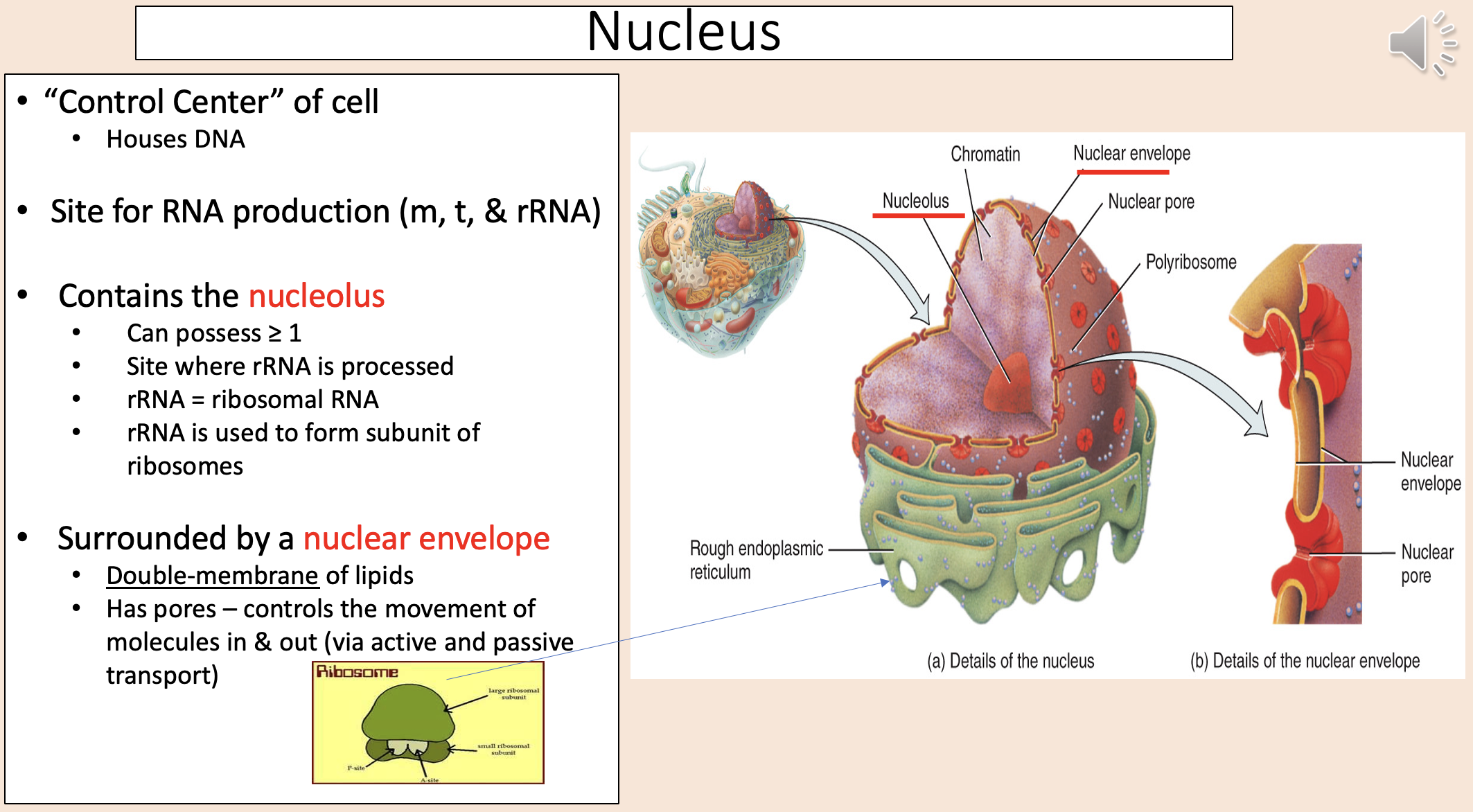
“Control Center” of cell
Houses DNA.
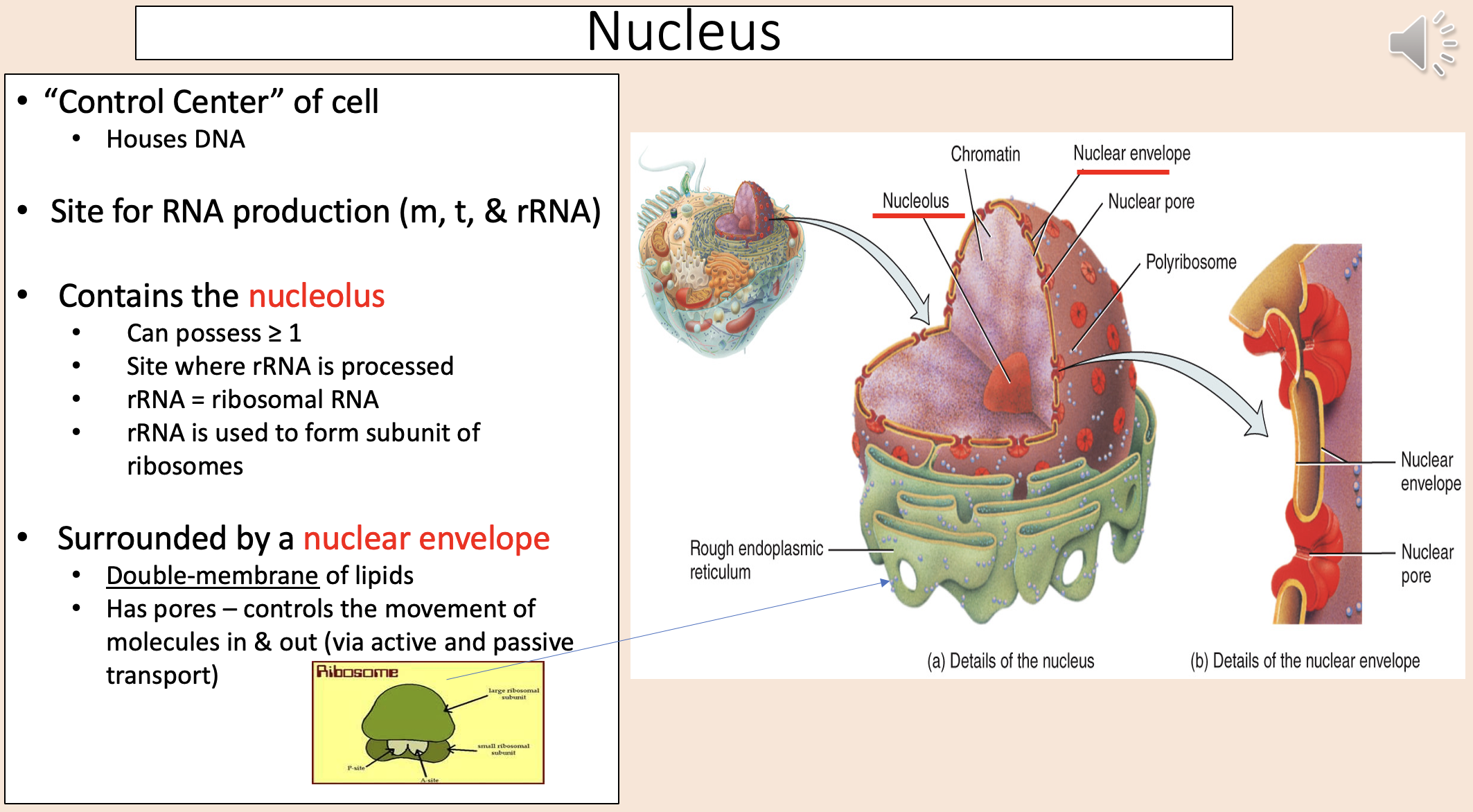
Contains the nucleolus
• Can possess ≥ 1.
• Site where rRNA is processed.
• rRNA = ribosomal RNA.
• rRNA is used to form subunit of ribosomes.
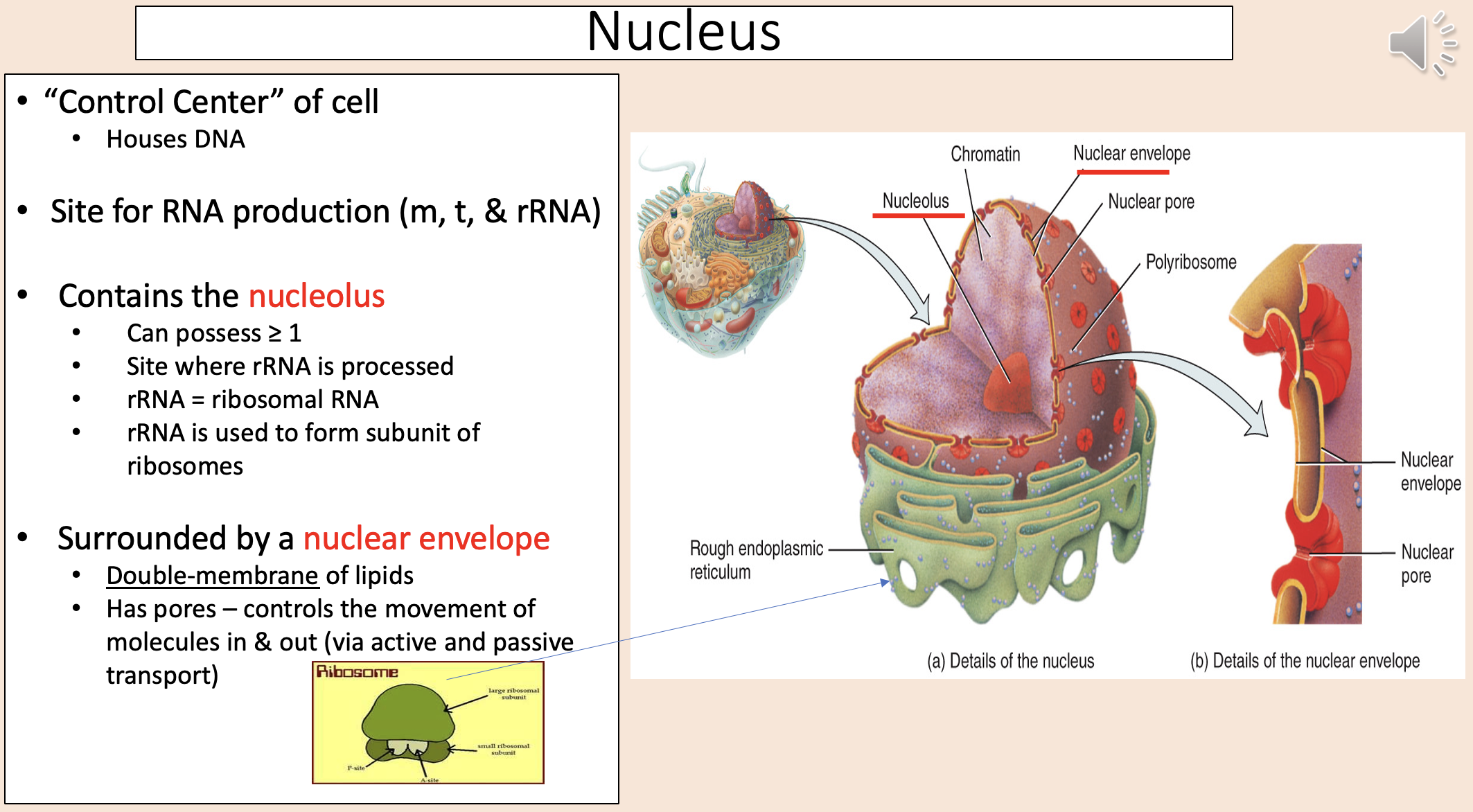
Surrounded by a nuclear envelope
• Double-membrane of lipids.
• Has pores – controls the movement of molecules in & out (via active and passive transport).
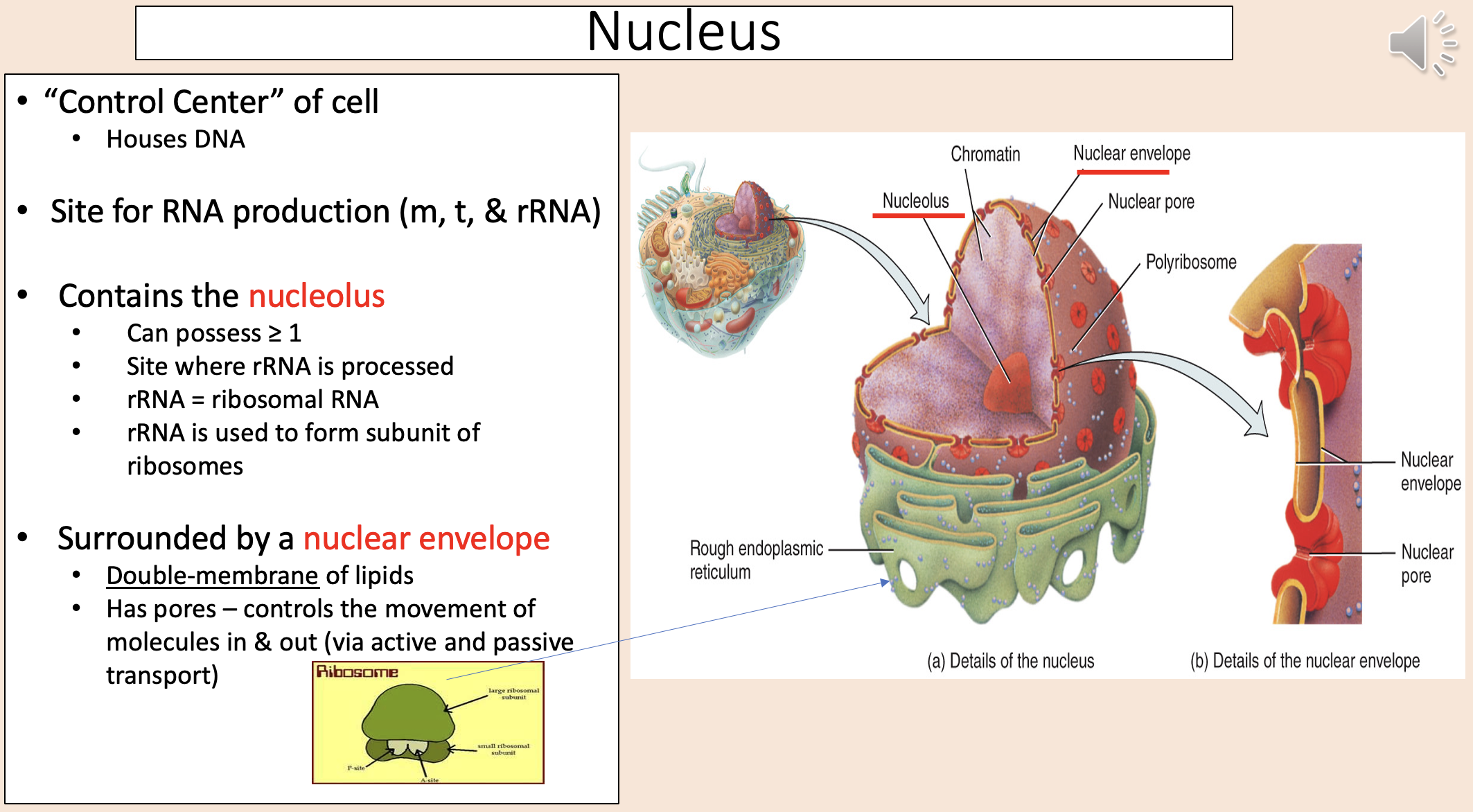
The nucleus houses our DNA...
• Recall DNA is a polymer of nucleotides arranged in a double helix.
• Chromosome.
• Sister chromatids.
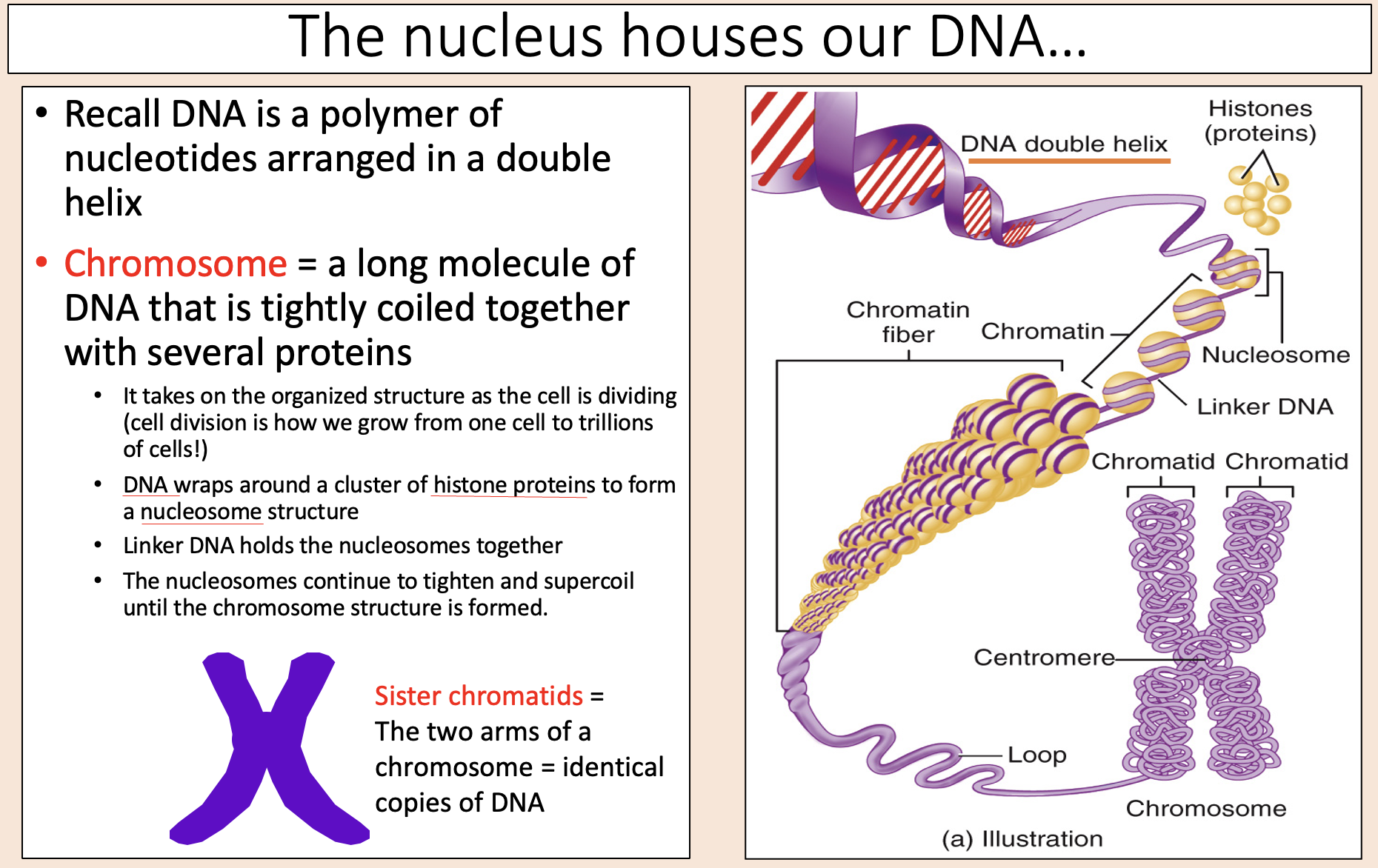
Chromosome
A long molecule of DNA that is tightly coiled together with several proteins.
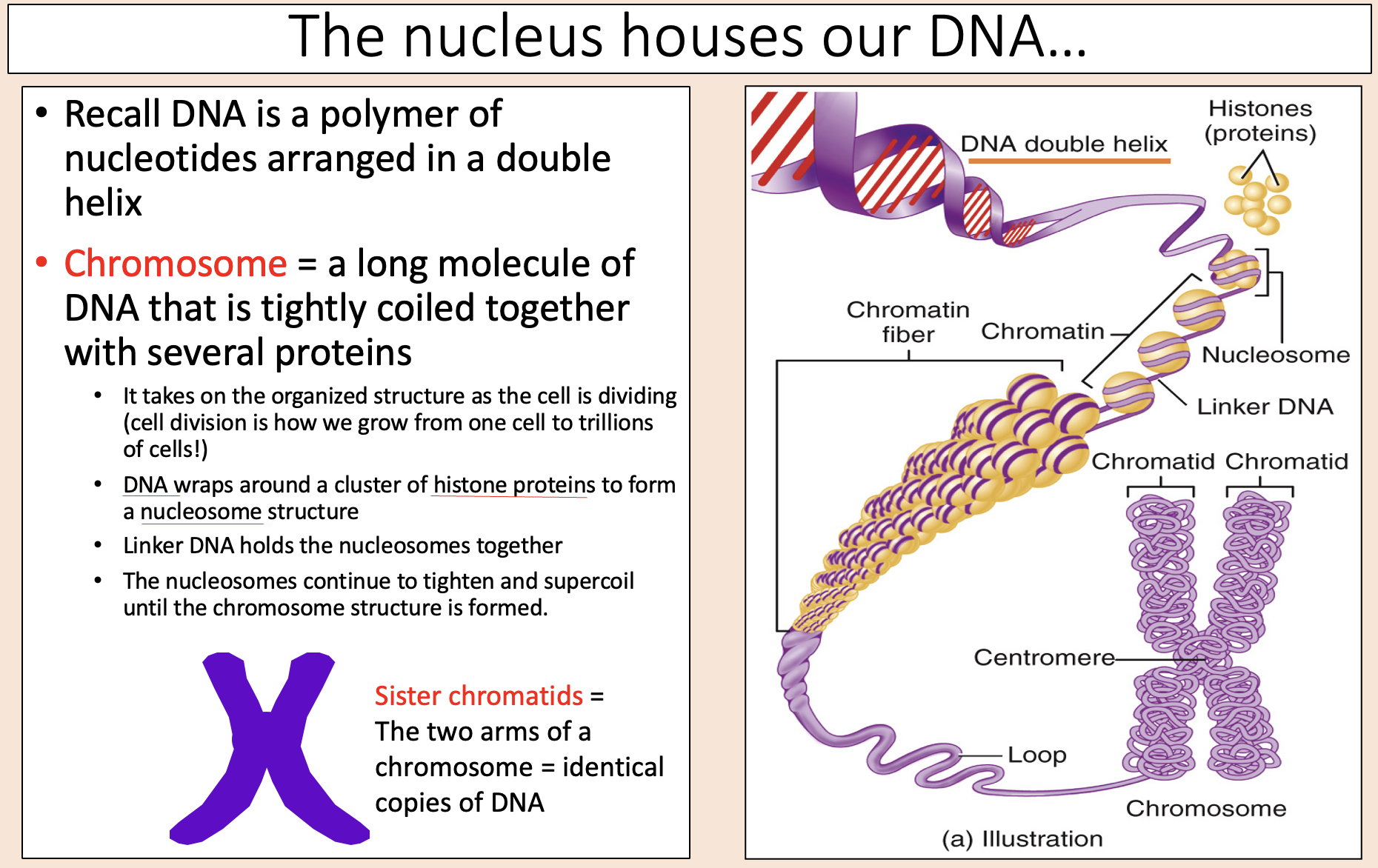
Chromosome = a long molecule of DNA that is tightly coiled together with several proteins
• It takes on the organized structure as the cell is dividing (cell division is how we grow from one cell to trillions of cells!).
• DNA wraps around a cluster of histone proteins to form a nucleosome structure.
• Linker DNA holds the nucleosomes together.
• The nucleosomes continue to tighten and supercoil until the chromosome structure is formed.
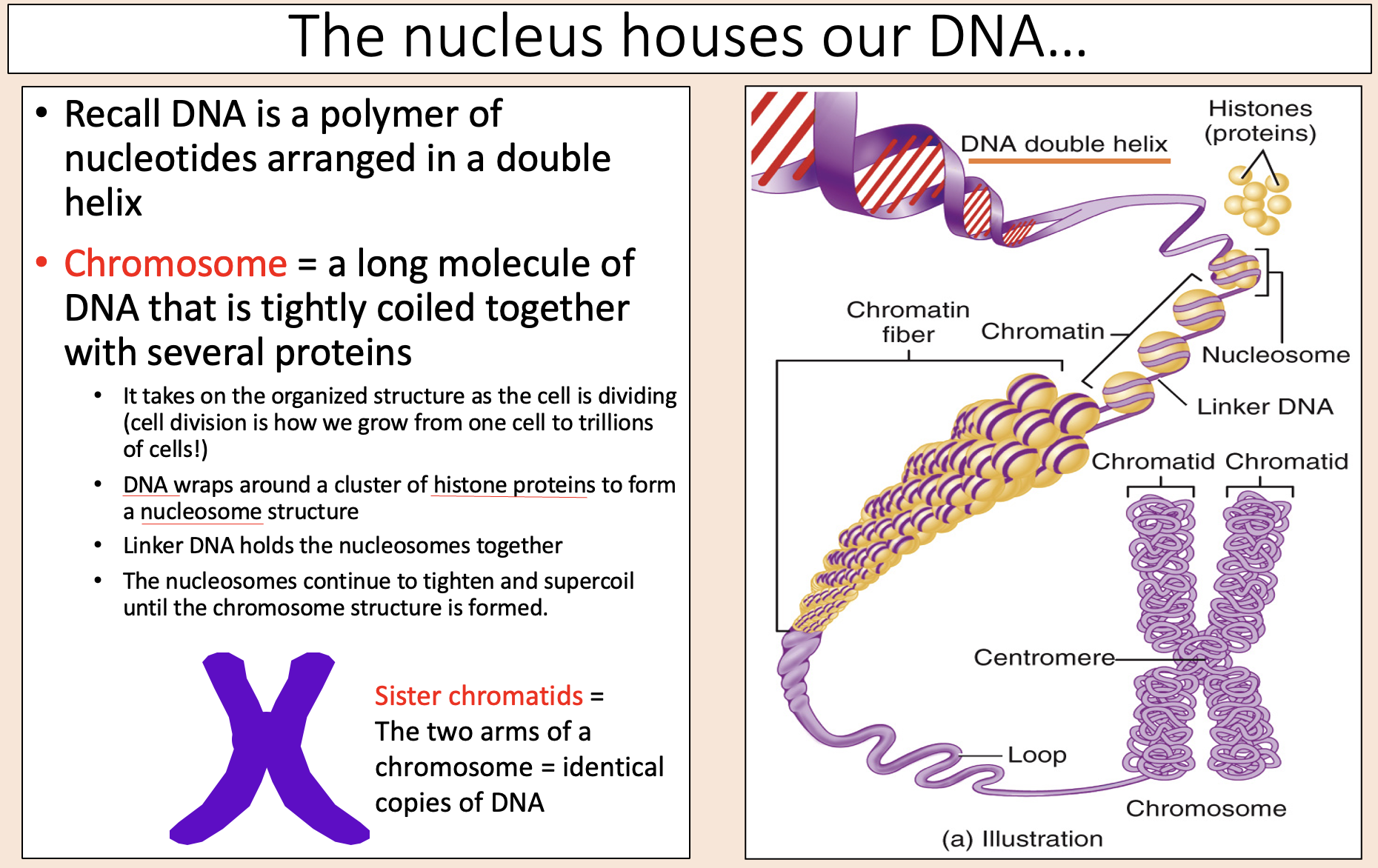
Sister chromatids
The two arms of a chromosome = identical copies of DNA.
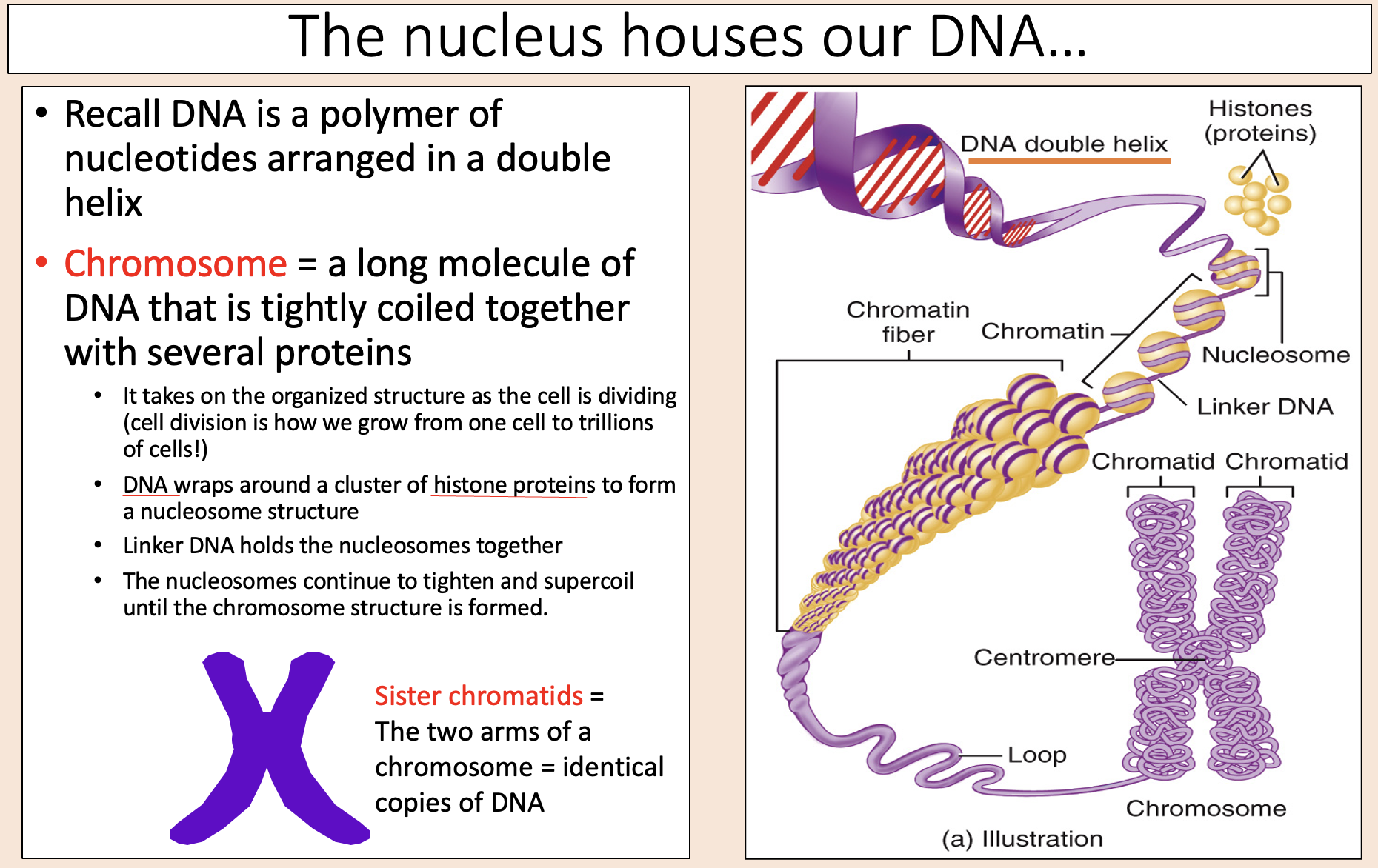
Closer Look at the Chromosome
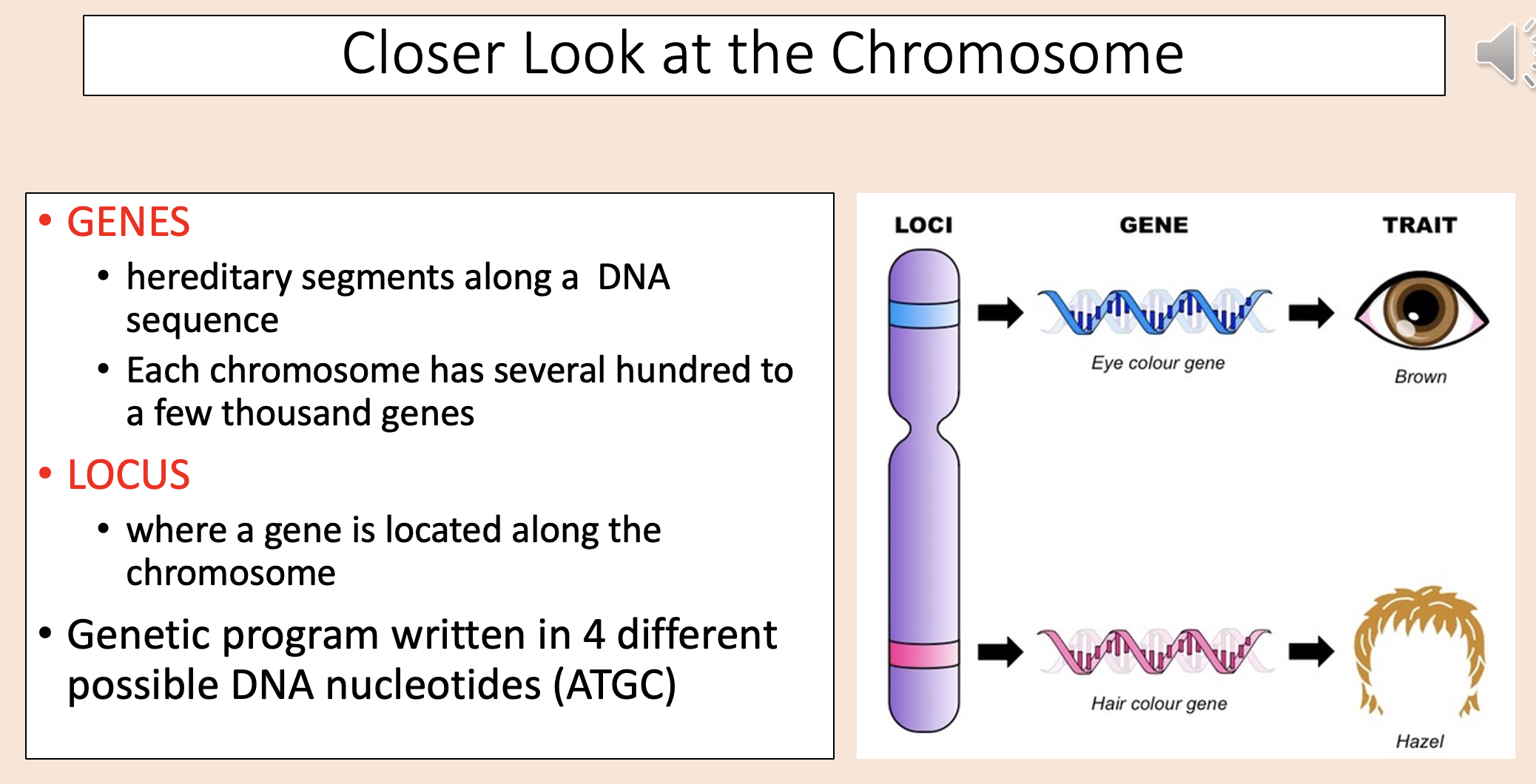
• GENES.
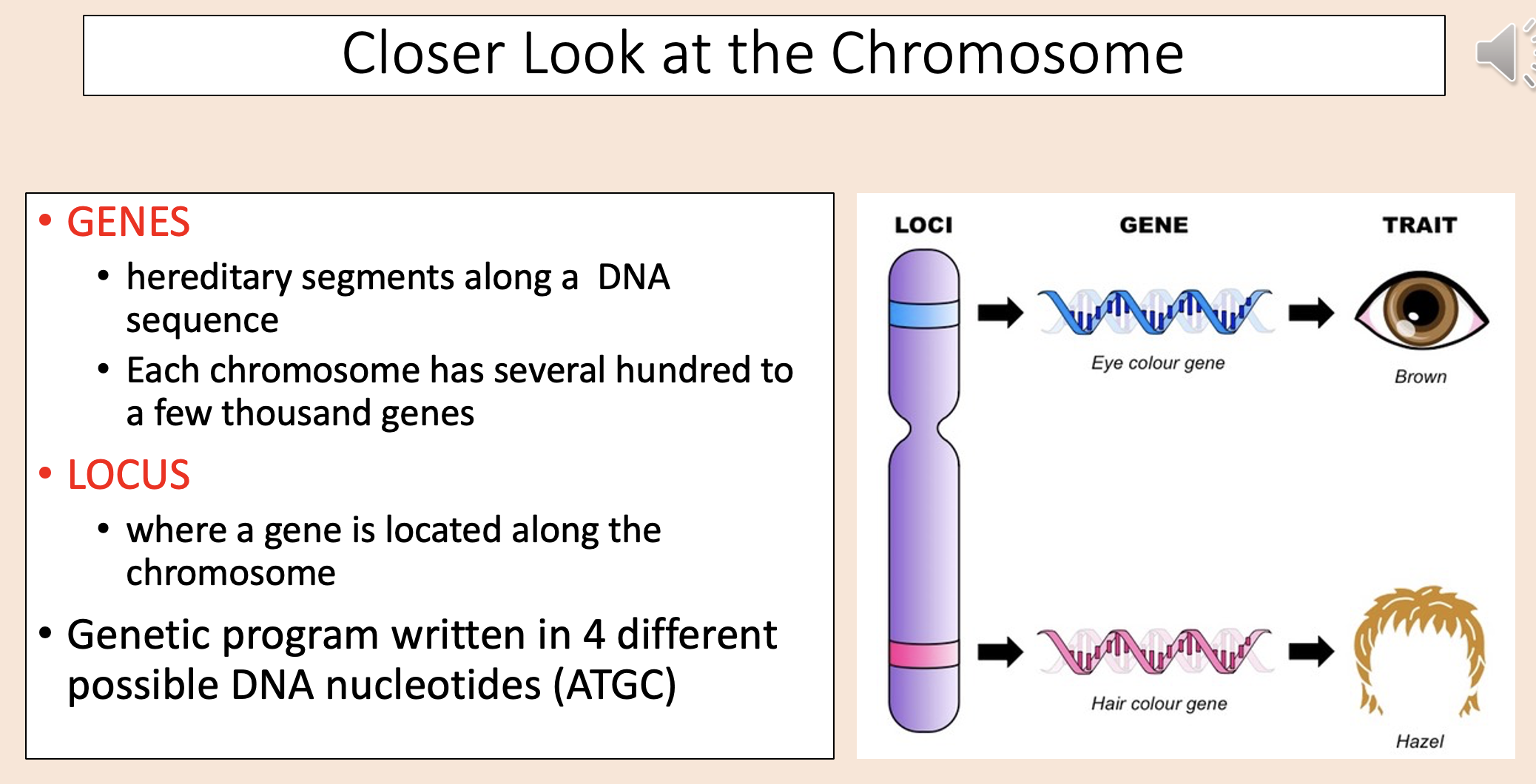
• LOCUS.
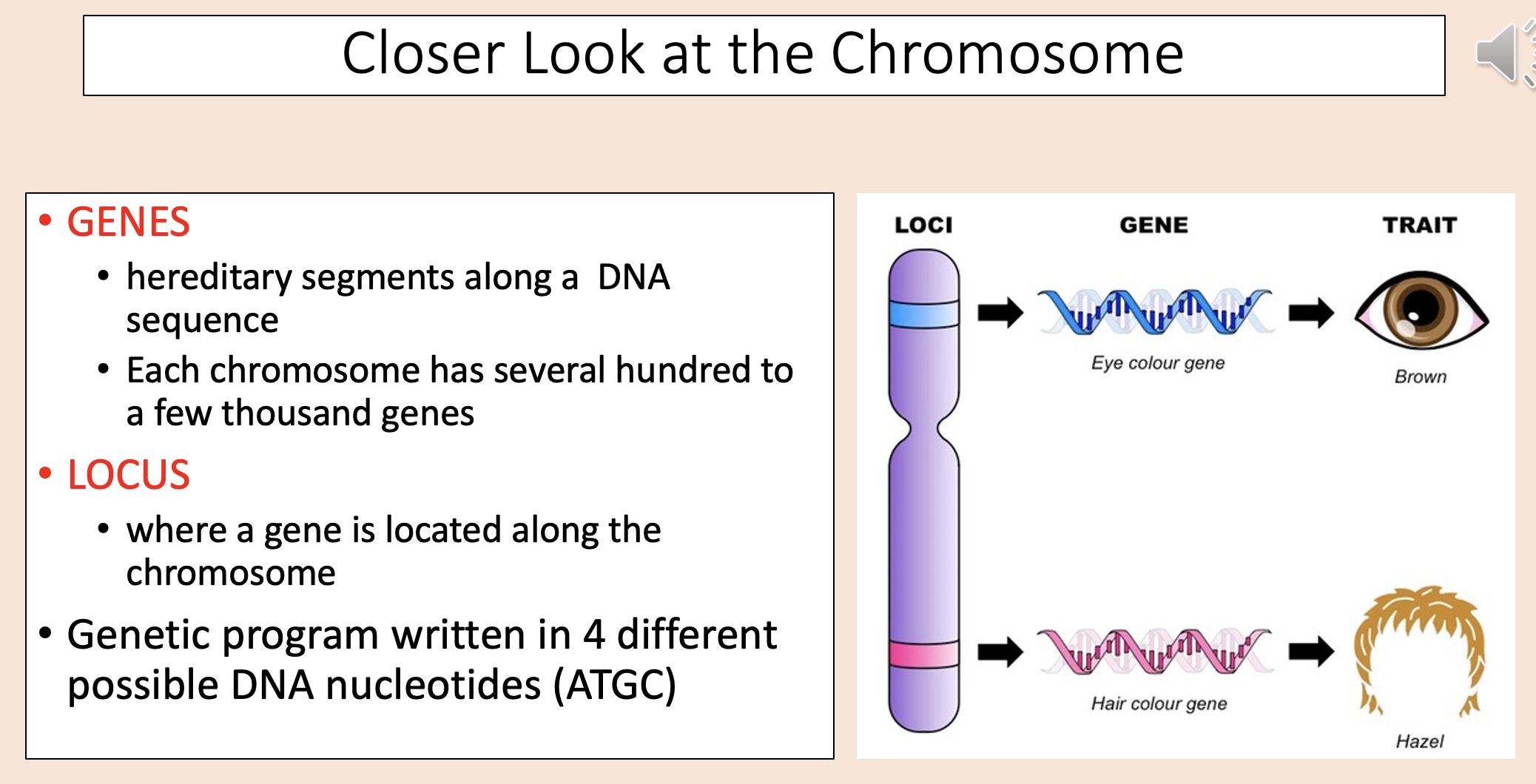
• Genetic program written in 4 different possible DNA nucleotides (ATGC).
GENES
• Hereditary segments along a DNA sequence.
• Each chromosome has several hundred to a few thousand genes.
LOCUS
Where a gene is located along the chromosome.
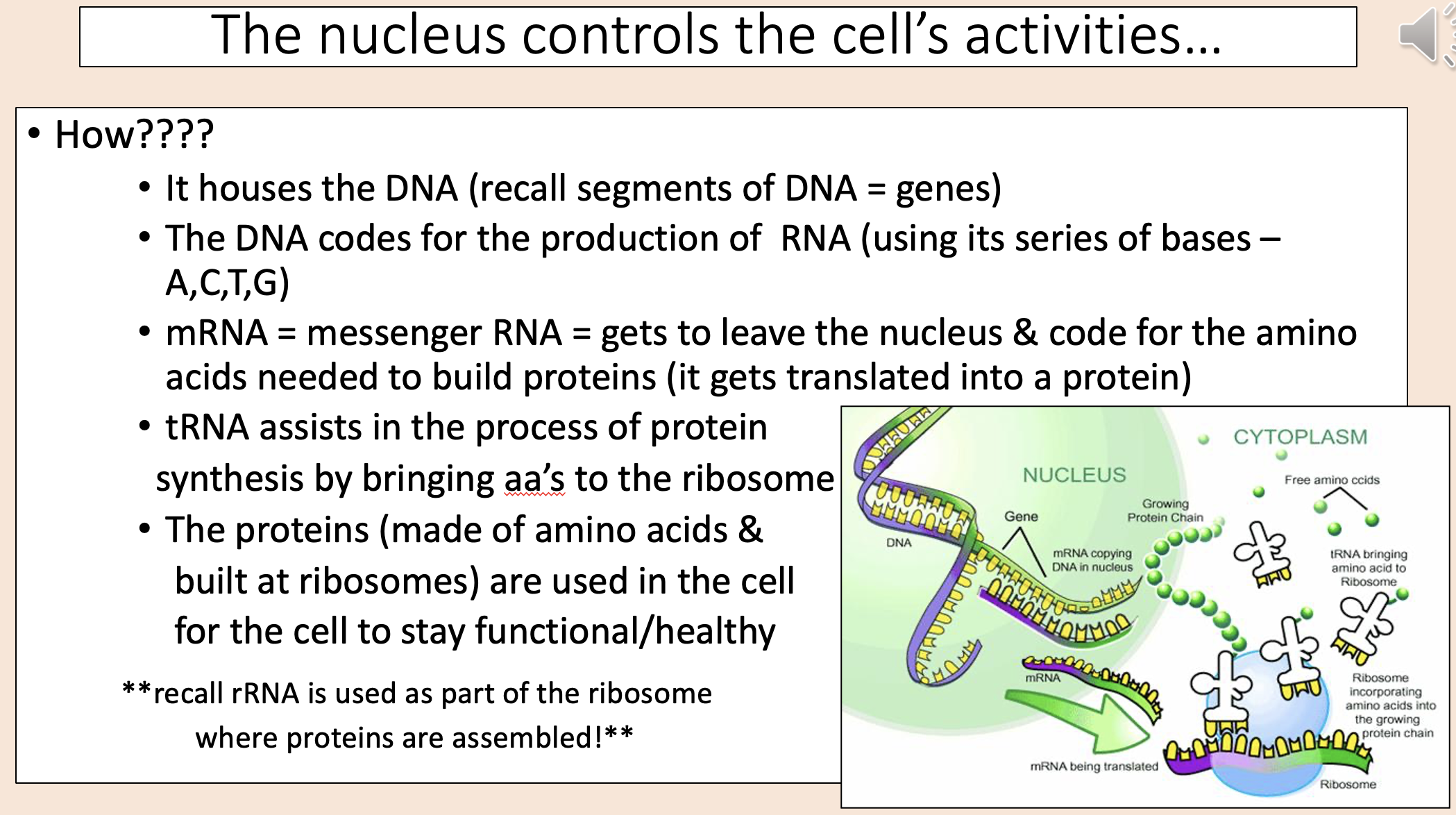
The nucleus controls the cell’s activities...
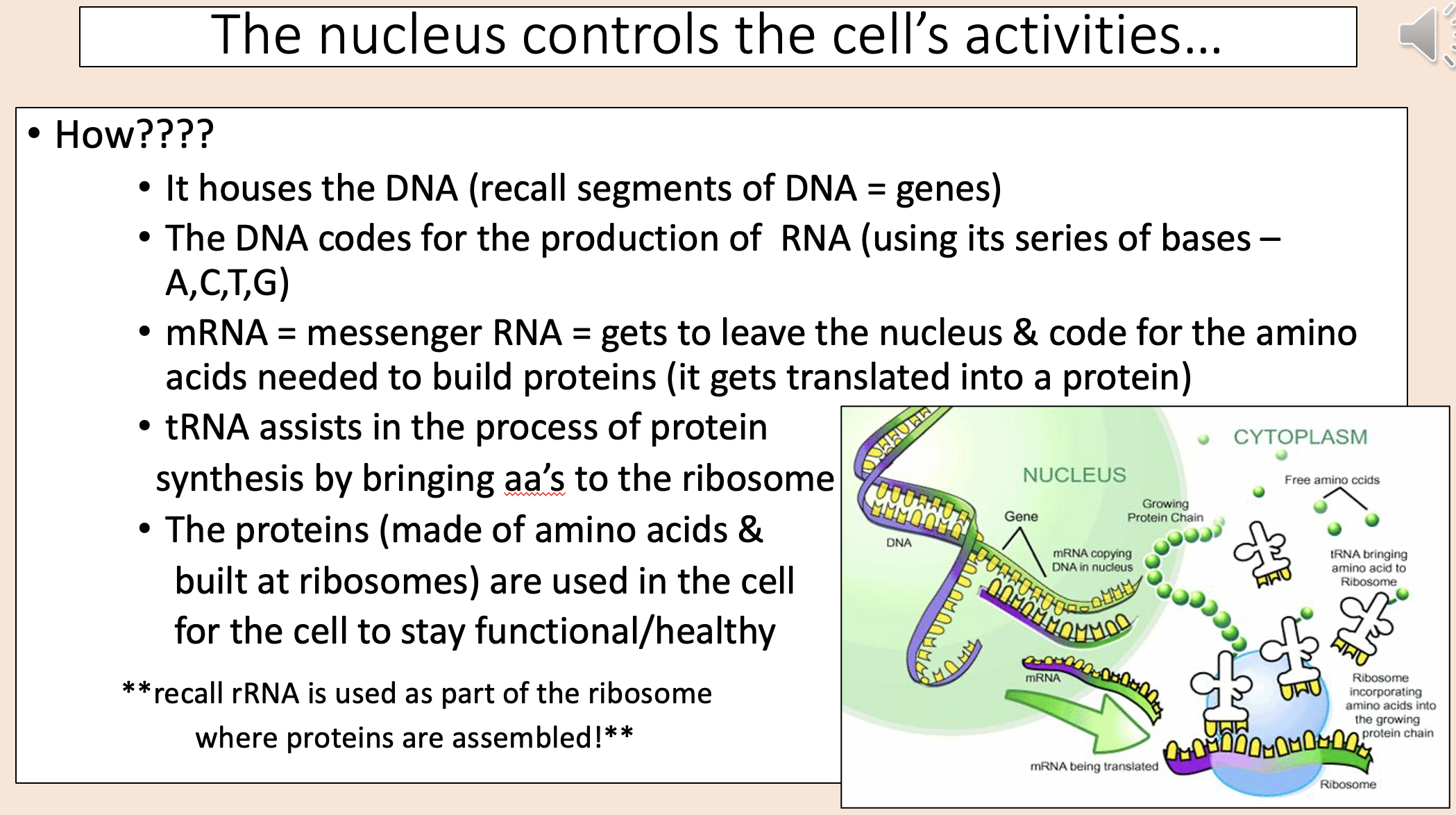
• It houses the DNA (recall segments of DNA = genes).
• The DNA codes for the production of RNA (using its series of bases – A,C,T,G).
• mRNA = messenger RNA = gets to leave the nucleus & code for the amino acids needed to build proteins (it gets translated into a protein).
• tRNA assists in the process of protein synthesis by bringing aa’s to the ribosome.
• The proteins (made of amino acids & built at ribosomes) are used in the cell for the cell to stay functional/healthy.
• recall rRNA is used as part of the ribosome where proteins are assembled!
mRNA = messenger RNA
Gets to leave the nucleus & code for the amino acids needed to build proteins (it gets translated into a protein).
Cytoplasm
Contains organelles
Contains organelles
• Each type of organelle has its own set of enzymes (proteins) that carry out specific reactions that aid the cell in maintaining homeostasis!
• Number and types of organelles vary among cell types.
Contains organelles Examples:
• Mitochondrion.
• Golgi apparatus.
• Endoplasmic Reticulum.
• Ribosomes.
Cell membrane
Separates the inside of the cell from its environment.
Cytoplasm
Jelly-like fluid.
DNA
Cell’s genetic material.
Nucleus
• Control center of the cell.
• Contains DNA or genetic material.
Chromatin
Tangled, spread out form of DNA found inside the nucleus memebrane.
Nucleolus
Structure where ribosomes are made.
Rough endoplasmic reticulum (rER) has ribosomes attached to it
Membrane enclosed passageway for transporting materials (proteins synthesized by ribosomes).
Smooth endoplasmic reticulum (sER) does not have ribosomes attached to it
Membrane enclosed passageway for transporting materials (proteins synthesized by ribosomes).
Golgi apparatus (Golgi body)
Receives proteins and other materials in small vesicles.
Lysosomes
Garbage collectors (take in damaged or worn out cells)
Mitochondria
During cellular respiration the mitochondria make ATP molecules that provide the energy for all the cell activities.
Cytoskeleton
Thread-like microfilaments which are made of protein and microtubules which are thin hallow tubes.
Plasma Membrane
Unique structure aids in its functions.
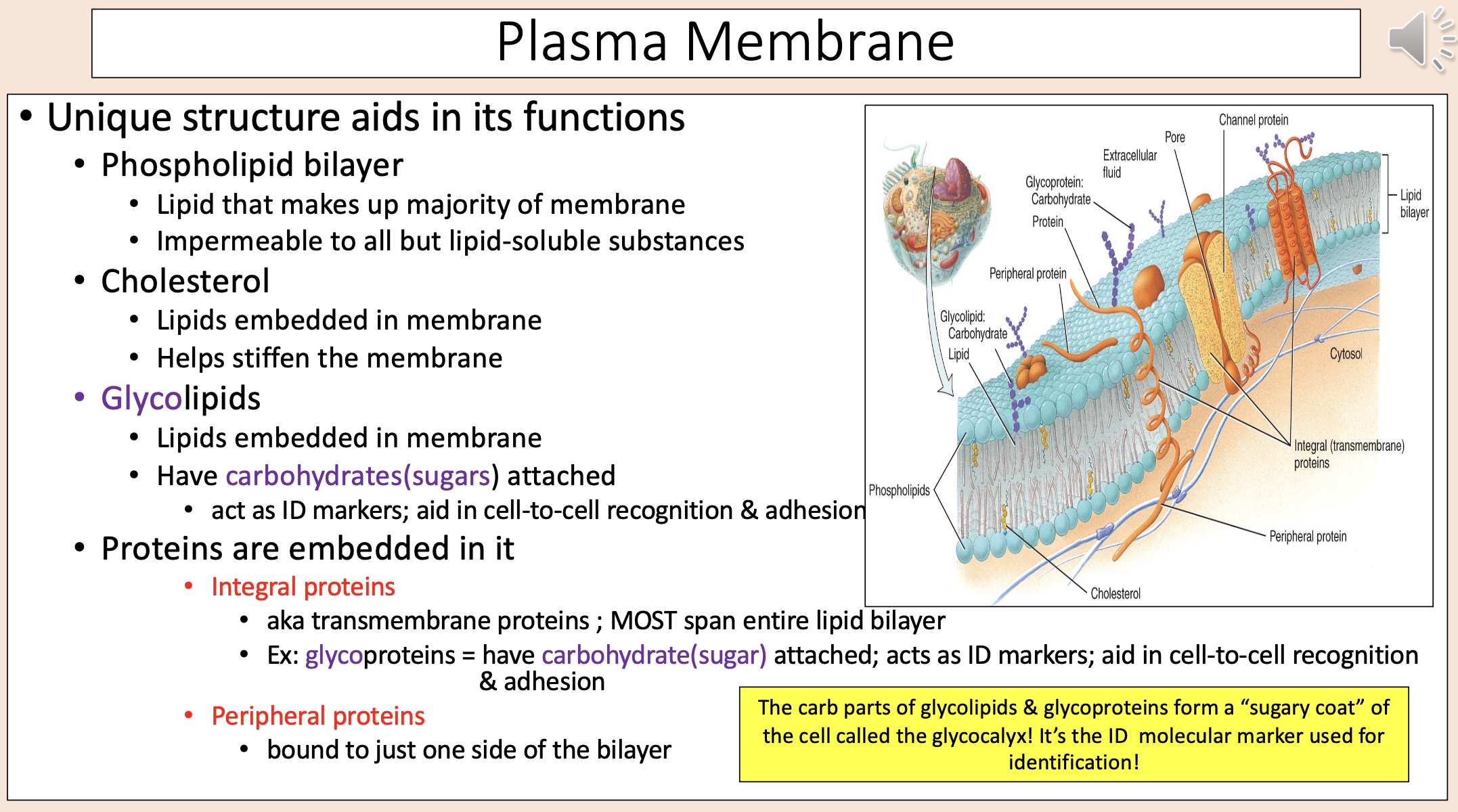
Unique structure aids in its functions
• Phospholipid bilayer.
• Cholesterol.
• Glycolipids.
• Proteins are embedded in it.
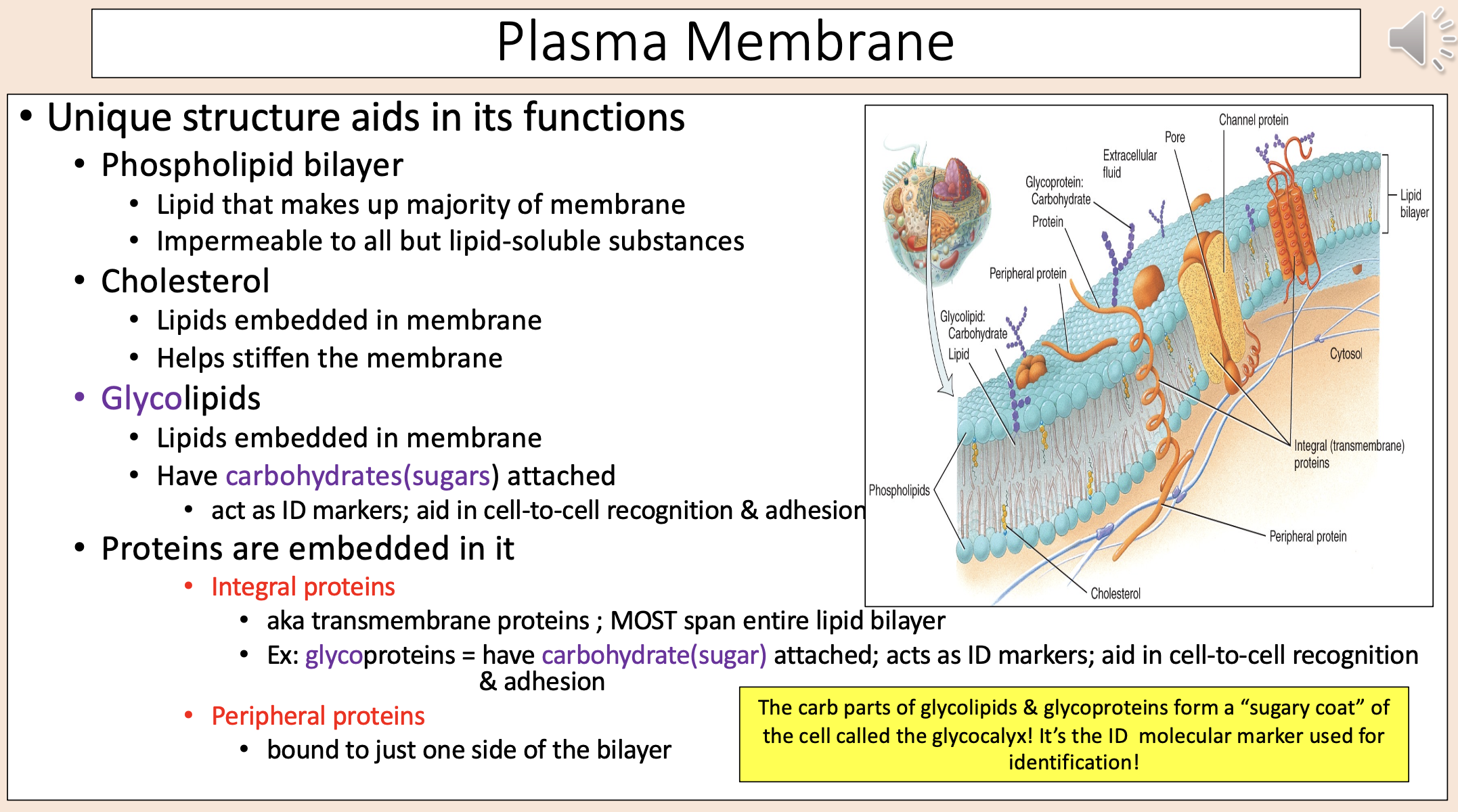
Phospholipid bilayer
• Lipid that makes up majority of membrane.
• Impermeable to all but lipid-soluble substances.
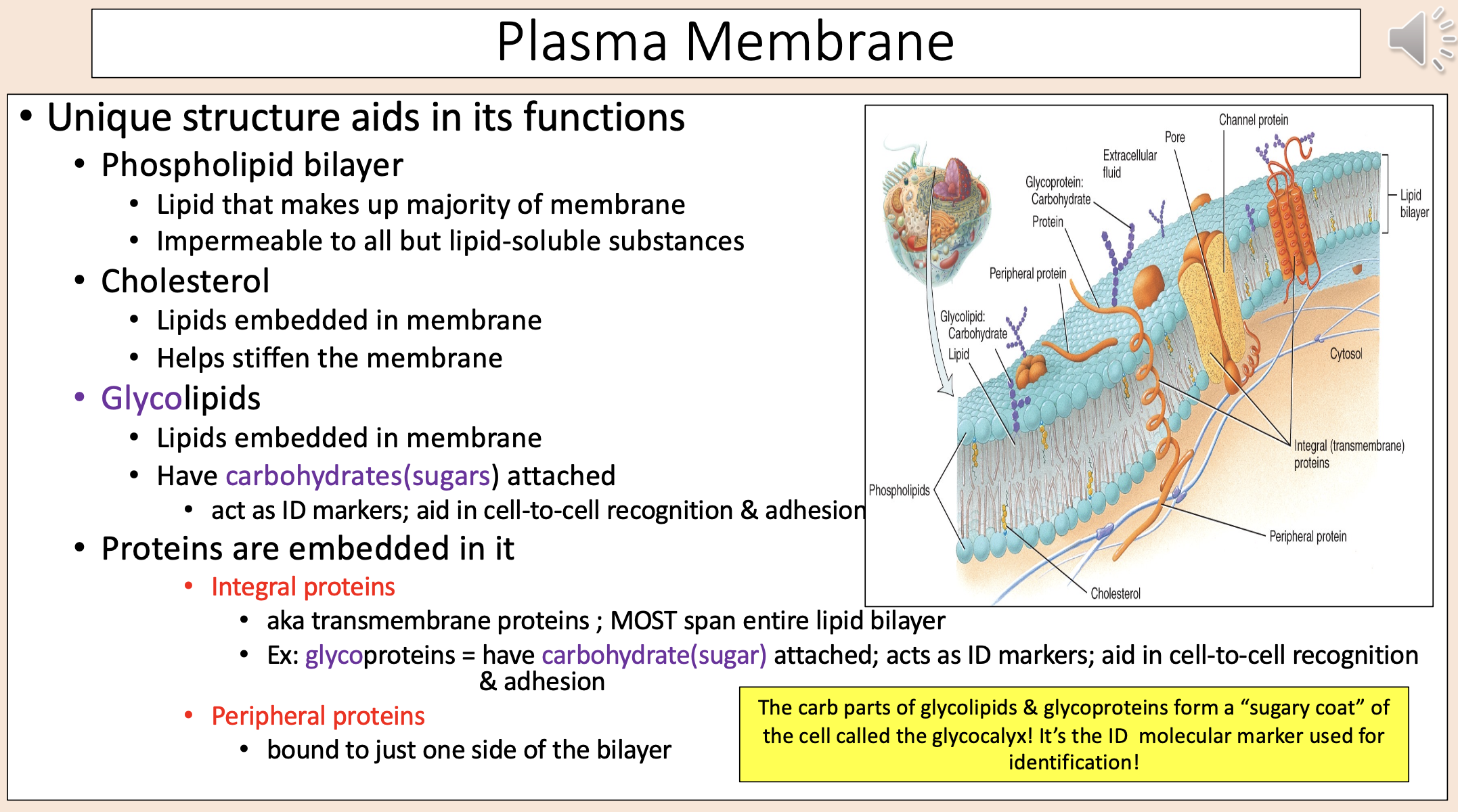
Cholesterol
• Lipids embedded in membrane.
• Helps stiffen the membrane.
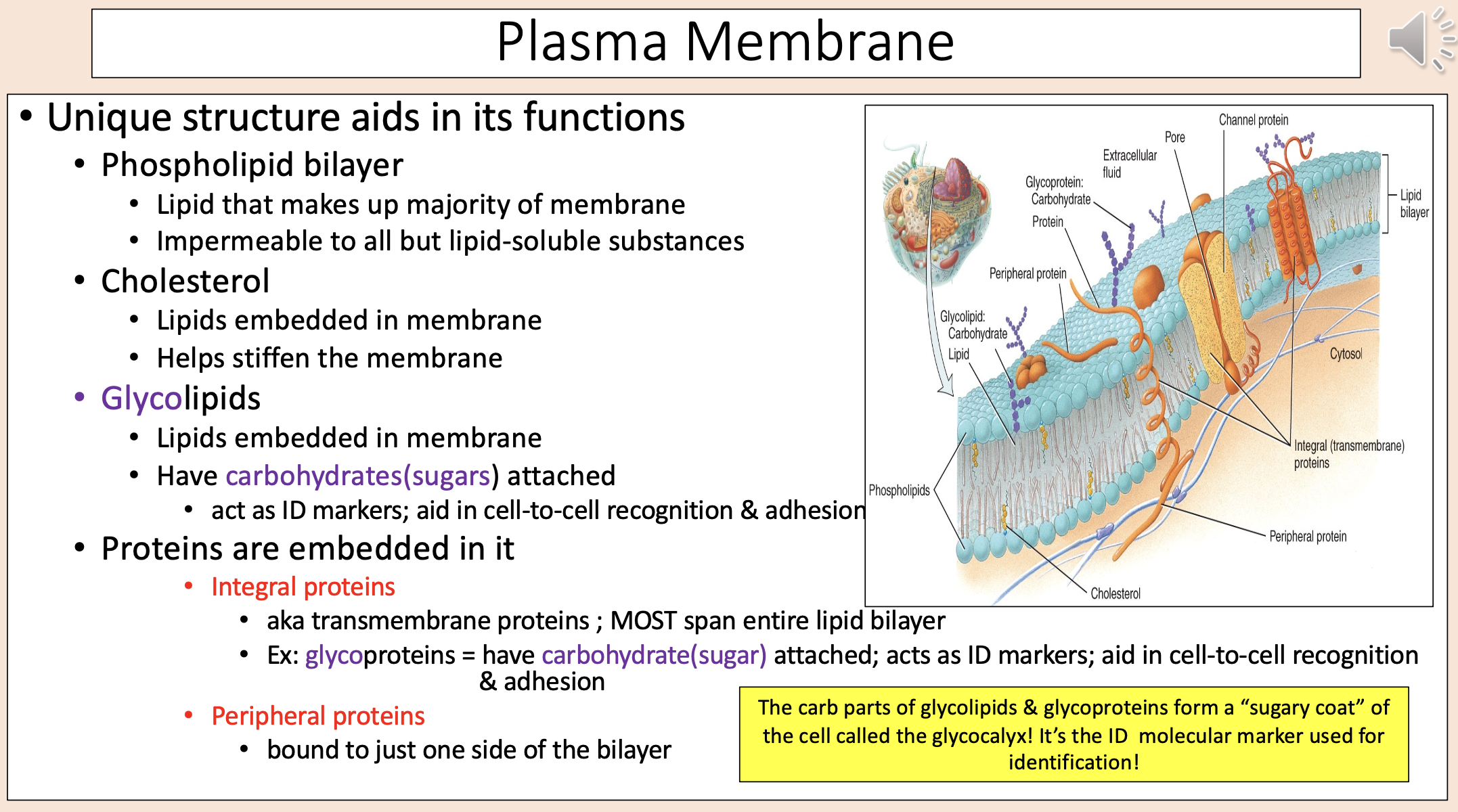
Glycolipids
• Lipids embedded in membrane.
• Have carbohydrates(sugars) attached.
• Act as ID markers; aid in cell-to-cell recognition & adhesion.
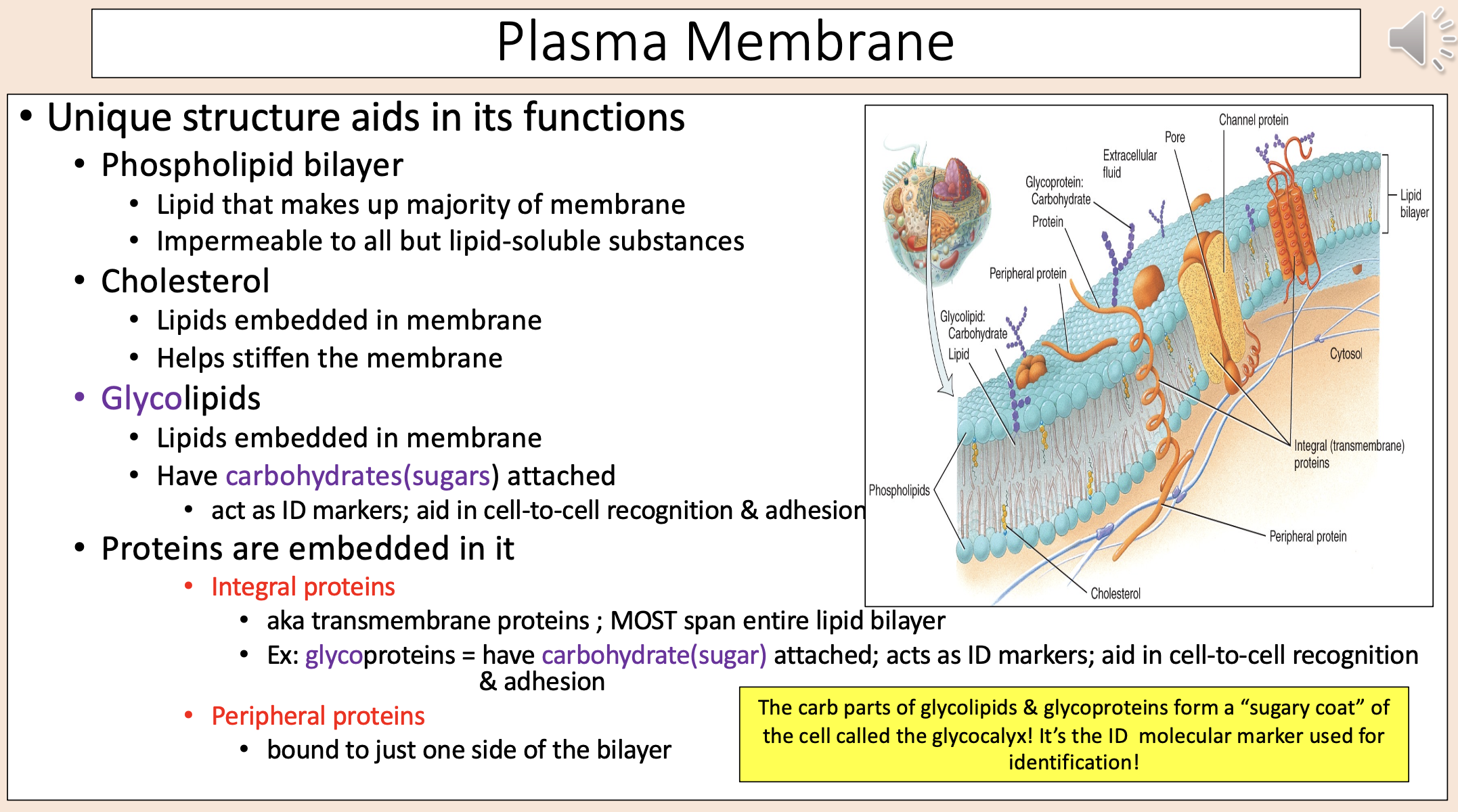
Proteins are embedded in it
• Integral proteins.
• Peripheral proteins.
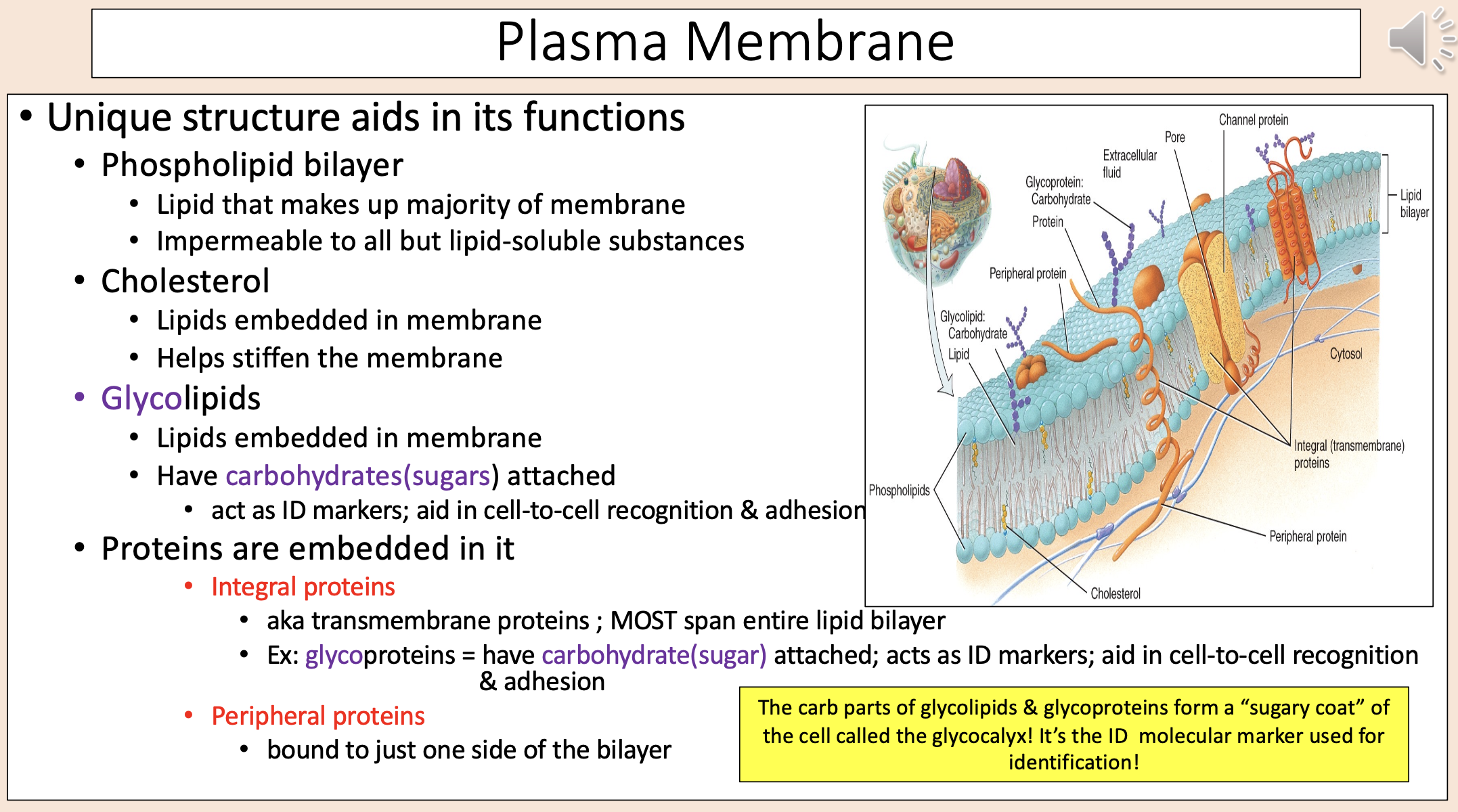
Integral proteins
• aka transmembrane proteins; MOST span entire lipid bilayer.
• Ex: glycoproteins = have carbohydrate (sugar) attached; acts as ID markers; aid in cell-to-cell recognition & adhesion.
• The carb parts of glycolipids & glycoproteins form a “sugary coat” of the cell called the glycocalyx! It’s the ID molecular marker used for identification!
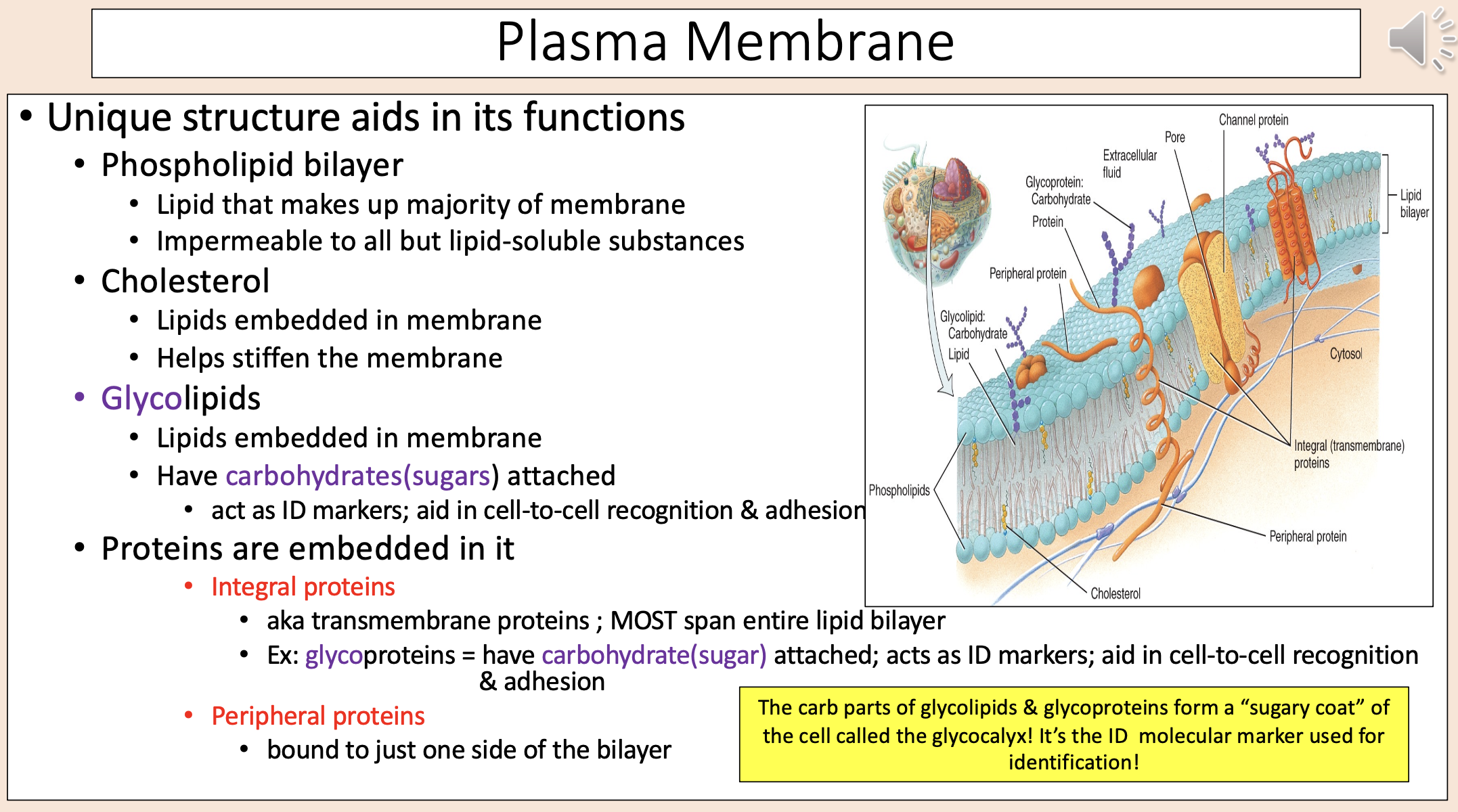
Peripheral proteins.
Bound to just one side of the bilayer.
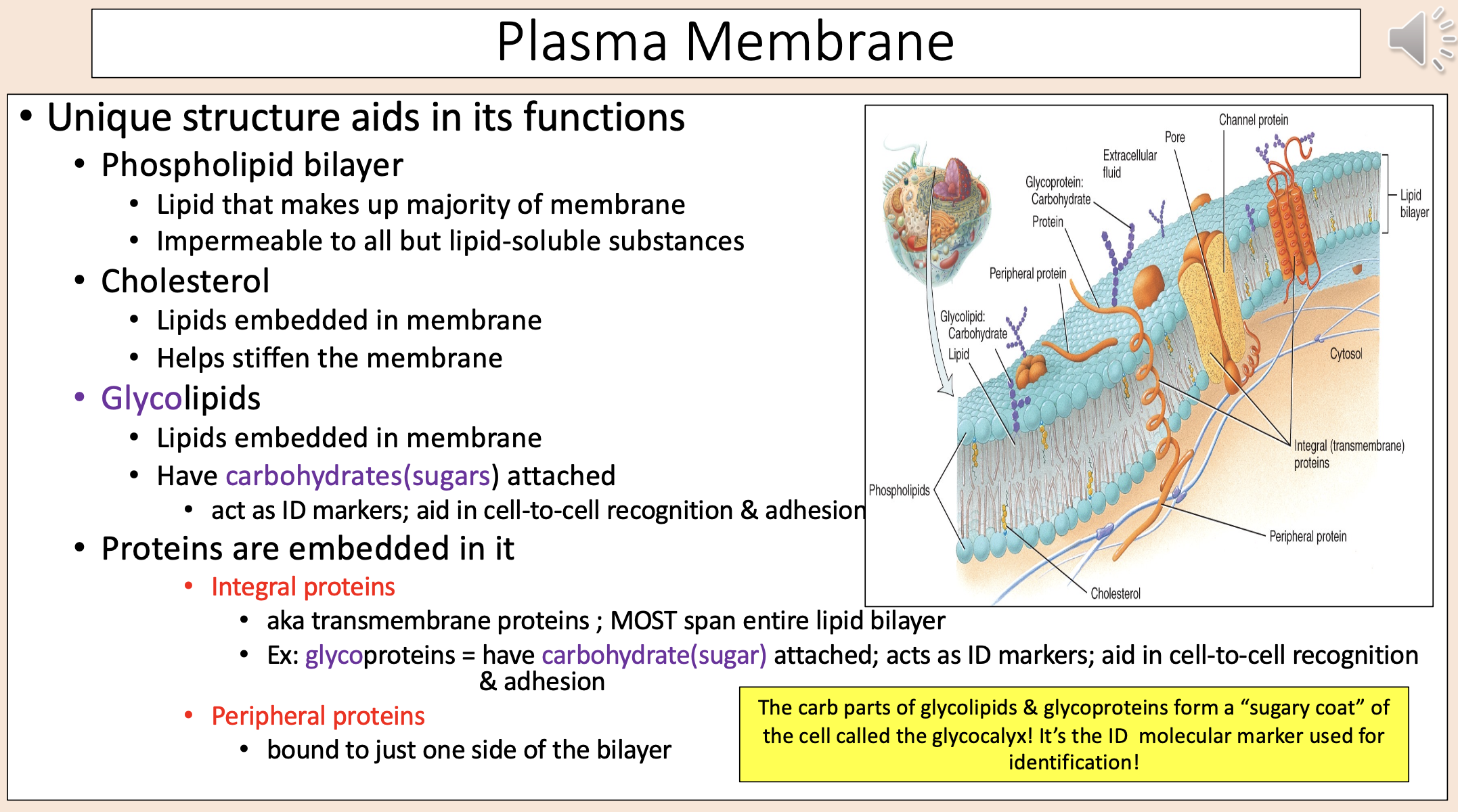
Why Do We Care about Membrane Proteins?
• Recall that protein function depends on protein shape, so these proteins are specific for ions/molecules.
• Recall that the lipid membrane tends to be impermeable to anything that is NOT a lipid!
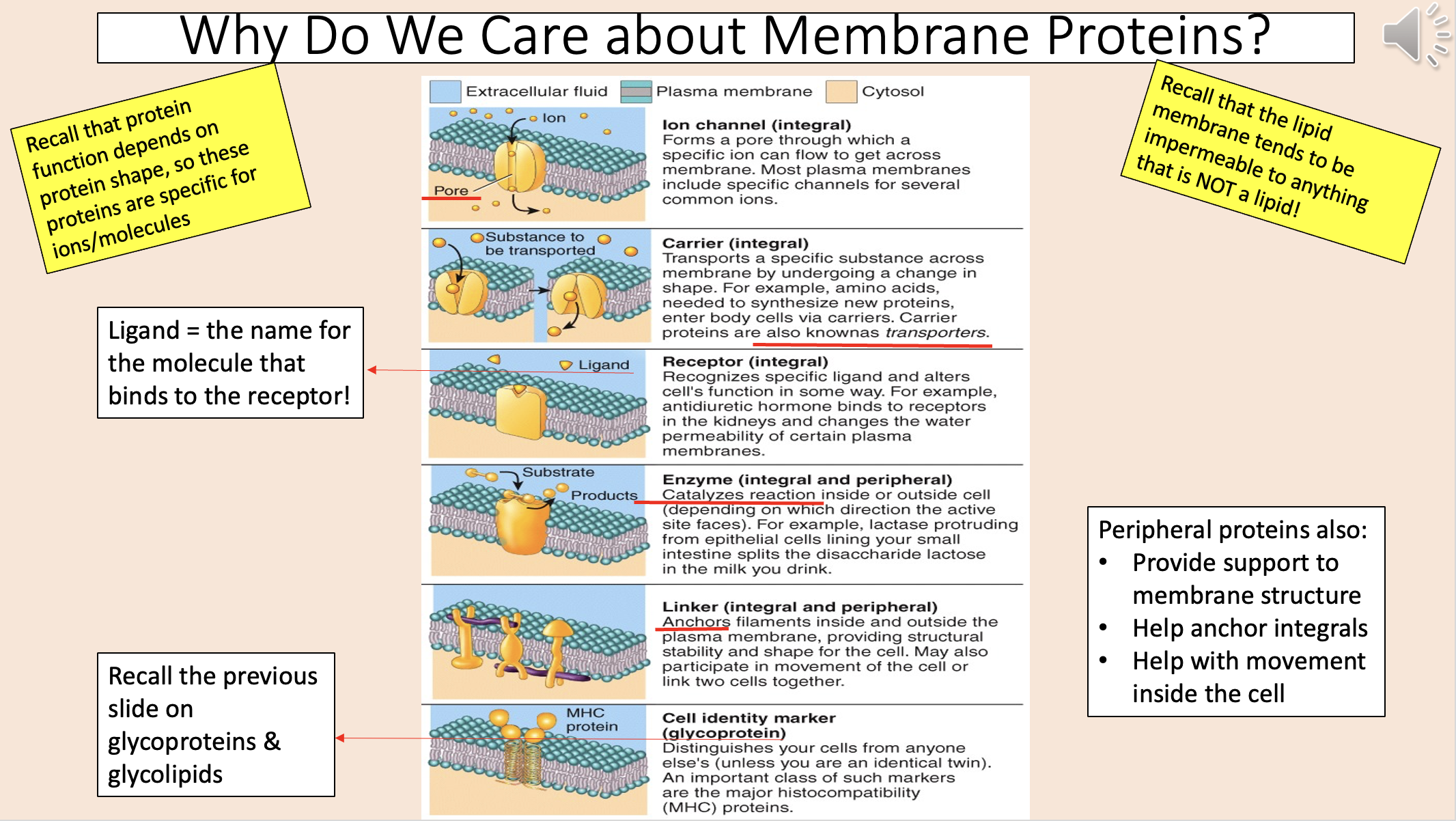
Peripheral proteins also:
• Provide support to membrane structure.
• Help anchor integrals.
• Help with movement inside the cell.
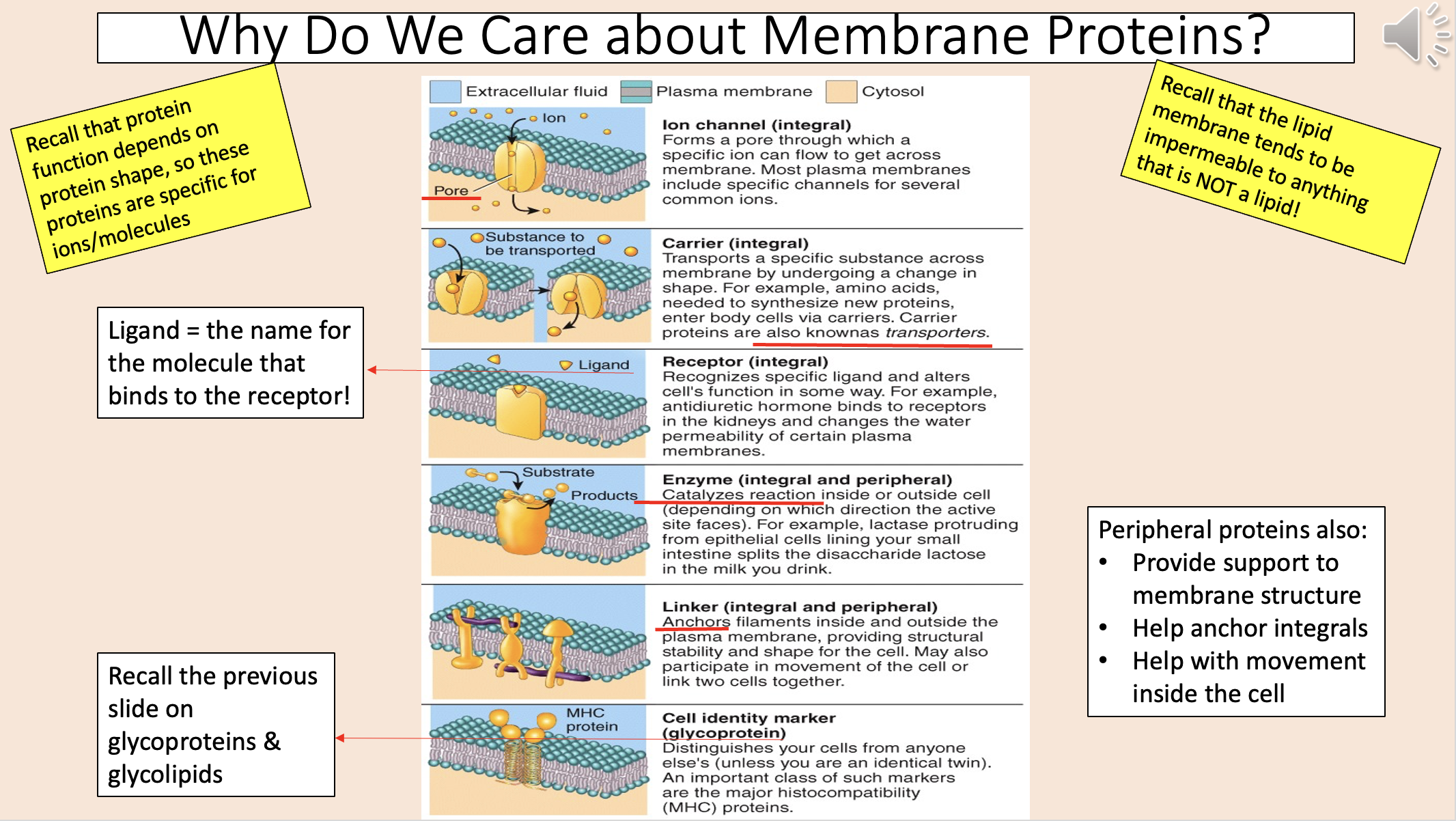
Why Do We Care about Membrane Proteins?
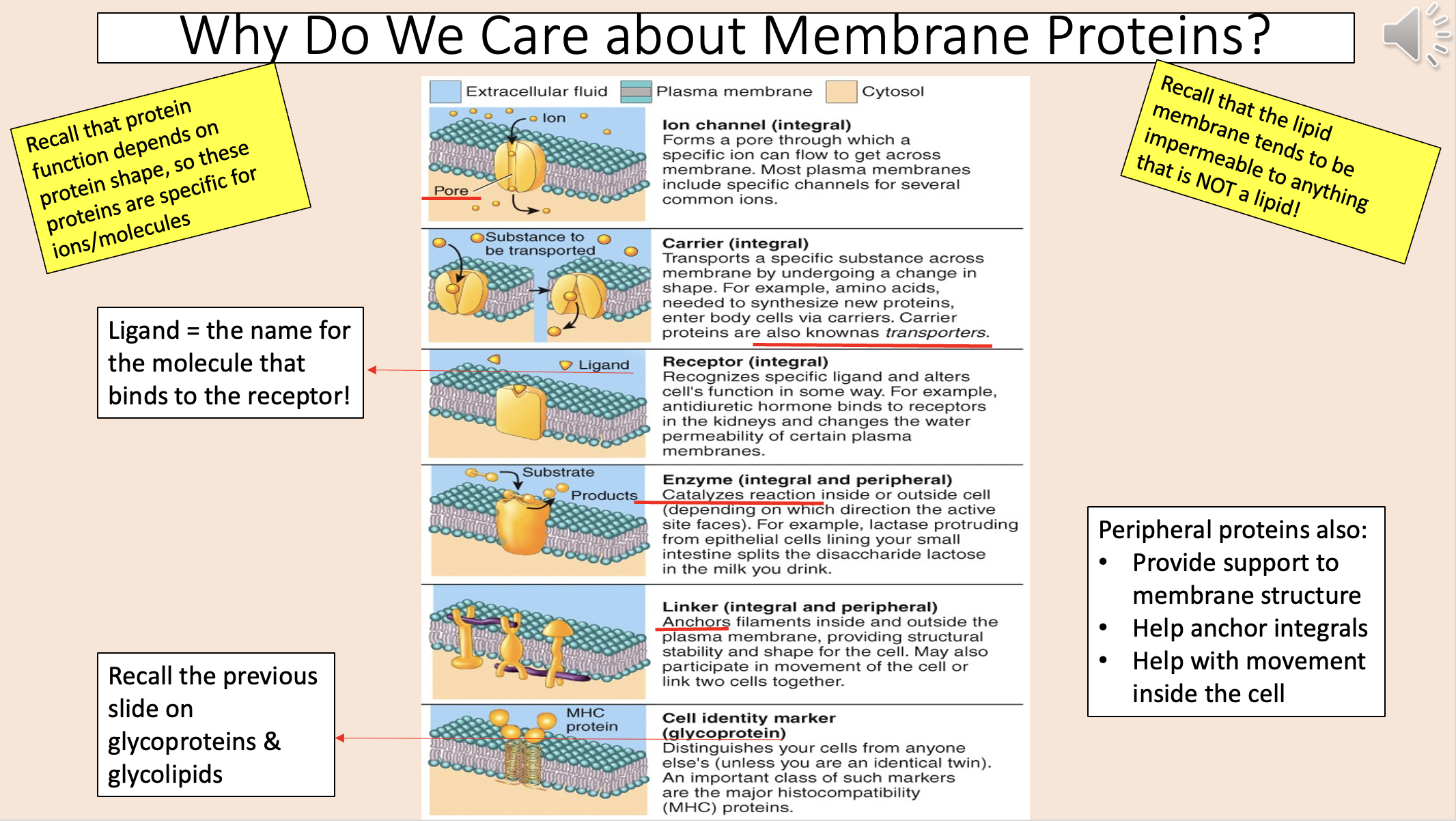
• Ion channel (integral).
• Carrier (integral).
• Receptor (integral).
• Enzyme (integral and peripheral).
• Linker (integral and peripheral).
• Cell identity maker (glycoprotein).
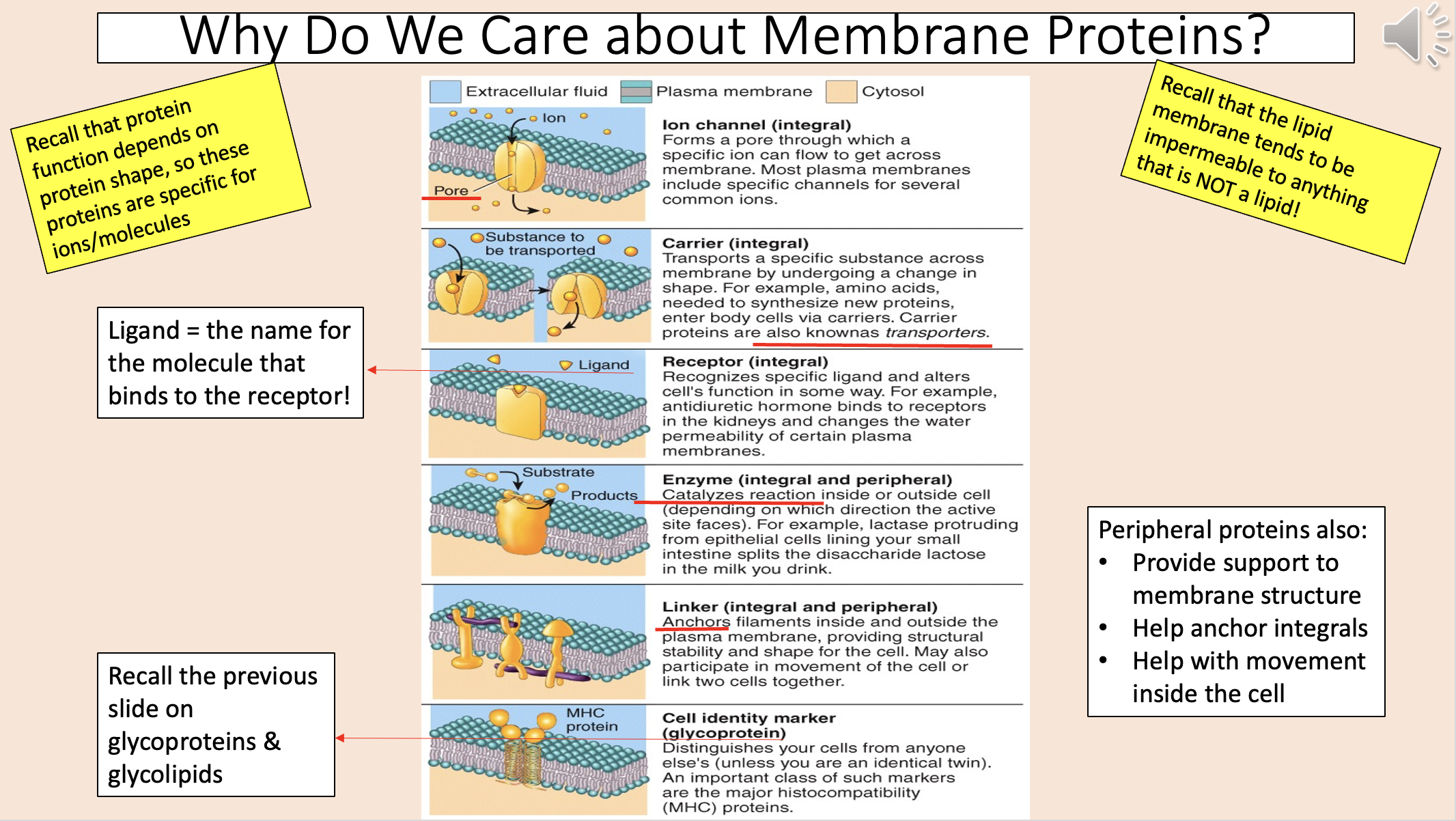
Ion channel (integral)
Forms a pore through which a specific ion can flow to get across membrane. Most plasma membranes include specific channels for several common ions.
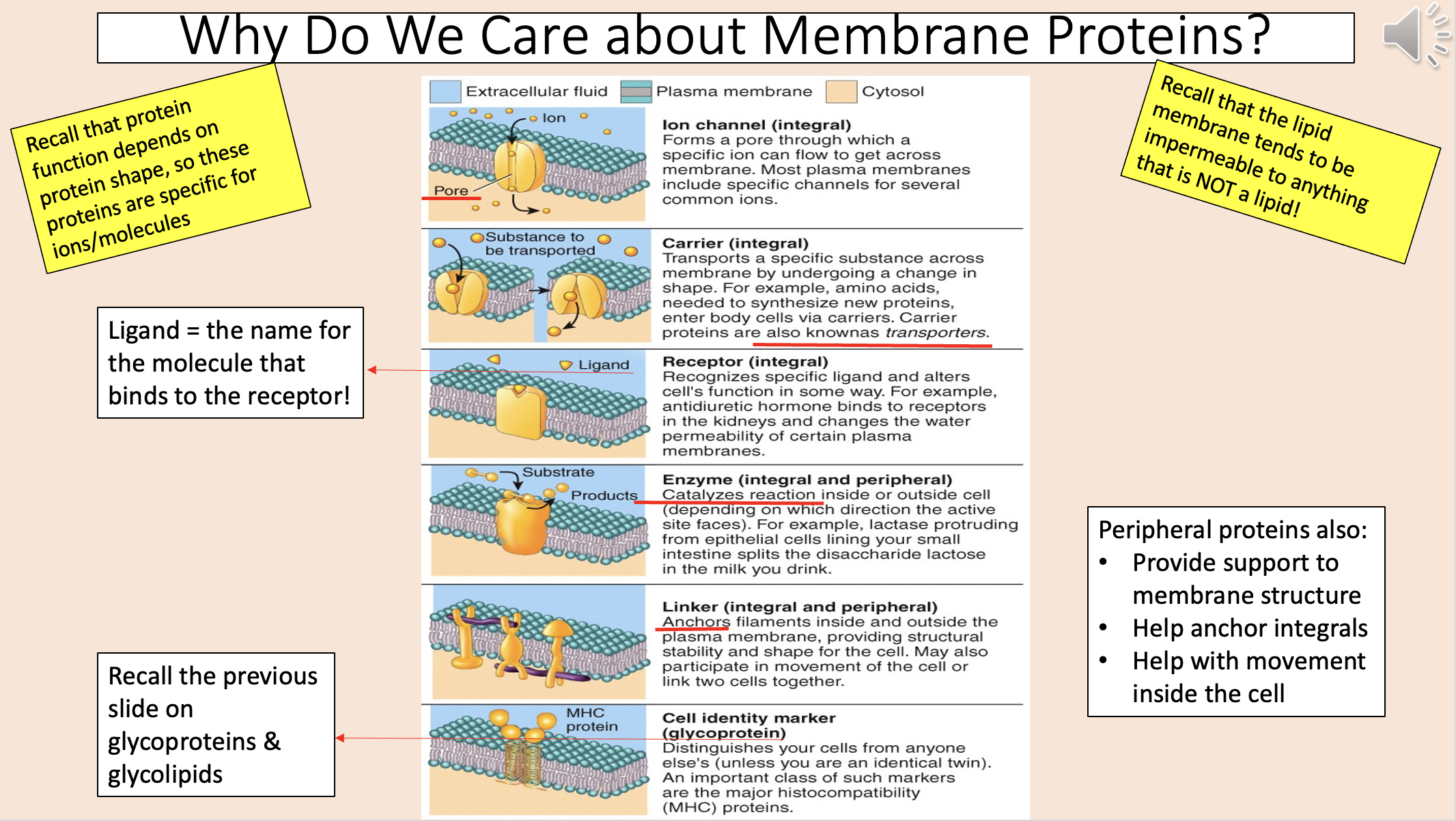
Carrier (integral)
Transports a specific substance across membrane by undergoing a change in shape. For example, amino acids, needed to synthesize new proteins enter body cells via carriers. Carrier proteins are also known as transporters.
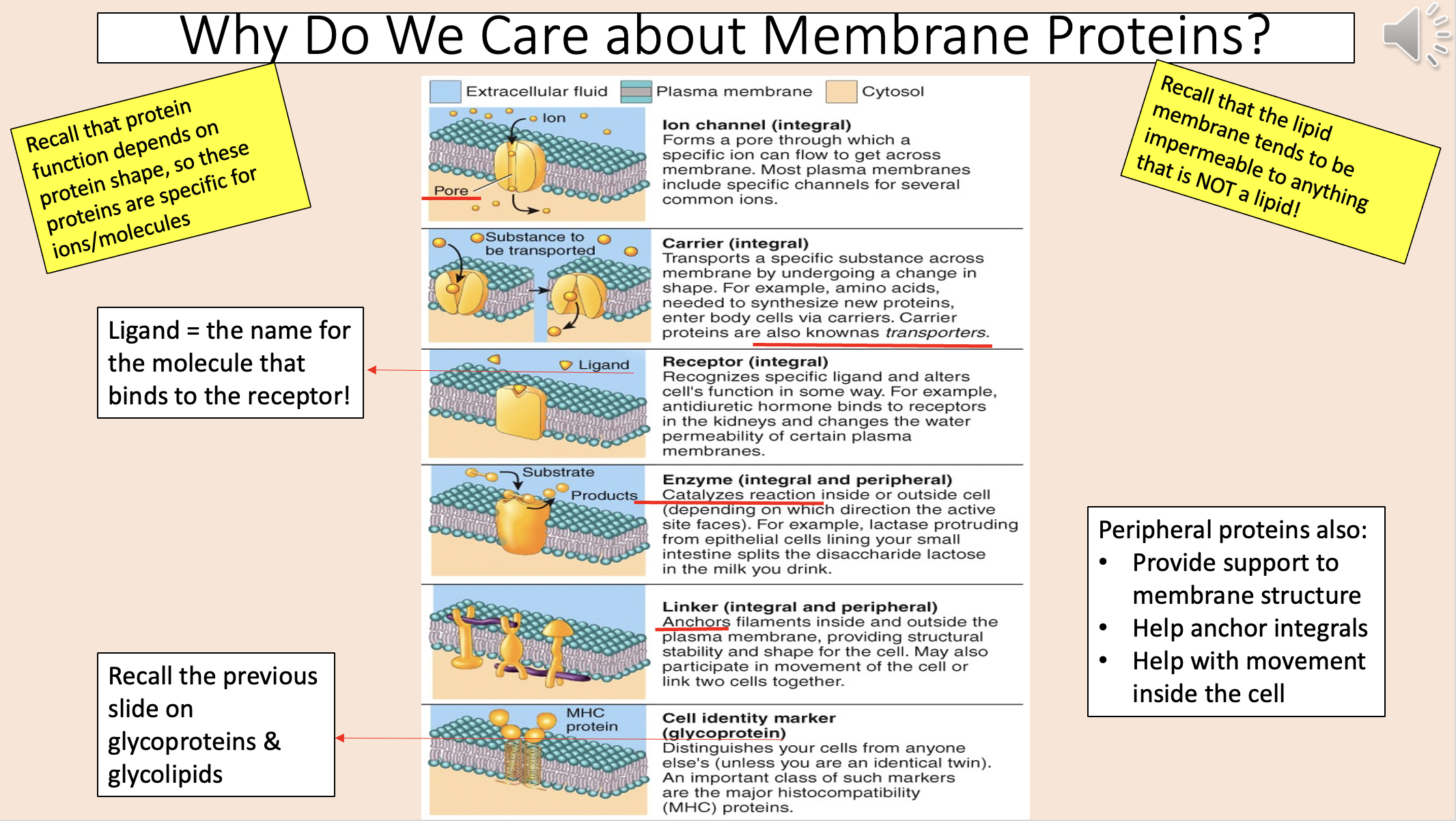
Receptor (integral)
Recognizes specific ligand and alters cell’s function in some way. For example, antidiuretic hormone binds to receptors in the kidneys and changes the water permeability of certain plasma membranes.
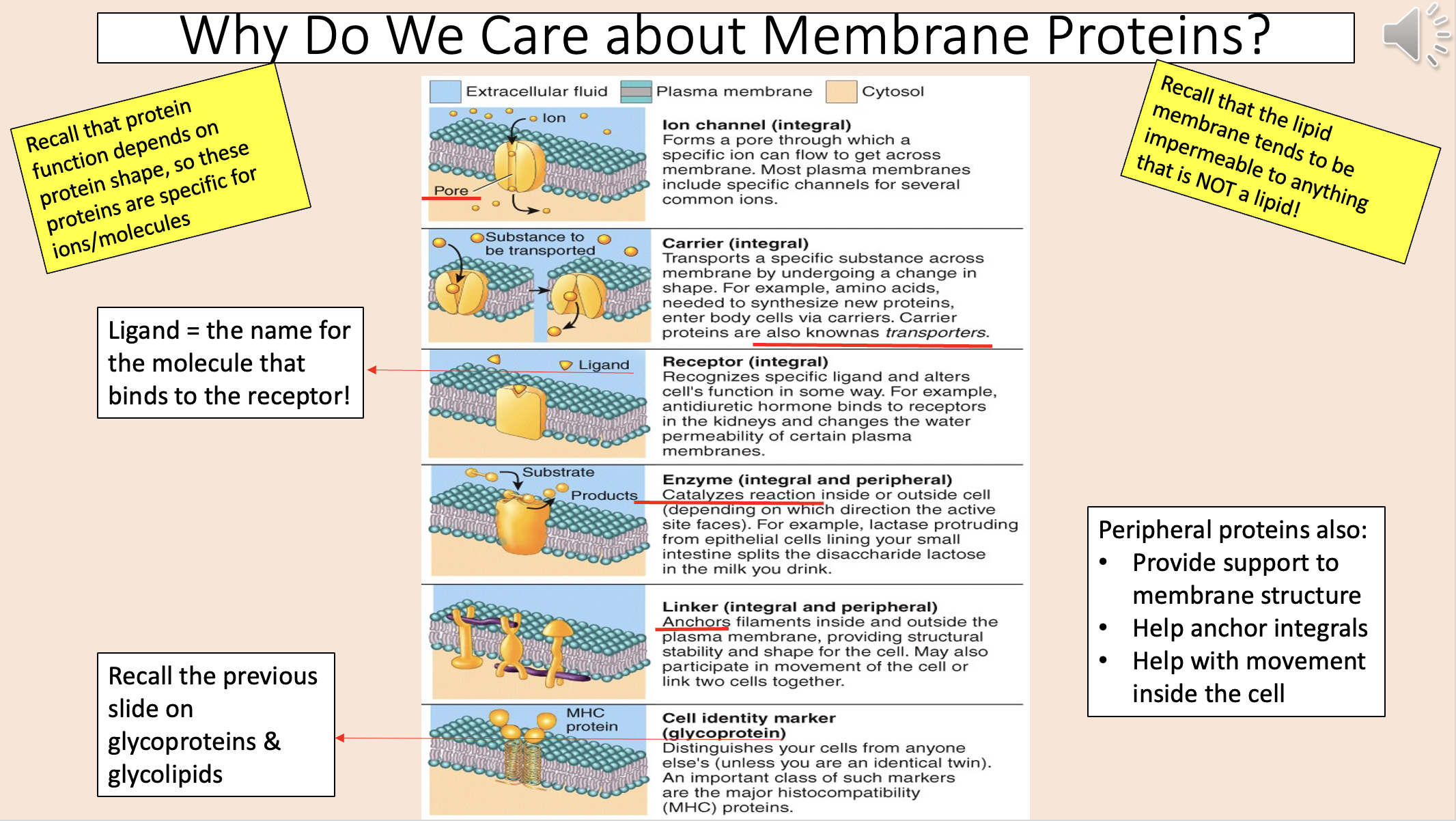
Ligand
The name for the molecule that binds to the receptor!
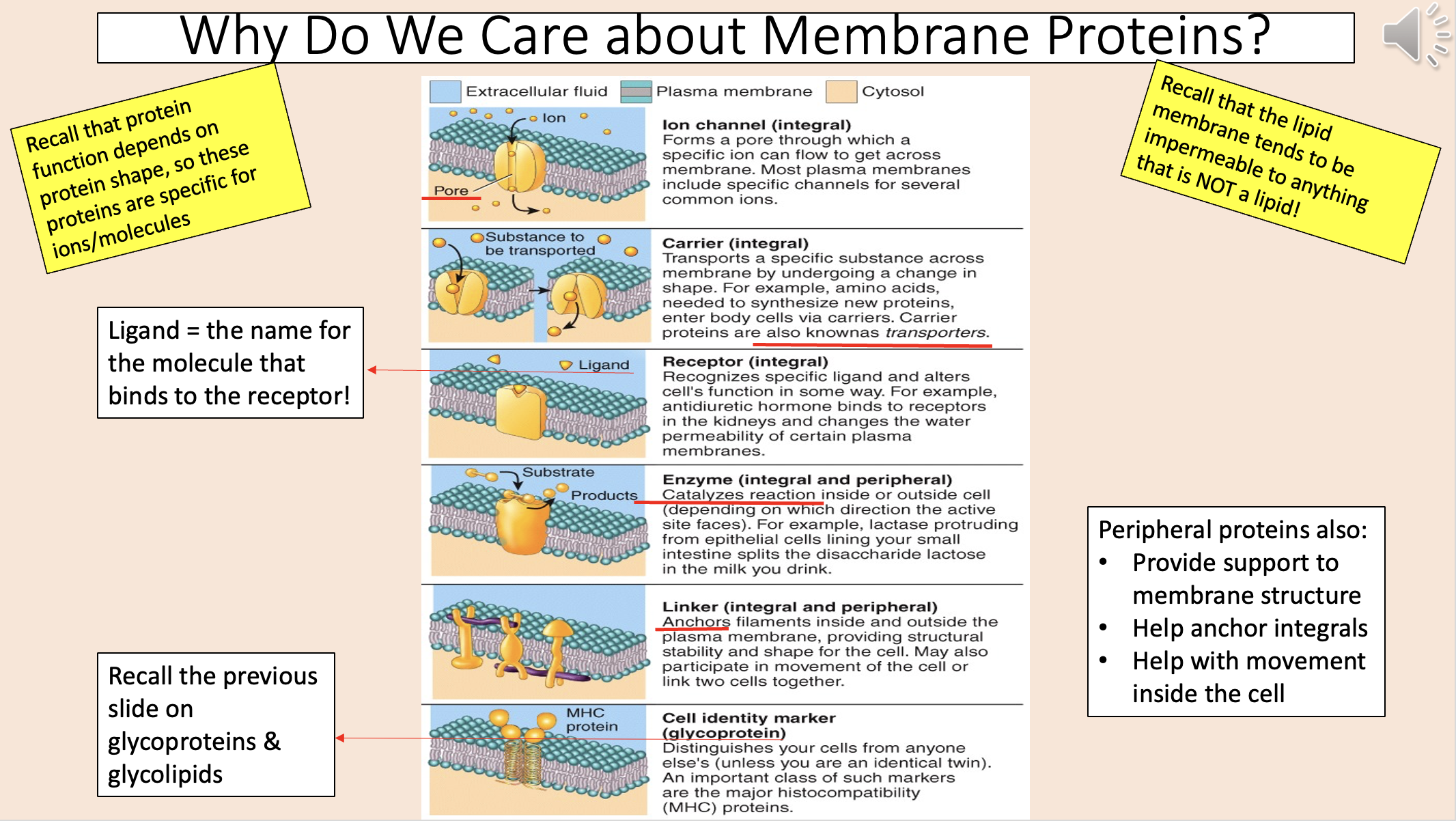
Enzyme (integral and peripheral)
Catalyzes reaction inside or outside cell (depending on which direction the active site faces). For example, lactase protruding from epithelial cells lining your small intestine splits the disaccharide lactose in the milk you drink.
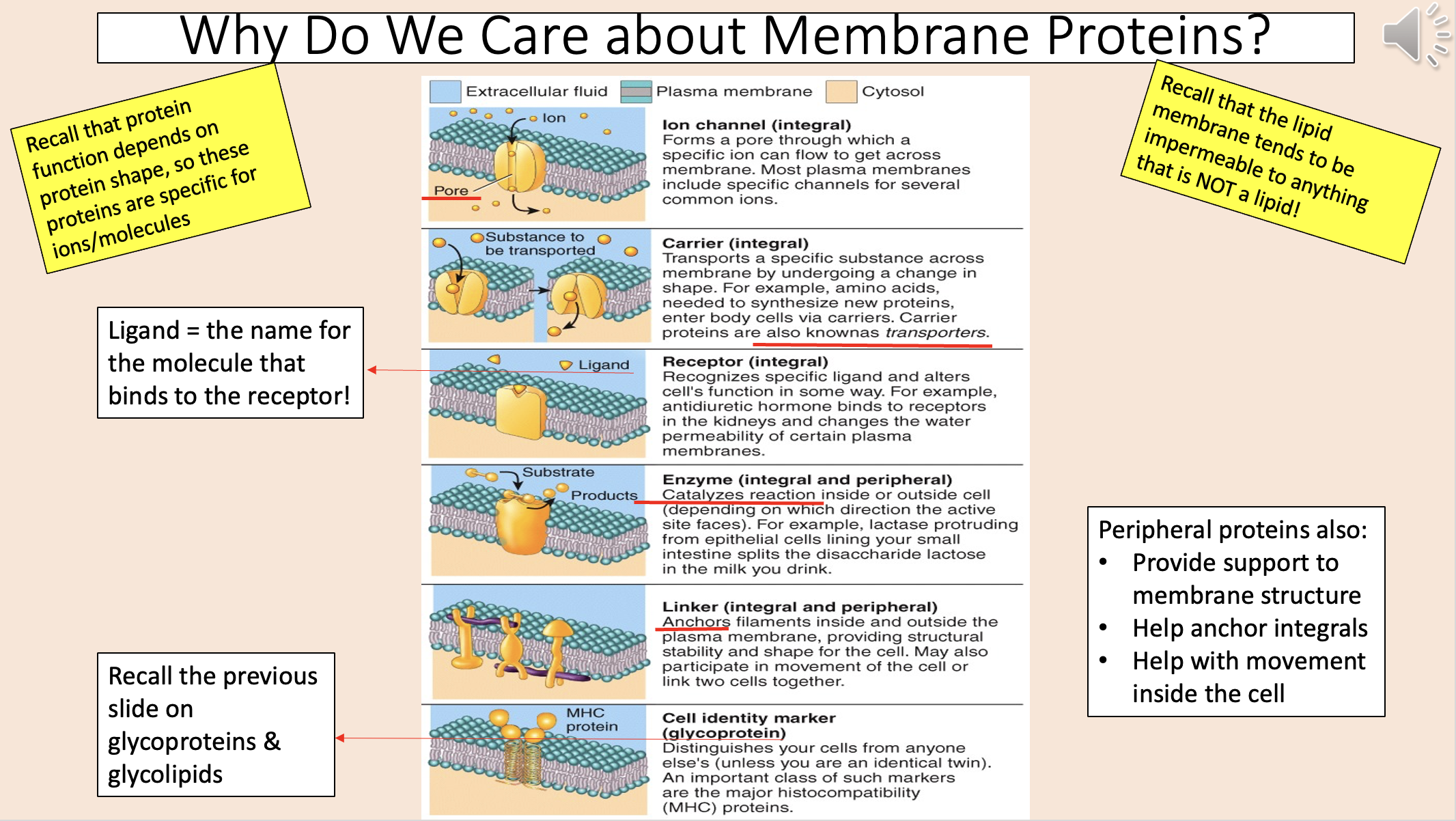
Linker (integral and peripheral)
Anchors filaments inside and outside the plasma membrane, providing structural stability and shape for the cell. May also participate in movement of the cell or ink two cells together.
Cell identity maker (glycoprotein)
Distinguishes your cells from anyone else’s (unless you are an identical twin). An important class of such markers are the major histocompatibility (MHC) proteins.
Channelopathies
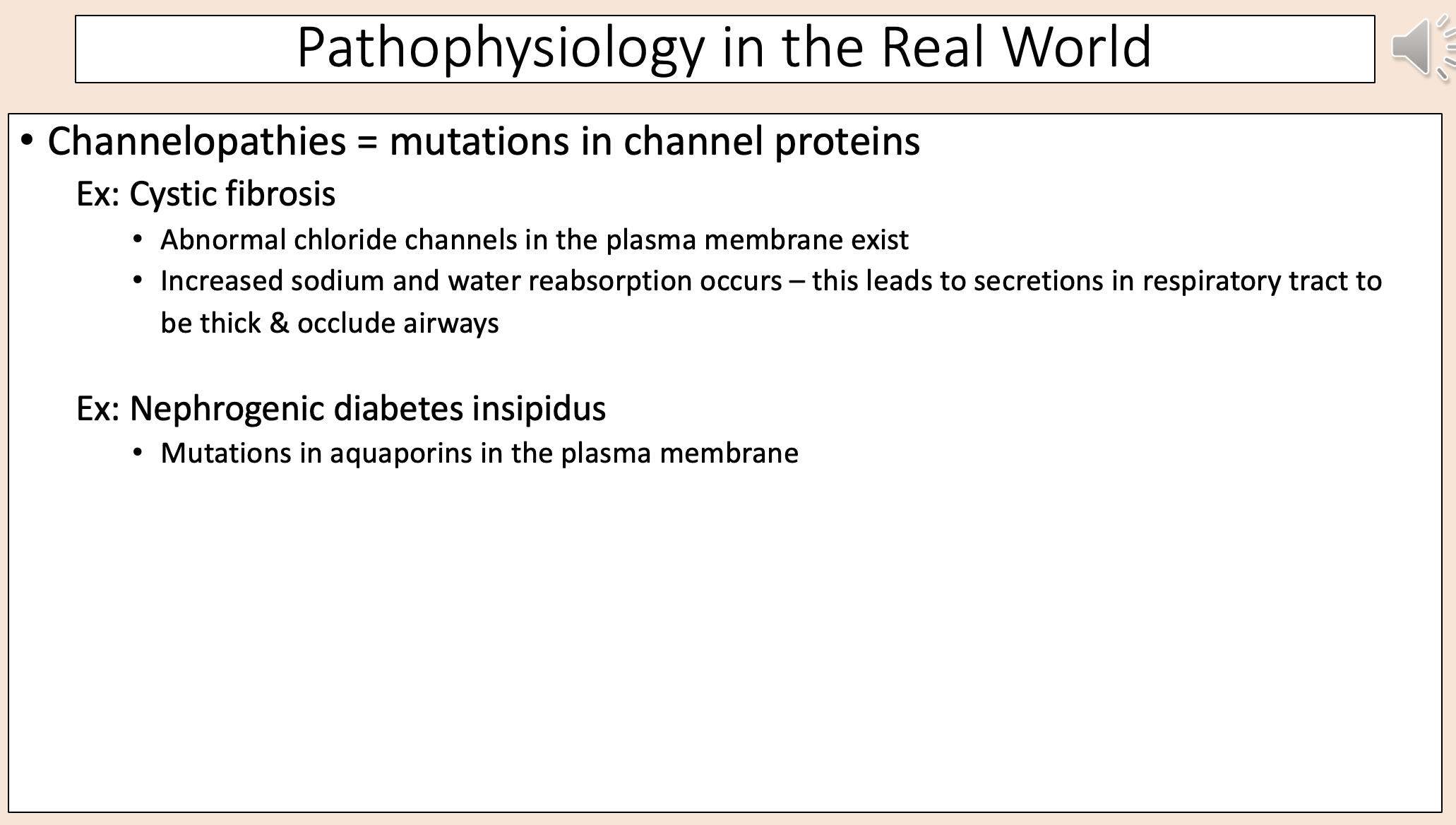
Mutations in channel proteins.
Channelopathies
• Cystic fibrosis.
• Nephrogenic diabetes insipidus.
Cystic fibrosis
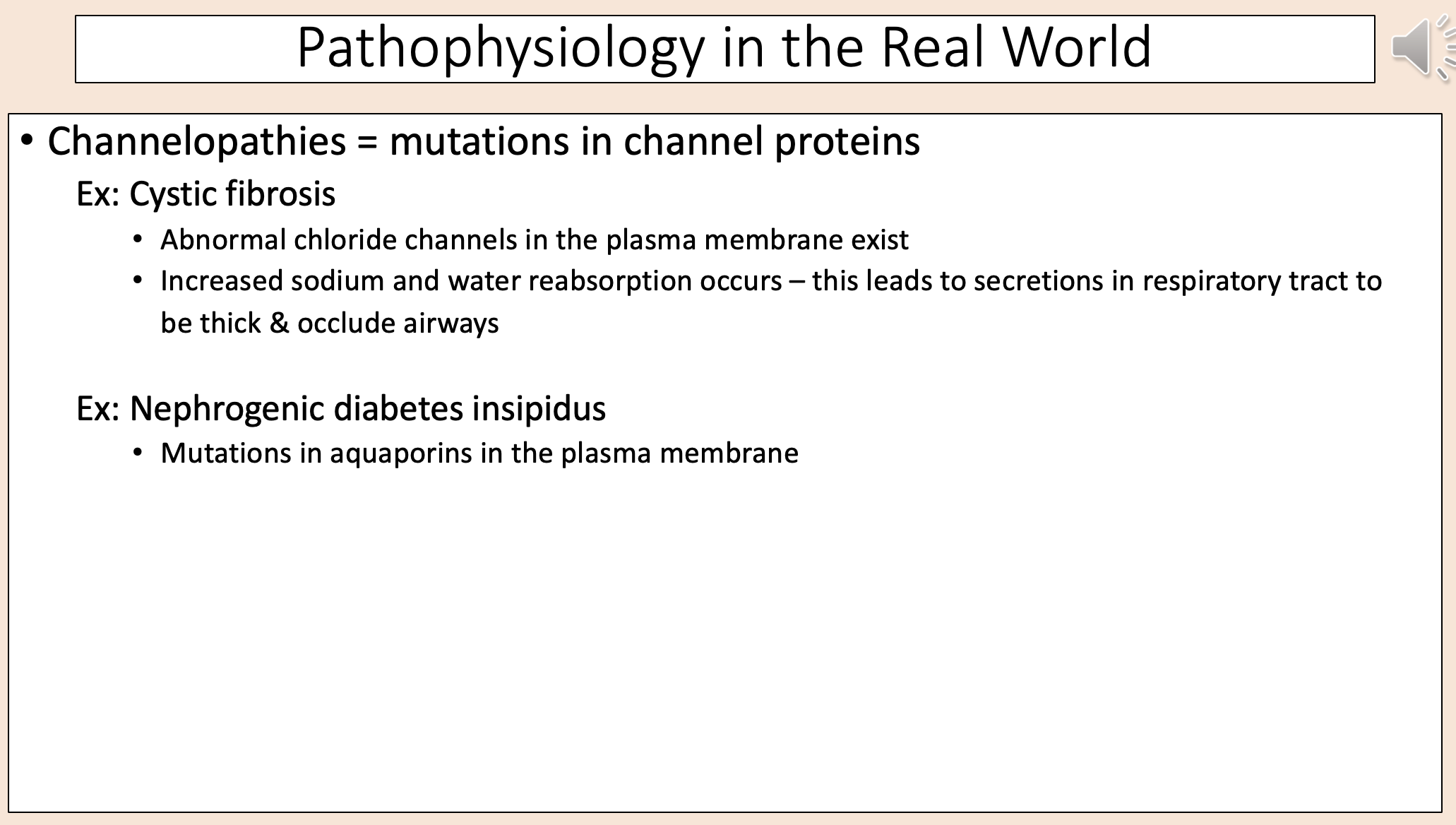
• Abnormal chloride channels in the plasma membrane exist.
• Increased sodium and water reabsorption occurs – this leads to secretions in respiratory tract to be thick & occlude airways.
Nephrogenic diabetes insipidus
Mutations in aquaporins in the plasma membrane.
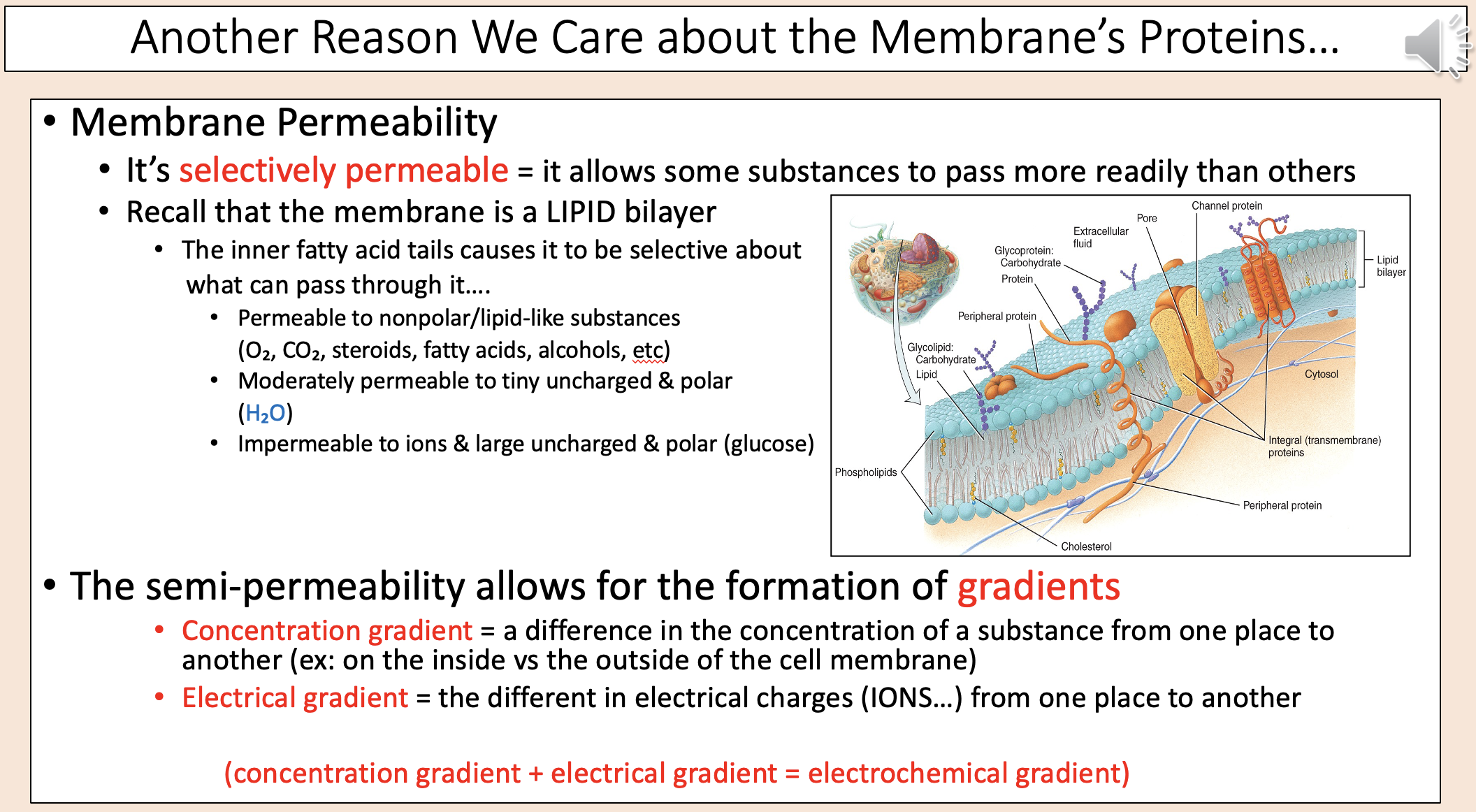
Another Reason We Care about the Membrane’s Proteins...
• Membrane Permeability.
• The semi-permeability allows for the formation of gradients.
Membrane Permeability
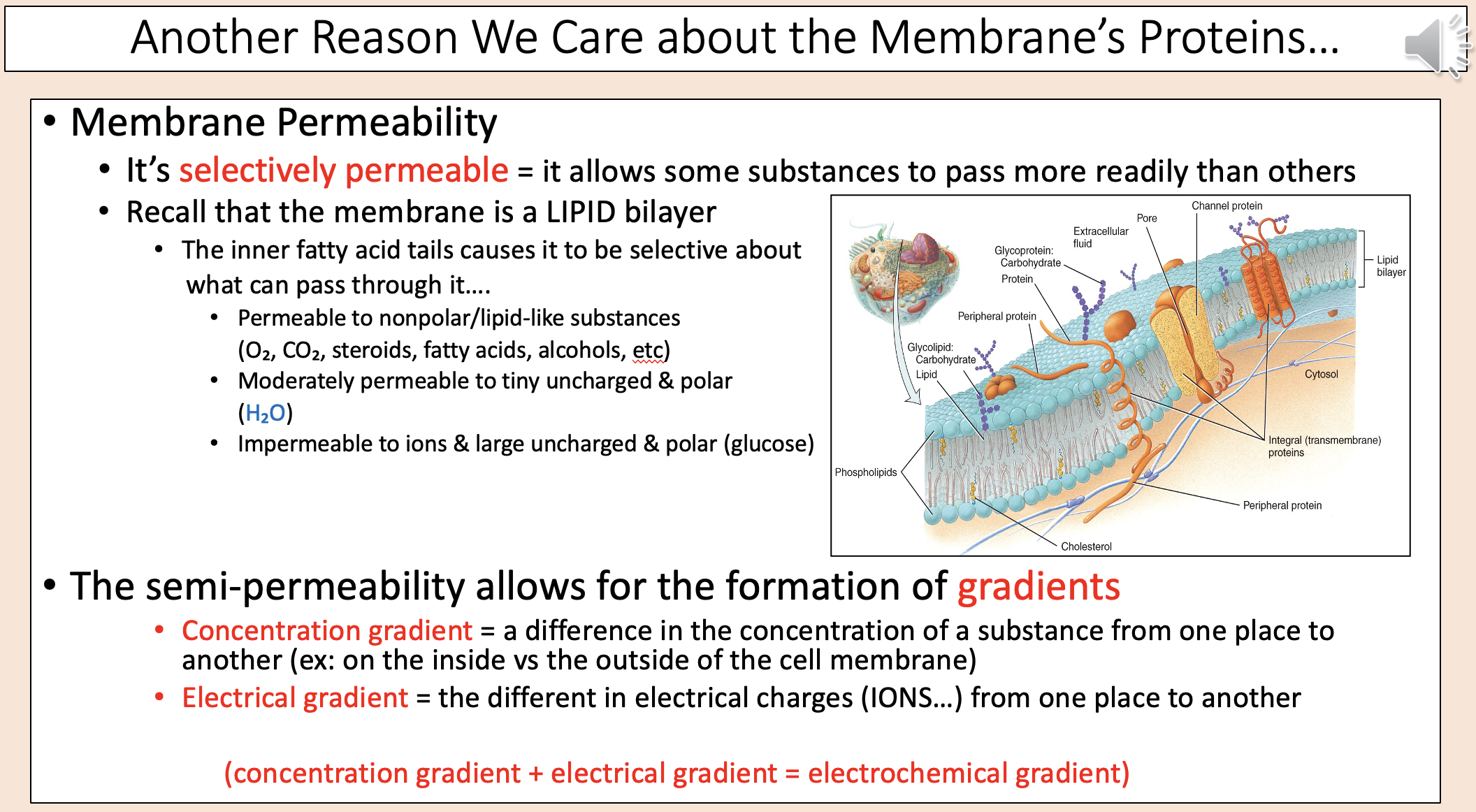
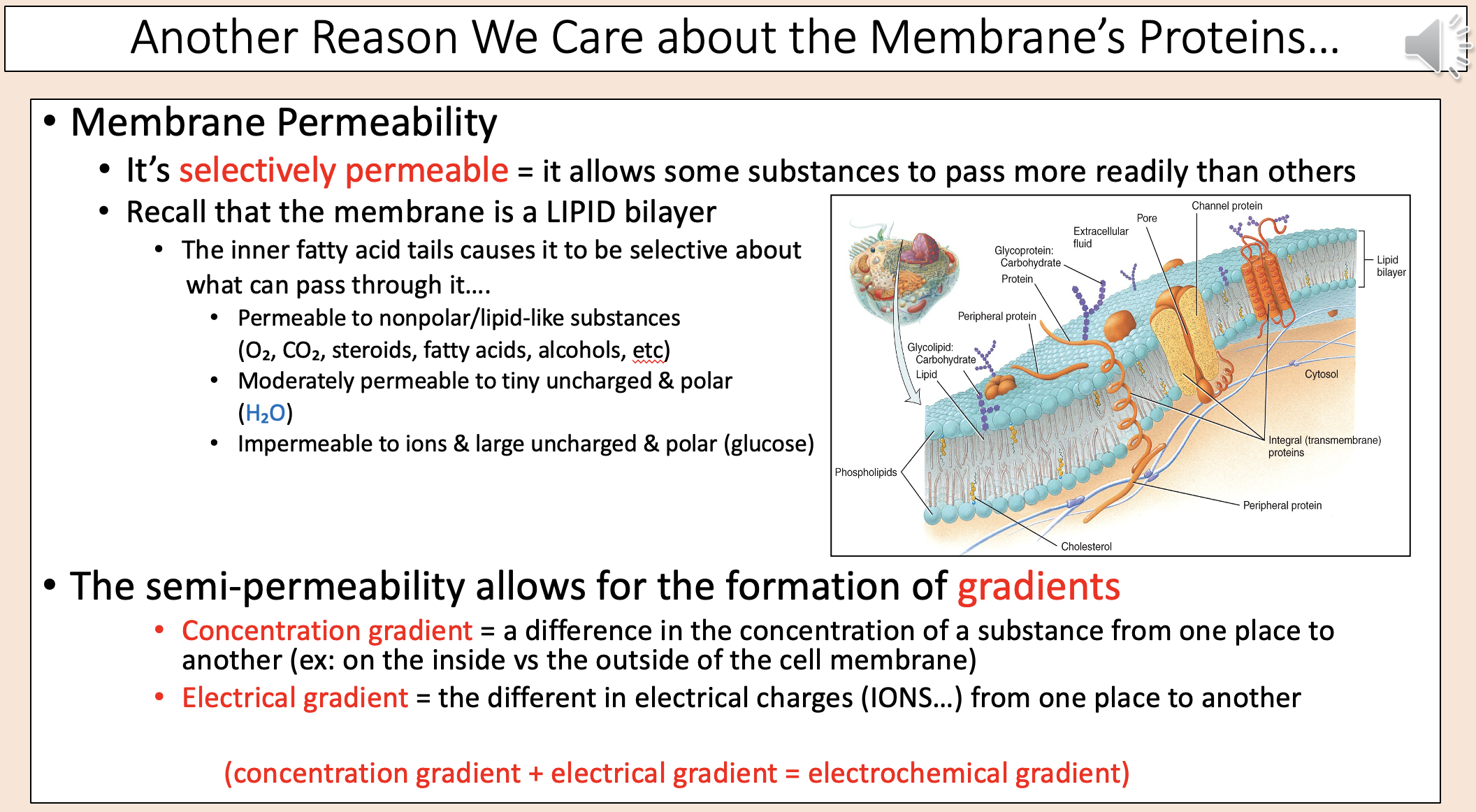
• It’s selectively permeable = it allows some substances to pass more readily than others.
• Recall that the membrane is a LIPID bilayer.
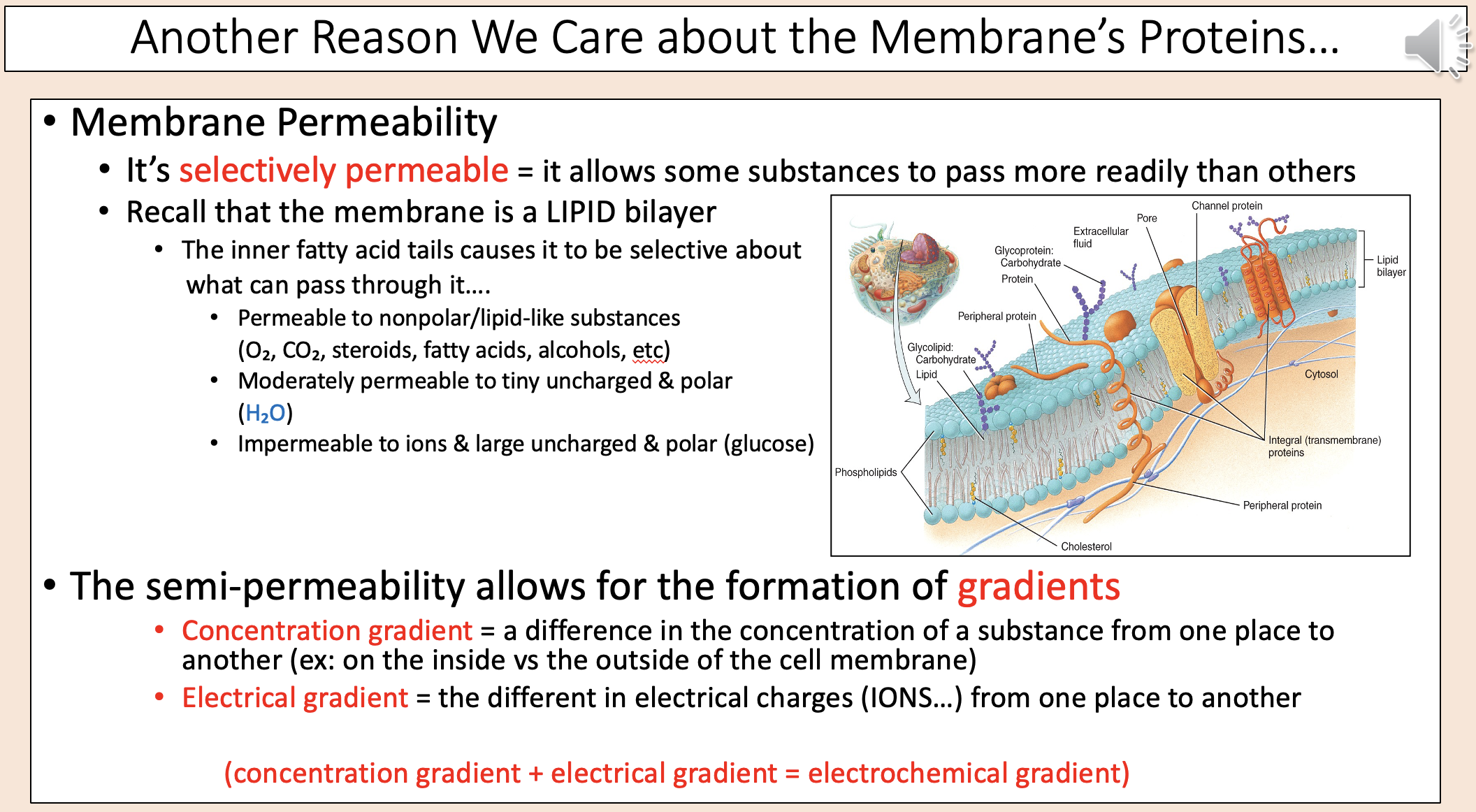
It’s selectively permeable
It allows some substances to pass more readily than others.
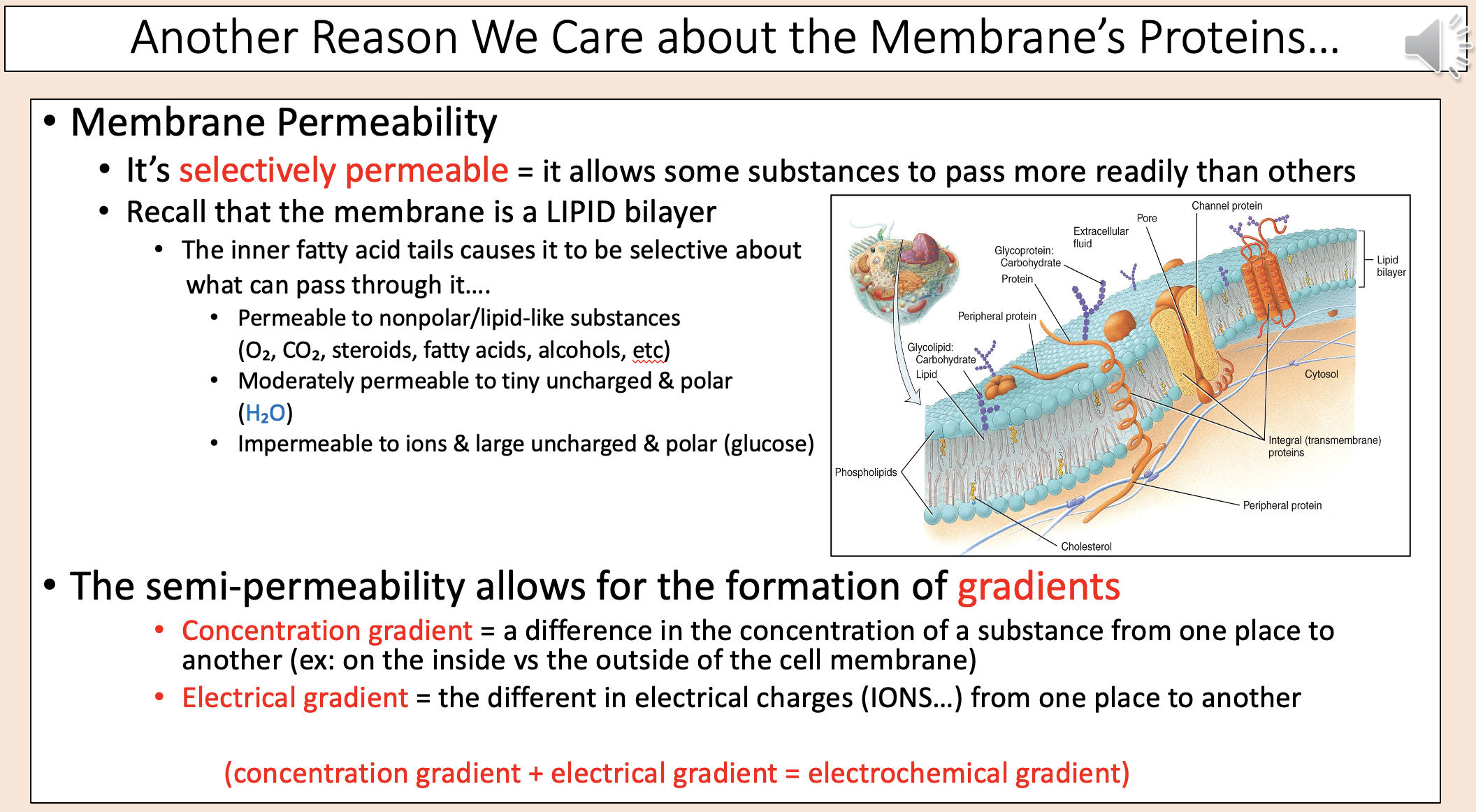
Recall that the membrane is a LIPID bilayer
The inner fatty acid tails causes it to be selective about what can pass through it....
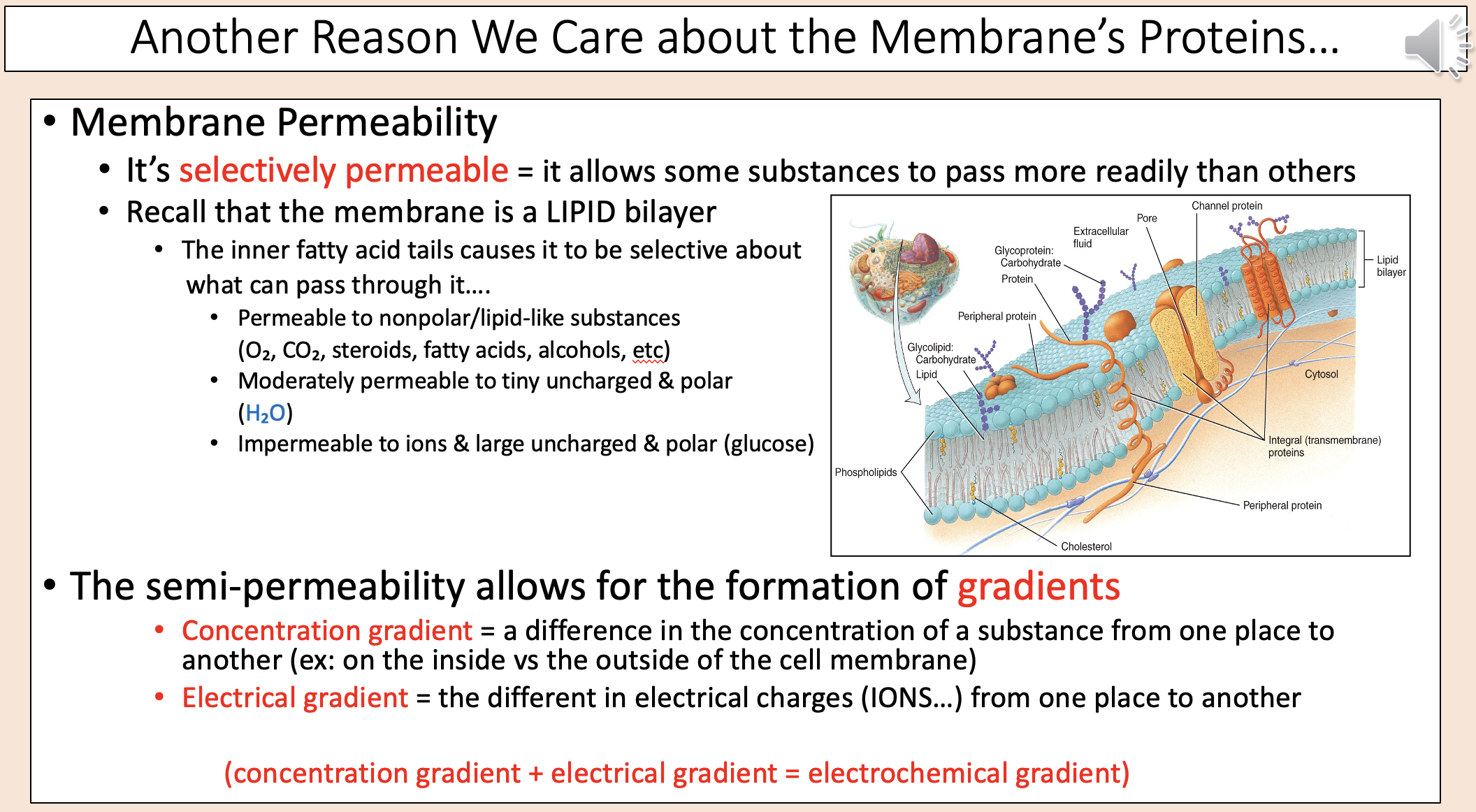
The inner fatty acid tails causes it to be selective about what can pass through it....
• Permeable to nonpolar/lipid-like substances (O2, CO2, steroids, fatty acids, alcohols, etc).
• Moderately permeable to tiny uncharged & polar (H2O).
• Impermeable to ions & large uncharged & polar (glucose).
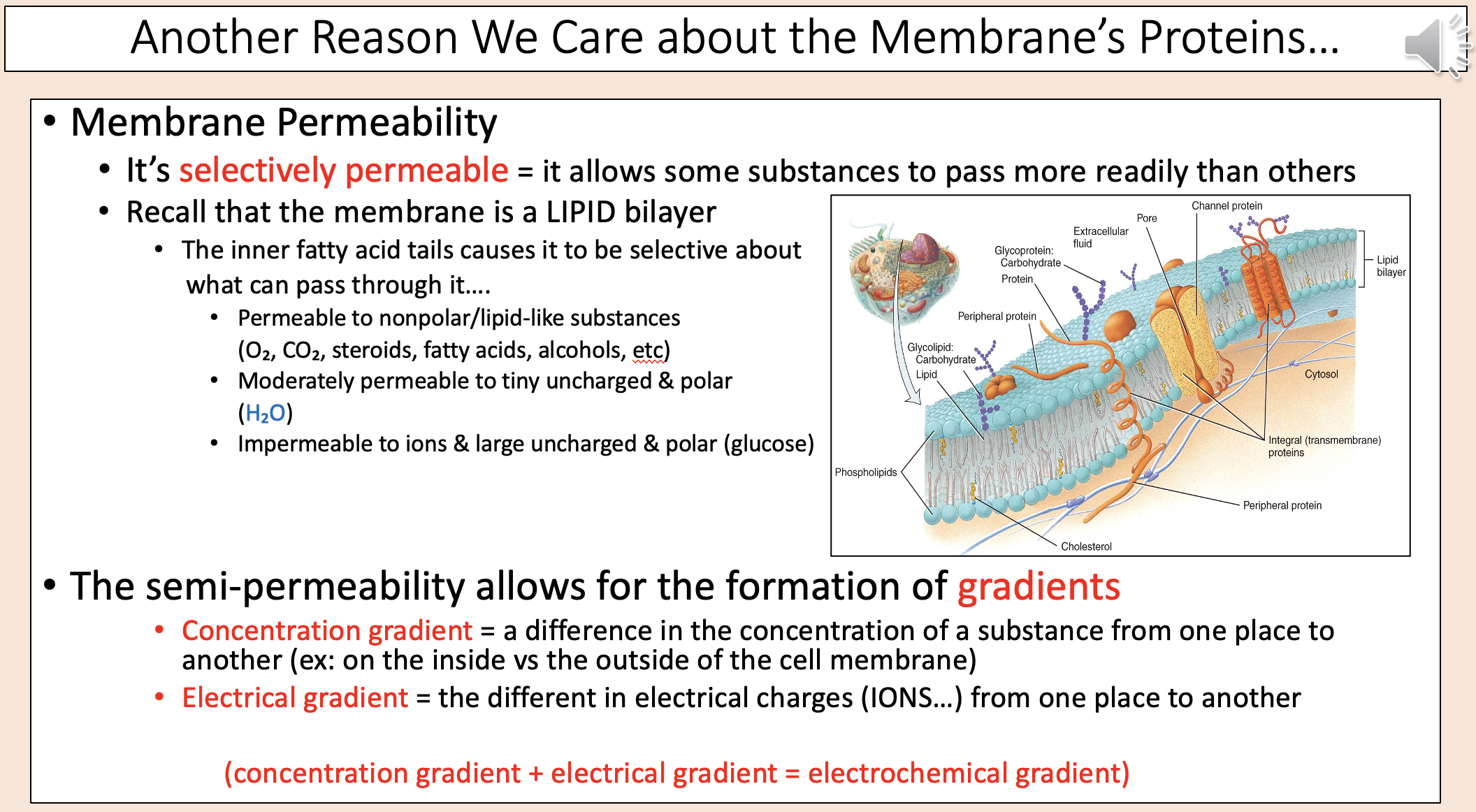
The semi-permeability allows for the formation of gradients
Concentration gradient = a difference in the concentration of a substance from one place to another (ex: on the inside vs the outside of the cell membrane).
Electrical gradient = the different in electrical charges (IONS...) from one place to another.
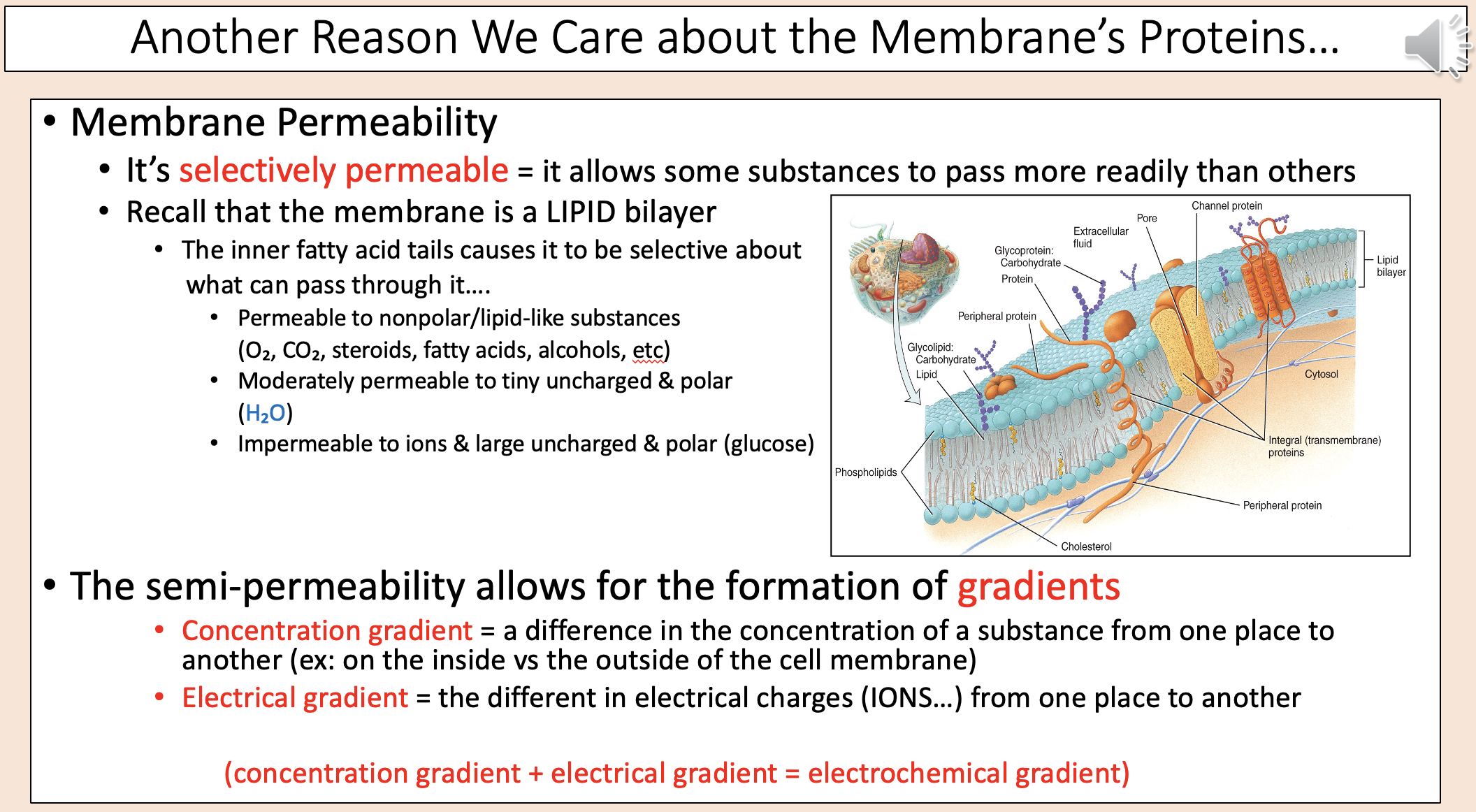
Concentration gradient
A difference in the concentration of a substance from one place to another (ex: on the inside vs the outside of the cell membrane).
Electrical gradient
The different in electrical charges (IONS...) from one place to another.
Concentration gradient + Electrical gradient
Electrochemical gradient
So Why Do We Care about Concentration Gradients?
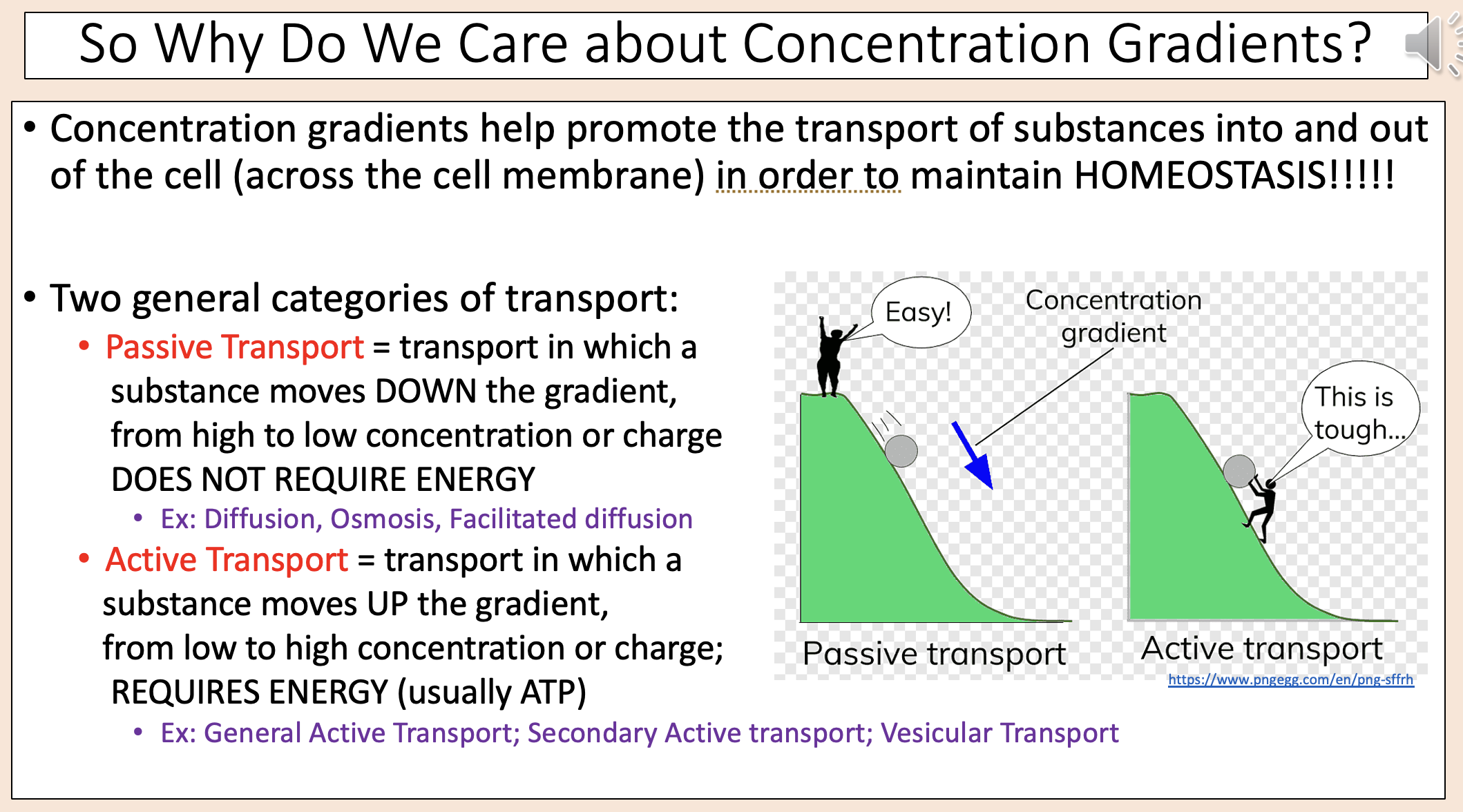
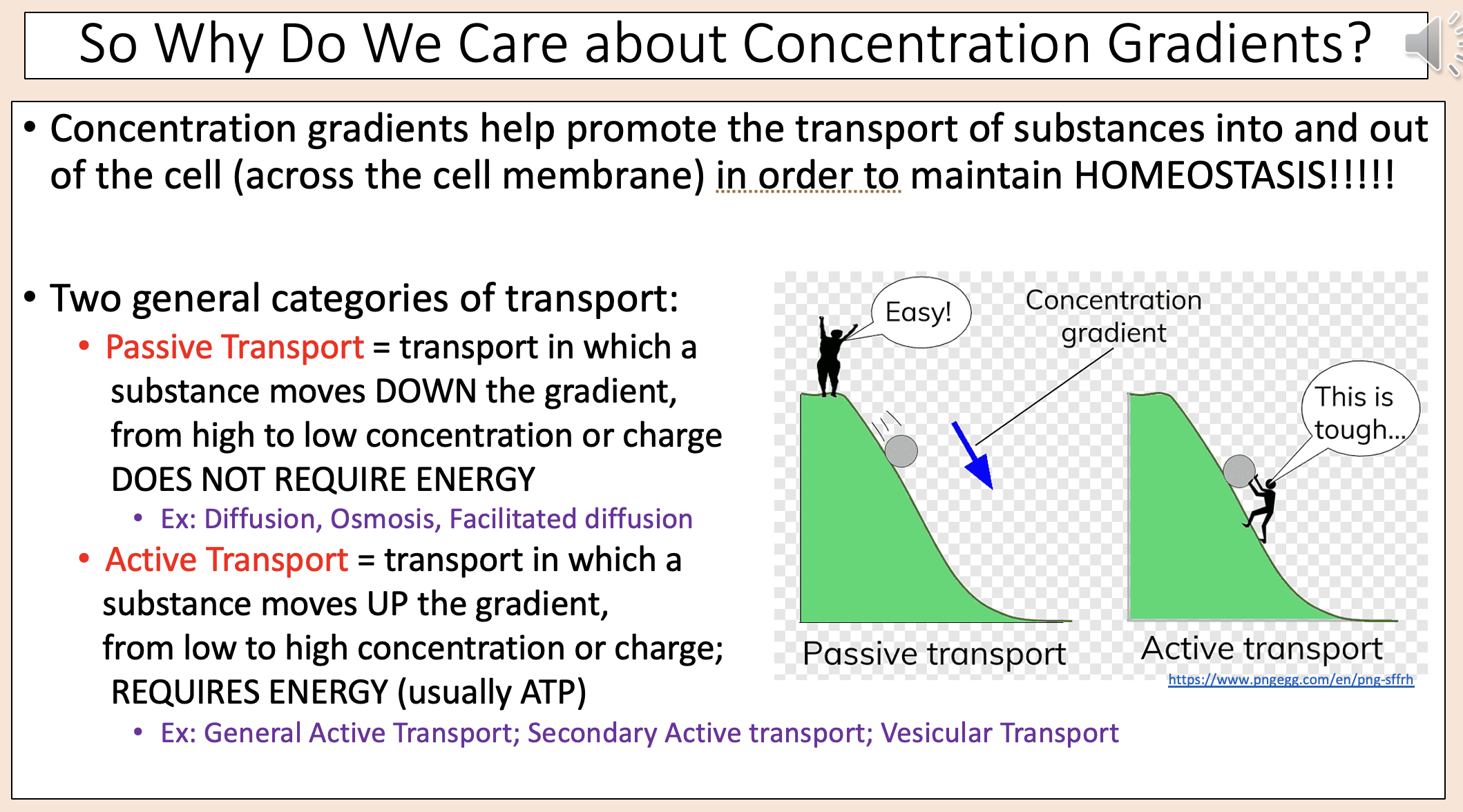
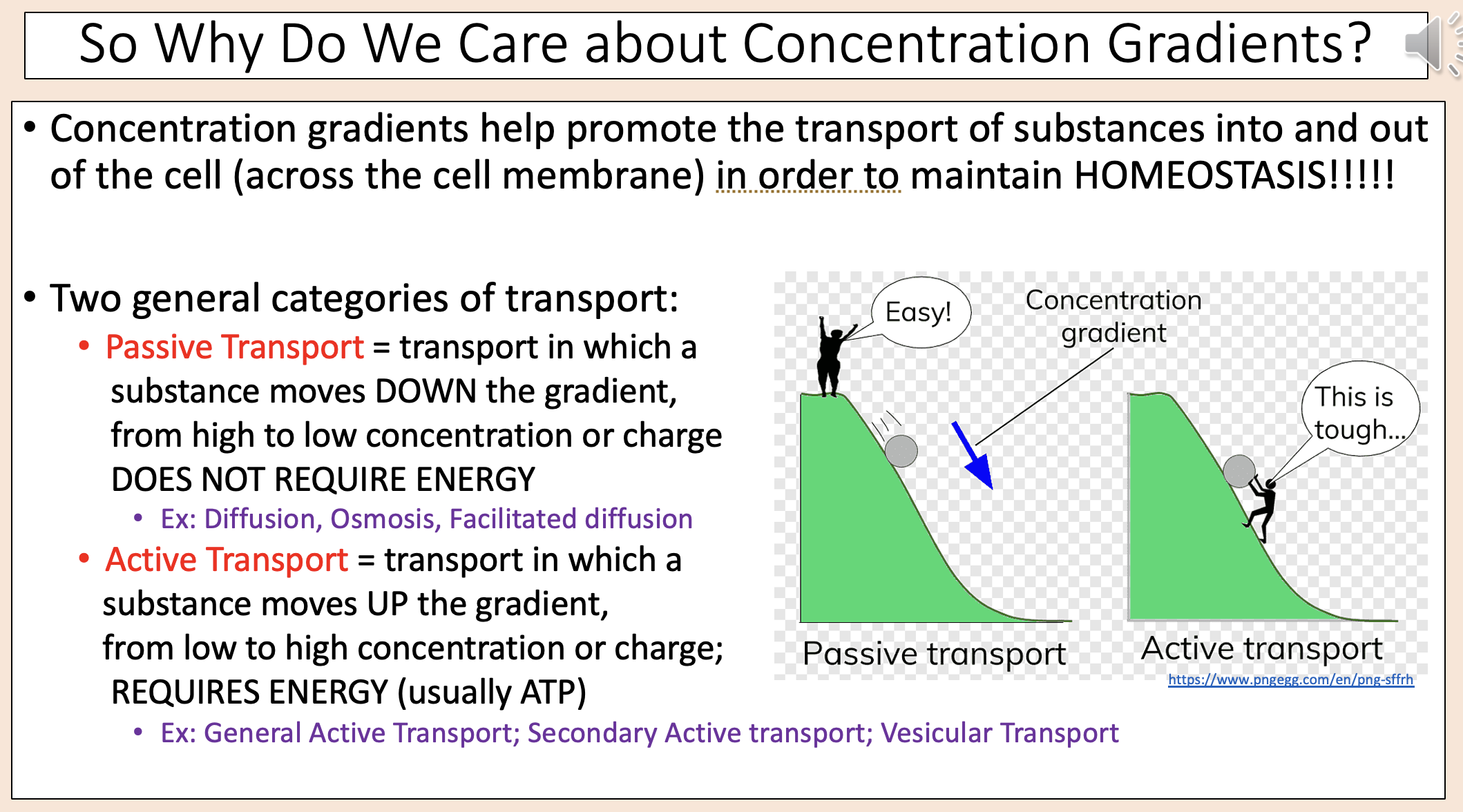
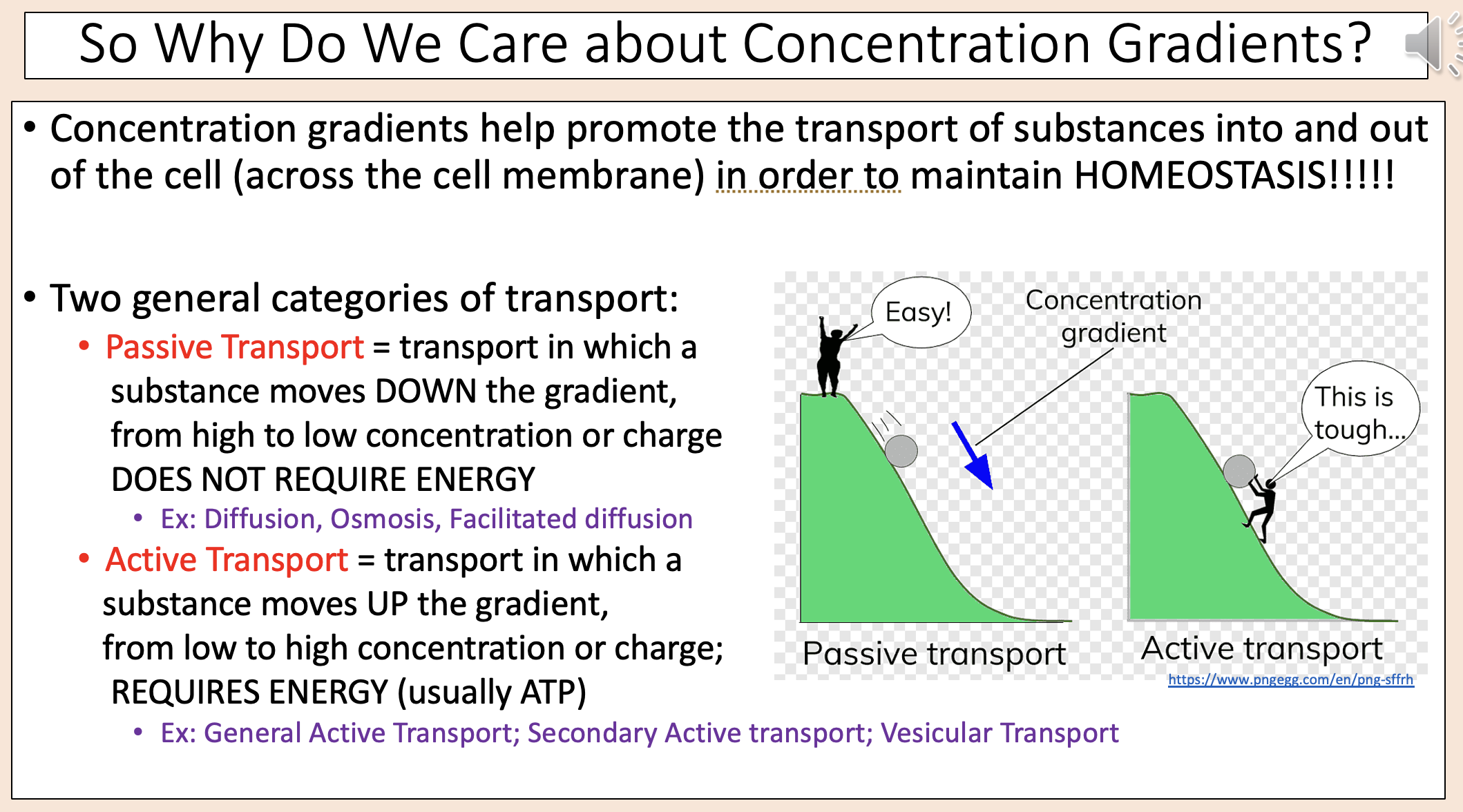
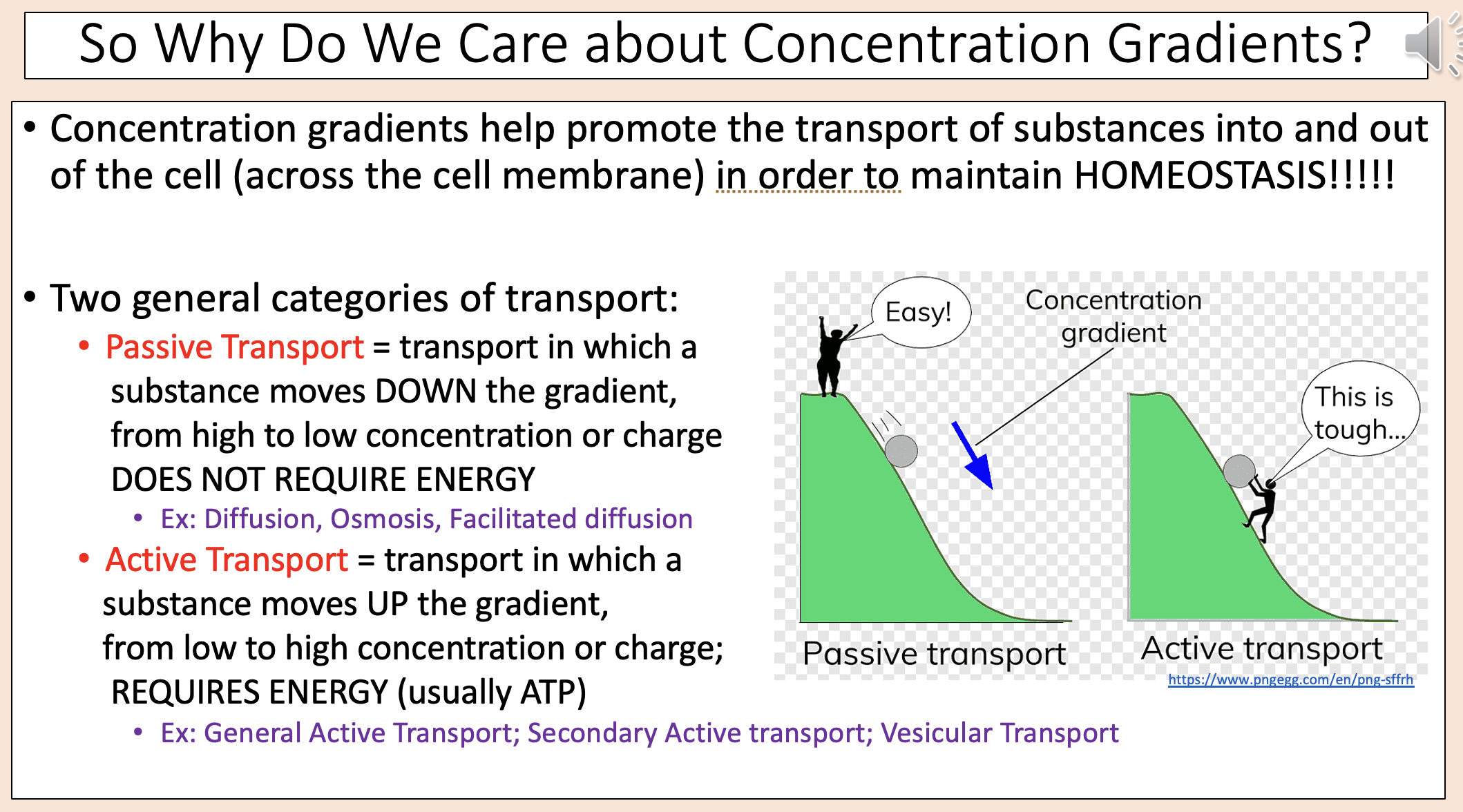
• Concentration gradients help promote the transport of substances into and out of the cell (across the cell membrane) in order to maintain HOMEOSTASIS!!!!!
• 2 general categories of transport.
2 general categories of transport:
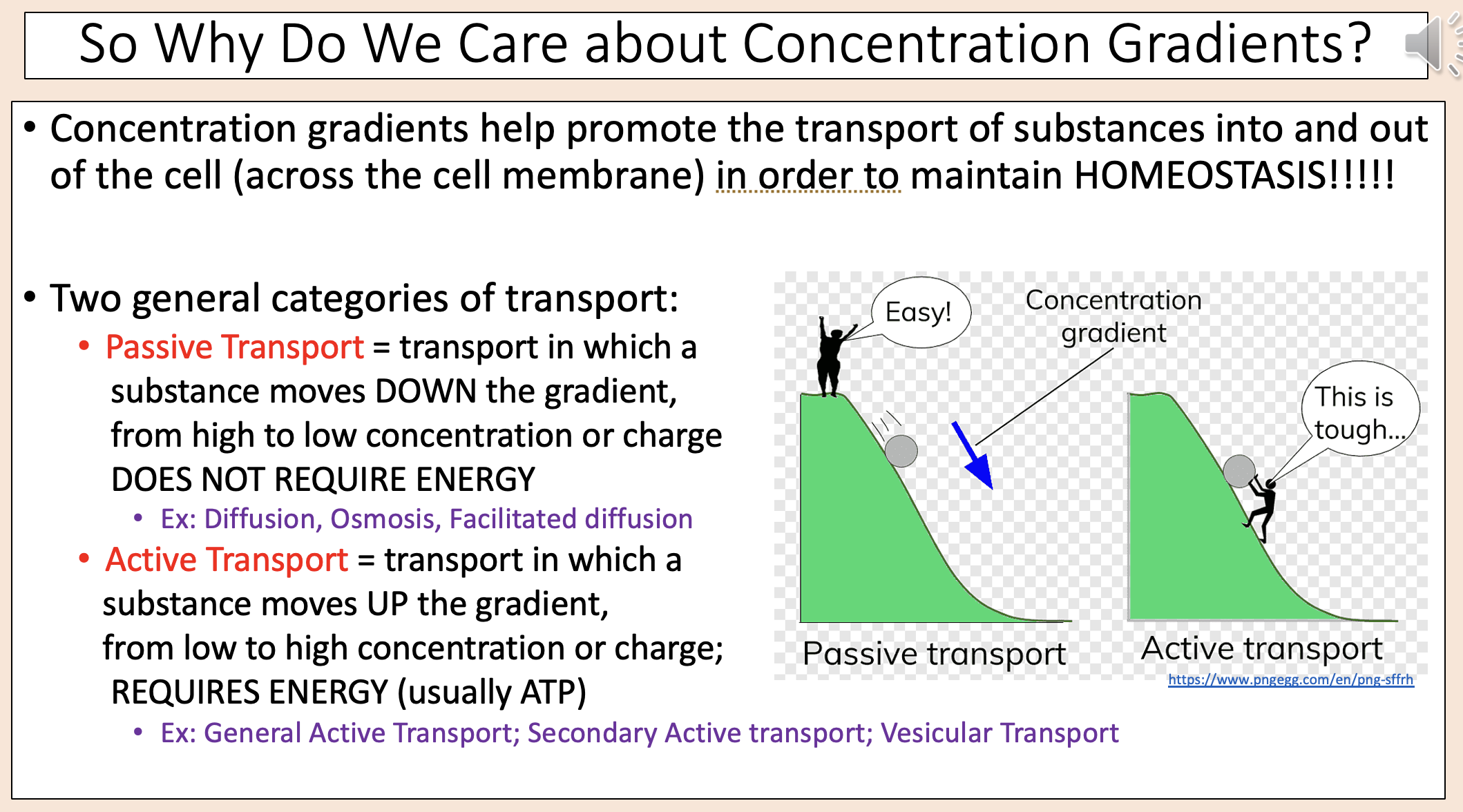
• Passive Transport = transport in which a substance moves DOWN the gradient, from high to low concentration or charge DOES NOT REQUIRE ENERGY.
• Active Transport = transport in which a substance moves UP the gradient, from low to high concentration or charge; REQUIRES ENERGY (usually ATP).
Passive Transport
Transport in which a substance moves DOWN the gradient, from high to low concentration or charge DOES NOT REQUIRE ENERGY.
Passive Transport Example
• Diffusion.
• Osmosis.
• Facilitated diffusion.
Active Transport
Transport in which a substance moves UP the gradient, from low to high concentration or charge; REQUIRES ENERGY (usually ATP).
Active Transport
• General Active Transport.
• Secondary Active transport.
• Vesicular Transport.
Passive Transport
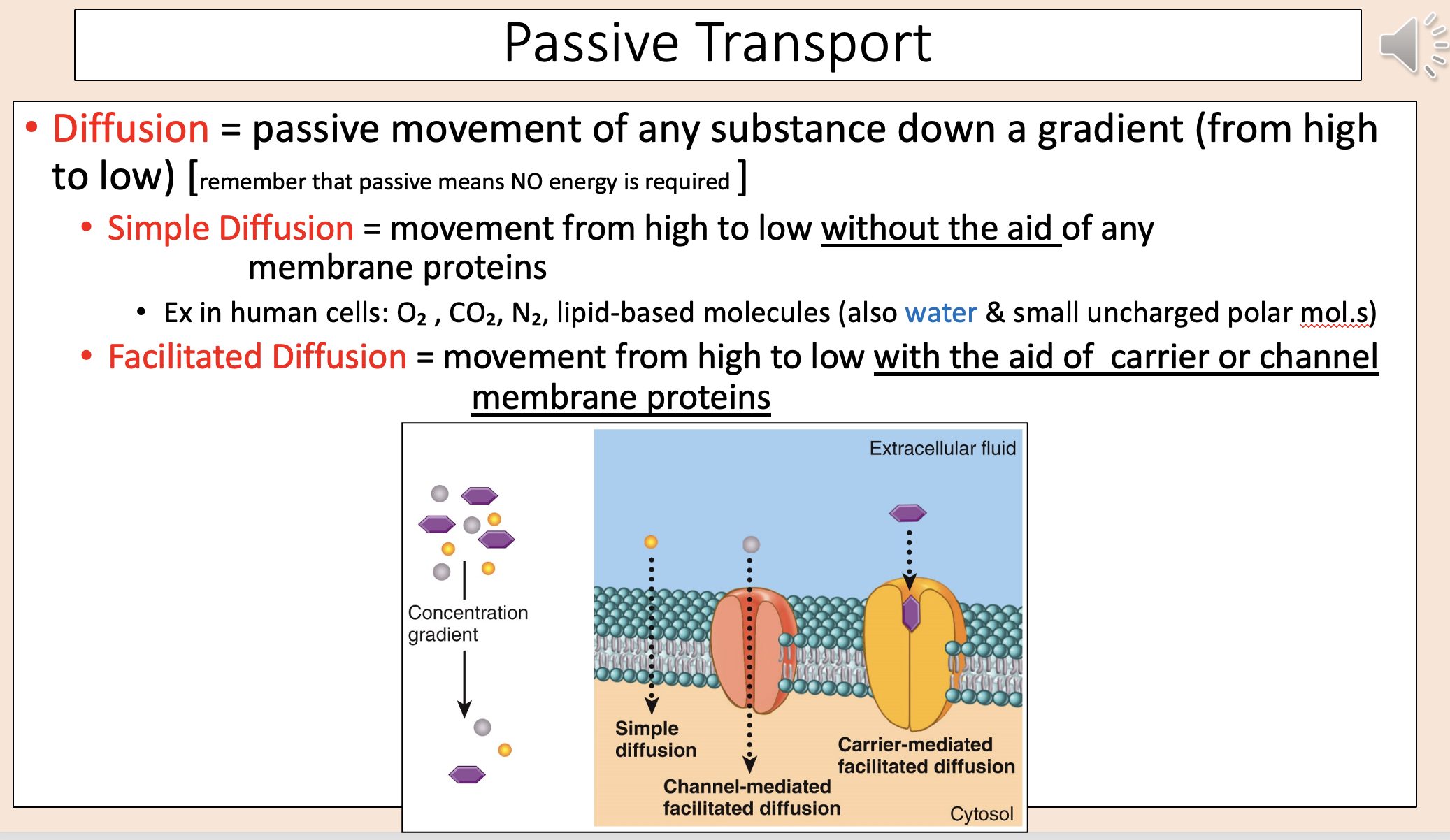
Diffusion = passive movement of any substance down a gradient (from high to low) [remember that passive means NO energy is required ].
![<p><span style="color: rgb(255, 0, 0);"><span>Diffusion </span></span><span><span>= passive movement of any substance down a gradient (from high to low) [remember that passive means NO energy is required ].</span></span></p>](https://knowt-user-attachments.s3.amazonaws.com/b7dd5243-3abd-458b-9108-546938d5e66a.png)
Diffusion
Passive movement of any substance down a gradient (from high to low) [remember that passive means NO energy is required ].
![<p><span><span>Passive movement of any substance down a gradient (from high to low) [remember that passive means NO energy is required ].</span></span></p>](https://knowt-user-attachments.s3.amazonaws.com/b055f087-f535-4135-bb6b-4dfdb26887cb.png)
Diffusion
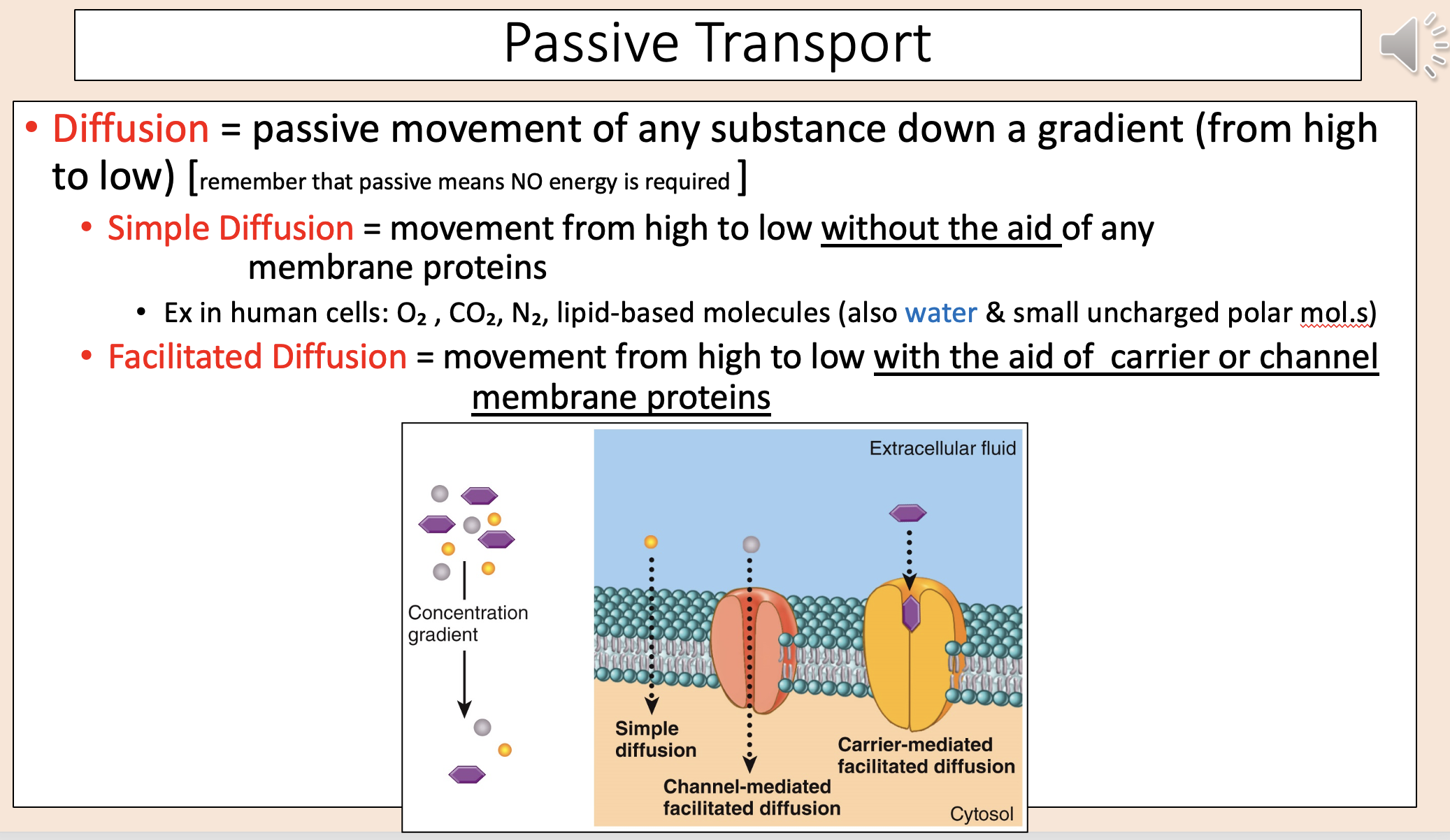
• Simple Diffusion = movement from high to low without the aid of any membrane proteins.
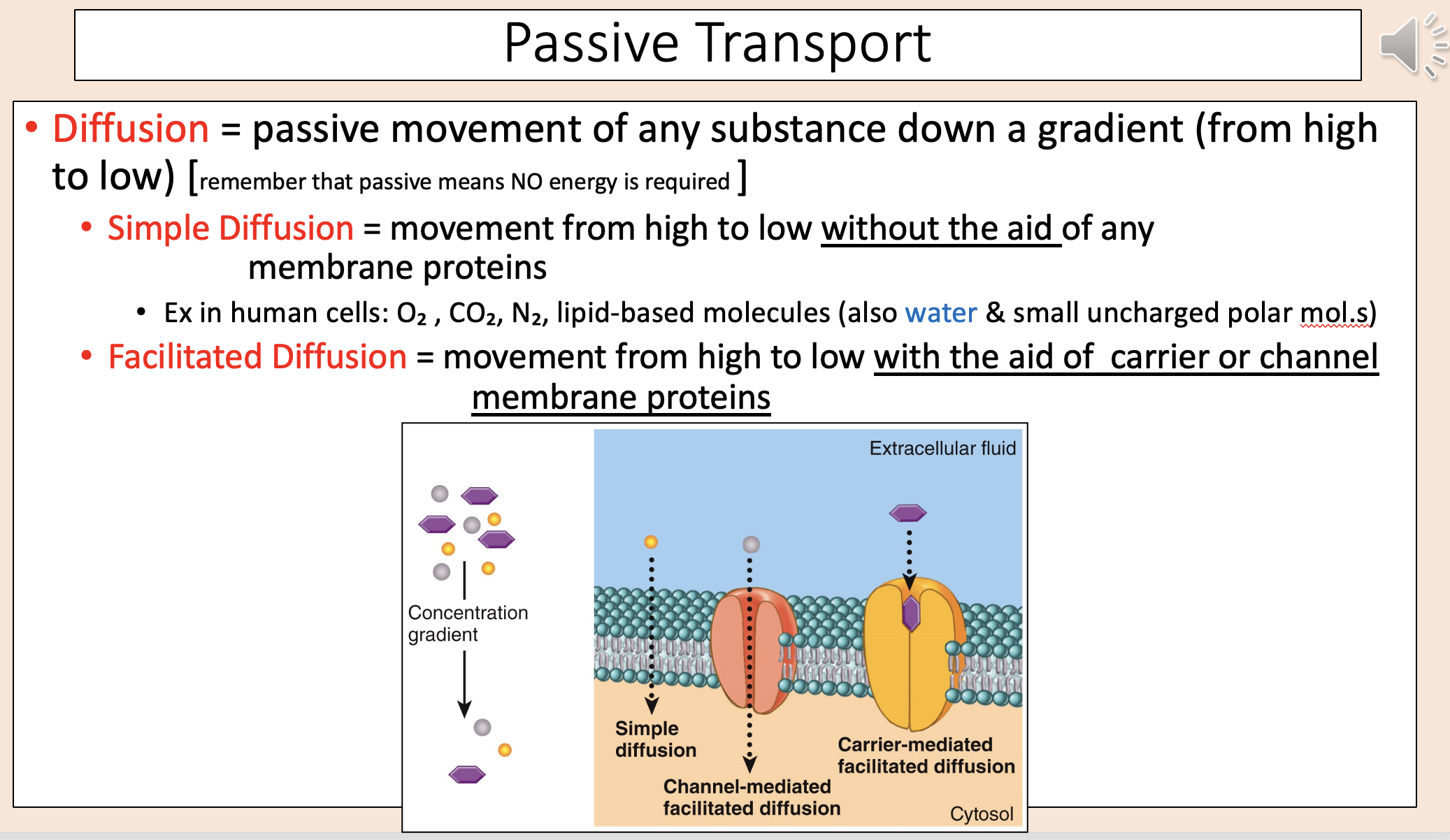
• Facilitated Diffusion movement from high to low with the aid of carrier or channel membrane proteins.
Simple Diffusion
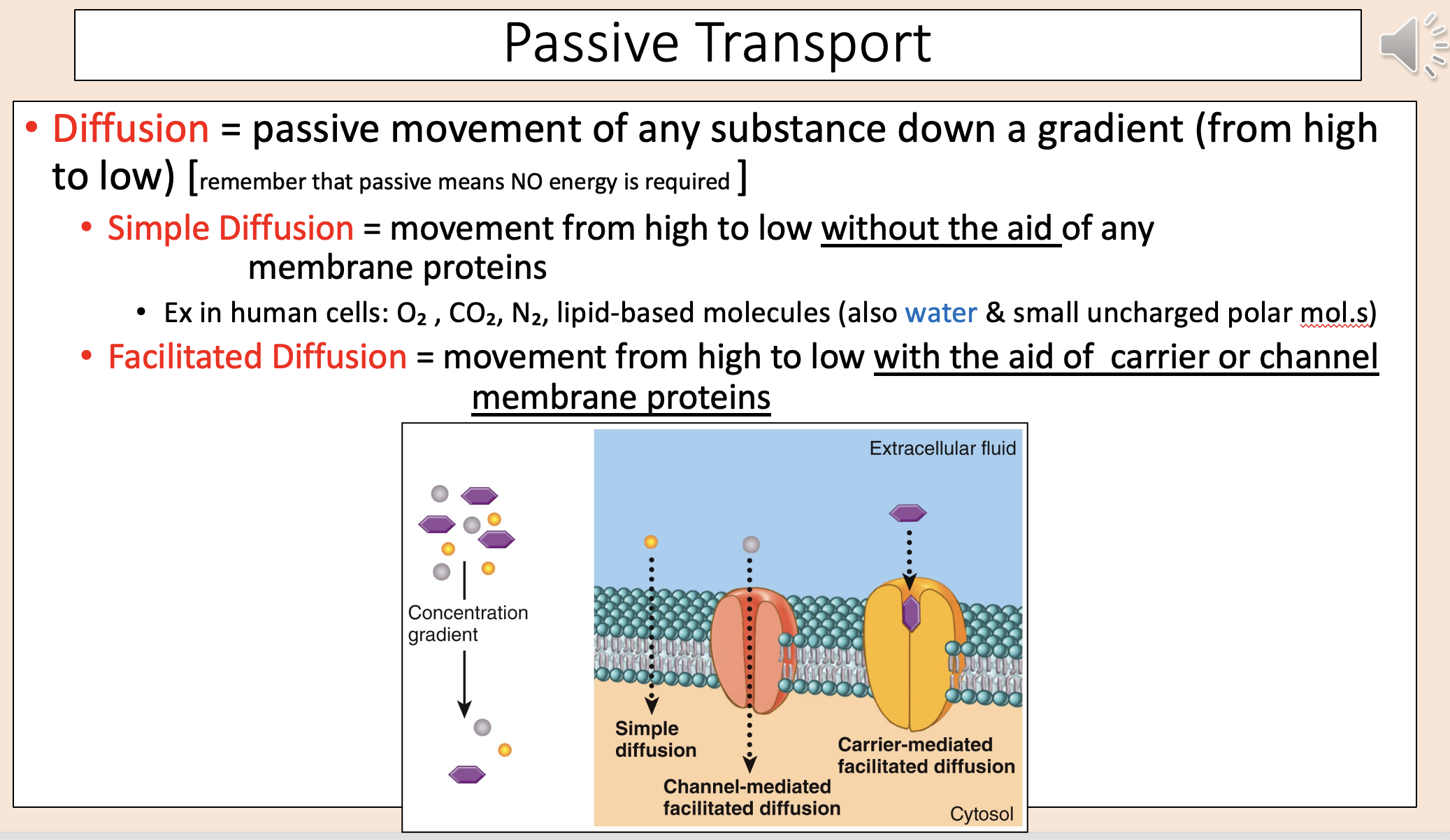
Movement from high to low without the aid of any membrane proteins.
Simple Diffusion Example
In human cells: O2 , CO2, N2, lipid-based molecules (also water & small uncharged polar mol.s).
Facilitated Diffusion
Movement from high to low with the aid of carrier or channel membrane proteins.
Another Look at Facilitated Diffusion’s Transport Proteins
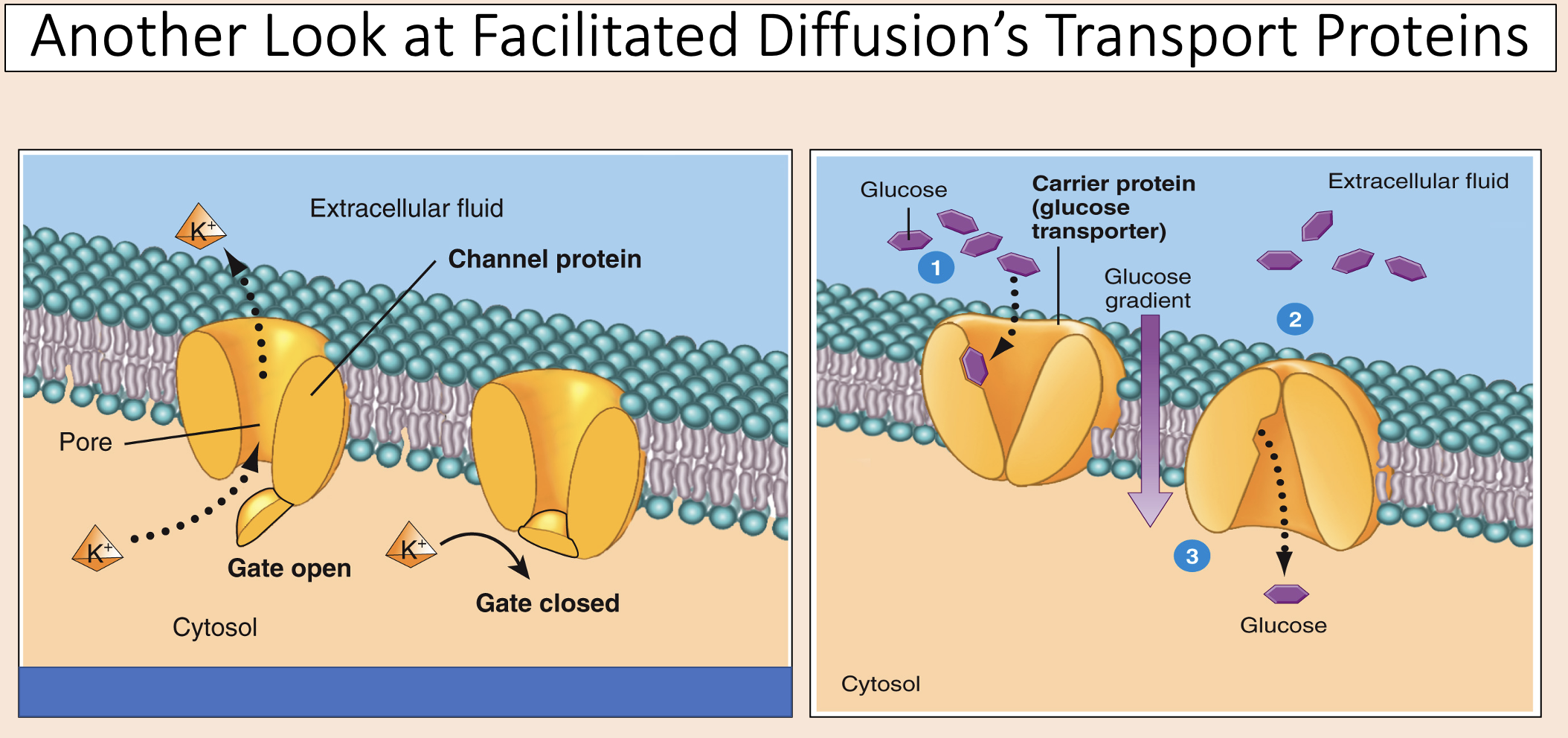
Example of Simple Diffusion in the Human Body
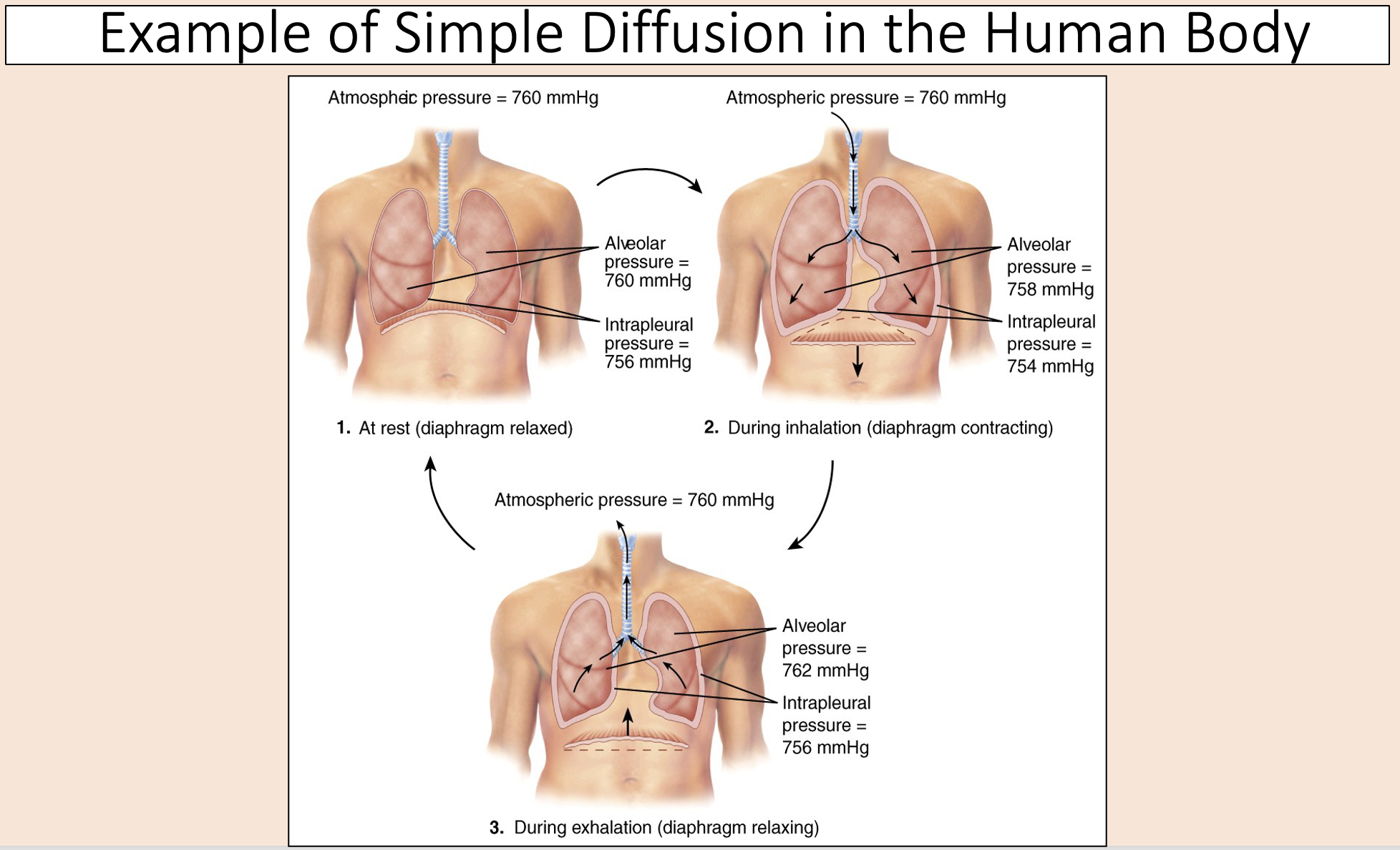
More Passive Transport
Osmosis = diffusion of water.
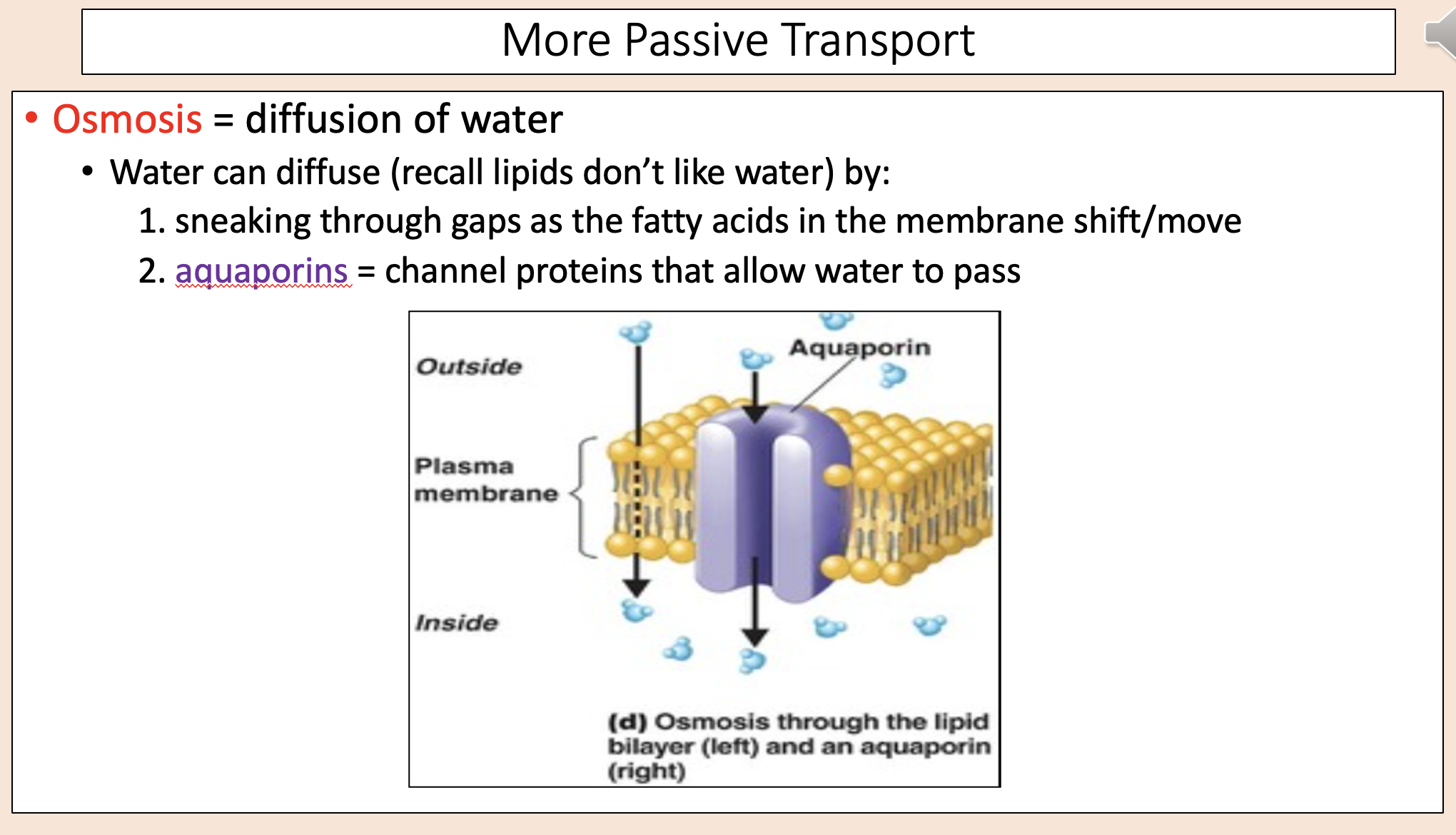
Osmosis
Diffusion of water.
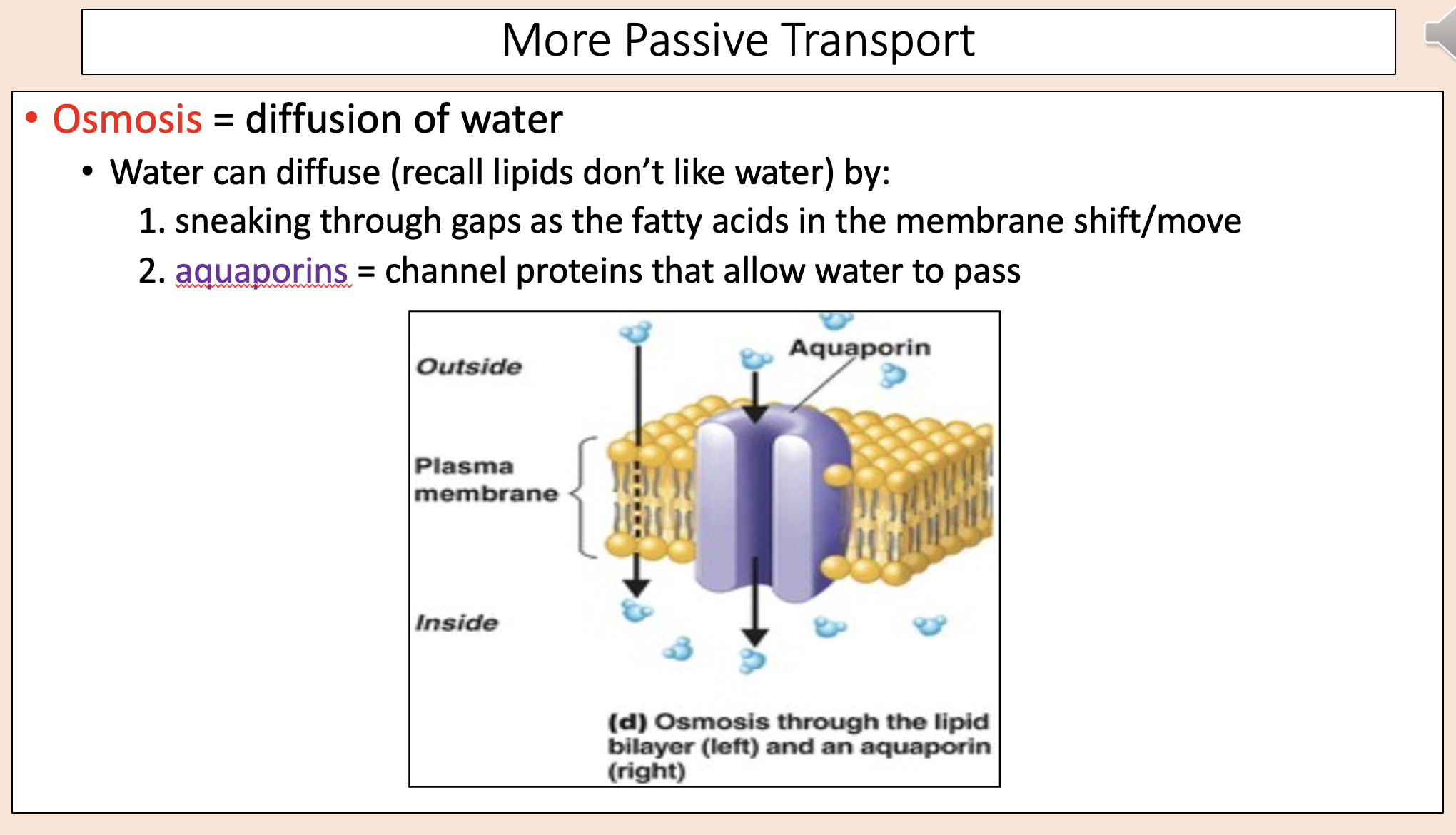
Osmosis Water can diffuse (recall lipids don’t like water) by
Water can diffuse (recall lipids don’t like water) by.
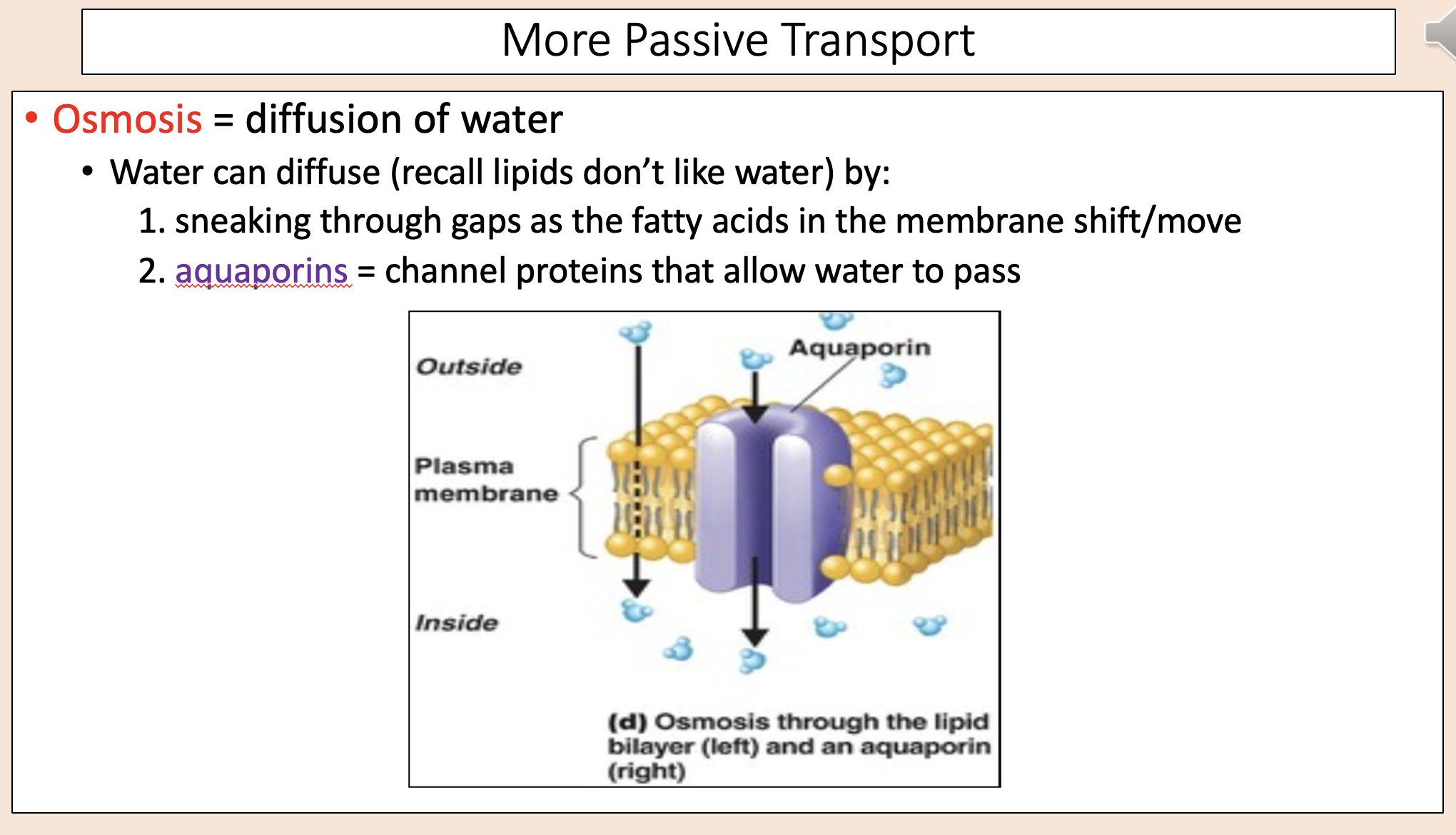
Water can diffuse (recall lipids don’t like water) by
1. Sneaking through gaps as the fatty acids in the membrane shift/move.
2. Aquaporins.
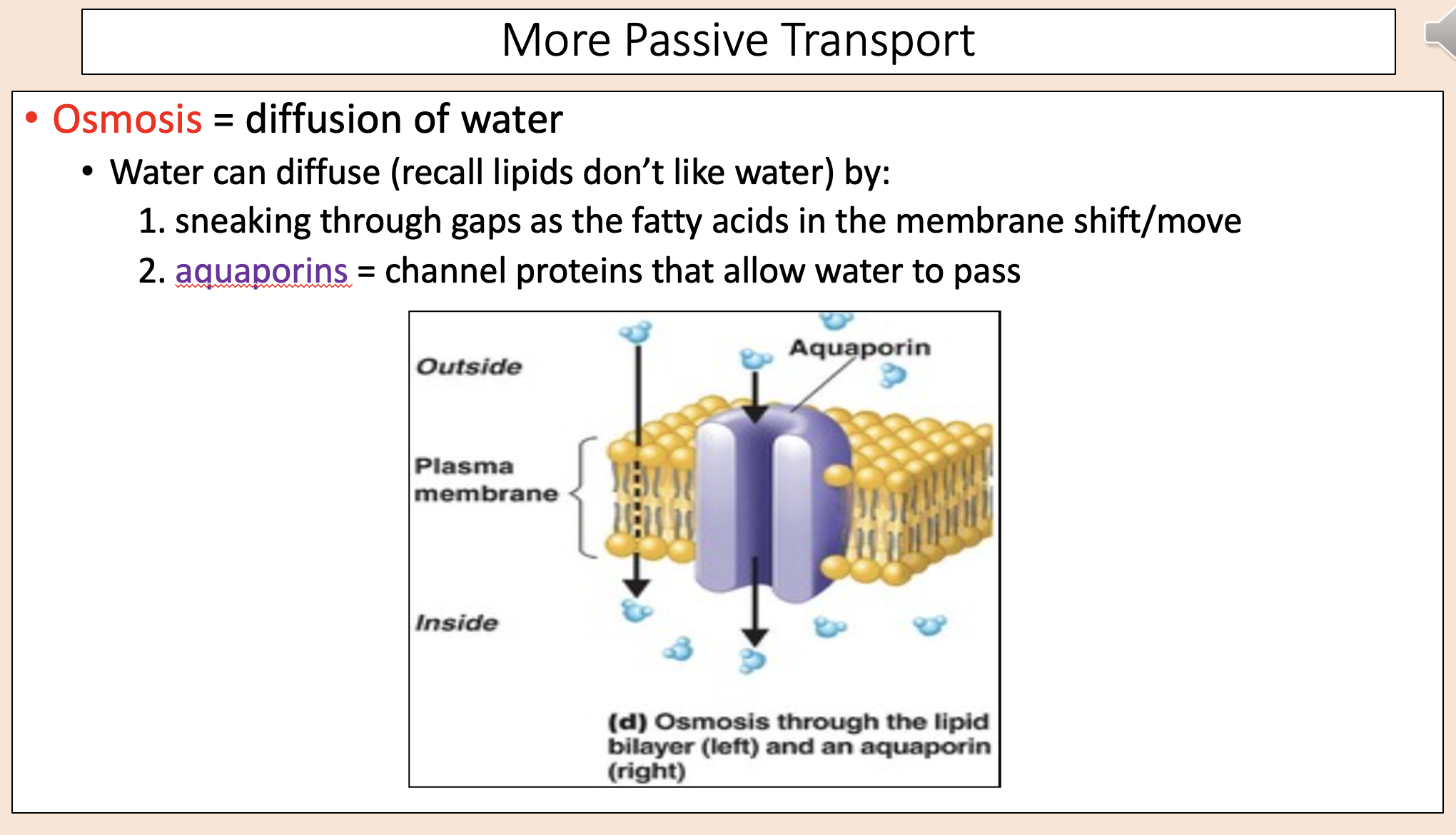
Aquaporins
Channel proteins that allow water to pass.
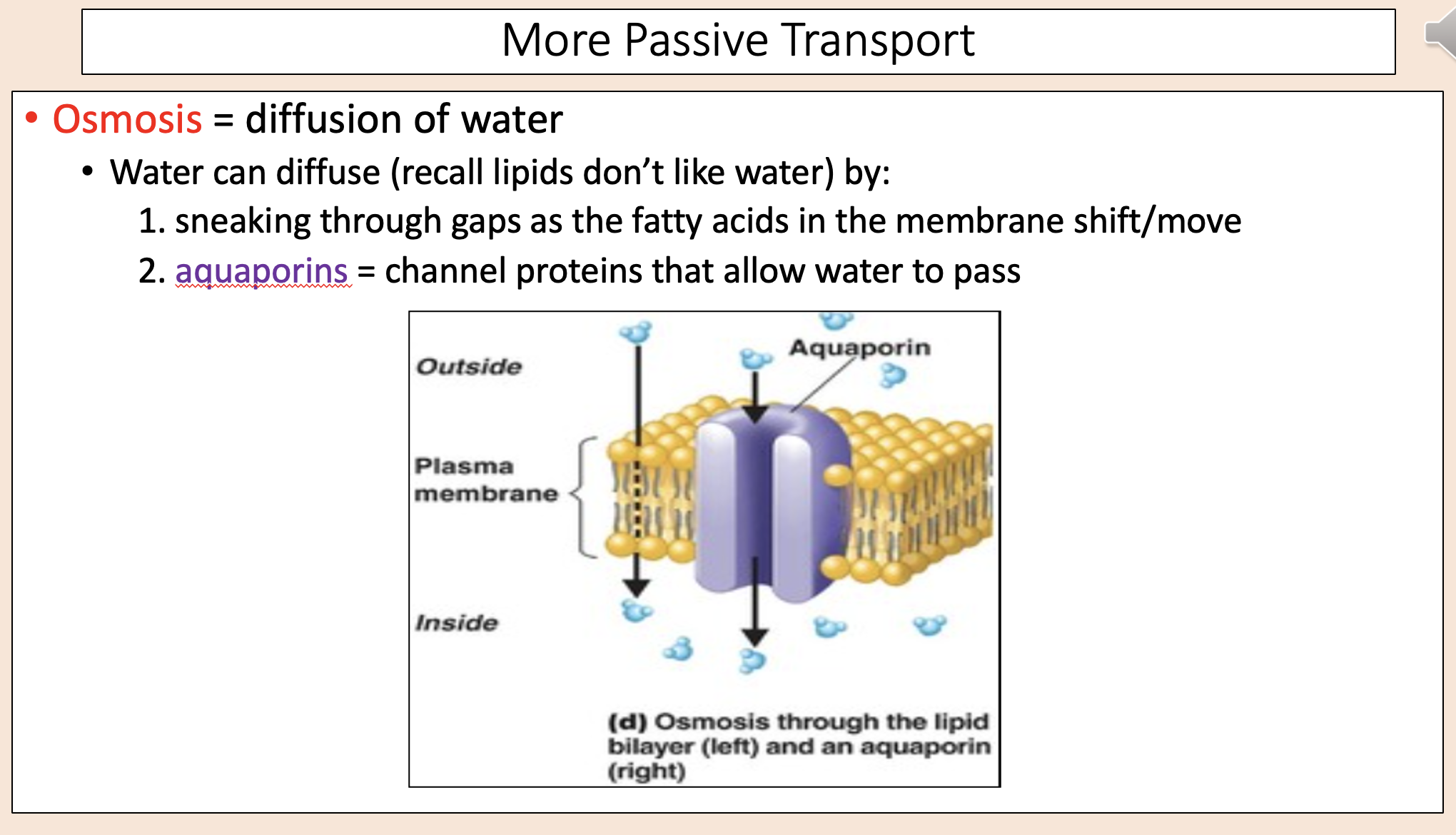
Osmosis & Tonicity
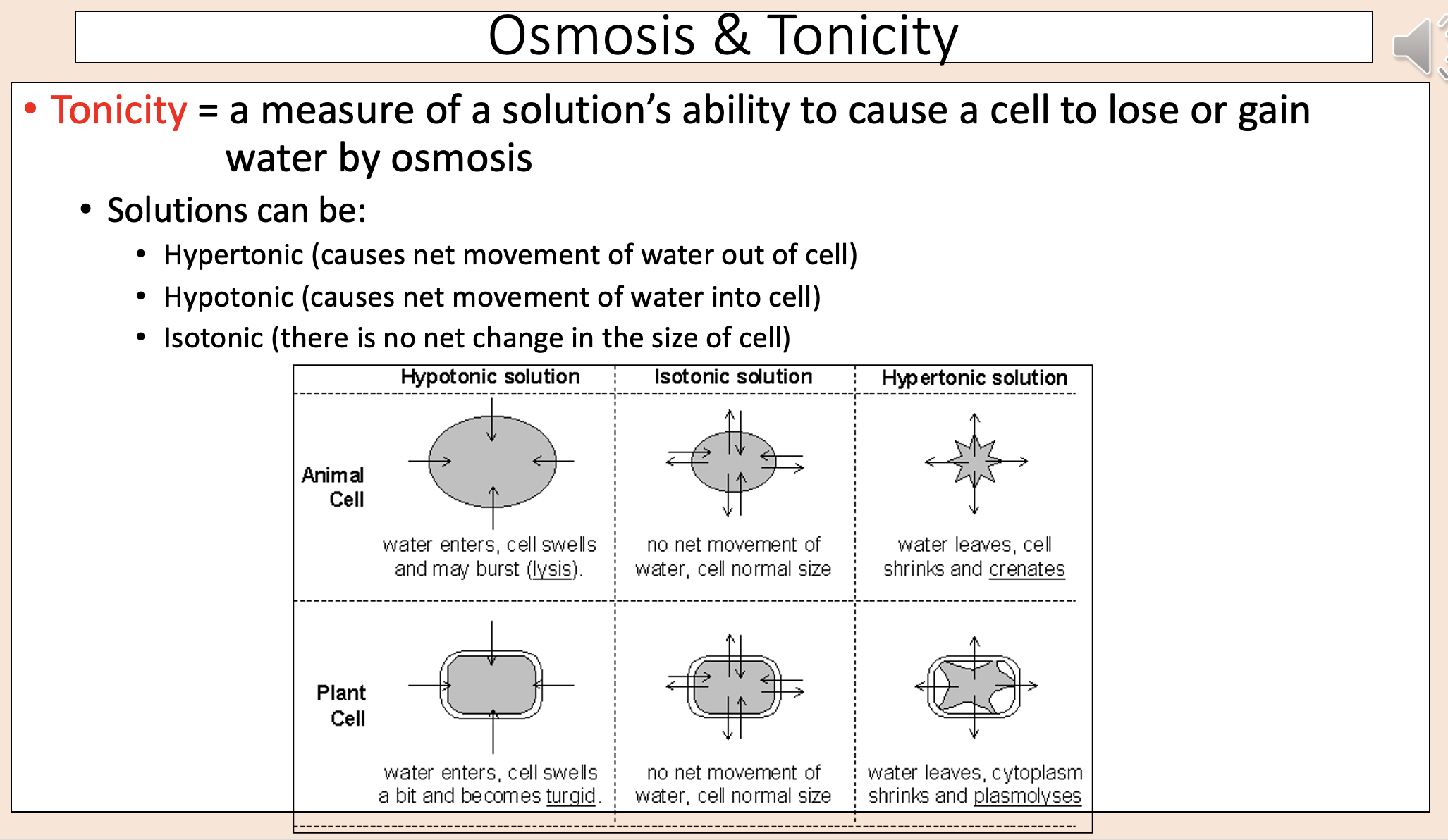
Tonicity = a measure of a solution’s ability to cause a cell to lose or gain water by osmosis.
Tonicity
A measure of a solution’s ability to cause a cell to lose or gain water by osmosis.
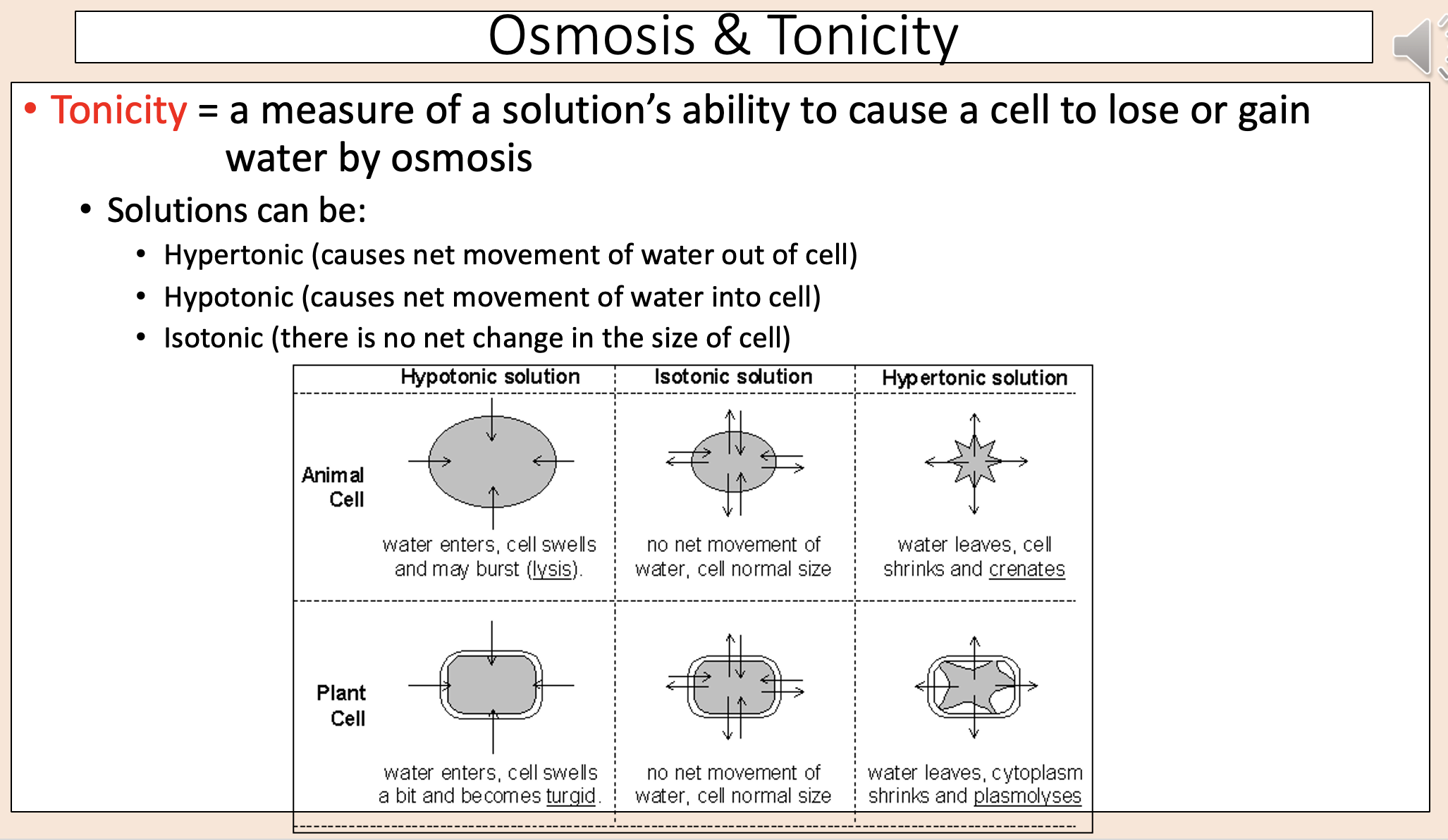
Tonicity solutions can be
• Hypertonic (causes net movement of water out of cell).
• Hypotonic (causes net movement of water into cell).
• Isotonic (there is no net change in the size of cell).
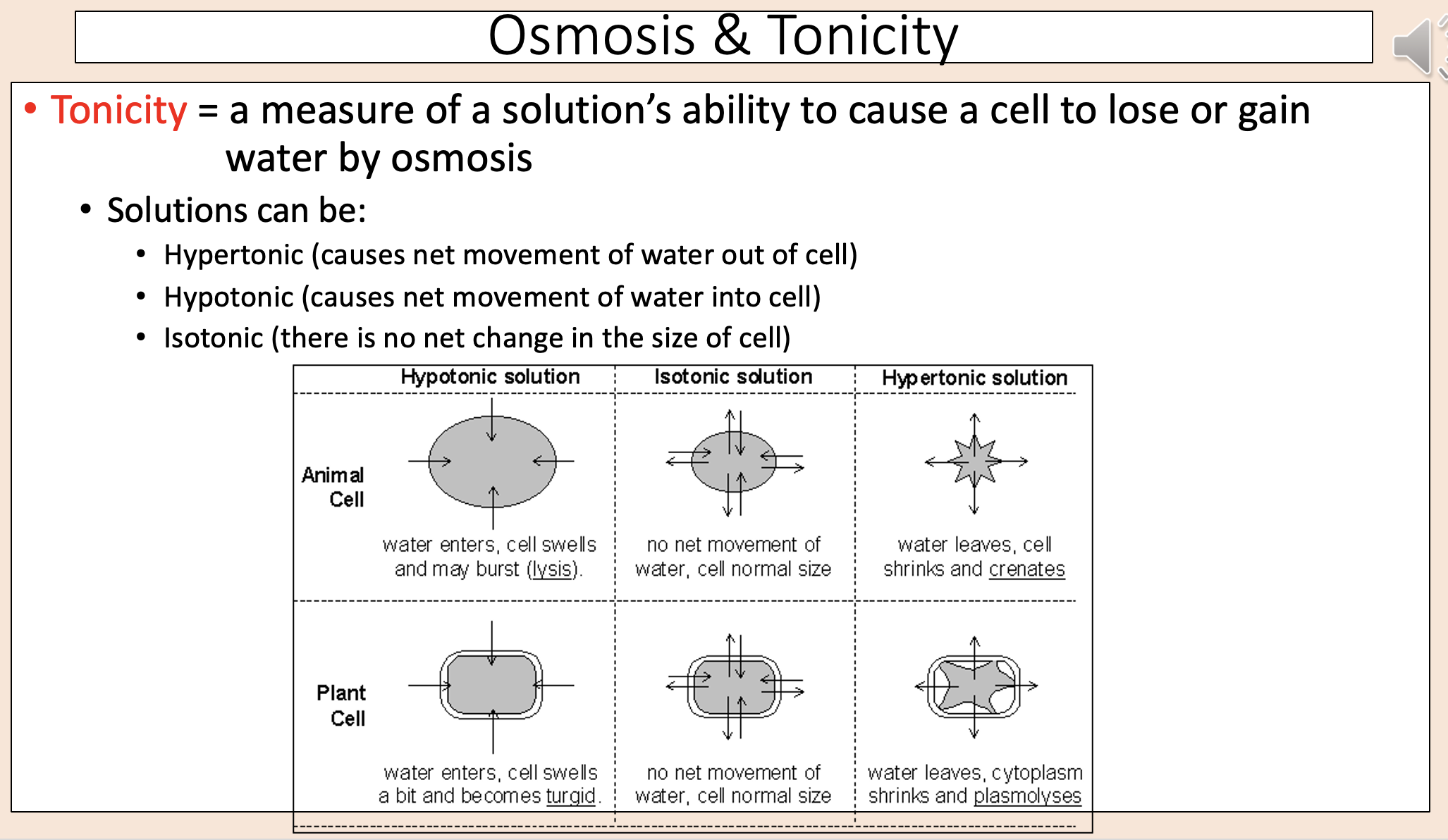
Hypertonic
Causes net movement of water out of cell.
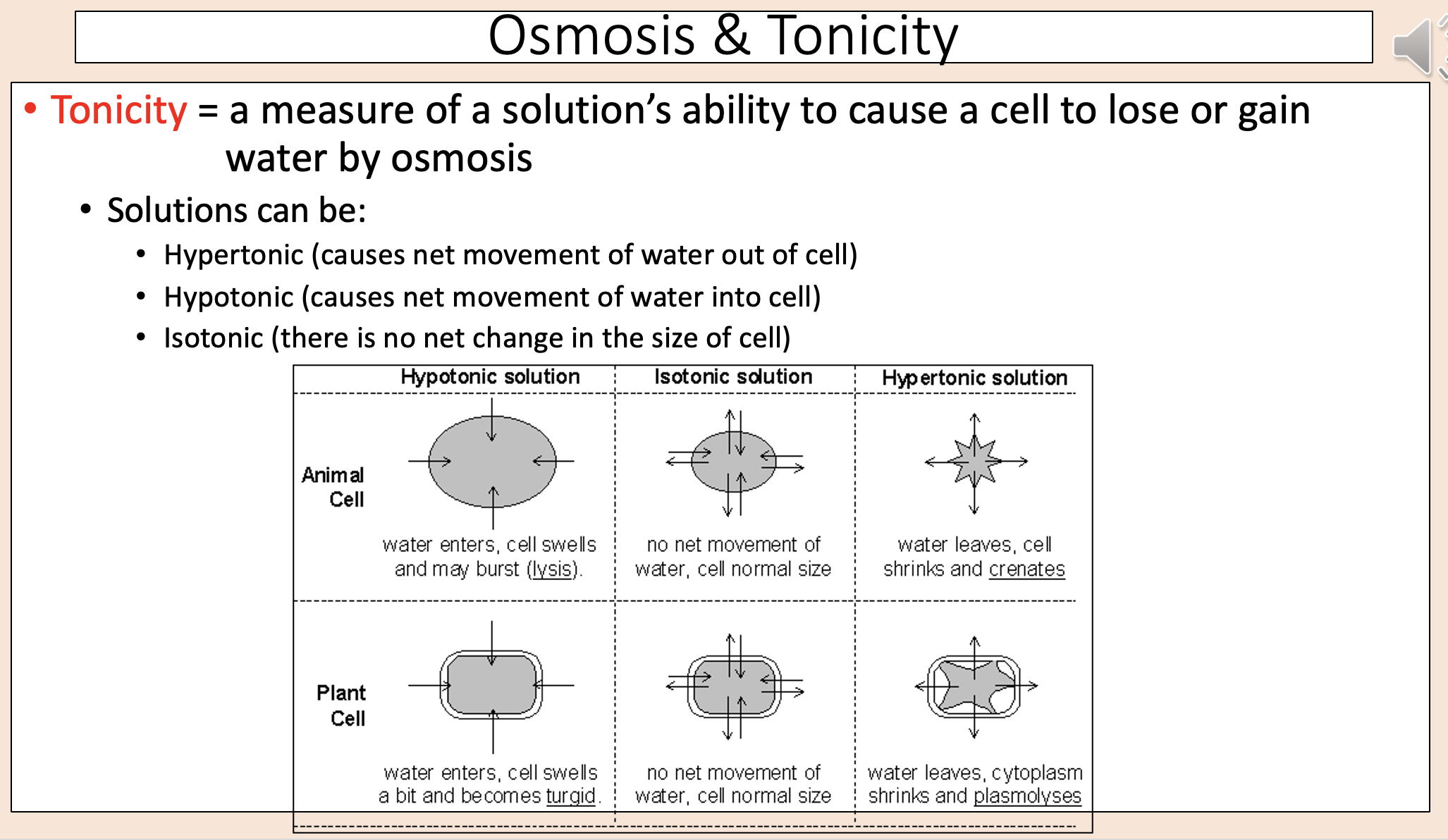
Hypotonic
Causes net movement of water into cell.
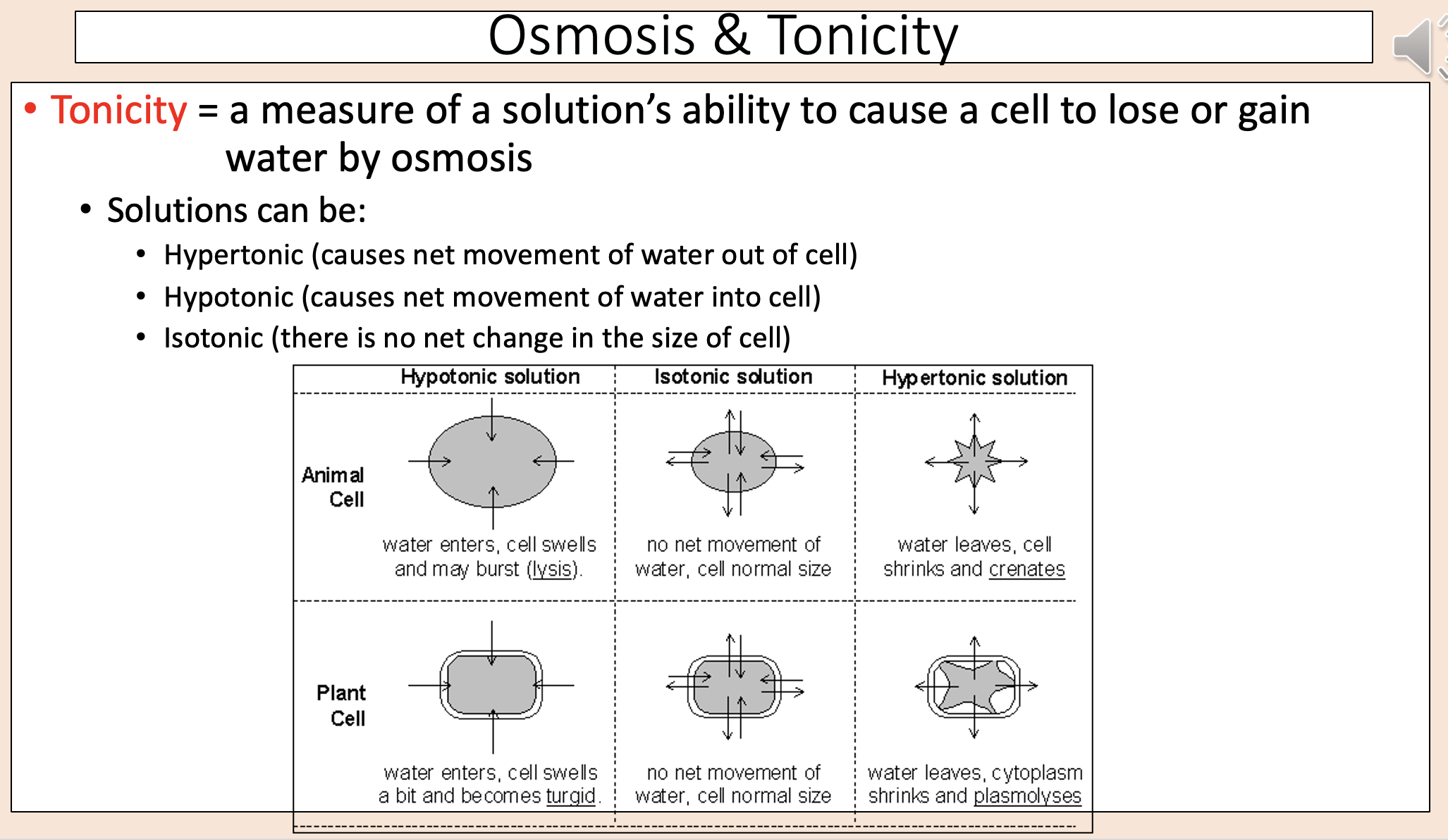
Isotonic
There is no net change in the size of cell.
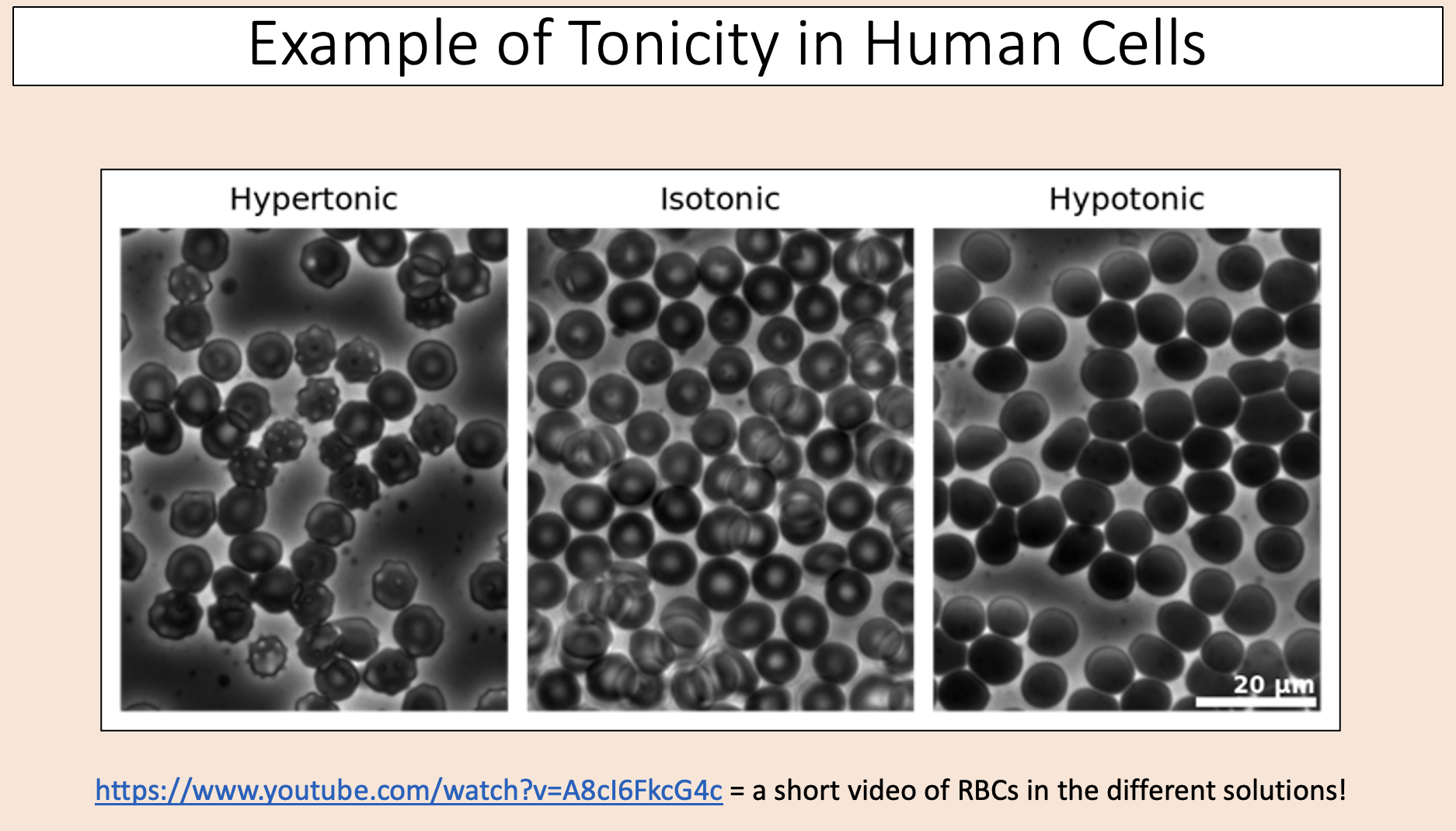
Example of Tonicity in Human Cells
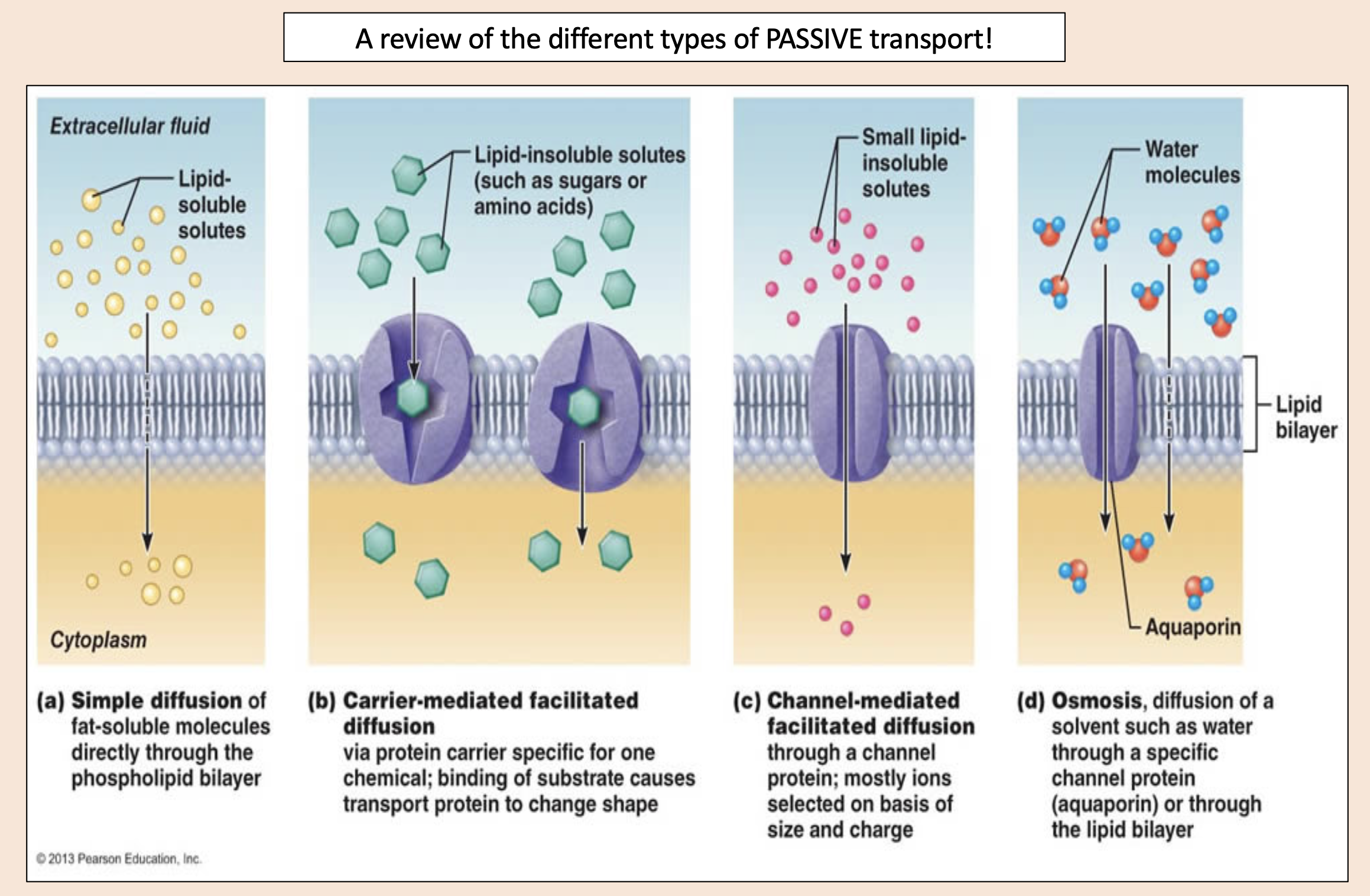
A review of the different types of PASSIVE transport!
• Simple diffusion.
• Carrier-mediated facilitated diffusion.
• Channel-mediated facilitated diffusion.
• Osmosis.
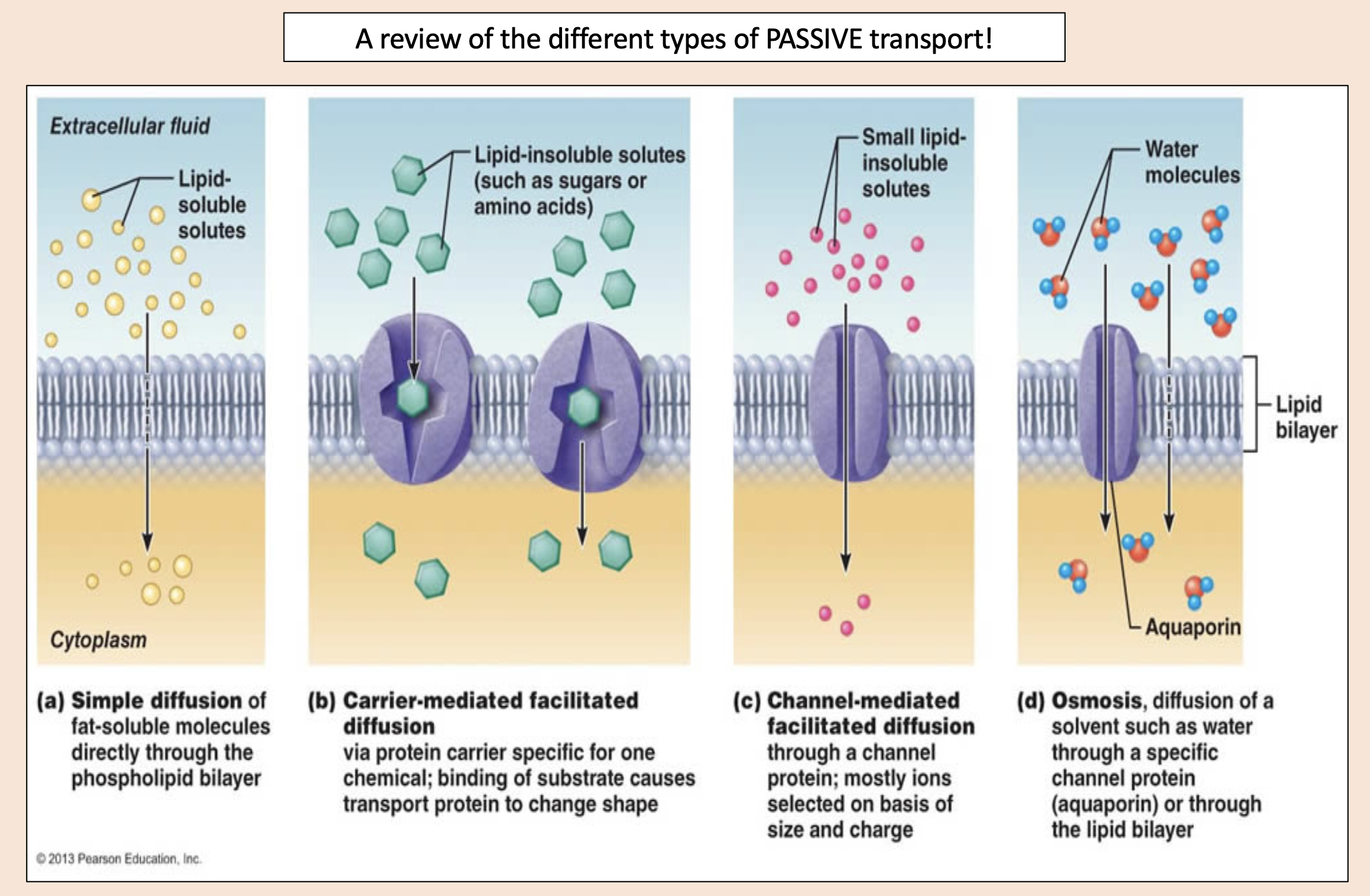
Simple diffusion
Fat-soluble molecules directly through the phospholipid bilayer.
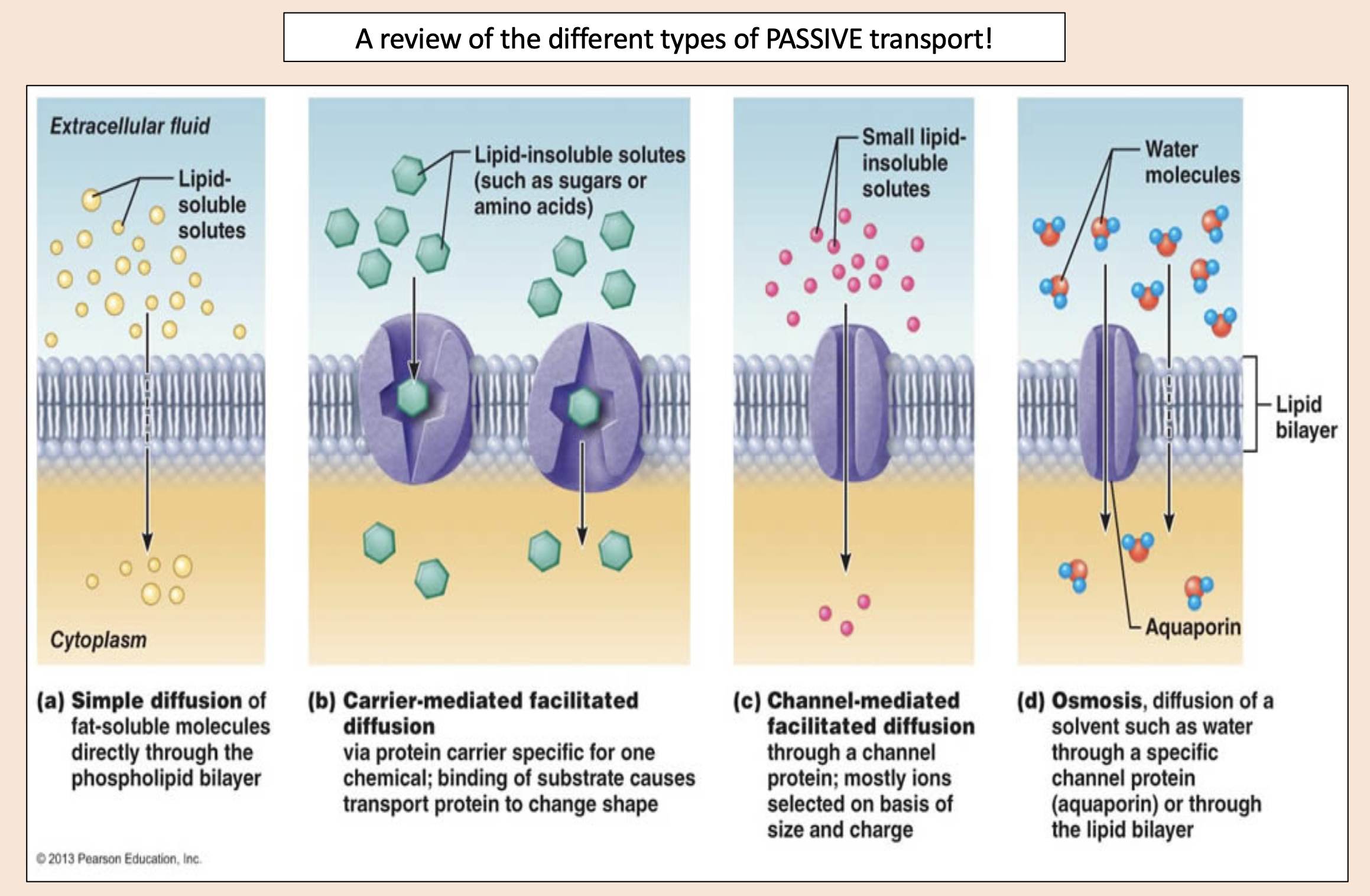
Carrier-mediated facilitated diffusion
Via protein carrier specific for one chemical; binding of substrate causes transport protein to change shape.
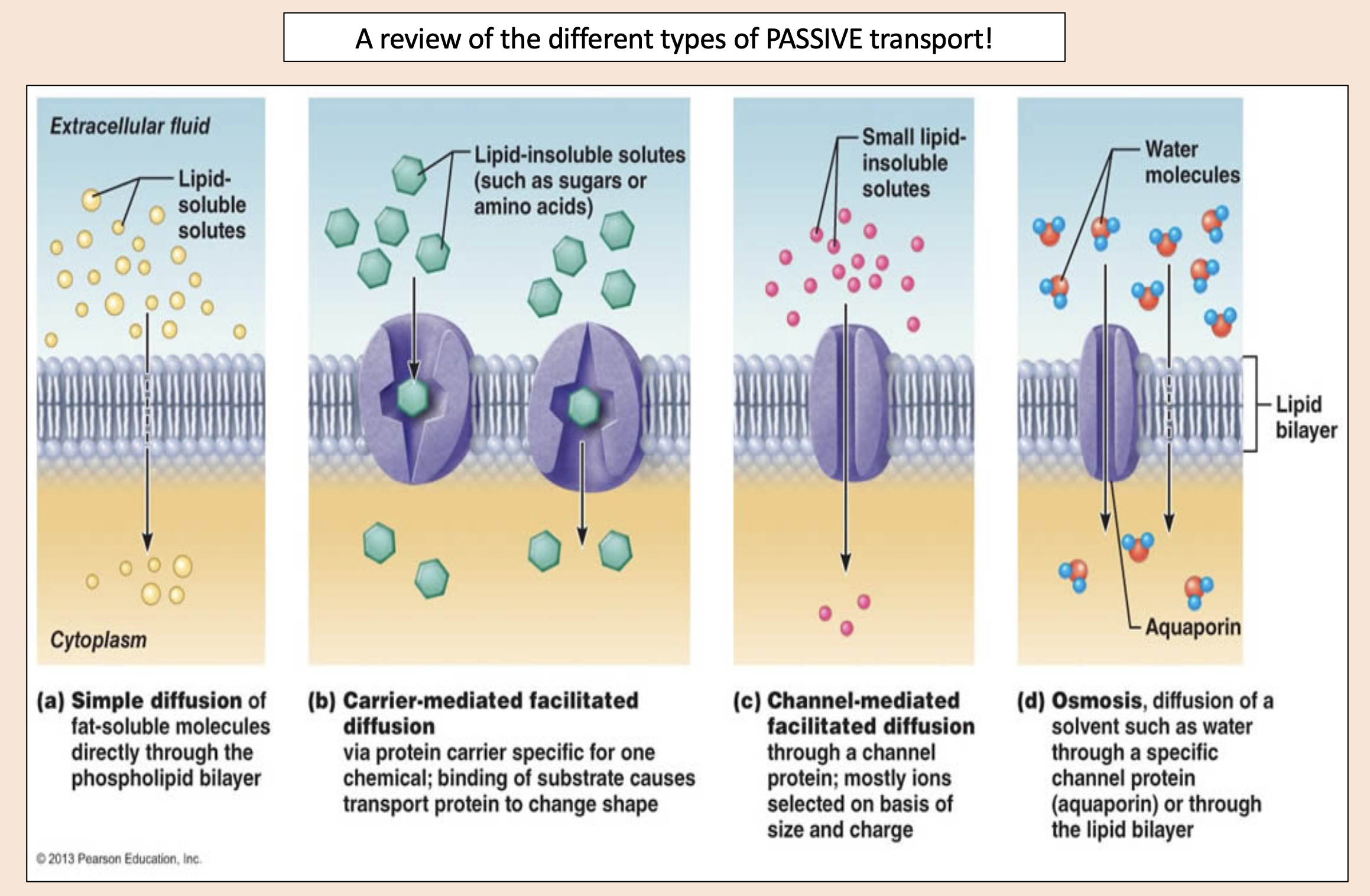
Channel-mediated facilitated diffusion
Through a channel protein; mostly ions selected on basis of size and charge.
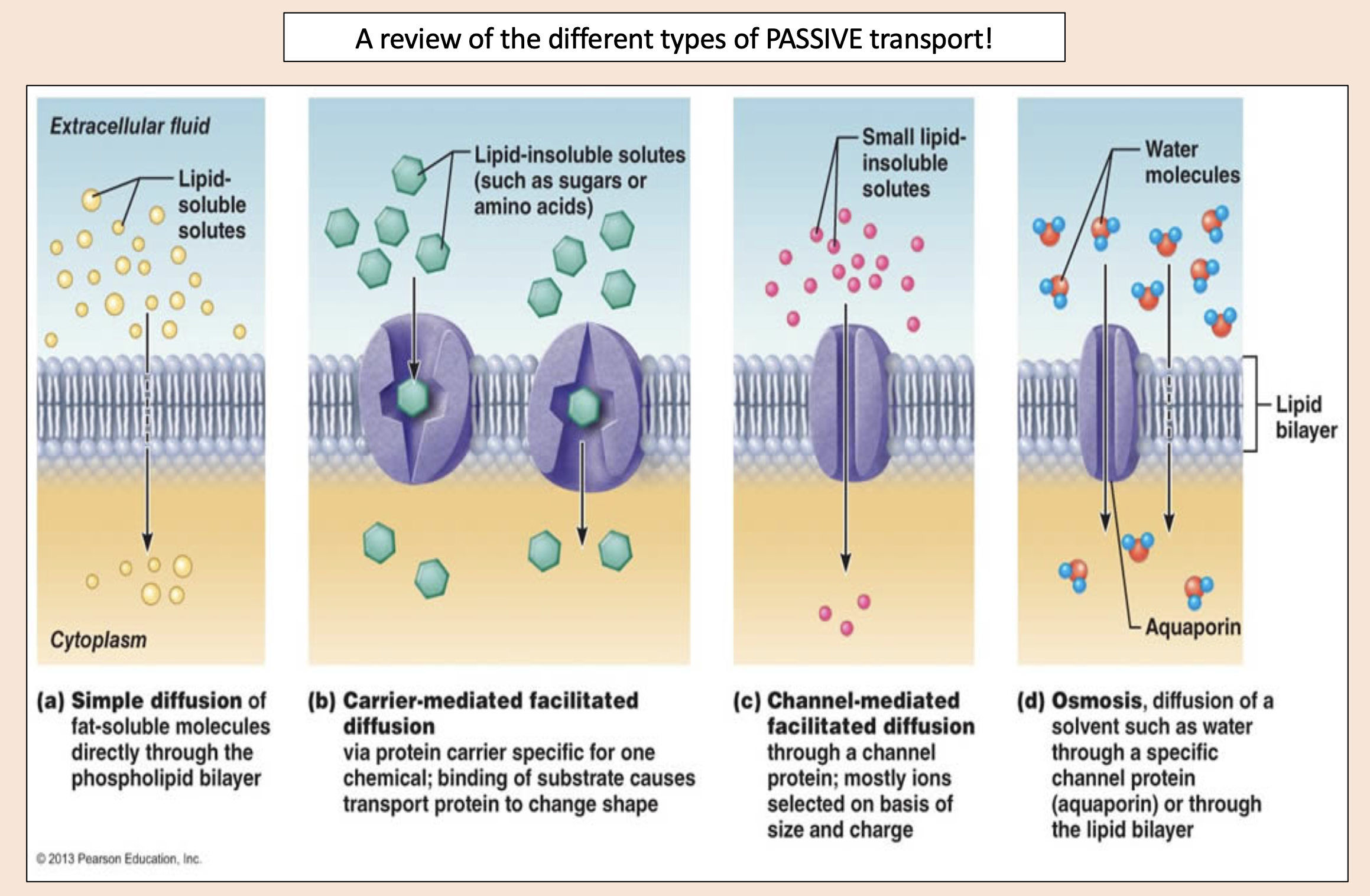
Osmosis
Diffusion of a solvent such as water through a specific channel protein (aquaporin) or through the lipid bilayer.
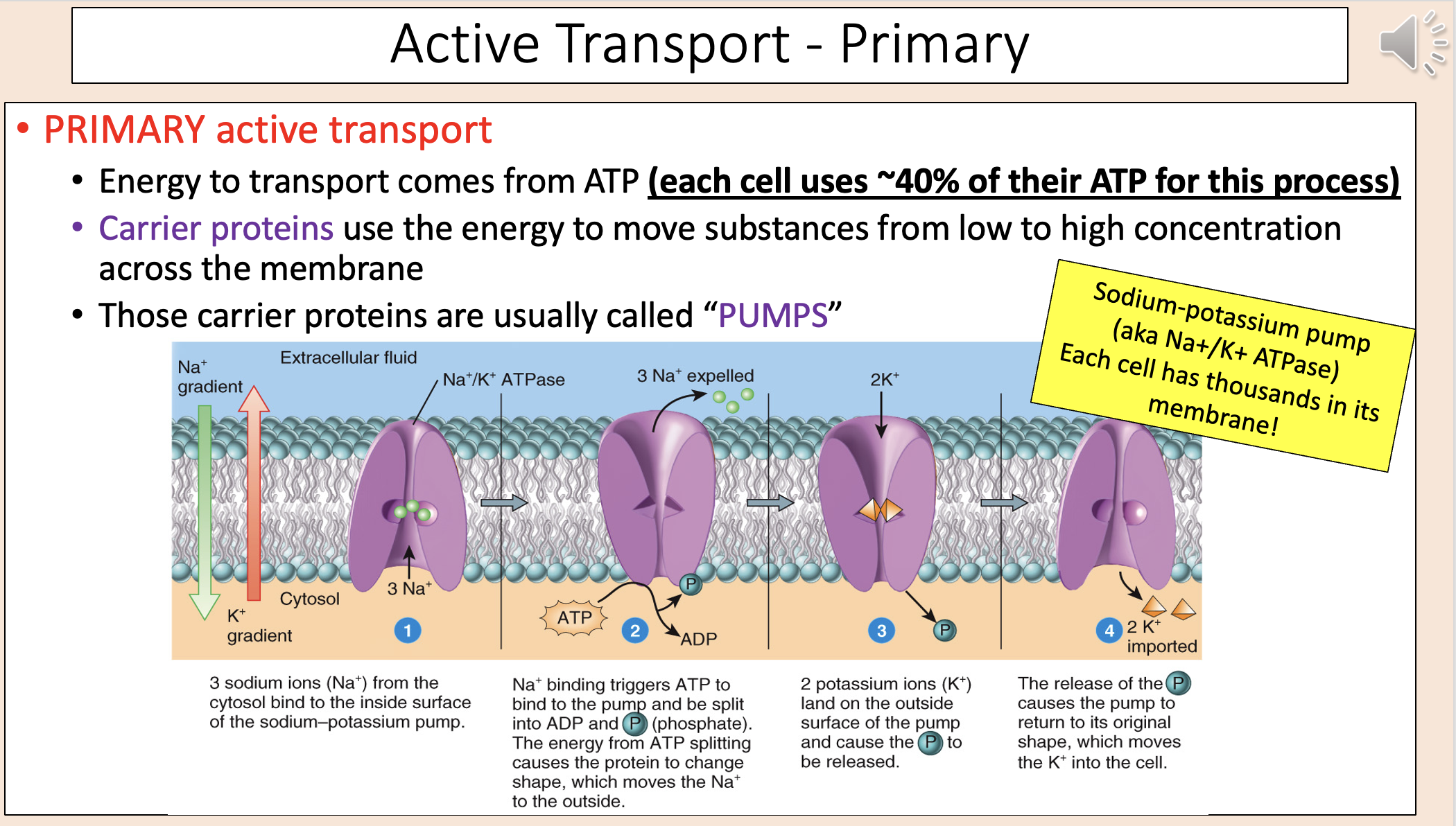
PRIMARY active transport
• Energy to transport comes from ATP (each cell uses ~40% of their ATP for this process)
• Carrier proteins use the energy to move substances from low to high concentration across the membrane
• Those carrier proteins are usually called “PUMPS”
• Sodium-potassium pump (aka Na+/K+ ATPase) Each cell has thousands in its membrane!
Cyanide poisoning
Cyanide shuts down the ATP pumps in cells.
 Note
Note  Flashcards (87)