physio exam 3 AI generated - test 1

0.0(0)
Studied by 0 people
call kaiCall Kai
learnLearn
examPractice Test
spaced repetitionSpaced Repetition
heart puzzleMatch
flashcardsFlashcards
GameKnowt Play
Card Sorting

1/28

encourage image

There's no tags or description

Looks like no tags are added yet.

Last updated 4:30 AM on 4/7/26
Name
Mastery
Learn
Test
Matching
Spaced
Call with Kai

No analytics yet

Send a link to your students to track their progress

29 Terms

1
New cards

Question

Answer

2
New cards

How does the drug treatment for Myasthenia Gravis directly address the physiological cause of muscle weakness?

Acetylcholinesterase inhibitors prevent the breakdown of ACh in the NMJ, allowing the neurotransmitter to remain in the synapse longer and bind to the few remaining functional nicotinic receptors.

3
New cards

Why does a muscle enter a state of rigor mortis after death despite no new action potentials occurring?

The cell runs out of ATP, which is required for the myosin head to detach from actin; without ATP, the cross-bridge remains in a locked, contracted state.

4
New cards

What specific mechanical events occur during the "latent period" of a muscle twitch?

The AP travels down T-tubules, DHP receptors trigger ryanodine receptors to open, Ca2+ flows into the cytosol and binds to troponin, and tropomyosin moves to expose actin binding sites.

5
New cards

Compare the role of Calcium in skeletal vs. smooth muscle contraction activation.

In skeletal muscle, Ca2+ binds to troponin to move tropomyosin; in smooth muscle, Ca2+ binds to calmodulin, which then activates Myosin Light Chain Kinase (MLCK) to phosphorylate myosin.

6
New cards

A patient is lifting a weight that is heavier than their maximum muscle tension. What type of contraction is occurring, and what happens to the Z-lines?

This is an eccentric contraction; the load exceeds the muscle tension, causing the muscle to lengthen and the Z-lines to be dragged further apart .

7
New cards

Explain the "Size Principle" of motor unit recruitment during a gradually increasing workload.

The nervous system recruits smaller motor units (slow-oxidative fibers) first for fine control, then intermediate fibers, and finally the largest motor units (fast-glycolytic) for maximum strength.

8
New cards

How does the function of the Sarcoplasmic Reticulum (SR) differ between skeletal and smooth muscle cells?

Skeletal muscle has a large SR with terminal cisternae for massive Ca2+ storage; smooth muscle has a much smaller SR and relies significantly on Ca2+ entering from the extracellular fluid.

9
New cards

Describe the role of Titin in the length-tension relationship.

Titin acts like a spring that attaches thick filaments to the Z-line, providing passive tension and ensuring the sarcomere returns to its resting length after being stretched or shortened .

10
New cards

What is the primary cause of "conduction failure" during high-intensity muscle fatigue?

Repetitive action potentials cause a buildup of ions in the T-tubules, which eventually prevents the conduction of further action potentials into the fiber.

11
New cards

How do intercalated disks facilitate the function of cardiac muscle as a functional syncytium?

They contain desmosomes to mechanically "glue" cells together and gap junctions to allow ions to flow between cells, electrically coupling them for simultaneous contraction.

12
New cards

Which metabolic pathway provides the fastest source of ATP for a muscle fiber at the very onset of exercise?

The Creatine Phosphate cycle, which uses creatine kinase to rapidly transfer a phosphate group to ADP to form ATP.

13
New cards

Explain why "fused tetanus" produces more tension than a single muscle twitch.

In fused tetanus, high-frequency stimulation keeps Ca2+ channels open, maintaining maximum cytosolic Ca2+ levels and ensuring all cross-bridges remain engaged without time for relaxation
14
New cards
Question
Answer
15
New cards
How do the nodes of the heart facilitate coordination despite not being contractile cells?
They act as a "pacemaker" system by spontaneously depolarizing via leak ion channels and spreading positive ions through gap junctions to adjacent contractile cells .
16
New cards
Why is the 0.1-second delay at the Atrioventricular (AV) node essential for efficient cardiac function?
The delay provides enough time for the atria to finish contracting and fully fill the ventricles with blood before ventricular systole begins.
17
New cards
A patient's ECG shows a normal P wave but a missing QRS complex. What clinical condition does this suggest and why?
This indicates a "heart block," where the electrical signal is obstructed (e.g., from the SA node to the AV node or bundle of His), preventing the ventricles from being excited .
18
New cards
How does the Parasympathetic Nervous System (vagus nerve) decrease heart rate at the molecular level?
Acetylcholine binds to muscarinic receptors on SA node cells, slowing the rate of spontaneous depolarization and requiring more time to reach the threshold for an action potential .
19
New cards
Compare isovolumetric contraction and ventricular ejection during the cardiac cycle.
In isovolumetric contraction, the ventricle squeezes with all valves closed to build pressure; in ejection, semilunar valves open and blood is forced into the arteries .
20
New cards
An "insufficiency" murmur is heard during diastole. Which valve is likely the cause and what is physically happening?
The semilunar valve is failing to stay closed while the heart is resting, allowing turbulent backflow of blood from the arteries into the ventricles.
21
New cards
Why can a highly trained athlete maintain the same cardiac output as a sedentary person despite having a much lower resting heart rate?
Athletes have higher heart contractility, leading to a significantly higher stroke volume; because CO = HR x SV, the higher SV compensates for the lower HR.
22
New cards
Explain how chronic hypertension leads to a decrease in stroke volume through the concept of "afterload."
Hypertension increases the pressure the ventricles must overcome to open semilunar valves; this higher resistance makes it harder to eject blood, leaving more blood in the heart (increased ESV) and decreasing SV .
23
New cards
How does the "respiratory pump" mechanism aid in venous return to the heart?
The contraction of the diaphragm during breathing increases pressure in the abdomen and decreases it in the chest, physically pushing blood through the veins toward the heart.
24
New cards
If a patient has severe liver disease and cannot produce enough plasma proteins, why do they develop edema (swelling)?
A decrease in plasma proteins drops the colloid osmotic pressure, which is the force that pulls fluid back into capillaries; without it, more fluid leaks out into the tissues.
25
New cards
How does the body compensate for a sudden hemorrhage to maintain arterial blood pressure?
The baroreceptor reflex triggers increased sympathetic discharge, which constricts veins to increase venous return and constricts arterioles to increase total peripheral resistance .
26
New cards
Why is the "respiratory zone" of the lungs (alveoli) composed of only a single layer of Type I epithelial cells?
This thinness minimizes the distance for gas exchange, allowing $O_{2}$ and $CO_{2}$ to diffuse rapidly between the air sacs and the surrounding capillaries .
27
New cards
Explain why shallow, fast breathing is less efficient for gas exchange than deep, slow breathing (using the concept of dead space).
Shallow breathing only moves air into the anatomical dead space (where no gas exchange occurs); deep breathing ensures a higher Alveolar Ventilation Rate (AVR) by getting fresh air into the actual alveoli .
28
New cards
How does hyperventilation lead to respiratory alkalosis?
Hyperventilation removes $CO_{2}$ faster than the body produces it; since $CO_{2}$ creates carbonic acid, its loss increases blood pH, making it more basic.
29
New cards
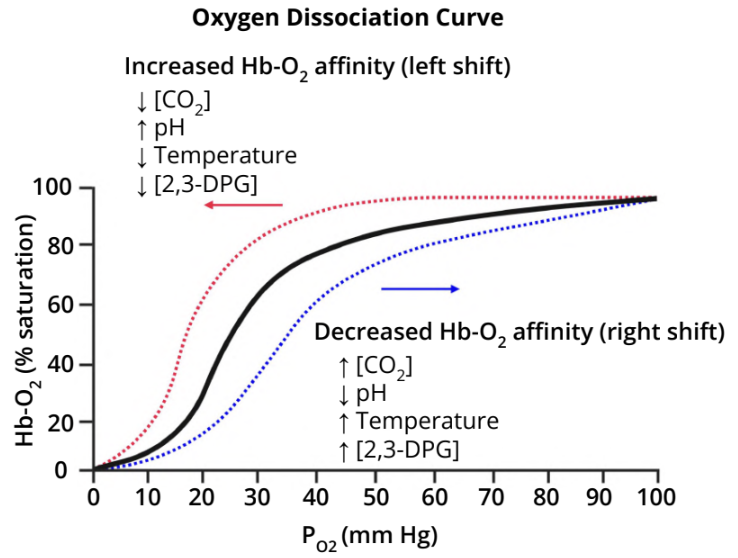
<p>What is the "Right Shift" in the oxygen-hemoglobin dissociation curve and when does it occur?</p>

What is the "Right Shift" in the oxygen-hemoglobin dissociation curve and when does it occur?

A right shift means hemoglobin has a decreased affinity for O2 (making it easier to unload to tissues); it occurs during exercise due to increased temperature and decreased pH (more H+.)

Explore top notes

note
0.2: Pre-Colonial America
Updated 1270d ago
0.0(0)
note
Vocab E Units 1-5
Updated 476d ago
0.0(0)
note
Week 2 Readings
Updated 1176d ago
0.0(0)
note
Physical Science - Chapter 1
Updated 955d ago
0.0(0)
note
chapter 4 Cell Structure
Updated 401d ago
0.0(0)
note
Heimler APUSH TP 5.11
Updated 476d ago
0.0(0)
note
Chapter 9 - Motivation and Emotion
Updated 1253d ago
0.0(0)
note
electricity
Updated 393d ago
0.0(0)
note
0.2: Pre-Colonial America
Updated 1270d ago
0.0(0)
note
Vocab E Units 1-5
Updated 476d ago
0.0(0)
note
Week 2 Readings
Updated 1176d ago
0.0(0)
note
Physical Science - Chapter 1
Updated 955d ago
0.0(0)
note
chapter 4 Cell Structure
Updated 401d ago
0.0(0)
note
Heimler APUSH TP 5.11
Updated 476d ago
0.0(0)
note
Chapter 9 - Motivation and Emotion
Updated 1253d ago
0.0(0)
note
electricity
Updated 393d ago
0.0(0)

Explore top flashcards

flashcards
General vocab/definitions
29
Updated 1070d ago
0.0(0)
flashcards
Exam 3 - Physiology
34
Updated 482d ago
0.0(0)
flashcards
safmed period 7 part 2
77
Updated 742d ago
0.0(0)
flashcards
Biology Chapter 7 Test
60
Updated 202d ago
0.0(0)
flashcards
Avancemos 2 2.2
72
Updated 862d ago
0.0(0)
flashcards
General vocab/definitions
29
Updated 1070d ago
0.0(0)
flashcards
Exam 3 - Physiology
34
Updated 482d ago
0.0(0)
flashcards
safmed period 7 part 2
77
Updated 742d ago
0.0(0)
flashcards
Biology Chapter 7 Test
60
Updated 202d ago
0.0(0)
flashcards
Avancemos 2 2.2
72
Updated 862d ago
0.0(0)



