lecture 5: sacrum
 Call Kai
 Learn
Learn Practice Test
 Spaced Repetition
 Match
Match Flashcards
 Knowt Play
1/12

There's no tags or description
Looks like no tags are added yet.
Name | Mastery | Learn | Test | Matching | Spaced | Call with Kai |
|---|
No analytics yet
Send a link to your students to track their progress
13 Terms
Increased size & # of ridges
Thickened capsule
Accessory articulations
what are the adaptive changes of the SI joint during the 3rd decade
sacroiliac joint
these joints are not present at birth, they develop functionally
-not totally symmetric
Ferguson's angle
another name for the lumbosacral angle; should be about 35 degrees
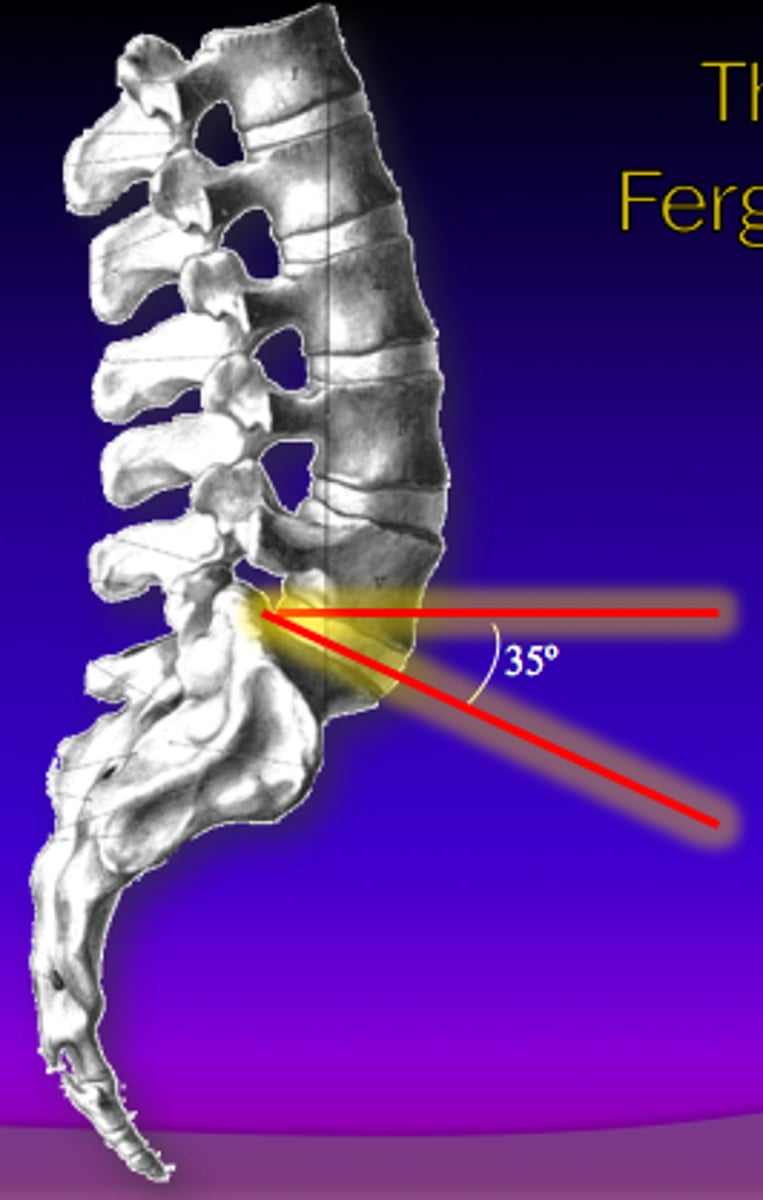
anterior portion of the sacral base
sacral motion is always named for what this part of the sacrum is doing
middle transverse axis
the functional axis of sacral nutation and counternutation in the standing position.
superior transverse axis
The hypothetical Axis around which the sacrum moves during respiration. Involuntary sacral motion which occurs during Cranial sacral flexion and extension occurs around this axis
unilateral flexion or extension
-bilaterals are physiologic
name the non-physiologic sacral dysfunctions
anterior torsions
left on left, right on right
what sacral diagnosis is physiologic neutral
posterior torsions
left on right, right on left
what sacral diagnosis is physiologic, non neutral
If there is NO springing allowed = Non-neutral condition (aka Backward torsion) or unilateral/bilateral sacral extension
what is a positive spring test?
If there is springing allowed = Neutral condition (aka Forward torsion) or unilateral /bilateral sacral flexion
what is a negative spring test?
•If sacral sulcus asymmetry (or ILA asymmetry) becomes less prominent with extension of the L5, then the sacrum is forward bent/flexed
what is a negative sphinx test?
•If sacral sulcus asymmetry (or ILA asymmetry) becomes more prominent with extension of the L5, then the sacrum is backward bent/extended
what is a positive sphinx test?

