cycle 1 bio class + class 2
 Call Kai
 Learn
Learn Practice Test
 Spaced Repetition
 Match
Match Flashcards
 Knowt Play
1/42

There's no tags or description
Looks like no tags are added yet.
Name | Mastery | Learn | Test | Matching | Spaced | Call with Kai |
|---|
No analytics yet
Send a link to your students to track their progress
43 Terms
What is chlamy
Eukaryote
Green algae
3 important characteristics of chlamy
Contains cell wall (like plant), eyespot, flagella (like animal)
Is chlamy a plant
NO, but it shares characteristics of plant and animal cell
Purpose of eyespot
Allows chlamy to swim toward and away from light source
Analogous to vision
Where is chlamy found
Freshwater systems in moderate temps
Chlamy division
Asexual: binary fission
Divides every 10 hrs under lab conditions
Mass doubles after division
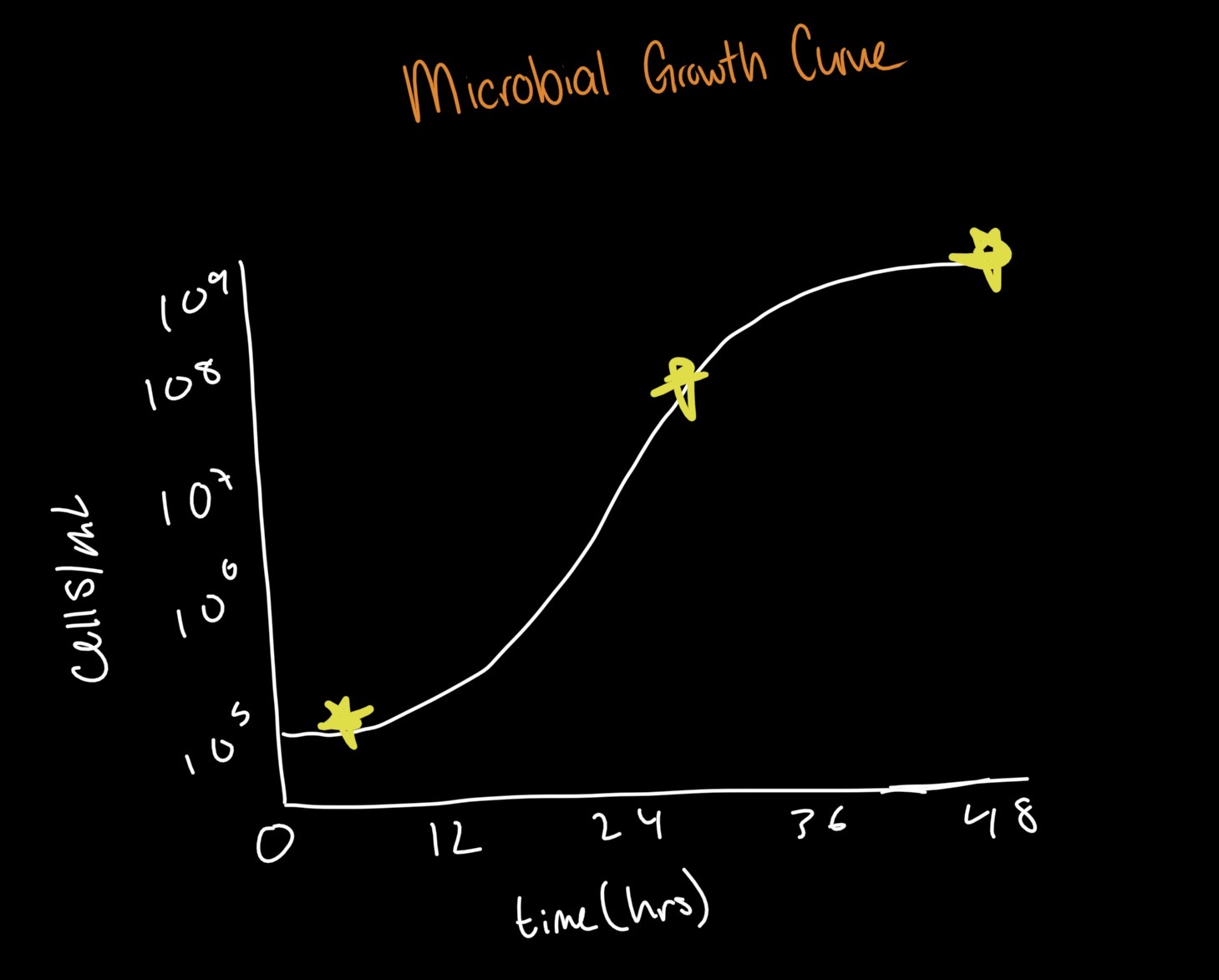
Name the phases
Lag phase (bottom): slow growth rate
Exponential (middle): max rate of cell growth
Stationary (top): no change in cell growth (stop)
Why does the cell reach stationary phase?
Cell will stop dividing because it has run out of nutrients
AKA LIMITING NUTRIENT (can run out of any nutrient)
What is tap media
standard maintenance medium
What MACRO nutrients to focus on for tap and why
Mg: is the central atom in chlorophyll (which chlamy has)
p: crucial for atp
N (from NH4Cl): N is in amino acids which makes proteins; N is in nucleotides which makes DNA/RNA
What micronutrient to focus on for tap and why
Fe: the pigment required for photosynthesis in the photosystems
Limited iron = decreased photosynthesis
What is the likeliest explanation for humans + chlamy to have flagella when plants don’t?
Trait got lost, plants didn’t require flagella
Why do prokaryotes and eukaryotes both have flagella
Only way to move around
Side note: bacteria has flagella, but chlamy has nothing in common with it (bacteria = prokary)
Flagella is an —logous trait between bacteria and eukaryotes
Same structure + function, but evolved independently of each other
Primary purpose of cilia/flagella:
Motility, sensory, sexual reproduction
What are microtubules that are found in flagella
A protein polymer made from TUBULIN subunits
what are dynein arms
A motor protein (meaning it converts chemical energy from atp hydrolysis into mechanical energy)
How does chlamy move?
Dynein arms cause microtubule to bend
Bending action generates directional force
This allows cell motility and movement of fluids
2 types of cilia
Motile (propel) and non motile (sensory)
What are ciliopathies
Malfunctioning cilia hairs
Diseases linked to cilia mutation
Non motile cilia relay what type of info
Light, colour, smell (IT IS SENSORY!)
what is comparative proteomics
Studies changes in protein abundance between different groups
How many chlamy proteins are homologous with plants and humans
Chlamy and human = 10%
Chlamy and plants= 26%
Chlamy and human and plants = 33%
What 2 processes does chlamy use light for
Source of energy
To understand surrounding through eyespot
What is organelle? Do prokaryotic have organelles
Membrane bound
Prokary don’t have organelle : RIBOSOME IS NOT ORGANELLE
What is a basal body
A motor for the flagella
Where microtubules assemble and grow
Not in prokary cells
What is phototaxis
Movement towards (+) or away (-) from light source
Purpose: to find optimal light for photosynthesis
Why would chlamy display negative phototaxis
To avoid light damage
Prevents oxidative stress causing cellular damage
where is eyespot located
Partly in chloroplast, partly in plasma membrane
Why does this structural arrangement matter
Carotenoid granule layer in the chloroplast acts as reflective shield
Channelrhodopsin plasma membrane detects light
How do these structures work together (cell movement)
Cell is rotating in helical pattern as it moves
The rotation allows for eyespot to periodically be exposed to light, then be shaded by carotenoids layer
This causes flashing light signal
So how does light detection change flagella movement
When light hits channelrhodopsin
It opens up (because it is a light gated ion channel)
Positive Ca ions flow into cell which changes flagella beating pattern
The 2 flagella beat differently
one is more sensitive than the other to the calcium change which causes the cell to turn
What is a carotenoid granule layer, why does it matter
Stacked array of carotenoid rich pigment granules that form a reflective shield
Purpose: it reflects and amplifies light like a mirror
It creates directional shading during rotation
What would happen without a carotenoid layer
Chlamy would only detect light intensity and not direction
(aka steering wheel would be impaired)
What is channelrhodopsin? Significance?
Light gated ion channel protein
Detects light and lets ions move across membrane
Purpose: enables phototaxis and allows cell towards mod. light and away from intense light
How does channelrhodopsin work
Light hits ops in
Protein changes shape
Pore in membrane opens
Positive ions (Ca2+) flow into cell
Electrical state of membrane changes which alters flagella beating pattern= cell turns!
Sumamry:
Carotenoid layer:
Channelrhodopsin:
Carotenoid layer= determines light direction
Channelrhodopsin= detects light and triggers movement
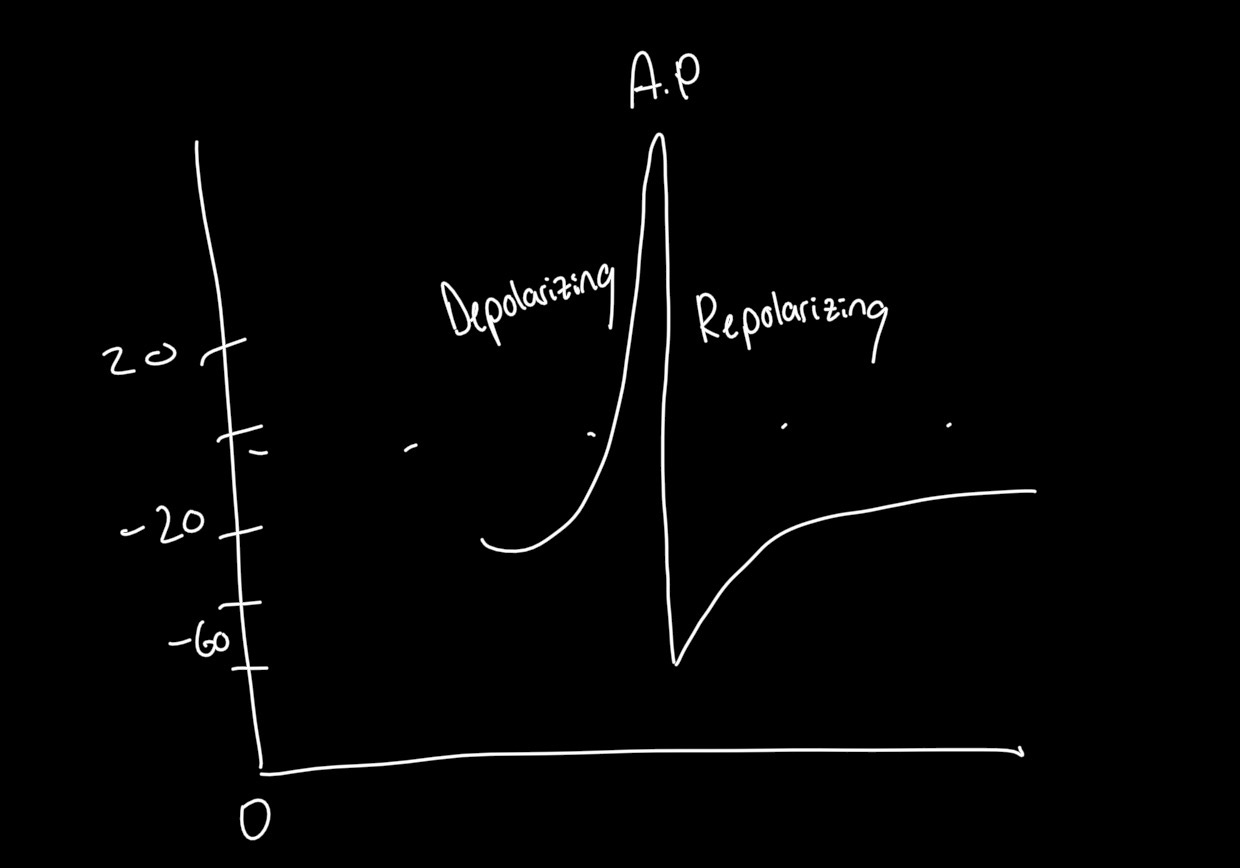
Explain
Channelrhodopsin exposed to light
Protein changes shape, pore in membrane opens up
Ca 2+ moves in, reducing polarization (inside = more +)
outcome: membrane is depolarized, flagella beating is altered (action potential)
Voltage gated channel (Na+) activates an Na+ moves out
The action potential migrates along plasma membrane and once it reaches BASAL BODY, movement occurs
How does chlorophyll trap light
Chlorophyll has porphyria ring with Mg2+ at its center, this ring is a conjugated system (key to absorbing light)
Light absorption happens in porphyrin ring
where e- move around freely because of conjugated system (conjugated system= single and double bond)
Conjugated system allows for e- to absorb energy from RED,BLUE light
when e- excite, they move to higher energy state
Excited ex transfer their energy to other molecules in photosystems
this generates atp + nadph
The e- moving freely is good because otherwise energy would disperse as heat instead of being channeled towards chem reactions.
Why can’t chlorophyll absorb green light
Blue and red light photons have right energy to excite chlorophyll e-
Green photons have wrong energy for e- to jump to that level
Result: green light bounces off
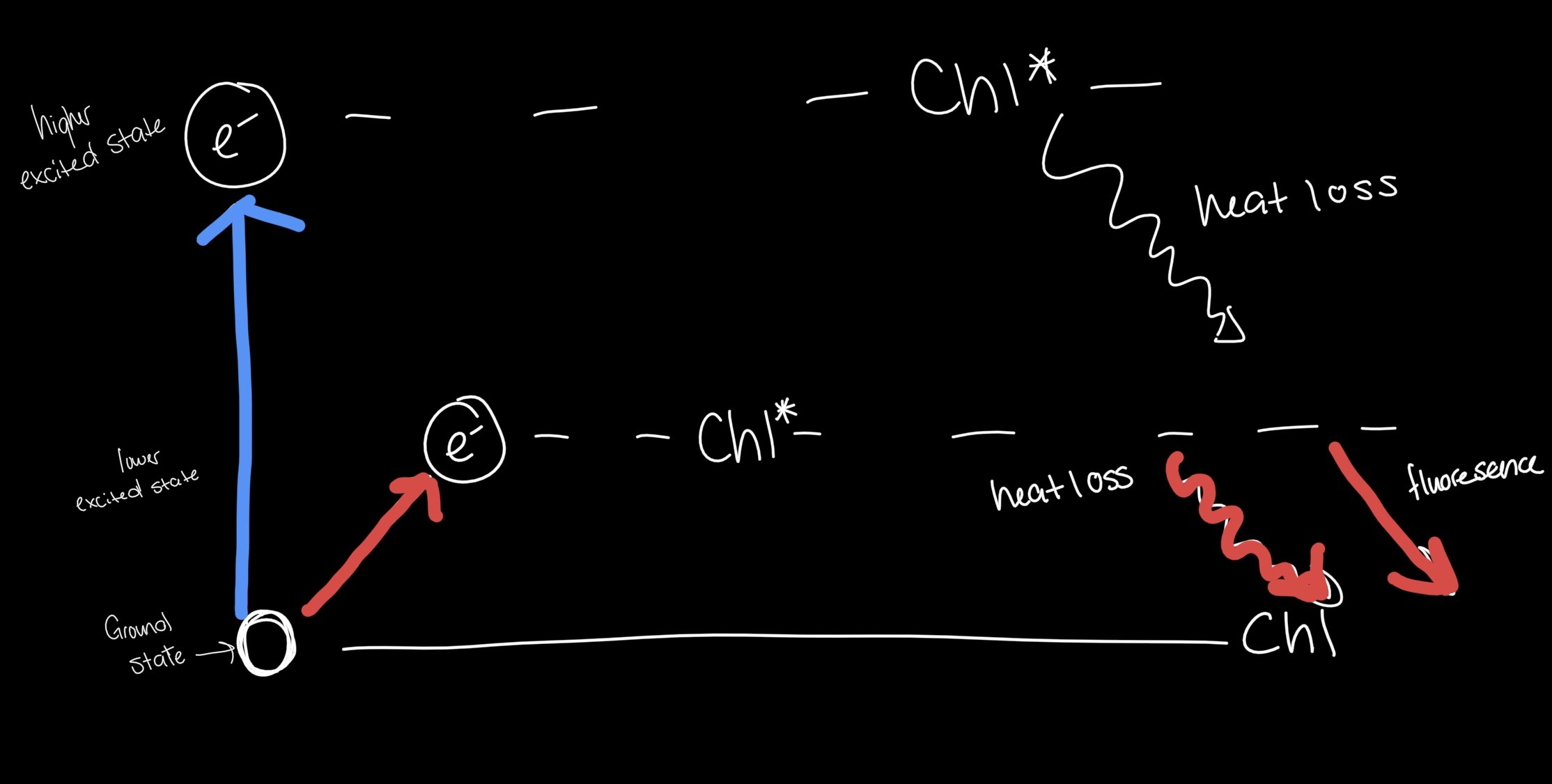
Which photon light has more energy
Blue light has more energy
Blue light doesn’t cause plants to grow faster because higher energy state decays before it can be used
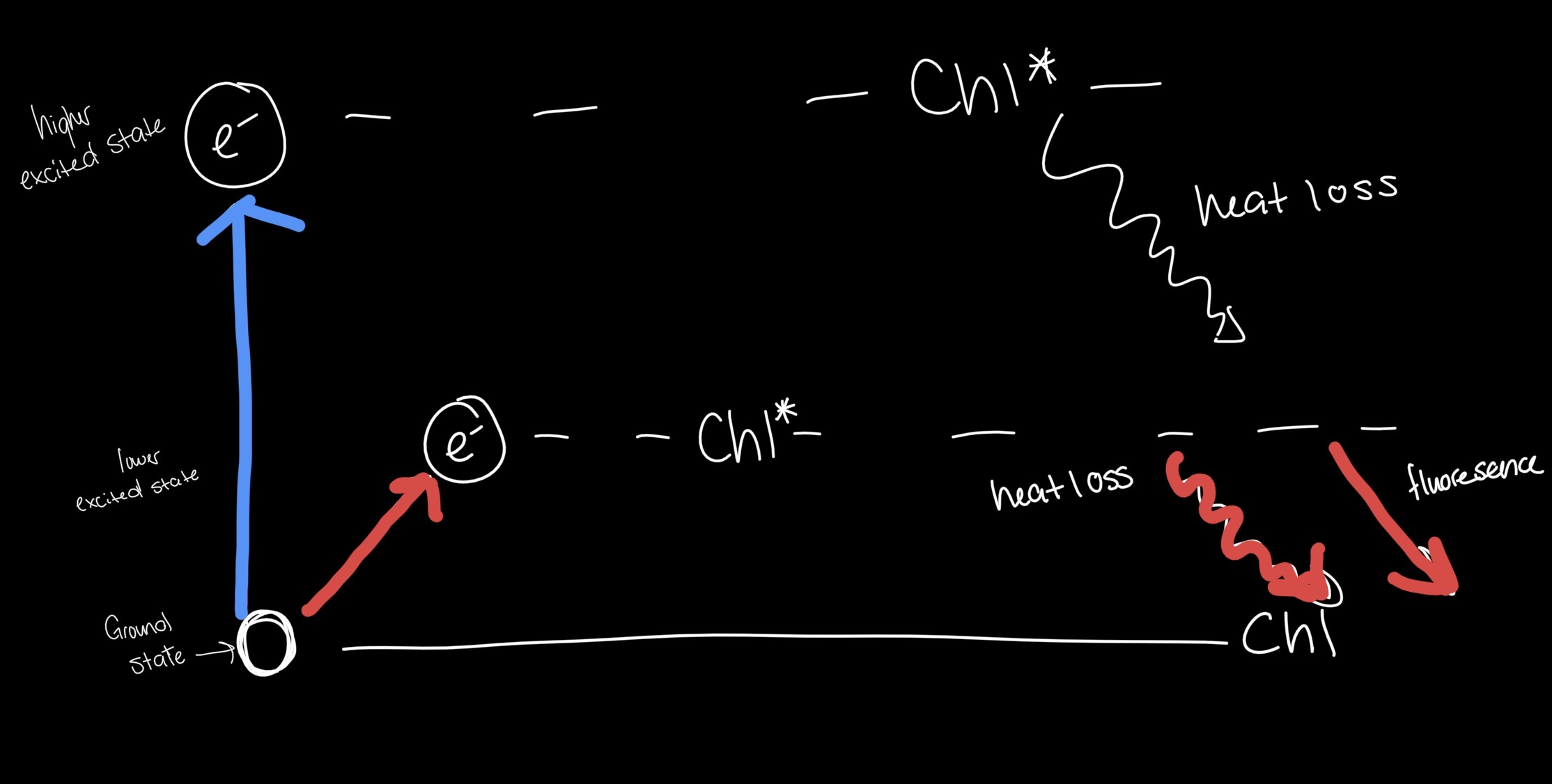
What are the 3 fates of excited red state
e- gets used for photosynthesis
e- is unstable and is lost as heat
Fluorescence: a little energy is lost from lower excited state, then pushes photon out (energy lost), then e- decays

