OPMA L8
 Studied by 0 people
 Call Kai
 Learn
Learn Practice Test
 Spaced Repetition
 Match
Match Flashcards
 Knowt Play
1/43

There's no tags or description
Looks like no tags are added yet.
Name | Mastery | Learn | Test | Matching | Spaced | Call with Kai |
|---|
No analytics yet
Send a link to your students to track their progress
44 Terms
operations manager
— who are most involved in the leadership, development and organization of human resources.
Human resource strategy
is the overall long-term approach to ensuring that an organization’s human resources provide a strategic advantage.
strategic partner
administering HR procedures and processes
employee champion
change agent
4 elements of HR activity
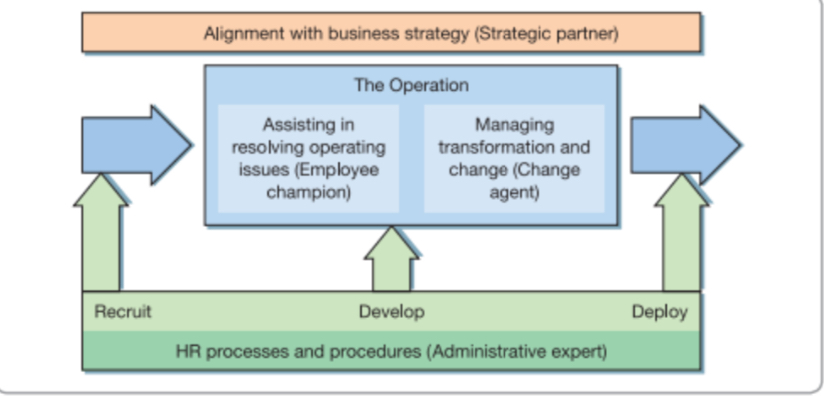
human resource strategy
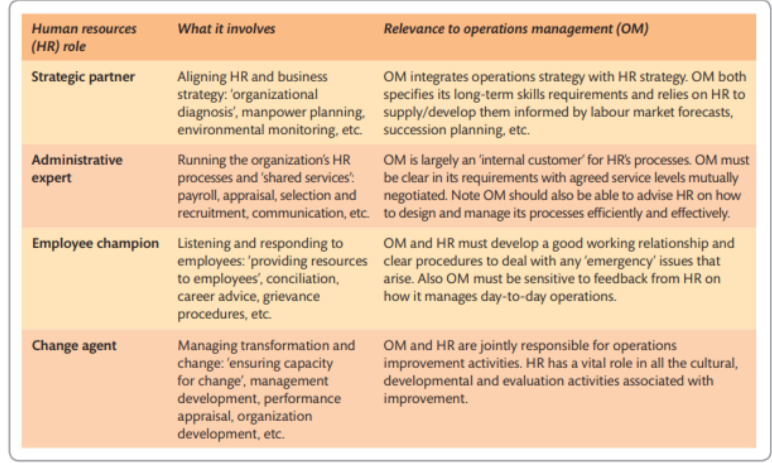
Ulrich”s HR roles
inter-reliant
just as in the operations function generally, people issues are
organization design
tasks and responsibilities are divided into distinct groupings, and how the responsibility and coordination relationships between the groupings are defined. This includes the informal relationships which build up between groups as well as their more formal relationships.
Gareth Morgan
One well-known analysis by — proposes a number of ‘images’ or ‘metaphors’ which can be used to understand organizations as follows.
Organizations are machines.
The resources within organizations can be seen as ‘components’ in a mechanism whose purpose is clearly understood. Relations within the organization are clearly defined and orderly
Organizations are organisms.
Organizations are living entities. Their behaviour is dictated by the behaviour of the individual humans within them. Individuals, and their organizations, adapt to circumstances just as different species adapt to the environment.
Organizations are brains.
Like brains, organizations process information and make decisions. They balance conflicting criteria, weigh up risks and decide when an outcome is acceptable. They are also capable of learning and changing their model of the world in the light of experience.
Organizations are cultures
An organization’s culture is usually taken to mean its shared values, ideology, pattern of thinking and day-to-day ritual. Different organizations will have different cultures stemming from their circumstances and their history.
Organizations are political systems
Organizations, like communities, are governed. The system of government is rarely democratic, but nor is it usually a dictatorship. Within the mechanisms of government in an organization are usually ways of understanding alternative philosophies
unitary form, or U-form,
The — organizes its resources primarily by their functional purpose. shows a typical — organization with a pyramid management structure, each level reporting to the managerial level above. Such structures can emphasize process efficiency above customer service and the ability to adapt to changing market.
M-form
This form of organizational structure emerged because the functionally based structure of the U-form was cumbersome when companies became large, often with complex markets. It groups together either the resources needed for each product or service group, or alternatively, those needed to serve a particular geographical market, in separate divisions.
Matrix form
Matrix structures are a hybrid, usually combining the M-form with the U-form. In effect, the organization has simultaneously two different structures (see Fig. 9.4(c)). In a matrix structure, each resource cluster has at least two lines of authority, for example, both to the division and to the functional groups.
N-form
In — organizations, resources are clustered into groups as in other organizational forms, but with more delegation of responsibility for the strategic management of those resources. N-forms have relatively little hierarchical reporting and control.
Job design
— is about how we structure each individual’s job, the team to which they belong (if any), their workplace and their interface with the technology they use
specialists and generalists; Adam Smith
Any operation must decide on the balance between using — . This idea is related to the division of labour – dividing the total task down into smaller parts, each of which is accomplished by a single person or team. It was first formalized as a concept by the economist — in his Wealth of Nations in 1746.
Monotony
The shorter the task, the more often operators will need to repeat it. Repeating the same task, for example every 30 seconds, eight hours a day and five days a week, can hardly be called a fulfilling job. As well as any ethical objections, there are other, more obviously practical objections to jobs which induce such boredom.
physical injury; repetitive strain injury (RSI)
The continued repetition of a very narrow range of movements can, in extreme cases, lead to — . The over-use of some parts of the body (especially the arms, hands and wrists) can result in pain and a reduction in physical capability. This is sometimes called —
Low flexibility
Dividing a task up into many small parts often gives the job design a rigidity which is difficult to alter under changing circumstances.
Poor robustness
Highly divided jobs imply materials (or information) passing between several stages. If one of these stages is not working correctly, for example because some equipment is faulty, the whole operation is affected.
Ergonomics; Physiology
— is concerned primarily with the physiological aspects of job design. — is about the way the body functions.
Ergonomics
— is sometimes referred to as human factors engineering or just ‘human factors’.
anthropo metric aspects
Many ergonomic improvements are primarily concerned with what are called the — of jobs – that is, the aspects related to people’s size, shape and other physical abilities.
anthropometric data
The design of an assembly task, for example, should be governed partly by the size and strength of the operators who do the job. The data which ergonomists use when doing this is called —
alienate
Jobs which are designed purely on division of labour, scientific management or even purely ergonomic principles can — the people performing them.
job rotation
If increasing the number of related tasks in the job is constrained in some way, for exam ple by the technology of the process, one approach may be to encourage — . This means moving individuals periodically between different sets of tasks to provide some variety in their activities.
job enlargement.
The most obvious method of achieving at least some of the objectives of behavioural job design is by allocating a larger number of tasks to individuals. If these extra tasks are broadly of the same type as those in the original job, the change is called —
Job enrichment
— not only means increasing the number of tasks, but also allocating extra tasks which involve more decision making, greater autonomy and greater control over the job.
Empowerment
— is an extension of the autonomy job characteristic prominent in the behavioural approach to job design. However, it is usually taken to mean more than autonomy.
autonomy; empowerment
Whereas — means giving staff the ability to change how they do their jobs, — means giving staff the authority to make changes to the job itself, as well as how it is performed.
Teamworking
A development in job design which is closely linked to the empowerment concept is that of team-based work organization (sometimes called self-managed work teams).
Skills flexibility
A flexible workforce that can move across several different jobs could be deployed (or deploy themselves) in whatever activity is in demand at the time
Time flexibility
These may define a core working time for each individual member of staff and allow other times to be accumulated flexibly.
Location flexibility
Location-specific means that a job must take place in one fixed location.
temperature
Predicting the reactions of individuals to working temperature is not straightforward. Individuals vary in the way their performance and comfort vary with — . Furthermore, most of us judging ‘—’ will also be influenced by other factors such as humidity and air movement
illuminaton levela
The intensity of lighting required to perform any job satisfactorily will depend on the nature of the job. Some jobs which involve extremely delicate and precise movement, surgery for example, require very high levels of illumination.
noise level
The damaging effects of excessive noise levels are perhaps easier to understand than some other environmental factors. Noise-induced hearing loss is a well-documented consequence of working environments where noise is not kept below safe limits.
Synthesis from elemental data
is a work measurement technique for building up the time for a job at a defined level of performance by totalling element times obtained previously from studies in other jobs containing the elements concerned or from syn thetic data.
Predetermined motion-time systems (PMTS)
is a work measurement technique whereby times established for basic human motions (classified according to the nature of the motion and the conditions under which it is made) are used to build up the time for a job at a defined level of performance
Analytical estimating
is a work measurement technique which is a development of estimating whereby the time required to carry out the elements of a job at a defined level of performance is estimated from knowledge and experience of the elements concerned.
Activity sampling
is a technique in which a large number of instantaneous observations are made over a period of time of a group of machines, processes or workers.
 Note
Note  Flashcards (47)