EVOLUTION OF COMPUTERS
 Call Kai
 Learn
Learn Practice Test
 Spaced Repetition
 Match
Match Flashcards
 Knowt Play
1/10

There's no tags or description
Looks like no tags are added yet.
Name | Mastery | Learn | Test | Matching | Spaced | Call with Kai |
|---|
No analytics yet
Send a link to your students to track their progress
11 Terms
What are the main characteristics of the 1st to 5th generations of computers?
1st gen (1945–1955): vacuum tubes/relays, manual programming, patch bays/circuits, one program at a time, no OS, no programming languages, tubes often burned out
2nd gen (1955–1965): transistors, better reliability, punch cards, FORTRAN/COBOL, batch processing
3rd gen (1965–1980): integrated circuits, multiprogramming, multitasking, multiple users, shared CPU time, still expensive/not portable
4th gen (1977–present): personal computers (PCs)
5th gen (1990–present): mobile computers/devices
What is an Operating System (OS)?
software layer between applications/users and hardware
gives programs access to hardware resources
hides hardware complexity through abstraction
provides an execution environment for applications
acts like a virtual machine / interface for programmers
makes programming easier than accessing hardware directly
What are the main roles of an operating system?
coordinator: shares hardware/resources between programs, schedules time, controls execution, isolates programs
resource manager: manages disks, I/O devices, and file systems
resource optimizer: uses memory hierarchy efficiently
registers → cache → main memory → disk
faster = smaller, slower = bigger
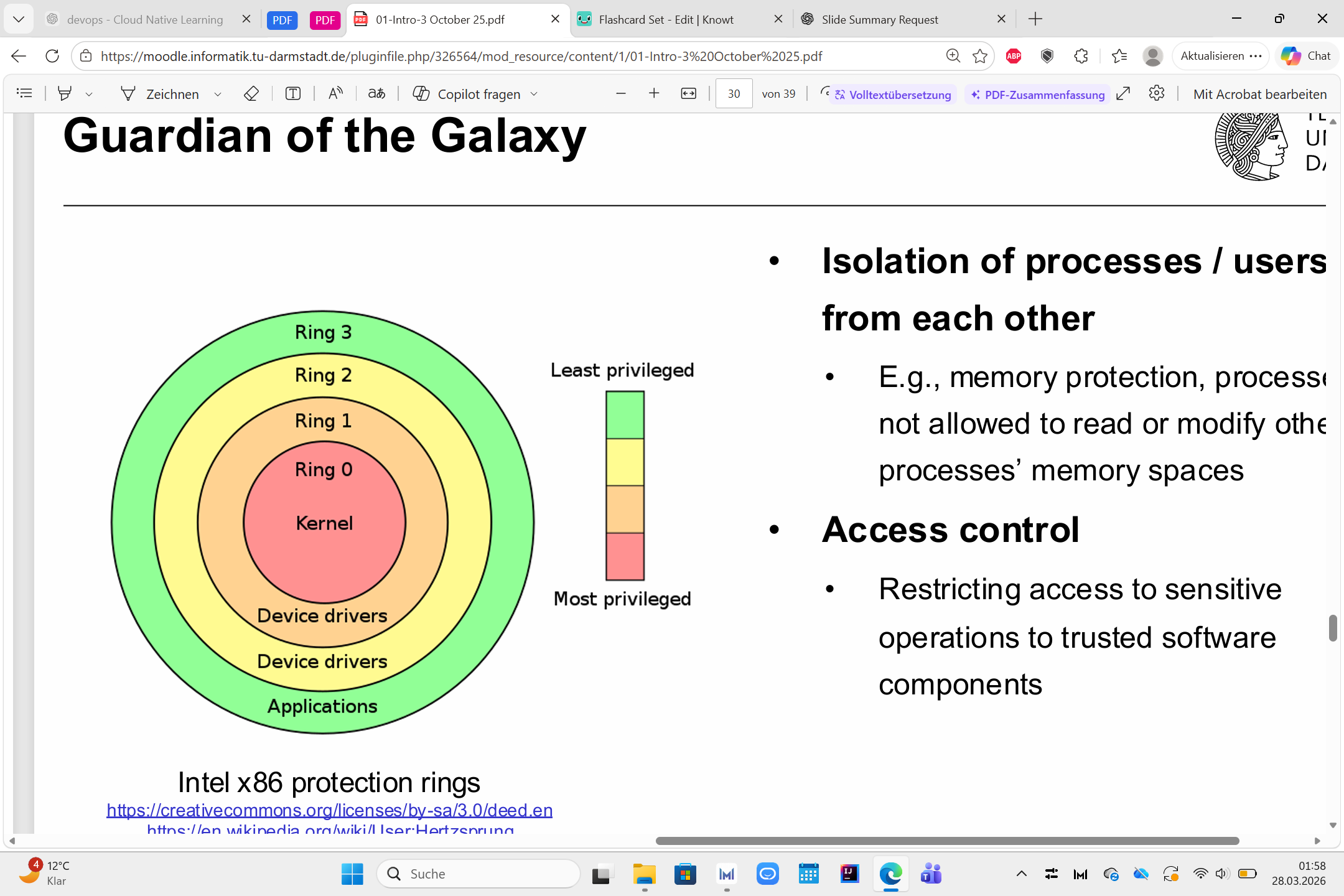
protector/security layer: isolates users/processes, memory protection, access control, only trusted software gets sensitive access
**Resources are the things a computer has and programs need to use.
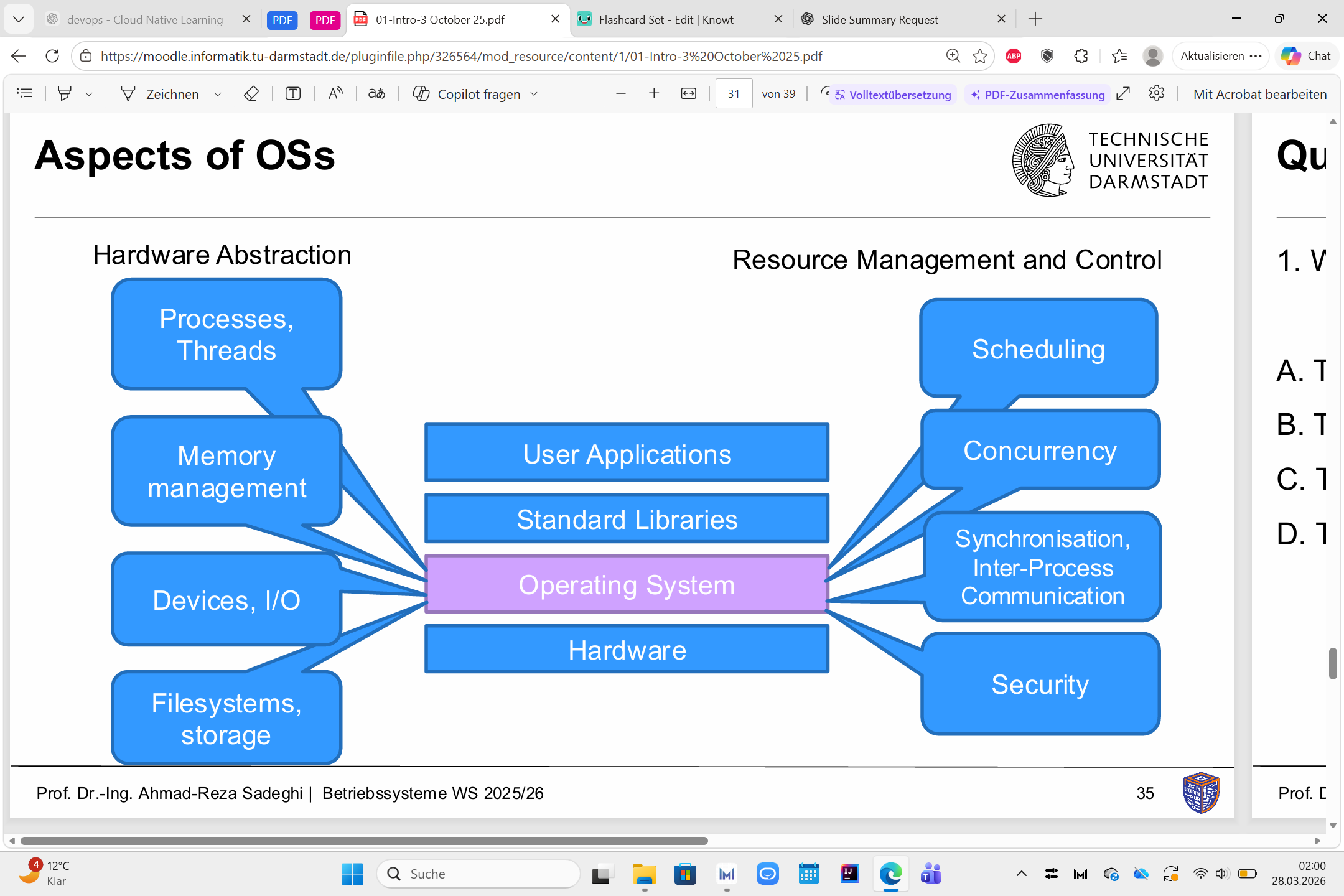
What are the main aspects of an operating system?
hardware abstraction:
processes / threads
memory management
devices / I/O
file systems / storage
resource management and control:
scheduling
concurrency
synchronization / inter-process communication
security
OS sits between applications/libraries and hardware
1. Which of the following best describes the main purpose of an operating system?
A. To translate source code into machine code
B. To provide direct access to hardware for user programs
C. To abstract hardware complexity and manage system resources
D. To store data permanently on secondary storage devices
Correct answer: C
OS main purpose: abstract hardware complexity + manage system resources
A = compiler
B = wrong, OS usually prevents direct hardware access
D = storage device/filesystem role, not the full main purpose
2. Which of the following is not a core function of an operating system?
A. Process and memory management
B. Scheduling and resource allocation
C. Hardware abstraction and security control
D. Compiling user programs into executable files
Correct answer: D
A, B, C = core OS functions
D = job of a compiler, not the operating system
3. The operating system’s hardware abstraction provides:
A. A hardware-independent interface for applications
B. A direct hardware control layer for programmers
C. An encryption mechanism for secure communication
D. A set of drivers unique to each application
Correct answer: A
OS abstraction = hardware-independent interface for applications
B wrong: OS hides direct hardware control
C not the main meaning of hardware abstraction
D wrong: drivers belong to the OS/hardware layer, not unique to each app
4. In the context of OS security, “isolation of processes” means:
A. Processes can freely access each other’s memory
B. Processes are prevented from interfering with each other’s data
C. Processes must share all system resources equally
D. Processes run only with administrator privileges
Correct answer: B
process isolation = one process cannot read/change another process’s memory or data
this protects programs from interfering with each other
A is the opposite
C is about sharing, not isolation
D is false, processes do not need admin privileges
Quiz 5/7 5. According to the lecture, why would writing programs directly for hardware be difficult?
A. Hardware lacks sufficient processing power
B. Each hardware component requires unique, complex control instructions
C. It would bypass security features of the OS
D. It would consume too much disk space
Correct answer: B
hardware components need different, specific control instructions
the OS hides this complexity with abstraction
A not the main reason
C can be a consequence, but not the lecture’s main point here
D unrelated
6. Which change best distinguishes second-generation computers from the first generation?
A. Programs were now entered via punch cards instead of manually wiring circuits
B. Computers became portable and battery-powered
C. Systems became mostly bug-free and required little maintenance
D. Machines started using optical processors
Correct answer: A
2nd generation: punch cards replaced manual wiring / patch bays
also: transistors replaced vacuum tubes
B is much later
C false
D false
7. Which of the following was a core benefit of transistors compared to vacuum tubes in second-generation computers?
A. Transistors were much smaller and more reliable, allowing smaller and more efficient computers
B. Transistors enabled color screens and graphical interfaces
C. Transistors removed the need for electrical circuits entirely
D. Transistors allowed computers to communicate over the Internet
Correct answer: A
transistors were smaller
more reliable
more efficient
helped make computers smaller and better
B much later, not the key transistor benefit
C false, transistors are part of electrical circuits
D false, not the reason here

