PHSL 3051 renal physiology

0.0(0)
studied byStudied by 9 people
0.0(0)
full-widthCall Kai
learnLearn
examPractice Test
spaced repetitionSpaced Repetition
heart puzzleMatch
flashcardsFlashcards
GameKnowt Play
Card Sorting

1/58

encourage image

There's no tags or description

Looks like no tags are added yet.

Study Analytics
Name
Mastery
Learn
Test
Matching
Spaced

No study sessions yet.

59 Terms

1
New cards

function of the kidneys

  1. regulation of water, inorganic ion balance, acid base balance

  2. removal of metabolic waste products from the blood and their excretion in the urine

  3. removal of foreign chemicals from the blood and their excretion in the urine

  4. gluconeogenesis

  5. production of hormones/enzymes

2
New cards

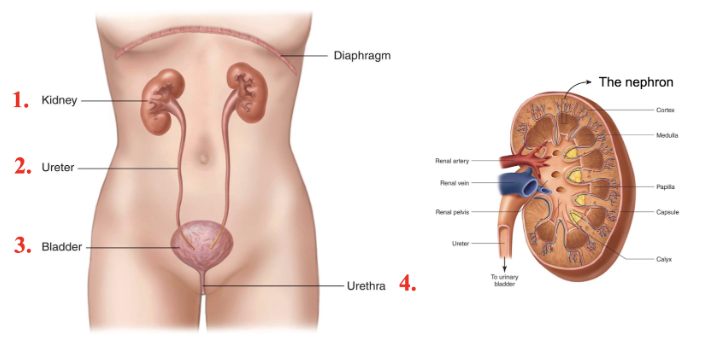
primary organs of the urinary system

  1. kidney

  2. ureter

  3. bladder

  4. urethra

<ol><li><p>kidney</p></li><li><p>ureter</p></li><li><p>bladder</p></li><li><p>urethra </p></li></ol><p></p>
3
New cards

layers of the kidney

renal cortex = outer layer

  • contains renal corpuscles, convoluted tubules, cortical nephrons

renal medulla = inner layer

  • contains renal pyramids, long loops of henele, collecting ducts
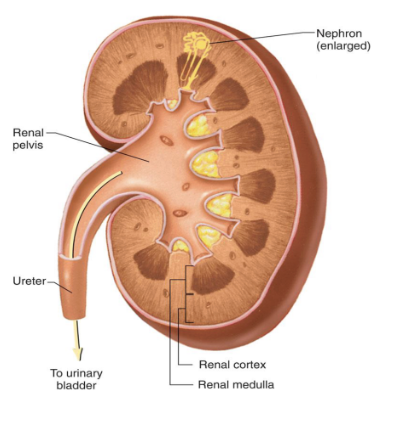
<p>renal cortex = outer layer</p><ul><li><p>contains renal corpuscles, convoluted tubules, cortical nephrons</p></li></ul><p>renal medulla = inner layer</p><ul><li><p>contains renal pyramids, long loops of henele, collecting ducts</p></li></ul><p></p>
4
New cards

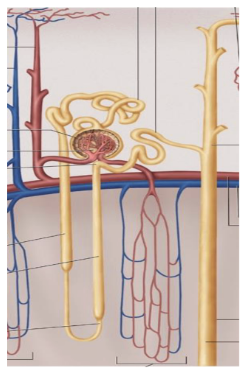
the nephron

the functional unit of the kidney

5
New cards

the nephron tubules

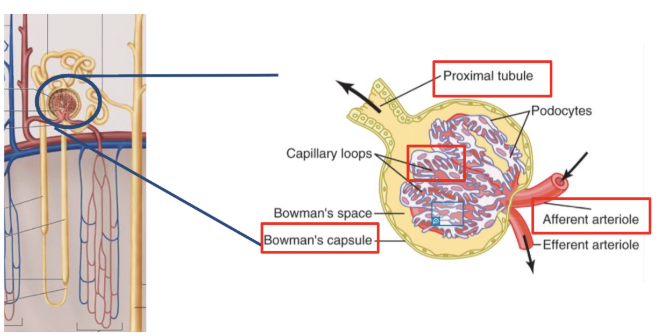
  1. bowmans capsule (part of corpuscle)

  2. proximal convulated/straight tubule

  3. loop of henele

  4. distal convulated tubule

  5. collecting duct

<ol><li><p>bowmans capsule (part of corpuscle)</p></li><li><p>proximal convulated/straight tubule</p></li><li><p>loop of henele</p></li><li><p>distal convulated tubule</p></li><li><p>collecting duct</p></li></ol><p></p>
6
New cards

the nephron blood supply

  1. a renal artery

  2. afferent arteriole

  3. glomerular capillaries

  4. efferent arteriole

  5. peritubular capillaries (possibly vasa recta, if in medulla)

  6. a renal vein

7
New cards

portal system

an arrangement by which blood collected from one set of capillaries passes through a large vessel or vessels, to another set of capillaries before returning to the systemic circulation

8
New cards

the renal corpuscle = 

glomerular capillaries + bowmans capsule

9
New cards

nephron =

glomerular (renal) corpuscle + renal tubule

10
New cards

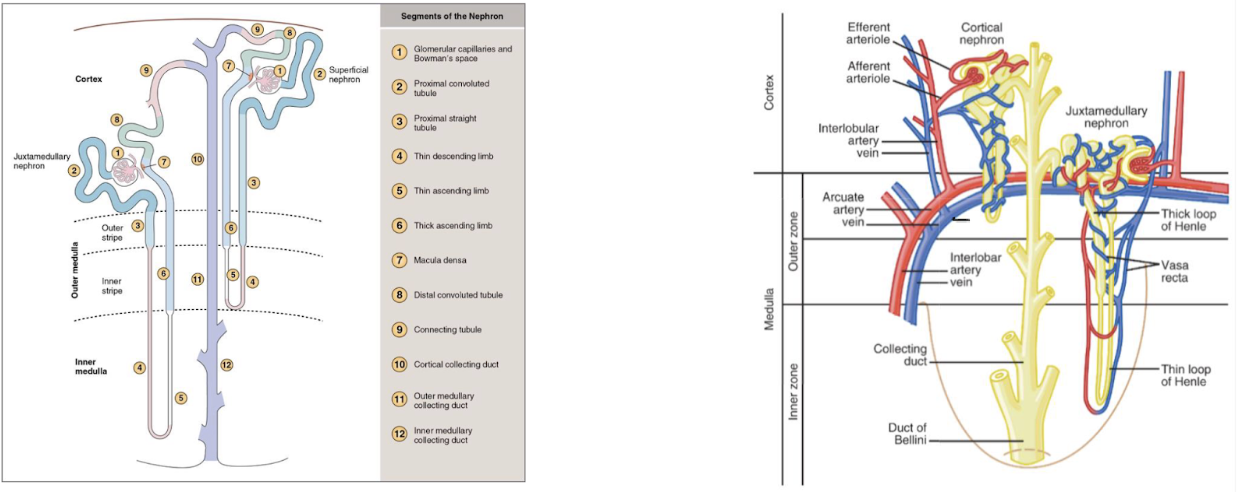
segments of the nephron

knowt flashcard image
11
New cards

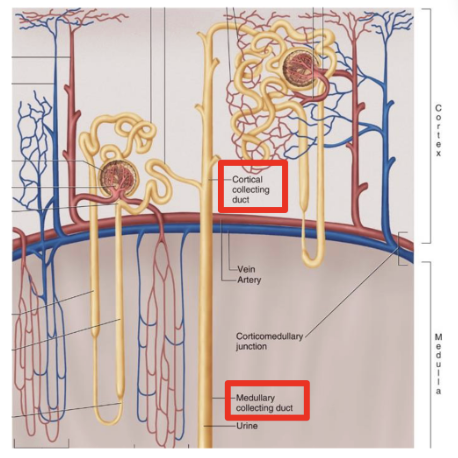
two types of nephrons

  1. cortical (85%)

  2. juxtamedullary (15%)

<ol><li><p>cortical (85%)</p></li><li><p>juxtamedullary (15%)</p></li></ol><p></p>
12
New cards

cortical nephron

  • short or no loops of henele

  • do not contribute to hypertonic medullary interstitium

  • change in volume and consumption of filtrate

13
New cards

juxtamedullary nephron

  • long loops of henele

  • generate gradient in medulla important for H2O reabsorption

  • peritubular capillaries are called the vasa rectua

  • concentrate the filtrate

14
New cards

juxtaglomerular apparatus (JGA) composition

  1. juxtaglomerular cell patch (afferent arteriole)

    1. senses pressure and releases renin when it is low

  2. macula densa cell patch (distal convoluted tubule)

    1. senses flow (specifically Na+ and Cl- and sends paracrine signals to afferent arterioles)
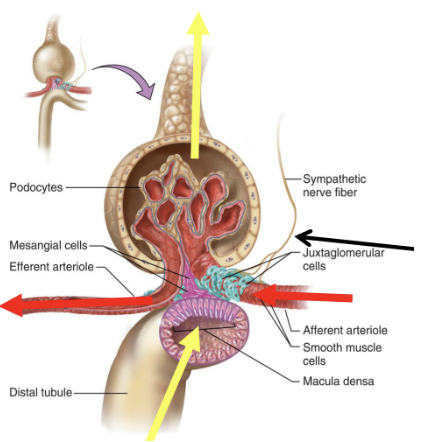
<ol><li><p>juxtaglomerular cell patch (afferent arteriole)</p><ol><li><p>senses pressure and releases renin when it is low</p></li></ol></li><li><p>macula densa cell patch (distal convoluted tubule)</p><ol><li><p>senses flow (specifically Na+ and Cl- and sends paracrine signals to afferent arterioles)</p></li></ol></li></ol><p></p>
15
New cards

sympathetic nerve from CVCC

  1. constricts afferent arteriole

  2. causes renin secretion from juxtaglomerular cells (special secretory cells)

16
New cards

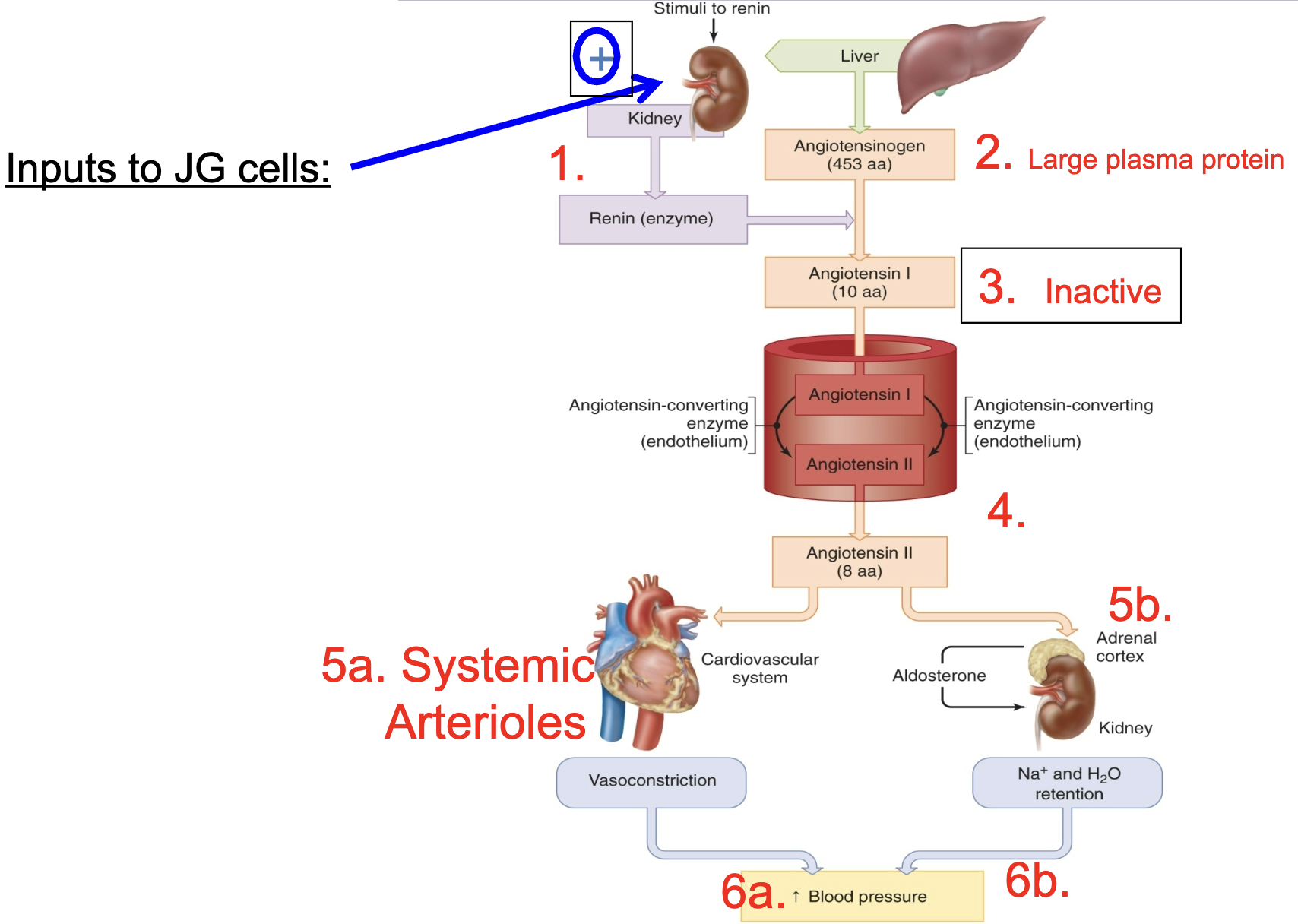
renin

an enzyme/hormone that is important for blood pressure regulation

17
New cards

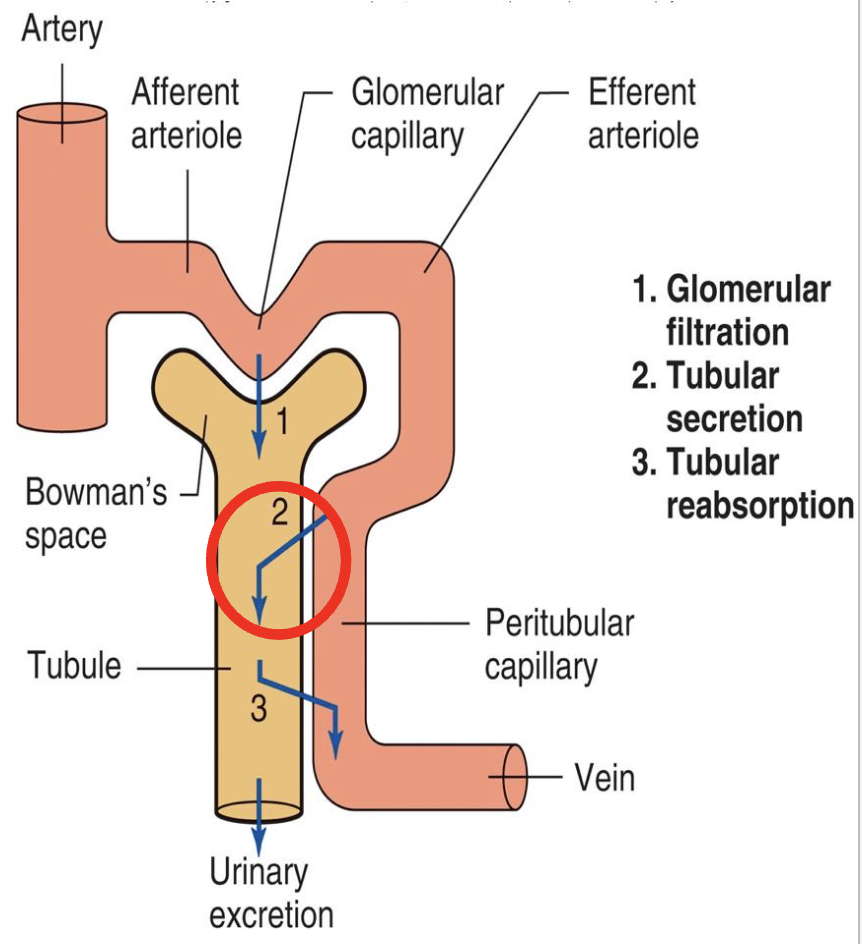
basic renal processes

  1. glomerular filtration

    1. 20% of plasma is filtered, 80% continues into peritubular capillaries

  2. tubular secretion

    1. from 80% that wasnt filtered

  3. tubular reabsorption

    1. reabsorbs from filtrate and put back into plasma *prevents excretion in urine
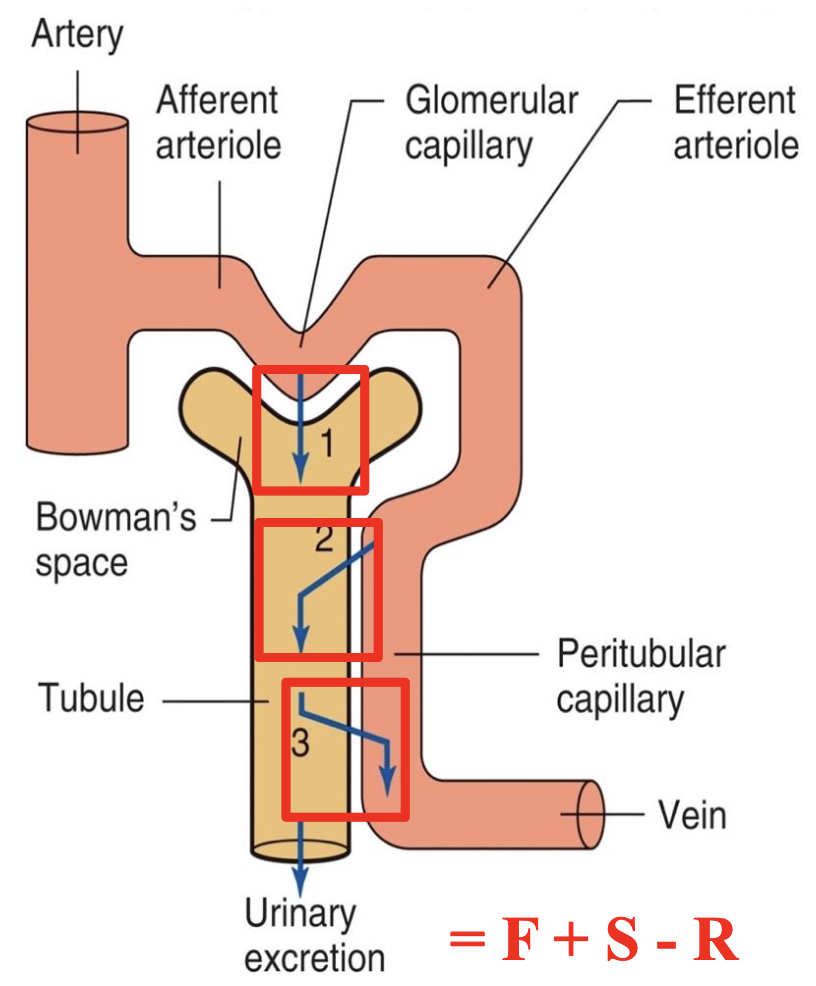
<ol><li><p>glomerular filtration</p><ol><li><p>20% of plasma is filtered, 80% continues into peritubular capillaries</p></li></ol></li><li><p>tubular secretion </p><ol><li><p>from 80% that wasnt filtered</p></li></ol></li><li><p>tubular reabsorption</p><ol><li><p>reabsorbs from filtrate and put back into plasma *prevents excretion in urine</p></li></ol></li></ol><p></p>
18
New cards
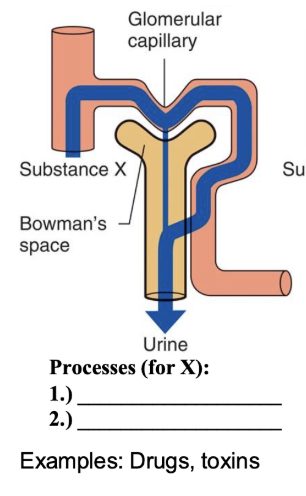
<p>processes for X</p>

processes for X

  1. freely filtered

  2. 100% secreted

19
New cards
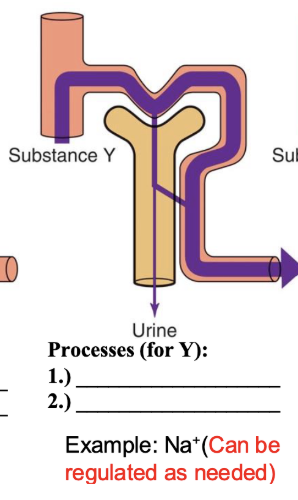
<p>processes for Y</p>

processes for Y

  1. freely filtered

  2. partially reabsorbed

20
New cards
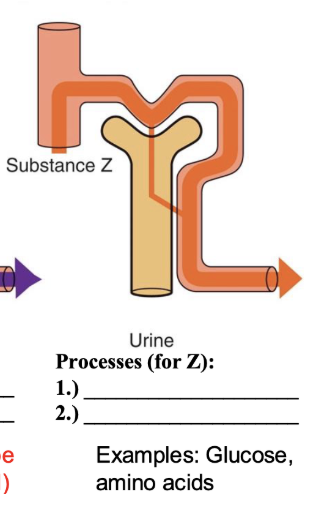
<p>processes for Z</p>

processes for Z

  1. freely filtered 

  2. 100% reabsorbed *more excreted in urine

21
New cards
  1. glomerular filtration

  • 20% of plasma is filtered, 80% continues into peritubular capillaries

  • plasma proteins and cells are too big for filtration

  • negatively charged membranes, also exclude plasma proteins

  • filtrate = blood plasma except for RBC and proteins

    • glomerular filtrate is plasma without cells or plasma proteins

  • useful molecules like nutrients are reabsorbed, while waste products and toxins are secreted

  • **GFR = 125 mL/min (180 L/day)

<ul><li><p>20% of plasma is filtered, 80% continues into peritubular capillaries</p></li><li><p>plasma proteins and cells are too big for filtration</p></li><li><p>negatively charged membranes, also exclude plasma proteins</p></li><li><p><em>filtrate = blood plasma except for RBC and proteins</em></p><ul><li><p>glomerular filtrate is plasma without cells or plasma proteins</p></li></ul></li><li><p>useful molecules like nutrients are reabsorbed, while waste products and toxins are secreted</p></li><li><p>**GFR = 125 mL/min (180 L/day)</p></li></ul><p></p>
22
New cards

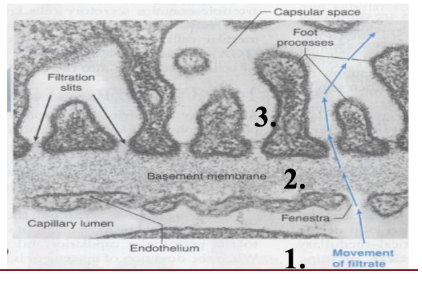
3 layers of GFR

  1. capillary endothelium (50x more leaky than other typical capillary bed)

  2. basement membrane (negative charge)

  3. bowmans epithelium (i.e. podocytes

<ol><li><p>capillary endothelium (50x more leaky than other typical capillary bed)</p></li><li><p>basement membrane (negative charge)</p></li><li><p>bowmans epithelium (i.e. podocytes</p></li></ol><p></p>
23
New cards

filtered load vs excreted load (3 important equations)

  1. FL = GFR x [P]

FL = flow/min GFR = mL/min P = mg/mL

  1. EL = V x [U]

EL = mg/min V= urine flow rate, mL/min U = mg/mL

  1. if EL < FL, net reabsorption

  2. if FL < EL, net secretion

24
New cards

starling forces in glomerular filtration

favoring filtration

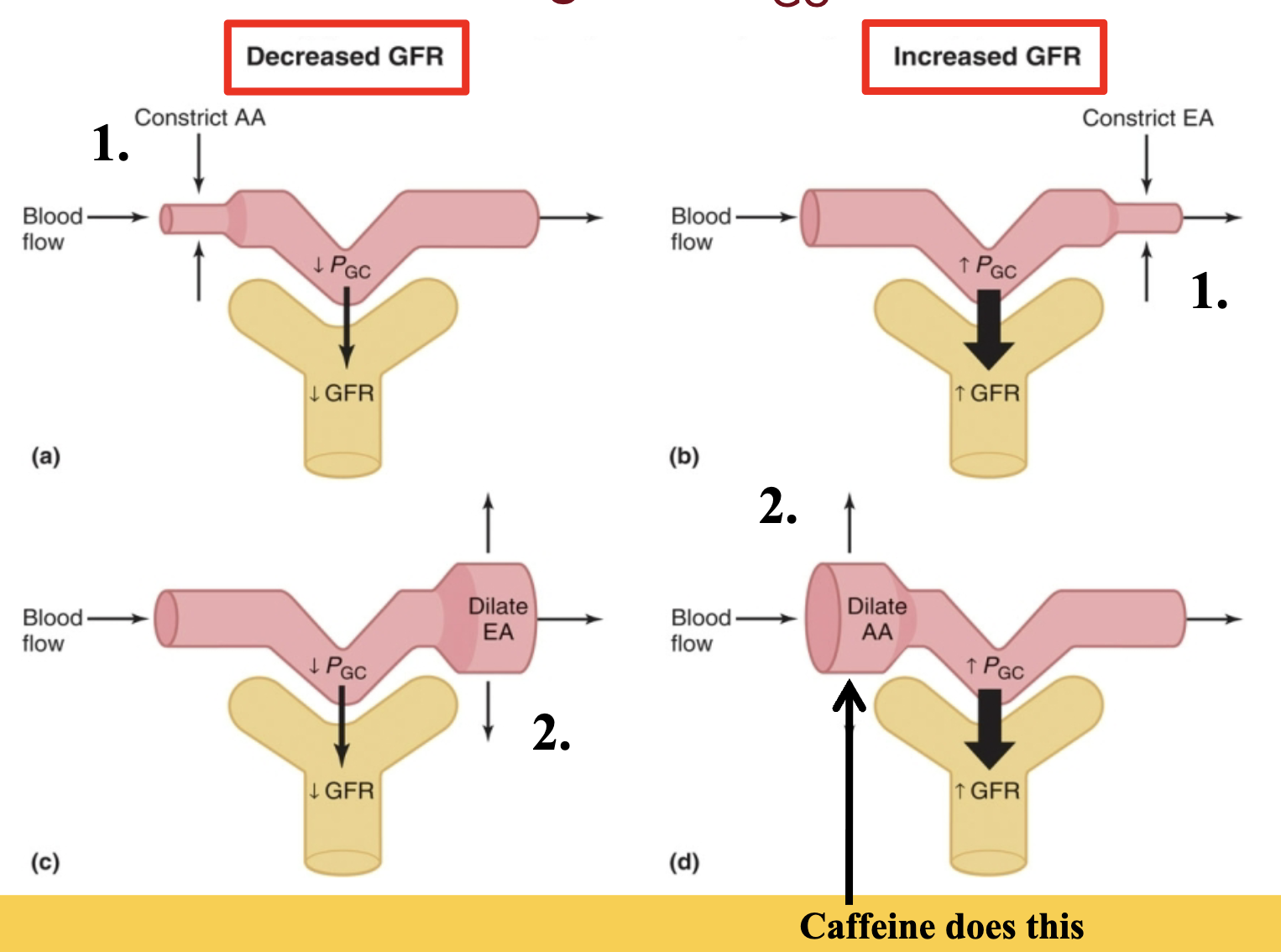
  • glomerular capillary blood pressure (PGC) → 60 mmHg

opposing filtration

  • fluid pressure in bowmans space (PBS) → 15 mmHg

  • osmotic force due to protein in plasma (πGC) → 29 mmHg

Net glomerular filtration pressure = PGC - PBS - πGC → 16 mmHg
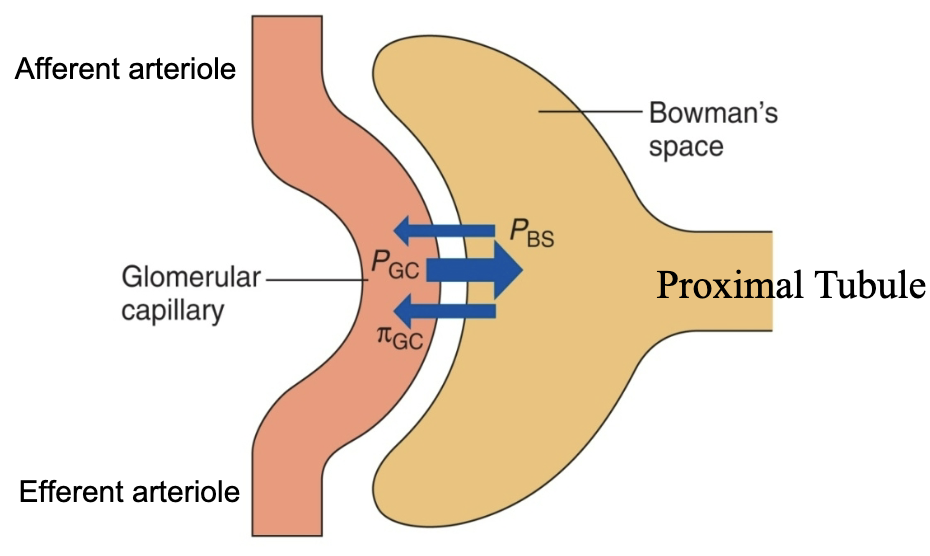
<p>favoring filtration</p><ul><li><p>glomerular capillary blood pressure (PGC) → 60 mmHg</p></li></ul><p>opposing filtration</p><ul><li><p>fluid pressure in bowmans space (PBS) → 15 mmHg</p></li><li><p>osmotic force due to protein in plasma (πGC) → 29 mmHg</p></li></ul><p><strong>Net glomerular filtration pressure = PGC - PBS - πGC → 16 mmHg</strong></p><p></p>
25
New cards

renal arterioles regulate PGC and thus GFR
knowt flashcard image
26
New cards
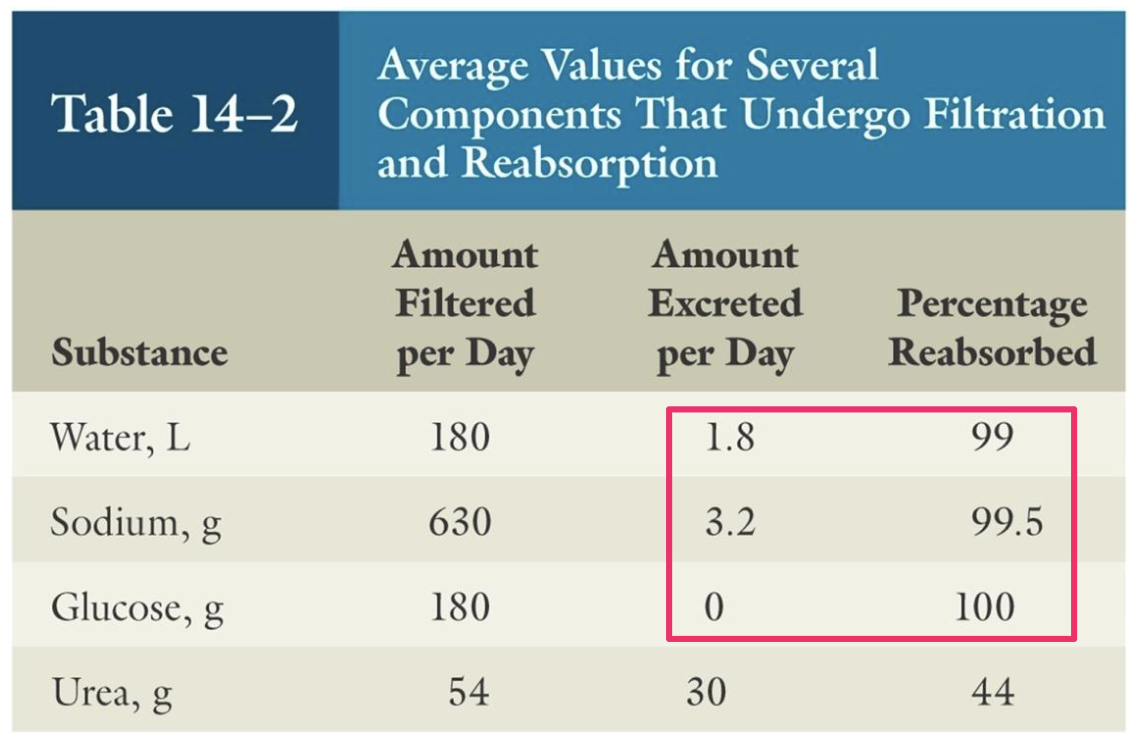
  1. tubular reabsorption

  • filtered loads are HUGE (180 L/day of water)

  • reabsorption of water, ions, nutrients, etc. is almost complete

  • reabsorption of wastes is incomplete → excreted
<ul><li><p>filtered loads are HUGE (180 L/day of water)</p></li><li><p>reabsorption of water, ions, nutrients, etc. is almost complete</p></li><li><p>reabsorption of wastes is incomplete → excreted</p></li></ul><p></p>
27
New cards

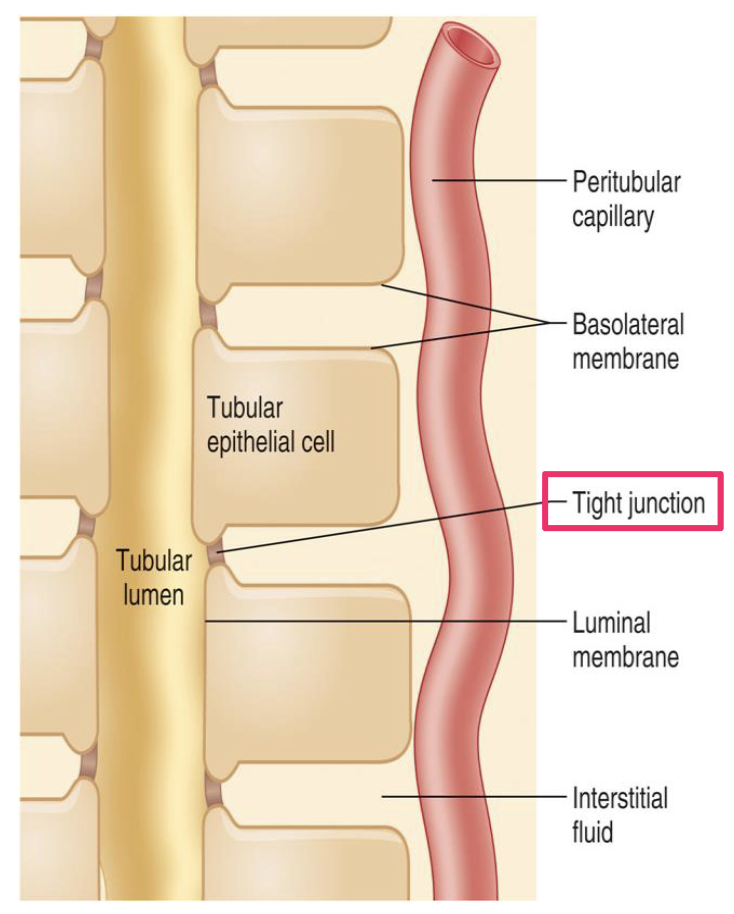
modes and routes of tubular reabsorption

99% of filtrate volume is reabsorbed 

*tight junctions vary by region

  1. diffusion

    1. lipid soluble substances that dont need carriers

  2. meditated transport

    1. large/charged substances (glucose)

<p>99% of filtrate volume is reabsorbed&nbsp;</p><p>*tight junctions vary by region</p><ol><li><p>diffusion</p><ol><li><p>lipid soluble substances that dont need carriers</p></li></ol></li><li><p>meditated transport</p><ol><li><p>large/charged substances (glucose)</p></li></ol></li></ol><p></p>
28
New cards

transcellular route

  1. luminal membrane

  2. basolateral membrane

  3. renal interstitial fluid

  4. peritubular capillaries

29
New cards

paracellular route

  1. through tight functions

  2. renal interstitial fluid

  3. peritubular capillaries

30
New cards

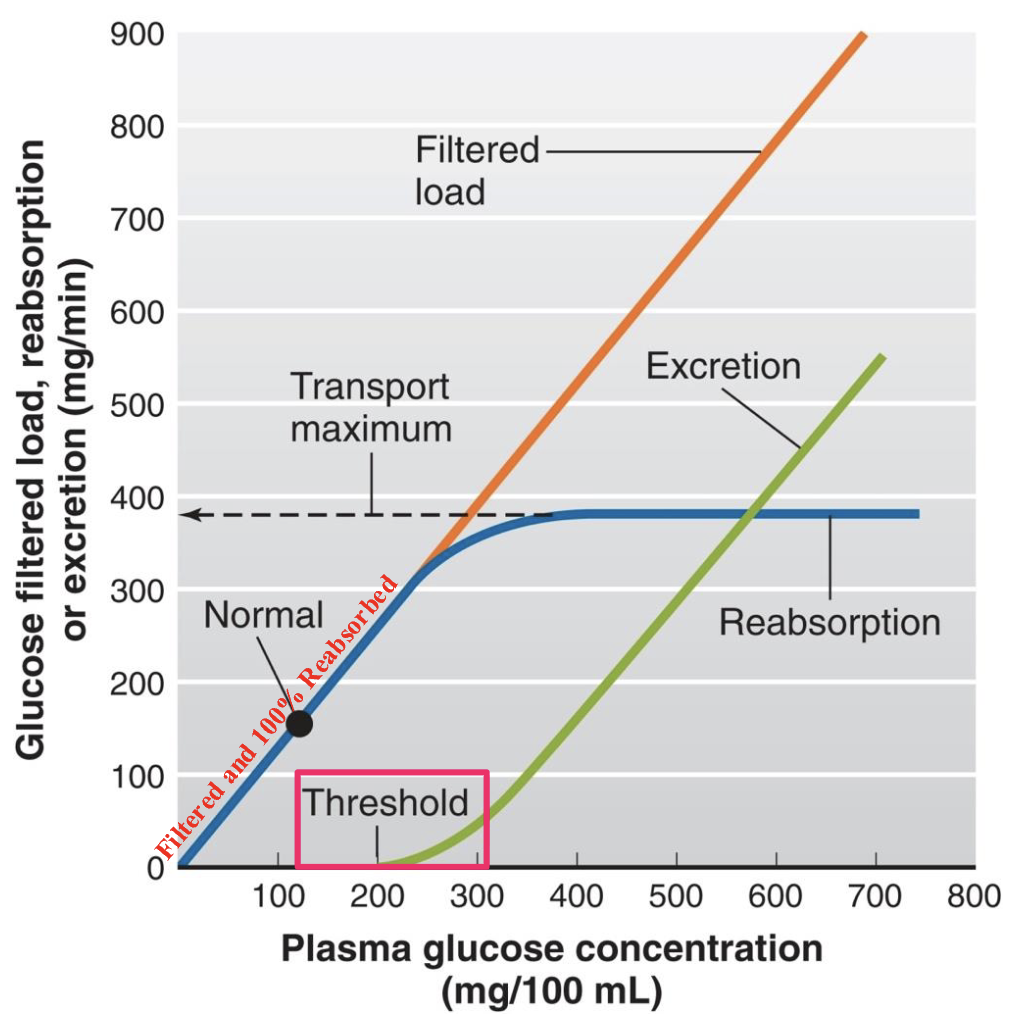
substances needing protein carriers have a transport maximum (Tm)

example: glucose

  • glucose is freely filtered, and in health, is fully reabsorbed in the proximal tubule - the plasma glucose of a healthy person almost never becomes high enough to cause glucose excretion in the urine

  • however, in uncontrolled diabetes mellitus, plasma glucose concentration may rise high enough to cause the filtered load of glucose to exceed the transport max, resulting in urinary glucose excretion
<p>example: glucose</p><ul><li><p><span style="background-color: transparent;"><span>glucose is freely filtered, and in health, is fully reabsorbed in the proximal tubule - the plasma glucose of a healthy person almost never becomes high enough to cause glucose excretion in the urine</span></span></p></li></ul><ul><li><p><span style="background-color: transparent;"><span>however, in uncontrolled diabetes mellitus, plasma glucose concentration may rise high enough to cause the filtered load of glucose to exceed the transport max, resulting in urinary glucose excretion</span></span></p></li></ul><p></p>
31
New cards

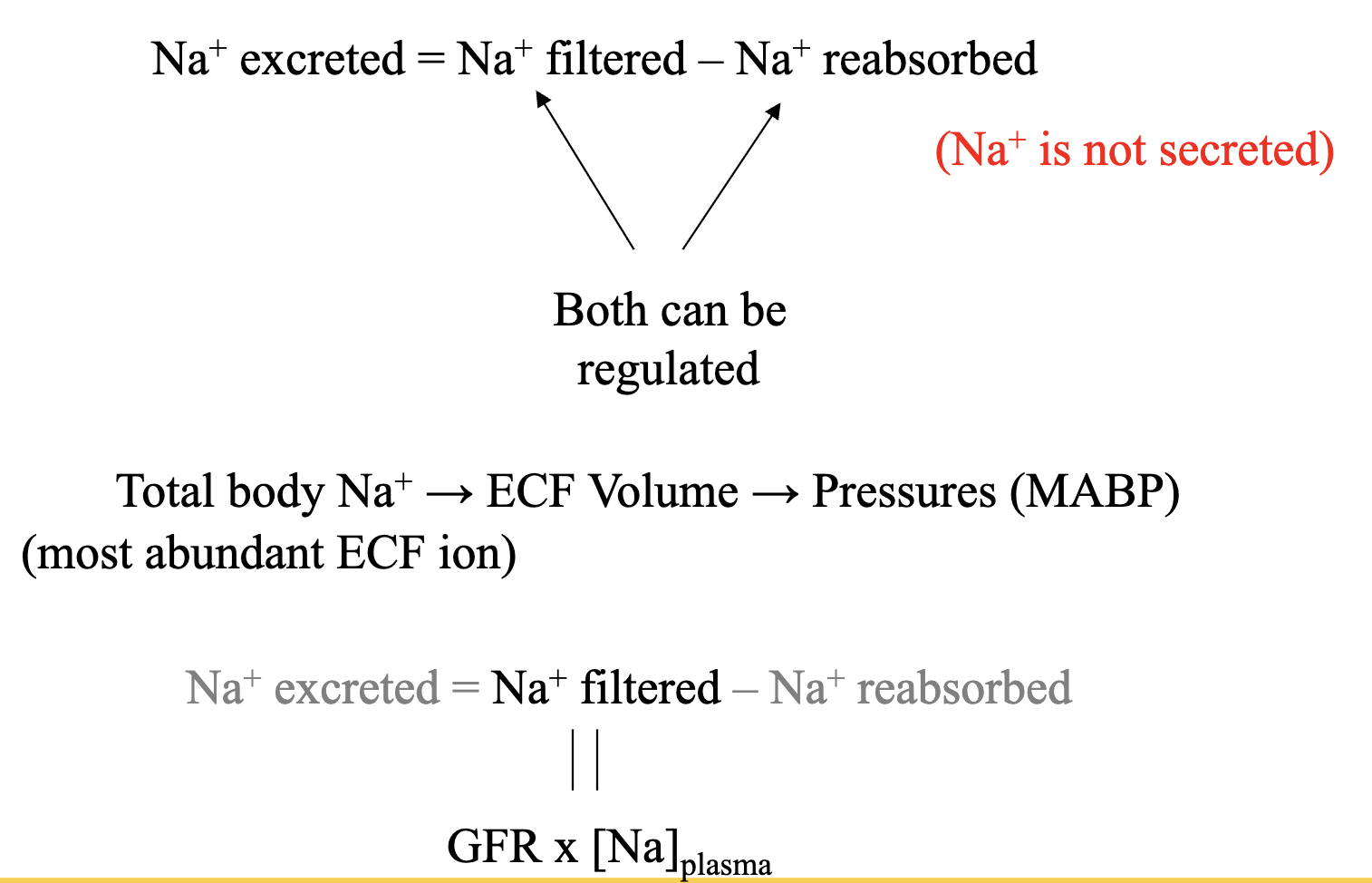
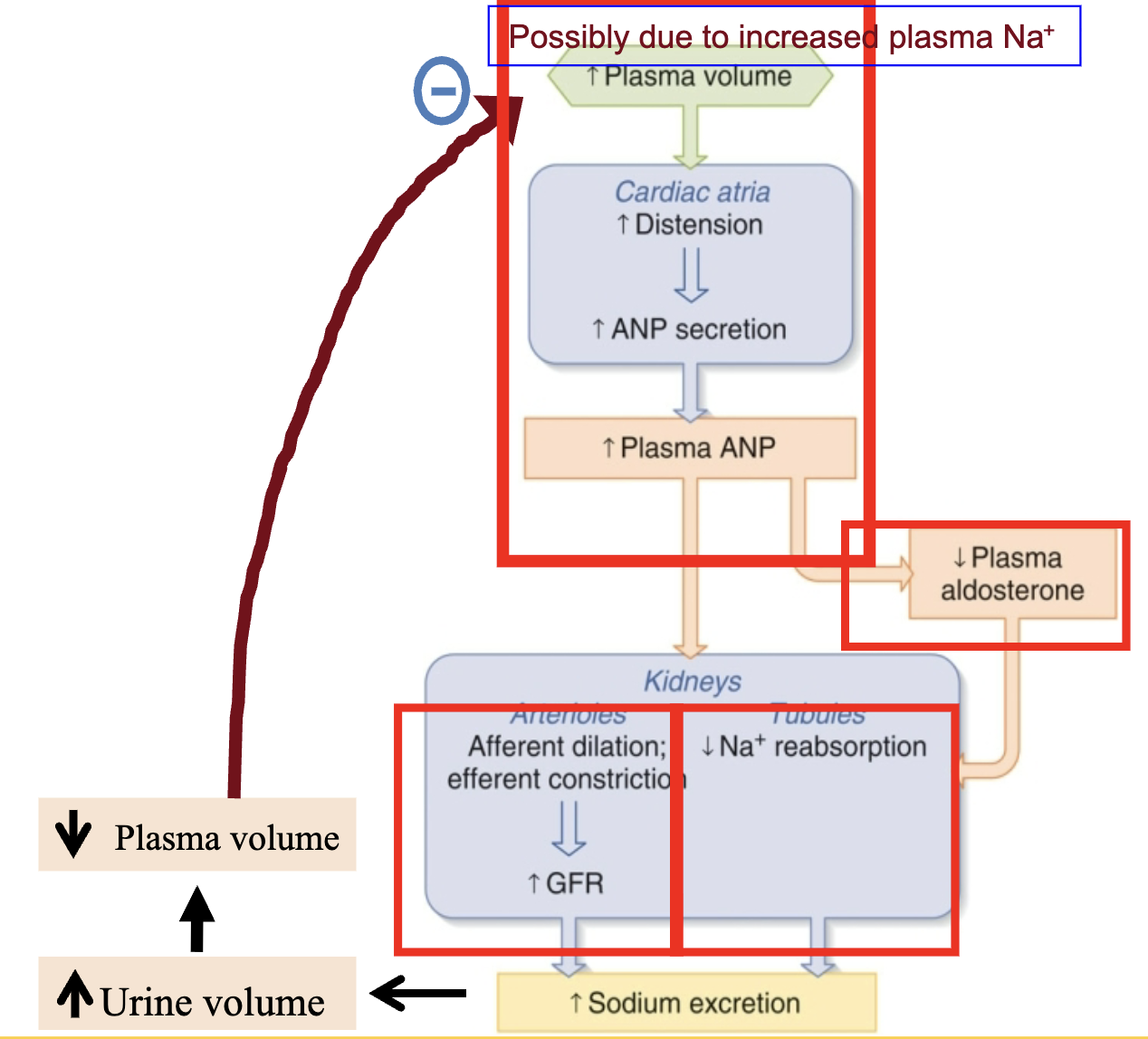
renal sodium regulation

Notes

  • when plasma volume drops, a decrease in GFR reduces Na+ and H2O loss

  • regulation of sodium reabsorption

    • renin/angiotensis/aldosterone system

<p>Notes</p><ul><li><p>when plasma volume drops, a decrease in GFR reduces Na+ and H2O loss</p></li><li><p>regulation of sodium reabsorption</p><ul><li><p>renin/angiotensis/aldosterone system</p></li></ul></li></ul><p></p>
32
New cards

renal sodium regulation steps

knowt flashcard image
33
New cards

renal sodium regulation ANP

atrial natriuretic peptide

  • “the anti-aldosterone”

<p>atrial natriuretic peptide</p><ul><li><p>“the anti-aldosterone”</p></li></ul><p></p>
34
New cards

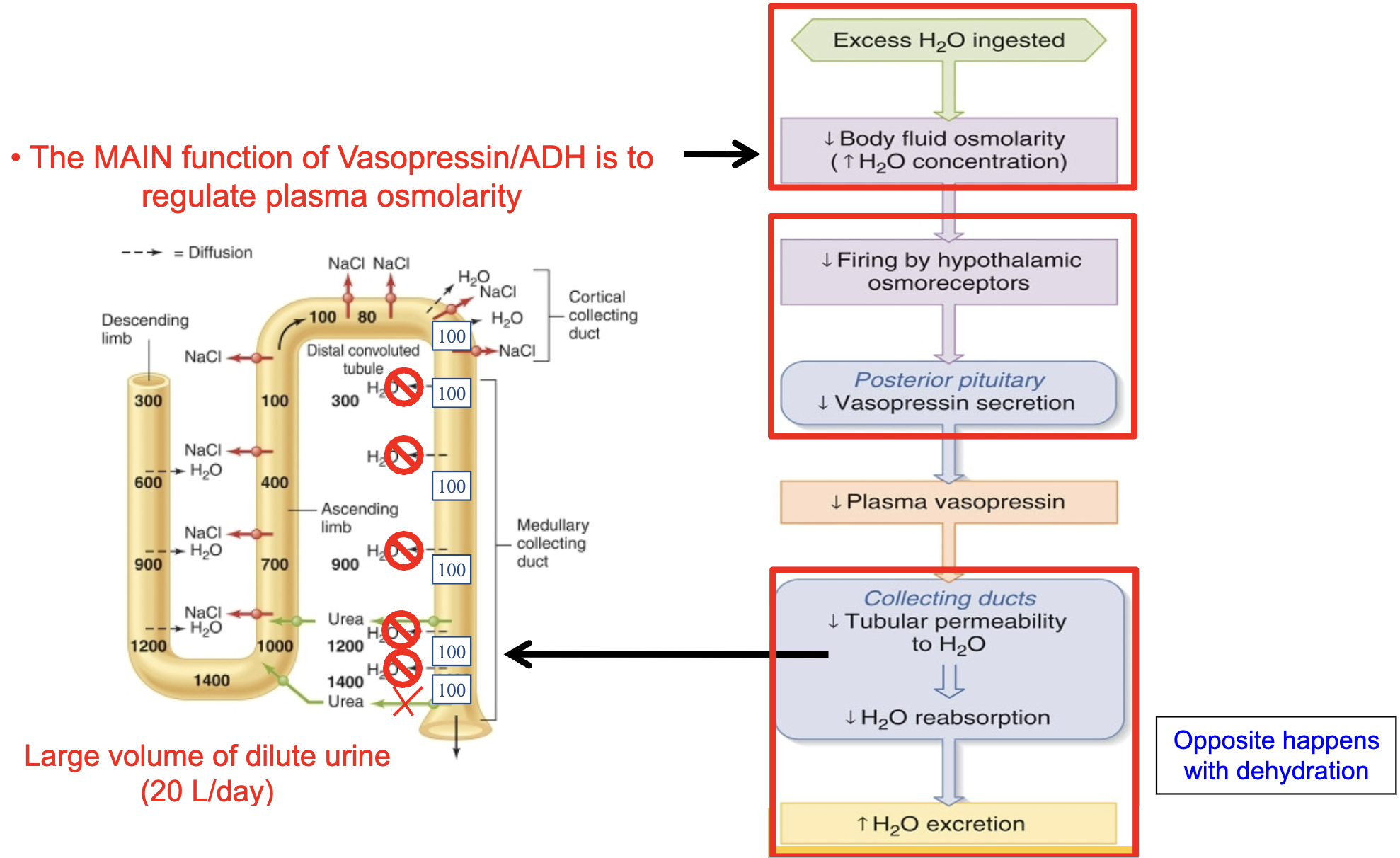
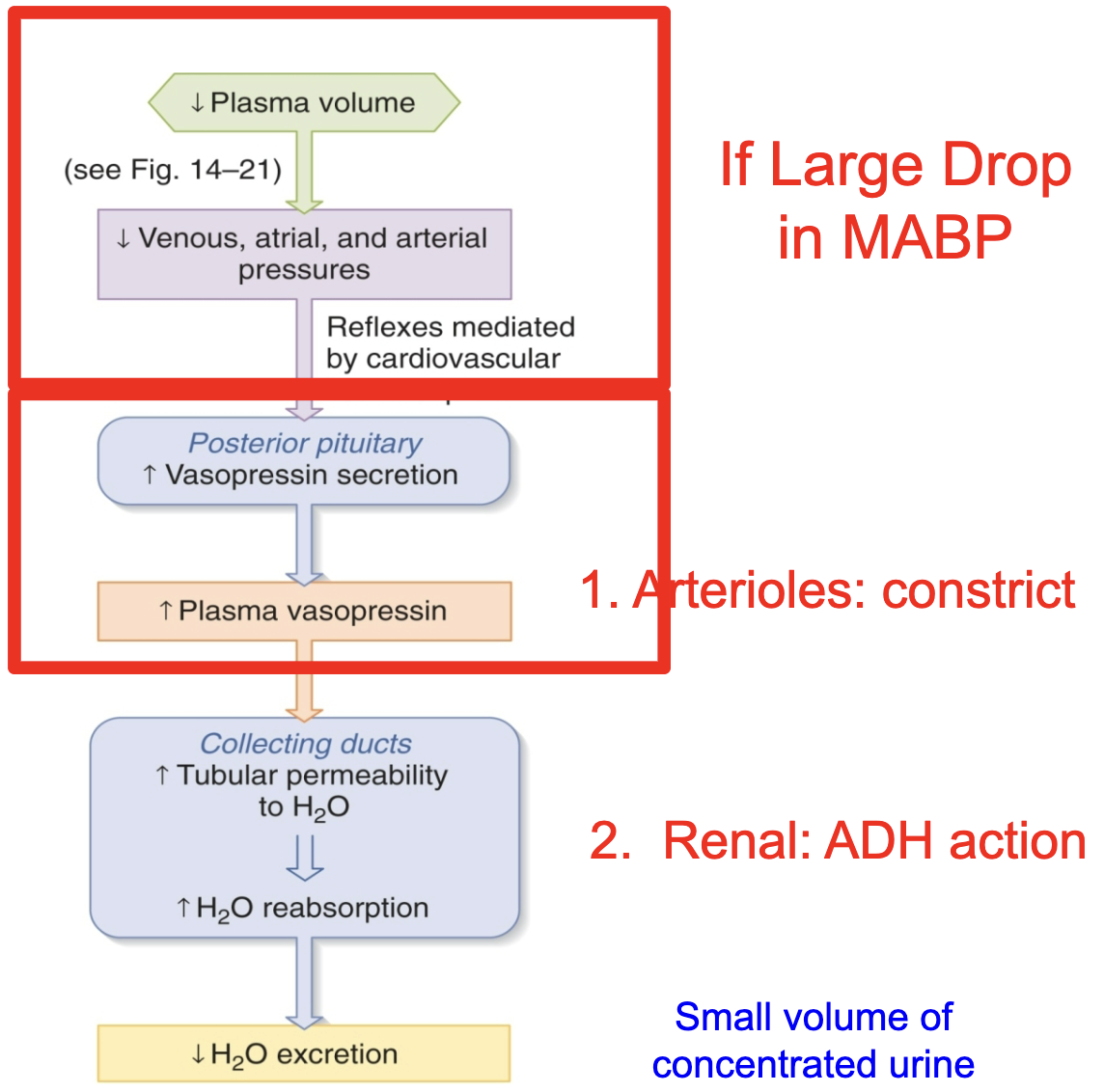
renal water regulation

there is also a baroreceptor reflex for
vasopressin/ADH secretion

  • although this reflex plays a lesser role under most physiological circumstances compared to the
    osmoreceptor reflex
<p><span style="color: rgb(0, 0, 0);"><span>there is also a baroreceptor reflex for</span></span><span style="color: rgb(0, 0, 0);"><br></span><span style="color: rgb(0, 0, 0);"><span>vasopressin/ADH secretion </span></span></p><ul><li><p><span style="color: rgb(0, 0, 0);"><span>although this reflex plays a lesser role under most physiological circumstances compared to the</span></span><span style="color: rgb(0, 0, 0);"><br></span><span style="color: rgb(0, 0, 0);"><span>osmoreceptor reflex</span></span></p></li></ul><p></p>
35
New cards

renal water regulation

knowt flashcard image
36
New cards

tubular secretion

  • foreign chemicals and toxins

    • penicillin

  • usually involves active transport

    • coupled to Na+ reabsorption

    • i.e. secondary active transport

  • most secretion occurs into the proximal tubules

    • except K+ and H+ ions are mainly secreted into the distal tubule

  • secreted substances can have a Tm too

<ul><li><p>foreign chemicals and toxins</p><ul><li><p>penicillin</p></li></ul></li><li><p>usually involves active transport</p><ul><li><p>coupled to Na+ reabsorption</p></li><li><p>i.e. secondary active transport</p></li></ul></li><li><p>most secretion occurs into the proximal tubules</p><ul><li><p>except K+ and H+ ions are mainly secreted into the distal tubule</p></li></ul></li><li><p>secreted substances can have a Tm too</p></li></ul><p></p>
37
New cards

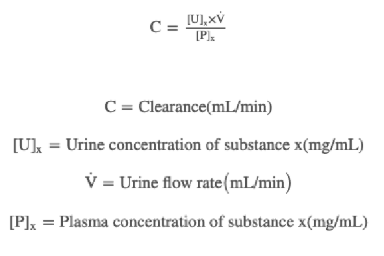
renal plasma clearance definition/equation

the volume of PLASMA per unit time from which all of a substance is removed/cleared by the kidneys and excreted in the urine
<p>the volume of PLASMA per unit time from which all of a substance is removed/cleared by the kidneys and excreted in the urine</p>
38
New cards

renal plasma clearance

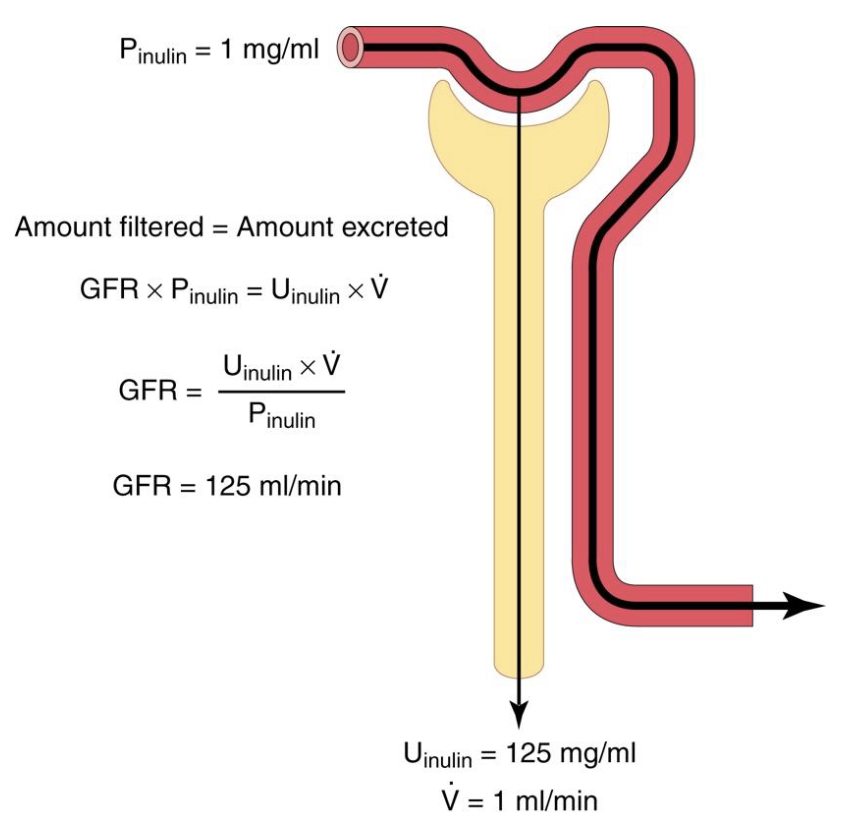
  • RPC measurements can be used to determine how well the kidneys are functioning or how a substance is handled by the kidney

    • very important when figuring out dosing, developing new drugs, etc. 

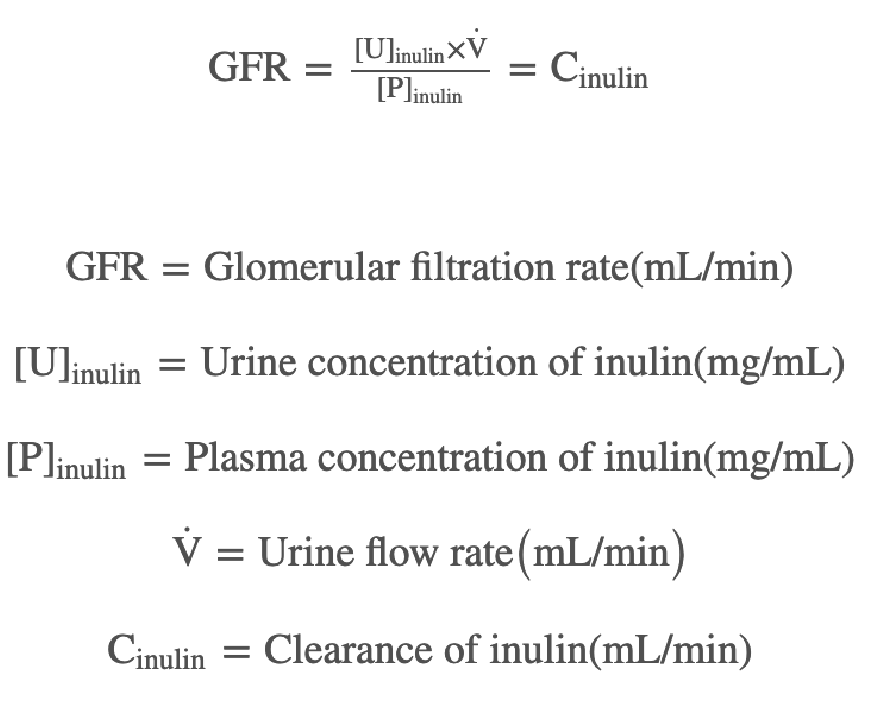
  • inulin (an exogenous substance) is freely filtered but not secreted or reabsorbed

  • RPCinulin = GFR (typically 125 mL/min)

  • RPC of any new substance will show how that substance is handled by the kidneys
<ul><li><p><span style="background-color: transparent;"><span>RPC measurements can be used to determine how well the kidneys are functioning or how a substance is handled by the kidney</span></span></p><ul><li><p><span style="background-color: transparent;"><span>very important when figuring out dosing, developing new drugs, etc.&nbsp;</span></span></p></li></ul></li><li><p><span style="background-color: transparent;"><span>inulin (an exogenous substance) is freely filtered but not secreted or reabsorbed</span></span></p></li><li><p><span style="background-color: transparent;"><span>RPCinulin = GFR (typically 125 mL/min)</span></span></p></li><li><p><span style="background-color: transparent;"><span>RPC of any new substance will show how that substance is handled by the kidneys</span></span></p></li></ul><p></p>
39
New cards

renal plasma clearance outcomes

RPC > GFR, substance is NET secreted

RPC < GFR, substance is NET reabsorbed (or partially filtered)

40
New cards

RBCinulin = GFR

knowt flashcard image
41
New cards

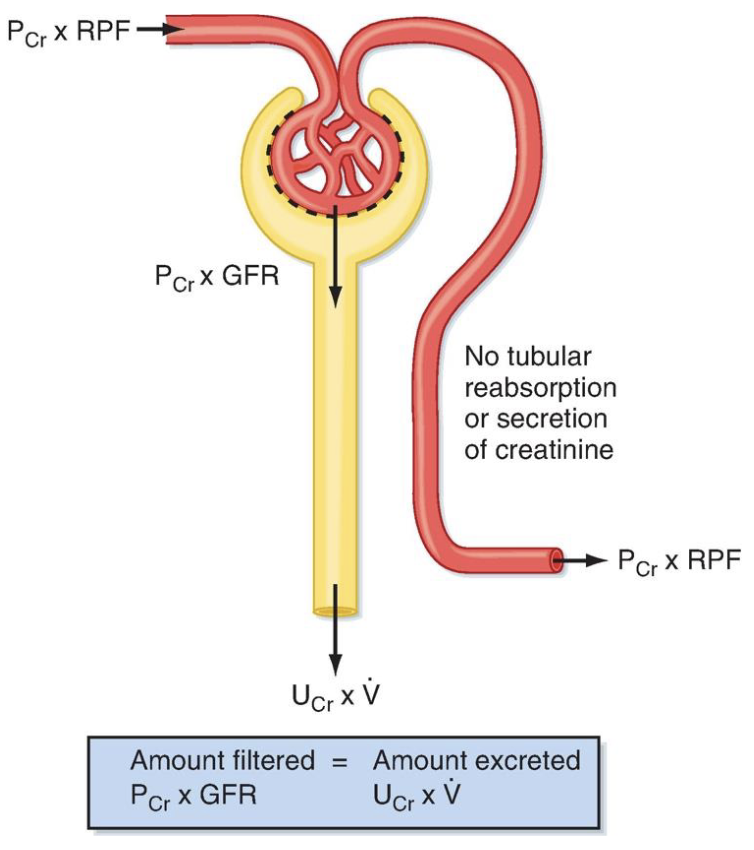
renal plasma clearance of creatinine

a more practical, less invasive way of determining GFR

  • produced by muscles at a constant rate (byproduct of normal skeletal muscle metabolism)

  • freely filtered

  • not reabsorbed

  • slightly secreted

  • RPCcr = to true GFR

<p>a more practical, less invasive way of determining GFR</p><ul><li><p>produced by muscles at a constant rate (byproduct of normal skeletal muscle metabolism)</p></li><li><p>freely filtered</p></li><li><p>not reabsorbed</p></li><li><p>slightly secreted</p></li><li><p>RPCcr = to true GFR</p></li></ul><p></p>
42
New cards

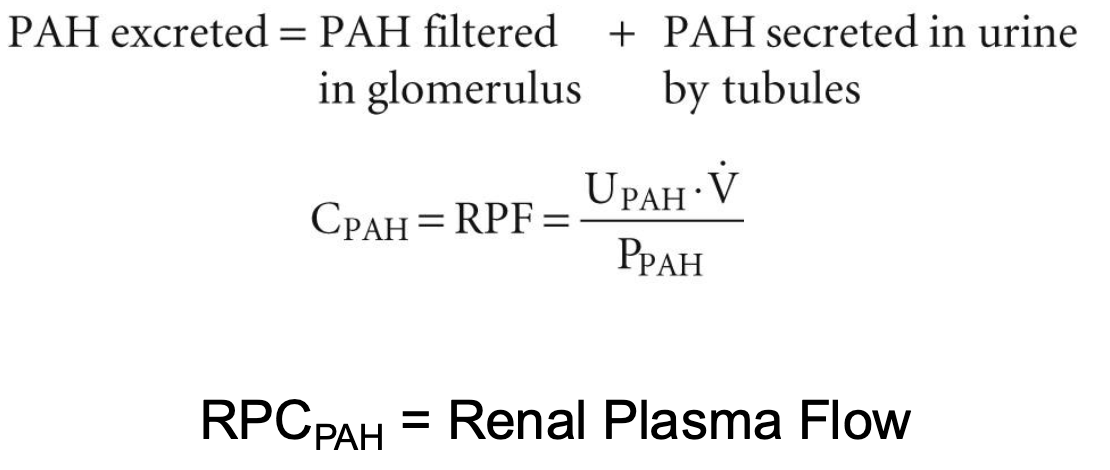
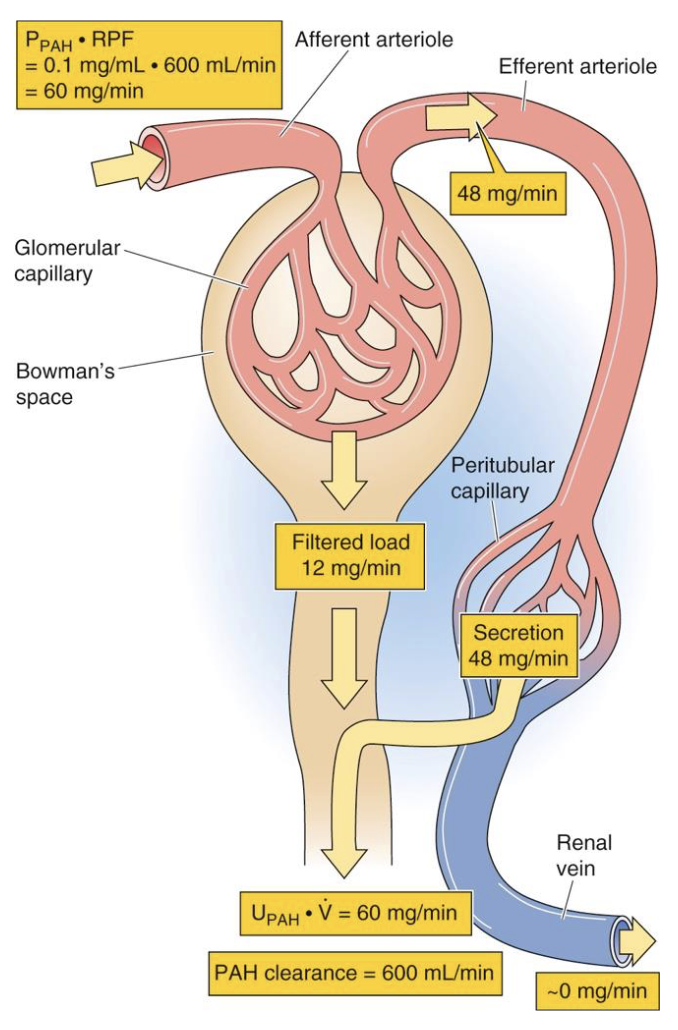
renal plasma flow definition/equation

  • the volume of plasma going to the kidneys per minute

  • PAH is freely filtered and essentially 100% secreted

  • normal RPF is 625 mL/min

<ul><li><p>the volume of plasma going to the kidneys per minute</p></li><li><p>PAH is freely filtered and essentially 100% secreted</p></li><li><p>normal RPF is 625 mL/min</p></li></ul><p></p>
43
New cards

renal plasma flow

knowt flashcard image
44
New cards

micturition (urination)

knowt flashcard image
45
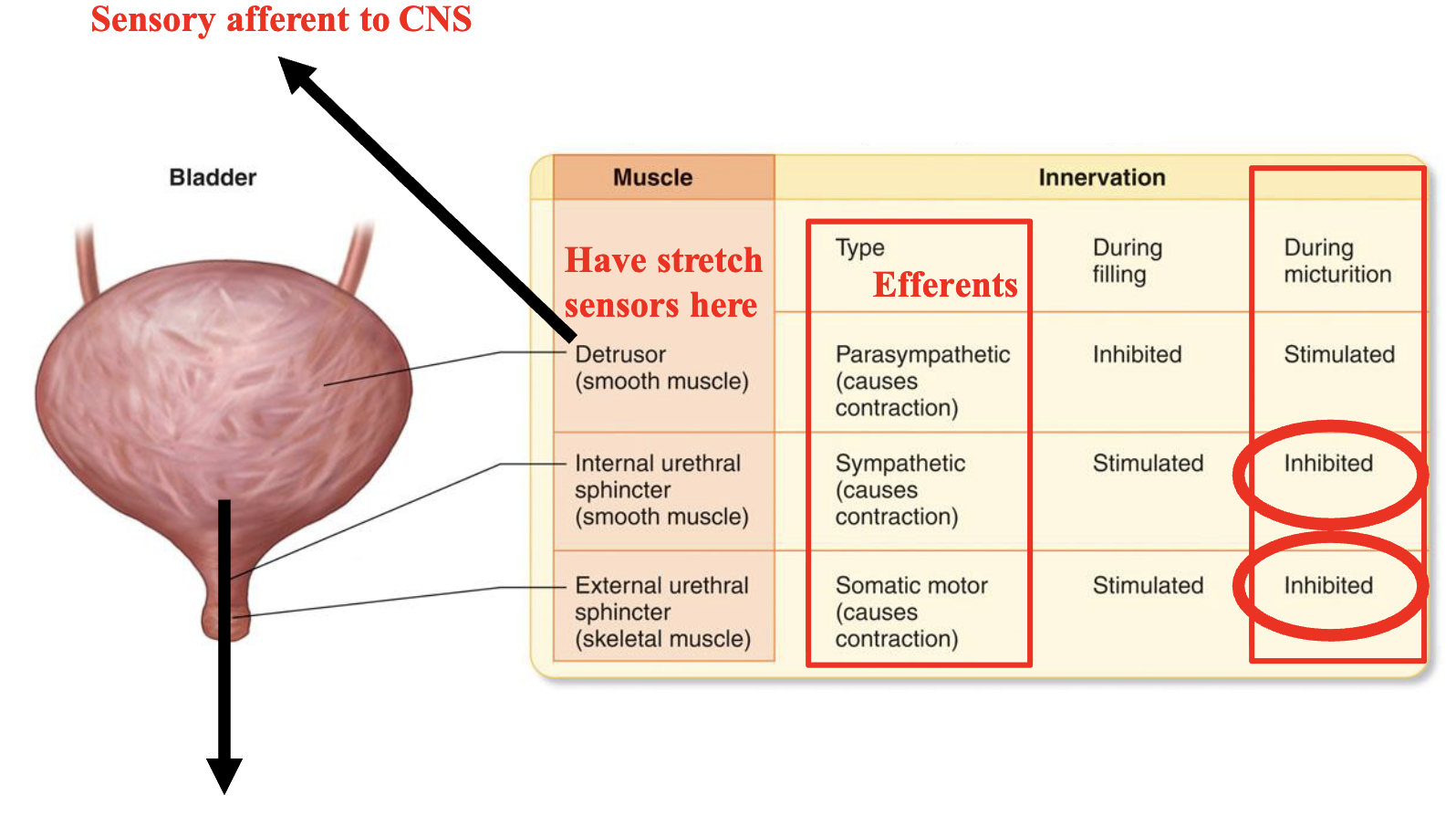
New cards

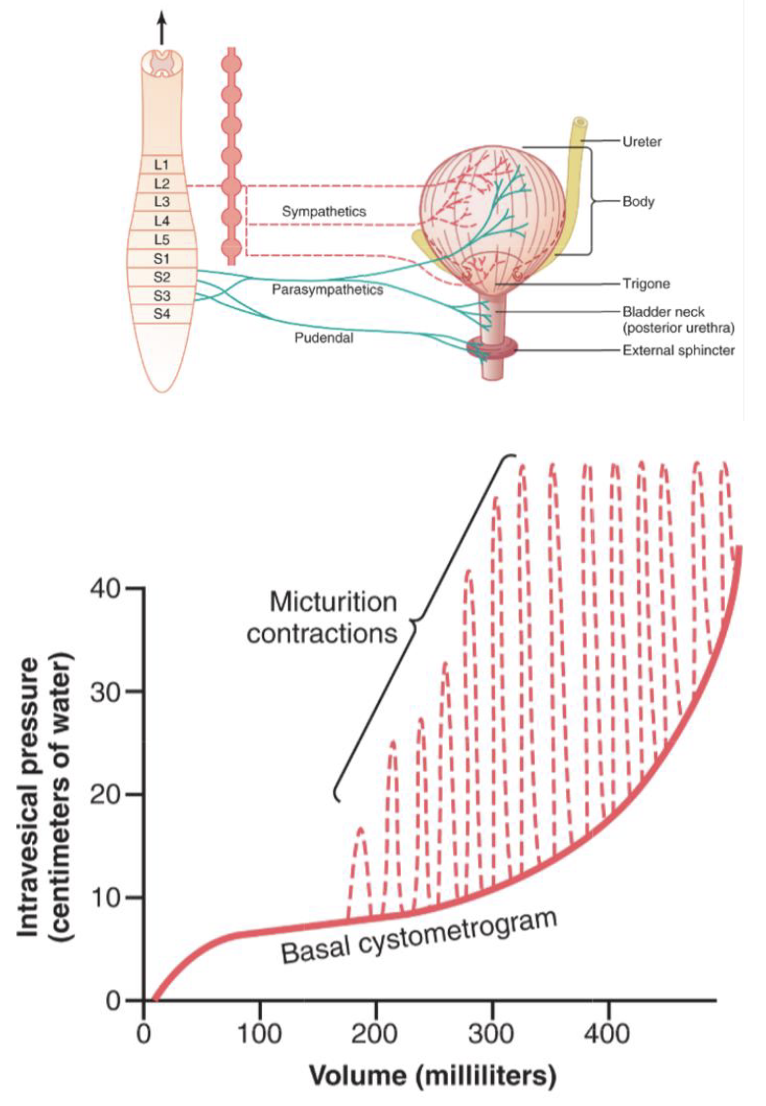
the micturition reflex is a single complete cycle of…

  1. progressive and rapid increase of pressure

  2. a period of sustained pressure

  3. return of the pressure to the basal tone of the bladder

  • once a micturition reflex has occurred but has not succeeded in emptying the bladder, the nervous elements of this reflex usually remain in an inhibited state for a few minutes to an hour or more before another micturition reflex occurs

  • as the bladder becomes more and more filled, micturition reflexes occur more and more often and more powerfully
<ol><li><p>progressive and rapid increase of pressure</p></li><li><p>a period of sustained pressure</p></li><li><p>return of the pressure to the basal tone of the bladder</p></li></ol><ul><li><p><span style="background-color: transparent;"><span>once a micturition reflex has occurred but has not succeeded in emptying the bladder, the nervous elements of this reflex usually remain in an inhibited state for a few minutes to an hour or more before another micturition reflex occurs</span></span></p></li><li><p><span style="background-color: transparent;"><span>as the bladder becomes more and more filled, micturition reflexes occur more and more often and more powerfully</span></span></p></li></ul><p></p>
46
New cards

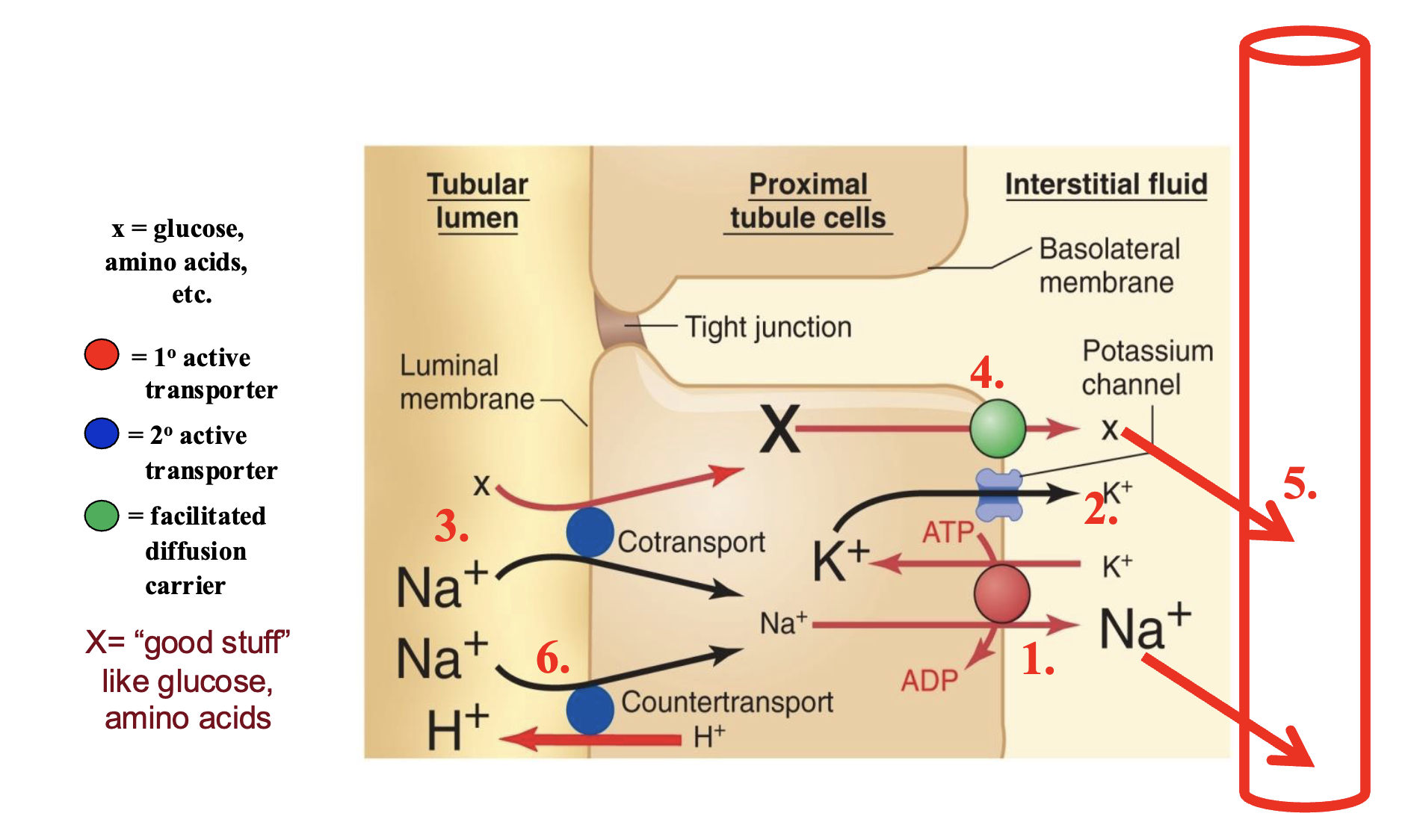
Na+ reabsorption in the proximal tubule

65% of reabsorption occurs here and is non regulated
<p>65% of reabsorption occurs here and is non regulated</p>
47
New cards

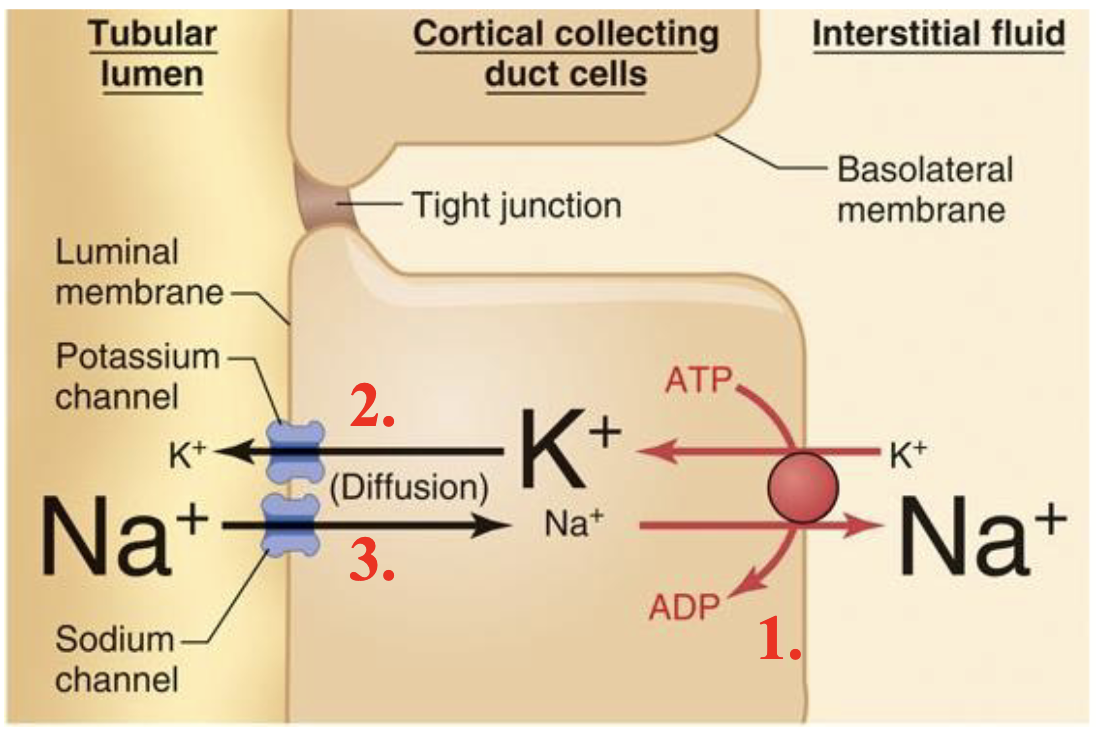
Na+ reabsorption in the distal tubule and cortical collecting duct (distal nephron)

Na+ reabsorption occurring here is regulated by hormones, no Tm

  • ex. aldosterone builds Na+ channels and Na+/K+ ATPases
<p>Na+ reabsorption occurring here is regulated by hormones, no Tm</p><ul><li><p>ex. aldosterone builds Na+ channels and Na+/K+ ATPases</p></li></ul><p></p>
48
New cards

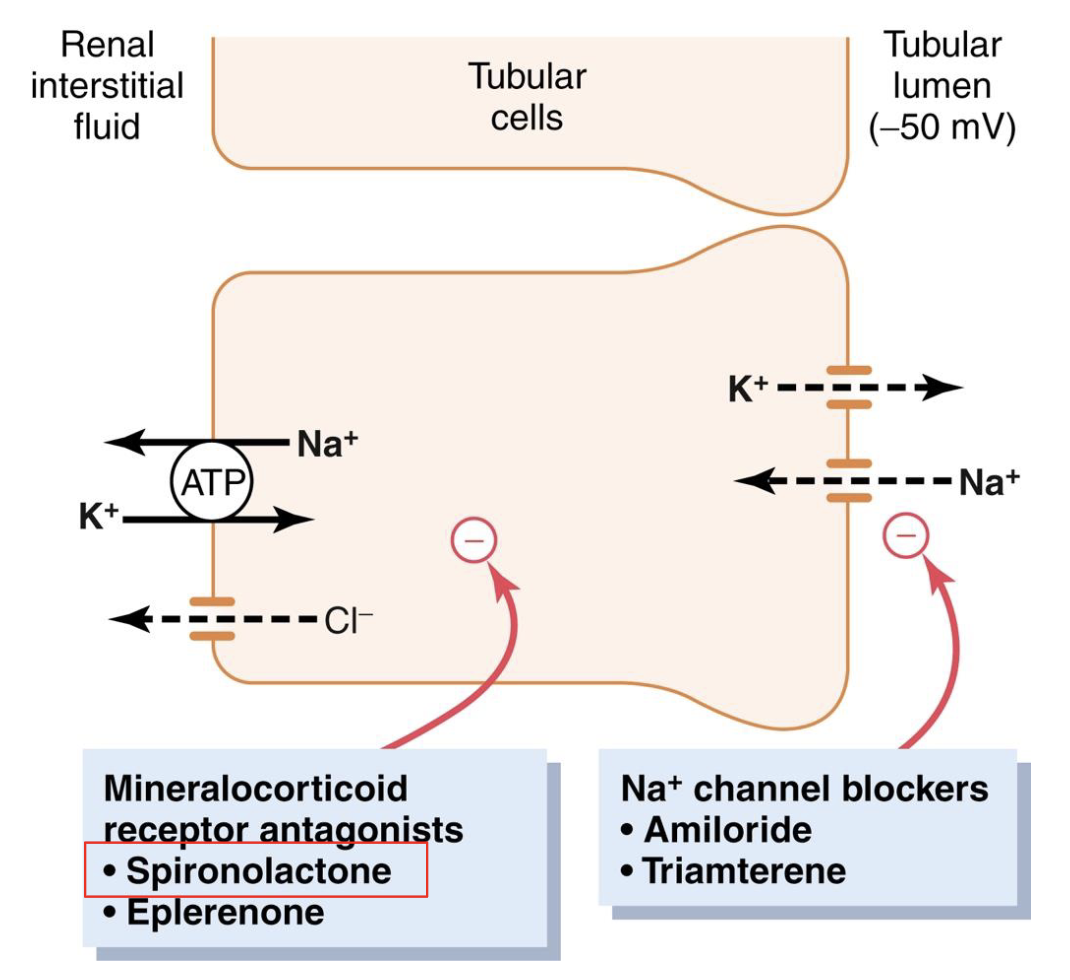
distal tubule/collecting duct

there are diuretics that block the actions of aldosterone, and thus inhibit the reabsorption of Na+ from the distal tubule/collecting duct
<p>there are diuretics that block the actions of aldosterone, and thus inhibit the reabsorption of Na+ from the distal tubule/collecting duct</p>
49
New cards

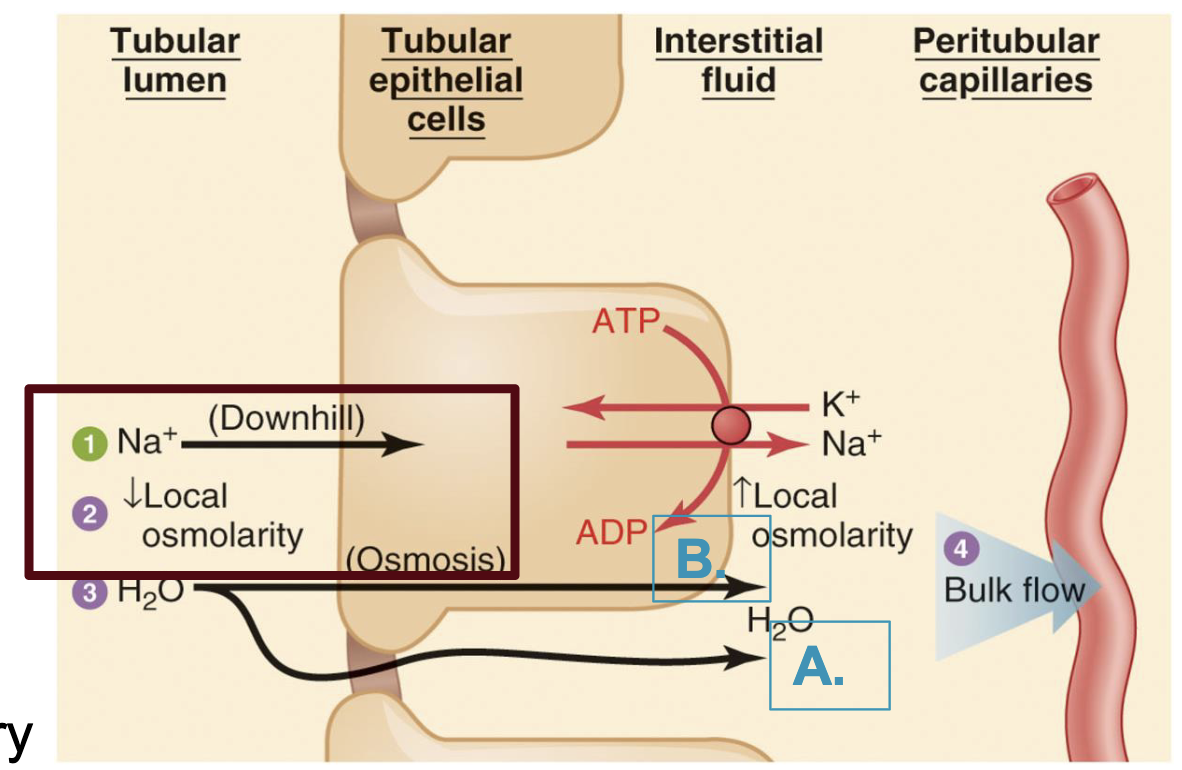
water follows Na+ passively by osmosis (2 routes)

  1. paracellular

    1. main water route in proximal tubule (leaky tight junctions)

    2. non regulated

  2. transcellular

    1. main water route in the distal tubule and collecting ducts (very tight junctions)

    2. requires the insertion of aquaphorins (regulated by ADH/vasopressin)
<ol><li><p>paracellular</p><ol><li><p>main water route in proximal tubule (leaky tight junctions)</p></li><li><p>non regulated</p></li></ol></li><li><p>transcellular</p><ol><li><p>main water route in the distal tubule and collecting ducts (very tight junctions)</p></li><li><p>requires the insertion of aquaphorins (regulated by ADH/vasopressin)</p></li></ol></li></ol><p></p>
50
New cards

review: Na+ and H2O reabsorption (proximal tubule/loop of henle)

  • Na+ reabsorption is high and constant (not regulated)

  • H2O permeability is high and constant (not regulated)

  • reabsorption of Na+ and H2O are coupled

51
New cards

review: Na+ and H2O reabsorption (distal tubule/collecting duct)

  • Na+ reabsorption is variable, is regulated by aldosterone, and is NOT directly coupled to water reabsorption

  • water permeability is variable, regulated by ADH, and requires the renal medullary gradient

52
New cards

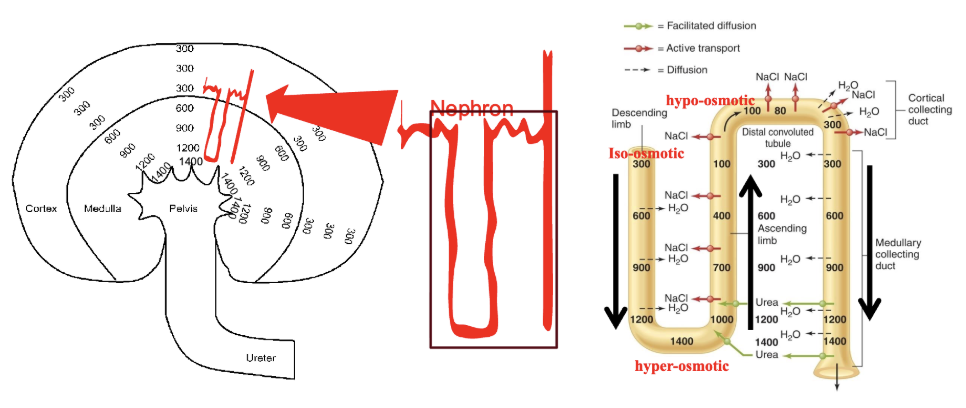
the renal medullary gradient

the countercurrent multiplier system

  1. active transport of NaCl (reabsorption) from the ascending limb

  2. ascending limb is impermeable to water

  3. water reabsorption via osmosis from the descending limb

  4. recycling of urea from the collecting duct
<p>the countercurrent multiplier system</p><ol><li><p>active transport of NaCl (reabsorption) from the ascending limb</p></li><li><p>ascending limb is impermeable to water</p></li><li><p>water reabsorption via osmosis from the descending limb</p></li><li><p>recycling of urea from the collecting duct</p></li></ol><p></p>
53
New cards

concentration of urine

  • because of the hyperosmotic medullar ISF, filtrate can become highly concentrated with a low volume in the presence of ADH

  • net result: excretion of a low volume of highly concentrated urine
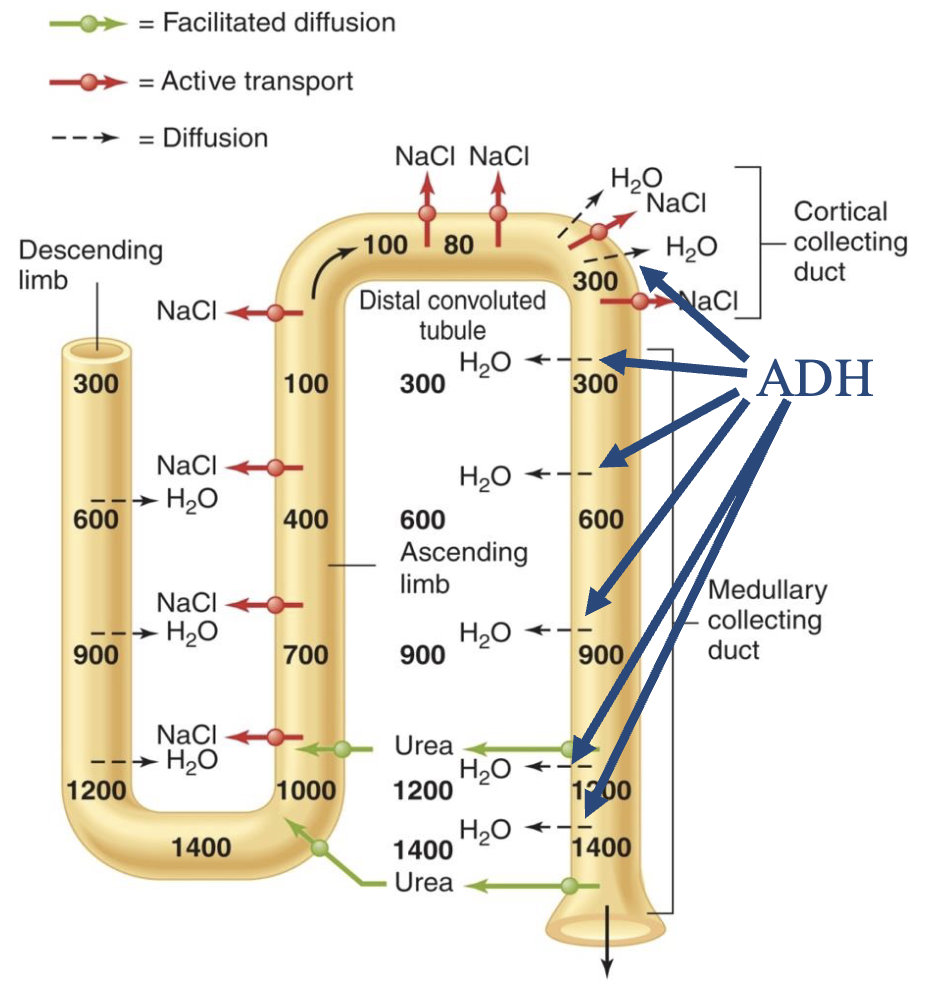
<ul><li><p>because of the hyperosmotic medullar ISF, filtrate can become highly concentrated with a low volume in the presence of ADH</p></li><li><p>net result: excretion of a low volume of highly concentrated urine</p></li></ul><p></p>
54
New cards

concentration of urine requires ADH

aquaporins 3 and 4 (AQP3, AQP4) are always present in the basolateral membrane. AQP2 is the only present on the luminal membrane if ADH is present
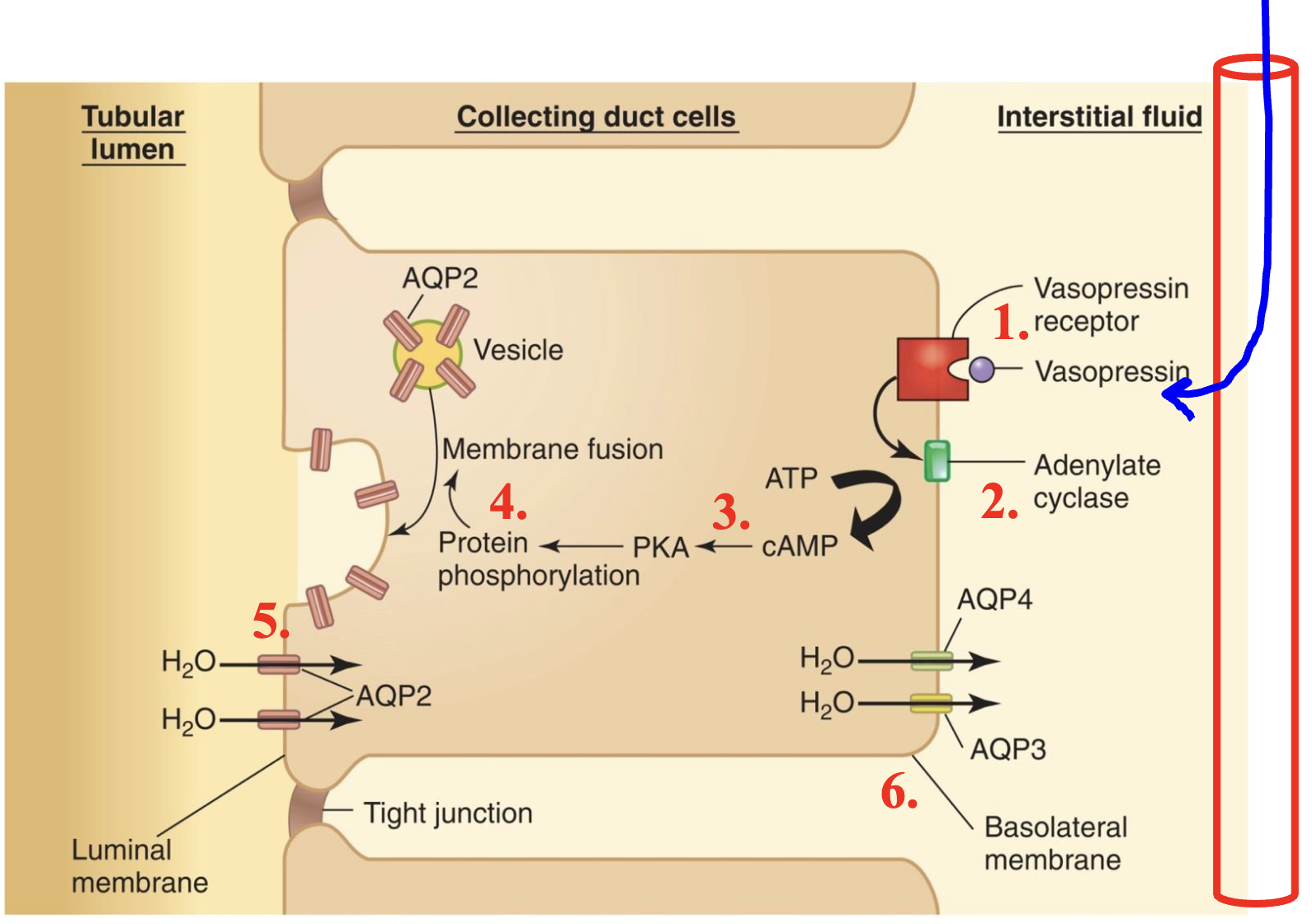
<p>aquaporins 3 and 4 (AQP3, AQP4) are always present in the basolateral membrane. AQP2 is the only present on the luminal membrane if ADH is present</p>
55
New cards

summary: importance of each nephron region
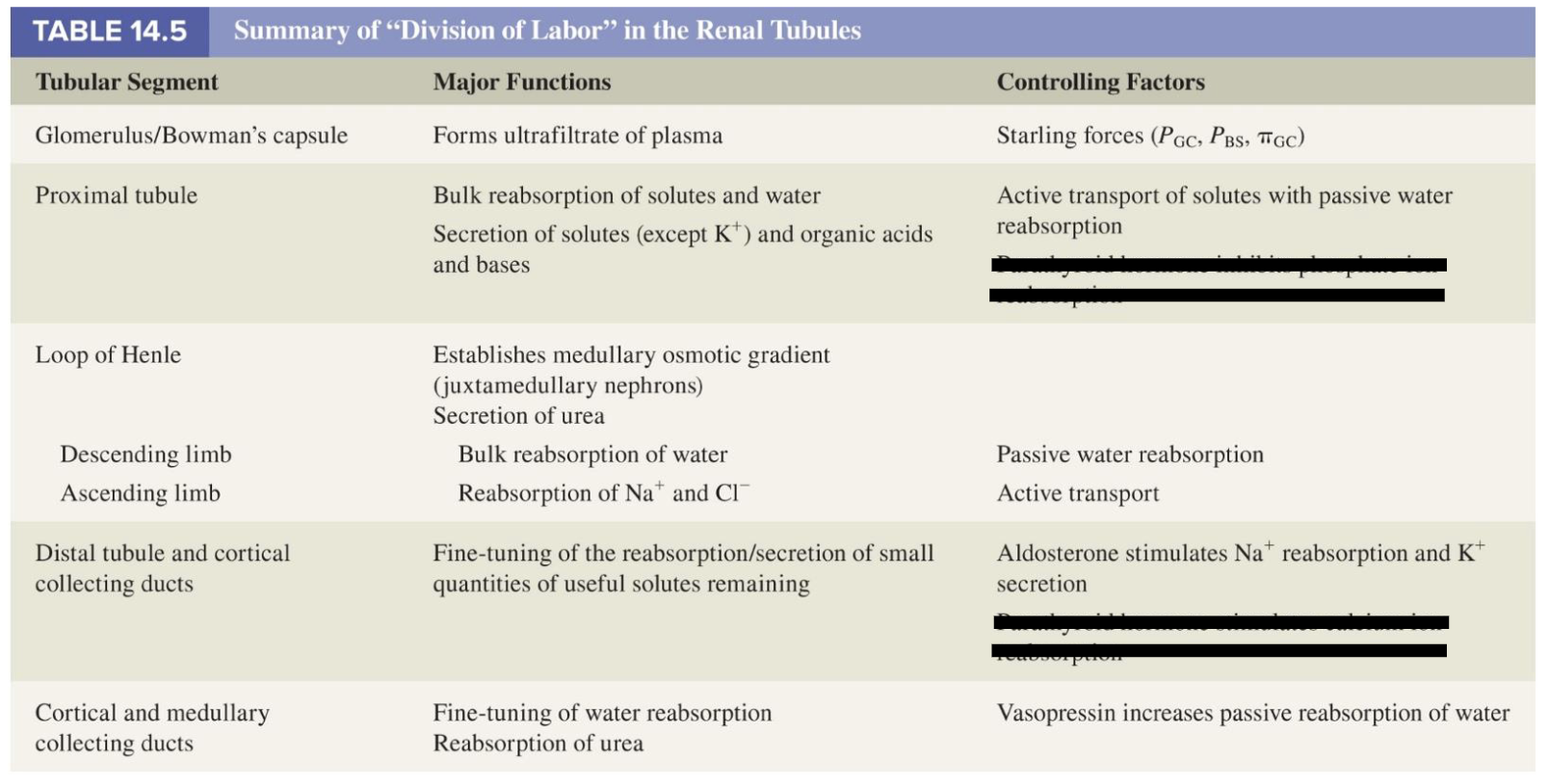
knowt flashcard image
56
New cards

the response to sweating

  • sweat comes out of your ECF and contains both water and NaCl

  • both must be preserved after severe sweating in order to maintain blood volume and osmolarity
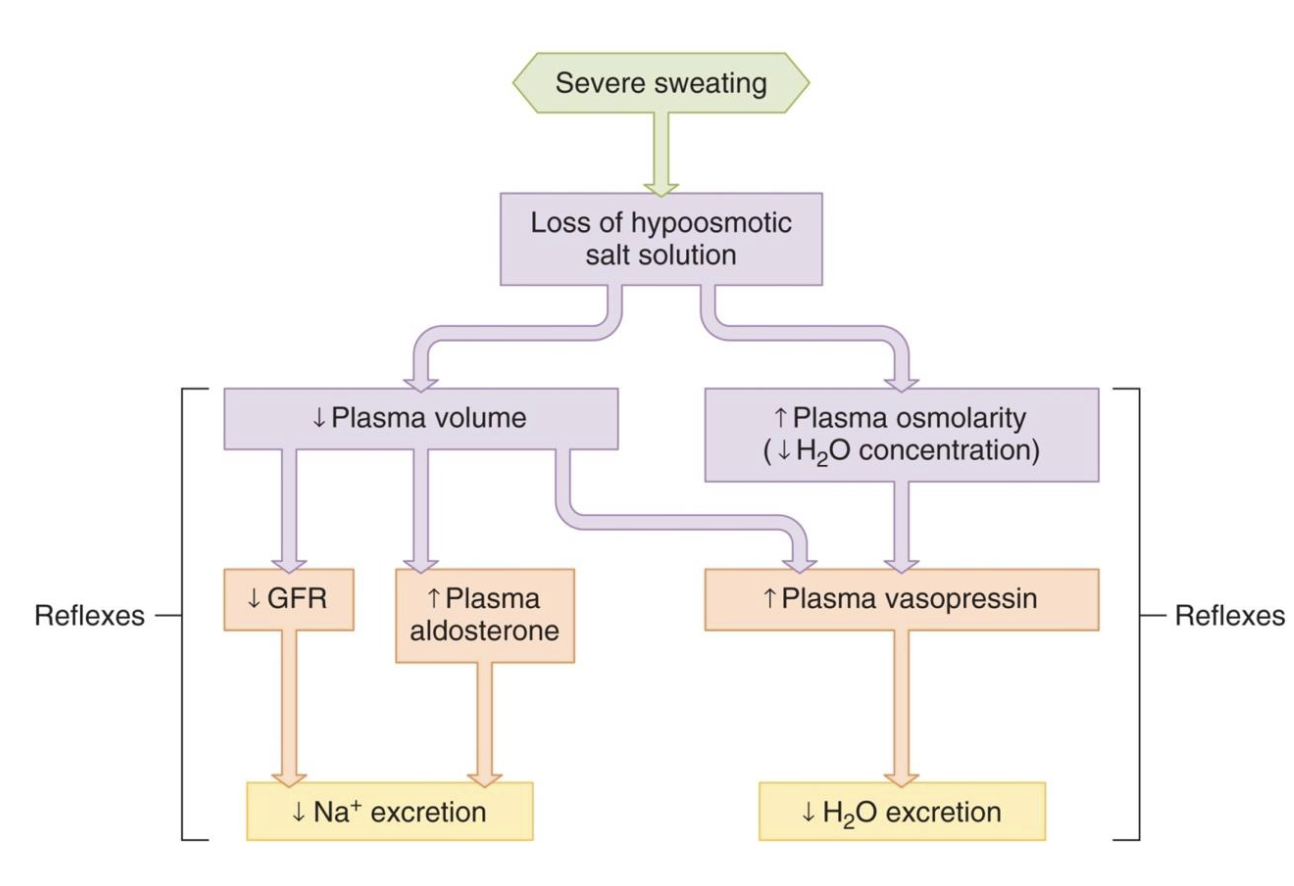
<ul><li><p>sweat comes out of your ECF and contains both water and NaCl</p></li><li><p>both must be preserved after severe sweating in order to maintain blood volume and osmolarity</p></li></ul><p></p>
57
New cards

thirst and salt appetite

  • kidneys can excrete excess water and Na+ that you ingest but can only reduce the rate (cant completely stop excretion) at which you lose them in times when you dont eat/drink enough

    • you must urinate some volume, so there will be fluid loss even when you are dehydrated

  • you need regular intake to replace regular losses, and need to intake extra when excess fluid is lost through regular processes like sweating, vomiting, diarrhea, hemorrhage
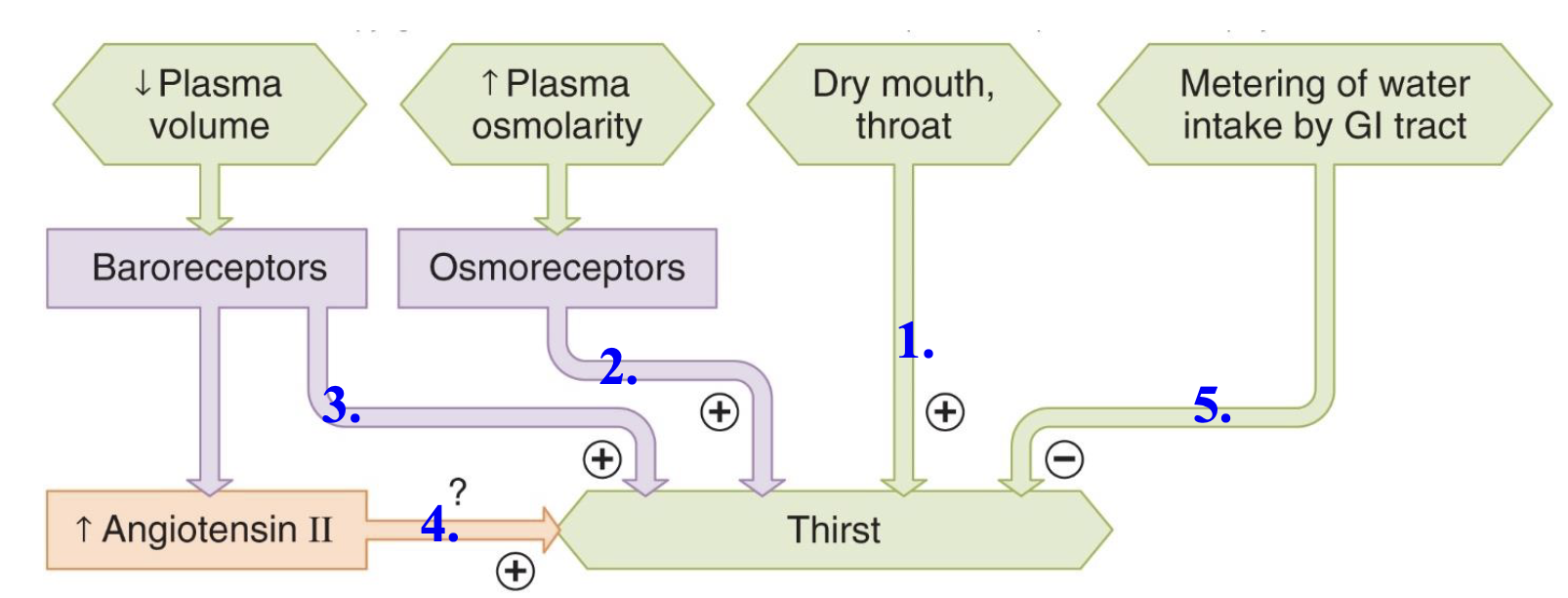
<ul><li><p>kidneys can excrete excess water and Na+ that you ingest but can only reduce the rate (cant completely stop excretion) at which you lose them in times when you dont eat/drink enough</p><ul><li><p>you must urinate some volume, so there will be fluid loss even when you are dehydrated</p></li></ul></li><li><p>you need regular intake to replace regular losses, and need to intake extra when excess fluid is lost through regular processes like sweating, vomiting, diarrhea, hemorrhage</p></li></ul><p></p>
58
New cards

thist

thirst must be obeyed, but keep in mind…

  • caffeine dilates afferent arterioles

  • alchohol inhibits ADH secretion

59
New cards

respiratory vs metabolic acid base disorders
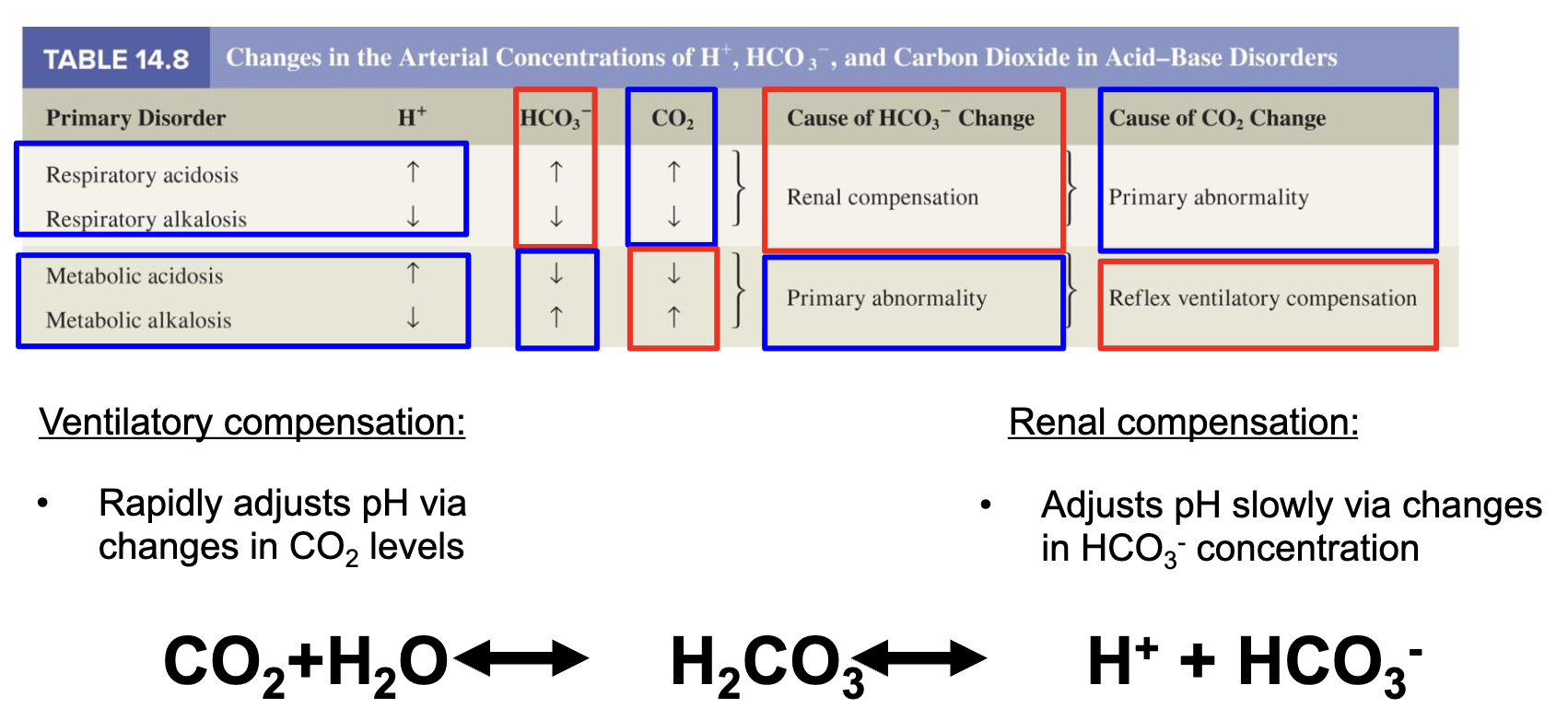
knowt flashcard image