ED.13&14- FUNGI
 Studied by 0 people
 Call Kai
 Learn
Learn Practice Test
 Spaced Repetition
 Match
Match Flashcards
 Knowt Play
1/36

There's no tags or description
Looks like no tags are added yet.
Name | Mastery | Learn | Test | Matching | Spaced | Call with Kai |
|---|
No analytics yet
Send a link to your students to track their progress
37 Terms
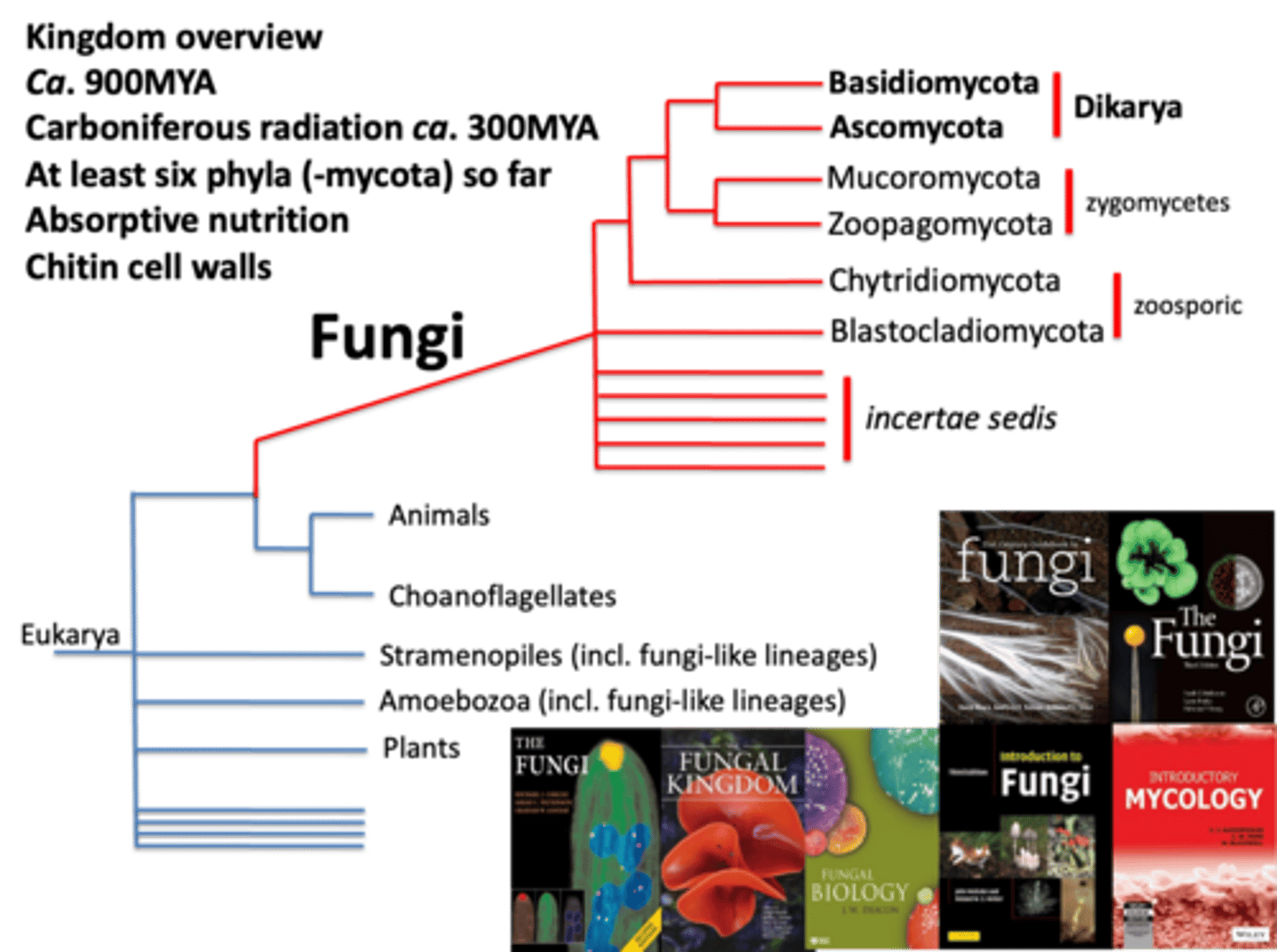
kingdom overview
Ca. 900MYA
Carboniferous radiation ca. 300MYA
At least six phyla (-mycota) so far
Absorptive nutrition
Chitin cell walls
phylo tree
Estimates for fungal species
extrapolations. 1.5 million- plant species x3
3.5- DNA survey of envirnment
9- same.
most microscopic and hard to cultivate in labs.
axenic
pure culture
Monoxenic culture
1 species and host source
roles of fungi
Main plant mutualists: lichens, mycorrhizas.
Main plant pathogens: rusts, blasts, blights, moulds, wilts, spots, smuts, mildews, cankers, diebacks, rots.
Main terrestrial recyclers: degradation of wood, leaves and roots.
Animal mutualists: rumen fungi, ant/termite/beetle farmers of recyclers.
Animal pathogens: amphibian decline, bat decline, sea fan coral death, human mycoses.
Industry: bread, beer, wine, sake, cider, gin, rum, tequila, vodka, whiskey, marmite, cocoa, miso, soy sauce, soft cheeses, blue cheeses, cured meats, tempeh, quorn, citric acid, enzymes, steroids, antibiotics; ca. £44 trillion.
Eukaryotic models: yeasts, Neurospora, Aspergillus, Candida, >6,600 genomes.
characteristics of most fungi
Sexual and asexual reproduction: meiotic & mitotic spores, fragmentation.
Symbiosis (parasites, commensals, mutualists), biotrophy.
Indeterminate growth.
Growth within solid matrices (e.g., soil, plant, animal, fungus).
No motile cells.
Absorptive nutrition, hydrolytic exoenzymes.
Filamentous, form networks by cell fusion.
Cell walls of branched glucan, glycoprotein and chitin (N-acetyl glucosamine chains).
Store glycogen and/or lipids. Ergosterol in cell membranes.
Hyperdiverse life cycles: diploid, haploid, dikaryon, multikaryon; homo- or heterokaryotic; parasexuals.
dimorphic
both yeast and filamentous stages- allowing them to live in liquid + solid
hypha
filament of a multicellular fungus, some are septate others are aseptate (lacking internal cross-walls or partitions)
growth forms
unicells with flagella or without. when no flagella, they can be fission yeasts ( even mitosis ) or budding yeasts (small daughter, uneven mitosis)
Mycelium and Growth Patterns
A filamentous fungus forms a mycelium- formed from 1 spore
A mycelium can form a network:
Has connections between cells
Means they can form tissues (reproduction, support, transport)
Younger filaments are trying to occupy as much space as possible, so experience negative autotropism
Older filaments are trying to stabilize themselves, so want interconnections, so positive autotropism
Uses alternating reciprocity (self-signaling "ping pong" mechanism)
negative and positive autotropism
neg- they grow away from themselves
pos- attracted towards self
alternating reciprocity
"ping-pong" mechanism, is a rhythmic chemical dialogue where two genetically identical fungal hyphae coordinate their growth by switching between "sender" and "receiver" states. By alternating these roles every 10–12 minutes—where one cell sends a signal pulse while the other listens—the fungi avoid the "paradox" of getting confused by their own signals, allowing them to accurately home in on each other and fuse into a stable, interconnected network.
Hyphal Structure
At the tip of a hypha is the apical cell
Between septate cells there are pores
Organelle unique to fungi called the Spitzenkörper (apical body):
-Arrangement of cytoskeleton, vesicles + ribosomes
-Controls branching
-Determines direction of hyphal growth
-Organises + releases secretory vesicles
apical cell
the cell capable of mitosis, feeding + steering
sexual Fusions (Anastomosis)
Controlled by mating type loci
Alleles must be different
asexual fusions mechanism
Form network
Controlled by compatibility loci
Alleles must match
Efficient resource translocation
Mycelial stability — as it is connected it can heal
Genetic variation, as only the loci must be identical
Asexual reproduction vs asexual fusion
Reproduction creates new individuals
Fusion does not; it unites existing networks together
asexual
Risky because viruses or harmful organelles could invade the healthy mycelium
Beneficial because the fungus can gain new genetic traits, e.g., antibiotic resistance, without needing a full round of sexual pre-reproduction
Prototrophs
Fungi that can synthesize all the complex organic compounds that they need for growth from inorganic salts + a carbon source
Auxotrophs
Lost the ability to synthesize a specific nutrient; can only grow if that substance is in their medium
Necrotrophy
from biotrophy to causing cell death — release toxins, digest the tissue
Biotrophic
may enter through openings made for them, stomata, or through wounds
fungal mitosis and evolution
In animals and plants, the nuclear envelope breaks down completely at the start of mitosis.
In fungi, the nuclear envelope remains intact.
This distinction is referred to as open vs. closed mitosis.
Evolutionary path: Unicells with flagella → hyphae → yeasts.
ascomycota overview
Structure: Often cup-shaped and produce lichens.
Yeasts: This group includes yeasts.
Lifestyles: Mainly saprotrophic, lichenized, pathogenic, or commensal.
Commensal: Grow within an organism but do not cause harm.
Biology:
They are haploid and considered good organisms to study.
Possess septate filaments with pores between cells.
They can block pores with Woronin bodies when a cell is damaged to prevent loss of cytoplasm.
asci production up to spore production
Signaling: The female structure releases pheromones to attract a partner.
Mitosis: Multiple nuclei form via mitosis within enlarged cells at the tip.
Plasmogamy: The female grows a filament called a trichogyne towards the male; they fuse, and male nuclei move into the female structure.
The Hook (Crozier): A new filament forms where nuclei move in pairs (one male, one female). A "hook" forms and grows towards itself (positive autotropism).
Karyogamy: The paired nuclei fuse (karyogamy), and septa form to separate the new diploid cell.
spore production
The cell undergoes meiosis to produce 4 nuclei.
It then undergoes mitosis to produce 8 nuclei.
Free-cell formation: Spores form with their own cell membranes around each nucleus.
Dispersal: A vacuole is created at the bottom of the ascus. It increases in size to build pressure, acting like a "cannon" to shoot the spores out.
ascoma types
Ascoma Structures: Some Ascomycetes join their asci together to form larger fruiting bodies called an ascoma:
Apothecium: Cup-shaped.
Perithecium: Flask-shaped.
Cleistothecium: Entirely enclosed/spherical.
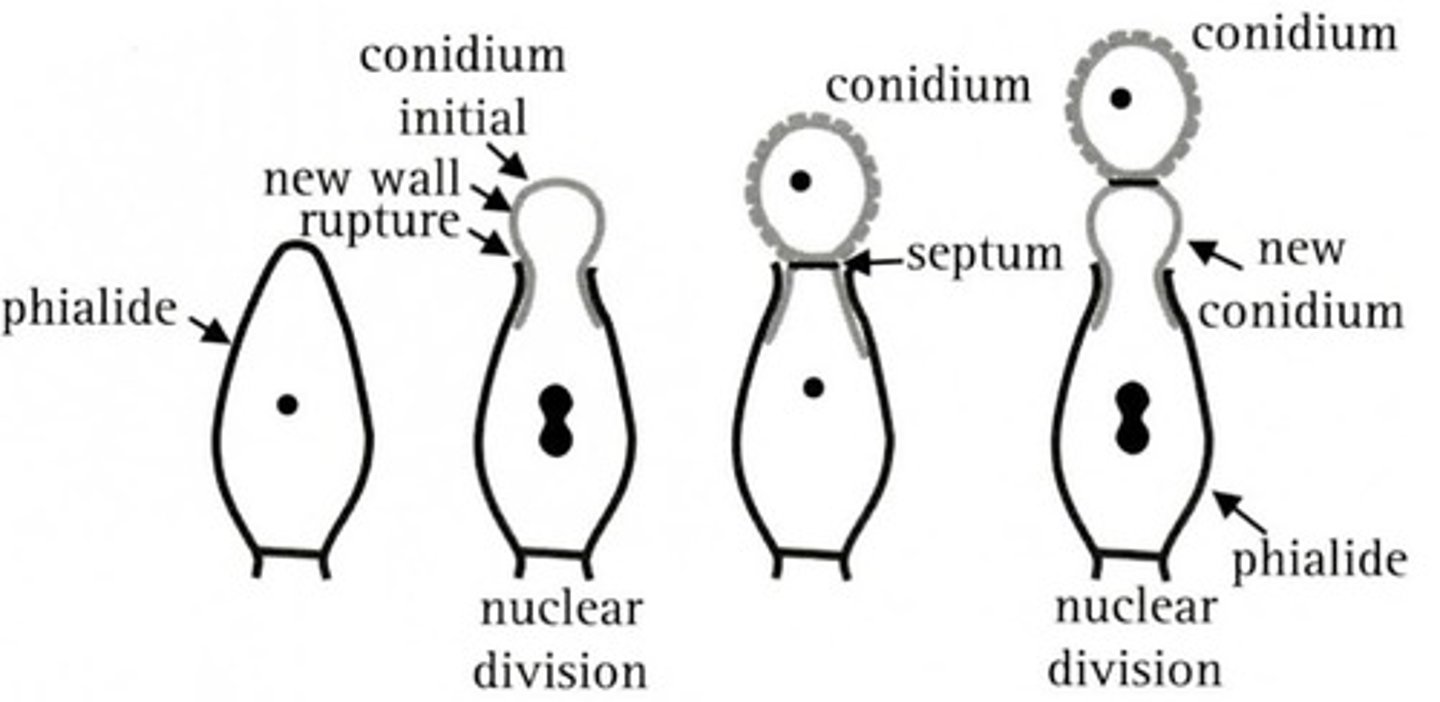
development of conidia
Tip cell → Mitosis → New cell forms, septa form → Repeats.
mitotic spores, asexual reproduction
lichens
Composition: A symbiosis between an Ascomycota fungus and a photobiont (typically green algae).
Obligate Biotrophs
Structure: They form a Thallus, a symbiotic body where only the two organisms survive together.
Can grow on the poorest substrates.
Cope well with natural stresses but not air pollution.
photobiont and fungus exchange
Photobiont: Provides organic carbon (sugars).
Fungus: Digests land, protects the symbiont, and retains water and minerals.
The fungus grows through the photobiont cell wall but does not disturb the cell membrane (a highly regulated process).
yeast
Significance: Known as Brewer's/Baker's yeast and is the most fully understood eukaryote.
Function: Drives alcoholic fermentation and was the first eukaryotic genome sequenced.
Mating Types: Uses types a and α.
Both release pheromones to attract each other.
Mating Type Switching: A process of recombination where a cell can "switch" its mating type.
basidiomycota overview
Second most diverse fungal phylum, > 30K species described so far.
Mainly recyclers or pathogens, some mycorrhizal.
Spend most of their life as dikaryotic septate filaments.
Meiotic basidiospores formed outside a hypha called basidium.
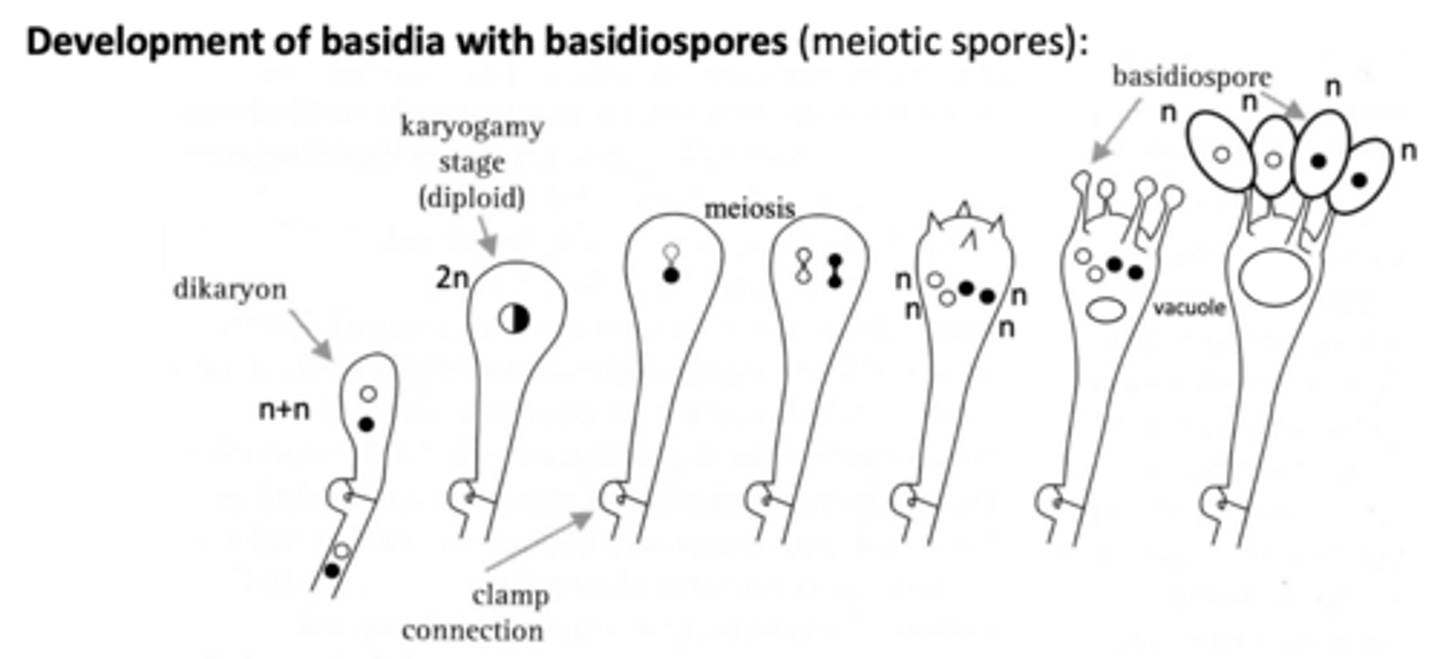
development of basidia (meiotic spores)
The Dikaryon State (n+n): The process begins with a dikaryotic hypha, which contains two compatible haploid nuclei (one from each parent) that have not yet fused.
Karyogamy (2n): Within the young basidium (the specialized tip of the hypha), the two nuclei fuse together. This creates a temporary diploidnucleus.
Meiosis: This diploid nucleus immediately undergoes meiosis, resulting in four haploid nuclei.
Sterigmata Formation: Small, peg-like outgrowths called sterigmata begin to form at the top of the basidium.
Spore Migration: A vacuole develops at the base of the basidium. As this vacuole expands, it pushes the four haploid nuclei up through the sterigmata and into the developing basidiospores on the outside of the hypha.
Ballistic Discharge: Once mature, the spores are launched from the sterigmata using a high-pressure surface tension mechanism (the coalescence of Buller's drop).
mitosis basidiomycota
Branch Growth: As the terminal hypha prepares to divide, a small branch (the clamp) grows backward from the tip cell.
Synchronous Mitosis (Conjugate Division): Both parent nuclei (A and B) undergo mitosis at exactly the same time:
Nucleus A divides in the main body of the hypha.
Nucleus B divides such that one of its daughter nuclei migrates into the backward-growing clamp.
Septum Formation: Two cell walls (septa) form simultaneously:
One septum closes the base of the clamp, trapping a daughter nucleus (B′) inside.
The other septum forms across the main hypha, creating a new apical (tip) cell and a sub-apical (behind the tip) cell.
The Bypass Fusion: The tip of the clamp then fuses with the sub-apical cell. The trapped nucleus (B′) moves through this bridge into the sub-apical cell.
Result: Both the new tip cell and the sub-apical cell now have one nucleus of type A and one of type B, maintaining the dikaryotic state.
Wood Decomposition and Biomass Recycling
The Challenge: Lignin is too complex for standard hydrolytic enzymes.
White-Rot Fungi:
The only fungi that can break down lignin (along with cellulose and pectin) all the way to CO2 and H2O.
Use oxidative exoenzymes (peroxidases, phenoloxidases, laccases).
Use the Fenton’s reaction
This creates a hydroxyl free radical that can break the complex lignin bonds.
They are less fragile and can travel further to find new wood sources.
Rhizomorphs
Complex, threadlike "cords" made of thousands of hyphae.
 Note
Note  Flashcards (74)