Biology 1002 Study Guide Pt2
 Call Kai
 Learn
Learn Practice Test
 Spaced Repetition
 Match
Match Flashcards
 Knowt Play
1/126

Earn XP
Description and Tags
Topics Covered from Midterm to Final Bio 1002
Name | Mastery | Learn | Test | Matching | Spaced | Call with Kai |
|---|
No analytics yet
Send a link to your students to track their progress
127 Terms
Gene Expression
The process by which information encoded in DNA directs the synthesis of proteins or, in some cases, RNAs that are not translated into proteins and instead function as RNAs
Operator
A segment of DNA that is a regulatory “switch”. Usually located within the promoter
Operon
The entire stretch of DNA that includes the operator, promotor, and the genes that they control
Regulatory Gene
Produces protein repressors
Repressor
Prevents gene transcription by binding to the operator and blocking RNA polymerase. (They can switch off Operons)
Inducer
inactivates the repressor to turn lac operon on
Corepressor
A molecule that cooperates with a repressor protein to switch an operon off
Repressible Operon
Usually on; binding of repressor to the operator shuts off transcription
Inducible Operon
Usually off; an inducer inactivates the repressor and turns transcription on
Tryptophan (trp) Operon
A set of genes in bacteria that code for enzymes needed to produce the amino acid Tryptophan
Lactose (lac) Operon
an inducible operon that contains genes encoding enzymes for hydrolysis and metabolism of lactose
Allolactose Operon
Present is lactose is present in the body. Acts as an Inducer
Activator
A protein that binds to an enhancer and stimulates transcription
cAMP (cyclic AMP)
A ring-shaped molecule made from ATP that is a common intracellular molecule (second messenger) in eukaryotic cells. It is a regulator of some bacterial operons.
CAP
When glucose is scarce, this is activated by binding cAMP. When it is activated, it attaches to the promotor of lac operon and increases the affinity of RNA polymerase, thus accelerating transcription
Histone Acetylation
When Acetyl groups are attached to positively charged lysine in histone tails. This loosens chromatin structure, promoting initiation of transcription
Methylation
Addition of methyl groups. This can condense chromatin
Epigenetic Inheritance
The transmission of information from on generation to the next that affects gene expression without altering the underlying DNA sequence
Transcription Initiation Complex
The completed assembly of transcription factors and RNA polymerase bound to a promotor
Control Elements
Segments of noncoding DNA that serve as transcription factor binding sites
Enhancers
A group of Distal control elements. May be far away from gene or located in an intron
Alternative RNA Splicing
Different mRNA molecules are produced from same primary transcript, depending on which segments are treated as exons and introns
Protein Degradation
A biological process in which cells break down old, damages proteins into smaller parts (amino acids) to be recycled or disposed of
Regulatory Sequences
A segment of DNA (or RNA) that acts as a control switch for a specific gene
Transposons
Move by means of a DNA intermediate and require a transposase enzyme
Retrotransposons
Move by means of an RNA intermediate, using a reverse transcriptase
Viruses
Infectious particles consisting of nucleic acid enclosed in a protein coat and, in some cases a membranous envelope
Capsids
The protein shell that encloses the viral genome. Built from protein subunits called Capsomeres
Viral Envelope
Derived from host cell membranes, contain a combination of viral and host cell molecules
Bacteriophage /// Phages
Viruses that infect bacteria
Lytic Cycle
Produces new phages and lyses the host cell (kills the host cell), releasing the progeny virus particles
Lysogenic Cycle
Replicates the phage genome without destroying the host cell
Virulent Phages
A phage that reproduces only by the lytic cycle
Temperate Phages
Phages that use both lytic and lysogenic cycles
Prophage
The integrated viral DNA that is incorporated into the host cell’s chromosome
DNA Viruses
A microorganism that uses DNA as its genetic material and relies on a host cell’s machinery to replicate
RNA Viruses
A microorganism that uses RNA as its genetic material
Retroviruses
Uses reverse transcriptase to copy their RNA genome into DNA. An RNA virus that replicates by transcribing its RNA into DNA and then inserting the DNA into a cellular chromosome; an important class of cancer-causing viruses.
Reverse Transcriptase
An enzyme encoded by certain viruses (retroviruses) that uses RNA as a template for DNA synthesis
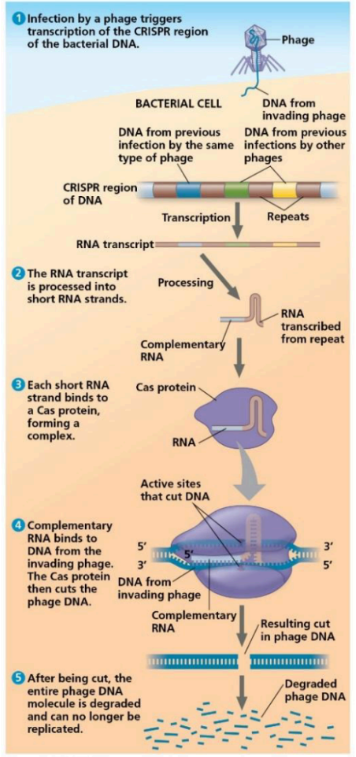
CRISPR-Cas
A type of bacterial immune system. A technique for editing genes in living cells, involving a bacterial protein called Cas9 associated with a guide RNA complementary to a gene sequence of interest.
Somatic Cells
Any cells that are not gametes (Humans have 23 Pairs)
Gametes
Sperm and egg cells
Clone
A group of genetically identical individuals from the same parent
Diploid
Has two chromosome sets (for humans; 2n=26)
Haploid
A single set of chromosomes (Humans: n=23)
Karyotype
An ordered display of he chromosome pairs from a cell
Homologous Chromosomes (Homologs)
The two chromosomes in each pair. They are the same length and shape, and carry genes that control the same inherited characters but may have different alleles
Sex Chromosomes
Determine the sex of an individual, they are called X and Y
Autosomes
All other pairs of chromosomes (NOT the pair of sex chromosomes)
Synapsis
When Homologous chromosomes loosely pair up, aligned gene by gene
Crossing over
Exchange of DNA segments, occurs between nonsister chromatids
Chiasmata
X-shaped regions where crossing over occured
Character
Distinct heritable features (i.e. flower color)
Trait
Each variant for a character (i.e. a purple flower)
Allele
Alternative versions of a gene that may produce distinguishable phenotypic effects
Dominent
An allele who’s fully expressed in the phenotype of a heterozygote
Recessive
An allele whose phenotypic effect is not observed in a heterozygote
Homozygous
Having two identical alleles for a given gene
Heterozygous
Having two different alleles for a given gene.
Phenotype
The observable physical and physiological traits of an organism, which are determined by its genetic makeup.
Genotype
The genetic makeup, or set of alleles, of an organism
True-breeding
Plants that produce offspring of the same variety as themselves when they self pollinate (Homozygous for purple flower color)
Punnett Square
A diagram used in the study of inheritance to show the predicted genotypic results of random fertilization in genetic crosses between individuals of known genotype.
Testcross
Breeding the mystery individual with a homozygous recessive individual
Complete Dominance
Occurs when the phenotypes of the heterozygote and dominant homozygote are identical
Incomplete Dominance
Occurs when the phenotype of F1 hybrids is in between the phenotype of the two parental varieties
Codominance
Two dominant alleles affect the phenotype in separate, distinguishable ways
Pleiotrophy
Genes with multiple phenotypic effects
Multiple Alleles
Three of more alternative forms of a gene at specific locus within a population
Epistasis
A gene at one locus alters the phenotypic expression of a gene at the second locus
Polygenic Inheritance
An additive effect of two or more genes on a single phenotype
Carriers
Heterozygous individuals who carry the recessive allele but are phenotypically normal
Phenotypic Range
The total spectrum of possible physical traits that a single genotype can express when exposed to different environmental conditions
Multifactorial Characters
Genetic and environmental factors collectively influence phenotype (pH of soil affecting the color of hydrangea)
P Generation
Parental Generations
F1 Generation
Filial Generation (Kids)
F2 Generation
Filial Generation 2 (Grandkids)
Wild Type
The phenotype most commonly observed in natural populations; also refers to the individual with that phenotype.
Linked genes
Genes located on the same chromosome that tend to be inherited together
Sex-linked genes
A gene located on either sex chromosome
X-linked genes
Genes on the X chromosome. Has genes for many characters unrelated to sex
Y-linked genes
Genes on the Y chromosome; there are relatively few but they mainly encode genes related to sex determination
Barr body
A dense object lying along the inside of the nuclear envelope in cells of female mammals, representing a highly condensed, inactivated X chromosome
Genetic recombination
The production of offspring with combinations of traits differing from either parent
Map units
A unit of measurement of the distance between genes. One is equivalent to a 1% recombination frequency.
Recombination frequencies
The number of recombinant offspring divided by the number of total offspring (Multiply by 100)
Recombinant offspring
Offspring with nonparental phenotypes (a new combination of traits)
Nondisjunction
Pairs of homologous chromosomes do not separate normally during meiosis
Aneuploidy
Results from fertilization of gametes in which nondisjunction occurred
Offspring have an abnormal number of a particular chromosome
Monosomic
Zygote has only one copy of a particular chromosome
Trisomic
Zygote has three copies of a particular chromosome
Polyploidy
A condition in which an organism has more than 2 complete sets of chromosomes
Triploidy (3n): 3 sets of chromosomes
Tetraploidy (4n): 4 sets of chromosomes
Deletion
Removes a chromosomal segment
Duplication
Repeats a chromosomal segment
Inversion
Reverses a chromosomal segment
Translocation
Moves a chromosomal segment from one chromosome to a nonhomologous chromosome.
Adaptations
Inherited characteristics of organisms that enhance their survival and reproduction in specific environments
Natural Selection
A process in which individuals with favorable inherited traits are more likely to survive and reproduce
Artificial Selection
A process in which humans have modified other species by selecting and breeding individuals with desired traits
Homology

