Expressionism
 Studied by 0 people
 Call Kai
 Learn
Learn Practice Test
 Spaced Repetition
 Match
Match Flashcards
 Knowt Play
1/7

There's no tags or description
Looks like no tags are added yet.
Name | Mastery | Learn | Test | Matching | Spaced | Call with Kai |
|---|
No analytics yet
Send a link to your students to track their progress
8 Terms
Expressionism
Expressionism is an 20th-century art movement that uses distortion, strong color, and exaggerated forms to express inner emotion and psychological experience, rather than realistic appearance.
Rough brushwork and simplified forms.
Themes often include:
Anxiety
Alienation
Suffering
Spiritual crisis
Expressionism vs expressionism
Expressionism (capital “E”)
A German-based movement in the early 20th century.
Uses colour, distortion, and form to express:
Emotion
Psychology
Spirituality
Opposes Impressionism, which focused on outward visual sensations.
expressionism (lowercase “e”)
Any art that distorts reality to express deeper meaning.
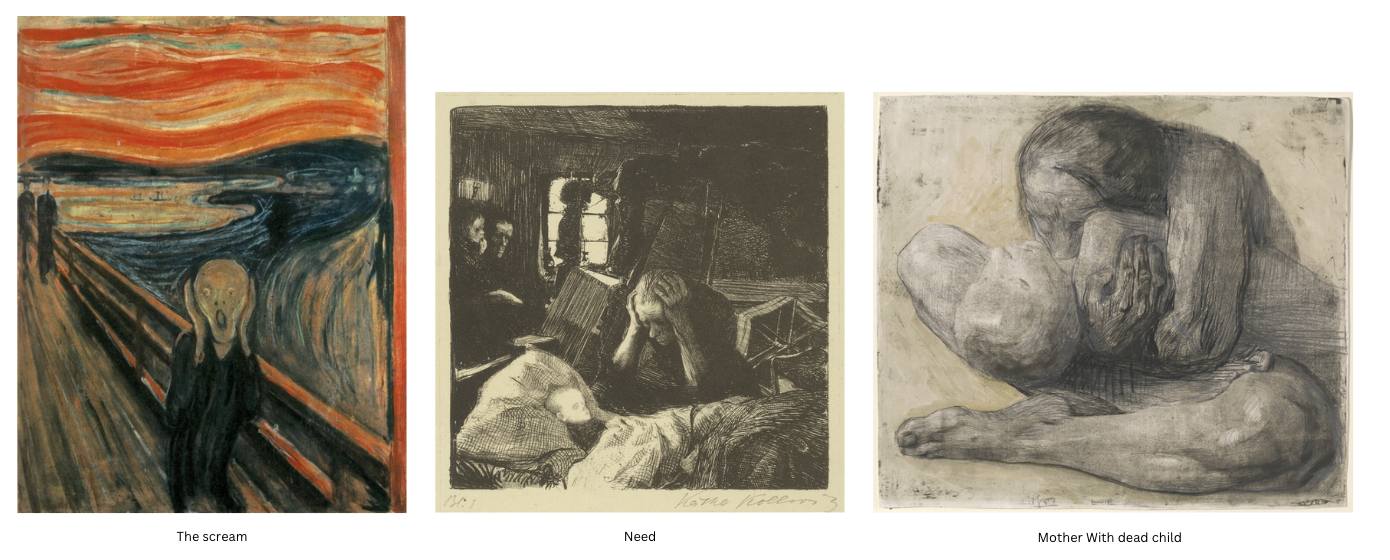
Seen earlier in artists like Van Gogh and Munch.
Pre-expressionists (lowercase e)
Vincent van Gogh is classified as a Post-Impressionist, but his emotionally charged use of color, distortion, and brushwork makes him a key precursor to Expressionism with its post impressionism works: The Night Cafe, The Potato Eaters and Self-Portrait (1889).
Edvard Munch – The Scream (1893)
Iconic image of anxiety and existential fear
Distorted figure and landscape
Universal emotional terror
Inner scream made visible
Käthe Kollwitz Need (1893–1901) LITHOGRAPHY
Poverty and suffering
Social injustice
Expressive line and dark mood
Mother with Dead Child (1903) ETCHING
Raw grief and despair
No idealization
Emotional truth over beauty
Der Brücke - German Expressionism
Die Brücke" (The Bridge) was a pivotal German Expressionist art group, formed by four architecture students (Kirchner, Heckel, Schmidt-Rottluff, Bleyl), aiming to build a "bridge" to a new artistic future by rejecting academic tradition.
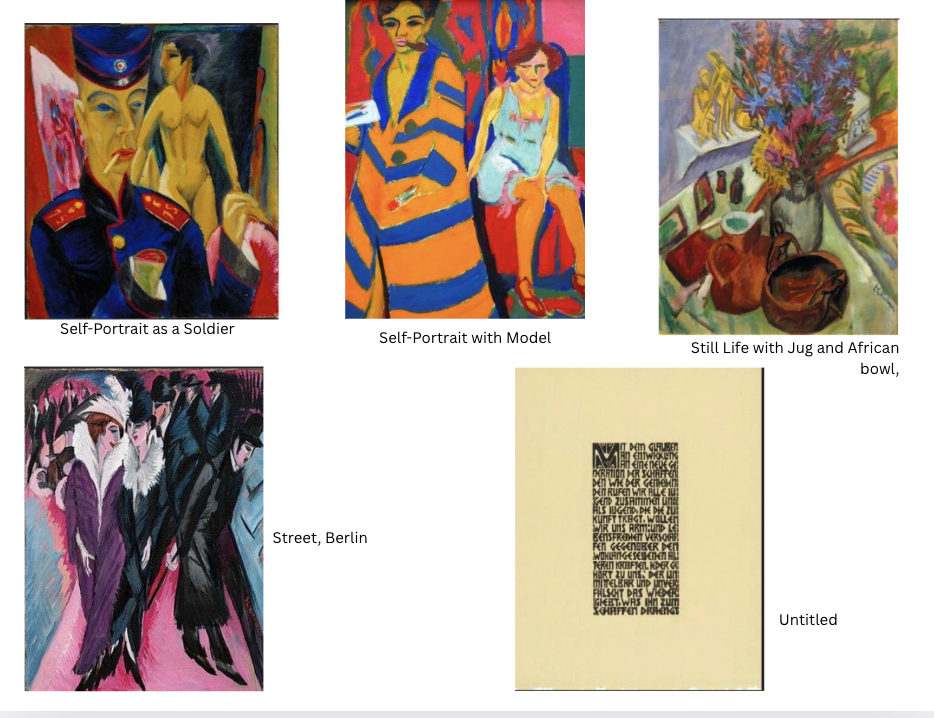
Ernst Ludwig Kirchner
Untitled (woodcuts, 1906)
Rough lines, primitive energy
Street, Berlin (1913)
Urban alienation, anxiety, sharp angles
Still Life with Jug and African Bowl (1912)
Non-Western influence, distorted forms
Self-Portrait with Model (1907/26)
Sexual tension, psychological discomfort
Self-Portrait as a Soldier (1915)
Trauma of WWI, loss of identity
Der Brücke - German Expressionism (Continued)
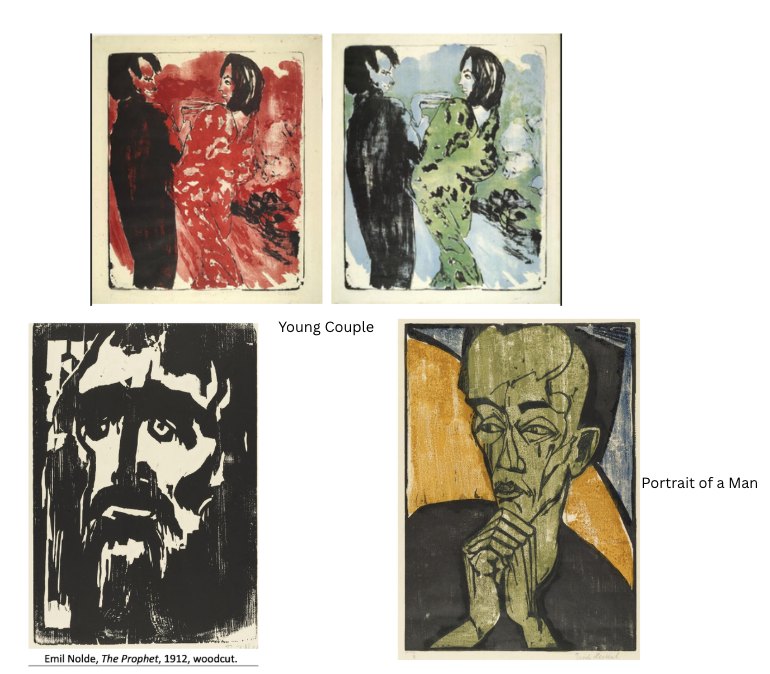
Erich Heckel – Portrait of a Man (1919) WOODCUT
Woodcut technique
Simplified, mask-like face
Emotional directness
Emil Nolde
Young Couple (1913) LITHOGRAPH
Emotional tension through color
The Prophet (1912) WOODCUT
Rough woodcut style
Spiritual intensity
Primitive, direct expression
Der Blaue Reiter - German Expressionism
Der Blaue Reiter (The Blue Rider) was a German Expressionist artists' group, formed by Wassily Kandinsky and Franz Marc, focused on expressing spiritual truths through abstraction, vibrant colors, and symbolic form.
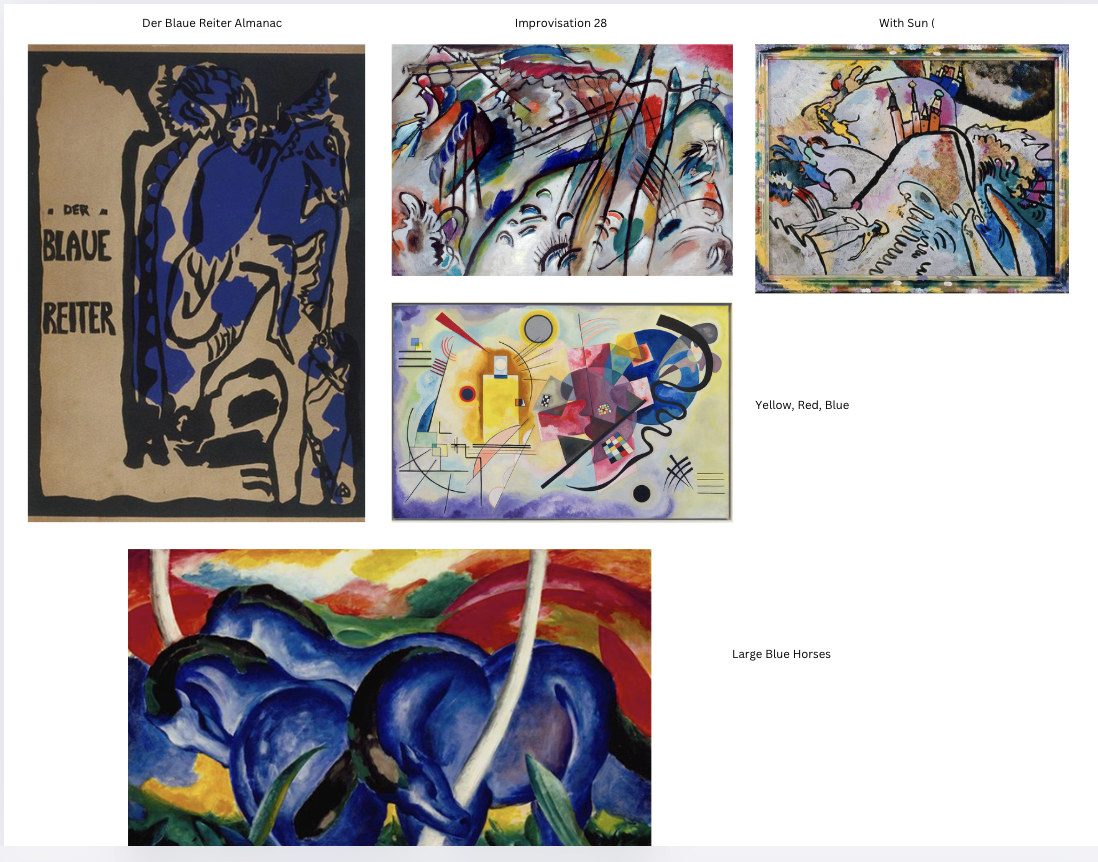
Wassily Kandinsky
Der Blaue Reiter Almanac (1912)
Theory + art + spirituality
With Sun (1910)
Abstract symbolism
Improvisation 28 (1912)
Emotion expressed through color & line
Yellow, Red, Blue (1925(
Fully abstract emotional balance
Franz Marc – Large Blue Horses (1912)
Animals as spiritual symbols
Blue = spirituality
Harmony between nature and emotion
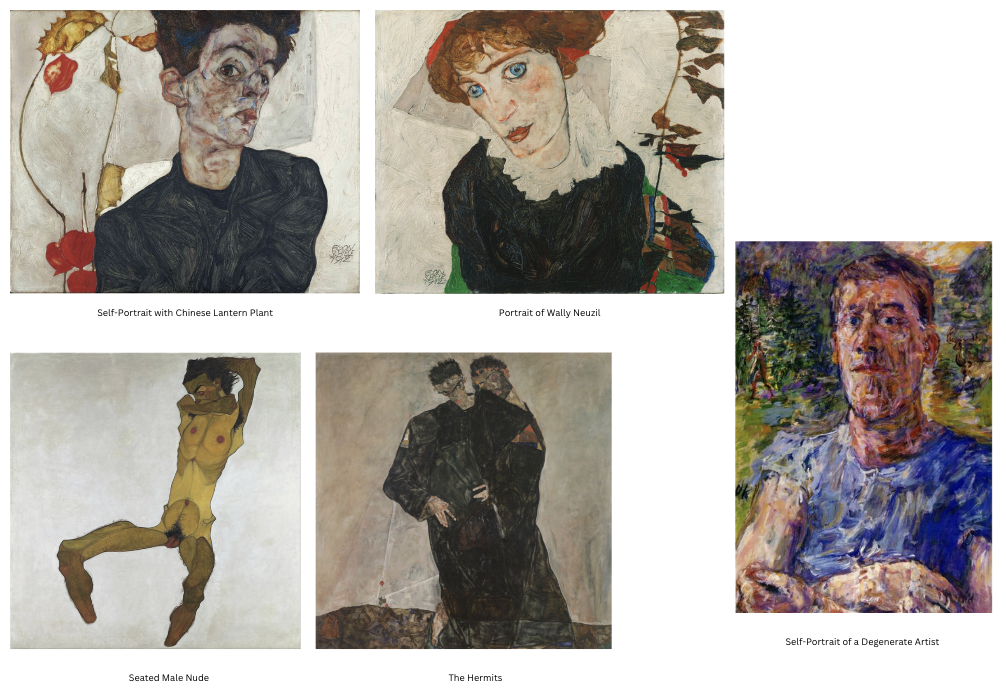
Expressionism in Austria
Egon Schiele
Self-Portrait with Chinese Lantern Plant (1912)
Portrait of Wally Neuzil (1912)
Seated Male Nude (1910)
The Hermits (1912)
Characteristics:
Distorted bodies
Sexual tension
Existential anxiety
Raw psychological exposure
Oskar Kokoschka – Self-Portrait of a Degenerate Artist (1937)
Painted under Nazi persecution
Expression of isolation and defiance
Art as personal resistance
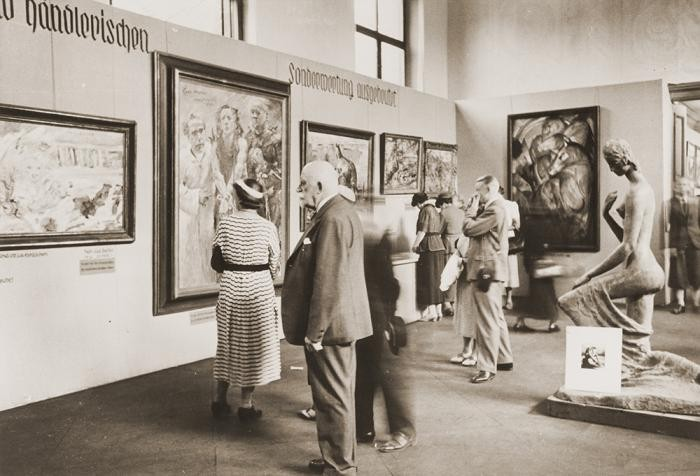
Expressionism & the Nazis
Degenerate Art Exhibition (1937)
Nazis labeled modern art as “degenerate”
Expressionism targeted and confiscated
Massive art theft and destruction
Artists censored, exiled, or silenced
 Note
Note  Flashcards (32)