Income and Social Class
 Studied by 0 people
 Call Kai
 Learn
Learn Practice Test
 Spaced Repetition
 Match
Match Flashcards
 Knowt Play
1/22

There's no tags or description
Looks like no tags are added yet.
Name | Mastery | Learn | Test | Matching | Spaced | Call with Kai |
|---|
No analytics yet
Send a link to your students to track their progress
23 Terms
Decision to Spend
Consumer demand for goods/services depends on both our ability and our willingness to buy
Discretionary Income = the money available to a household over and above what it requires to lead a comfortable life
Research suggests $75,000 is the “magic number” for annual income
Emotional well-being steadily rises as people get to this level but doesn’t significantly increase after that
Types of spenders:
1. Tightwads: those who hate to part with money and actually experience emotional pain when doing so
2. Spendthrifts: those who enjoy buying everything in sight
Money has complex psychological meanings – we equate it with success/failure, social acceptability, security, love, freedom, etc.
Consumer Confidence
Our expectations about the future affect our current spending, and eventually add up to affect a society’s overall well-being
Consumers’ beliefs about what the future holds are an indicator of consumer confidence
When consumers are pessimistic about their prospects, they spend less and take on less debt
When consumers are optimistic about their prospects, they spend more and take on more debt
Income Inequality and Social Mobility
Income inequality is one of the biggest issues currently
Plutonomy = an economy that’s driven by a fairly small number of rich people
The U.S. has one of the largest income inequalities of all countries
Social mobility = passage of individuals from one social class to another
Horizontal mobility: when a person moves from one position to another that’s roughly equivalent in status
Downward mobility: when a person loses status of some kind
Upward mobility: when a person gains status of some kind
In the U.S., the most social mobility is observed in the Northeast, Great Plains, and the West
The Great Recession and Materialism
The Great Recession – lasted from December 2007 to June 2009
Largest drop in employment since the Great Depression
Rather than the “buy now” mentality, we try to see where we can save
Many fashionistas have turned into frugalistas; they refuse to sacrifice style but will achieve it on a budget
It’s cool to admit getting deals rather than paying full price
Consumers are happier when they buy a bunch of smaller things over time rather than blowing it all on one big purchase
This is a result of…
Hedonic Adaptation = to maintain a fairly stable level of happiness, we tend to become used to changes, big or small, good or bad
This means that over time the rush from a major purchase will dissipate and we’re back to baseline
Income-Based Marketing
Two factors contribute to an overall upward income trajectory
A shift in women’s roles
Mothers with preschool children are the fastest-growing segment of working people; many are in high-paying occupations like medicine and architecture
Increases in education attainment
Degree holders earn 80% more
Targeting High-Income Consumers
People tend to indulge in luxury goods while pinching pennies on everyday items
Three groups of consumers based on attitudes towards luxury…
#1: Luxury is functional – consumers use their money to buy things that will last and have enduring value; conduct extensive prepurchase research rather than emotional/impulsive choices
#2: Luxury is a reward – consumers tend to be younger and wish to signal their success (I’ve made it) to others by buying conspicuous luxury items like cars and homes
#3: Luxury is indulgence – smallest of the three groups and includes younger consumers and more males than the other two; the purpose of owning luxury is to be very lavish and self-indulgent; more likely to make impulse purchases
Old vs. New Money
Old money families live primarily on inherited funds (e.g. Rockefellers, DuPonts, Fords, etc.)
To achieve social prominence, you need a family history of public service and philanthropy beyond just money
Old money families distinguish themselves in terms of ancestry and lineage rather than wealth; making large donations achieves a sense of immortality (e.g. Carnegie Hall)
Nouveau Riche consumers recently achieved their wealth; along the lines of rags to riches which is a powerful force of motivation in our society
Many suffer from status anxiety
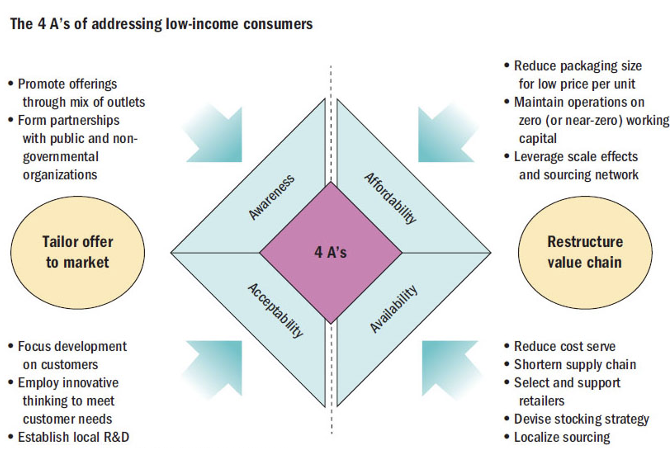
Targeting Low-Income Consumers (NOT ON TEST)
Social Class and Consumer Identity
Six social classes (identified by sociologist W. Lloyd Warner)
Upper Upper
Lower Upper
Upper Middle
Lower Middle
Upper Lower
Lower Lower
The proportion of consumers that fall into each category fluctuates over time
Social Class
Social class = describes an overall rank of people in a society
Tend to have similar occupations and lifestyles by virtue of income levels and common tastes
Homogamy = we tend to marry people in a social class similar to our own (not a hard and fast rule)
Social Stratification
Social Stratification = the creation of artificial divisions; some members of a group get more resources than others by virtue of their relative standing, power, or control in the group
Most groups exhibit a status hierarchy in which some members are better off than others (they may have more power or are simply more liked)
We tend to define someone’s “worth” by their occupational prestige
Affluenza = well-off consumers tend to be unhappy and stressed; just because someone has a higher social standing doesn’t mean they’re happier
Income vs. Social Class
Although we equate money with social class, they are by no means synonymous
So, is social class or income a better indicator of consumer behavior?
It depends on the type of product – do people buy it largely for its functional value or for its symbolic value
Income vs. Social Class
Social class is a better predictor for symbolic aspects with low to moderate prices (e.g., cosmetics, liquor)
Income is a better predictor for major expenditures that don’t have status or symbolic meanings (e.g., major appliances)
Both social class and income predict purchases of expensive, symbolic products (e.g., cars, homes)
Social Class – China
An economic boom is creating a middle class of more than 130 million people
Projected to grow to more than 400 million in 10 years
Brands are important in signaling higher social status (e.g., Louis Vuitton, Maserati, Hugo Boss, Prada)
Nike is named China’s coolest brand and symbolizes success to Chinese consumers
Social Class – Japan
Highly brand-conscious society where upscale, designer labels are very popular
“Office ladies”: Single, working women are largely responsible for fueling Japan’s luxury-goods spending
Typically live with their parents which gives them more money to spend on goods
Social Class – Middle East
Searching for the latest Western luxury brands is a major leisure activity for those with money
Like China, there is a growing middle class of more than 150 million people
Young economy; more than half of people are younger than 25 years old
Many high-end retailers have stores in the Middle East to cater to the market (e.g., Saks Fifth Avenue)
Social Class - UK
England is extremely class-conscious
People traditionally divided into upper, middle, and working classes
Dominance of inherited wealth has faded in the traditionally aristocratic society
UK was hit hard by the Great Recession and a new emphasis on frugality has altered people’s priorities
Social Class – India
India’s economy is booming and affluent consumers prize higher-end global trends
Soon there will be about 267 million middle-class Indian consumers; more than half of population is younger than 25 years
Celebrities have a very strong influence on consumers’ purchasing behavior
Status Symbols and Social Capital
It’s getting harder to link certain brands/stores with a specific class
e.g., affordable luxuries
Rising incomes in other countries along with decreasing prices for consumer goods creates an explosive demand for luxury products
Mass Class = hundreds of millions of global consumers who enjoy a level of purchasing power that allows them to afford many high-quality products
Brands that target this market: H&M, Zara, EasyJet, L'Oréal
Taste Cultures, Codes, and Cultural Capital
Taste Cultures = describes consumers in terms of aesthetic and intellectual preferences
People’s tastes can vary based on social status
THIS IS ON THE EXAM
Codes = the ways consumers express and interpret meanings
THIS IS ON THE EXAM
THE REST ISNT
Marketers use codes to target certain consumer markets with messages they can relate to
Restricted codes: focus on the content of objects, not on relationships among objects
Elaborated codes: more complex and depend on a more sophisticated worldview
Code differences extend to the way consumers approach basic concepts like time, social relationships, and objects
Social and Cultural Capital
Social Capital = showcase for wealth that causes exclusivity (e.g., glamping)
Those with social capital have access to exclusive networks where business and political deals happen
Cultural Capital = a set of distinctive and socially rare tastes and practices (e.g., etiquette lessons and debutante balls)
Knowledge of “refined” behavior that admits a person into a realm of the upper class
Allows the elite to hold positions of power and authority
Status Symbols
Status symbols = items that we purchase that signal to others our wealth
Invidious distinction = we use goods to inspire envy in others through our display of wealth or power
Conspicuous consumption = people’s desires to provide prominent visible evidence of the ability to afford luxury goods
Quiet vs. loud signals
How are gift-giving habits affected by conspicuous consumption?
Parody Display = reverse strategy by separately avoiding typical status symbols
e.g., purchasing new “old ripped jeans”
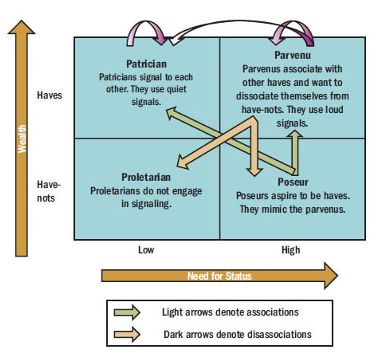
Signaling to Others
Brand Prominence = level of loudness in signaling
Four types of consumption groups based on status signaling
 Note
Note  Flashcards (145)