Plant Tax Exam 2 Review
 Call Kai
 Learn
Learn Practice Test
 Spaced Repetition
 Match
Match Flashcards
 Knowt Play
1/17

There's no tags or description
Looks like no tags are added yet.
Name | Mastery | Learn | Test | Matching | Spaced | Call with Kai |
|---|
No analytics yet
Send a link to your students to track their progress
18 Terms
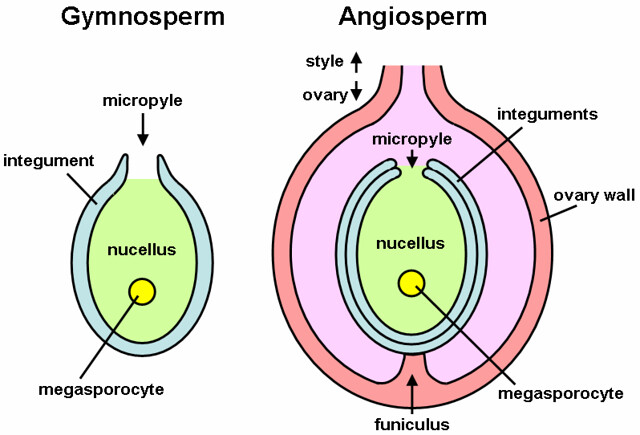
gymnosperm vs angiosperm ovule
Angiosperm basically takes the gymnosperm ovule and adds a bunch of stuff surrounding it
9 evolutionary novelties
Closed carpel
2nd layer of integument
Megagametophyte= embryo sac
Microgametophytes from microsporangia in anthers
Pollen transfer >/= wind (early beetle pollination)
No pollination droplet, sticky surface of stigma
Pollen tube is longer, grows through style to ovary and ovule
Double fertilization produces zygote (2n) and endosperm (3n)
Fruit production and other carpel modifications for dispersal
What makes Ceratophyllum so strangely different?
no endosperm, no apertures on pollen, no filaments, 1 carpel, 1 integument
Submerged aquatic plant
Extremely reduced flowers
Filiform (thread-like) leaves
No obvious roots
Very simple morphology compared to other angiosperms
What was the flower of Archaefructus like? (plus floral formula)
Apocarpous carpels
Stamens below carpels
No calyx or corolla
No perianth
Laminar stamens
Possibly aquatic herbaceous plant
*, 0, 0, ∞, ∞, follicles
What monocot traits connect them to Magnoliids and dicots?
Spiral floral arrangement in some early monocots
Tepals rather than sepals + petals
3-part flower structure
Scattered vascular bundles
Traits supporting monocot monophyly
One cotyledon
Parallel venation
Fibrous root system
Scattered vascular bundles
Floral parts in 3s
Monocot family with the most species (and why)
Orchidaceae
Extreme pollination specialization
Tiny wind-dispersed seeds
Mycorrhizal germination
Ability to colonize many habitats
Iris flower modifications
Adaptations:
Petaloid style branches
Stigma located underneath the style arm
Anthers also under the style arm
Pollination process:
Bee lands on the sepal (“fall”)
Crawls into tunnel between sepal and style arm
Contacts stigma first, then pollen
Iris vs Acorus
Iris
Equitant leaves
Showy flowers
Specialized pollination
Inferior ovary
Acorus
Simple flowers
Spadix inflorescence
6 tepals
Early monocot lineage
Aloe vs Agave comparison
Similarities
Succulent leaves
Rosette growth
Dry habitat adaptation
Differences
Agave
New World
Often monocarpic
Fibers used for rope
Fruit = capsule
Aloe
Old World (Africa)
Leaves mucilaginous (medicinal)
Often bird pollinated
Arecaceae traits
Spathe present
Branched spadix
Fruits usually drupes
Huge tropical diversity (~2600 species)
Wind-pollinated monocot traits
Reduced flowers
No bright petals
Lots of pollen
Feathery stigmas
Exposed anthers
Inflorescences elevated in wind
Evolutionarily advanced Zingiberales traits
Large herbs
Bilateral flowers
Inferior ovaries
Petaloid staminodes
Pseudostems
Arillate seeds
Perisperm
Bromeliads (Bromeliaceae)
Many epiphytes
Leaf rosettes that collect water
Showy bracts
CAM photosynthesis
Important habitat for insects and amphibians
Ranunculales synapomorphies
Numerous stamens
Numerous carpels
Often apocarpous
Many have secondary metabolites
Often early spring ephemerals
Families in the Proteales (and why they are grouped)
Proteaceae , Nelumbonaceae, and Platanaceae
Single ovule per carpel
Magnolia cone vs Banksia cone
Magnolia
Aggregate of follicles
Each follicle from a separate carpel
Carpels arranged on elongated receptacle
Banksia
Woody cone-like infructescence
Many fruits embedded in a woody axis
Both of these cones evolved independently
What fruit types are these: Apple, Yucca, Coconut, Milkweed, Tangerine
Apple- pome, Yucca- septicidal capsule, coconut- drupe, milkweed- follicule, tangerine- hesperidium

