TUT6 R14 Coming to Closure
 Studied by 0 people
 Call Kai
 Learn
Learn Practice Test
 Spaced Repetition
 Match
Match Flashcards
 Knowt Play
1/70

Earn XP
Description and Tags
Zachary, L. J. (2009). Chapter 6: Coming to closure with your mentor. The mentee’s guide: Making mentoring work for you (pg. 99-112). San Francisco, CA: Jossey-Bass.
Name | Mastery | Learn | Test | Matching | Spaced | Call with Kai |
|---|
No analytics yet
Send a link to your students to track their progress
71 Terms
Closure
A critical phase of the mentoring relationship focused on
Reflection
Positioning yourself to continue your developmental journey after the relationship is over
Closure Purpose
Prepares you to leverage the knowledge you have gained and move forward.
It does not simply signify an end, but rather a process that leads to further action and continued growth.
Redefining the Relationship
Coming to closure redefines the mentoring relationship and may come in the form of
Renegotiating goals (working with the same mentor)
Working with a different mentor
Pursuing goals independently
Importance of Closure
Although individuals’ need for closure varies, it is essential for learning and development
During closure:
Deep learning occurs
Appreciation is articulated
Celebration takes place
Closure Overlooked
Closure phase is often overlooked
Many mentoring relationships end with the relationship fading out naturally
Avoidance of Closure
Some archetypes that may lead to avoidance of closure in mentoring:
Closure Avoidance
Heavy Reliance
Emotional Discomfort
Uncertainty About Taking Initiative
Blurred Boundaries
Closure Avoidance
Some people avoid closure in all relationships
This tendency tends to carry over into mentoring relationships
Heavy Reliance
Mentees may rely heavily on their mentor throughout their mentorship
This can lead to avoidance of closure as they feel uneasy moving forward without their support
Emotional Discomfort
Some mentees are uncomfortable expressing gratitude or the emotions they feel during closure.
Others may avoid appearing “too soft,” particularly if their mentor is not the “warm, fuzzy” type.
Uncertainty About Taking Initiative
Mentees may expect the mentor to signal when it is time for closure and worry about appearing presumptuous if they initiate it themselves.
There may also be concerns about offending the mentor or hurting their feelings.
Blurred Boundaries
Over time, mentees may become friends with their mentors and drift into a more informal personal relationship.
This shift can make it harder to recognize when the mentoring phase should formally come to an end.
Cost of Avoiding Closure
While it’s easy to avoid closure entirely, it comes at the cost of missed opportunity
Without closure, mentees miss the chance to experience mentoring fully and to make the most of the mentoring relationship.
Example (Mentor-Mentee Mismatch)
Mia initially felt intimidated by Martha’s outgoing personality, fast pace, and energy, and was surprised they were matched together.
Their differences made Mia feel overwhelmed and uncertain about her own abilities.
Example (Structure of Relationship)
hey agreed to meet monthly with a mid-month email check-in, and Martha invited Mia to reach out if she needed more support.
Despite this, Mia was reluctant to take up too much of Martha’s time and limited herself to the prescribed meetings.
Example (Growing Tension and Self Doubt)
Although Mia made progress, she sensed Martha’s impatience and felt that she was not fast, dynamic, or bold enough.
Even when Martha acknowledged her progress, Mia felt something “wasn’t right” in the relationship.
Example (Avoiding Closure)
As Martha became busier and the mentoring year came to an end, both sensed relief that the relationship was concluding.
Mia was tempted to simply thank Martha and move on without discussion, which would have robbed both of a learning opportunity.
Example (Courageous Closure Conversation)
Instead, Mia chose to engage in an honest closure conversation, expressing gratitude, regret, and discomfort.
She reflected on how she did not take Martha up on offers for support and eventually stopped reaching out.
Example (Learning and Growth Through Closure)
Martha acknowledged Mia’s increased assertiveness and noted that she would not have been brave enough to have this conversation earlier.
The closure conversation affirmed Mia’s growth and helped her clarify future goals and the possibility of working with another mentor.
Example (Value of Closure)
The conversation became a pivotal moment for Mia, allowing her to recognize her development and use the relationship to move forward.
This illustrates how closure transforms a difficult mentoring relationship into a meaningful learning experience.
How to Plan for Closure
Plan Early
Discuss Desired Outcomes
Process and Preparation
Revisit Ground Rules
No-Fault Rule
Addressing Closure if it Wasn’t Planned
When a Partner Resists Closure
Plan Early
Planning for a meaningful closure experience should ideally begin while you are “doing the work,” if not before.
Mentees are encouraged to ask their mentor what they would like to take away from closure and to share their own hopes and expectations.
Discuss Desired Outcomes
Mentoring partners should discuss what they would ideally like to see happen when the relationship comes to an end.
Consider:
How to celebrate success
What would make the closure meaningful
What might get in the way of a positive closure experience
Process and Preparation
Once desired outcomes are identified, partners should talk about the process and planning for closure.
Preparation helps ensure that closure becomes a mutually satisfying learning experience rather than an afterthought
Revisiting Ground Rules
Planning for closure is supported by revisiting the ground rules established at the beginning of the mentoring relationship.
One common ground rule is agreeing to end on good terms.
No-Fault Rule
Many mentoring partners adopt a no-fault rule, meaning there is no blaming if the partnership is not working or if one person becomes uncomfortable.
This approach supports openness and psychological safety during closure.
Addressing Closure if it Wasn’t Planned
If closure has not been discussed earlier, partners should talk about it as the relationship approaches its end.
Meaningful closure requires intentional preparation by both mentoring partners.
When a Partner Resists Closure
If a mentoring partner is not interested in meeting again or does not see the need for closure, mentees are encouraged not to give up.
Having played an active role throughout the relationship, the mentee may still seek some form of closure for themselves.
Closure Conversation
Should contain four elements
Coming to a Learning Conclusion
What you’ve learned
Integrating Learning
How you will apply what you’ve learned
Celebration and Appreciation
Redefining of the Relationship
Learning Conclusion
A focused and reflective discussion centered on the specific learning taken from the mentoring experience.
Even if the relationship did not meet expectations, the focus remains on the process, progress, and content of the learning.
Coming to a Learning Conclusion
Mentees are encouraged to thoughtfully prepare for the learning conclusion to make the most of the opportunity.
Preparation may include
answering reflection questions,
creating a timeline of work with the mentor,
identifying milestones, or
reviewing a journal
Reflection Questions
Some key questions that can help the mentee come to a learning conclusion include:
whether learning goals were achieved
what was learned
what got in the way of progress
how the mentee may have contributed
Other questions explore insights gained, remaining learning needs, lessons about mentoring, and what the mentee would do differently in the future.
Example (Coming to a Learning Conclusion)
Maggie begins the conversation by describing increased self-awareness, confidence, competence, and job satisfaction.
Ernie confirms her progress and provides specific observations about her interpersonal skills, confidence, and ability to balance short- and long-term goals.
Example (Mutual Learning and Accountability)
The conversation allows both mentor and mentee to reflect on their learning and acknowledge areas for improvement.
Ernie reflects on his own mentoring style and apologizes for not providing enough time during a critical period.
Example (Insight Through Reflection)
Maggie recognizes that she initially took things personally and learned the importance of advocating for her needs and developing resilience.
She connects this insight to her tendency toward perfectionism and difficulty seeing the bigger picture.
Example (Link to Future Development)
The discussion helps Maggie identify future learning needs, including strategic thinking and leadership.
The learning conclusion reinforces her growth and provides a foundation for the next phase of closure, integrating learning into future action.
Integrating Learning
Focuses on how the lessons from mentoring will be used again and again in everyday work and life.
Leveraging Learning After Goals Are Met
Closure conversations push mentees to consider how they will leverage their learning now that learning goals have been completed.
The emphasis is on applying learning intentionally rather than letting it fade.
Example (Adam and Bert)
Bert, a small business entrepreneur completing an MBA, worked with Adam, his faculty mentor, for several years.
Adam initially found Bert hurried and impersonal, but came to appreciate his intelligence and insight as the relationship developed.
Example (Awareness and Personal Change)
The relationship faced challenges due to Bert’s lack of openness, but over time Bert became aware of how his behavior affected others.
He learned that it is not just what you do, but who you are, and began to slow down, seek out others, and draw from their learning.
Example (Openness to Feedback)
Bert recognized the value of seeking feedback and becoming more introspective.
He acknowledged that while he once heard only positive feedback, he now understood the importance of hearing negative feedback as a constructive way to grow.
Example (Applying Learning to Action)
Bert identified specific ways he would apply his learning, including healing a difficult relationship with a team member and improving relationships with customers.
He committed to being more objective, less judgmental, and more open.
Example (Ongoing Development)
The 360-degree feedback process was described as an eye-opener that Bert intended to continue using and encouraging within his organization.
This demonstrates how mentoring tools can extend beyond the relationship itself.
Action Steps and Closure
To realize the full impact of closure, conversations must include discussion of concrete next steps.
Mentors can help identify opportunities to apply learning and take development to the next level.
Celebration
Reinforces learning and signals the transition that redefines the relationship.
Meaningful celebration helps mark accomplishments and acknowledge growth.
Meaningful and Learning Based Celebration
Celebration should connect to learning and reflection rather than being purely symbolic.
A good celebration allows both mentor and mentee to discuss milestones, insights, development, and next-level goals.
Example of a Fitting Celebration
Attending Marian Wright Edelman’s presentation on mentors provided a meaningful way to celebrate (for the author and her mentee) because it aligned with the focus of their mentoring work.
The experience allowed them to connect the speaker’s message to their own learning and mentoring relationship.
Example (Reflection and Transition)
After the event, the author and mentee discussed what they had learned, how it applied to their work, and how the mentee would use it moving forward.
They also talked about their plan for staying in touch, reinforcing the transition rather than an abrupt ending.
Authenticity Over Formality
Celebration does not require a major event or elaborate words.
What matters is finding an authentic way to acknowledge the work done together and honor the relationship.
Expressing Appreciation
Saying thank you and expressing appreciation can be challenging, but it is an essential part of closure.
Genuine gratitude reinforces learning and validates the effort invested by both mentor and mentee.
Example of Written Appreciation
A letter from a mentee to an advisory mentoring panel illustrated how sincere appreciation can bring powerful closure.
The letter acknowledged guidance, shared learning, support, and the lasting impact of the mentoring relationship.
Gratitude Mutual Benefits
Expressing appreciation benefits both the mentor and the mentee by bringing emotional closure and affirming the value of the relationship.
Even if a mentor minimizes the need for thanks, mentees are encouraged to insist on taking the time to celebrate and express gratitude.
Redefining the Relationship
Mentoring relationships naturally change once the formal program ends
Important to discuss how the connection will evolve, whether it becomes informal, shifts to a colleague or friend role, or ends entirely.
Considering New Roles
Think about what the relationship will look like without the structure of formal mentoring.
Clarify expectations for ongoing communication and how both parties will interact moving forward.
Decide on Contact
Determine if and how you want to maintain contact with your mentor.
Discuss what aspects of the relationship will stay the same and what will change to support both personal and professional growth.
Example (Redefining the Relationship)
Shelley and her mentor Amanda navigated closure by having open conversations about their evolving relationship.
They agreed that Shelley could update Amanda on her progress, but formal mentoring would end to allow Shelley to connect fully with a new mentor.
Guiding Closure Conversations
Effective closure includes reflecting on the relationship’s evolution, clarifying future contact, and discussing expectations for the next phase.
These conversations help both mentor and mentee transition smoothly while preserving the value of the relationship.
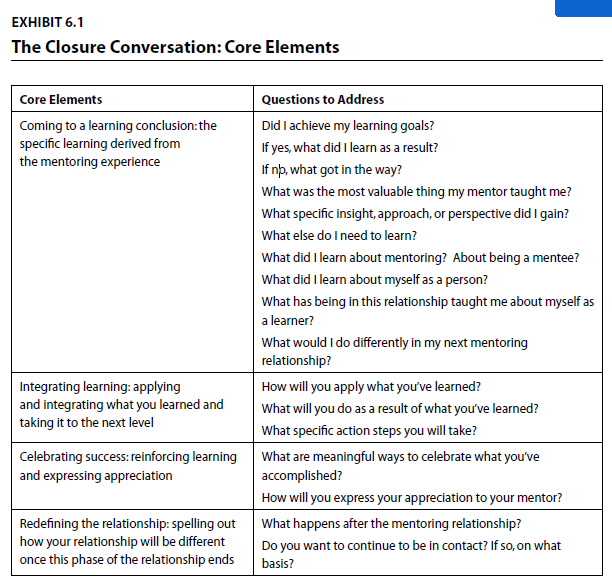
Exhibit 6.1
An exercise provided by the reading that covers the 4 elements of the closure conversation.
Can be used to facilitate a closure conversation with a mentor
When to End the Mentoring Relationship
How do you know when to end the mentoring relationship?
Determining the End
Recognizing Closure Signals
Respecting the Mentor’s Wishes
Determining the End
In formal programs, the length of the mentoring relationship is usually predetermined by months or years.
In informal mentoring, closure may depend on completing specific goals, which act as natural milestones signaling the end.
Recognizing Closure Signals
Ideally, regular check-ins help you identify when closure is approaching.
If not, pay attention to signs the relationship may be ending, while being aware that your own anxiety, fear, or hope can influence how you interpret them.
Respecting the Mentor’s Wishes
Even if you are not ready to end the relationship, you must honor your mentor’s decision.
Assess the progress toward goals—once objectives are met, it’s time to celebrate achievements and transition out of the mentoring relationship.
Premature Closure
Even when the mentoring relationship has a planned duration, certain circumstances may make it necessary to end early.
Examples include relocation, promotion, illness, new responsibilities, or a mismatch in goals where the mentor lacks relevant experience.
Signs a Relationship Isn’t Working
Sometimes it’s harder to sense when the mentoring relationship itself isn’t effective.
Low energy, repetitive discussions, lack of personal connection, and diminishing relevance of advice are key indicators that closure might be needed.
Example (Early Closure)
Guy felt obligated to attend meetings with his mentor James, but discussions were unhelpful and lacked personal connection.
He realized that staying in the relationship would cost him valuable time and career opportunities, even though ending it felt risky.
Taking Action
Guy decided to address the issue directly, explaining that James’s expertise did not align with his current career goals.
He asked for guidance in finding a mentor better suited to his objectives, which James welcomed.
Benefits of Premature Closure
Ending a mismatched mentoring relationship can free time and create opportunities for more relevant guidance.
Acting proactively demonstrates leadership and ensures personal and professional growth is not hindered by a poor fit.
Transitioning After Closure
Once closure is complete—whether the relationship ends, shifts to friendship or colleague roles, or continues in a new form—it’s time to move on.
This transition can feel challenging, especially if you had relied heavily on your mentor’s guidance.
Mentor’s Lasting Influence
Even after the relationship ends, your mentor’s advice often continues to guide you.
You may find yourself reflecting on how your mentor would approach situations or recalling their insights in real-life decisions.
Expressing Appreciation Over Time
Gratitude can extend beyond the formal ending; you may feel compelled to thank your mentor again as you apply their guidance.
This reinforces the lasting impact of their support.
Embracing the Void
The absence of a mentoring relationship creates space for reflection, growth, and self-discovery.
Resisting the urge to immediately fill the void allows for learning and regeneration.
Paying it Forward
Effective mentoring involves continuous growth for both mentor and mentee.
Consider becoming a mentor yourself, extending the benefits you’ve received and continuing the cycle of learning and development.
 Note
Note  Flashcards (32)