Model 2.2 - 2.3 Electrostatics and Electrodynamics
 Studied by 0 people
 Call Kai
 Learn
Learn Practice Test
 Spaced Repetition
 Match
Match Flashcards
 Knowt Play
1/75

There's no tags or description
Looks like no tags are added yet.
Name | Mastery | Learn | Test | Matching | Spaced | Call with Kai |
|---|
No analytics yet
Send a link to your students to track their progress
76 Terms
Electrostatics
Study of electric charges in stationary form
Charge is measured in
coulombs
Friction
transfer of e- by rubbing objects together
Contact (conductions)
transfer of e- by touching an electrified object to another object
Induction
Charged and uncharged objects DO NOT touch
What charges are imparted when electrification by CONTACT occurs?
imparted with the same charge
What charges are imparted when electrification by INDUCTION occurs?
imparted with the opposite charge
List the Law of Electrostatics
1. Like charges repel, unlike charges attract
2. Coulomb’s Law (electrostatics law)
1. Distribution of charge
1. Concentration of charge
Coulomb’s Law (electrostatics law) - The forces between two charges is:
Directly proportional to the magnitude of the 2 charges
Inversely proportional to the square of the distance
Distribution of charge
Over outer surface only of a dense conductor or a hollow object
Concentration of charge
Concentrated at sharpest curves on irregular objects
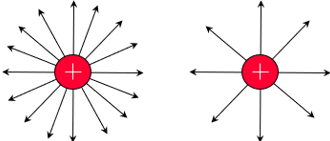
Strong fields =
more lines of force
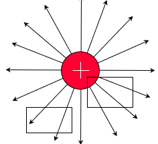
Strong field =
closer lines of force
Electrodynamic
study of electric charges in motion
Conductor:
Allows electrons to flow
Insulator:
Inhibits the flow of electrons
Other names for Insulator
Nonconductor and dielectric
Semiconductor:
Acts as both a conductor and an insulator
Superconductor:
Allows electrons to flow without resistance
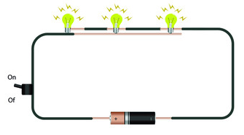
Components of a Circuit
1. Current (amperage) (I = Intensity)
2. Potential Difference (V = Voltage)
3. Resistance (ohms) (R = Resistance)
Current (amperage) =
I = Intensity
Potential Difference =
V = Voltage
Resistance (ohms) =
R = Resistance
Unit of Current:
rate of electrons flowing per second
ampere =
Charge/time
Potential Difference:
force that causes charges to move
Other names for Potential Difference:
Electromotive Force; EMF; voltage
If potentials are connected by a conducting path e- will flow from
high - to low – (negative to positive)
How come the battery isn’t connected from the inside?
There’s an insulator inside the battery
Meters are
Devices to determine electrical values
Voltmeter:
Measures PD (Potential difference)
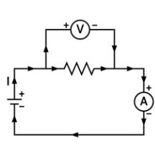
Voltmeter are :
Connected across load (parallel connection)
Ammeter:
Measures current (intensity, ampage)

Ammeter are :
Connected in path so all e- pass through it (series connection)
Which meter is connected via series connection?
Ammeter
Which meter is connected in a parallel connection?
Voltmeter
Which meter measures potential difference?
Voltmeter
Which meter measures current?
Ammeter
Resistance
Anything that opposes or limits current
The Amount of R dependent on
Material
Length of Path:
Cross sectional area:
Temperature:
Length of Path vs Resistance
Direct relationship
Cross sectional area vs Resistance
Inverse relationship
Temperature vs Resistance
Direct relationship
What are the following that increases resistance?
longer length, smaller cross section, and higher temperature
As the length of the conductor increases, what happens to the resistance?
resistance increases
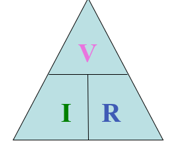
Ohm’s Law
Voltage in a circuit will be equal to the current times the resistance
Ohm’s Law Formula
V = I x R
I = V/R
R = V/I
Electric Power Formula
P(power) = V x I
Electric Power Unit
Watts, W = J/s → KW (kilowatts = 1000)
Formula for Finding Power using I & R
P = I2 R
Direct Current (DC)
a. Steady direct current
b. Pulse Direct Current
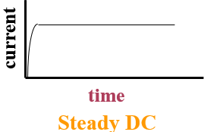
Steady direct current:
DR will flow and stay steady at a certain level it tops off and then, once it’s turned off, it goes down (the current)
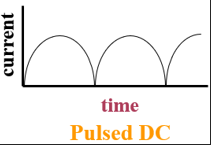
Pulse Direct Current:
You turn it up, it’ll flow up to the peak, drop down, flow up to peak, and continue this pattern.
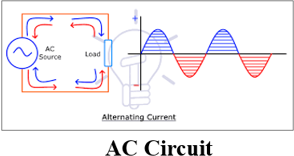
Alternating Current (AC)
e- flow one way then the opposite way
Capacitor
Uses electricity and metal plates to create Potential Difference
Capacitor is
Another source of potential difference
A device that temporarily stores in an electric circuit
Capacitance
Ratio of charge stored to potential difference between plates
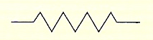
Resistor
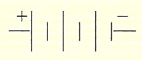
Battery
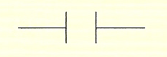
Capacitor

Ammeter

Voltmeter
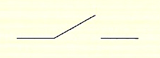
Switch
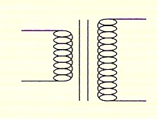
Transformer
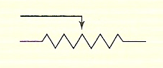
Rheostat
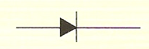
Diode
A circuit has 90 volts of EMF and 30 amps. What is the resistance? What is the power loss?
R = V/I → 90/30 = 3 ohms
P = (I)2R → (30) 2(3) = 2700 watts or 2.7 kW
A circuit has a current of 10 amps with 34 ohms of resistance. What is the voltage? What is the power loss?
V = (I)(R) → (10)(34) = 340 V
P = (I)2R → (10) 2(36) = 3400 watts or 3.4 kW
A circuit has 120 volts and 26 ohms of resistance. What is the amperage? What is the power used?
I = V/R → 120/26 = 4.61 amps
P = (I)2R → (4.61) 2(26) = 552 watts
Battery uses
chemicals to create a potential difference!
A 15A fuse is placed in a 110V power line. What is the maximum amount of power the line can carry before the fuse will activate?
R = 110/15 → R = 7.33 ohms
P = I2R = (15)2 (7.33) = 1649.25 W
Find the power of a 240W light bulb that draws a 0.46A current.
P = I2 R = [0.46A]2 240 W = 50.784 W → 51 W
A 15A fuse is placed in a 110V power line. What is the maximum amount of power the line can carry before the fuse will activate?
P = I x V → 15A x 110V= 1650W = 1.65 kW
Examples of Conductor
metal and water
Examples of Insulator
Rubber
 Note
Note  Flashcards (50)