OT 883 - Cog Neuro Midterm
 Call Kai
 Learn
Learn Practice Test
 Spaced Repetition
 Match
Match Flashcards
 Knowt Play
1/233

Earn XP
Description and Tags
Module 1 & 2
Name | Mastery | Learn | Test | Matching | Spaced | Call with Kai |
|---|
No analytics yet
Send a link to your students to track their progress
234 Terms
Why learn about Neuroanatomy?
A change in neuroanatomy can cause changes in cognition and motor function which effects how we interact with the world.
what are the 6 categories which effect Neuroanatomy?
Neurodegenerative disorders, mental illness, toxicology, brain tumor, infectious diseases, neurodevelopmental disorders
What is the nervous system?
the bodys command center, originating in the brain that controls all movements, thoughts and autonomic responses to the world
what is the precise definition of the nervous system? Hint: Structures
It is a system of nerve cells (neurons) and fibers which transmits nerve impulses between parts of the body to regulate the actions and responses of humans
what 3 structures make up the nervous system
brain, spinal cord, nerves
what is the function of the spinal cord?
connects the nerves to the brain via the spinal cord
how does the brain control all the commands?
the neuron controls the central processing in the central nervous system pathway
what is a nerve cell? (3)
fundamental unit of signal processing, specialized cell which is electrically excitable cell that processes and transmits information through electrical and chemical signals
function of the dendrites
recieves information
function of the cell body (soma)
processes and intergrates information to send nerve impulses to the axon
function of the axon
conducts action potentials to another neuron
function of the synapse
the junction between the axon terminal of a neuron and dendrites of the next, the gap where specialized interactions occur
what are the 3 types of neurons classified by shape
bipolar interneuron, unipolar sensory neuron, multipolar motor neuron
what are the 3 types of neurons classified by function
sensory (afferent), motor (efferent), interneuron
what is an interneuron
the inbetween neuron which relays information, mainly found in the spinal cord
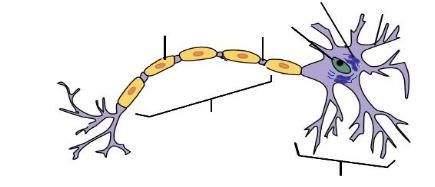
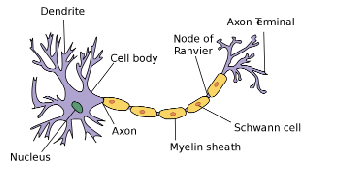
Name the structures
axon, myelin sheath, nodes of ranvier, nucleus, cell body, dendrites
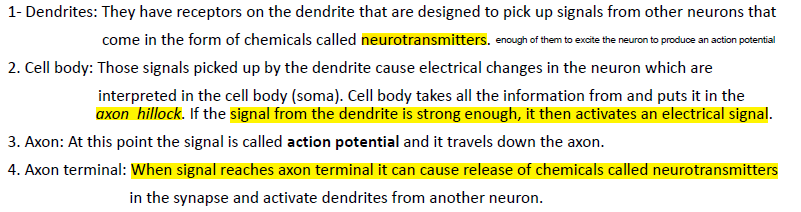
how is the neuron organized? Basic chain of what?
neurons are organized into long chains, allowing them to pass signals quickly to one another through neural signal transmission
neural signal transmission is also called
synaptic transmission
what are the 4 steps of synaptic transmission?
dendrite, cell body, axon, axon terminal
What is ALS - Amyotrophic lateral sclerosis or Lou gehrigs disease?
progressive neurodegenrative disease that affects motor neurons in the brain and spinal cord, motor neurons degenrate or die causing loss of action potentials to muscles
what are the main signs of ALS? (5)
muscle weakness or stiffness, twitching or fasciculations, muscle atrophy
what is myelin?
an electrically insulating material that forms a layer around the axon which is essential for proper functioning of the nervous system
what does myelin increase in the nervous system?
myelin increases electrical resistance across the cell membrane, to prevent electrical current from leaving the axon
what is the gap between myelin? what does it do?
Nodes of Ranvier, allows for salutatory conduction which allows action potentials to jump creating faster impulses
two types of nerve fibers
unmyelinated; impulses move slow and continuously, myelinated; impulses move fast and hops
what allows for a faster conduction of electrical impulses?
myelin and a thicker axon
what are glial cells?
support cell that forms myelin sheaths around axons which provide nutrients, repair damage, regulates neuronal conduction
glial cells in CNS
oligodendrocytes - do not regenerate
glial cells in PNS
schwann cells - regenerate
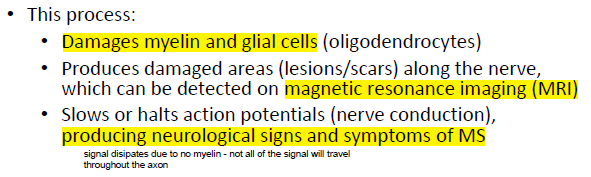
what are demyelinating disorders? What does it cause?
diseases related to damage to myelin, scar tissue forms in its place, disrupts action potentials down the axons
What is Multiple Sclerosis (MS)?
autoimmune condition that attacks the myelin in the central nervous system
what does MS cause? (3)
what are the 5 most common symptoms of MS?
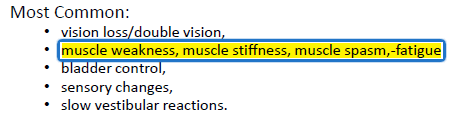
MS permanent damage to myelin may cause nerve dealth in the following symptoms
vision loss, paresis, paralysis
what is a synapse?
a junction between the axon terminal and dendrites where specialized chemical or electrical interactions occur
what is the order of operations at a synapse?
presynaptic neuron, synapse, postsynaptic neuron
electrical synapse are connected by specialized channels called
gap junctions
what are the characteristic of electrical synapses? (3)
electric current from presynpatic to postsynaptic cell, transmission signal is fast and can be bidirectional
what are the steps in the electrical synapse process?
resting potential, depolarization, repolarization, refractory, resting potential
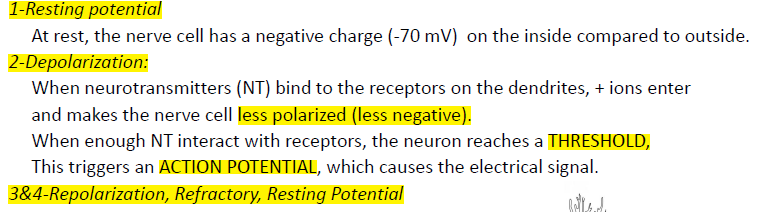
are pre and post synaptic cell membranes connected in chemical synapses?
No
Characteristics of chemical synapses?
transmission of neurotransmitter between presynpatic and postsynaptic cells, transmission signal is slow, transmission signal is unidirectional
steps to chemical synapse process?
excited presynaptic cell, release of neurotransmitters, neurotransmitters bind to receptors on postsynpatic cell causing reaction, activation or inhibition of action potential, reabsorption of neurotransmitter
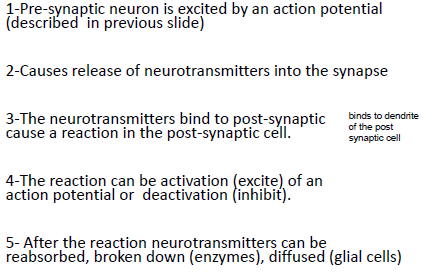
what will glial cells do in chemical synapses?
glial cells remove extra neurotransmitters in the synpatic cleft
what are neurotransmitters?
chemicals that transmit signals across a synapse from one neuron to another target neuron, stored in vesicles in the pre-synaptic membrane that are released into the synaptic cleft to bind to receptors on the post synaptic membrane to inhibit or excite the membrane
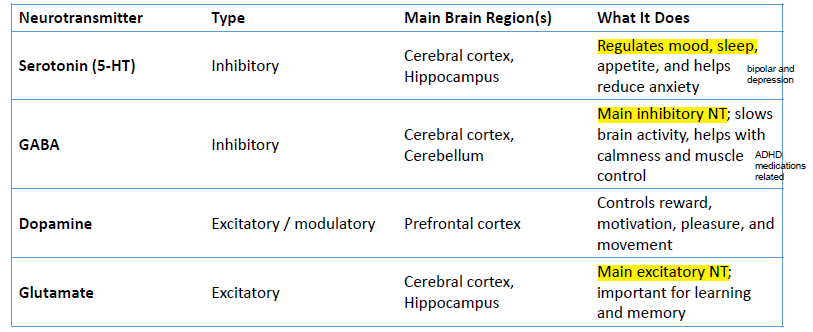
what are the 4 neurotransmitters? what type are they? Main brain regions? what it does?
How do drugs work? What do they affect?
blocks the dopamine and reuptake pumps, causing a feeling of euphoria from the overstimulation of dopamine production
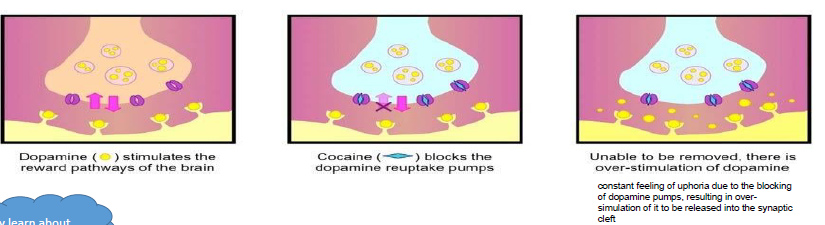
what are the 4 things medications do to affect neurotransmitters?
change speed or volume of neurotransmitter production, change release of neurotransmitter, act as neurotransmitters, block re-storage of neurotransmitter in pre-synaptic cell

what is a nerve fiber
is one axon from a single nerve cell
what is a nerve
bundle of nerve fiber (bundle of axons)
what is the peripheral nervous system
nerves outside the central nervous system connecting to organs, limbs, and skin
what are the 3 planes in the brain?
coronal - front and back, horizontal - top and bottom, sagittal - right and left
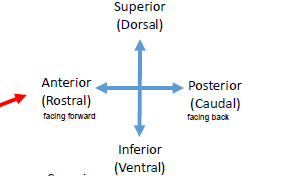
what are the directional terms of the CNS
superior (dorsal), posterior (caudal), Inferior (ventral), Anterior (rostral)
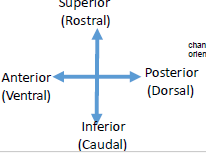
what are the directional terms of the SC
superior (rostral), posterior (dorsal), inferior (caudal), anterior (ventral)
what is the function of the brain
the brain manages and coordinates motor, sensory, and cognitive responses as well as autonomic function heart rate, respiration, blood pressure
what are the 3 sections of the brain
forebrain, midbrain, hindbrain
what is the forebrain responsible for? what structures are their?
voluntary motor movement, tone, posture, cognitive and sensory function, cerebral hemispheres (cerebral cortex), basal ganglia, thalamus, hypothalamus
what is the midbrain responsible for? what structures are their?
topmost part of the brainstem, regulates all sensory (visual and auditory) and motor information that travels between the forebrain and spinal cord
what does the hindbrain do? what structures are their?
connects the brain to spinal cord that is vital for survival, pons, medulla oblongata, cerebellum, cranial nerves
what are the structures in the hindbrain? functions?
midbrain - motor and sensory/vision processing, pons - motor of eyes and mouth sesnory of head and face hearing equilibrium, medulla - vital autonomic functions to live, reflexes

what does the white and gray matter do in the CNS?
gray - nerve cell bodies which integration of signals white - myelinated axons which transmit signals over distances
within the CNS (brain) where is the white and grey matter? made up of?
grey matter is on the surface of the cerebral cortex made of cell bodies called nuclei
within the CNS (spinal cord) where is the white and grey matter? made up of?
grey matter is at the center made of clusters of cell bodies in the PNS called ganglia
white matter in the CNS terminology
tracts/Commissure
white matter in the PNS terminology
peripheral nerves which are bundles of axons composed of sensory and motor fibers
efferent nerves
pathways carrying motor information from CNS to body
afferent nerves
pathways carrying sensory information from body to CNS
redraw this diagram
neuron, posterior horn, dorsal root, ganglion, spinal nerves, ventral root, ventral horn
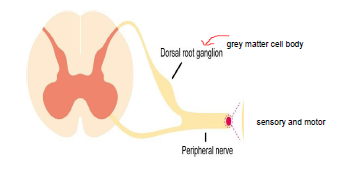
what is the structure of the spinal cord?Segments?
Long bundle of neurons in the spinal column, C1-8, T1-12, L1-5, S1-5, Coccygeal nerve
when does the spinal cord end?
below L1-2, at the cauda equina
what sections/segments of the spinal cord are responsible for sections on the body?
neck (C1-8) - motor and sensory of the neck, Chest (T1-12) - sensory and motor processing of the chest, Abdomen (L1-5) - sensory and motor of abdomen, Pelvis (S1-5) - sensory and motor, Coccygeal nerve
which structures are these?
posterior dorsal horn, anterior ventral horn
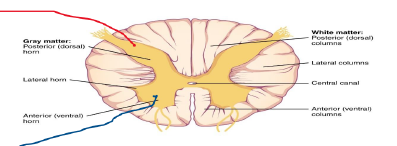
what is the order of information travel through the structures?
posterior horn, dorsal root, ganglion, spinal nerves, ventral root, ventral horn
what are the 3 functions of the spinal cord
carrying sensory and motor information to and from brain, reflexes, autonomic nervous system
what does spinal cord injury cause?
changes in motor and sensation and other body functions below the site of the injury
tetraplegia
all four limbs affected
paraplegia
two lower limbs
what is a reflex?
an involuntary and nearly instantaneous movement in response to a stimulus involving nerve cells that is not controlled by the brain (no concious thought)
what is a reflex made possible by?
neuronal pathways called reflex arcs
two types of synaptic reflex arcs
monosynaptic - one sensory and one motor neuron, polysynaptic - many interneurons between sensory and motor neurons in the reflex pathway
what is the most common type of reflex arc?
Polysynaptic arc
what are the two types of reflexes?
somatic - affecting muscles, Autonomic - affecting inner organs
what are the four types of somatic reflex arcs?
stretch reflex, golgi tendon reflex, withdrawl reflex (flexor reflex), crossed extensor reflex
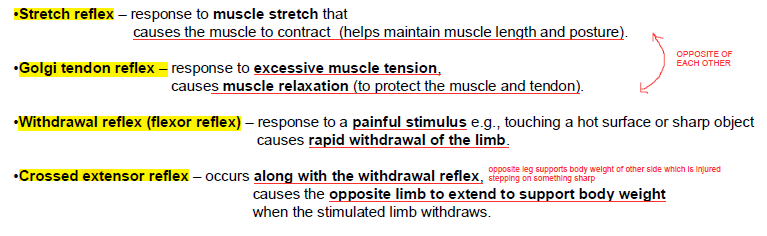
order of steps of the withdrawl reflex
sensation, pain receptors, sensory neuron, relay neuron, spinal cord, motor neuron, muscle fiber response
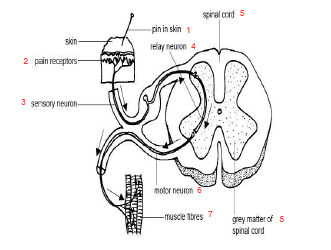
what is the withdrawl reflex pain?
a polysynaptic reflex arc; spinal reflex intended to protect body from damaging stimuli
what is the autonomic nervous system?
part of the PNS which functions unconciously controlled by the limbic system, hypothalamus, and afferent nerve tracts
what does the autonomic nervous system control?
control of respiration, cardiac regulation, vasomotor activity, and reflex actions
what are the vasomotor activitives in the autonomic nervous system
blood pressure, digestion, metabolism, urination/defication, sexual response
what are the reflex activitives in the autonomic nervous system
coughing, sneezing, swallowing, and vomiting
what is the 2 sections of the autonomic nervous system?
sympathetic - fight or flight, parasympathetic - rest and digest
what are the parasympathetic body responses in the autonomic nervous system?
stimulates flow of saliva, slows heartbeat, constricts bronchi, stimulates peristalsis and secretion, stimulates release of bile, contracts bladder
what are the sympathetic body responses in the autonomic nervous system?
dilates pupils, inhibts flow of saliva, increases heart beat, dilates bronchi, inhibits peristalisis and secretions, conversions of glycogen to glucose and adrenaline or noradrenaline, inhibits bladder
what does the brain do and their functions?
controls our motor, sensory, and cognitive responses as well as autonomic functions such as heart rate, respiration, and blood pressure
what are the motor functions in the brain
balance, tone, and strength
what are the sensory functions in the brain
touch, taste, smell, hearing, and vision
what are the cognitive responses in the brain
problem solving, judgement, planning and attention
what structures are in the forebrain
cerebral cortex, subcortical white matter, basal ganglia, thalamus, hypothalamus
the cerebral cortex is divided into two …. and connected by ……. consists of how many lobes….
left and right hemispheres, corpus collosum, 4 lobes
what is the 5th lobe of the cerebral cortex? what is the function?
the insula which controls autonomic function through regulation of the sympathetic and parasympathetic systems
what are the four lobes of the cerebral hemispheres? functions?
frontal - motor, higher executive functioning, planning, problem solving, parietal - sensory integration touch, temperature, pressure and pain, temporal - sensory processing hearing, language, memories, occipital - visual processing
what are sulci, gyri, and fissure?
sulci - shallow groove, gyri - bumps or ridges between sulci, fissure - large groove divides the brain in lobes

