Armed Force II
 Call Kai
 Learn
Learn Practice Test
 Spaced Repetition
 Match
Match Flashcards
 Knowt Play
1/10

There's no tags or description
Looks like no tags are added yet.
Name | Mastery | Learn | Test | Matching | Spaced | Call with Kai |
|---|
No analytics yet
Send a link to your students to track their progress
11 Terms
Key Themes For This Lecture
1. The traditional exceptions to the prohibition on the use of force
2. The controversial / undiscovered country
Exceptions to the Prohibition on the Use of Force
Three well-established exceptions:
• UN authorization [Art. 42] → the treaty-based exception
• Self-Defense → based both on customary law and Art. 51
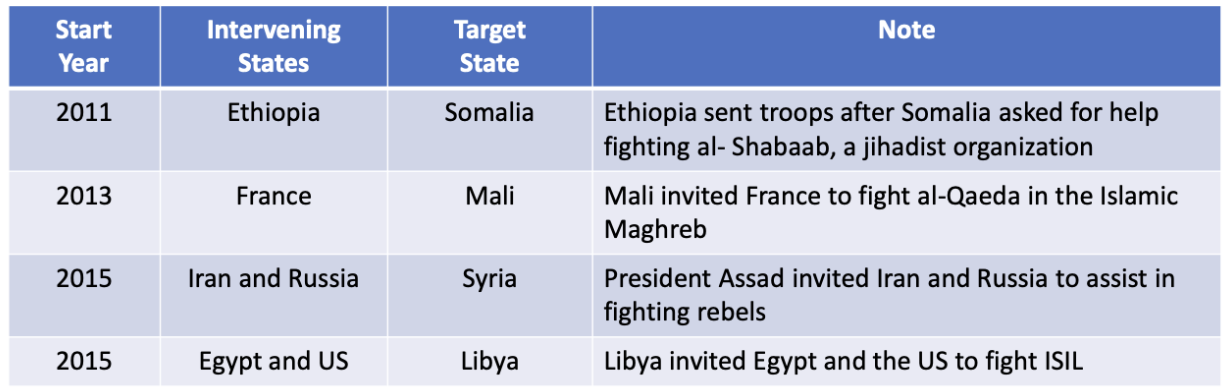
• Intervention by invitation
• Less well-established:
• Humanitarian intervention
UN Authorization
• Article 42 of the UN Charter provides the legal basis for the UN to authorize the use of force: Should the Security Council consider that measures provided for in Article 41 would be inadequate or have proved to be inadequate, it may take such action by air, sea, or land forces as may be necessary to maintain or restore international peace and security. Such action may include demonstrations, blockade, and other operations by air, sea, or land forces of Members of the United Nations.
• Interpretation games (i.e., the invasion of Iraq / Libya / Security Council Resolution 2249)
Self-Defense – The Charter Framework
• The legal basis for self-defence is found both in customary law and in Art. 51 of the UN Charter
• Nothing in the present Charter shall impair the inherent right of individual or collective self-defence if an armed attack occurs against a Member of the United Nations, until the Security Council has taken measures necessary to maintain international peace and security. Measures taken by Members in the exercise of this right of self-defence shall be immediately reported to the Security Council and shall not in any way affect the authority and responsibility of the Security Council under the present Charter to take at any time such action as it deems necessary in order to maintain or restore international peace and security.
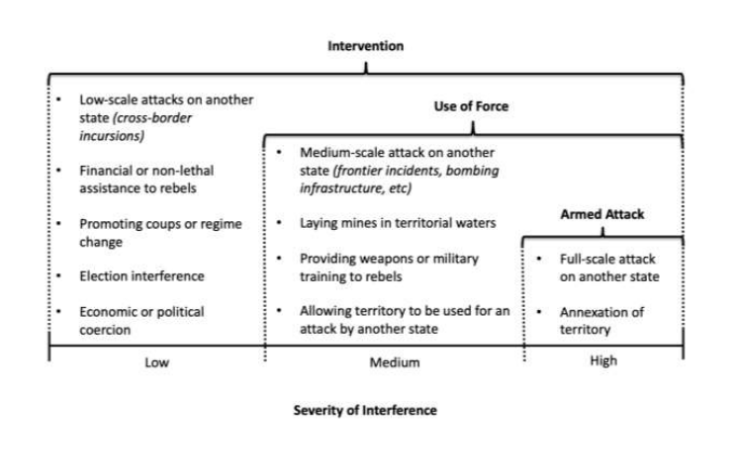
Responding to Armed Attacks: Gravity Threshold
• From the ICJ ruling for Nicaragua
• Use of force only qualifies as an “armed attack” (under the law of self-defense) if it is sufficiently severe
Self-Defence – The Requirements
• There must be an armed attack:
• There appears to be a gravity threshold (Nicaragua and Oil Platforms)
• There may even be a fault requirement (deliberate targeting, intention to target) (Oil Platforms)
• Compliance with procedural requirements is evidence as to whether exercise of self-defence is legitimate (note: procedural requirements not imposed under customary law)
• Must be proportional and necessary
• Blowing up oil platforms might not be necessary in the context of injury to warships (Oil Platforms)
Self-Defence – The Undecided Country
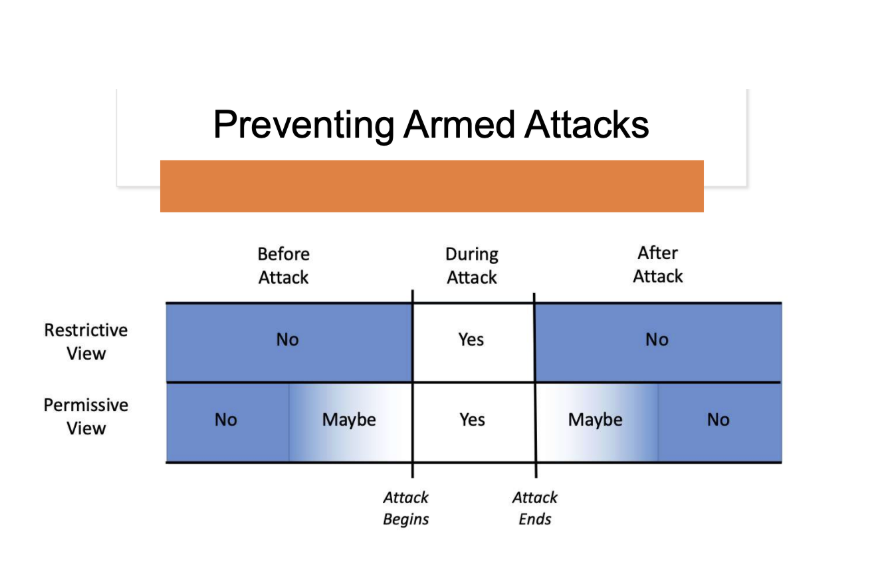
• Must the perpetrator of the armed attack be a state?
• Letter of US to UN Security Council post 9/11
• The unwilling or unable standard?
• Do you need to wait for the mushroom cloud to act?
Protecting Nationals Abroad?
• 1976: Israel intervened in Uganda to rescue Jewish hostages from an airplane hijacked by terrorists.
• 1980: The US launched a failed mission to save its hostages in Iran
Humanitarian Intervention
• Common in 19th century
• Europeans used force to protect Christians in non-Western territories
• Ex: Greece, Lebanon-Syria, Bulgaria
1970s Revival
1971: India invades East Pakistan (Bangladesh)
1971: India invades East Pakistan (Bangladesh)
• 1978: Vietnam invades Kampuchea (Cambodia)
• 1979: Tanzania invades Uganda
Consent to Intervention?