obesity socio-cultural perspective
 Call Kai
 Learn
Learn Practice Test
 Spaced Repetition
 Match
Match Flashcards
 Knowt Play
1/25

Earn XP
Description and Tags
public health
Name | Mastery | Learn | Test | Matching | Spaced | Call with Kai |
|---|
No analytics yet
Send a link to your students to track their progress
26 Terms
worldwide, obesity has tripled since 1975
In 2026, more than ____ billion adults, 18 years and older, were overweight. Of
these over ____ million were obese
2 , 650
39% of adults aged 18 years and over were overweight in 2024, and 13% were obese.
overweight and obesity kills more people than underweight
39 million children under the age of 5 were overweight or obese in 2024.
double burden of malnutrition
many low + middle income countries face so called burden of malnutrition
problems of infectious diseases and undernutrition, also experiencing risks factors such as obesity and overweight rapidly (non communicable disease)
common to find undernutrition and obesity co-existing within the same country, community, and household
Children in LMIC are more vulnerable to inadequate pre-natal, infant, and
young child nutrition. At the same time, these children are exposed to high-
fat, high-sugar, high-salt, energy-dense, and micronutrient-poor foods,
which tend to be lower in cost but also lower in nutrient quality
look at graphs in the slides
patterns
collecting food, famine, receding famine, chronic disease (NCD’s), behavioral change
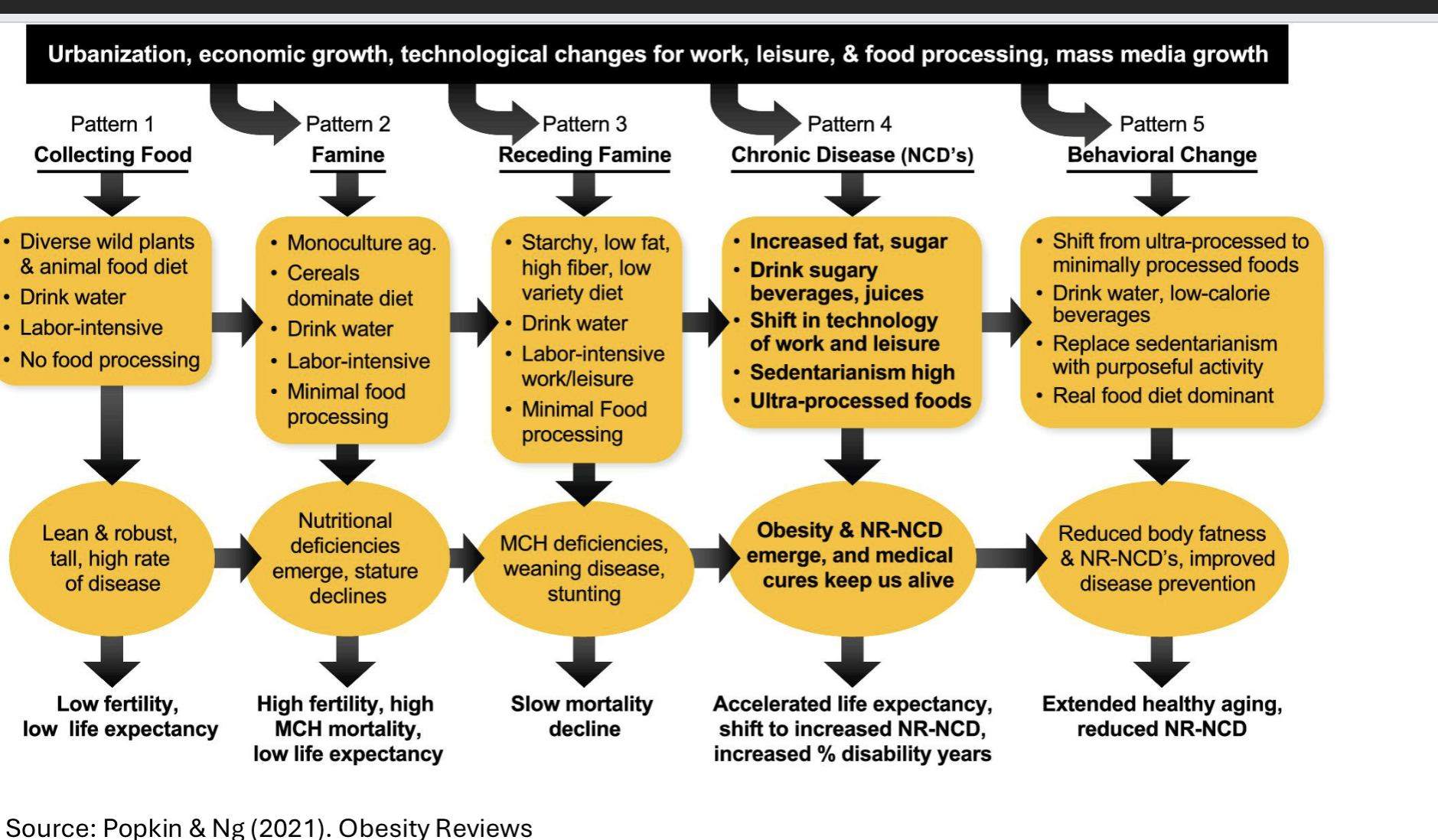
major cause of obesity pandemic
preferences for fat and sugar
higher incomes lead to higher fat and sugar purchases
lower food prices, especially vegetable oil
Globalization/centralization of the media to promote certain
aspects of food cultureTechnological factors that affect work and leisure, productivity
and effortOther changes in household purchasing patterns and time, e.g.
meals eaten outside of home
T2 diabetes mellitus (T2DM)
more than tripled from 1900-2019
obesity and life factors - unhealthy diets, smoking, reduced physical activity, represent the major drivers drivers of disability and mortality attributed to T2DM
Metabolic syndrome
increase from 28-37% among American adults, 1999-2018
Non-alcoholic fatty liver disease (NAFLD)
25 to 28% from 1990 to 2019
The forecasted prevalence of NAFLD for year 2040 exceeds 50%, with an annual
increase rate of 2.16% for the period 2020–2040
Type 2 diabetes is a leading comorbidity with obesity.
difficult to control, especially in weaker health systems
key point:
insulin is a main fat storage regulatory hormone
type 2 diabetes is a loss of sensitivity to insulin secretions
impaired ability to clear glucose from blood into muscle
obesity transition (stage 1)
stage 1
low obesity prevalence
women >> men
adults » children
high SES » low SES
obesity transition stage 2
increasing obesity prevalence
women >men
adults > children
high ses > low ses
obesity transition 3
epidemic rise of obesity
women > men
adults > children
low ses > high ses
obesity transition 4
-declining
-obesity prevalence
obesity transition theory
conceptual model which was proposed to describe the evolving characteristics of obesity epidemiology in different countries depending on the stage of
their economic progression and development
4 distinct stages
stage 1. populations are largely impovershed and afflicted by political
unrest; the overall obesity rates are low, but the obesity prevalence starts
slowly to rise among wealthy middle-aged subjects, especially women, and is
much higher in adults than children. Many developing countries of South Asia
and sub-Saharan Africa are currently at this stage
stage 2:
As countries become richer, the obesity rates continue to increase: more in adults than in
children, there is a faster transition in women compared to men due to their different
adipose tissue physiology, but men start also to gain weight
At this stage, obesity shows a clear increasing trend in groups of lower SES. Many Latin
American and Middle Eastern countries are currently at this stage.
High-income East Asian countries are also at this stage, but with a lower prevalence of
obesity
stage 3:
the obesity prevalence gap between men and women becomes narrower, and the
socioeconomic gradient becomes more pronounced with continuously rising obesity rates predominantly among people of lower incomeAt this point, obesity rises
massively and takes on epidemic
proportions. In children and
women of high SES, obesity rates
remain stable (plateau). Most
European countries are now at
this stage
stage 4
Finally, the obesity prevalence starts to decline, usually after a period of
previous stabilization. Of note, no country shows currently decreasing trends
or is projected to reduce its obesity prevalence in the near future across their
entire population
in women who eat a poor diet before conception, late gestation fetus directs more
blood to the liver and lays down more fat
key points:
The nutrition transition disproportionately
affects LMIC facing a dual burden of
undernutrition and obesity.
• Global shift from traditional diets high in fiber
and physical activity to modern diets high in
refined carbohydrates, added sugars, fats,
and ultra-processed foods.
• transition is driven by urbanization,
economic growth, globalization of the
food system, and technological change,
leading to rising obesity and non-
communicable diseases (NCDs).
• Mismatch: When individuals exposed to
undernutrition in utero or early childhood
later experience calorie-dense, sedentary
environments→ mismatch occurs between
biological expectations and actual
conditions.

