The Mind (Memory) - HOSA Behavioral Health
 Call Kai
 Learn
Learn Practice Test
 Spaced Repetition
 Match
Match Flashcards
 Knowt Play
1/21

There's no tags or description
Looks like no tags are added yet.
Name | Mastery | Learn | Test | Matching | Spaced | Call with Kai |
|---|
No analytics yet
Send a link to your students to track their progress
22 Terms
Memory
The ability to retain knowledge
3 Steps of Memory
Encoding
Storage
Retrieval
Atkinson-Shiffrin Memory Model (stages)
Sensory Memory (very brief)
Short-Term Memory (improved through rehearsal and chunking)
Working Memory (for information that is actively being manipulated)
Long-Term Memory
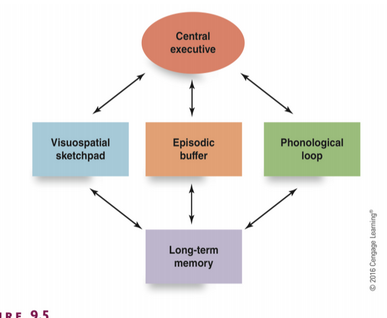
Working Memory Model
Phonological loop → auditory and verbal information
Episodic buffer → area to combine past information that has already been encoded into long-term memory
Visuospatial sketchpad → visual and spacial information
Primacy Effect
Better recall of the first items in a list
Recency Effect
Better recall of the last items in a list
Declarative Memory
Consciously retrieved memory, easy to verbalize, also known as explicit memory
Semantic Memory
Type of declarative memory that is general knowledge.
Ex: What is a sandwich?
Episodic Memory
Type of declarative memory that is a personal experience
Ex. a vacation
Autobiographical Memory
An episodic or semantic memory that is in reference to the self
Nondeclarative Memory
Unconsciously/effortlessly retrieved, difficult to verbalize, can arise from conditioning, procedural learning and priming.
Procedural Memory
A nondeclarative memory for how to carry out a skilled movement
Priming
A change in a response to a stimulus that occurs as a result of exposure to another stimulus
What happens when someone damages their hippocampus?
They retain old memories but lose the ability to form new ones.
Spreading Activation Model
Theory suggesting that people organize general knowledge based off of experience → concepts differ in strength of their connections
Encoding Specificity
A process in which memories incorporate unique combinations when encoded → environment is incorporated into the memory
Reconstruction
Rebuilding a memory out of stored elements → we retain the general idea and rebuild around it
Flashbulb Memory
A particularly detailed account of an emotional event
Interference
Competition between newer and older information in memory
Retroactive → reduced memory due to later learning
Proactive → reduced memory due to earlier learning
Motivated Forgetting
Failure to retrieve negative memories
Long Term Potentiation
Enhanced communication between 2 neurons resulting from synchronous activation
The translation of incoming sensory information into neuron signals is called…
Transduction

