(25.2) Nephrons

0.0(0)
studied byStudied by 0 people
0.0(0)
full-widthCall with Kai
learnLearn
examPractice Test
spaced repetitionSpaced Repetition
heart puzzleMatch
flashcardsFlashcards
GameKnowt Play
Card Sorting

1/23

encourage image

There's no tags or description

Looks like no tags are added yet.

Study Analytics
Name
Mastery
Learn
Test
Matching
Spaced
Call with Kai

No study sessions yet.

24 Terms

1
New cards

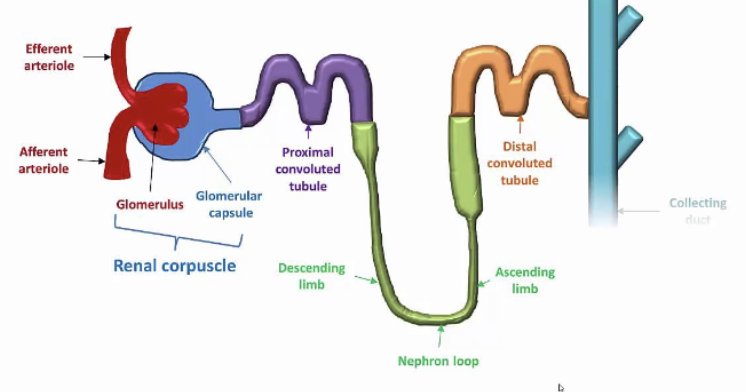
Describe the function of Nephrons

  1. The structural and functional units that form urine

  2. > 1 million/kidney

2
New cards

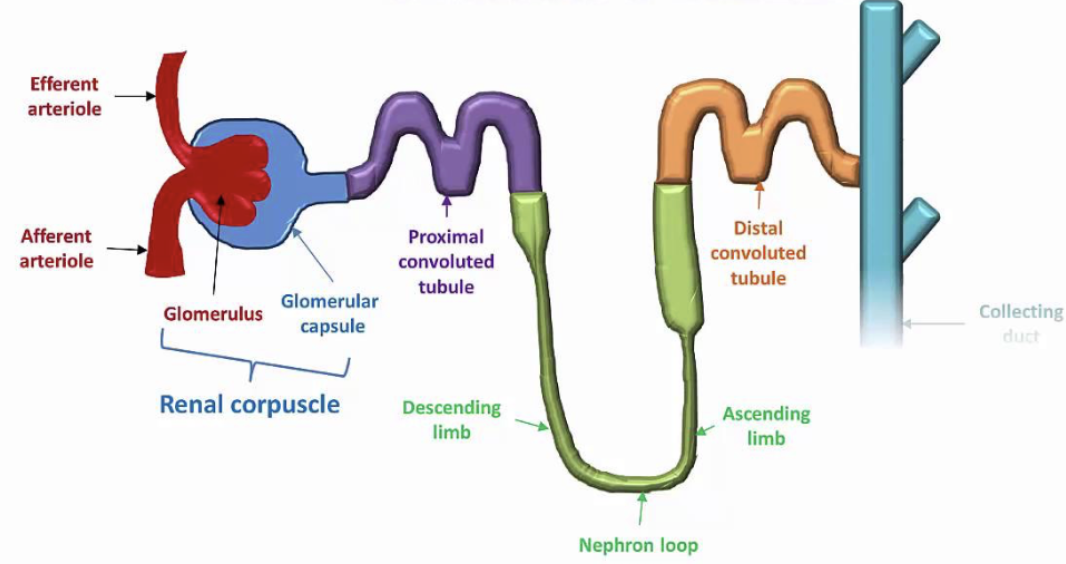
Describe the structure of the Nephron

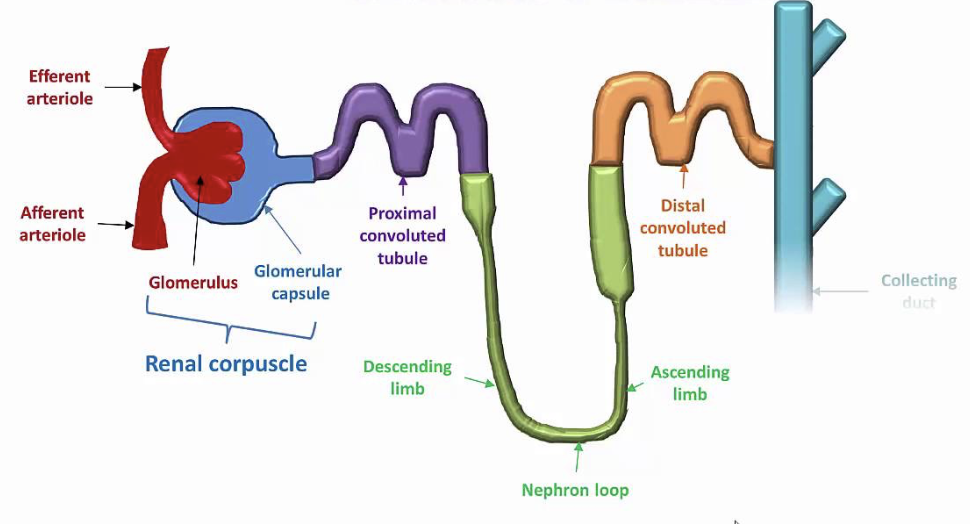
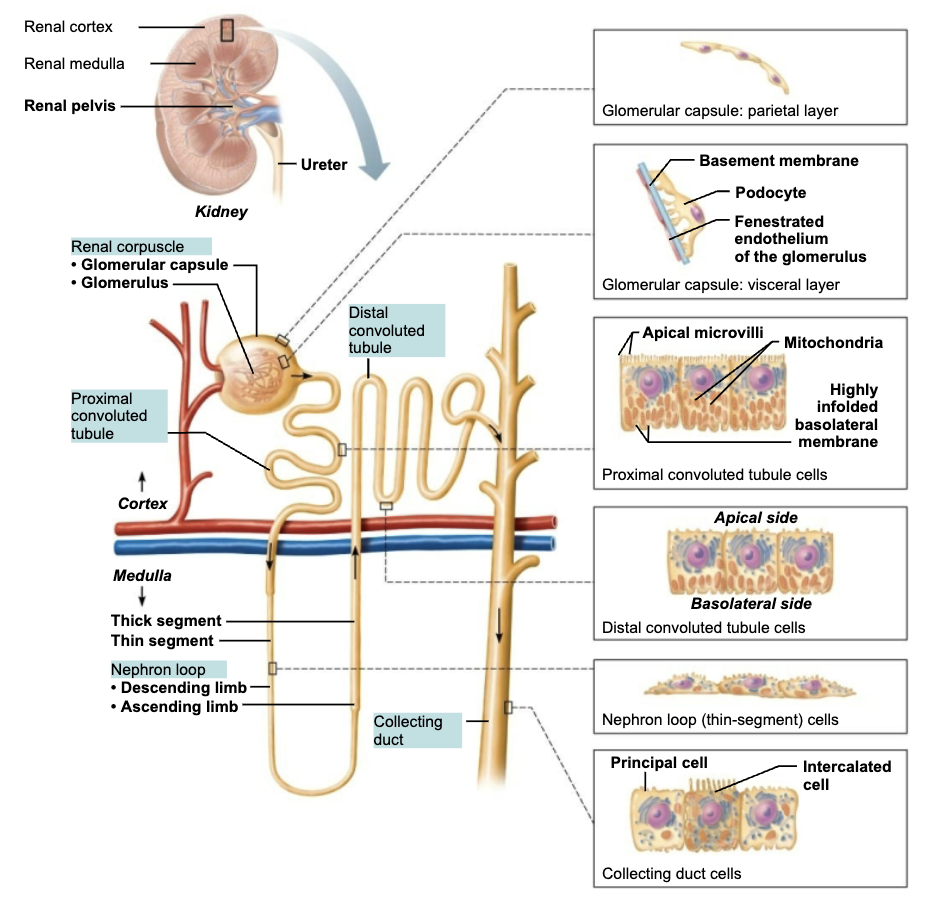
Two main parts:

  1. Renal corpuscle

  2. Renal tubule

<p>Two main parts: </p><ol><li><p><strong>Renal corpuscle</strong></p></li><li><p><strong>Renal tubule</strong></p></li></ol><p></p>
3
New cards

Describe the Structure and Function of Regions of the Renal Corpuscle

  1. Glomerulus 

    • STURCTURE 

      • Tufts of capillaries composed of fenestrated endothelium 

    • FUNCTION 

      • Highly porous capillaries (fenestrated)

      • Allows for efficient filtrate formation

  2.  Glomerular capsule (Bowman’s capsule)

    • STURCTURE

      • Parietal layersimple squamous epithelium

      • Visceral layer → clings to glomerular capillaries; branching epithelial podocytes

    • FUNCTION 

      • Cup-shaped hallow structure surrounding glomerulus
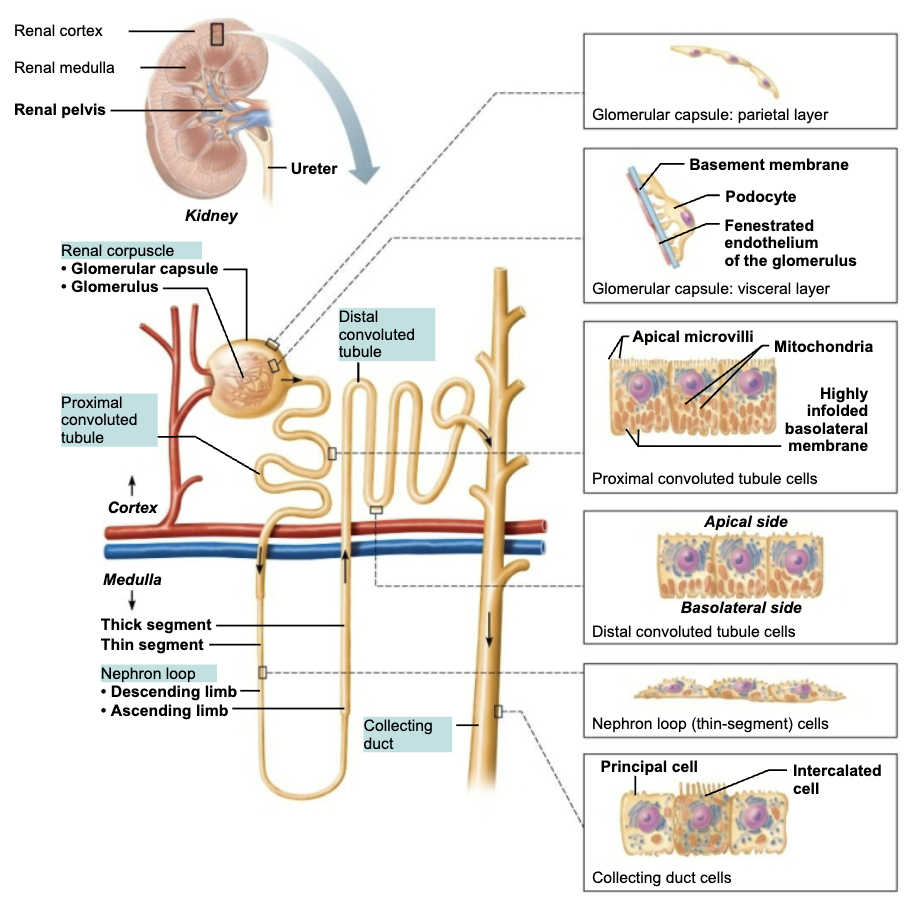
<ol><li><p><strong>Glomerulus&nbsp;</strong></p><ul><li><p><span style="color: blue;"><strong><span>STURCTURE</span></strong></span><span style="color: red;"><strong><span>&nbsp;</span></strong></span></p><ul><li><p><span style="color: blue;">Tufts of capillaries</span> composed of <span style="color: purple;"><strong><em>fenestrated endothelium</em></strong></span>&nbsp;</p></li></ul></li><li><p><span style="color: red;"><strong><span>FUNCTION&nbsp;</span></strong></span></p><ul><li><p>Highly porous capillaries (fenestrated)</p></li><li><p>Allows for efficient <span style="color: purple;"><strong><span>filtrate</span></strong></span> formation</p></li></ul></li></ul></li><li><p><strong>&nbsp;Glomerular capsule </strong>(<em>Bowman’s capsule</em>)</p><ul><li><p><span style="color: blue;"><strong><span>STURCTURE</span></strong></span></p><ul><li><p><span style="color: blue;">Parietal layer</span> → <span style="color: purple;"><strong><em>simple squamous epithelium</em></strong></span></p></li><li><p><span style="color: blue;">Visceral layer</span> → clings to glomerular capillaries; branching <span style="color: purple;"><strong><em>epithelial podocytes</em></strong></span></p></li></ul></li><li><p><span style="color: red;"><strong><span>FUNCTION</span></strong></span><strong><span>&nbsp;</span></strong></p><ul><li><p>Cup-shaped hallow structure surrounding glomerulus</p></li></ul></li></ul></li></ol><p></p>
4
New cards

Role of Filtrate

Plasma-derived fluid that renal tubules process to form urine 

5
New cards

Describe the structure and function of Regions of the Renal Tubule

STRUCTURE

  • 3cm (1.2 in) long

  • Single layer of epithelial cells

FUNCTION

  • Each region has its own unique histology and function

    1. Proximal Convoluted Tubule (PCT)

    2. Nephron loop

    3. Distal Convoluted Tubule (DCT)

    4. Collecting ducts

<p><span style="color: blue;"><strong>STRUCTURE </strong></span></p><ul><li><p><span style="color: green;"><strong>3cm (1.2 in) long</strong></span></p></li><li><p>Single layer of <span style="color: purple;"><strong><em>epithelial cells </em></strong></span></p></li></ul><p><span style="color: red;"><strong>FUNCTION</strong></span><span style="color: blue;"><strong> </strong></span></p><ul><li><p>Each region has its own unique histology and function</p><ol><li><p><strong>Proximal Convoluted Tubule (PCT) </strong></p></li><li><p><strong>Nephron loop </strong></p></li><li><p><strong>Distal Convoluted Tubule (DCT)  </strong></p></li><li><p><strong>Collecting ducts </strong></p></li></ol></li></ul><p></p>
6
New cards

Structure and Function of Proximal Convoluted Tubule (PCT)

Region of the Renal Tubule (1/4)

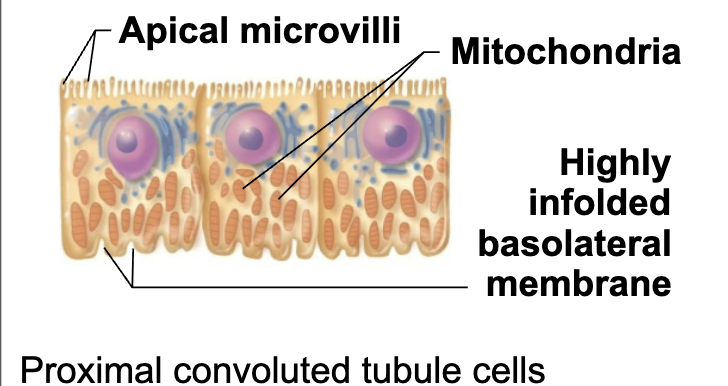
STRUCTURE

  • Confined to cortex

  • Cuboidal cells with dense microvilli that form brush border

FUNCTION

  1. Increase surface area

  2. Reabsorption & secretion

<p><code>Region of the Renal Tubule (1/4) </code></p><p><span style="color: blue;"><strong><span>STRUCTURE</span></strong></span></p><ul><li><p><span style="color: purple;"><strong><mark data-color="purple" style="background-color: purple; color: inherit;"><span>Confined to cortex</span></mark></strong></span></p></li><li><p><span style="color: blue;"><strong><span>Cuboidal cells</span></strong></span> with dense microvilli that form brush border</p></li></ul><p><span style="color: red;"><strong><span>FUNCTION</span></strong></span></p><ol><li><p>Increase surface area</p></li><li><p>Reabsorption &amp; secretion</p></li></ol><p></p>
7
New cards

Structure and Function of Nephron loop

Region of the Renal Tubule (2/4)

Loop of Henle

STRUCTURE

  • Middle segment

  • U-shaped structure consisting of two limbs

    1. Descending limb

    2. Ascending limb

FUNCTION

  1. Plays a vital role in the kidney’s ability to form dilute or concentrated urine
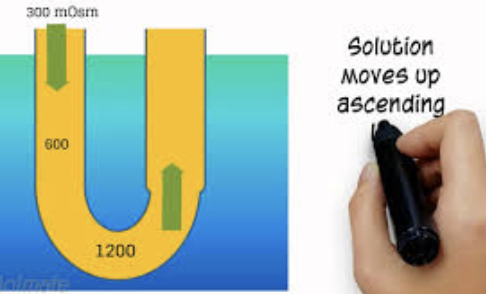
<p><code>Region of the Renal Tubule (2/4) </code></p><p><strong><em>Loop of Henle</em></strong></p><p><span style="color: blue;"><strong><span>STRUCTURE</span></strong></span></p><ul><li><p><span style="color: purple;"><strong><mark data-color="purple" style="background-color: purple; color: inherit;"><span>Middle segment</span></mark></strong></span></p></li><li><p>U-shaped structure consisting of two limbs</p><ol><li><p><span style="color: blue;"><span>Descending limb</span></span></p></li><li><p><span style="color: blue;"><span>Ascending limb</span></span></p></li></ol></li></ul><p><span style="color: red;"><strong><span>FUNCTION</span></strong></span></p><ol><li><p><span>Plays a vital role in the kidney’s ability to form dilute or concentrated urine</span></p></li></ol><p></p>
8
New cards

Distinguish between Descending limb & Ascending limb

  • Descending limb

    • Proximal part of descending limb is continuous with proximal convoluted tubule (PCT)

    • Distal portion also called descending thin limb

  • Ascending limb

    • Thick ascending limb

<ul><li><p><strong>Descending limb</strong></p><ul><li><p><span style="color: purple;"><strong><mark data-color="purple" style="background-color: purple; color: inherit;">Proximal part of descending limb is continuous with proximal convoluted tubule (PCT) </mark></strong></span></p></li><li><p>Distal portion also called <span style="color: blue;">descending thin limb </span></p></li></ul></li><li><p><strong>Ascending limb </strong></p><ul><li><p><span style="color: red;">Thick ascending limb </span></p></li></ul></li></ul><p></p>
9
New cards

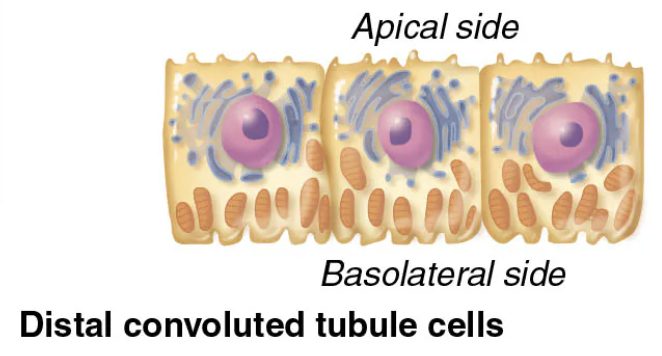
Structure and Function of Distal Convoluted Tubule (DCT) 

Region of the Renal Tubule (3/4)
STRUCTURE

  • Confined to cortex

FUNCTION

  1. MORE SECRETION than reabsorption

<p><code>Region of the Renal Tubule (3/4)</code><br><span style="color: blue;"><strong><span>STRUCTURE</span></strong></span></p><ul><li><p><span style="color: purple;"><strong><mark data-color="purple" style="background-color: purple; color: inherit;"><span>Confined to cortex</span></mark></strong></span></p></li></ul><p><span style="color: red;"><strong><span>FUNCTION</span></strong></span></p><ol><li><p>MORE SECRETION than reabsorption</p></li></ol><p></p>
10
New cards

Structure and Function of Collecting Ducts

Region of the Renal Tubule (4/4)
STRUCTURE

  • Run through medullary pyramids 

FUNCTION

  1. Receive filtrate from many nephrons 

  2. Ducts fuse together to deliver urine through papillae into minor calyces 
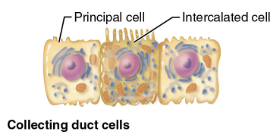
<p><code>Region of the Renal Tubule (4/4)</code><br><span style="color: blue;"><strong><span>STRUCTURE</span></strong></span></p><ul><li><p><span style="color: purple;"><strong><mark data-color="purple" style="background-color: purple; color: inherit;">Run through medullary pyramids&nbsp;</mark></strong></span></p></li></ul><p><span style="color: red;"><strong><span>FUNCTION</span></strong></span></p><ol><li><p>Receive filtrate from many nephrons&nbsp;</p></li><li><p>Ducts fuse together to deliver urine through papillae into minor calyces&nbsp;</p></li></ol><p></p>
11
New cards

Name the Major Groups of Nephrons

  1. Cortical nephrons

    • Make up 85%

    • Almost entirely in cortex

  2. Juxtamedullary nephrons

    • Long nephron loops deeply invade medulla

    • Ascending limbs have thick and thin segments

    • Important in production of concentrated urine

12
New cards

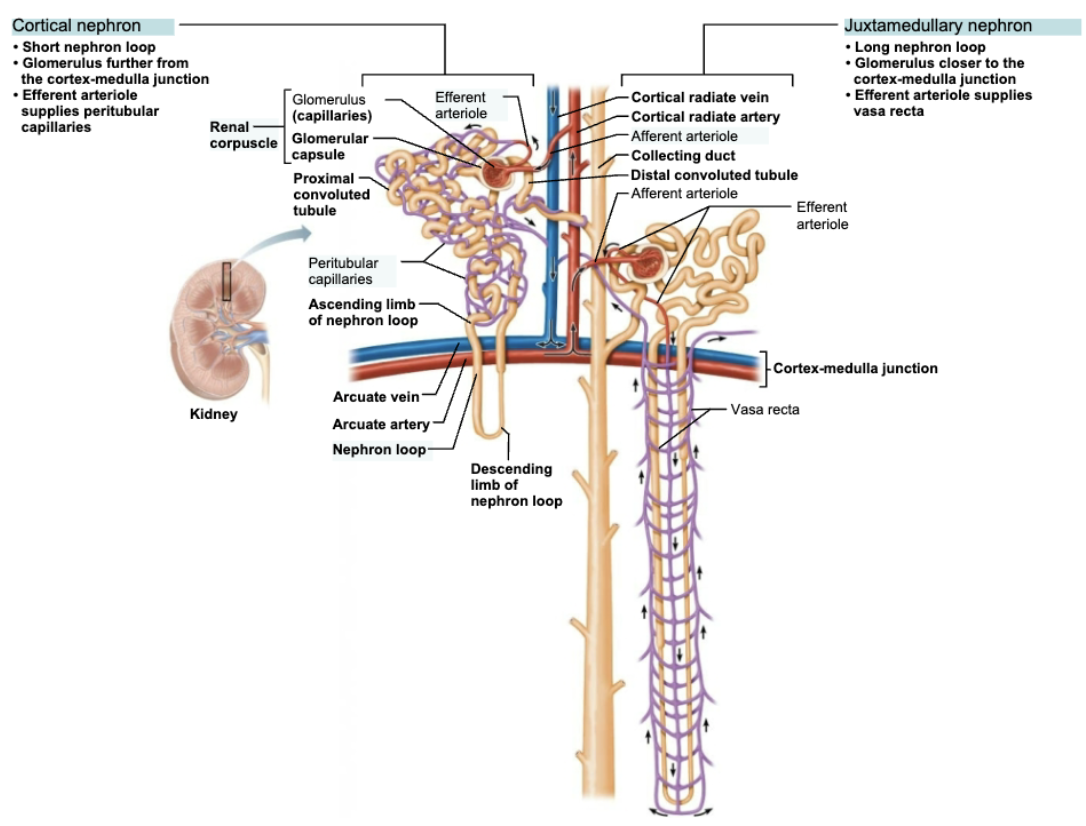
Compare and constast Cortical vs Juxtamedullary Nephrons Structure

  • Cortical nephrons

    1. Almost entirely in cortex

    2. Short nephron loop 

    3. Glomerulus further from the cortex-medulla junction 

    4. Efferent arteriole supplies peritubular capillaries 

  • Juxtamedullary nephrons

    • Long nephron loops deeply invade medulla

    • Long nephron loop 

    • Glomerulus closer to the  cortex-medulla junction 

    • Efferent arteriole supplies vasa recta 
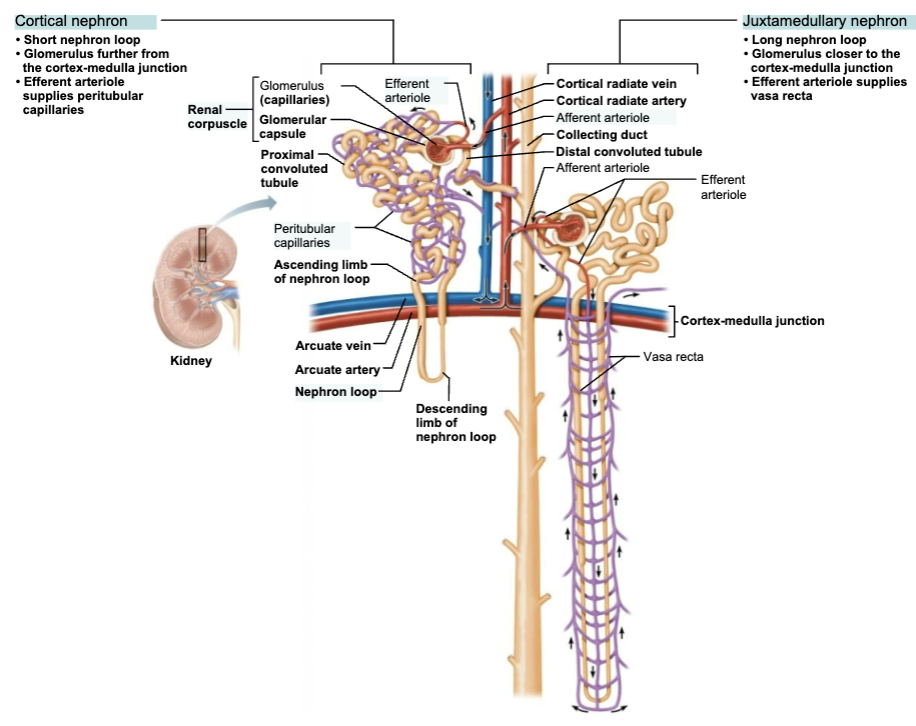
<ul><li><p><strong>Cortical nephrons</strong></p><ol><li><p>Almost entirely in <span style="color: purple;"><strong><mark data-color="purple" style="background-color: purple; color: inherit;"><span>cortex</span></mark></strong></span></p></li><li><p><strong><em>Short</em></strong> nephron loop&nbsp;</p></li><li><p>Glomerulus <strong><em>further</em></strong> from the cortex-medulla junction&nbsp;</p></li><li><p>Efferent arteriole supplies <strong><em><u>peritubular capillaries&nbsp;</u></em></strong></p></li></ol></li><li><p><strong>Juxtamedullary nephrons</strong></p><ul><li><p>Long nephron loops deeply invade <span style="color: purple;"><strong><mark data-color="purple" style="background-color: purple; color: inherit;"><span>medulla</span></mark></strong></span></p></li><li><p><strong><em>Long</em></strong> nephron loop&nbsp;</p></li><li><p>Glomerulus <strong><em>closer</em></strong> to the&nbsp; cortex-medulla junction&nbsp;</p></li><li><p>Efferent arteriole <strong><em><u>supplies vasa recta</u></em></strong>&nbsp;</p></li></ul></li></ul><p></p>
13
New cards

Name the Capillary Bed(s) associated to Cortical nephrons  

  1. Glomerulus

  2. Peritubular capillaries

<ol><li><p><strong>Glomerulus </strong></p></li><li><p><strong>Peritubular capillaries </strong></p></li></ol><p></p>
14
New cards

Name the Capillary Bed(s) associated to Juxtamedullary Nephrons

  1. Glomerulus

  2. Vasa recta 

<ol><li><p><strong>Glomerulus</strong></p></li><li><p><strong>Vasa recta&nbsp;</strong></p></li></ol><p></p>
15
New cards

Describe Location and Function of Glomerulus Capillaries

LOCATION 

  • Cortical & Juxtaglomerular Complex (JGC) →  Renal Corpusle

FUNCTION 

  1. Capillaries are specialized for filtration 

  2. Different from other capillary bends because they are fed and drained by arteriole 

    • Afferent arteriole enters glomerulus and leaves via efferent arteriole
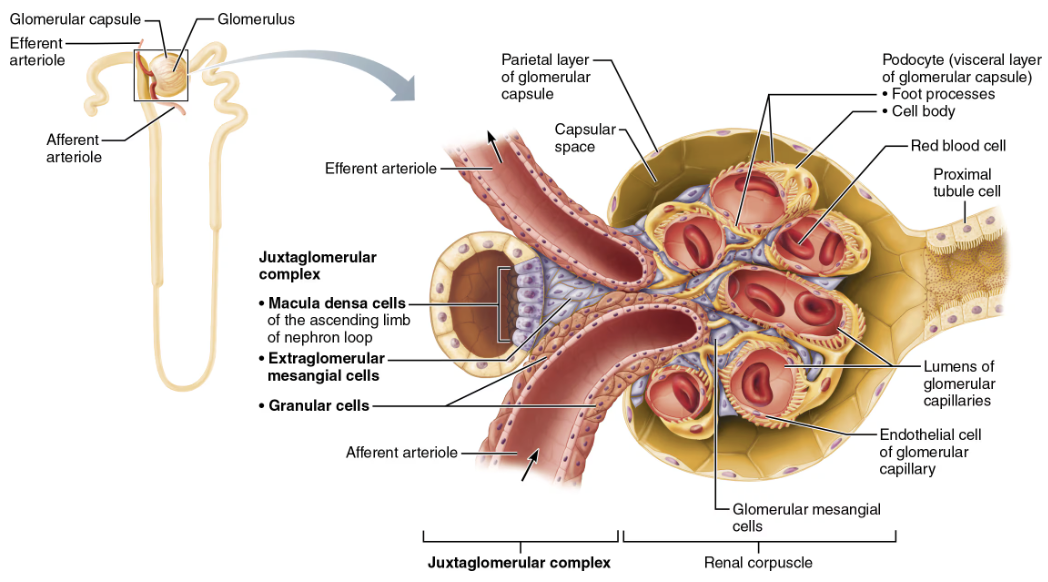
<p><strong>LOCATION</strong>&nbsp;</p><ul><li><p><span style="color: purple;"><strong><u><mark data-color="yellow" style="background-color: yellow; color: inherit;"><span>Cortical &amp; Juxtaglomerular Complex (JGC</span></mark></u><mark data-color="yellow" style="background-color: yellow; color: inherit;"><span>)</span></mark></strong></span>&nbsp;→&nbsp;&nbsp;<span style="color: purple;"><strong><mark data-color="purple" style="background-color: purple; color: inherit;"><span>Renal Corpusle</span></mark></strong></span></p></li></ul><p><span style="color: red;"><strong><span>FUNCTION&nbsp;</span></strong></span></p><ol><li><p>Capillaries are specialized for filtration&nbsp;</p></li><li><p>Different from other capillary bends because they are <strong><em>fed and drained</em></strong> by <span style="color: blue;"><strong><span>arteriole</span></strong></span>&nbsp;</p><ul><li><p><span style="color: blue;"><strong><span>Afferent arteriole</span></strong></span> enters <strong>glomerulus</strong> and leaves via <span style="color: blue;"><strong><span>efferent arteriole</span></strong></span></p></li></ul></li></ol><p></p>
16
New cards

T/F: Blood pressure in glomerulus is low

→ FALSE

  • Blood pressure in glomerulus is HIGH → Afferent arterioles are larger in diameter than efferent arterioles
<p><strong>→ FALSE </strong></p><ul><li><p> Blood pressure in glomerulus is <strong>HIGH</strong> → Afferent arterioles are larger in diameter than efferent arterioles </p></li></ul><p></p>
17
New cards

Describe Location and Function of Peritubular Capillaries 

LOCATION 

  • Cortical  Nephron →  Renal Tubule

STRUCTURE

  • Arise from efferent arterioles → Empty into venules

  • Cling to ajacent renal tubules in cortex

FUNCTION 

  1. Low-pressure, porpus capillaries adapted for absorption ot water and solutes
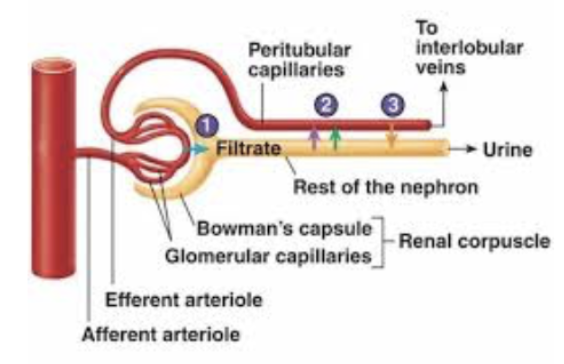
<p><strong>LOCATION</strong>&nbsp;</p><ul><li><p><span style="color: purple;"><strong><u><mark data-color="yellow" style="background-color: yellow; color: inherit;"><span>Cortical&nbsp; Nephron</span></mark><mark data-color="purple" style="background-color: purple; color: inherit;"><span>&nbsp;</span></mark></u></strong></span>→&nbsp;&nbsp;<span style="color: purple;"><strong><mark data-color="purple" style="background-color: purple; color: inherit;"><span>Renal Tubule</span></mark></strong></span></p></li></ul><p><span style="color: blue;"><strong><span>STRUCTURE</span></strong></span></p><ul><li><p>Arise from efferent arterioles → Empty into venules</p></li><li><p>Cling to ajacent renal tubules in cortex</p></li></ul><p><span style="color: red;"><strong><span>FUNCTION&nbsp;</span></strong></span></p><ol><li><p>Low-pressure, porpus capillaries adapted for absorption ot water and solutes</p></li></ol><p></p>
18
New cards

Describe Location and Function of Vasa recta  

LOCATION 

  • Juxtaglomerular Complex (JGC)→  Renal Tubule

STRUCTURE

  • Long, thin-walled vessels parallel to long nephron loops to Juxtamedullary Nephrons

  • Arise from efferent arterioles serving Juxtamedullary Nephrons

FUNCTION 

  1. Formation of concentrated urine 

19
New cards

SUMMARY of Nephron Capillary Beds

Glomerulus

LOCATION 

  • Cortical & Juxtaglomerular Complex (JGC) →  Renal Corpusle

STRUCTURE

  • Different from other capillary bends because they are fed and drained by arteriole 

    • Afferent arteriole enters glomerulus and leaves via efferent arteriole

FUNCTION 

  • Capillaries are specialized for filtration 

Peritubular Capillaries

LOCATION 

  • Cortical  Nephron →  Renal Tubule

STRUCTURE

  • Arise from efferent arterioles → Empty into venules

  • Cling to adjacent renal tubules in cortex

FUNCTION 

  • Low-pressure, porous capillaries adapted for absorption of water and solutes

Vasa recta

LOCATION 

  • Juxtaglomerular Complex (JGC)→  Renal Tubule

STRUCTURE

  • Arise from efferent arterioles serving Juxtamedullary Nephrons

  • Long, thin-walled vessels parallel to long nephron loops to Juxtamedullary Nephrons

FUNCTION 

  • Formation of concentrated urine 

<p><code>Glomerulus</code></p><p><strong>LOCATION</strong>&nbsp;</p><ul><li><p><span style="color: purple;"><strong><u><mark data-color="yellow" style="background-color: yellow; color: inherit;"><span>Cortical &amp; Juxtaglomerular Complex (JGC</span></mark></u><mark data-color="yellow" style="background-color: yellow; color: inherit;"><span>)</span></mark></strong></span>&nbsp;→&nbsp;&nbsp;<span style="color: purple;"><strong><mark data-color="purple" style="background-color: purple; color: inherit;"><span>Renal Corpusle</span></mark></strong></span></p></li></ul><p><span style="color: rgb(0, 0, 0);"><strong><span>STRUCTURE</span></strong></span></p><ul><li><p>Different from other capillary bends because they are <strong><em>fed and drained</em></strong> by <span style="color: blue;"><strong><span>arteriole</span></strong></span>&nbsp;</p><ul><li><p><span style="color: blue;"><strong><mark data-color="green" style="background-color: green; color: inherit;"><span>Afferent arteriole</span></mark></strong></span> enters <strong>glomerulus</strong> and leaves via <span style="color: blue;"><strong><mark data-color="red" style="background-color: red; color: inherit;"><span>efferent arteriole</span></mark></strong></span></p></li></ul></li></ul><p><span style="color: rgb(0, 0, 0);"><strong><span>FUNCTION&nbsp;</span></strong></span></p><ul><li><p><span style="color: red;"><strong>Capillaries are specialized for filtration&nbsp;</strong></span></p></li></ul><p><code>Peritubular Capillaries</code></p><p><strong>LOCATION</strong>&nbsp;</p><ul><li><p><span style="color: purple;"><strong><u><mark data-color="yellow" style="background-color: yellow; color: inherit;"><span>Cortical&nbsp; Nephron</span></mark><mark data-color="purple" style="background-color: purple; color: inherit;"><span> </span></mark></u></strong></span>→&nbsp;&nbsp;<span style="color: purple;"><strong><mark data-color="purple" style="background-color: purple; color: inherit;"><span>Renal Tubule</span></mark></strong></span></p></li></ul><p><strong><span>STRUCTURE</span></strong></p><ul><li><p>Arise from <span style="color: blue;"><strong><mark data-color="green" style="background-color: green; color: inherit;">efferent arterioles</mark></strong></span> → Empty into <span style="color: blue;"><strong><mark data-color="red" style="background-color: red; color: inherit;">venules</mark></strong></span></p></li><li><p>Cling to adjacent renal tubules in cortex</p></li></ul><p><strong><span>FUNCTION</span></strong><span style="color: red;"><strong><span>&nbsp;</span></strong></span></p><ul><li><p><span style="color: red;"><strong>Low-pressure, porous capillaries adapted for absorption of water and solutes</strong></span></p></li></ul><p><code>Vasa recta</code></p><p><strong>LOCATION</strong>&nbsp;</p><ul><li><p><span style="color: purple;"><strong><u><mark data-color="yellow" style="background-color: yellow; color: inherit;"><span>Juxtaglomerular Complex (JGC</span></mark></u></strong></span><strong><mark data-color="yellow" style="background-color: yellow; color: inherit;"><span>)</span></mark></strong>→&nbsp;&nbsp;<span style="color: purple;"><strong><mark data-color="purple" style="background-color: purple; color: inherit;"><span>Renal Tubule</span></mark></strong></span></p></li></ul><p><strong><span>STRUCTURE</span></strong></p><ul><li><p>Arise from <span style="color: blue;"><strong><mark data-color="green" style="background-color: green; color: inherit;">efferent arterioles</mark></strong></span> serving Juxtamedullary Nephrons</p></li><li><p>Long, thin-walled vessels parallel to long nephron loops to&nbsp;Juxtamedullary Nephrons</p></li></ul><p><strong><span>FUNCTION</span></strong><span style="color: red;"><strong><span>&nbsp;</span></strong></span></p><ul><li><p><span style="color: red;"><strong>Formation of concentrated urine&nbsp;</strong></span></p></li></ul><p></p>
20
New cards

Role of Afferent & Efferent Arteriole

  • Afferent Arteriole

    • Supplies blood to the glomerulus of a nephron.

  • Efferent Arteriole

    • Drains blood from the glomerulus of a nephron

21
New cards

Explain Structure and Function of Juxtaglomerular Complex (JGC)

LOCATION 

  • Each nephron has one Juxtaglomerular Complex (JGC)

STRCTURE 

  • Involves modified portions of:

    1. Distal portion of ascending limb of nephron loop

    2. Afferent arteriole

FUNCTION 

  1. Important in regulating rate o filtrate formation and blood pressure
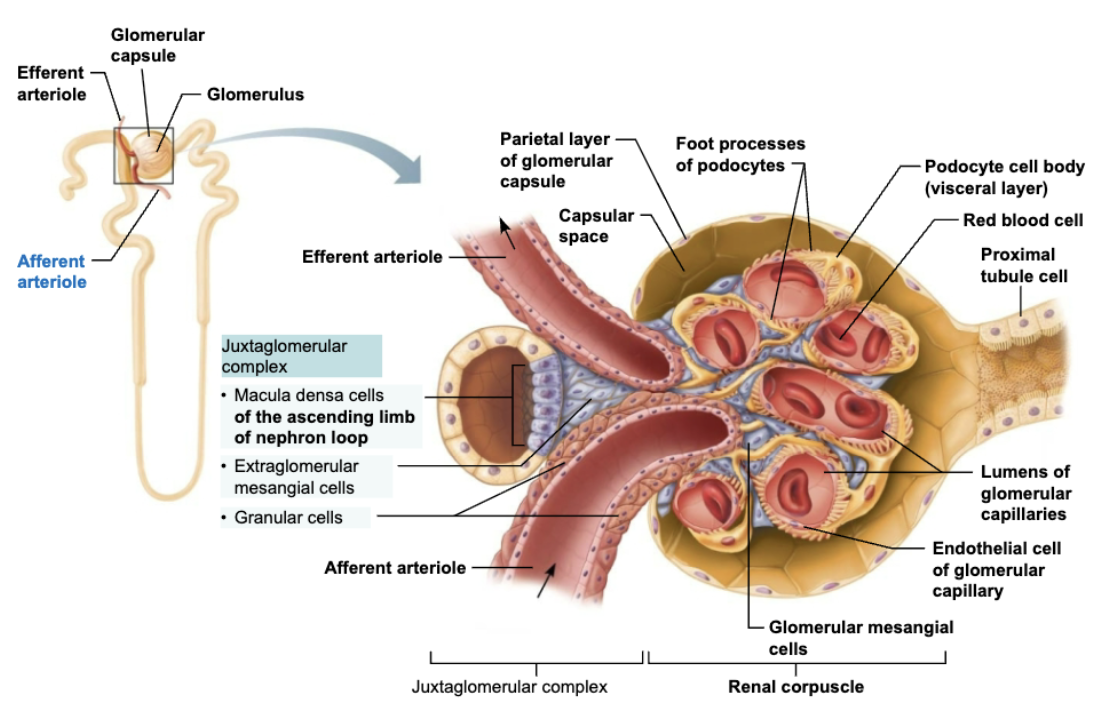
<p><strong>LOCATION&nbsp;</strong></p><ul><li><p><span style="color: purple;"><strong><mark data-color="purple" style="background-color: purple; color: inherit;">Each nephron has one</mark></strong></span>&nbsp;Juxtaglomerular Complex (JGC)</p></li></ul><p><span style="color: blue;"><strong>STRCTURE</strong></span><strong>&nbsp;</strong></p><ul><li><p>Involves modified portions of: </p><ol><li><p>Distal portion of ascending limb of <span style="color: blue;">nephron loop </span></p></li><li><p><span style="color: blue;">Afferent arteriole</span> </p></li></ol></li></ul><p><span style="color: red;"><strong>FUNCTION</strong></span><strong>&nbsp;</strong></p><ol><li><p>Important in regulating rate o filtrate formation and blood pressure</p></li></ol><p></p>
22
New cards

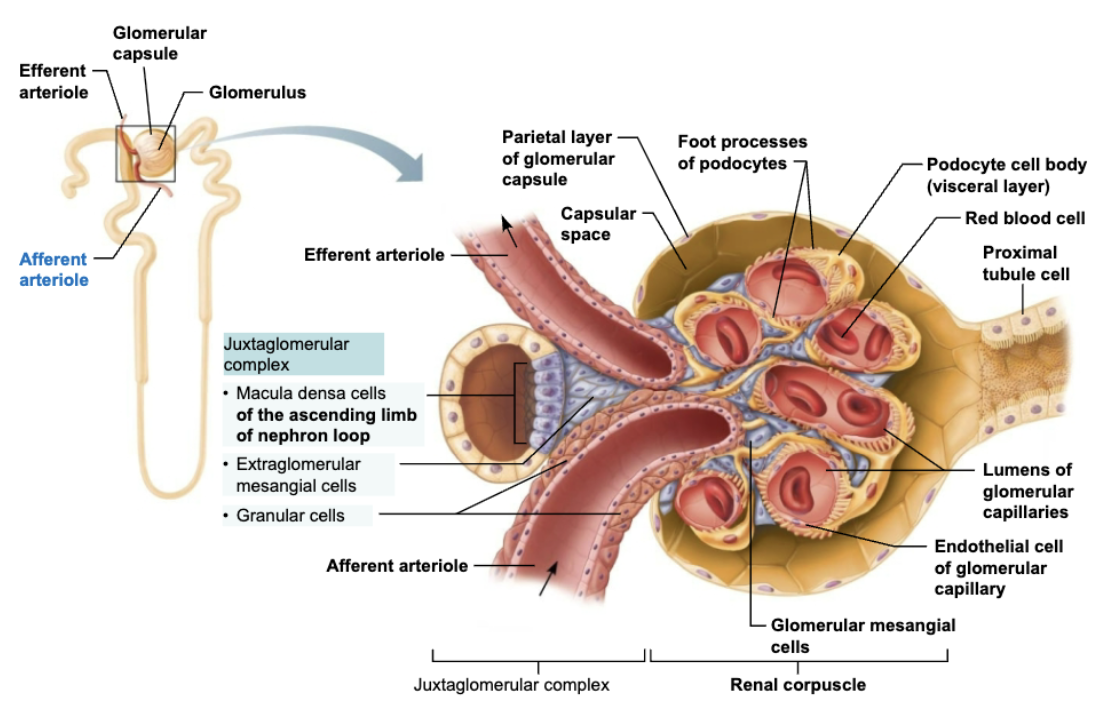
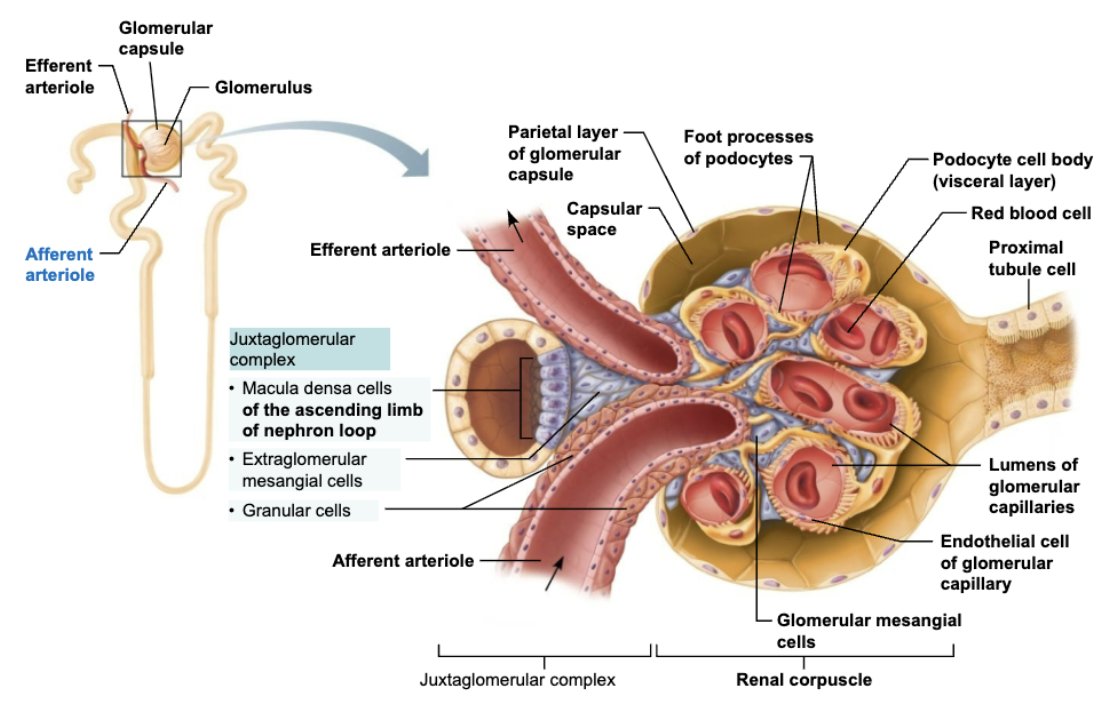
Name the Cell Populations in JGC 

  1. Macula densa cells

  2. Granular cells 

23
New cards

Explain Structure and Function of Macula densa cells

Juxtaglomerular Complex

STRUCTURE 

  • Closely packed cells of ascending limb 

FUNCTION

  1. Contain chemoreceptors that sense NaCl content of filtrate
<p><span style="color: purple;"><strong><mark data-color="purple" style="background-color: purple; color: inherit;">Juxtaglomerular Complex</mark></strong></span></p><p><span style="color: blue;"><strong>STRUCTURE&nbsp;</strong></span></p><ul><li><p>Closely packed cells of ascending limb&nbsp;</p></li></ul><p><span style="color: red;"><strong>FUNCTION</strong></span></p><ol><li><p>Contain <strong>chemoreceptors</strong> that sense NaCl content of <span style="color: purple;"><strong>filtrate</strong></span></p></li></ol><p></p>
24
New cards

Explain Structure and Function of Granular cells 

Juxtaglomerular Complex

STRUCTURE 

  • Enlarged, smooth muscle cells of arteriole 

FUNCTION

  • Act as mechanoreceptors to sense BP in afferent arteriole 

  • Contain secretory granules that contain renin 
<p><span style="color: purple;"><strong><mark data-color="purple" style="background-color: purple; color: inherit;"><span>Juxtaglomerular Complex</span></mark></strong></span></p><p><span style="color: blue;"><strong><span>STRUCTURE&nbsp;</span></strong></span></p><ul><li><p>Enlarged, smooth muscle cells of arteriole&nbsp;</p></li></ul><p><span style="color: red;"><strong><span>FUNCTION</span></strong></span></p><ul><li><p>Act as <strong>mechanoreceptors</strong> to sense BP in afferent arteriole&nbsp;</p></li><li><p>Contain <strong>secretory granules</strong> that contain <span style="color: red;"><strong>renin</strong></span>&nbsp;</p></li></ul><p></p>