AP Bio Unit 9 Cell Communications, Survival
 Call Kai
 Learn
Learn Practice Test
 Spaced Repetition
 Match
Match Flashcards
 Knowt Play
1/96

There's no tags or description
Looks like no tags are added yet.
Name | Mastery | Learn | Test | Matching | Spaced | Call with Kai |
|---|
No analytics yet
Send a link to your students to track their progress
97 Terms
The detector of light during de-etiolation (greening) of a tomato plant is (are) _____.
xanthophylls
carotenoids
phytochrome
auxin
3
Plant hormones _____.
are unable to move from one cell to another
in plant cells naturally exist in very large amounts
change their shape in response to stimulus
affect only cells with the appropriate receptor
4
Which of the following can function in signal transduction in plants ?
I) calcium ions
II) nonrandom mutations
III) receptor proteins
IV) autochrome
V) secondary messengers
only II, III, and V
only I, III, and V
only I, III, and IV
only I, II, and V
2
Plant hormonal regulation differs from animal hormonal regulation in that _____.
only animal hormones may have either external or internal receptors
there are no dedicated hormone-producing organs in plants as there are in animals
only animal hormone concentrations are developmentally regulated
all production of hormones is local in plants with little long-distance transport
2
Which of the following statements best summarizes the acid-growth hypothesis in an actively growing shoot?
Auxins activate aquaporins that increase turgor pressure in the cells.
Auxins and gibberellins together act as a lubricant to help stretch cellulose microfibrils.
Auxin stimulates proton pumps in the plasma membrane and tonoplast.
Auxin-activated proton pumps lower the pH of the cell wall, which breaks bonds and makes the walls more flexible.
4
You have a small tree in your yard that is the height that you want it, but does not have as many branches as you want. How can you prune it to trigger it to increase the number of branches?
Cut off the leaves at the base of most of the branches.
Cut off lower branches.
Cut off the tips of the main shoots.
Cut off the leaves at the ends of several branches.
3
A researcher found a beautiful plant while traveling in Alaska and collected its seeds. When she came back to Florida, she soaked some seeds in pure water and some in water with a hormone. When she put the seeds in soil to grow, only the seeds that had been soaked with the hormone germinated. The hormone most likely was _____.
ethylene
auxin
abscisic acid (ABA)
gibberellin
4
Many plants flower in response to day-length cues. Which of the following statements best summarizes this phenomenon?
As a rule, long-day plants flower in the spring or fall.
Flowering in short-day and long-day plants is controlled by phytochrome.
As a rule, short-day plants flower in the summer.
Long-day plants flower in response to long days, not short nights.
2
Which of the following can be sensed by plants?
I) gravity
II) pathogens
III) wind
IV) light
only II, III, and IV
only I, II, and IV
I, II, III, and IV
only I and III
3
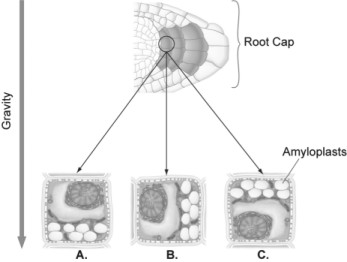
Suppose you laid a seedling on its side so that the root was parallel to the ground as shown in the figure above. Several hours after the change in position, where in the root cells (position A, B, or C in the figure above) would you find the amyloplasts?
A
B
C
1
In extremely cold regions, woody species may survive freezing temperatures by _____.
emptying water from the vacuoles to prevent freezing
decreasing the fluidity of all cellular membranes
decreasing the numbers of phospholipids in cell membranes
increasing cytoplasmic levels of specific solute concentrations, such as sugars
4
Most scientists agree that global warming is underway; thus, it is important to know how plants respond to heat stress. Which of the following would be a useful line of inquiry to try and improve plant response and survival to heat stress?
increased production of heat-shock proteins
the production of heat-stable carbohydrates
the opening of stomata to increase evaporational heat loss
protoplast fusion experiments with xerophytic plants
2
When an arborist prunes a limb off a valuable tree, he or she may paint the cut surface. The primary purpose of the paint is to _____.
stimulate growth of the cork cambium to "heal" the wound
block entry of pathogens through the wound
improve the appearance of the cut surface
minimize water loss by evaporation from the cut surface
2
Use the following information to answer the question(s) below.
Some plants have continually produced secondary defense compounds. Other plants are induced to form secondary defense compounds when they are injured. Corn seedling leaves that are chewed on by the caterpillars of a type of cutworm moth emit immediate volatile chemicals (LOX products), and after six hours large amounts of terpenoid compounds are released into the air. The terpenoids are released not only from the leaf being chewed, but from all leaves of the plant. The terpenoid compounds attract a parasitoid wasp female that lays her eggs on the caterpillar. When the wasp larvae hatch, they eat and kill the moth caterpillar. (T.C.J. Turlings, J. H. Loughrin, P. J. McCall, U. S. R. Rose, W. J. Lewis, and J. H. Tumlinson. 1995. How caterpillar-damaged plants protect themselves by attracting parasitic wasps. Proceedings of the National Academy of Sciences 92:4169-74.)
Refer to the paragraph on how caterpillar-damaged plants protect themselves by attracting parasitic wasps. To test the hypothesis that caterpillar saliva and a wound are both necessary to attract the parasitoid wasps you would need to include which of the following in your experiment?
I) Slash the corn leaves with a razor blade.
II) Put caterpillar saliva on a leaf wound.
III) Put caterpillar saliva on an intact leaf.
only I
only II
only III
I, II, and III
4
Both plants and animals respond to environmental stimuli. Identify the correct statement(s) about this response.
Select all that apply.
Both plants and animals have physiological cycles called circadian rhythms.
The molecular processes determining how plants and animals perceive environmental changes are often homologous.
The molecular processes determining how plants and animals perceive environmental changes are equally complex
All of the above
How do plant and animal hormones differ?
Select all that apply.
In plants more so than in animals, it is the balance between existing hormones, rather than hormones acting in isolation, that controls growth and development.
Unlike animal hormones, plant hormones do not bind to a specific receptor and trigger responses in target cells and tissues.
Unlike animal hormones, plant hormones act only locally.
1
Though they are not mobile, plants have effective defenses against biological attack. Identify the correct statement(s) about these defenses.
Select all that apply.
Plants may defend against herbivores by producing compounds that reduce protein function in the herbivore.
Plants have R proteins that recognize pathogen-derived molecules.
A plant’s triple response protects it against viral attack.
1 & 2
Some plants respond to herbivore damage by releasing volatile compounds. Identify the correct effect(s) of volatiles.
Select all that apply.
Volatiles may warn nearby plants of the same species, so that they can mount a biochemical defense.
Volatiles may poison the attacking herbivore.
Volatiles may attract parasitoid wasps to attack an insect herbivore.
1 & 3
When a plant is attacked by a pathogen, it may respond by carrying out a defense that causes cell and tissue death near the infection site, restricting the spread of the pathogen. What is the name of this defense?
Physical defense
Systemic acquired resistance
The hypersensitive response
3
In a simple synapse, neurotransmitter chemicals are released by _____.
axon hillocks
the presynaptic membrane
ducts on the smooth endoplasmic reticulum
cell bodies
2
In a simple synapse, neurotransmitter chemicals are received by _____.
the postsynaptic membrane
cell bodies
the presynaptic membrane
axon hillocks
1
The operation of the sodium-potassium "pump" moves _____.
sodium and potassium ions into the cell
sodium and potassium ions out of the cell
sodium ions out of the cell and potassium ions into the cell
sodium ions into the cell and potassium ions out of the cell
3
Two fundamental concepts about the ion channels of a "resting" neuron are that the channels _____.
open and close depending on stimuli, and are specific as to which ion can traverse them
are always open, but the concentration gradients of ions frequently change
are always closed, but ions move closer to the channels during excitation
open in response to stimuli, and then close simultaneously, in unison
1
Refer to the following graph of an action potential to answer the question(s) below.
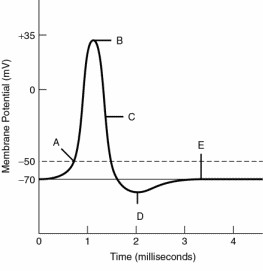
The membrane's permeability to sodium ions is at its maximum at label _____.
A
B
C
D
B
Refer to the following graph of an action potential to answer the question(s) below.
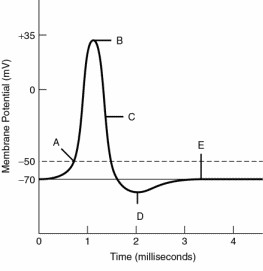
The minimum graded depolarization needed to operate the voltage-gated sodium and potassium channels is indicated by the label _____.
A
B
C
D
1
Refer to the following graph of an action potential to answer the question(s) below.
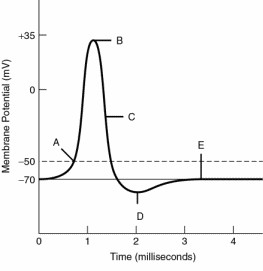
The neuronal membrane is at its resting potential at label _____.
A
B
D
E
4
If you experimentally increase the concentration of Na+ outside a cell while maintaining other ion concentrations as they were, what would happen to the cell's membrane potential?
The answer depends on the thermodynamic potential.
The membrane potential would increase.
The membrane potential would be unaffected.
The membrane potential would decrease.
2
Opening all of the sodium channels on an otherwise typical neuron, with all other ion channels closed (which is an admittedly artificial setting), should move its membrane potential to _____.
+62 mV
0 mV
-90 mV
+30 mV
1
A toxin that binds specifically to voltage-gated sodium channels in axons would be expected to _____.
prevent graded potentials
prevent the depolarization phase of the action potential
increase the release of neurotransmitter molecules
prevent the hyperpolarization phase of the action potential
2
After the depolarization phase of an action potential, the resting potential is restored by _____.
a brief inhibition of the sodium-potassium pump
the opening of voltage-gated potassium channels and the closing of sodium channels
the opening of more voltage-gated sodium channels
a decrease in the membrane's permeability to potassium and chloride ions
2
Action potentials are normally carried in only one direction: from the axon hillock toward the axon terminals. If you experimentally depolarize the middle of the axon to threshold, using an electronic probe, then _____.
an action potential will be initiated and proceed only in the normal direction toward the axon terminal
two action potentials will be initiated, one going toward the axon terminal and one going back toward the hillock
no action potential will be initiated
an action potential will be initiated and proceed only back toward the axon hillock
2
Why are action potentials usually conducted in one direction?
Voltage-gated channels for both Na+ and K+ open in only one direction.
The nodes of Ranvier conduct potentials in one direction.
The brief refractory period prevents reopening of voltage-gated Na+ channels.
The axon hillock has a higher membrane potential than the terminals of the axon.
3
Why do Na+ ions enter the cell when voltage-gated Na+ channels are opened in neurons?
because the Na+ concentration is much lower outside the cell than it is inside
because the Na+ concentration is much higher outside the cell than it is inside, and the Na+ ions are attracted to the negatively charged interior
because the Na+ concentration is much higher outside the cell than it is inside, and the Na+ ions are actively transported by the sodium-potassium pump into the cell
because the Na+ ions are actively transported by the sodium-potassium pump into the cell
2
Which of the following will increase the speed of an action potential moving down an axon?
I) Action potentials move faster in larger diameter axons.
II) Action potentials move faster in axons lacking potassium ion channels.
III) Action potentials move faster in myelinated axons.
only I and III
only II and III
only I and II
I, II, and III
1
In multiple sclerosis the myelin sheaths around the axons of the brain and spinal cord are damaged and demyelination results. How does this disease manifest at the level of the action potential?
I) Action potentials move in the opposite direction on the axon.
II) Action potentials move more slowly along the axon.
III) No action potentials are transmitted.
only I
only II
only III
only II and III
2
Receptors for neurotransmitters are of primary functional importance in assuring one-way synaptic transmission because they are mostly found on the _____.
axonal membrane
axon hillock
postsynaptic membrane
presynaptic membrane
3
The botulinum toxin, which causes botulism, reduces the synaptic release of _____.
endorphin
gamma-aminobutyric acid (GABA)
acetylcholine
nitric oxide
3
What happens if twice as many inhibitory postsynaptic potentials (IPSPs) as excitatory postsynaptic potentials (EPSPs) arrive at a postsynaptic neuron in close proximity?
A weaker action potential results.
A stronger action potential results.
No action potential results.
3
Identify the correct statement(s) about the resting membrane potential of a cell.
Select all that apply.
Neurons are the only cells that have a charge difference across their membranes.
Potassium (K+) and sodium (Na+) gradients are maintained by active transport in a resting mammalian neuron.
Concentration gradients of potassium (K+) and sodium (Na+) across the plasma membrane represent potential energy.
2 & 3
If the membrane potential of a neuron decreases, the membrane potential _____.
becomes more negative.
remains unchanged.
becomes less negative.
3
Why is an action potential an all-or-none response to stimuli?
Because voltage-gated ion channels open when membrane potential passes a particular level
Because a typical neuron receives signals through multiple dendrites but transmits signals through a single axon
Because neurons contain gated ion channels that are either open or closed
1
The plasma membrane of a neuron has voltage-gated sodium and potassium channels. What is the effect of membrane depolarization on these channels?
Membrane depolarization opens sodium channels but closes potassium channels.
Membrane depolarization opens sodium and potassium channels at the same time.
Membrane depolarization first opens sodium channels and then opens potassium channels.
3
What causes the falling phase of the action potential? Select the best answer.
Inactivation of voltage-gated sodium channels and the opening of voltage-gated potassium channels
The opening of voltage-gated sodium channels
The opening of voltage-gated potassium channels
1
Our understanding of mental illness has been most advanced by discoveries involving the _____.
degree of convolutions in the brain's surface
chemicals involved in brain communications
nature of the blood-brain barrier
sequence of developmental specialization
2
Which of the following supports the argument that viruses are nonliving?
They do not evolve.
They have RNA rather than DNA.
Their DNA does not encode proteins.
They are not cellular.
4
Viruses _____.
manufacture their own ATP, proteins, and nucleic acids
metabolize food and produce their own ATP
use the host cell to copy themselves and then viruses synthesize their own proteins
use the host cell to copy themselves and make viral proteins
4
The host range of a virus is determined by _____.
the proteins on its surface and that of the host
the enzymes carried by the virus
the proteins in the host's cytoplasm
whether its nucleic acid is DNA or RNA
1
Which of the following accounts for someone who has had regular herpesvirus-mediated cold sore or genital sore flare-ups?
re-infection by the same herpesvirus strain
copies of the herpesvirus genome permanently maintained in host cell cytoplasm
copies of the herpesvirus genome permanently maintained in host nuclei
re-infection by a closely related herpesvirus of a different strain
3
Which of the following is characteristic of the lytic cycle?
A large number of phages are released at a time.
The viral genome replicates without destroying the host.
Viral DNA is incorporated into the host genome.
The virus–host relationship usually lasts for generations.
1
Which of the following statements describes the lysogenic cycle of lambda (λ) phage?
After infection, the viral genes immediately turn the host cell into a lambda-producing factory, and the host cell then lyses.
The phage DNA is copied and exits the cell as a phage.
The phage genome replicates along with the host genome.
Most of the prophage genes are activated by the product of a particular prophage gene.
3
What is the function of reverse transcriptase in retroviruses?
It converts host cell RNA into viral DNA.
It uses viral RNA as a template for DNA synthesis.
It translates viral RNA into proteins.
It uses viral RNA as a template for making complementary RNA strands.
2
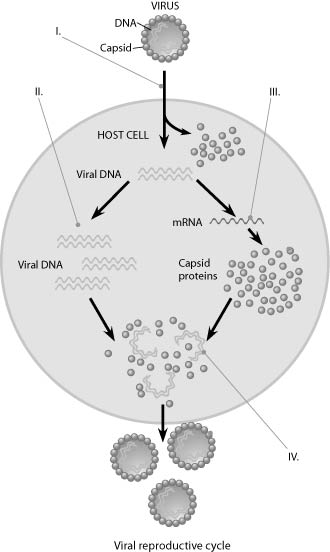
In the figure, at the arrow marked II, what enzyme(s) are being utilized?
host cell DNA polymerase
viral DNA polymerase
host cell RNA polymerase
reverse transcriptase
1
HIV is inactivated in the laboratory after a few minutes of sitting at room temperature, but the flu virus is still active after sitting for several hours. What are the practical consequences of these findings?
The flu virus can be transmitted more easily from person to person than HIV
Disinfecting surfaces is more important to reduce the spread of HIV than the flu
This property of HIV makes it more likely to be a pandemic than the flu virus
HIV can be transmitted more easily from person to person than the flu virus
1
Why do RNA viruses appear to have higher rates of mutation?
RNA nucleotides are more unstable than DNA nucleotides.
Replication of their genomes does not involve proofreading.
RNA viruses can incorporate a variety of nonstandard bases.
RNA viruses are more sensitive to mutagens.
2
The difference between vertical and horizontal transmission of plant viruses is that vertical transmission is _____.
the spread of viruses from trees and tall plants to bushes and other smaller plants, and horizontal transmission is the spread of viruses among plants of similar size
transmission of a virus from a parent plant to its progeny, and horizontal transmission is one plant spreading the virus to another plant
the transfer of DNA from a plant of one species to a plant of a different species, and horizontal transmission is the spread of viruses among plants of the same species
the spread of viruses from upper leaves to lower leaves of the plant, and horizontal transmission is the spread of a virus among leaves at the same general level
2
What are prions?
mobile segments of DNA
viral DNA that attaches itself to the host genome and causes disease
misfolded versions of normal protein that can cause disease
tiny circular molecules of RNA that can infect plants
3
Effective antiviral drugs are usually associated with which of the following properties?
removal of viral mRNAs
removal of viral proteins
interference with viral replication
prevention of the host from becoming infected
3
What is difference between an epidemic and a pandemic?
An epidemic is caused by a bacterial infection; a pandemic is caused by a viral infection.
An epidemic is a disease; a pandemic is a treatment.
An epidemic is restricted to a local region; a pandemic is global.
An epidemic has low mortality; a pandemic has higher mortality.
3
Will treating a viral infection with antibiotics affect the course of the infection?
No; antibiotics work by inhibiting enzymes specific to bacteria. Antibiotics have no effect on eukaryotic or virally encoded enzymes.
Yes; antibiotics can prevent viral entry into the cell by binding to host-receptor proteins.
No; antibiotics do not kill viruses because viruses do not have DNA or RNA.
Yes; antibiotics activate the immune system, and this decreases the severity of the infection.
1
How does a virus differ from a bacterium?
Select all that apply.
Viruses, unlike bacteria, lack metabolic enzymes.
Viruses are two-dimensional, whereas bacteria are three-dimensional.
A virus, unlike a bacterium, lacks a genome.
1
All of the statements below are true. Select the statement that best supports the view of most biologists that viruses are nonliving.
An isolated virus is unable to replicate its genes or regenerate ATP.
Viruses are obligate intracellular parasites.
The viral genome may be single-stranded or double-stranded RNA or DNA.
1
Why is it ineffective to treat viral disease with antibiotics?
Pathogenic RNA viruses have a high rate of mutation, producing new genetic varieties that are insensitive to antibiotic treatment.
Antibiotics inhibit enzymes specific to bacteria and have no effect on virally encoded enzymes.
Due to excessive antibiotic use, most viruses have evolved to be resistant to antibiotics.
2
Identify all correct statements about how viroids differ from viruses.
Select all that apply.
Unlike viruses, the genetic material of a viroid is protein.
Unlike viruses, viroids do not encode proteins.
Unlike viruses, viroids cause plant disease.
2
How do prions differ from viruses?
Select all that apply.
Unlike viruses, prions are infectious proteins.
Unlike viruses, prions do not include any nucleic acids.
Unlike a virus, a prion is a single molecule.
All of the above
A boy falls while riding his bike. A scrape on his hand almost immediately begins to bleed and becomes red, warm, and swollen. What response is occurring?
adaptive immune response
autoimmune response
inflammatory response
lytic response
3
Acidity in human sweat is an example of _____.
cell-mediated immune responses
adaptive immunity
acquired immunity
innate immunity
4
The eyes and the respiratory tract are both protected against infections by _____.
the release of slightly alkaline secretions
interferons produced by immune cells
the secretion of lysozyme onto their surfaces
the secretion of complement proteins
3
Mucus occurs in both the respiratory and digestive tracts. What is its main immunological function?
physically trapping pathogens
destruction of pathogens because it is acidic
sweeping away debris
increasing oxygen absorption
1
Clonal selection and differentiation of B cells activated by antigen exposure leads to the production of _____.
large quantities of the antigen initially recognized
short-lived plasma cells that secrete antibodies for the antigen
vast numbers of B cells with random antigen-recognition receptors
long-lived erythrocytes that can later secrete antibodies for the antigen
2
Immunological memory accounts for _____.
the ability of a helper T cell to signal B cells via cytokines
the observation that some strains of the pathogen that causes dengue fever cause more severe disease than others
the human body's ability to distinguish self from non-self
the ancient observation that someone who had recovered from the plague could safely care for those newly diseased
4
Vaccination increases the number of _____.
lymphocytes with receptors that can bind to the pathogen
major histocompatability (MHC) molecules that can present an antigen
epitopes that the immune system can recognize
macrophages specific for a pathogen
1
If a patient is missing B and T cells, what would be absent from the immune response?
defense against bacteria
lysozymes
cytokines
memory
4
Which of the following statements are fundamental to the clonal-selection theory of how the adaptive immune system functions?
I) Each lymphocyte has a unique membrane receptor that recognizes one antigen.
II) When the lymphocyte binds an antigen, it is activated and begins dividing to form many identical copies of itself.
III) Cloned lymphocytes have slight differences and are selected by the spleen for removal if they do not bind an antigen.
IV) Cloned cells descend from an activated lymphocyte and persist even after the pathogen is eliminated.
only II, III, and IV
only I and III
only II and IV
only I, II, and IV
4
What major advantage is conveyed by having a system of adaptive immunity?
It allows for the destruction of antibodies.
It enables a rapid defense against an antigen that has been previously encountered.
It enables an animal to counter most pathogens almost instantly the first time they are encountered.
It results in effector cells with specificity for a large number of antigens.
2
Which of the following is a difference between B cells and T cells?
One has a major role in antibody production, while the other has a major role in cytotoxicity.
T cells are produced in the thymus and B cells are produced in the bone marrow.
One binds a receptor called BCR (B-cell receptor), while the other recognizes a receptor called TCR (T-cell receptor).
B cells are activated by free-floating antigens in the blood or lymph. T cells are activated by membrane-bound antigens.
1
A certain cell type has existed in the blood and tissue of its vertebrate host's immune system for over twenty years. One day, it recognizes a newly arrived antigen and binds to it, subsequently triggering a secondary immune response in the body. Which of the following cell types most accurately describes this cell?
memory cell
thyroid cell
plasma cell
macrophage
1
Arrange in the correct sequence these components of the mammalian immune system as it first responds to a pathogen.
I) Pathogen is destroyed.
II) Lymphocytes secrete antibodies.
III) Antigenic determinants from pathogen bind to antigen receptors on lymphocytes.
IV) Lymphocytes specific to antigenic determinants from pathogen become numerous.
V) Only memory cells remain.
III → IV → II → I → V
IV → II → III → I → V
I → III → II → IV → V
II → I → IV → III → V
1
CD4 and CD8 are _____.
receptors present on the surface of natural killer cells
molecules present on the surface of T cells where they interact with major histocompatability (MHC) molecules
molecules on the surface of antigen-presenting cells where they enhance B cell activity
proteins secreted by antigen-presenting cells
2
Jenner's successful use of cowpox virus as a vaccine against the smallpox virus was due to the fact that _____.
the immune system responds nonspecifically to antigens
cowpox and smallpox are caused by the same virus
there are some epitopes (antigenic determinants) common to both pox viruses
the cowpox virus made antibodies in response to the presence of smallpox
3
An individual who has been bitten by a poisonous snake that has a fast-acting toxin would likely benefit from _____.
vaccination with a weakened form of the toxin
injection of interferon
injection of antibodies to the toxin
injection of interleukin-1
3
For the successful development of a vaccine to be used against a pathogen, it is necessary that _____.
the major histocompatability (MHC) molecules are heterozygous
the pathogen has only one epitope
all of the surface antigens on the pathogen be identified
the surface antigens of the pathogen stay the same
4
An immune response to a tissue graft will differ from an immune response to a bacterium because _____.
a bacterium cannot escape the immune system by replicating inside normal body cells
the graft will stimulate an autoimmune response in the recipient
the tissue graft, unlike the bacterium, is isolated from the circulation and will not enter into an immune response
MHC molecules of the donor may stimulate rejection of the graft tissue, but bacteria lack MHC molecules
4
The ability of some viruses to remain inactive (latent) for a period of time is exemplified by _____.
the virus that causes a form of the common cold, which recurs in patients many times in their lives
Kaposi's sarcoma, which causes a skin cancer in people with AIDS but rarely in those not infected by HIV
herpes simplex viruses (oral or genital) whose reproduction is triggered by physiological or emotional stress in the host
influenza, a particular strain of which returns every 10-20 years
3
Which of the following would help a virus avoid triggering an effective adaptive immune response?
I) having frequent mutations in genes for surface proteins
II) building the viral shell from host proteins
III) producing proteins very similar to those of other viruses
IV) infecting and killing helper T cells
only I, II, and IV
only I, II, and III
only I and III
only II, III, and IV
1
Which of the following is the best definition of autoimmune disease?
a condition in which the adaptive immune system fails to recognize the second infection by the same antigen
a condition in which the immune system creates random antibodies without being triggered by an antigen
a condition in which B cells and T cells respond independently to antigens and do not interact correctly
a condition in which self molecules are treated as non-self
4
Which of the following would prevent allergic attacks?
reducing the number of helper T cells in the body
blocking the attachment of the IgE antibodies to the mast cells
blocking the antigenic determinants of the IgM antibodies
reducing the number of cytotoxic cells
2
Each person makes more than 1 million different B cell antigen receptors and more than 10 million different T cell antigen receptors. How is such diversity in antigen receptors generated?
Genes for individual antigen-binding sites have a very high rate of mutation, generating great diversity.
By combining variable elements, the immune system assembles many different receptors from a much smaller collection of parts.
A large percentage of the vertebrate genome is devoted to genes for individual antigen-binding sites.
2
What is the role of recombinase in generating lymphocyte diversity?
Early in B cell development, recombinase links one light-chain V gene segment to one J gene segment.
Recombinase splices RNA to produce variable transcripts.
Recombinase combines DNA from human and viral origin.
1
Select the correct statement about the immune system.
Antibodies are secreted by T cells.
Adaptive immunity is characteristic of invertebrates and vertebrates.
All antigen receptors produced by a single B cell or T cell are identical and bind to the same epitope.
3
How does an antihistamine reduce allergy symptoms?
An antihistamine binds pollen antigens, preventing them from provoking an allergic reaction.
An antihistamine kills mast cells, blocking an allergic reaction.
An antihistamine blocks receptors for inflammatory chemicals released from granules within mast cells
3
Because antigen receptor genes are randomly rearranged, some immature lymphocytes produce receptors specific for epitopes on the organism’s own molecules. Why doesn’t the immune system attack these molecules on the body’s cells and tissues?
Only a very few lymphocytes produce receptors that attack the body’s own molecules, so it’s not a problem.
B and T cells with receptors specific for the body’s own molecules are destroyed by apoptosis.
The body’s cells are immune to such attack.
2
Which of the following is a type of local signaling in which a cell secretes a signal molecule that affects neighboring cells?
autocrine signaling
synaptic signaling
paracrine signaling
hormonal signaling
3
Neurotransmitters affect postsynaptic cells by _____.
I) initiating signal transduction pathways in the cells
II) causing molecular changes in the cells
III) affecting ion-channel proteins
IV) altering the permeability of the cells
III and IV
II and IV
I and III
I, II, III, and IV
4
The herpes viruses are important enveloped DNA viruses that cause disease in vertebrates and in some invertebrates such as oysters. Some of the human forms are herpes simplex virus (HSV) types I and II, causing facial and genital lesions, and the varicella zoster virus (VSV), causing chicken pox and shingles. Each of these three actively infects nervous tissue. Primary infections are fairly mild, but the virus is not then cleared from the host; rather, viral genomes are maintained in cells in a latent phase. The virus can later reactivate, replicate again, and infect others.
In electron micrographs of HSV infection, it can be seen that the intact virus initially reacts with cell surface proteoglycans, then with specific receptors. This is later followed by viral capsids docking with nuclear pores. Afterward, the capsids go from being full to being "empty." Which of the following best fits these observations?
Viral capsids are needed for the cell to become infected; only the capsids enter the nucleus.
Only the genetic material of the virus is involved in the cell's infectivity, and is injected like the genome of a phage.
The viral envelope is not required for infectivity, since the envelope does not enter the nucleus.
The viral envelope mediates entry into the cell, the capsid mediates entry into the nuclear membrane, and the genome is all that enters the nucleus.
4
Suppose a plant had a photosynthetic pigment that absorbed far-red wavelengths of light. In which of the following environments could that plant thrive?
on the forest floor, beneath a canopy of taller plants
on mountaintops, closer to the Sun
on the ocean floor, in very deep waters
on the surface of a lake
1
Yearly vaccination of humans for influenza viruses is necessary because _____.
the flu can generate anaphylactic shock
surviving the flu one year exhausts the immune system to nonresponsiveness the second year
of an increase in immunodeficiency diseases
rapid mutation in flu viruses alters the surface proteins in infected host cells
4
Which of the following best reflects what we know about how the flu virus moves between species?
An influenza virus gains new sequences of DNA from another virus, such as a herpesvirus; this enables it to be transmitted to a human host.
An animal such as a pig is infected with more than one virus, genetic recombination occurs, the new virus mutates, the virus is passed to a new species such as a bird, and the virus mutates again and can now be transmitted to humans.
The flu virus in a pig is mutated and replicated in alternate arrangements so that humans who eat the pig products can be infected.
flu virus from a human epidemic or pandemic infects birds; the birds replicate the virus differently and then pass it back to humans.
2

