3.2 Gas exchange
 Call Kai
 Learn
Learn Practice Test
 Spaced Repetition
 Match
Match Flashcards
 Knowt Play
1/22

There's no tags or description
Looks like no tags are added yet.
Name | Mastery | Learn | Test | Matching | Spaced | Call with Kai |
|---|
No analytics yet
Send a link to your students to track their progress
23 Terms
Explain how the body surface of a single-celled organism is adapted for gas exchange.
Thin, flat shape and large surface area to volume ratio.
Short diffusion pathway to all parts of the cell, allowing rapid diffusion of gases such as oxygen and carbon dioxide.
Describe the tracheal system of an insect.
Spiracles = pores on the surface that can open or close to allow diffusion.
Tracheae = large tubes full of air that allow diffusion.
Tracheoles = smaller branches from the tracheae that are permeable, allowing gas exchange with cells.
Explain how an insect's tracheal system is adapted for gas exchange, focusing on the structure of the tracheoles and tracheae.
Tracheoles have thin walls → so short diffusion pathway to cells.
High numbers of highly branched tracheoles → so short diffusion pathway to cells, and so large surface area.
Tracheae provide tubes full of air → so fast diffusion.
Explain how an insect's tracheal system is adapted for gas exchange, focusing on abdominal pumping.
Contraction of abdominal muscles (abdominal pumping) changes pressure in the body, causing air to move in and out, which maintains a concentration gradient for diffusion.
Explain how an insect's tracheal system is adapted for gas exchange, focusing on what happens to the fluid in the tracheoles during exercise.
Fluid in the end of the tracheoles is drawn into tissues by osmosis during exercise because lactate produced in anaerobic respiration lowers the water potential of cells.
Explain how an insect's tracheal system is adapted for gas exchange, focusing on what replaces the fluid in the tracheoles during exercise.
As fluid is removed, air fills the tracheoles.
Explain how an insect's tracheal system is adapted for gas exchange, focusing on why air filling the tracheoles increases the rate of diffusion.
So the rate of diffusion to the gas exchange surface increases, as diffusion is faster through air.
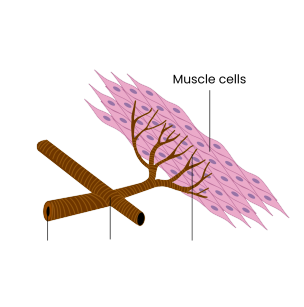
Label the three main parts of an insect's tracheal system.
Spiracles
Tracheae
Tracheoles
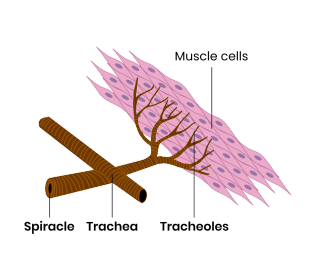
Explain the structural and functional compromises in terrestrial insects that allow efficient gas exchange while limiting water loss.
Thick waxy cuticle / exoskeleton → increases diffusion pathway so less water loss via evaporation.
Spiracles can open to allow gas exchange AND close to reduce water loss via evaporation.
Hairs around spiracles → trap moist air, reducing the water potential gradient so less water loss via evaporation.
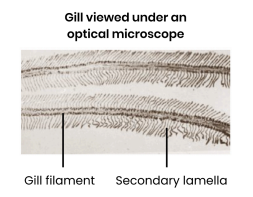
Explain how the gills of fish are adapted for gas exchange, focusing on their structure.
Gills made of many filaments covered with many lamellae → increase surface area for diffusion.
Thin lamellae epithelium → so short diffusion pathway between water and blood.
Lamellae have a large number of capillaries → remove O₂ and bring CO₂ quickly, so maintains a concentration gradient.
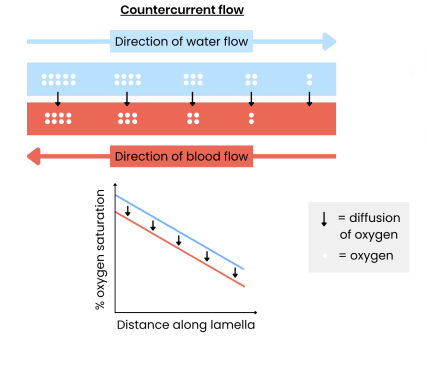
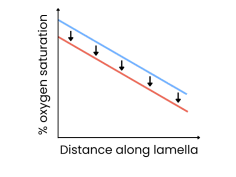
Explain counter-current flow in fish gills. (Part 1 – direction of flow)
Blood and water flow in opposite directions over the lamellae.
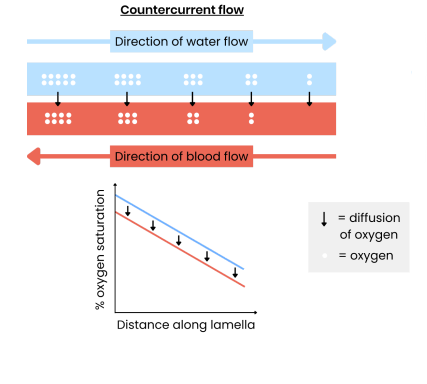
Explain counter-current flow in fish gills. (Part 2 – oxygen concentration gradient)
So oxygen concentration is always higher in water than in the blood nearby.
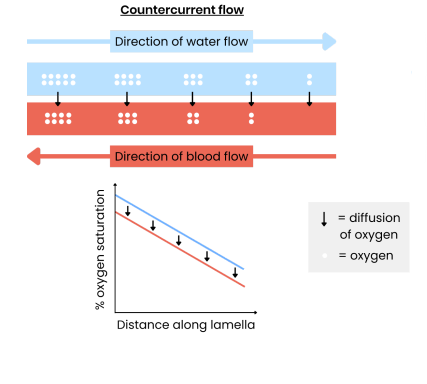
Explain counter-current flow in fish gills. (Part 3 – maintaining the gradient)
So a concentration gradient of O₂ is maintained between water and blood for diffusion along the whole length of the lamellae.
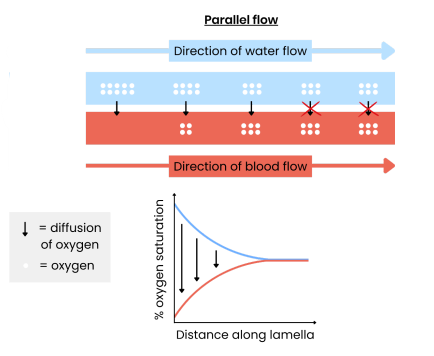
Explain what would happen with parallel flow instead of counter-current flow in fish gills.
If parallel flow, equilibrium would be reached, so oxygen wouldn't diffuse into the blood along the whole gill plate.
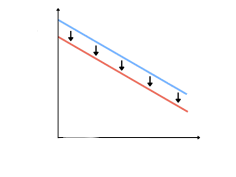
Label the percentage oxygen saturation and distance along the lamella in a fish gill diagram.
% oxygen saturation
Distance along lamella
Explain how the leaves of dicotyledonous plants are adapted for gas exchange.
Many stomata (high density) → allow diffusion when opened by guard cells.
Spongy mesophyll contains air spaces → gases can diffuse through, and this provides a large surface area of cells and cell membranes for diffusion.
Thin → short diffusion pathway.
Large surface area to volume ratio → increases diffusion rate.
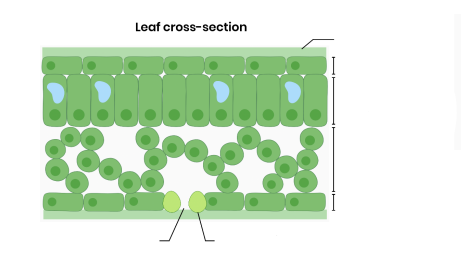
Label the following structures in a dicotyledonous leaf cross-section.
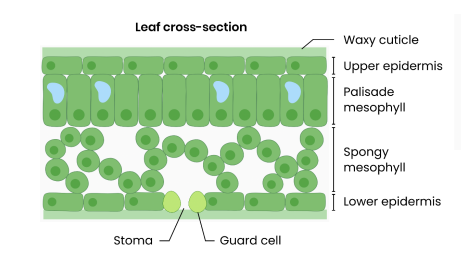
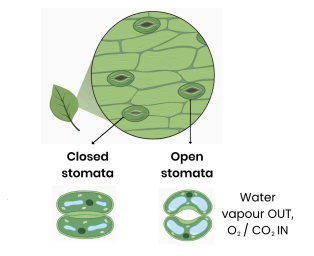
What moves out of and into an open stoma in a dicotyledonous leaf?
Water vapour OUT
O₂ and CO₂ IN
What is a xerophyte? Give two examples.
Xerophyte = a plant adapted to live in very dry conditions.
Examples: cacti and marram grass.
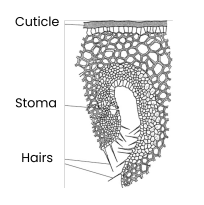
Explain the structural and functional compromises in xerophytic plants that allow efficient gas exchange while limiting water loss. (Part 1 – cuticle)
Thicker waxy cuticle → increases diffusion pathway so less water loss via evaporation.
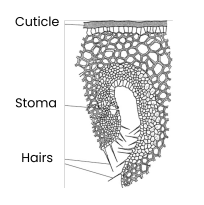
Explain the structural and functional compromises in xerophytic plants that allow efficient gas exchange while limiting water loss. (Part 2 – stomata position and hairs)
Sunken stomata in pits, rolled leaves, or hairs → trap water vapour and protect stomata from wind, so reduced water potential gradient between leaf and air, so less water loss via evaporation.
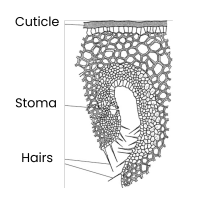
Explain the structural and functional compromises in xerophytic plants that allow efficient gas exchange while limiting water loss. (Part 3 – spines or needles)
Spines or needles → reduces surface area to volume ratio.
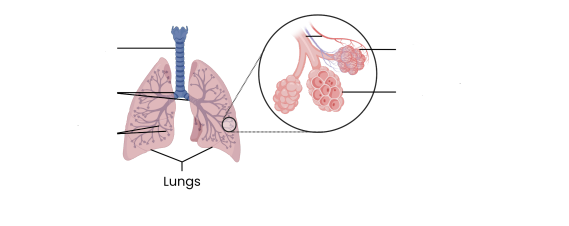
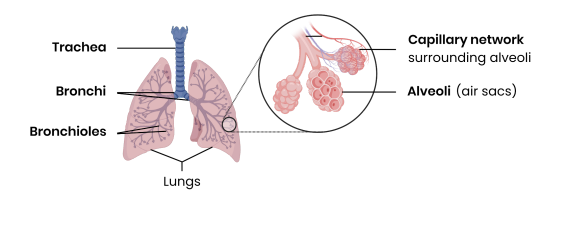
Describe the gross structure of the human gas exchange system.