Biology 2018 Exam 1
 Studied by 0 people
 Call Kai
 Learn
Learn Practice Test
 Spaced Repetition
 Match
Match Flashcards
 Knowt Play
1/107

Earn XP
Description and Tags
Made from Chapter 19,20, 21, 22, 24, 25
Name | Mastery | Learn | Test | Matching | Spaced | Call with Kai |
|---|
No analytics yet
Send a link to your students to track their progress
108 Terms
strata
Compressed layers of mud and rock in sedimentary rock
Lamark’’s Theory of Evolution
Use and Disuse
parts of the body that are used to become larger and stronger, while the ones that aren’t deteriorate
Inheritance of Acquired Characteristics
organisms can pass these modifications to its offspring, since they have an innate drive to become more complex
these theories are false!
Darwin’s Branching Tree
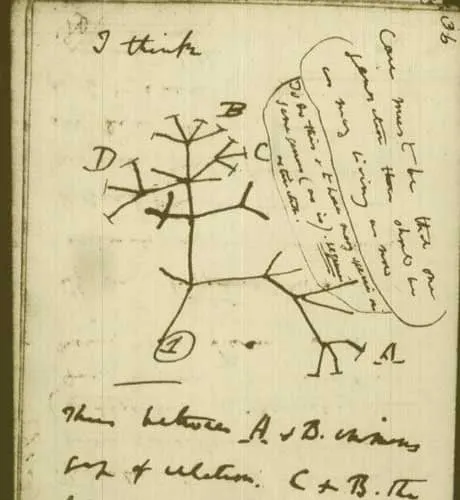
branch tips: present day species
unlabeled branches: extinct groups
each fork: most recent common ancestor
Darwin’s Theory of Evolution
Organisms share many traits, showing a unity of life through a common ancestor
As descendants spread to different environments, they accumulated adaptations
Artificial Selection
Humans have modified other species over many generations, selecting and breeding the most desirable traits
Homology
similarities resulting from a shared common ancestor
Homologous Structures
The same structure resulting from a shared common ancestor, but with different functions
forelimbs in mammals (wings, arms, etc)
Vestigial Structures
remants of features that served a purpose in an organisms ancestors
wisdom teeth
Convergent Evolution
evolution of similar featuresin different lineages
sugar gliders and flying squirrel
Analogies
animals that have both adapted to their environments in similar ways and are said to be…
Fossil Record
fossils show that past organisms differed from living organisms
also shows that many organisms have become extinct
and that many species have evolved over time
and that they document the origin of major new groups of organisms
Binomial Nomenclature
the two part format of the scientific name of an animal
the first part is the name of the Genus ( and is capitalized
the seond part is the specific epithet (and both parts are italicized)
Specific Epithet
The unique name for each species within a genus
Taxon
the named unit at any level
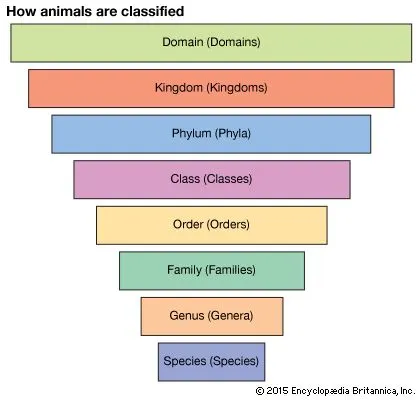
Phylogenic Tree
The evolutionary history of a group’s organisms depicted in a branching diagram
depicts a hypothesized evolutionary relationship using two way branch points
Dichotomies
two way branching points
Sister Taxa
Groups of organisms sharing an immediate common ancestor
Evolutionary Lineages
sequences of ancestral organisms leading to a particular descendant taxon
the order in which taxa appear does not represent the sequence of evolution
all phylogenic trees are rooted, meaning a branch point represents the most recent common ancestor of all taxa in the tree
Basal Taxon
the lineage that diverges from all members of its groups the earliest
Cladistics
System of grouping common ancestors
places species into groups called clades, which includes the ancestor and all descendants
Clades
Basic unit of grouping species
Monophyletic Groups
Has ancestral group plus all its descendants
this is a clade
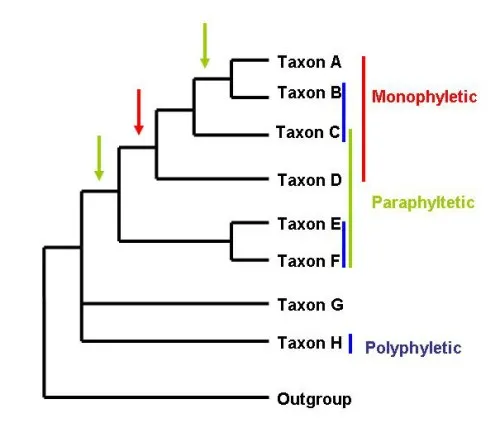
Paraphyletic Group
Has ancestral group and some, but not all descendants
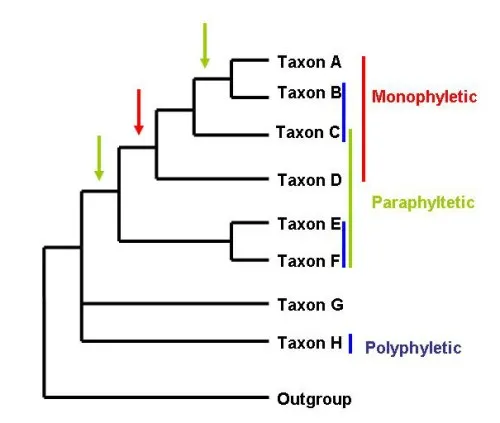
Polyphyletic Groups
Includes descendants, but no common ancestor
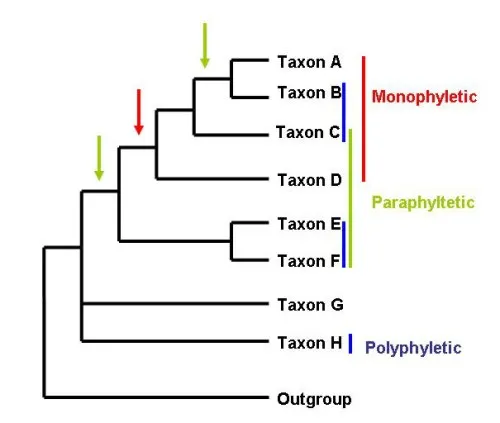
Cladogram
The nested hierarchy of clades within clades
Synapomorphies
The shared derived character that is unique to a clade
Shared Ancestral Character
A characteristic derived from an ancestor older than the common ancestor
ex: backbone in mammals
Outgroup
a species from a lineage close enough but not distinctly related to other animals in a group called the ingroup
Proportional Branch Lengths
In some tree diagrams, branch lengths are proportional to the amount of evolutionary change or length of time since particular events occur
the cladogram has a timeline below it
Maximum Parsimony
Principle that states that the simplest explanation is consistent with the facts
Molecular Clocks
Method for estimating the time for a given amount of evolutionary change
assumes that the number of genetic differences between two species is proportional to the time since they shared a common ancestor
not exactly accurate
Evolution
Changes in the genetic makeup of a population over time
adaptations to environmental pressures
changes in allele or genotype frequency
Population
Interbreeding members of the same species living in the same geographic area
united by its gene pool
Hardy-Weinberg Equilibrium Conditions
the allele and genotypic frequencies will remain constant if the population...
is large
mates at random
has no mutations
has no natural selection
p and q in the hardy-weinburg
the two possible alleles at a particular locus
p² and q² in Hardy-Weinberg
the frequency of the homozygotes genotype
2pq in Hardy-Weinberg
The frequency of the heterozygote genotype
Macroevolution
Evolution occurring above the species level, including the origination, diversification, and extinction of species over long periods of evolutionary time
Microevolution
evolution occurring within populations; changes in allele frequency from one generation to the next
Mutations
The ultimate source of heritable genetic variation within a population
they are rare, but occur at a steady rate
occur randomly all over the genome
caused by various types of errors in the nucleotide sequences of DNA
Mutations in the germline are the only ones that get passed down to its offspring
Genetic Variation
Increases with sexual reproduction
does not guarantee that a population will evolve
Species
Groups of actually or potentially interbreeding natural populations that are reproductively isolated from other groups
common descent
Hardy Weinberg Equilibrium
Describes the genetics of non-evolving populations
used to disprove the null hypothesis that evolution does not exist
Genetic Drift
Changes in allele frequencies of a gene pool due to random meeting of gametes in fertilization’
effect is greater in smaller populations
there are two types!
Bottleneck Effect
When a catastrophe occurs that wipes out a bunch of the population, and the remaining population (a tiny fraction really) has much lower genetic diversity.
Founder Effect
A type of bottleneck that occurs when a small group of the population leaves and forms their own colony
Natural Selection
The only force that consistently produces adaptive evolutionary changes
Three criteria:
Variability for a trait
Heritability of that trait
Differential reproductive success based on that trait
REMEMBER: It has no goal.
Sexual Selection
Selection for traits that increase access to mates and reproductive success
Two types:
Intrasexual: Occurs between members of the same sex
Intersexual: Mate choice by members of the opposite sex
Prezygotic Barriers
blocks fertilization from occurring in 1 of 3 ways:
impeding members of different species from attempting to mate
preventing an attempted mating from being completed successfully
hindering fertilization if mating is completed
Postzygotic Barriers
Barriers that contributes to reproductive isolation after hybrid zygote is formed
reduced hybrid viability
reduced hybrid fertility
hybrid breakdown
Allopatric Speciation
Once physically separated, gene flow between the two steps and divergence begins
leads to adaptive radiation
and co-speciation
Adaptive Radiation
Explosive form of speciation leading to the formation of many new species
Co-Speciation
Occurs when two species that associate with each other speciate in response to each other and at the same time (Host-parasite)
Sympatric Speciation
individuals within a species that become specialized due to habitat differentiation, sexual selection, and polyploidy
in plants, it happens almost instantly
in animals, it occurs in tens of thousands of years
Habitat Differentiation
When two species occupy different components of the environment
Hybrid Zones
Members of different species that meet and mate, producing at least some offspring of mixed ancestry
Reinforcement (Hybrid Zones)
The process where natural selection actively strengthens the walls between two species to prevent them from making low quality hybrids
They do this by favoring individuals that mate with their own species
strengthens pre-zygotic barriers
stronger in sympatric populations
Fusion (Hybrid Zones)
When two different species “forget to stay separated and merge back into one
the two species that recently branched from a common ancestor meet in a hybrid zone and the barriers that are usually strong get weaker, so the interbreeding begins
the two species fuse into one
Stability (Hybrid Zones)
A permanent “middle ground” where hybrids are produced year after year
they could be because the hybrids survive and/or reproduce better
OR it could be due to a balance of selection against hybrids and gene flow from parents
The role of speciation and extinction
speciation rate > extinction rate: rise of a group of organisms
speciation rate < extinction rate: fall of a group of organisms
Speciation Rate
The number of species produced
Extinction Rate
The number of species dying
Plate Techtonics
Movements of the great plates of the Earth’s crust
causes the continents on/part of the plates to also move, causing continental drift
alters the habitat of organisms, causing extinction/speciation
Mass Extinctions
Most of the species that have ever lived are now EXTINCT
can be caused by habitat destruction or unfavorable environmental change
Permian Mass Extinction
around 252 Million years ago
defines the boundary between the Paleozoic and Mesozoic Eras
wiped out 96% of marine animal species
likely caused by intense volcanism
Cretaceous Mass Extinction
around 66 million years ago
marks the boundary between the Mesozoic and Cenozoic Era
wiped out >50% of marine animals and many plants and land animals
likely caused by a meteorite
Intrinsic Biological Mechanisms
Morphological differences that can arise from genes, altering many different things
Heterochrony
Morphological differences that can arise from genes, altering the rate of development
Paedomorphosis
Morphological differences that can arise from genes, altering the timing of development
Homeotic Genes
Morphological differences that can arise from genes, altering the spatial pattern of development, including…
changes in gene sequence
changes in gene regulation
Pattern of Early Earth
We start with small, simple organic molecules, such as amino acids and nitrogenous bases
The molecules join together, making macromolecules
The packing of these molecules into protocells
Origin of self-replicating molecules, making inheritance possible
Protocells
Droplets of membranes that maintained internal chemistry, different from its surroundings
once they retained self replicating DNA, natural selection began favoring the most efficient ones
Cynobacteria
The main photosynthetic organisms for over a billion years
they transformed the atmosphere by releasing oxygen produced via photosynthesis
Stromalites
Fossils formed by cyanobacteria and several other types of photosynthetic bacteria
the most abundant organisms on Earth
They thrive in most environments
Fimbrae
Hairlike appendages that help cells adhere to other cells or to a substrate
Capsule
Sticky layer of polysaccharide or protein that can help cell adherence and/or evasion of a host’s immune system
Internal Organization
No nucleus or other membrane-enclosed organelles; usually no complex compartmentalization
Flagella
Structures used by most motile bacteria for propulsion; many species can move toward or away from certain stimuli
Cell Wall
Found in nearly all prokaryotes; structure differs in gram positive and gram negative bacteria
Circular Chromasome
Often accompanied by smaller rings of DNA called plasmids
Pilus
Appendage that facilitates conjugation
Reproduction in Bacteria
Asexual
Rapid reproduction due to smaller genome size
Divide via binary fission
Daughter cells are clones of the parents
Genetic Recombination
Horizontal Gene Transfer between members of different species
Transformation in Horizontal Gene Transfer
In this, the genotype and possibly phenotype of a prokaryotic cell are altered by the uptake of foreign DNA from its surroundings.
A nearby nonpathogenic cell picks up pathogenic DNA from a dead pathogenic cell and replacing it with its own, becoming a recombinant cell
Transduction in Horizontal Gene Transfer
In this, phages carry prokaryotic genes from one host cell to another.
essentially, DNA is transferred from a donor to a recipient through the virus
Conjugation in Horizontal Gene Transfer
DNA is transferred between two prokaryotic cells that are temporarily joined
The DNA is copied and sent to the recipient, who integrates it into its own system
Major Roles of Prokaryotes
Recycling chemical elements between living and nonliving components of the ecosystem
Converting molecules into forms that can be taken up by other organisms
Decomposers
organisms that break down dead organic materials and release mineral nutrients
some prokaryotes are these
Symbiosis
The relationship between two species that live in close contact with one another
Mutualism
Both organisms benefit from synbiosis
Commensalism
One organism benefits while neither harming nor helping the other in any significant way
Parasitism
An organism called a parasite harms but does not kill its host
parasites that cause disease are pathogens
Nitrogen Fixation
The conversion of atmospheric nitrogen to ammonia
Endospore
A tough, dormant and non reproductive structure in certain bacteria that acts as an escape pod, allowing it to survive in even the harshest of environments that would normally kill it
Cytoskelaton
Helps the eukaryotic cell move around
Meiosis
Sexual reproduction that produces genetically unique gametes or spores
Endosymbiont Theory
Mitochondria and plastids were formerly small bacteria that began living within larger cells
Endosymbiont
A cell that lives within a cell
Serial Endosymbiont Hypothesis
Mitochondria evolved before plastids through a sequence of endosymbiotic events
What selective pressures favored the evolution of simple multicellular organisms from a single celled ancestor?
Protection: Multicellularity helps organisms avoid being eaten
Stability in the fluid environments: Multicellular organisms may be better able to maintain their position on a surface or in the water column
Feeding Opportunities: Multicellularity may enhance feeding opportunities
 Note
Note  Flashcards (20)