Social Influence
 Studied by 2 people
 Call Kai
 Learn
Learn Practice Test
 Spaced Repetition
 Match
Match Flashcards
 Knowt Play
1/46

There's no tags or description
Looks like no tags are added yet.
Name | Mastery | Learn | Test | Matching | Spaced | Call with Kai |
|---|
No analytics yet
Send a link to your students to track their progress
47 Terms
What are the three types of conformity?
Compliance, Identification, Internalisation
What does Compliance mean in conformity?
Compliance is associated with NSI, it means a person conforms in order to avoid disapproval by a majority group and usually in one event
What does identification mean in conformity?
Identification is when a person adjusts their behaviour when they are in the presence of the majority because they want to fit in
What does internalisation mean in conformity?
Internalisation is when a persons own views and opinions privately and publicly match those of a majority group
Whats NSI?
Normative Social Influence, when people conform to be liked by members of the majority. This is associated with compliance
Whats ISI?
Informational social influence, when people conform in order to be right in ambiguous or novel situations. This is associated with internalisation
Which studies prove NSI to be a strong explanation for conformity?
-Asch's line experiment
Which studies prove ISI to be a strong explanation for conformity?
-Lucas et al
-students were given math questions easy and hard
-conformity was higher for harder questions suggesting people conformed to those who they thought were more intelligent in order to get the correct answer
Summarise ASCH line experiment
- 123 US male undergrads
- Correct answer was always obvs
- 7-9 people, only one was real , the rest were confederates
-75% of ppts conformed to atleast one wrong answer
-When asked they did it to avoid public rejection but still trusted their own judgements
What were the situational variabels for ASCHS study?
- task difficulty
- group size
- unanimity
Evaluation for ASCH study
Strength - methodology (controlled lab experiment, established cause and effect, eliminated extranuous variables)
Weakness - lacks ecological valadility
Weakness - population validility ( 123 male us undergrads)
Weakness - ethical issues ( mislead, BUT cost benefit analysis)
sumarise zimbardos stanford prison experiment
- 21 male uni students who volunteered
- paid 15 dollars to take part
- assaigned prisoner or prison guard
- all participents conformed to their social roles
Evaluation for Zimbardo?
- Weakness : completley unethical (strip searches, arrested, people were abused) BUT COST BENEFIT ANALYSIS
- Weakness : right to withdraw ( payed 15 dollars)
-Strength : key variables were controlled ( increases internal validity)
- weakness BONUS : zimbardo himself was involved in the study ( biased results )
what does obedience mean?
when a person obeys perceived authority figures either dispositional or situationally
what are the two explanations of obedience?
-dispositional explanation (authorial personality) remember DIS positional (discipline = strict = more obedient personality)
-situational explanation (agentic state)
situational explanation of obedience summary
AGENTIC STATE
-When a person obeys because they feel they are acting on behalf of someone else
-they're 'agents' of others (diffused responsibility)
-people obey percieved authority figures because thats what we are taught to do from a young age
whats being in an agentic state?
when u obey percieved authority figures and dont feel responsible because u act as an 'agent'
whats legitimacy of authority?
the amount of social power held by someone giving instructions
social power -
social roles (teacher, police officer, doctor)
social status (gang members, older family members)
dispositional explanation of obedience summary
AUTHORIAN PERSONALITY
-trait of people who had strict upbringing which makes a person more likley to be obedient
-person becomes dogmatic
-they show excessive respect
what does dogmatic mean?
when someone follows rules no matter what
whats the key study for obedience?
Milgram
summarise Milgrams study on obedience
-wanted to investigate if people would obey percieved authority figures even if it was morally wrong
- lab experiment at Yale
- 40 male ppts , ages 20-50
- volunteer sample
-paid 4.50
-'teacher','learner','experimenter'
-65% obeyed up to 450
-all obeyed up to 300
what were Milgrams situational variables
-uniform
if confederates wore ordinary clothes then obedience dropped from 65% to 20% for 450 volts
-proximity
if confederate was in the same room , obedience dropped to 40%
-location
if the location was non prestigious (run down office block) then obedience drops to 48%
who supported Milgrams experiment?
Bickman
He went to strangers dressed as security asking for money, 92% obeyed. When in ordinary clothes only 58% obeyed.
AO3 milgrams study
Weakness- low ecological validity and population validity
Strength- supporting evidence from Bickman
Weakness- ethical concerns
-right to withdraw was not clear
-no protection from psychological harm
-however cost benefit analysis
Weakness - gender bias
Strength - controlled variables increasing internal validity
AO3 Situational explanations of obedience (authorian personality)
Strength - support from Bickman for legitimacy of authority (security uniform)
Weakness- gives people the ability to avoid accountability
AO3 Dispositional explanations of obedience (agentic state)
Weakness - too simplistic
-people with low education are more likley to obey
- milgrams study shows location, proximity and uniform all affect obedience
-maybe both D and S
-more effective to consider wider range
Strength - Adornos supporting research
-F scale
Milgrams sample of ppts
What does resisting social influence mean?
the ability to resist social pressures to conform or obey authority
What are the two ways to resist social influence?
Dispositional factors - Locus of control
dispositional is from the inside (a persons character)
Situational factors - Social support
situational is from the outside (depending on the situation a person is in, external factors)
summarise dispositional factors of resisting social influence
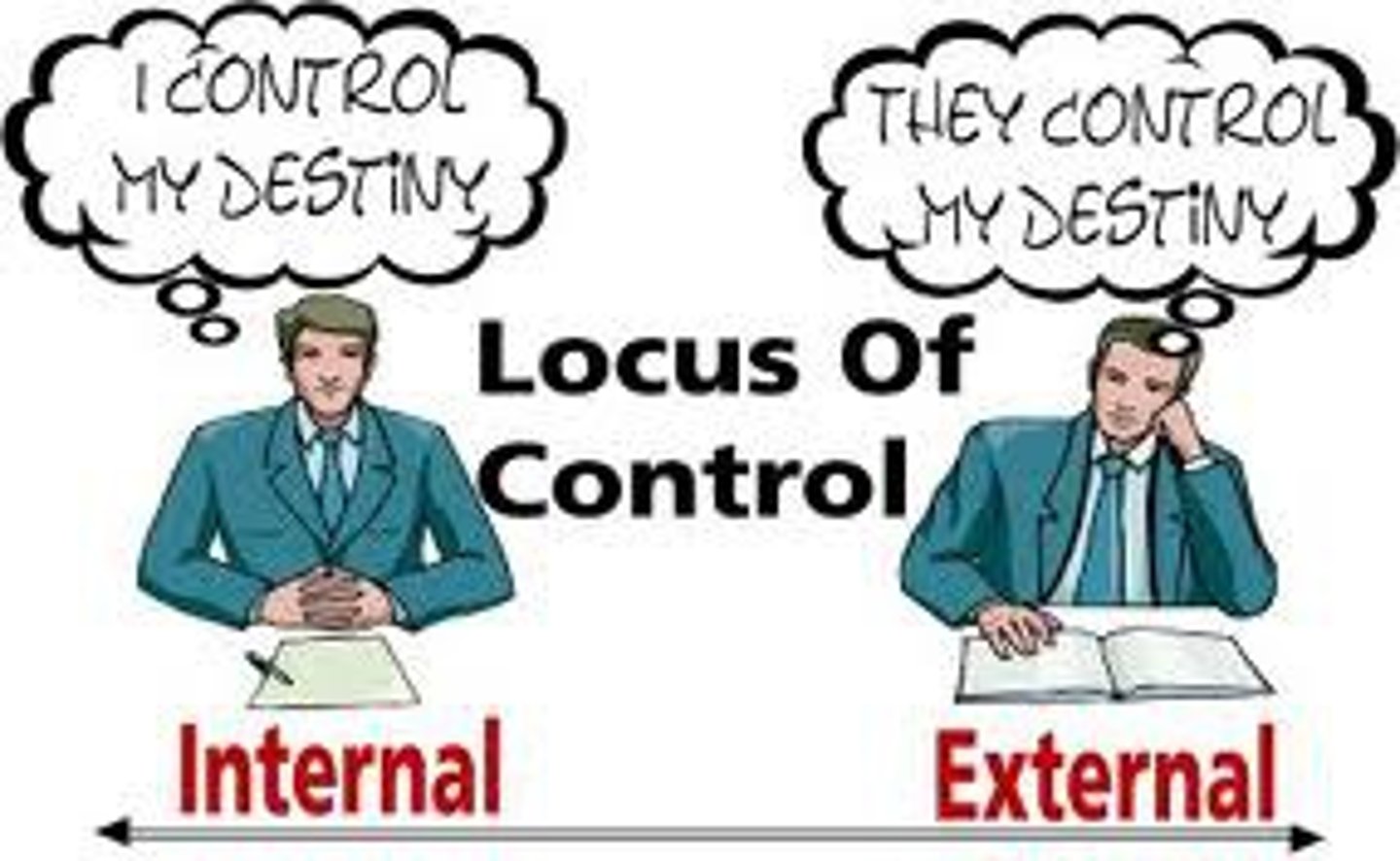
LOCUS OF CONTROL
-Rotter proposed this personality theory which tells the extent to which a person has control over their lives
INTERNAL LOCUS OF CONTROL- when a person believes they have control over their own life + are better at resisting social influence
EXTERNAL LOCUS OF CONTROL - when a person believes they don't have control over their own life + are not good at resisting social influence

What does having an internal locus of control mean?
Internal locus of control
- people believe what happens in their life is a result of their own actions
- have control of their life
- better at resisting social pressures
- take personal responsibility
- are more confident and intelligent
What does having an external locus of control mean?
External locus of control
- people believe what happens to them is a result of luck or fate
- no control of their life
- more likely to conform or obey and are less able to resist social influence
Who proposed the idea of locus of control?
Rotter
Personality theory which tells to which extent a person has control over their own lives
summarise situational explanations of resisting social influence
SOCIAL SUPPORT
- the presence of others who are able to resist whom act as role models to show resistance to social influence is possible
RESISTING CONFORMITY
- the presence of someone else resisting social pressures
RESISTING OBEDIENCE
- the presence of someone else disobeying a perceived authority figure
how does one resist conformity? (social support)
- having the presence of someone else who resists social pressures allows another person to feel more confident to do the same and make their own decision
- having an ally breaks the unanimity allowing others to free up the room to think and behave differently to the majority
- ASCH's unanimity variables shows that when just one confederate (dissenter) gave the right answer, conformity decreased
how does one resist obedience (social support)
- the presence of someone who disobeys, empowers others to do the same
-disobedient people serve as role models who reduce obedience
- In Milgram study, obedience dropped when a disobedient confederate joined the participant
AO3 Dispositional factors of resisting social influence (locus of control)
Strength - Supporting evidence
- Spector used Rotters scale on 157 students
- Found that those with a high locus of control were less likely to conform
- However, this was provided in only NSI situations, suggesting the desire to be liked is easier to resist than the desire to be right on those with an internal locus of control
Weakness - Other contributing factors
- social responsibility
- disobedient pts from Milgrams research were found to have an internal locus of control AND scored higher on the social responsibility scale
-suggests both social responsibility and locus of control are important factors and it would be too simplistic to just rely on locus of control
AO3 Situational factors of resisting social influence (social support)
Strength - Supporting evidence from ASCH
- In asch unanimity variation, one confederate was a dissenter who gave the correct answer throughout
- conformity then dropped to 5%
- having an ally makes it easier to resist social influence
Strength - Evidence from Milgrams research
- In one of Milgrams variations, one real participant was paired with two confederates who withdrew from the experiment early
- The percentage of 65% of real pts obeying until 450 volts decreased to 10%
- supports the idea that if someone has support from another person disobeying when they want to, then they are more likely to resist social pressures from an authority figure
What are the minority influences?
Consistency
Commitment
Flexibility
Snow Ball Effect
Summarise Consistency
The minority keeping the same beliefs over time
-effective because it draws attention to the minority when they have consistent views
-majority may re asses their situation and views
-leads to cognitive conflict as they start thinking differently
Summarise Commitment
When the minority show determinism and dedication to their views
-making personal sacrifices
-engaging in extreme activities that put the minority group at risk
-effective because it shows the minority are not acting out of self interest
Summarise Flexibility
Nemeth argued that consistency is not important but adapting pov is more effective
-consistency can be interpreted negatively as it is unbending and unreasonable
-the minority making a compromise which causes sympathy from the majority
-effective when flexible because theyre seen more seriously about social change
Summarise Snow Ball Effect
When the majority, over time, switch to the minority's position
- all three factors make the majority think over time
- the more this happens the faster the rate of conversion
- gradually the minority's views become the majorities and social change occurs
The Role Of Social Influence Processes In Social Change ( 6 steps )
1 - drawing attention to the issue
2 - cognitive conflict
3 - consistency
4- augmentation principle
5- snowball effect
6- social change occurs
Which researchers/psychologists evaluated research into minority influence
- Moscovici
- Nameth
- Mass et al
A03 Evaluation of Research Into Minority Influence
Strength- Moscovicis research supports consistency
- conducted a lab experiment with female only participents
- when 4 confederates were consistently estimating, 8% of real participents agreed
- when 4 confederates were inconsistenly estimating, 1% of real participents agreed
- suggests a consistent minority has greater effect than an inconsistent one, and therfore consistency is a key element in social influence for social change
Weakness/Consideration- Other factors as well as consistency, flexibility and commitment would be involved
- when the minority identify with the majority, they are more likley to be persuasive
- mass et al found that homosexual minorities had less of an imact on hetrosexual majorities when trying to persuade them, but when the minority was hetrosexual just as the majority they were more persuasive
- suggests other factors such as identification need to be considered
Strength- nemeths research supports flexibility BUT disregards consistency
- nemeth found that when a consistent minority argued and refused to change their position, there was no effect on the majority
-wheras when the minority were flexible and compramised, there was more of an effect on the majority
-this suggests that minorities have to be flexible in order to be persuasive
A03 of the role of social influence processes in social change
Strength - Practical Applications
- social influence can bring about more positive social change
-e.g improving health care for the nation could work through NSI and ISI by making people feel like theyre the minority (nsi) and through giving information about the dangers of smoking (isi)
- HOWEVER
- could also bring negative social change as children become advised to play on video games or people are advised to eat unhealthy foods that promote obesity
Weakness - methodology flaws in research on social influence
- moscovici, asch and milgram all have studies that are artificial and dont represent real world dilemas and situations (lacking mundane realism)
- eg moscovici's research was on colour estimation which is irrelevant to real social situations that could occur which therfore limits the findings that can be taken from these researchers
 Note
Note  Flashcards (25)