ATAR Human Bio - Nervous System #2
 Studied by 0 people
 Call Kai
 Learn
Learn Practice Test
 Spaced Repetition
 Match
Match Flashcards
 Knowt Play
1/32

There's no tags or description
Looks like no tags are added yet.
Name | Mastery | Learn | Test | Matching | Spaced | Call with Kai |
|---|
No analytics yet
Send a link to your students to track their progress
33 Terms
Propagation
the travel of a nerve impulse along an action potential
Myelinated Transmission
- the nerve impulse "jumps" between the nodes of ranvier (saltatory conduction)
- this is possible because the axons are covered by myelin sheath
Unmyelinated Transmission
- the nerve impulse travels along the neuron, stimulated by the flow of sodium ions, depolarizing the area
- transmission is slower, due to the need to repolarise at each node
all or none response
neurons have a threshold potential of +15 mV, if a stimulus is able to provide a voltage equal or higher to this (so the overall membrane potential is -55 mv), than an action potential is initiated
Depolarisation
Depolarisation causes an influx of Na+ ions into the intercellular environment due to voltage gated sodium channels opening. This creates an overall positive charge, continuing until the membrane potential reaches +30 mV.
Repolarisation
Voltage gated sodium channels close and voltage gated potassium channels open. K+ rushes out of the cell (down the concentration gradient) as membrane potential decreases. This creates an overall negative charge relative to the outside.
Hyperpolarisation
- K+ channels open for too long, resulting in membrane potential reaching -90 mV.
- the Sodium-potassium pump restores the resting membrane potential by pumping out 3NA and in 2K until the resting potential of -70 mV is re-established
Sodium Potassium Pump
The sodium potassium pump maintains a negative sodium charge in the cell, relative to the outside.
It uses ATP (active transport) to move 3 sodium ions (Na⁺) out of the cell and 2 potassium ions (K⁺) in.
Sodium Potassium Pump role in Nervous and Endocrine System
Role in Nervous System
- Neurons rely on the sodium-potassium pump to maintain the resting membrane potential
- Without this pump, a neuron can't reach threshold, depolarise, or send action potentials.
role in Endocrine System
Some hormones change pump activity to alter cell excitability
e.g. thyroid hormone increases pump rate to raise metabolism and heat production
aldosterone increases pump rate in the kidney to reabsorb more water
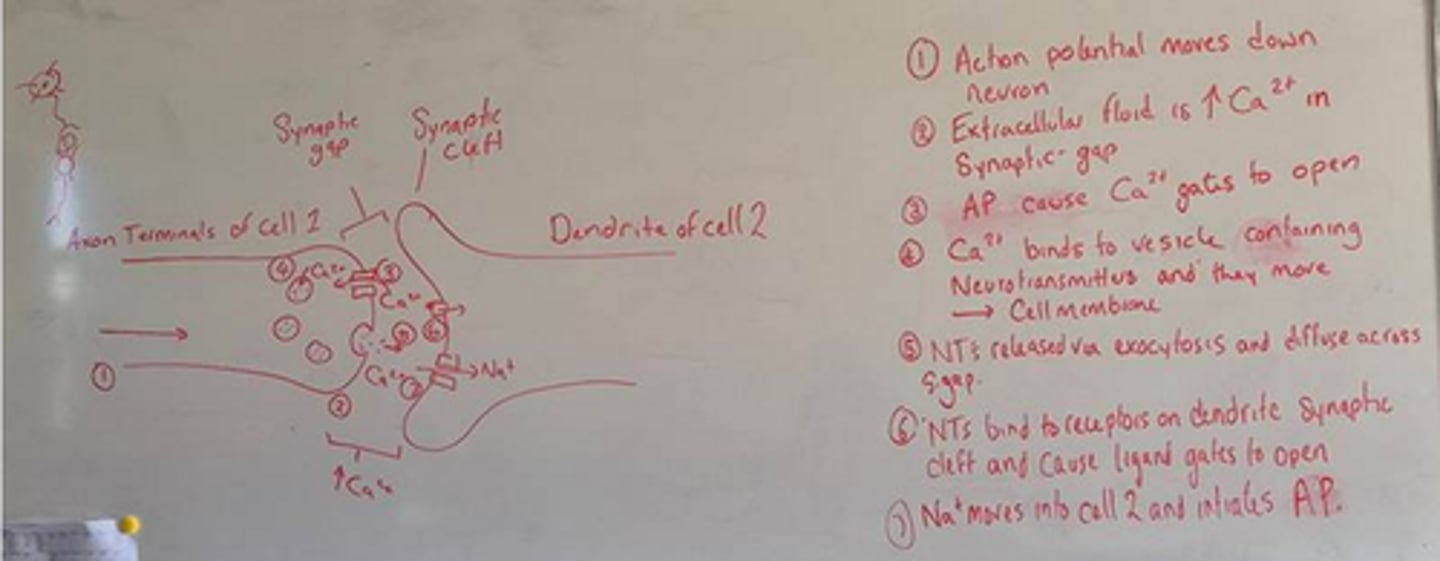
Synaptic Transmission
1. an incoming action potential research the axon terminal and causes depolarisation in the presynaptic knob
2. voltage gated calcium channels open; an influx of calcium in the synaptic gap enters the cell and binds to neurotransmitter vesicles
3. these vesicles release neurotransmitters into the synapse via exocytosis
4. neurotransmitters diffuse across the synaptic gap & bind to receptor sites on the dendrites of the other neuron. this triggers ligand-gated ion channels to open
5. the influx of sodium can initiate a new action potential in the postsynaptic neuron
bones (protection of brain)
- cranium protects the brain
- vertebral canal protects spinal cord
- hard bone provides a strong, rigid barrier. (but can cause issues when the brain swells, as the swelling has nowhere to go)
meninges
- connective issues that cover surface of brain & spinal cord
dura mater: outer layer, tough & fibrous
arachnoid mater: middle layer, loose mesh of fibres
pia mater: inner layer, thin and delicate. contains blood vessels.
cerebrospinal fluid
- clear watery fluid containing few cells, glucose, protein, urea and salts
- occupies a space between arachnoid and pia mater (sub arachnoid space)
- acts as a shock absorber & provides mechanical support to keep the brain buoyant
Sensory Neurons
- afferent neurons
- receives nerve impluses from CNS to body (e.g. move hands away after touching a hot stove)
- contains dorsal root ganglion
motor neurons
- efferent neurons
- sends nerve impulses from the CNS to body (e.g. instructions to start walking, speaking, swallowing)
- contains ventral root ganglion
somatic nervous system
controls 5 senses & voluntary movement
cranial nerves
12 mixed nerves arsing from the brain & carrying sensory fibres to and from the brain.
spinal nerves
31 pairs of spinal nerves arise from the spinal cord. includes ventral and dorsal root.
autonomic nervous system
involuntary bodily functions (e.g. heart rate, respiration, digestion)
sympathetic nervous system
- activates body in response to a threat (fight or flight)
- nerve endings release noradrenaline
examples of sympathetic responses
- dilation of pupil
- acceleration of heart rate
- dilation of bronchi
- inhibits stomach & pancreas
- relaxes bladder
- stimulates ejaculation
parasympathetic nervous system
- maintains homeostasis & normal levels of arousal (rest & digest)
- nerve endings release acetylcholine
Cerebral Cortex
outermost brain layer, involved in higher cognitive processes. (e.g. thinking, reasoning, memory, consciousness)
Corpus Callosum
connects the right and left hemispheres and allows communication between them (contralateral control)
Cerebrum
responsible for posture, balance and coordination of voluntary muscle movements
Hypothalamus
maintains homeostasis (e.g. digestive system, body temperature) and motivated behaviour (e.g. thirst, sex drive) and controls mood.
Spinal Cord
provides a pathway for communication between muscles/glands and the brain, allows for reflex responses
Medulla Oblongata
regulates the heart, breathing & diameter of blood vessels under the influence of hypothalamus.
Cardiac Centre
regulates rate and force of heartbeat
Respiratory Centre
regulates rate and depth of breath
Vasomotor Centre
regulates diameter of blood vessels
cerebrum (grey and white matter)
- Is the biggest structure in the brain
- consists of:
○ grey matter (cerebral cortex): neuron cell bodies, dendrites and unmyelinated axons
○white matter (corpus callosum): myelinated axons (below the cerebral cortex)
Spinal Cord (inc tracts)
- a structure extending from the foramen magnum
- nerve fibres are arranged in ascending & descending tracts.
ascending tract - sensory neurons that carry impulses upwards towards the CNS
descending tract - motor neurons that sends impulses downwards away from the CNS
 Note
Note  Flashcards (35)