optical fibres
 Call Kai
 Learn
Learn Practice Test
 Spaced Repetition
 Match
Match Flashcards
 Knowt Play
1/17

There's no tags or description
Looks like no tags are added yet.
Name | Mastery | Learn | Test | Matching | Spaced | Call with Kai |
|---|
No analytics yet
Send a link to your students to track their progress
18 Terms
State two uses of optical fibres
Medical endoscopes to see inside the body, communications to carry light signals
How does light travel along an optical fibre?
It undergoes total internal reflection each time it reaches the fibre boundary
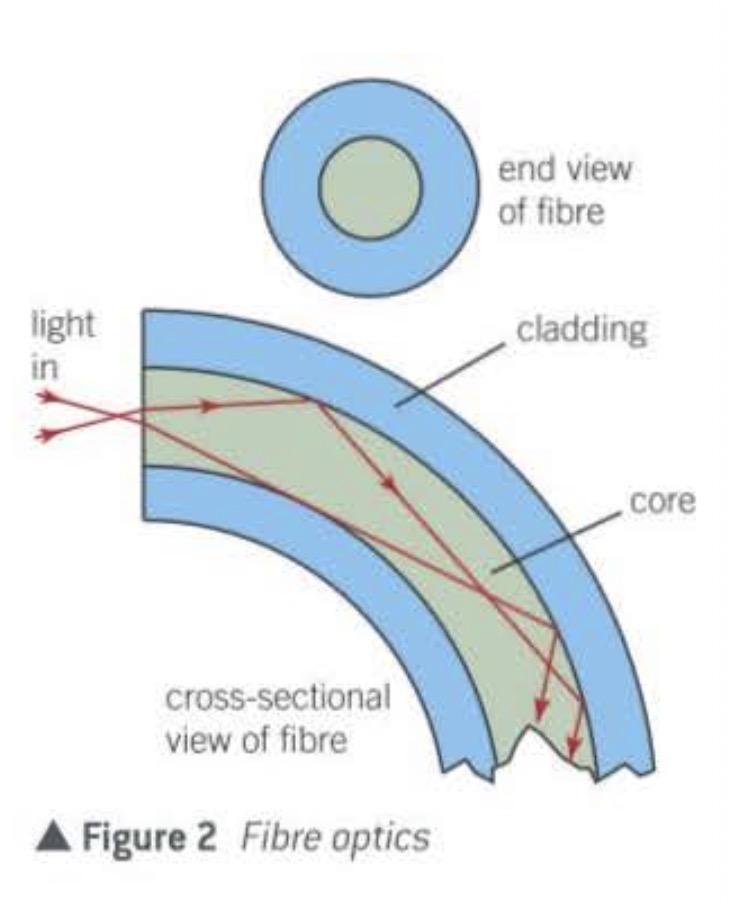
What condition must be met at every point along an optical fibre for TIR to occur?
The angle of incidence at the boundary must exceed the critical angle of the fibre at every point
When does TIR fail in an optical fibre?
When the radius of a bend is too small. This causes the angle of incidence to drop below the critical angle, so TIR no longer occurs and light escapes
Why is a high refractive index desirable in optical fibre material?
A higher refractive index gives a smaller critical angle, making it easier for light to exceed the critical angle and undergo TIR at every point along the fibre
What is the purpose of cladding in an optical fibre?
To surround the core with a material of lower refractive index, reducing light loss from the core
Why must the cladding have a lower refractive index than the core?
So that TIR can occur at the core cladding boundary, keeping light within the core
Why must optical fibres be highly transparent?
To minimise absorption of light, which would otherwise reduce the amplitude of the pulses as they travel along the fibre
What effect does light absorption have on pulses travelling along an optical fibre?
It progressively reduces the amplitude of the pulses the further they travel
What are the two main causes of amplitude reduction in an optical fibre?
Absorption of light by the fibre material
Light loss from the core
Describe the structure of a communications optical fibre
A highly transparent core surrounded by a layer of cladding with a lower refractive index than the core
Why does light loss from the core matter in a communications fibre?
It reduces the amplitude of the pulses, meaning the signal weakens over distance and may not reach the receiver intact
Why must the core of an optical fibre be very narrow?
To prevent modal dispersion. In a wide core, light rays travelling different paths travel different distance per metre of fibre, causing pulses to spread out and potentially merge
What is modal (multipath) dispersion?
When light travelling along the axis of a wide core travels a shorter distance than light undergoing repeated TIR, causing a pulse to arrive spread out and longer than it should be
What is the consequence of modal dispersion?
Adjacent pulses merge together, making it impossible to distinguish individual signals at the receiver
What is material (spectral) dispersion?
When white light is used instead an optical fibre, different wavelengths travelling at different speeds in the glass, causing the pulse to spread out faster and slower components separate
Why must monochromatic light be used in optical fibre?
To prevent material dispersion. Monochromatic light has a single wavelength so all components travelling at the same speed, preventing pulse spreading and merging
How does a narrow core prevent modal dispersion?
It limits light to travelling along a single path, so all light travels the same distance and arrives at the same time

