Organizational Behavior Exam 2 Ch. 6-10 Study Guide
 Call Kai
 Learn
Learn Practice Test
 Spaced Repetition
 Match
Match Flashcards
 Knowt Play
1/92

There's no tags or description
Looks like no tags are added yet.
Name | Mastery | Learn | Test | Matching | Spaced | Call with Kai |
|---|
No analytics yet
Send a link to your students to track their progress
93 Terms
Perception
process by which individuals organize and interpret their sensory impressions in order to give meaning to their environment
Three different factors in perceptions
1) Factors in the perceiver, 2) Factors in the situation, 3) Factors in the target
Factors in the perceiver
Attitudes, motives, interests, experience, expectations
Factors in the situation
time, work, setting, social setting
Attribution Theory
Suggests that when we observe an individual’s behaviors, we attempt to determine whether it was internally or externally cause
Internal caused behavior
Those that are believed to be under the personal control of the individual
Externally caused behavior
Results from outside causes
Fundamental Attribution Error
Tendency to underestimate the influence of external factors and overestimate the influence of internal factors. “We blame people first, not the situation”
Self Serving Bias
Tendency for individuals to attribute their own successes to internal factors while putting the blame for failures on external factors “It is “our” success but “their” failure”
Selective perception
People selectively interpret what they see on the basis of their interests, background, experience, and attitudes
Halo Effect
drawing a general impression about an individual or the basis of a single characteristic
Contrast Effect
Evaluation of a person’s characteristics that are affected by comparisons with other people recently encountered who rank higher or lower on the same characteristics
Stereotyping
Judging someone on the basis of the perception of the group to which that person belongs a prevalent and often useful, if not always, accurate, generalization
Employment Interview
Interviewers make perceptual judgement about applicants that are often inaccurate and are formed in a single glance
Performance Expectations
Self fulfilling prophecy (Pygmalion effect) characterizes the fact that people’s expectations determine their behavior
Performance Evaluations
Many jobs are evaluated in subjective terms. Subjective Measures are, by definition, judgemental.
Rational Decision Making Model
“Perfect world model” which assumes complete information, all options known, and maximum playoff (Similar to scientific process)
Bounded Rationality
The “real world” model: It seeks satisfactory and sufficient solutions from limited data and alternatives
Intuition
A non-conscious process created from distilled experience that results in quick decisions. It relies on holistic associations and is affectively charged since it engages with emotions
Optimizing
From the Rational Decision Making Model, it is choosing from every single alternative
Satisficing
From Bounded Rationality, it is finding the first satisfying answer
Overconfidence Bias
believing too much in our own ability to make good decisions especially when outside of own expertise
Anchoring Bias
Using early, first received information as the basis for making subsequent judgments
Hindsight Bias
After an outcome is already known, believing it could have been accurately predicted beforehand
Confirmation Bias
selecting and using only facts that support our decision; discount information that contradicts past judgements
Availability Bias
emphasizing information that is most readily at hand. Very recent and vivid.
Escalation of commitment
Increasing commitment to a decision in spite of evidence that is wrong - especially if responsible for the decision!
Randomness Error
Creating meaning out of random events - superstitions
Winner’s Curse
Highest bidder pays too much due to value overestimation, likelihood increases with the number of people in auction
Motivation
The processes that account for an individual’s intensity, direction, and persistence, of effort toward attaining a goal, specifically an organization.
Three key elements of motivation
1) Intensity: how hard a person tries
2) Direction: Channeling effects towards the goal
3) Persistence: How long a person can maintain effort
Maslow’s Hierarchy of Needs
5 needs:
1) Self actualization: the realization of one’s full potential, creativity, and purpose
2) Esteem: high regard, respect, or admiration for someone
3) Social needs/belonging: reflects a deep psychological need for connection, encompassing both receiving and giving love and affection
4) Safety: Knowing to be safe at work
5) Physiological: basic needs for motivation
Alderfer’s ERG
Organizes Human needs into three categories:
1) Existence, 2) Relatedness, 3) Growth
Provides a more flexible alternative to Maslow's hierarchy. It posits that individuals can be motivated by multiple needs simultaneously and that, when higher-level needs are blocked, individuals may regress to lower-level needs, a concept known as frustration-regression
Reinforcement Theory
pioneered by B.F. Skinner, posits that behavior is a function of its consequences, meaning actions followed by positive outcomes are repeated, while those with negative or no consequences are abandoned
Positive Reinforcement
Strengthens or increases the frequency of desirable behavior adding a motivating reward, incentive, or appetitive stimulus immediately following the action
Negative reinforcement
Increases the frequency or strengthens desirable behavior by making avoidance of an unpleasant consequence contingent on its occurence.
Punishment
Decreases the frequency of or eliminates an undesirable behavior by making an unpleasant consequence contingent on its occurence.
Extinction
Decreases the frequency of or eliminates an undesirable behavior by removing or withholding the reinforcement that previously kept it
Herzberg’s 2 factor theory
Explores job satisfaction and dissatisfaction as separate phenomena. Herzeberg identified two sets of factors: Motivators and Hygiene Factors
Motivators
Intrinsic factors that lead to job satisfaction such as achievement, recognition, etc.
Hygiene Factors
Extrinsic factors that can lead to job dissatisfaction if absent but do not increase satisfaction if present.
Theory X
Assumptions that are negative, employees dislike work and will want to avoid it. They have to be coerced, controlled, or threatened with punishment.
McGregor’s Theory X and Y
1960 model of two contrasting models of workforce motivation and management styles
Theory Y
Assumptions that are positive. Employees view work as being as natural as rest or play.
McClelland’s Needs Theory
Three needs:
1) Affiliation (nAff): The need to form close and friendly relationships.
2) Power (nPow): The desire to influence or control others.
3) Achievement (nAch): The desire to excel and achieve standard.
Self Determination Theory
a framework for understanding human motivation, focusing on the intrinsic drive toward growth and the satisfaction of three basic psychological needs: autonomy, competence, and relatedness
Bandura’s Self Efficacy Theory
Belief that you can do something
Locke’s Goal Setting Theory
Want difficult but not impossible goals, need to be specific and difficult goals with self generated feedback lead to higher performance.
Vroom’s Expectancy Theory
Effort leads to performance which leads to rewards which leads to personal goals
Adam’s Equity Theory
Employees compare their ratios of outcomes to inputs of relevant others.
Organizational Justice
Overall perception of what is fair in the workplace
Distributive Justice
Fairness of Outcome
Procedural Justice
Fairness of outcome process
Interactional Justice
Fairness of treatment (dignity and respect)
Job Characteristics Model
Hackman and Oldham’s concept that any job can be described through five core job dimensions
Job Characteristics Model 5 core job dimensions
1) Skill Variety: requirements for different tasks in one job
2) Task Identity: completion of a whole piece of work
3) Task significance: the jobn’s impact on others
4) Autonomy: level of discretion in decision making
5) Feedback: amount of direct and clear information on performance
Job Rotation
Shifting of a worker from one task to another
Job Enlargement
The horizontal expansion of jobs
Job Enrichment
The vertical expansion of jobs
Flextime
Employees work during a common core time period each day but have discretion in forming their total workday from a flexible set of hours outside the core
Job Sharing
Two or more individuals split a traditional full time job which can be done by dividing the work hours.
Telecommuting
Employees do their work at home at least two days a week on a computer that is linked to their office
Virtual Office
Employees work out their home on a relatively permanent basis
Participative Management
Form of employee involvement where subordinates share decision making power with their superiors. This can beformal through briefings or informal such as daily consultations. Main goal is to enhance motivation by building trust and commitment.
Variable Pay Programs
A number of organization are moving away from paying solely on credentials or length of service.
Piece Rate Plans
Type of variable pay program where employees are paid a fixed rate per unit produced or task completed, rather than by the hour
Merit Based
type of variable pay program where organizations pay employees who exceed their expectations
Bonuses
Type of variable pay program that is based on quantity, quality, and given intermidden
Modular Plans
Type of benefit plans that is predesigned benefits packages for specific groups of employees
Core Plus Plans
Type of benefit plan that is a core of essential benefits and a menu-line selection of other benefits options
Flexible Spending Plans
Allow employees to use their tax free benefit dollars to purchase benefits and pay service premiums
Formal Group
defined by the organization’s structure with designated work assignments establishing tasks
Informal group
alliances that are NOT formally structured and occur naturally in response to the need for social contact and deeply affect behavior and performance
The Five Stage Model
Stage I Forming: The group forms
Stage II Storming: Tension and potential conflicts
Stage III Norming: The group begin to be supportive and collaborate
Stage IV Performing: The group start to perform well
Stage V Adjourning: End of the team’s journey
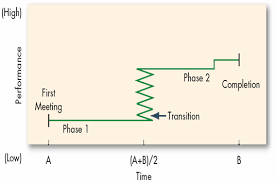
Punctuated Equilibrium Model
Temporary groups under deadlines go through transitions between inertia and activity at the halfway point, they experience can increase in productivity.
Sequence of actions:
1) Setting group direction
2) First phase of inertia
3) Halfway Point transition
4) Major changes
5) Second Phase of inertia
6) Accelerated activity
Psychological contract
an unwritten agreement that sets out mutual expectations of management and employees
Roles, Zimbardo’s (Stanford) Prison Experiment
Faked a prison using university student volunteers and randomly assigned to guard and prison roles. Within 6 days, the experiment was halted due to concerns. The guards had dehumanized the prisoners. Prisoners were subservient to the Guards. The students fell into roles as they understood them
Asch Study
The 1951, conducted by Solomon Asch, where participants were asked to match the length of lines on cards. Despite the clear difference in line lengths, many participants conformed to incorrect group answers due to social pressure. This experiment highlights how group dynamics can influence individual judgement.
Conformity
refers to the act of matching attitudes, beliefs, and behaviors to group norms.
Strengths of decision making
It generates more complete info and knowledge.
Offer increased diversity of views and greater creativity
Increased acceptance of decisions
More accurate but not as accurate as the most
Weaknesses of Decision Making
Time consuming, conformity pressures, dominance by few members, and ambiguous responsibility
Groupthink
Occurs when group pressures for conformity deter critical evaluation of alternatives. Leads to poor decision making as dissenting views are suppressed
Groupshift
Known as group polarization, this phenomenon describes how group discussion can lead members to adopt more extreme positions than initially held.
Group Cohesion
Degree to which group members are attracted to each other and are motivated to stay in the group.
Group Pressure
The direct or indirect social influence exerted by a group to compel its members to conform its norms, attitudes, or behaviors.
Work group
Get together to share information
Neutral
individual
random and varied
Work teams
collective performance
Positive
Individual and mutual
Complementary
Problem Solving Teams
Same department, meet for a few hours and solve problems
Self managed work teams
Do not have a formal boss and take on the responsibilities of their former supervisors
Cross Functional Teams
Employees from about the same hierarchical level but from different work areas who come together to accomplish a task.
Virtual Teams
teams that use computer technology to tie together physically dispersed member. Limited socializing.
Creative effective teams
Selection: making team skills one of the interpersonal skills in the hiring process
Training: individualistic people can learn
Rewards: rework the reward system to encourage cooperative efforts instead of competitive (individual) ones. Continue to recognize individual contributions while still emphasizing the importance of teamwork.
Team effectiveness model
Context: Adequate resources, leadership and structure, climate of trust, performance evaluation and reward systems
Composition: Abilities of members, personality, allocating ideas, diversity, size of teams, member flexibility, member preferences
Process: Common purpose, specific goals, team efficacy, conflict levels, social loafing

