SCM 3301 Exam 2 (Miller)
 Call Kai
 Learn
Learn Practice Test
 Spaced Repetition
 Match
Match Flashcards
 Knowt Play
1/80

There's no tags or description
Looks like no tags are added yet.
Name | Mastery | Learn | Test | Matching | Spaced | Call with Kai |
|---|
No analytics yet
Send a link to your students to track their progress
81 Terms
Strategic Sourcing Process
Identifying ways to improve long-term business performance by better understanding sourcing needs, developing long-term sourcing strategies, selecting suppliers, and managing the supply base.
Spend Analysis
The application of quantitative techniques to purchasing data in an effort to better understand spending patterns and identify opportunities for improvement.
Pareto chart
highlights the most important causes of the problem, highest to lowest left to right.
Internal Category profile
Understanding all aspects of a particular sourcing category that could ultimately have an impact on the sourcing strategy within our organization.
External Industry Analysis
Profiling the major forces and trends that are impacting an industry, including pricing, competition, regulatory forces, substitution, technology changes, and supply/demands trends.
Maverick Spending
Spending without purchasing process from suppliers to save cost
The Make-or-Buy Decision
A high-level, strategic decision regarding which products or services will be provided internally (Make) and which will be provided by external supply chain partners (Buy)
Insourcing
The use of resources within the firm to provide products or services. "Do it Myself" [Insourcing the Supply Chain is "Vertical integration"]
Outsourcing
The use of supply chain partners to provide products or services. "Pay someone to Do it"
Off-shoring
Location of an Insourced or outsourced Firm in a foreign country
Near shoring
Offshoring in an adjacent country
On-shoring
Location of an insourced or Outsourced Firm in the firm's country
Kraljic's Portfolio analysis
A structured approach used by decision makers to develop a sourcing strategy for a product or service, based on the value potential and the relative complexity or risk represented by a sourcing opportunity.
The Routine Quadrant: Office supply
Readily available products or services representing a relatively small portion of a firm's purchasing expenditures.
The Leverage Quadrant: Sub Supply
Standardized and readily available products or services representing a significant portion of spend.
The Bottleneck Quadrant: Merch
Products or services with unique or complex requirements that can be met only by a few potential suppliers.
The Critical Quadrant: Fashion
Products or service with unique or complex requirements coupled with limited supply base.
SSQDC
Safety, Sustainability, Quality, Delivery, Cost
Purchase Order (PO)
A document that authorizes a supplier to deliver a product or service and often includes key terms and conditions such as price, delivery, and quantity requirements [details taken from the Quotation or Proposal]
Statement of work (or scope of work)
Terms and conditions for a purchased service that indicate, among other things, what services will be performed and how the service provider will be evaluated
Product-based layout (continuous flow & production lines) EX: Sub
resources are arranged sequentially according to the steps required to make a product
Functional layout: Room by room
resources are physically grouped by function
Continuous flow processes: fluid
Produces highly standardized products using a tightly-linked, paced sequence of steps
Production Line: conveyor
used to produce a narrow range of standard items with identical or highly similar designs
Job shops
manufacturing operations that handle custom orders or small batch jobs
Make to stock (MTS): soup
0 customization
Assemble to Order (ATO): shirt
customized only at the very end of the manufacturing process.
Make to Order (MTO): sub
similar design, customized during production
Engineer to Order (ETO)
unique, customized products from start to finish.
Service Package
All the physical and intangible activities that a service organization provides
Physical
Requires capital expenditures, material costs, tangible assets
Intangible
Requires training, skill development, knowledge assets
Front Room
Direct customer interface, high customer contact. Activities designed to guide the customer through the process - "Onstage Activities"
Back Room
Activities done away from the customer, low customer contact. Activities carried out much like a manufacturing process - "Backstage Activities" and "Support Processes"
Challenge
communicating customer needs throughout the service process
Value Perspective
Quality is how well the characteristics of a product or service align with the needs of a specific customer.
Conformance Perspective
Quality is how closely a product or service was made or performs as measured against a pre-established standard.
Concept phase 1st
Project planners develop the project's definition, scope, budget, time.
Project definition 2nd
how to: accomplish, organize, resources, etc. Focus more on the budget.
Planning Phase 3rd
detailed planning
Performance Phase 4th
Execute the plan, making sure of dl/quality/costs/etc
Postcompletion Phase 5th
confirm and evaluate the outcome
Material Requirements Planning (MRP)
Translates the master production schedule (independent) into planned orders for actual parts and components needed (dependent)
Sales and operations planning S&OP
a process to develop tactical plans by integrating customer-focused marketing plans for new and existing products with the operational management of the supply chain
Master Scheduling
determines when specific products will be made, when specific customer orders will be filled, and what products/capacities are still available to meet new demand
Independent Demand
Typically for Finished Goods - products made up of purchased or produced components and materials
Product Tree Structure
Graphical or "outline" representation off all the components involved in building the Independent Demand Item
Planning Lead Time
The time from when a component is ordered (or produced) until it arrives and is ready to use.
Backward Scheduling
MRP calculates when Dependent Demand items must be ordered and when sub-assembly components must be produced in order to complete the Independent Demand item on schedule
Process
A set of logically related tasks or activities performed to achieve a defined business outcome.. To create value for a customer.
Primary process
A process that addresses the main value-added activities of an activities: Creating value for external customers.
Support process
A process that performs necessary, albeit not value-added activities: Creating value for internal customers
Development process
The process that seeks to improve the performance of primary and support processes (Process Improvement)
Gantt Chart
A graphical tool used to show expected start and end times for project activities and to track actual progress against these time targets.
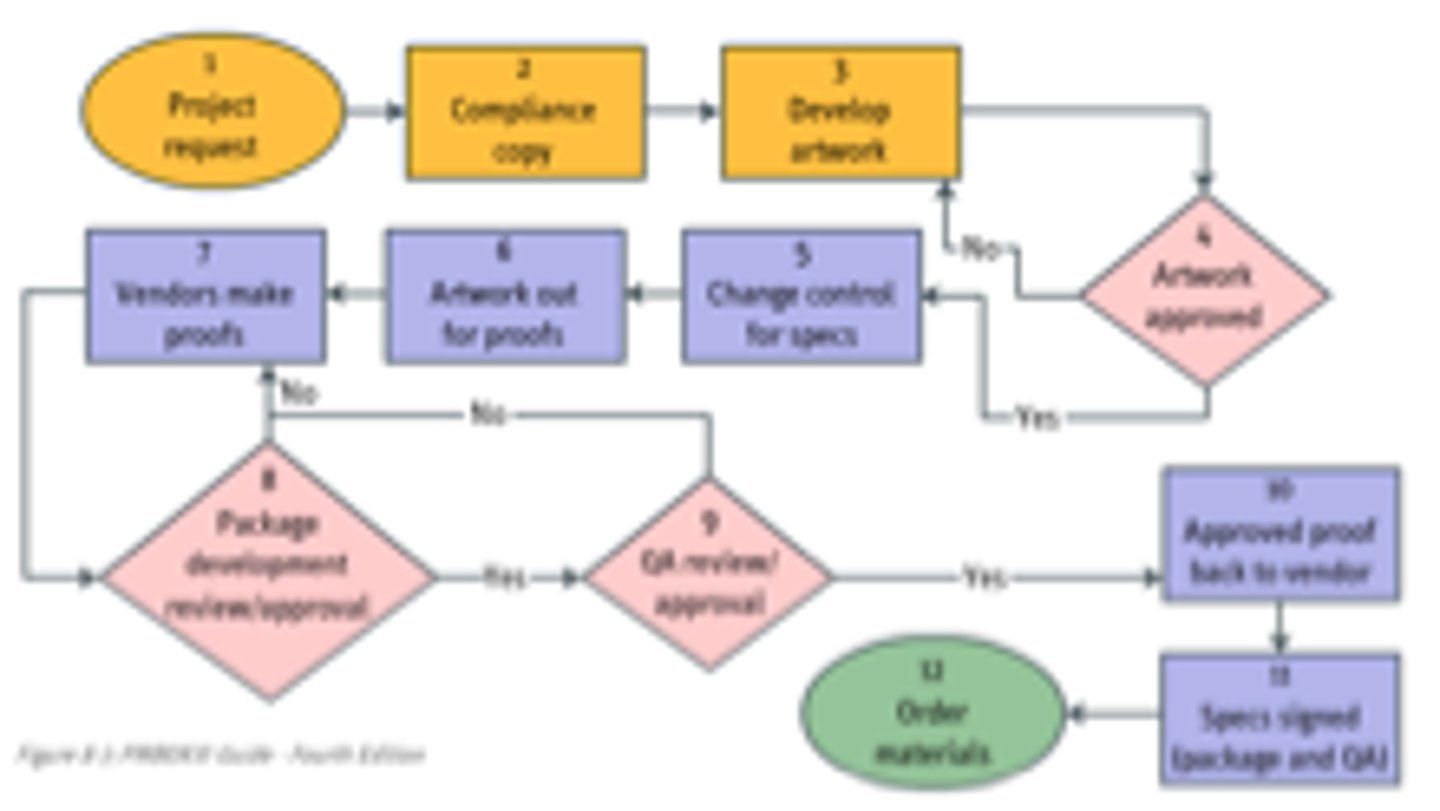
FlowChart Process Map
-Well defined start to finish
- top-down (but may be also left to right)
-Usually involves both tasks and options.
-several possible paths to get from the start to the finish.
-Used to understand and simplify complex processes.
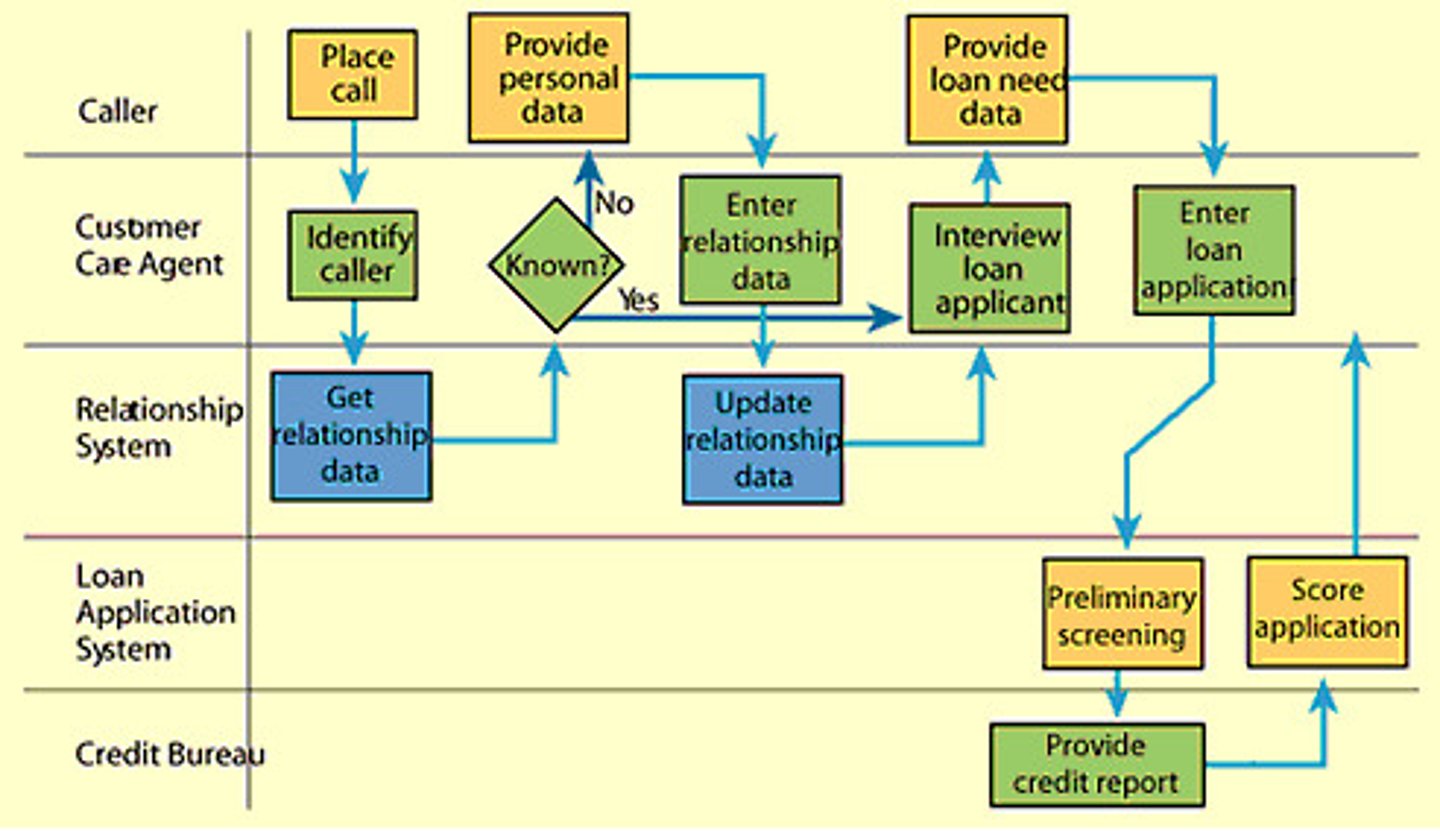
SwimLane Process Map
-Well defined start to finish
-Parallel work flows
-left to right
-arranged on a timeline.
-The various functions/people/specialties each have a horizontal "swimlane" within which all of their responsibilities are listed.
-Often used to describe processes that are managed by software.
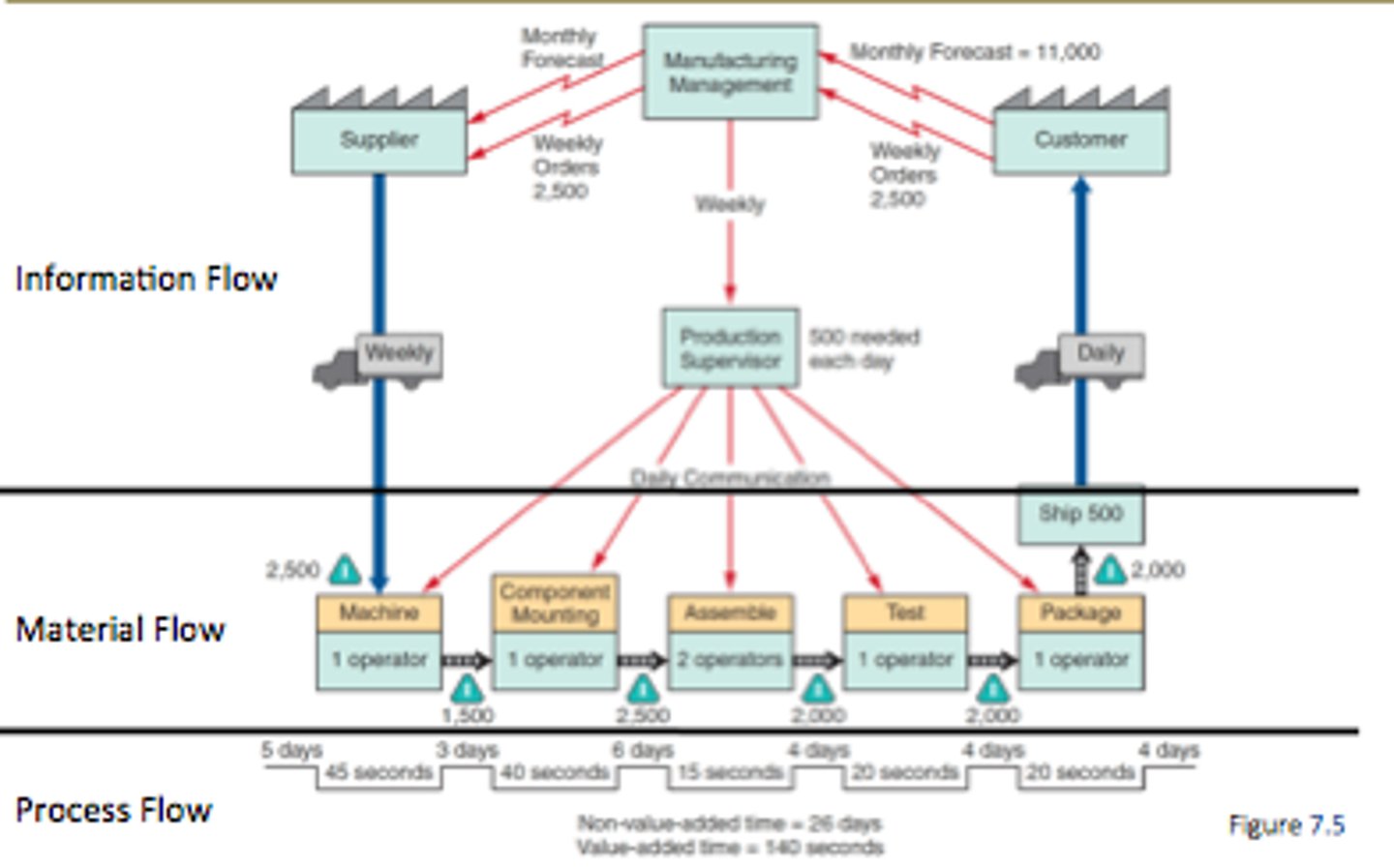
Value Stream Process Map
-Diagrams the entire creation of value through a company.
-Each product category is mapped separately.
-Left to right, from raw materials and tracking the creation of value through to the customer.
-Describes who does the work, in what quantities, the time it takes to do the work, and delays encountered.
-The top describes customer" infos influences the process.
-Decrease process delays/waste and meet the customer requirements.
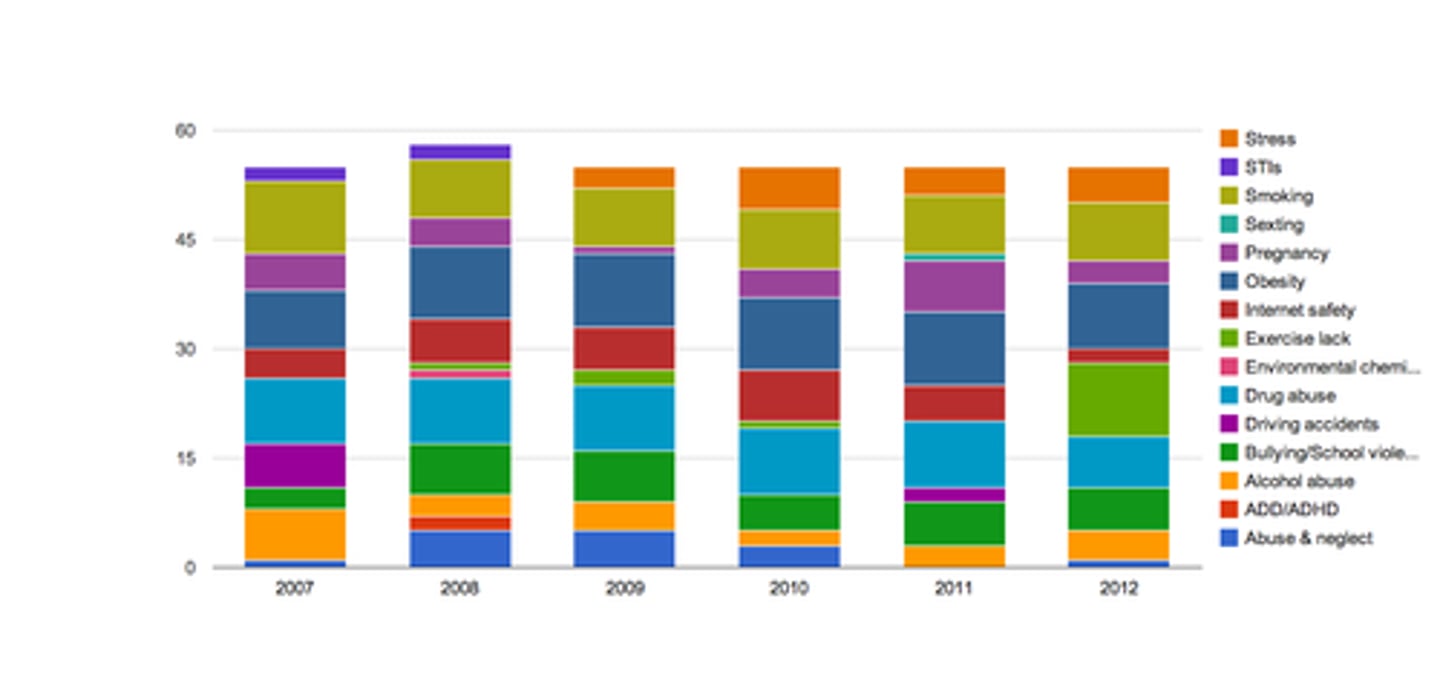
Line Balancing Process Map
-Lists all the individual tasks
-Graphically describes how long complete a process compared to a target rate
-"rebalance" the process by changing the responsibilities
-Allowing overworked functions/people to transfer some of their responsibility to underutilized functions/people.
Benchmarking
company compares its performance within the same organization or other businesses to help improve performance.
Lean
the identification of waste anywhere in a process and removing it
Six sigma
targets problem-solving and consistency using a well-defined analytical tools to improve
DMAIC
A six-sigma process: define, measure, analyze, improve, and control.
7 Wastes of Lean (TIMWOOD)
Transportation
Inventory
Movement
Waiting
Overproduction
Overprocessing
Defects
**Unused employee ingenuity
Cross Sourcing
The buying firm uses a single supplier for one particular part or service and another supplier with the same capabilities for a different part or service.
Balances risk while allowing for strong relationships with supplier.
External failure costs
costs that arise when a defect is discovered after the customer receives the service or product
Internal failure costs
costs for defects incurred within the system
Appraisal costs
costs of the inspection and testing to ensure that the product or process is acceptable
Prevention costs
costs associated with preventing defects before they happen
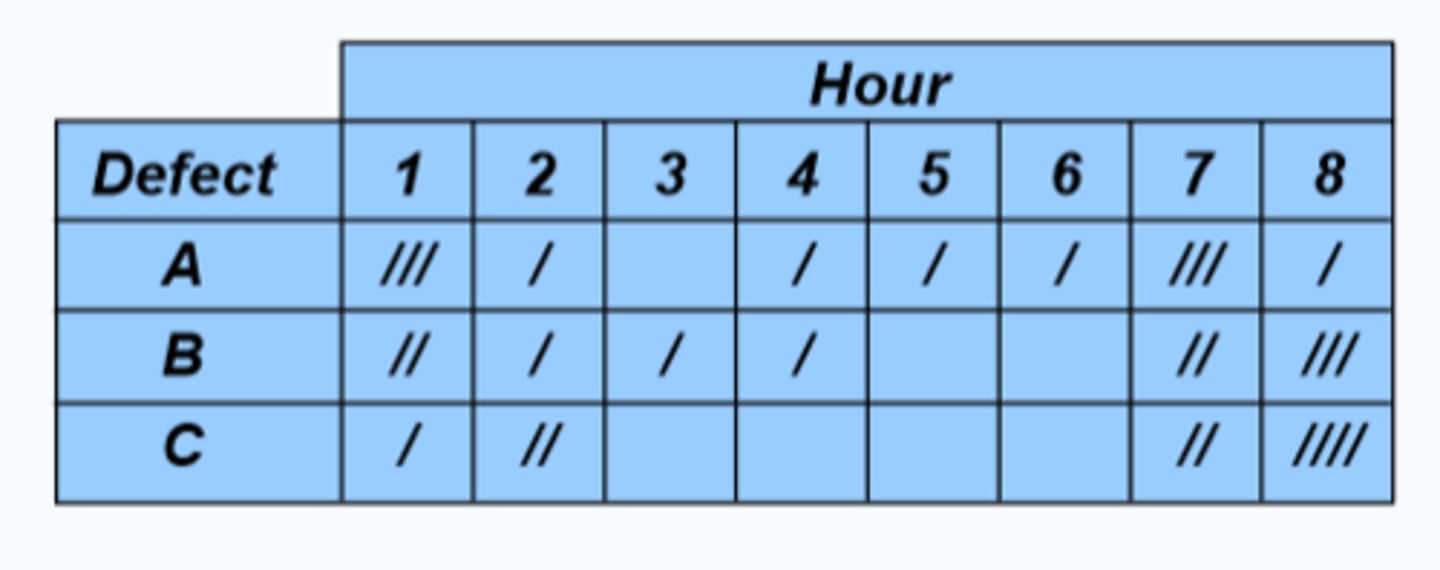
Check sheet
a sheet used to record how frequently a certain event occurs
Lower customization
Allow for standardized processes. Primary measurements are related to productivity and cost
Higher customization
Requires flexible processes. Primary measurement becomes customer satisfaction.
The level of customer contact
Front Room, Back Room, and Challenge. (Mapped using "Service Blueprinting)
Strategic Sourcing Process (STEP 1-6)
1. Assess opportunities
2. Profile internally and externally
3. Develop the sourcing strategy
4. Screen suppliers and create selection criteria
5. Conduct supplier selection
6. Negotiate and implement agreements
Visual management
The practice of making it easy to see how a process flows and what to do at each step.
Kanban tools
replenishment as soon as possible ex: box/bin
Total Quality Management (TQM)
-customer-focus
-leadership involvement
-continuous involvement
-employee empowerment
-quality assurance
-supplier partnership
-strategic quality plan
Taguchi Loss Function: watch
More variation, lower quality, higher cost. Quality is a target, the closer = less cost
5 Main steps for Procure-To-Pay-Cycle
1. Ordering
2. Follow-up & expediting
3. Receipt & inspection
4. Settlement & payment
5. Records maintenance
Settlement and Payment
○ May be paid through Electric Funds Transfer (EFT) Payment ○ Payment is aligned with Quotation, Receipt, and Inspection
Records Maintenance
Supplier Relationship Management (SRM) Software
Statement of work, or scope of work (SOW)
terms and conditions for a purchased service that indicate, among other things, what services will be performed and how the service provider will be evaluated

