Amino acid neurotransmitters: Glutamate & GABA
 Studied by 0 people
 Call with Kai
 Learn
Learn Practice Test
 Spaced Repetition
 Match
Match Flashcards
 Knowt Play
1/39

There's no tags or description
Looks like no tags are added yet.
Name | Mastery | Learn | Test | Matching | Spaced | Call with Kai |
|---|
No study sessions yet.
40 Terms
What is glutamate?
The main excitatory transmitter in the CNS
What is GABA?
The main inhibitory transmitter in the CNS
What molecule is glutamate synthesised from?
Glutamine
What molecule is GABA synthesised from?
Glutamate
What type of receptors do glutamate and GABA activate?
Ionotropic and metabotropic receptors
Describe the distribution of glutamate
Found in pyramidal neurones

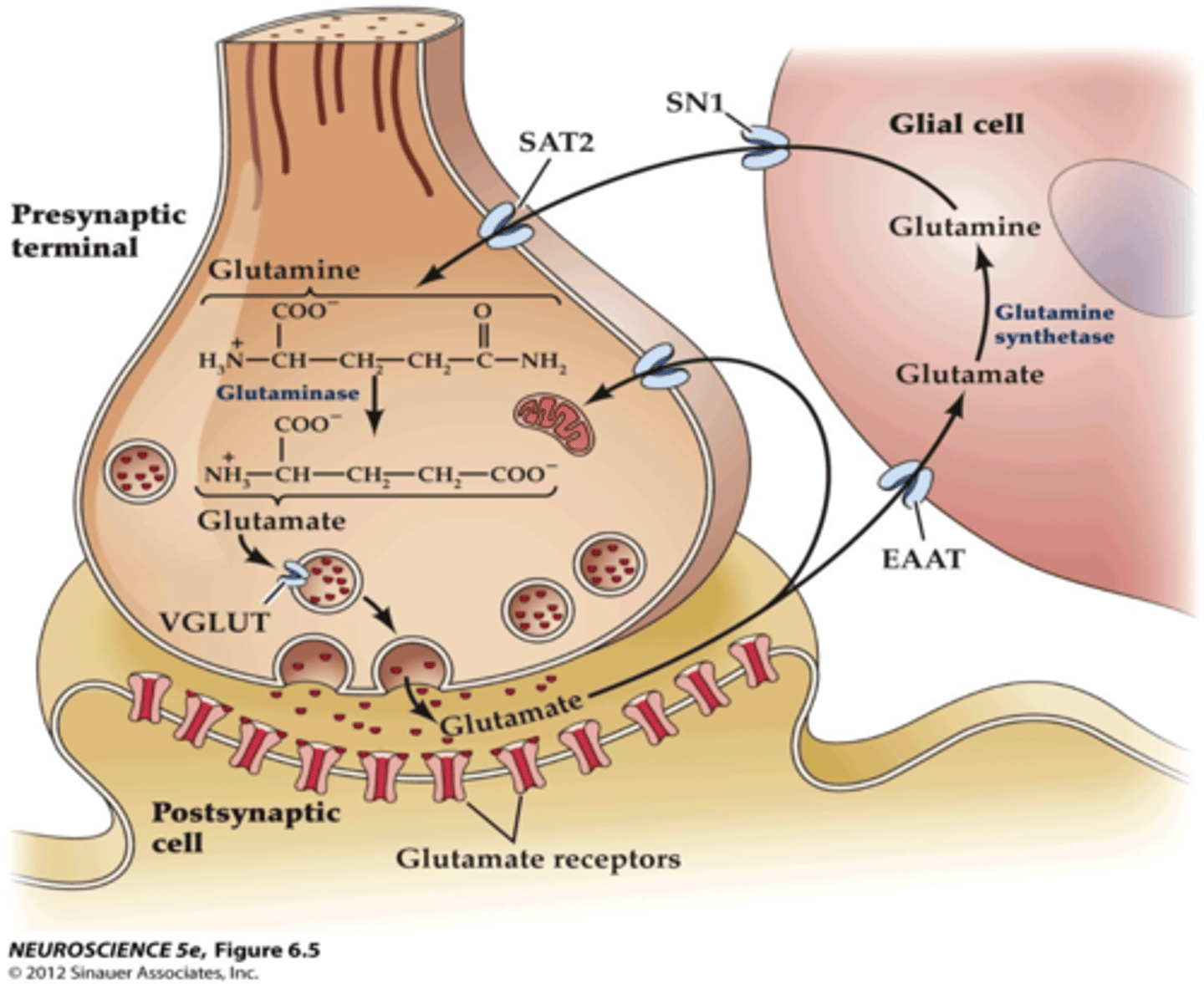
Describe the synthesis of glutamate
Glutamate in the CNS comes from either:
- Krebs cycle
- Glutamine
TCA cycles
Alpha-Oxo-glutarate is converted to glutamate using a reduction reaction
Glutamine
Glutamine made by glial glial cells and taken up by neurons.
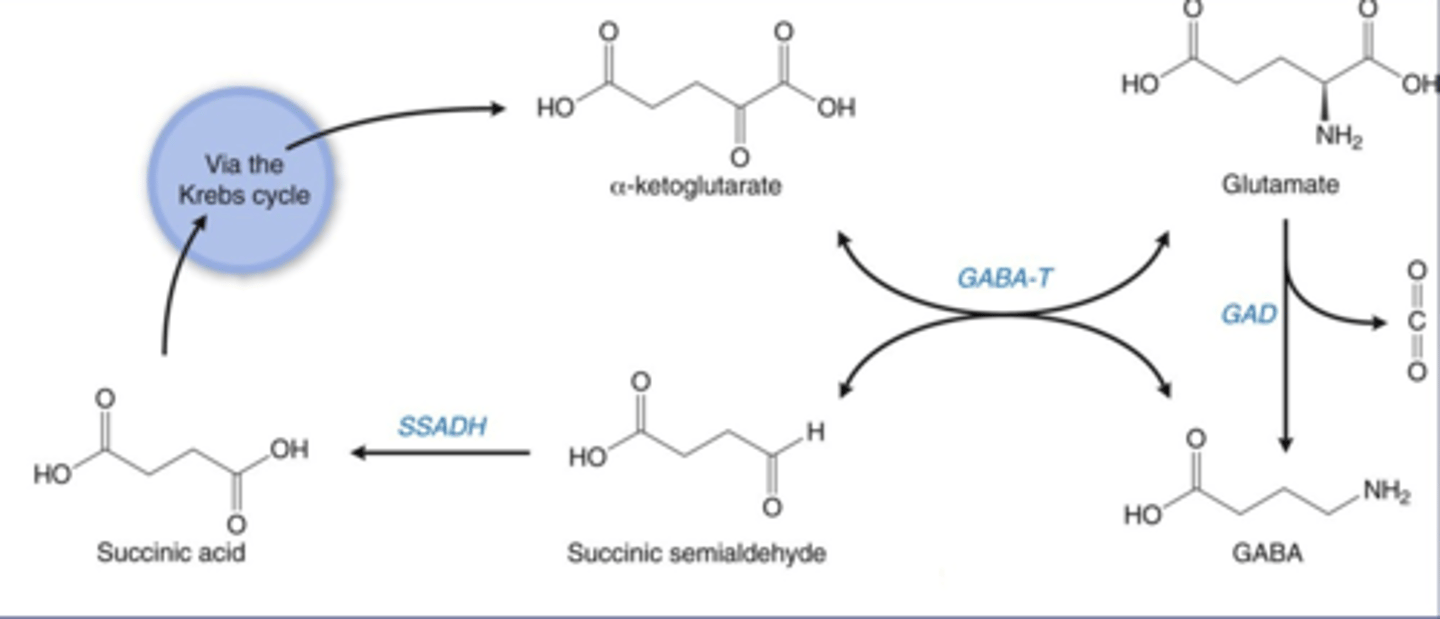
Describe the degradation of glutamate
1. Glutamate is stored in synaptic vesicles
2. Glutamate is released from vesicles by Ca2+ dependent exocytosis.
3. When glutamate is released, it can be taken up by glial cells (astrocytes specifically) OR into nerve cells by excitatory amino acid transport (EEAT) proteins.
4. In astrocytes, glutamate is converted to glutamine and and recycled back to neurones via transporters (GlnT).
5. Glutamine is converted back into glutamate in neurons.
6. Glutamate is taken up into synaptic vesicles by vesicular glutamate transporters (VGluT).
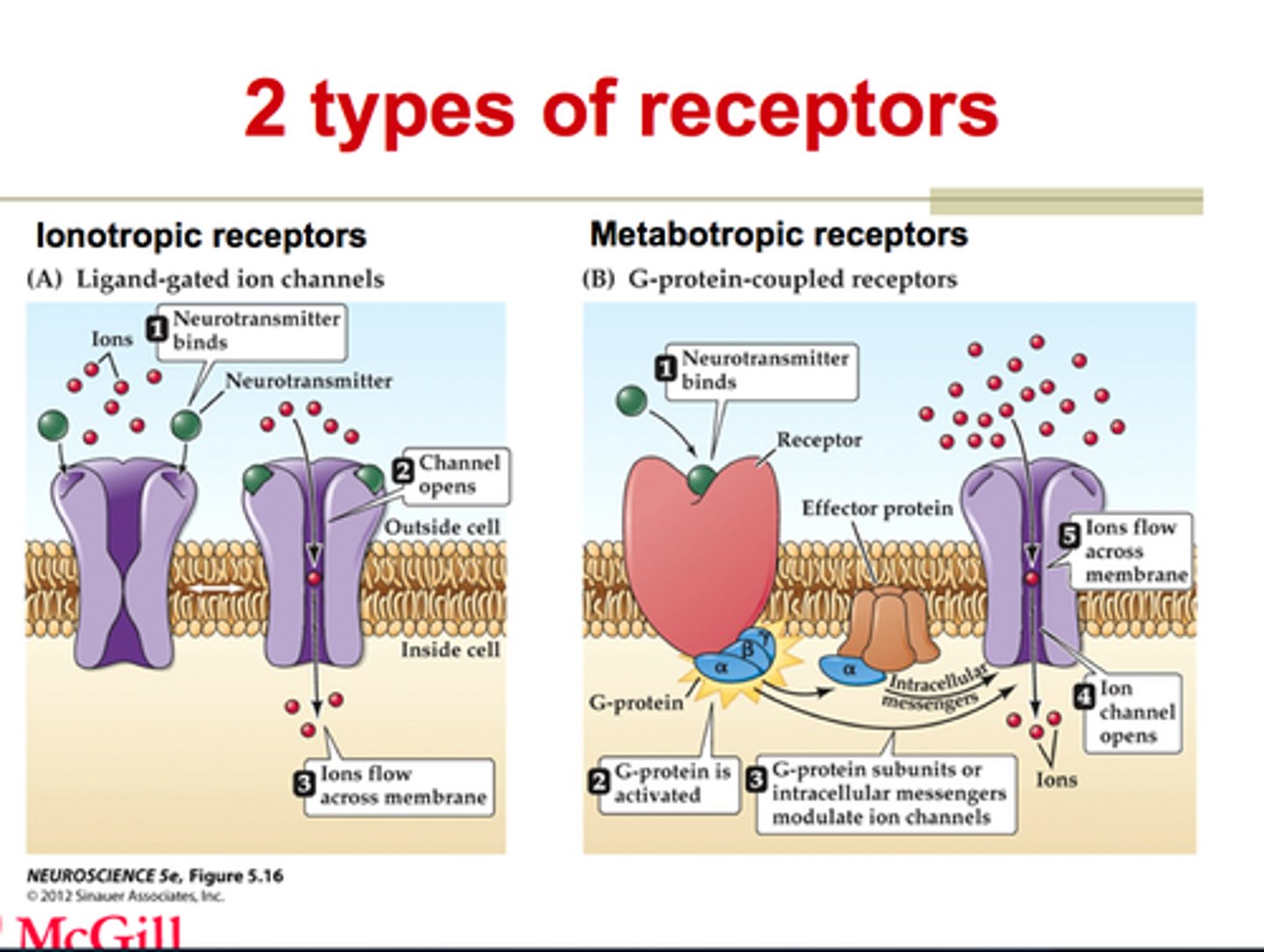
Describe ionotropic receptors
They are ligand-gated ion channels
- Multi subunit receptors
- Heterogeneous receptors
- Affects physiological function and pharmacology
- Rapid cellular effects
Describe metabotropic receptors
These are G protein-coupled receptors
- Hetero and homodimers
- Activate second messenger systems
- Slower effects on synaptic transmission
- May be "autoreceptors" located presynaptically on nerve terminals
Describe GABAa receptor
A Cl- ion channel
GABA is the agonist
Muscimol can also act as an agonist
Bicuculline can act as an antagonist
Its effect happens in milliseconds
It has an inhibitory effect by causing fast hyperpolarisation
Describe GABAb receptor
A GPCR (K+/ Ca2+)
GABA is the agonist
Baclofen can also act as an agonist
Bicusaclofen/CGP can act as an antagonist
Its effect happens in milliseconds - minutes
It has an inhibitory effect by causing fast hyperpolarisation
Describe GABAc receptor
A Cl- ion channel
GABA is the agonist
Muscimol can also act as an agonist
TPMpA can act as an antagonist
Its effect happens in milliseconds
It has an inhibitory effect by causing fast hyperpolarisation
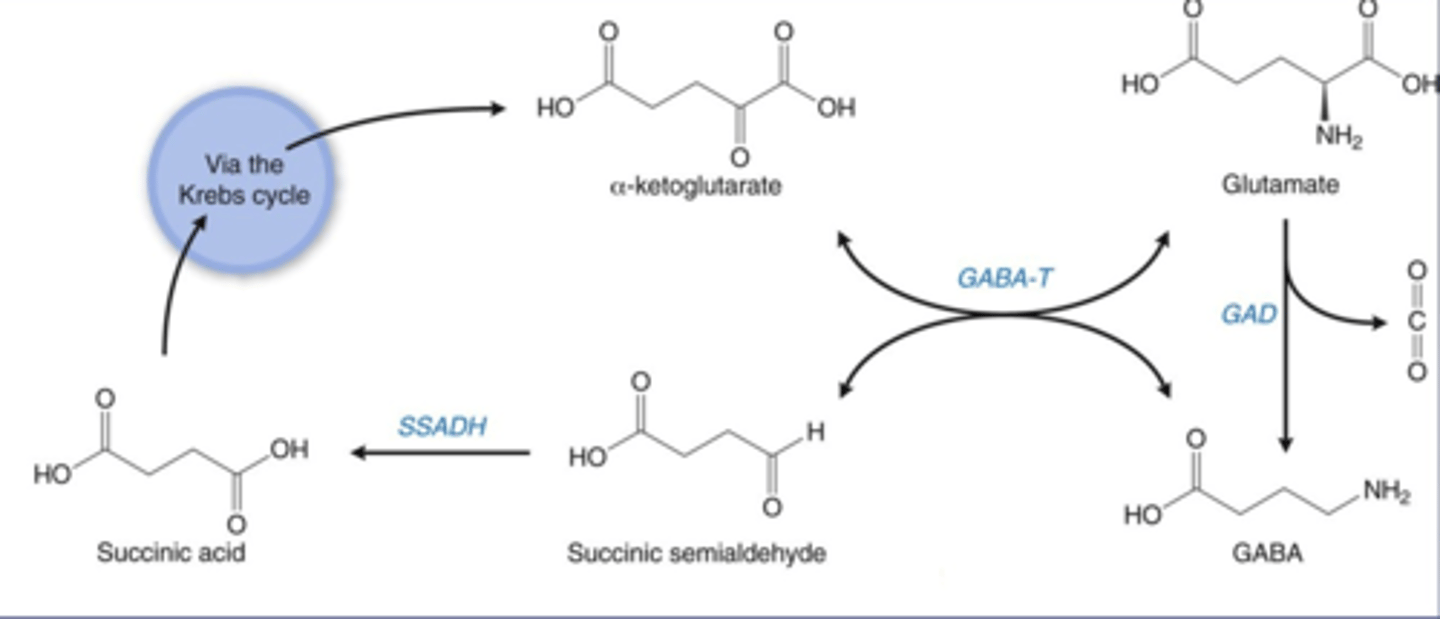
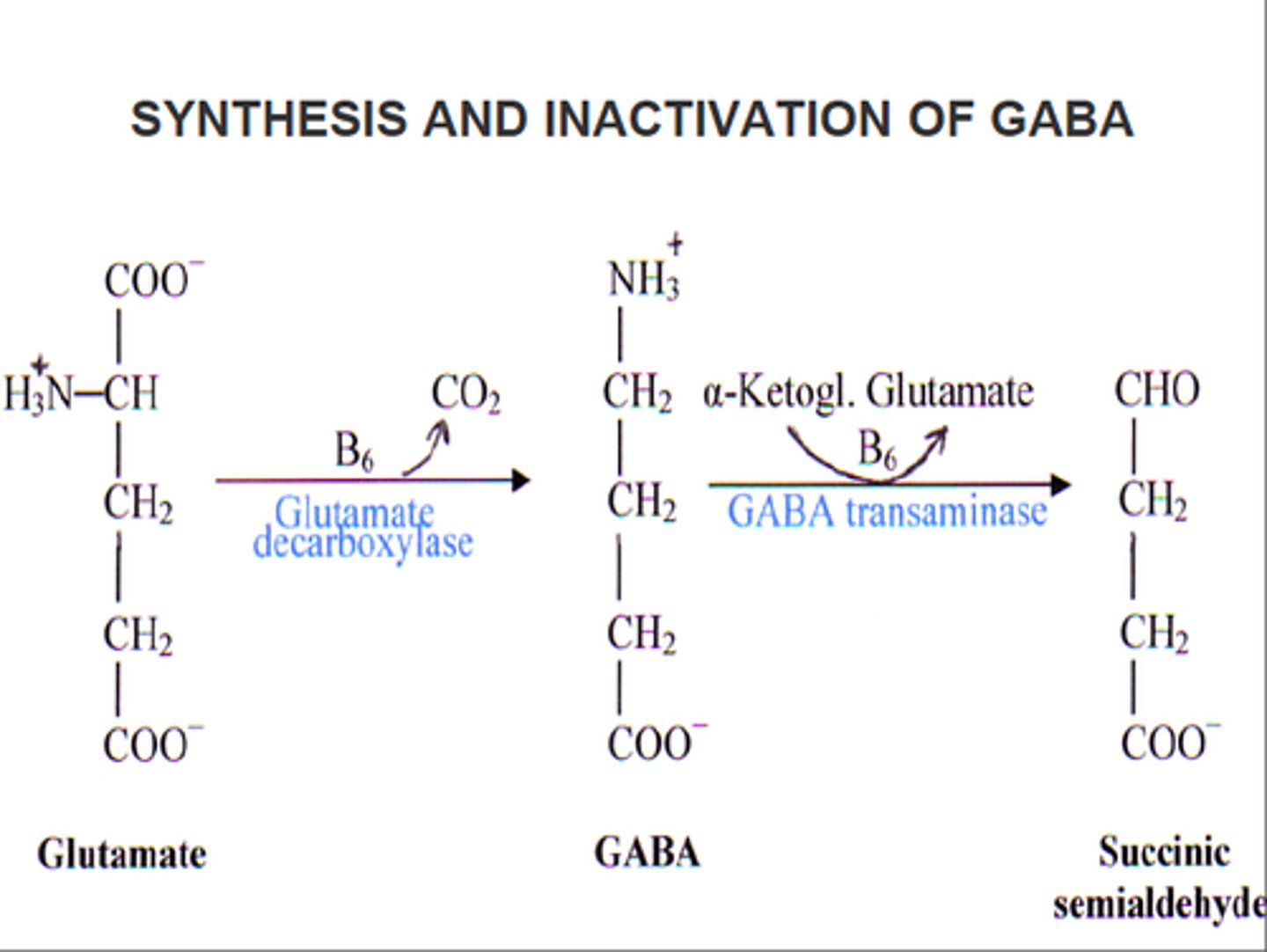
Describe the synthesis of GABA
Glutamic acid decarboxylase (GAD) converts glutamate into GABA.
Describe the degradation of GABA
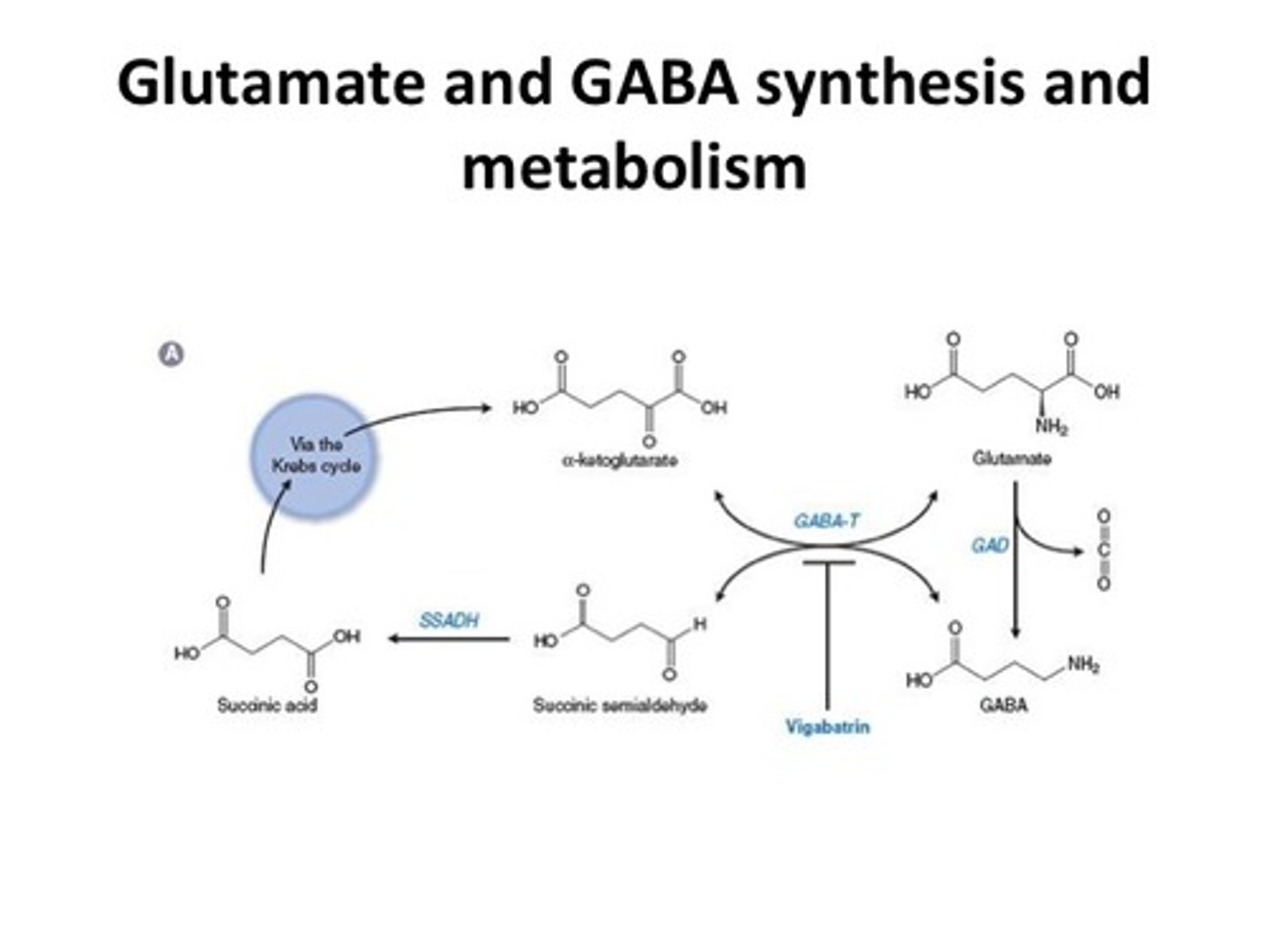
GABA is converted into succinic semialdehyde via GABA-T (GABA transaminase).
Succinic acid semi-aldehyde is then converted into succinate via succinic dehydrogenase.
Describe the distribution of GABA
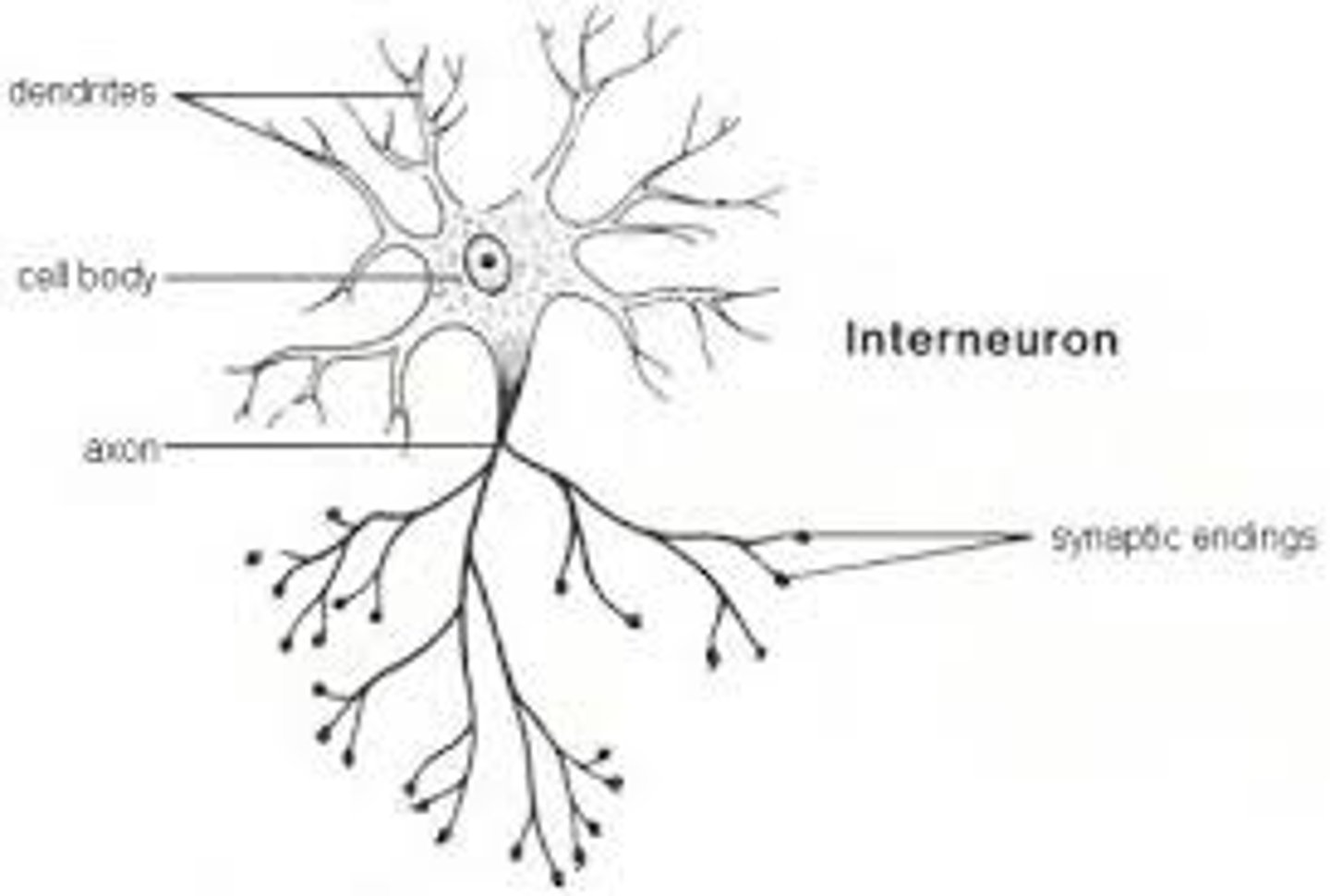
Mainly found in short local interneurons
Some found in longer projection neurones
What enzyme can inactivate GABA?
GABA-transaminase (GABA-T)
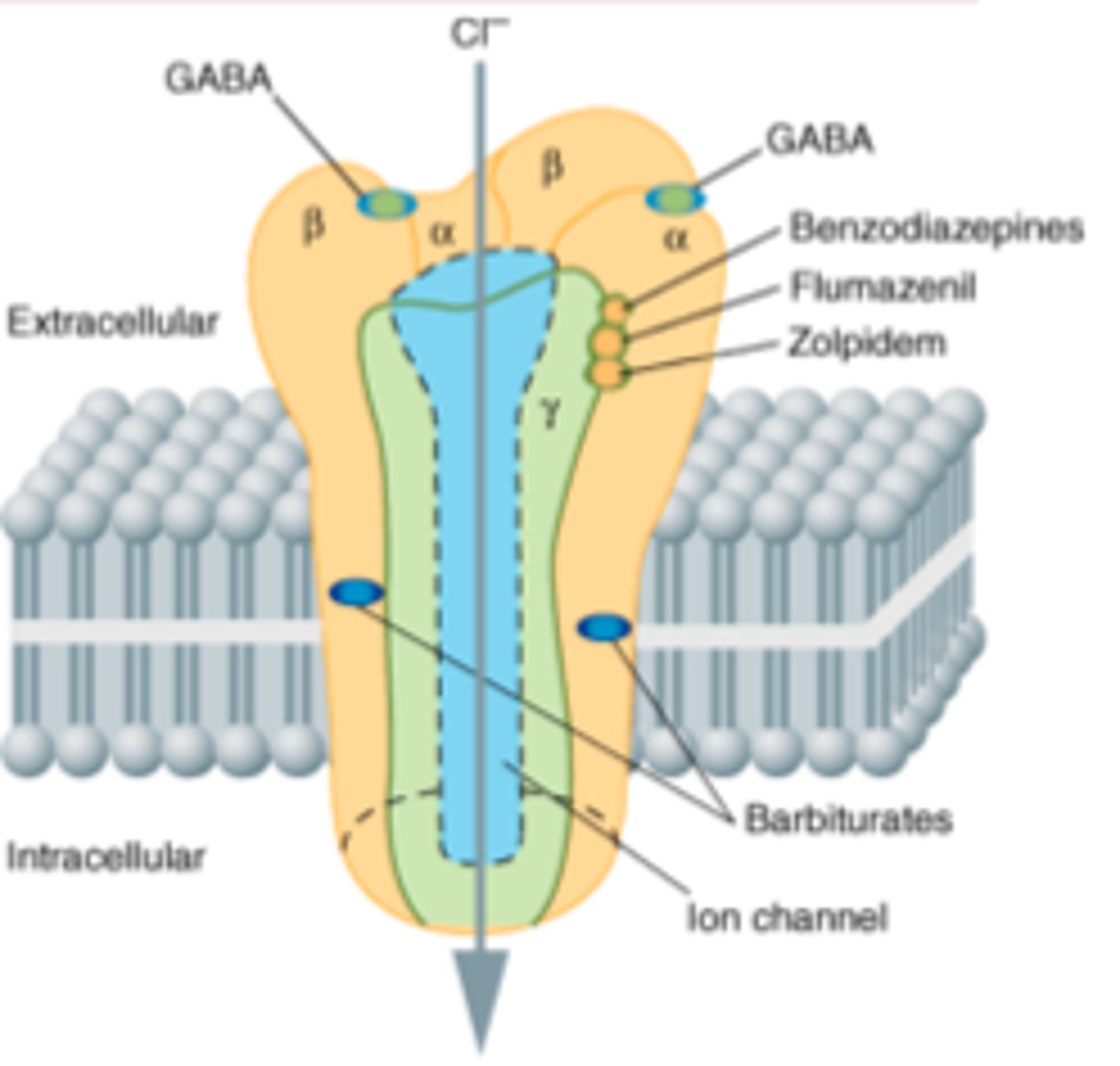
Describe the structure of ionotropic GABA receptors
It is a pentameric receptor. Has 2 alpha subunits, 2 beta subunits and a gamma subunit.
Name the ionotropic receptors for GABA
GABAa
GABAc
Name the metabotropic receptors for GABA
GABAb
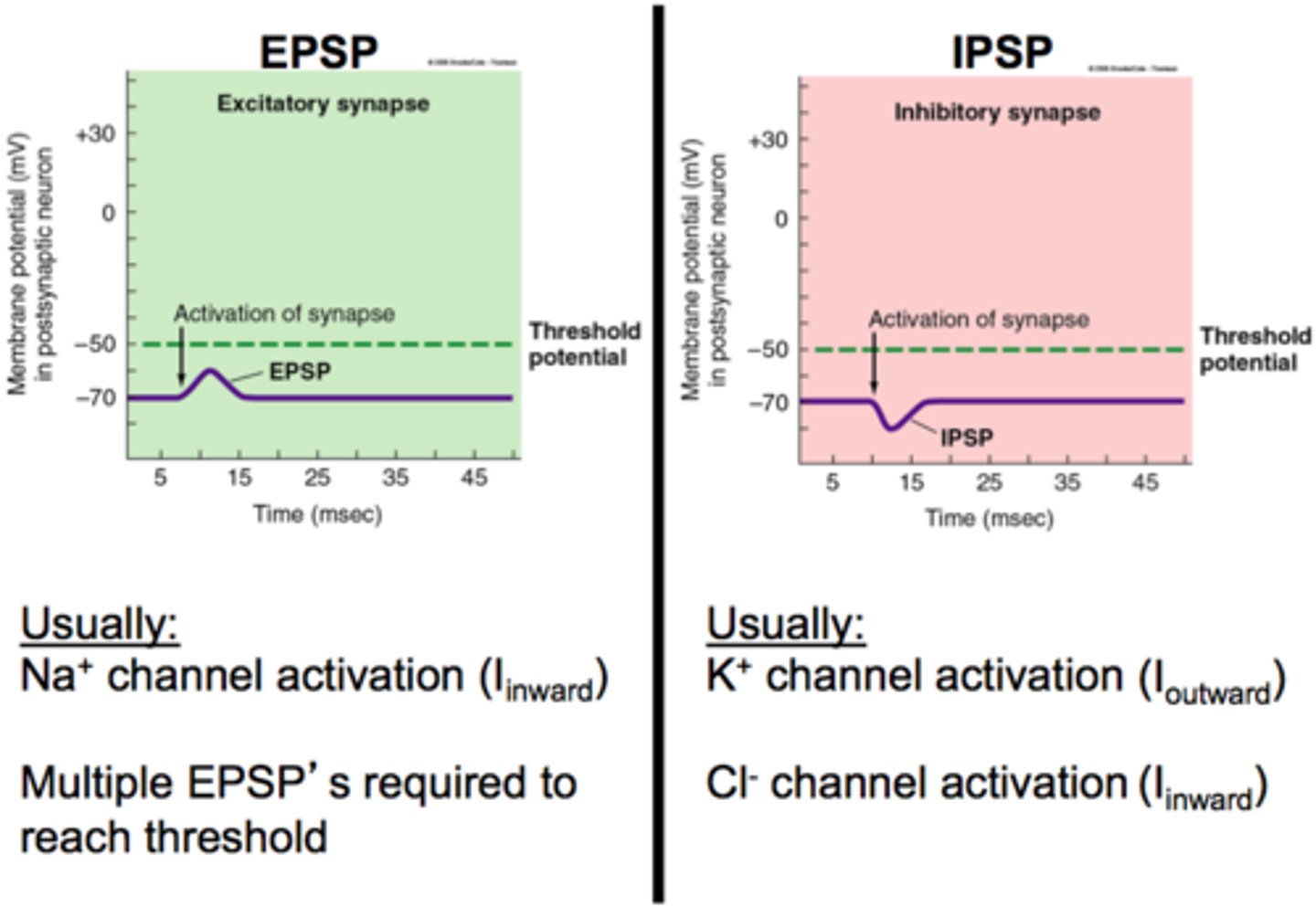
Explain what is meant by inhibitory transmission at a synaptic level
This means the cell becomes hyperpolarised. Therefore the membrane potential moves further from resting membrane potential. Membrane potential becomes more negative. This makes it hard to generate an action potential (AP).
This happens as:
The binding of GABA to the ionotropic receptor (GABAa) causes the channel to open and allow Cl- channels into the cell
What is the orthosteric site?
Where the agonist binds to the receptor.
What is the allosteric site?
A site where other substrates can bind to the receptor which is not where the agonist binds
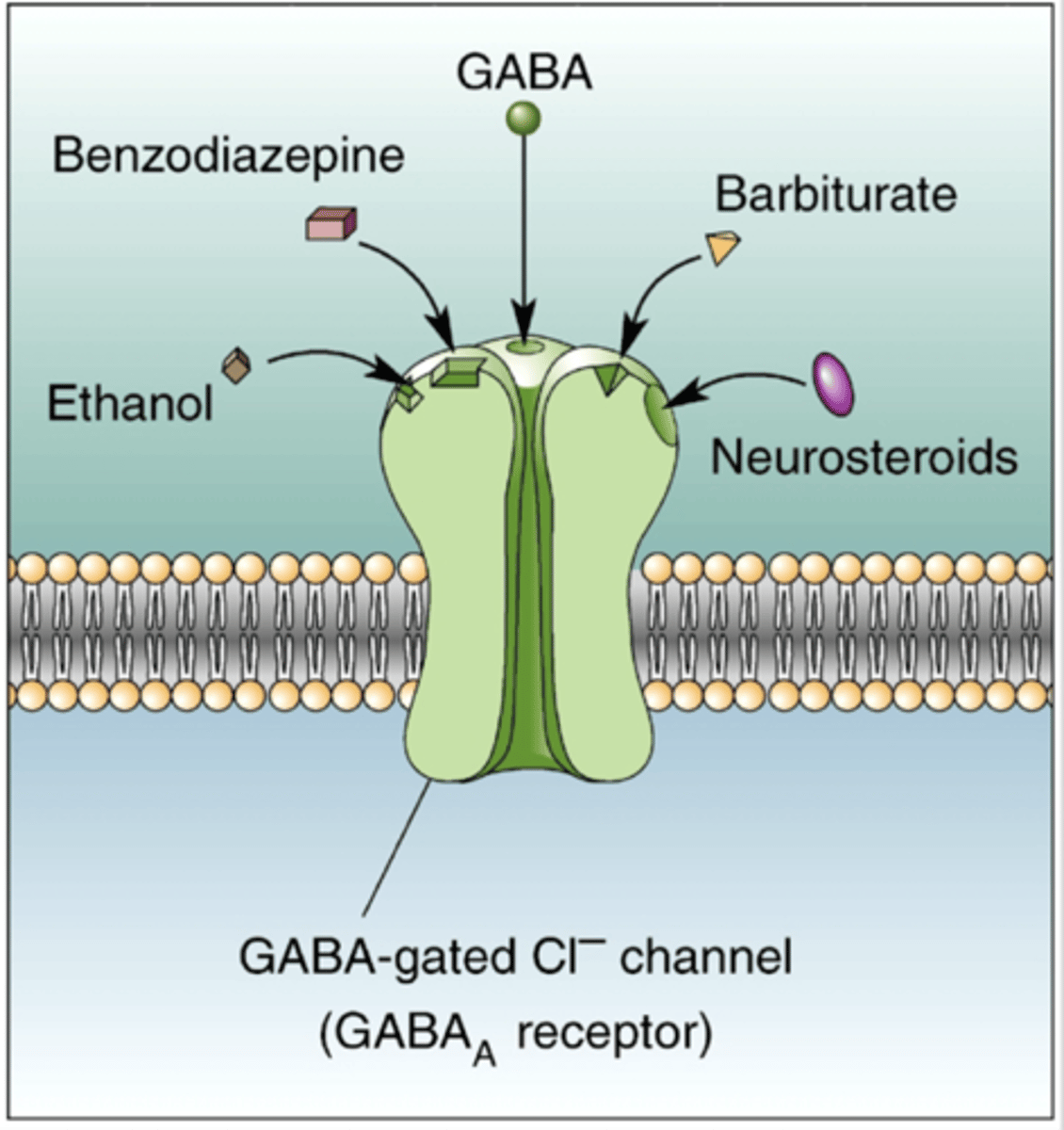
Describe the different sites on GABAa receptors
GABAa have the orthosteric site (where GABA binds) and allosteric/ modulatory sites where other substrates can bind.
What is the effect of allosteric binding on ionotropic receptors ?
Drugs can bind to allosteric sites to "turn up" or "turn down" effects of endogenous neurotransmitters.
The drugs (channel modulators) cannot open the channel by themself - only can modulate binding of endogenous neurotransmitter.
For example allosteric binding of channel modulators to GABAa receptors can affect transport of Cl- ions when GABA is bound to the orthosteric site.
What drugs can bind to GABAa receptors?
1. Anaesthetics
2. Barbiturates (used more before benzodiazepines made)
3. Benzodiazepines - for anxiety relief, hypnotic
4. Neurosteroids - metabolites of progesterone and deoxycorticosterone.
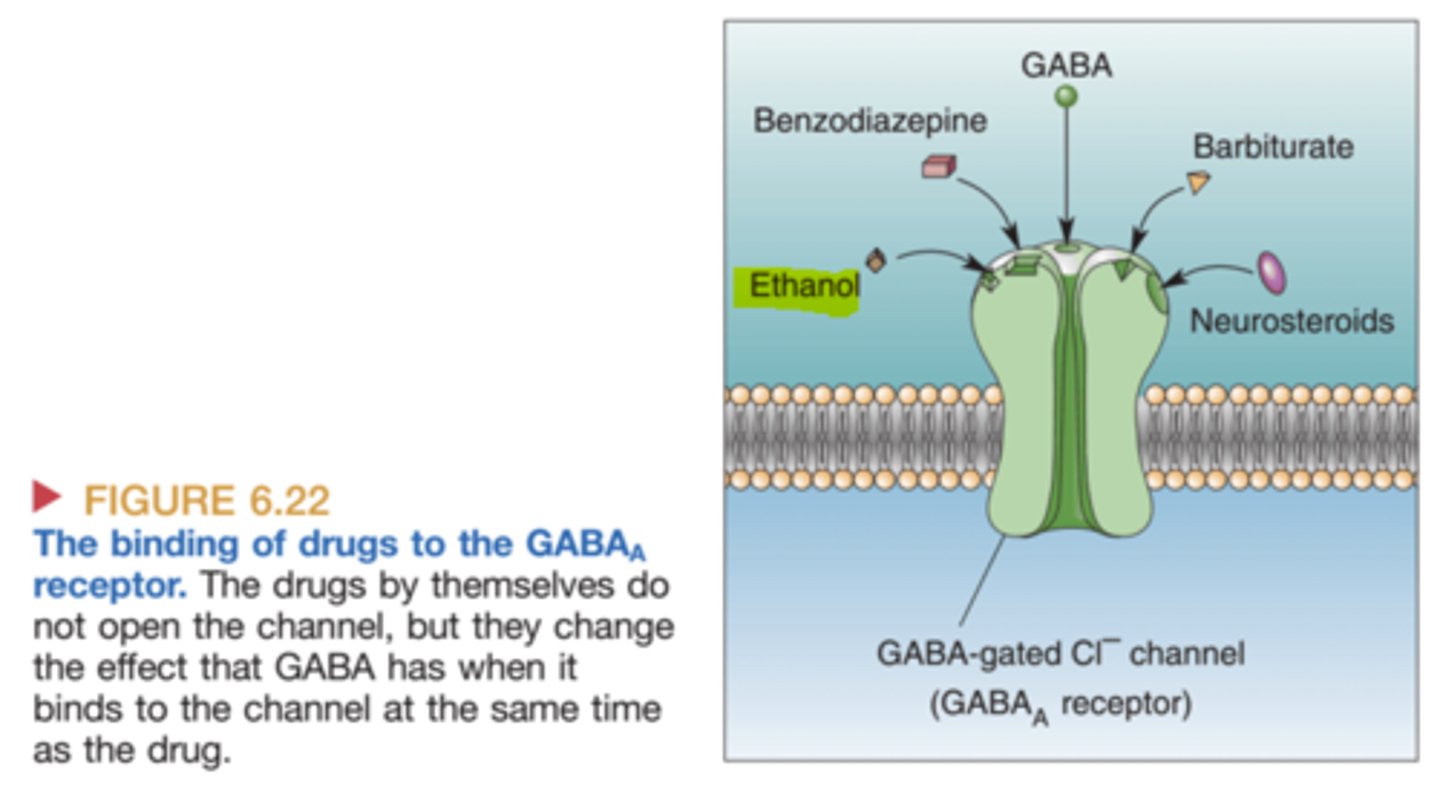
Give an example of anaesthetics which bind to GABAa receptors
Etomidate & propofol
Give an example of a barbiturate which bind to GABAa receptors
Pentobarbital (has sedative/anticonvulsant effects)
What is the effect of GABAb receptors presynaptically?
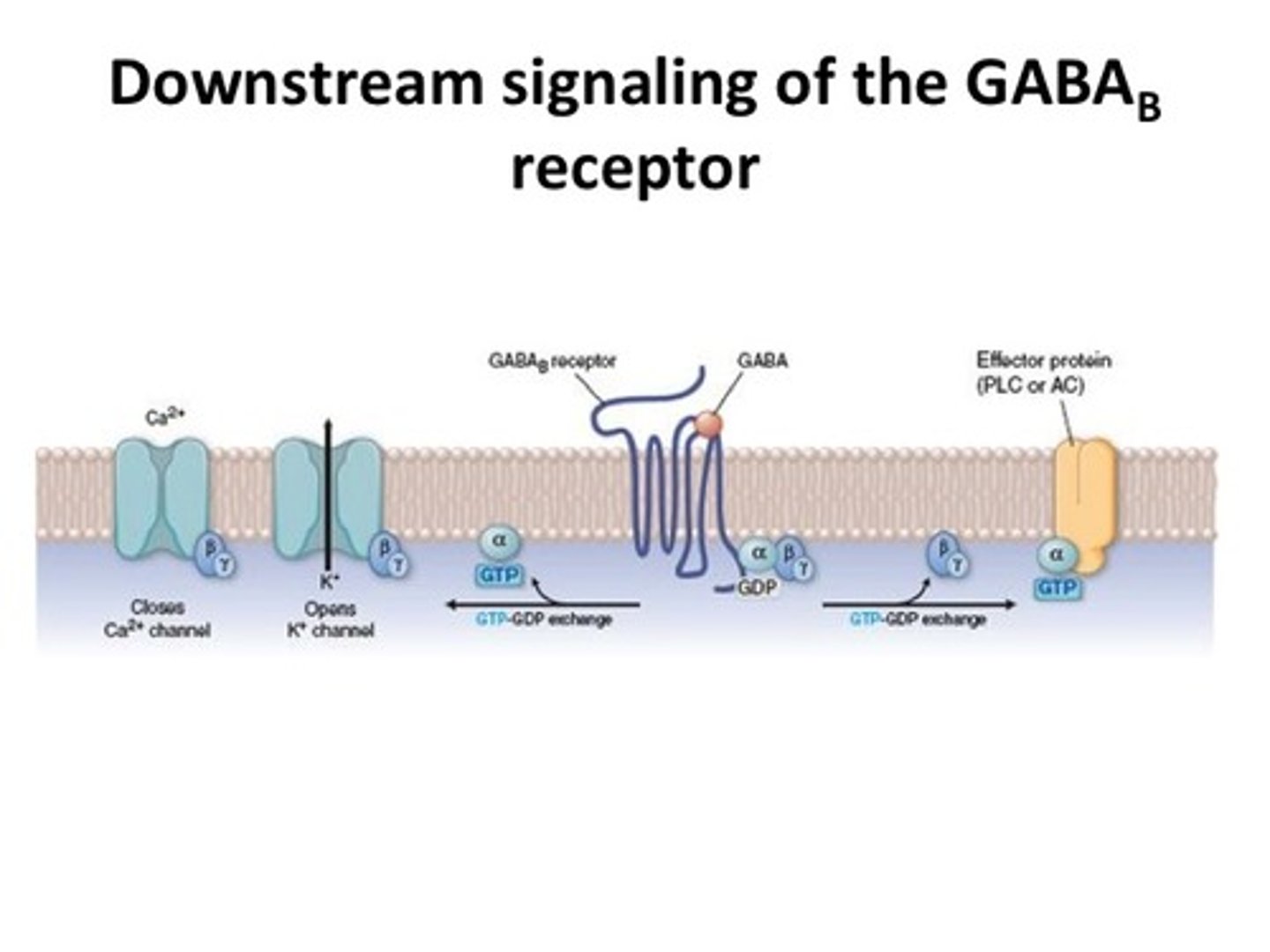
They close calcium channels presynaptically to reduce transmitter release (autoreceptor).
- Has an inhibitory effect as stops vesicular release of neurotransmitter.
What is the effect of GABAb receptors postsynaptically?
They open potassium channels postsynaptically causing a slow hyperpolarization
- Has an inhibitory effect
Describe GABAb receptor mechanism
Gio coupled receptor
It couples to calcium channels. Closes calcium channels so there is less calcium dependent release of neurotransmitter. (pre-synapse). Post synaptically, they open K+ channels. Open K+ channels then there is slow hyperpolarisation.
What is baclofen used to treat?
Baclofen is used to treat spasticity - rigidity in limbs and muscles.
This acts through the GABAb receptor by acting as an agonist.
However, it crosses the BBB so can cause sedation.
What are the different ionotropic glutamate receptors?
There are 3 types NMDA, AMPA, KAINATE.
They are named after the after the ligands which binds to them.
Describe the structure of ionotropic glutamate receptors
Tetrameric (4 subunits)
NMDA: 7 different sub-units
AMPA: 4 different sub-units
KAINATE: 5 different sub-units
Main ONE glutamate binds to NMDA
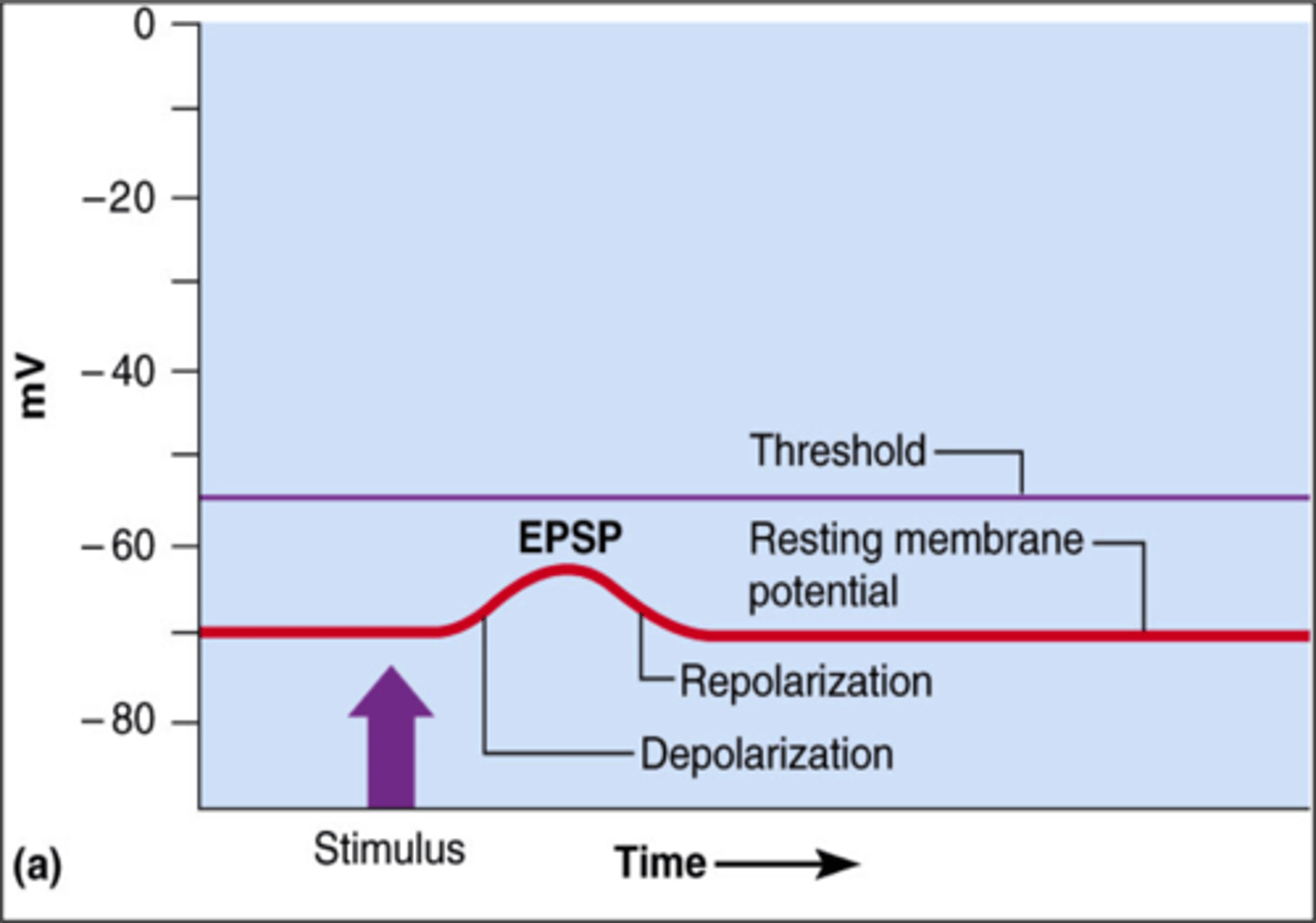
Explain what is meant by excitatory transmission at a synaptic level
When the membrane potential becomes transiently more positive. This makes it more likely for an action potential to occur.
It is responsible for fore fast excitatory neurotransmission.
This occurs because...
Glutamate binds to NMDA receptor which allows Na+ into the cell.
Describe metabotropic glutamate receptors
There are 8 different GPCRs split into 3 groups (groups 1-3).
Can have homo and heterodimers
Their neurotransmission is slow.
Can be found post and pre-synaptically.
Grouped by sequence, and the 2nd messenger systems that they are coupled to.
No drugs currently work through metabotropic receptor.
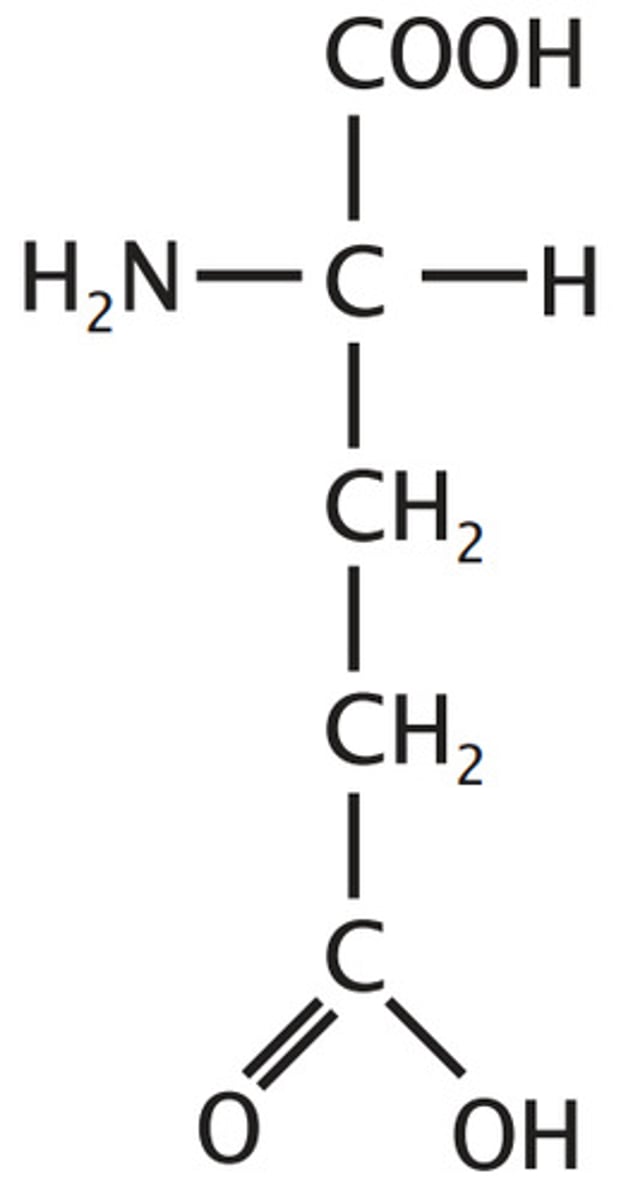
How does glutamate bind to so many different receptors?
The structure of glutamate is flexible. It can rotate its bonds along 2 different axis. Therefore, it can adopt different confirmations and have 9 different rotamers.
Describe the different sites on NMDA receptors
NMDA receptors have receptor site (orthosteric) and several modulatory sites (allosteric)
What are two selective NMDA receptor antagonists?
Ketamine memantine.
How do pre-synaptic receptors on NMDA receptors control neurotransmitter release?
1. Enhance glutamate release
they can increase glutamate release
by increasing Ca2+ influx.
Mg2+ block disappears when cell depolarised.
2. Inhibits glutamate release
they can decrease glutamate release
by decreasing Ca2+ influx.
Mg2+ can block Ca2+.
 Note
Note  Flashcards (50)