Topic 6 — Inheritance, Variation & Evolution
 Call Kai
 Learn
Learn Practice Test
 Spaced Repetition
 Match
Match Flashcards
 Knowt Play
1/160

Earn XP
Description and Tags
AQA GCSE Biology | Topic 6 — Inheritance, Variation & Evolution
Biology
GCSE Biology
AQA
Inheritance, Variation and Evolution
6.1 Reproduction
6.2 Variation & Evolution
6.3 The Development of Understanding of Genetics & Evolution
6.4 Classification of Living Organisms
6.1.1 Sexual & Asexual Reproduction
6.1.2 Meiosis
6.1.3 Advantages & Disadvantages of Sexual & Asexual Reproduction
6.1.4 DNA & The Genome
6.1.5 DNA Structure
6.1.6 Genetic Inheritance
6.1.7 Inherited Disorders
6.1.8 Sex Determination
6.2.1 Variation
6.2.2 Evolution
6.2.3 Selective Breeding
6.2.4 Genetic Engineering
6.2.5 Cloning
6.3.1 Theory of Evolution
6.3.2 Speciation
6.3.3 The Understanding of Genetics
6.3.4 Evidence for Evolution
6.3.5 Fossils
6.3.6 Extinction
6.3.7 Resistant Bacteria
Triple (Biology Only)
Paper 2
Name | Mastery | Learn | Test | Matching | Spaced | Call with Kai | Chat |
|---|
No analytics yet
Send a link to your students to track their progress
161 Terms
What is meosis?
The formation of four non-identical cells from one cell.
What is mitosis?
The formation of two identical cells from one cell.
What does sexual reproduction involve?
The fusion of male and female gametes.
What is the male gamete in animals?
Sperm
What is the female gamete in animals and flowering plants?
Egg cells
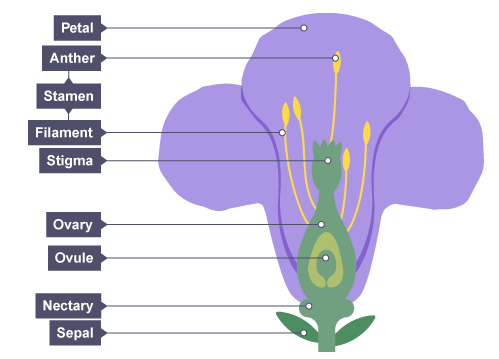
What is the male gamete in flowering plants?
Pollen
What process does the formation of gametes involve?
Meosis
In _______ reproduction there is a mixing of _________ _____________ that leads to _________ in the offspring.
sexual
genetic information
variety
Asexual reproduction involves only ______ _______ and no _________ of _________.
There is no mixing of ________ ____________.
one parent
fusion
gametes
genetic information
What does asexual reproduction produce?
Genetically identical offspring (clones)
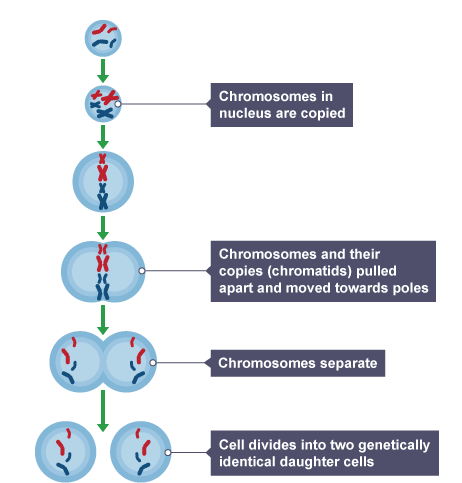
What process is involved in asexual reproduction?
Mitosis
Meiosis halves the number of chromosomes in gametes.
How is the full number of chromosomes restored?
Fertilisation
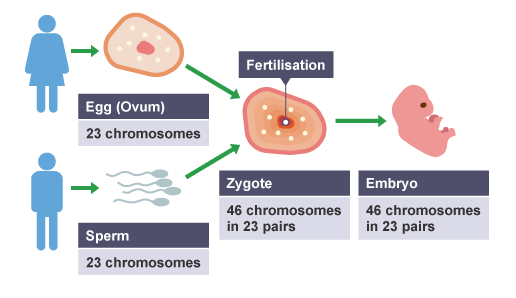
What does meosis do to the number of chromosomes in gametes?
Halves them
How many chromosomes are in a normal human cell?
46
How many chromosomes are in a human gamete?
23
Cells in ________________ ________ divide by _________ to form gametes
reproductive organs
meosis
What happens when a cell divides to form gametes?
Copies of the genetic information are made
The cell divides twice to form four gametes — each with a single set of chromosomes
All gametes are genetically different from each other
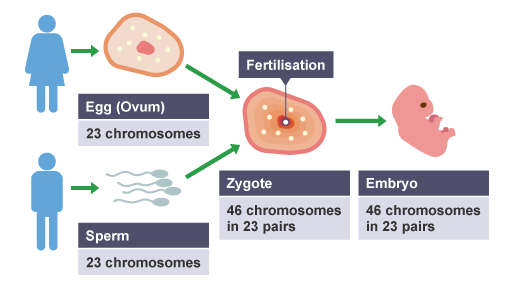
Gametes join at ______________ to restore the normal number of _____________.
The new cell divides by _________.
The number of cells __________.
As the ________ develops cells ___________.
fertilisation
chromosomes
mitosis
increases
embryo
differentiate
What are the advantages of sexual reproduction? (3)
Produces variation in the offspring.
If the environment changes, variation gives a survival advantage by natural selection.
Natural selection can be speeded up by humans in selective breeding to increase food production.
What are the disadvantages of sexual reproduction? (3)
Two parents/gametes are needed
It takes time and energy to find a mate/spread gametes
Slower than asexual reproduction
What are the advantages of asexual reproduction? (4)
Only one parent needed
More time and energy efficient as do not need to find a mate/spread gametes
Faster than sexual reproduction
Many identical offspring can be produced when conditions are favourable
What are the disadvantages of asexual reproduction?
Offspring are identical
If the environment changes, if one of the identical offspring can’t survive then none can.
Malarial parasites reproduce ___________ in the human host, but ___________ in the mosquito.
asexually
sexually
Many fungi reproduce __________ by spores but also reproduce ___________ to give __________.
asexually
sexually
variation
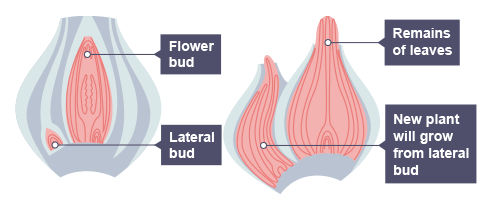
Many plants produce seeds _________, but also reproduce ___________ by runners such as strawberry plants, or bulb division such as daffodils.
sexually
asexually
What is the genetic material in the nucleus of a cell is composed of?
DNA
What is DNA?
A polymer made up of two strands forming a double helix.
What is DNA contained in?
Chromosomes
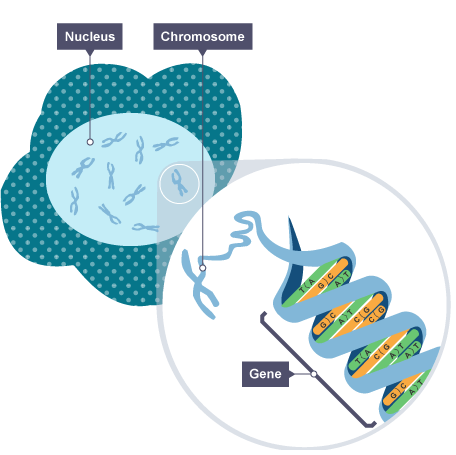
What is a gene?
A small section of DNA on a chromosome.
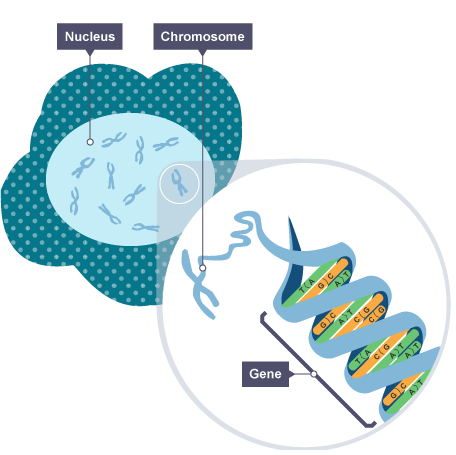
What does each gene code for?
A particular sequence of amino acids — to make a specific protein.
What is the genome of an organism?
The entire genetic material of that organism.
The whole human genome has now been studied and this will have great importance for medicine in the future.
Why is understanding the human genome important?
It helps with the:
search for genes linked to different types of disease
understanding and treatment of inherited disorders
use in tracing human migration patterns from the past
What is the structure of DNA?
A polymer made from four different nucleotides.
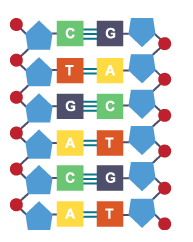
What does each nucleotide in DNA consist of?
A common sugar and phosphate group with one of four different bases attached to the sugar.
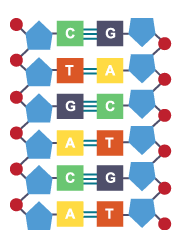
What are the four bases of DNA?
A
C
G
T
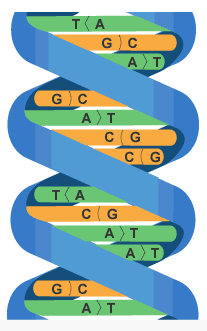
What is the code for a particular amino acid?
A sequence of three bases.
What does the order of bases control?
The order in which amino acids are assembled to produce a particular protein.
The long strands of DNA consist of ______________ ______ and __________ sections.
Attached to each sugar is one of the four _______.
The DNA polymer is made up of __________ __________ _______.
alternating
sugar
phosphate
bases
repeating nucleotide units
In the ________________ strands a C is always linked to a __ on the __________ strand and a __ to an A.
complementary
G
opposite
T
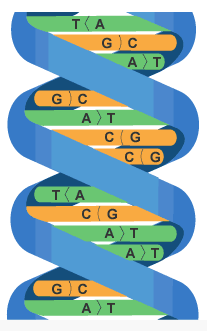
Each DNA molecule is made up of two DNA strands which are twisted together.
Each base is connected to another base in the other strand.
A bases only connect to T bases, and C bases only connect to G bases.
What is this called?
Complementary base pairing
There are also ______________ parts of DNA that do not code for _________.
Some of them are responsible for switching _______ on or off.
controlling whether the _______ is used to form a _________ or not.
non-coding
proteins
genes
gene
protein
What is protein synthesis?
The process of producing a protein from DNA.
If a gene is coded to make a protein, it has been ____________.
expressed
What are the two stages of protein synthesis?
Transcription
Translation
Where does transcription take place?
Nucleus
Where does translation take place?
Cytoplasm
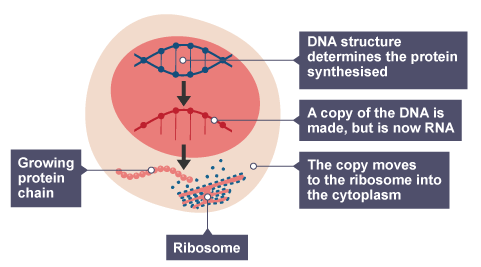
What is the process of protein synthesis?
Transcription:
The DNA double helix unwinds and the two strands separate.
A single-stranded copy of the gene (mRNA) is built using the DNA as a template.
The mRNA leaves the nucleus and moves into the cytoplasm.
Translation:
The mRNA attaches to a ribosome.
The ribosome reads the mRNA bases in groups of three (triplets).
Carrier molecules (tRNA) bring specific amino acids to the ribosome.
The amino acids join together in the exact order dictated by the mRNA to form a chain.
The completed chain folds into a unique 3D shape to become a functioning protein.
What can proteins be? (3)
Enzymes
Hormones
Structural proteins
What are enzymes?
Biological catalysts that speed up the rate of reaction.
What are hormones?
Chemical messengers that send signals around the body.
What are structural proteins?
Strong proteins that form structures (e.g. collagen)
What do mutations do?
Change the sequences of bases in DNA.
What is a mutation?
A random change in DNA which may result in genetic variants.
What are the ways that mutations can change the sequences of bases in DNA? (3)
A base is inserted into the code
A base is deleted from the code
A base is substituted
What effect does a base being inserted into the code have?
As the bases are read in triplets, it changes the way they are read.
It may change the amino acids coded for after this insertion.
What effect does a base being deleted from the code have?
They change the way it is read
It may change the amino acids coded for after this deletion.
What effect does a base being substituted have?
Only changes one amino acid in the sequence
It may not change the amino acid
The new sequence can sometimes still code for the same amino acid
What will a change in the type/sequence of amino acids do?
Affect the way it folds
This affects the structure
Mutations:
Most mutations do not alter the __________ (or only slightly).
Some can have a serious effect and can change the _______ of the protein:
The ___________ will not fit into the _______ _______ — it cannot act as a protein
A ___________ ________ can lose its shape.
There can also be mutations in the ______________ parts of DNA that control whether the genes are ____________.
protein
shape
substrate
active site
structural protein
non-coding
expressed
Why does variation arise between two organisms? (2)
Coding DNA — determines the proteins and their activity.
Non-coding DNA — determines which genes are expressed.
What is a gamete?
An organism’s reproductive cell which has half the number of chromosomes.
What is a chromosome?
A structure found in the nucleus — made up of a long strand of DNA.
What is a gene?
A short section of DNA which codes for a protein — contributes to a characteristic.
What are alleles?
The different forms of the gene.
What is a dominant allele?
An allele that is always expressed, even if only one copy is present.
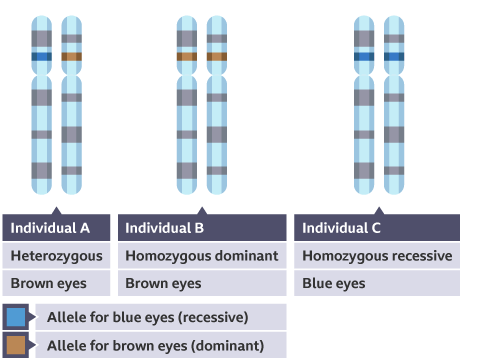
What is a recessive allele?
An allele that is only expressed if two copies are present — no dominant allele is present.
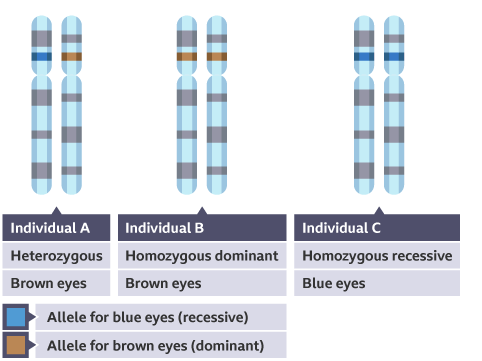
What is meant by homozygous?
The two alleles present are the same — HH or hh
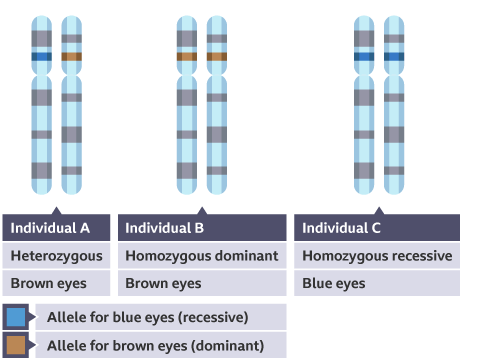
What is meant by heterozygous?
The two alleles present are different — Hh
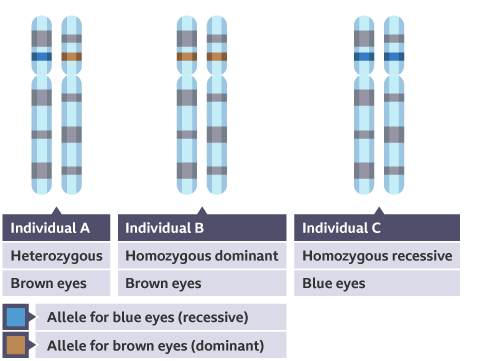
The alleles present, or ___________, operate at a molecular level to develop ______________ that can be expressed as a ___________.
genotype
characteristics
phenotype
What is a genotype?
The collection of alleles that determine characteristics.
What is a phenotype?
The physical characteristics of an organism.
What are most characteristics a result of?
Multiple genes interacting
Fill in the table and write the probability of being homozygous dominant.
Gametes | B | B |
B | 1 | 2 |
b | 3 | 4 |
1 — BB
2 — BB
3 — Bb
4 — Bb
50%
Fill in the table and write the probability of being heterozygous.
Gametes | F | f |
f | 1 | 2 |
f | 3 | 4 |
1 — Ff
2 — ff
3 — Ff
4 — ff
50%
Polydactyly (having extra fingers or toes) is caused by a _________ allele.
dominant
Cystic fibrosis (a disorder of cell membranes) is caused by a _________ allele
recessive
If someone has polydactyly and they are heterozygous, what are the their chances of passing on the disorder, and why?
50%
Half the gametes will contain the dominant allele
If someone has polydactyly and they are homozygous, what are the their chances of passing on the disorder, and why?
100%
Every gamete will contain the dominant allele
The Genetics of Cystic Fibrosis:
Cystic fibrosis is caused by a _____________ allele, so it must be inherited from _______ parents.
Children affected by cystic fibrosis are usually born to parents who do not have the disorder.
The parents have a __________ _________ allele, so they have a healthy ___________.
They also carry the ___________ cystic fibrosis allele.
Because it gives them no ____________, they have no idea it is there. They are known as ________.
recessive
both
dominant healthy
phenotype
recessive
symptoms
carriers
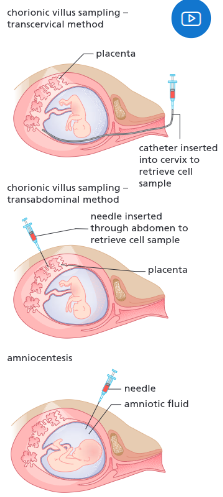
What is embryo screening?
Performing genetic tests on an embryo to show if they carry a specific allele.
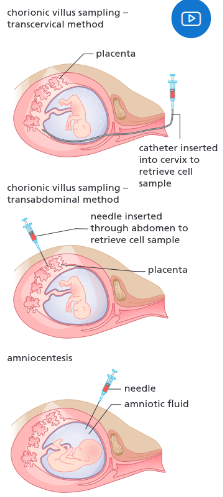
What are the concerns with embryo screening? (4)
The processes used to collect cells from a developing foetus can cause a miscarriage.
They can give false positives or negatives — can lead to the termination of a healthy pregnancy or the unexpected birth of a child with a genetic disorder.
It is very expensive.
A rise in demand for ‘designer babies’
What is the main advantage of embryo screening?
It prevents suffering for the child.
How many pairs of chromosomes do ordinary human body cells have?
23
What are the sex chromosomes in females?
XX
What are the sex chromosomes in males?
XY
Fill in the genetic cross and state the chance of having a female or male child.
Gametes | X | X |
X | 1 | 2 |
Y | 3 | 4 |
1 — XX
2 — XX
3 — XY
4 — XY
50%
![<ul><li><p>Figure 1 shows six stages in the process of meiosis.</p></li><li><p>In Figure 1, A is the first stage and F is the final stage. </p></li><li><p>Stages B to E are not in the correct order. </p></li></ul><p>Give the correct order of stages A to F. [1 mark]</p><p>A → ___ → ___ → ___ → ___ → F</p>](https://assets.knowt.com/user-attachments/c69807ce-2e5b-4269-b00f-76a6af992d83.png)
Figure 1 shows six stages in the process of meiosis.
In Figure 1, A is the first stage and F is the final stage.
Stages B to E are not in the correct order.
Give the correct order of stages A to F. [1 mark]
A → ___ → ___ → ___ → ___ → F
E
D
C
B

![<ul><li><p>Figure 1 shows six stages in the process of meiosis.</p></li><li><p>At the end of meiosis the number of chromosomes is different from the number of chromosomes at the start of meiosis.) </p></li></ul><p>Give the number of chromosomes in one cell in Figure 1 [2 marks]:</p><ul><li><p>at the start of meiosis</p></li><li><p>at the end of meiosis.</p></li></ul><p></p>](https://assets.knowt.com/user-attachments/d36b7ed1-b052-4483-afba-47cb867b057c.png)
Figure 1 shows six stages in the process of meiosis.
At the end of meiosis the number of chromosomes is different from the number of chromosomes at the start of meiosis.)
Give the number of chromosomes in one cell in Figure 1 [2 marks]:
at the start of meiosis
at the end of meiosis.
16
8
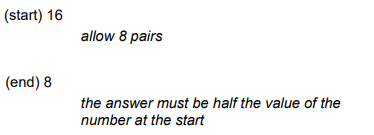
At the end of meiosis the number of chromosomes is different from the number of chromosomes at the start of meiosis
Explain why the change in the number of chromosomes is important. [3 marks]
Meosis forms gametes
Two gametes fuse
So it gives the correct chromosome number for the embryo
Meiosis produces cells that are genetically different.
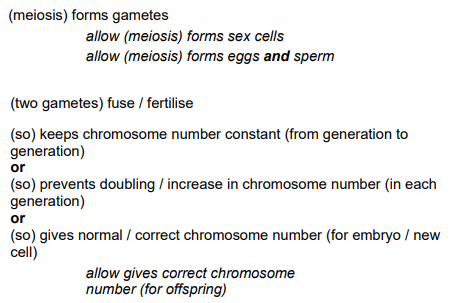
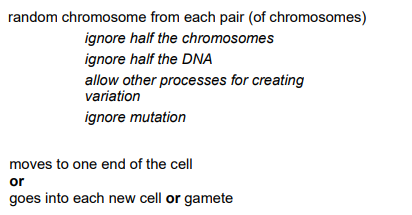
Describe how meiosis produces cells that are genetically different. [2 marks]
Random chromosome from each pair of chromosomes moves to one end of the cell.
![<ul><li><p>Chromosomes contain DNA. </p></li></ul><ul><li><p>Figure 2 shows part of a DNA molecule.</p></li></ul><p>What type of substances are labelled A, C, G and T in Figure 2? [1 mark]</p>](https://assets.knowt.com/user-attachments/b6c53e41-24f6-49d7-a78c-017315b3061a.png)
Chromosomes contain DNA.
Figure 2 shows part of a DNA molecule.
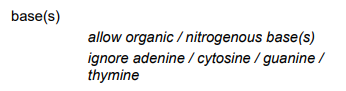
What type of substances are labelled A, C, G and T in Figure 2? [1 mark]
Bases
![<ul><li><p>Chromosomes contain DNA. </p></li></ul><ul><li><p>Figure 2 shows part of a DNA molecule.</p></li><li><p>DNA is made of nucleotides. </p></li></ul><p>How many nucleotides are shown in Figure 2? [1 mark]</p>](https://assets.knowt.com/user-attachments/03246aed-0e31-4f20-b7f5-34b7d1b2900b.png)
Chromosomes contain DNA.
Figure 2 shows part of a DNA molecule.
DNA is made of nucleotides.
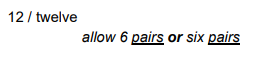
How many nucleotides are shown in Figure 2? [1 mark]
12
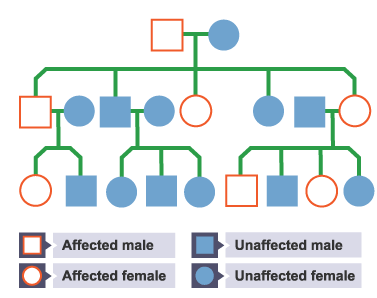
![<ul><li><p>Maple syrup urine disease (MSUD) is a rare inherited human condition. </p></li><li><p>MSUD is usually diagnosed early in childhood and can be controlled by having a low-protein diet. </p></li><li><p>Figure 1 shows the inheritance of MSUD in one family.</p></li><li><p>The allele for MSUD is recessive.</p></li></ul><p>Give one piece of evidence from Figure 1 which shows that MSUD is a recessive condition. [1 mark]</p>](https://assets.knowt.com/user-attachments/0ec5f781-ca98-4a42-ab9d-888f50c4d889.png)
Maple syrup urine disease (MSUD) is a rare inherited human condition.
MSUD is usually diagnosed early in childhood and can be controlled by having a low-protein diet.
Figure 1 shows the inheritance of MSUD in one family.
The allele for MSUD is recessive.
Give one piece of evidence from Figure 1 which shows that MSUD is a recessive condition. [1 mark]
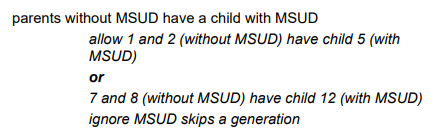
Parents without MSUD have a child with MSUD.
![<ul><li><p>Maple syrup urine disease (MSUD) is a rare inherited human condition. </p></li><li><p>MSUD is usually diagnosed early in childhood and can be controlled by having a low-protein diet. </p></li><li><p>Figure 2 shows chemical reactions involved in the normal breakdown of some types of amino acid inside body cells.</p></li><li><p>A person with MSUD cannot make Enzyme 2.</p></li><li><p>One of the final products shown in Figure 2 is urea. </p></li></ul><p>Where in the human body are the reactions shown in Figure 2 most likely to occur? [1 mark]</p>](https://assets.knowt.com/user-attachments/175aed98-2895-4cfe-8419-7d13f2fc4cd1.png)
Maple syrup urine disease (MSUD) is a rare inherited human condition.
MSUD is usually diagnosed early in childhood and can be controlled by having a low-protein diet.
Figure 2 shows chemical reactions involved in the normal breakdown of some types of amino acid inside body cells.
A person with MSUD cannot make Enzyme 2.
One of the final products shown in Figure 2 is urea.
Where in the human body are the reactions shown in Figure 2 most likely to occur? [1 mark]
Liver
![<ul><li><p>Maple syrup urine disease (MSUD) is a rare inherited human condition.</p></li><li><p>MSUD is usually diagnosed early in childhood and can be controlled by having a low-protein diet.</p></li><li><p>Figure 2 shows chemical reactions involved in the normal breakdown of some types of amino acid inside body cells.</p></li><li><p>A person with MSUD cannot make Enzyme 2.</p></li><li><p>Scientists can analyse blood samples or urine samples to see if a person has MSUD. </p></li><li><p>The test identifies high concentrations of toxic substance P, shown in Figure 2.</p></li></ul><p>Explain why the blood of a person with MSUD will have a high concentration of toxic substance P. [3 marks]</p><p>Use information from Figure 2.</p>](https://assets.knowt.com/user-attachments/d3b9371e-a407-443d-af33-57a4497593b0.png)
Maple syrup urine disease (MSUD) is a rare inherited human condition.
MSUD is usually diagnosed early in childhood and can be controlled by having a low-protein diet.
Figure 2 shows chemical reactions involved in the normal breakdown of some types of amino acid inside body cells.
A person with MSUD cannot make Enzyme 2.
Scientists can analyse blood samples or urine samples to see if a person has MSUD.
The test identifies high concentrations of toxic substance P, shown in Figure 2.
Explain why the blood of a person with MSUD will have a high concentration of toxic substance P. [3 marks]
Use information from Figure 2.
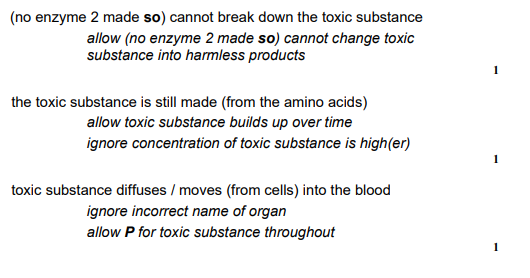
No enzyme 2 is made so they cannot break down the toxic substance.
The toxic substance is still made from the amino acids.
The toxic substance diffuses from the cells into the blood.
![<ul><li><p>Maple syrup urine disease (MSUD) is a rare inherited human condition.</p></li><li><p>MSUD is usually diagnosed early in childhood and can be controlled by having a low-protein diet.</p></li><li><p>Figure 2 shows chemical reactions involved in the normal breakdown of some types of amino acid inside body cells.</p></li><li><p>A person with MSUD cannot make Enzyme 2.</p></li><li><p>Scientists can analyse blood samples or urine samples to see if a person has MSUD. </p></li><li><p>The test identifies high concentrations of toxic substance P, shown in Figure 2.</p></li></ul><p>Explain why the urine of a person with MSUD will have a high concentration of toxic substance P. [2 marks]</p>](https://assets.knowt.com/user-attachments/df0acb40-c749-47e1-9e50-c445b3aa0b37.png)
Maple syrup urine disease (MSUD) is a rare inherited human condition.
MSUD is usually diagnosed early in childhood and can be controlled by having a low-protein diet.
Figure 2 shows chemical reactions involved in the normal breakdown of some types of amino acid inside body cells.
A person with MSUD cannot make Enzyme 2.
Scientists can analyse blood samples or urine samples to see if a person has MSUD.
The test identifies high concentrations of toxic substance P, shown in Figure 2.
Explain why the urine of a person with MSUD will have a high concentration of toxic substance P. [2 marks]
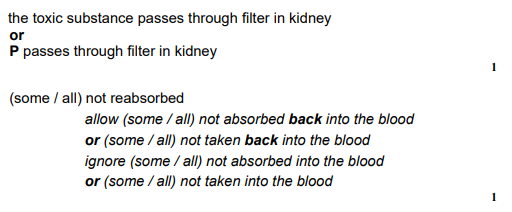
The toxic substance passes through filter in kidney
Some is not reabsorbed
![<ul><li><p>Maple syrup urine disease (MSUD) is a rare inherited human condition.</p></li><li><p>MSUD is usually diagnosed early in childhood and can be controlled by having a low-protein diet.</p></li><li><p>Figure 2 shows chemical reactions involved in the normal breakdown of some types of amino acid inside body cells.</p></li><li><p>A person with MSUD cannot make Enzyme 2.</p></li><li><p>Scientists can analyse blood samples or urine samples to see if a person has MSUD. </p></li><li><p>The test identifies high concentrations of toxic substance P, shown in Figure 2.</p></li></ul><p>Explain why a person with MSUD must have a low-protein diet. [3 marks]</p>](https://assets.knowt.com/user-attachments/ea3dd95c-5825-47ff-853d-5060fd87f1a7.png)
Maple syrup urine disease (MSUD) is a rare inherited human condition.
MSUD is usually diagnosed early in childhood and can be controlled by having a low-protein diet.
Figure 2 shows chemical reactions involved in the normal breakdown of some types of amino acid inside body cells.
A person with MSUD cannot make Enzyme 2.
Scientists can analyse blood samples or urine samples to see if a person has MSUD.
The test identifies high concentrations of toxic substance P, shown in Figure 2.
Explain why a person with MSUD must have a low-protein diet. [3 marks]
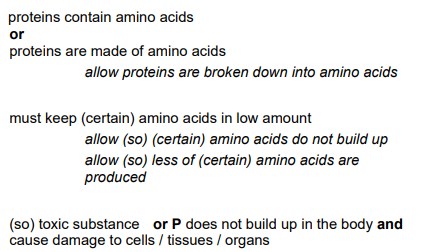
Proteins are made of amino acids
They must keep certain amino acids in low amount
So toxic substance does not build up in the body and cause damage to cells
What is variation?
The differences in the characteristics of individuals in a population.
What may variation be due to differences in? (3)
Genetic causes — the genes they have inherited
Environmental causes — the conditions in which they have developed
A combination of genes and the environment
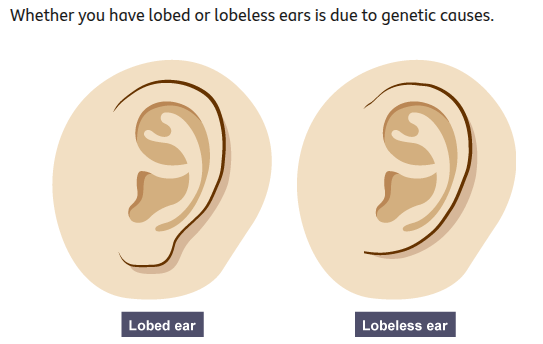
What are examples of features that show environmental variation? (3)
Scars
Smaller and yellow leaves — plants
Language and accent