Stellar evolution
 Studied by 0 people
 Call Kai
 Learn
Learn Practice Test
 Spaced Repetition
 Match
Match Flashcards
 Knowt Play
1/22

There's no tags or description
Looks like no tags are added yet.
Name | Mastery | Learn | Test | Matching | Spaced | Call with Kai |
|---|
No analytics yet
Send a link to your students to track their progress
23 Terms
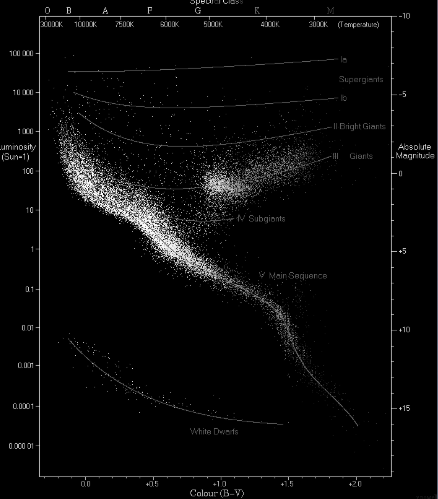
What is on the x-axis of the Hertzsprung-Russel diagram?
Spectral class (OBAFGKM) or temperature
What is the range of spectral class and temperature on the x-axis of a hertzsprung-russel diagram?
Spectral class: OBAFGKM, OBA close together and FGKM spread further apart
30 000K-3 000K; high temp on the right, low on the left
What is on the y-axis of the Hertzsprung-russel diagram?
Luminosity or absolute magnitude
What is the range of luminosity and absolute magnitude on the y-axis of a hertzsprung-russel diagram?
Luminosity: 100 000 - 0.000 01 (logarithmic scale)
Absolute magnitude: -10 → +15
Draw a hertzsprung-russel (H-R) diagram and label star areas. +explain using stefan’s law
HERE
What is the minimum mass for a cloud to become a protostar? (/Minimum temperature for thermonuclear reactions to take place)
0.1 * solar mass
What are brown dwarves?
What happens in the main sequence phase of a star?
the inward force of gravity and the outward force due to nuclear fusion are in equilibrium. The star is stable.
Hydrogen nuclei are fused into Helium nuclei
The greater the mass of the star, the shorter the main sequence phase of the star.
What happens in the protostar phase of a star?
Nebulae clumps together due to gravitational forces
The irregular clumps rotate and a gravity/conservation of
angular momentum spins them inwards to form a denser centre (a protostar)
Protostar is surrounded by a circumstellar disc
When protostar is hot enough, it fuses elements producing a stellar wind that blows away surrounding material
What is a circumstellar disc?
a disc of material (surrounding a protostar)
Red giant
star < 3 solar masses
hydrogen runs out, temperature of the core increases and begins fusing helium nuclei into heavier elements (carbon, oxygen, beryllium)
Outer layers of the star expand and cool
White dwarf
star < 1.4 solar masses
Once all fuel is used, fusion stops and the core contracts as gravity > outward force of fusion
Outer layers thrown off, forming a planetary nebula around the remaining core
core becomes extremely dense
Eventually cools to a black dwarf
Red supergiant
star > 3 solar masses
Once hydrogen runs out, temperature of the core increases and begins to fuse helium nuclei into heavier elements
Fuses elements up to iron (which red grains cannot)
Supernova (stellar evolution)
star > 1.4 solar masses
all fuel runs out, fusion stops and the core collapses inwards suddenly and becomes rigid (cannot become more dense)
Outer layers of the star fall inwards and rebound off the core, resulting in a shockwave
As shockwave passes through surrounding material, elements heavier than iron are fused and released into space
Remaining core is dependent on mass of the star
defined by its rapidly increasing absolute magnitude
Neutron star
1.4 - 3 solar masses
protons and electrons are fused to form neutrons
stars are as dense as nuclear matter
Pulsars are spinning neutron stars that emit beams of radiation from the magnetic poles as they spin
Black hole
star > 3 solar masses
its escape velocity is greater than the speed of light
Schwarzchild radius is the radius of the event horizon
What is a type I supernova?
when a star accumulates matter from its companion star in a binary system and explodes after reaching a critical mass
What is a type 1a supernova?
A type I supernova with a white dwarf.
How are type 1a supernovae formed?
when the companion star in a binary system runs out of hydrogen, it expands, and the white dwarf accumulates some of its mass.
When the white dwarf star reaches a critical mass, fusion begins and the mass increases, causing the white dwarf to explode into a supernova.
How are type 1a supernovae used as standard candles?
all type 1a supernovae occur at the same critical mass, therefore they reach a consistent peak luminosity, so their distances can be determined using their observed brightness.
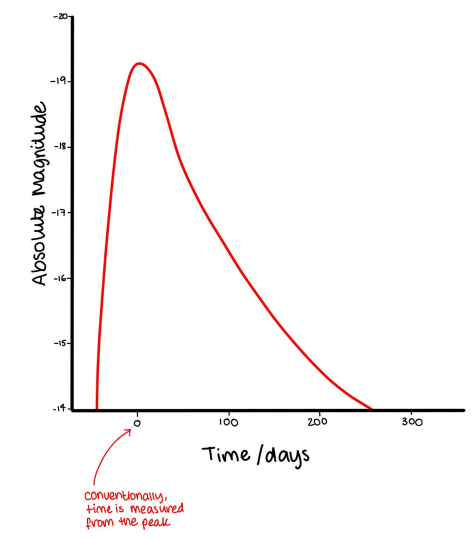
absolute magnitude is constant = -19.3
What is the typical light curve for a type 1a supernova? (draw)
time is measured starting from the peak
What is a type II supernova?
The death of a high-mass star after it runs out of fuel
(normal, stellar evolution definition)
What is a standard candle?
a celestial object with a known and predictable luminosity, allowing astronomers to determine its distance from Earth by comparing its apparent brightness to its luminosity
 Note
Note  Flashcards (244)