Feline infectious peritonitis
 Studied by 0 people
 Call Kai
 Learn
Learn Practice Test
 Spaced Repetition
 Match
Match Flashcards
 Knowt Play
1/15

There's no tags or description
Looks like no tags are added yet.
Name | Mastery | Learn | Test | Matching | Spaced | Call with Kai |
|---|
No analytics yet
Send a link to your students to track their progress
16 Terms
What type of virus causes Feline infectious peritonitis
Alphacoronovirus (FCoV)
Describe coronaviruses
RNA genome inside lipid envelope
dies in environment
RNA means constantly evolving
Surface proteins
What are the two biotypes of feline corona viruses
FIPV - feline infectious peritonitis virus
FECoV - feline enteric coronavirus
Do all cats with FECoV develop FIV? WHY
no.
depends on :
virus biotype / strain
dose of virus
immune status of cat
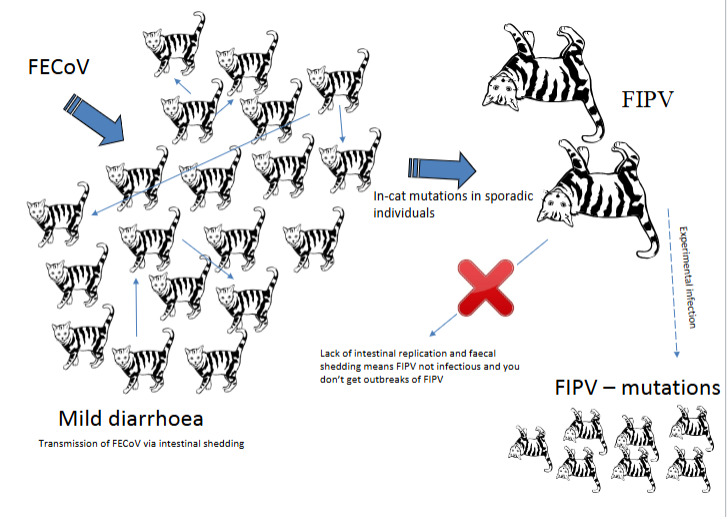
Describe pathogenesis of FeCoV
oronasal infection
grows and proliferates in tonsils, URT, and intestinal epithelium
in some cases, sporadically mutates into FIPV.
Describe pathogenesis of FIPV and how this infection occurs
cat infected with FeCoV → sporadic mutation of virus → FIPV.
FIPV is an immune complex disease.
Immune complexes deposit in walls of small blood vessels leading to vasculitis
• Antibody binding to virus enhances uptake by macrophages
• Cats that do not have antiviral antibodies do not develop FIP
three possible outcomes
good cell mediated immunity = recovery
partial cell mediated immunity = dry FIP
poor cell mediated immunity = wet FIP
How does antibody enhancement affect FIP treatments / prevention?
FIP is an immune complex disease. Cannot give Abs for treatment, Abs in vaccine will cause more damage.
Immune complexes deposit in walls of small blood vessels leading to vasculitis. Antibody binding to virus enhances uptake by macrophages, Cats that do not have antiviral antibodies do not develop FIP
Where does FeCoV replicate?
Where does FIPV replicate?
enterocytes
enterocytes and macrophages.
What are the symptoms of wet FIP
Invariably fatal
accumulation of fluid within body cavities
depression
lethargy
weight loss
abdominal swelling
jaundice
hepatomelargy
dyspnoea
muffles heart sounds
fluctuating unresponsive fever
Dry FIP symptoms
Invariably fatal.
fluctuating unresponsive fever
anorexia
depression
lethargy
jaundice
ataxia
paresis
behavioral changes
iritis
uveitis
signs are dependent on organ involved.
How can you diagnose FIP
definitive - histopathology + post mortem
pre-mortem - clinical signs, fluid examination, clinical pathology and FeCov serology
What would you see in the haematology / blood biochemistry in cat with FIP
Hyperproteinaemia – raised globulins
Albumin/globulin ratio decreases
Increased liver enzymes, bilirubin and urea
What does FIP fluid look like and contain?
viscous, straw coloured fluid.
froths when shaken, clots on standing.
high protein content IgG>IgA
What is a limitation of PCR for diagnosis?
cannot differentiate between FIPV and FeCov
How can you test for FCOV in serology
limitations?
Immunofluorescence, ELISA
not differenciative between FIP / FCOV
How is FeCoV transmited?
shed in faeces and saliva
cats infected by ingestion of virus
(can also have transplacental spread)
 Note
Note  Flashcards (101)